Early on the morning after Thanksgiving our Urban Sketchers group went to Oakland’s Chinatown for some sketching. It was business as usual in the busy produce markets, herb shops, meat and seafood stalls, and Chinese restaurants, with no sign of Black Friday.
I found a spot to sit in front of a bank and had fun drawing all the details in the architecture. I started in pencil because the scene seemed so complicated. It’s easier to get it “right” with an eraser but it takes so much longer to draw it twice, in pencil and then in ink. I had to add the watercolor at home from a photo because by the time I chose my spot and did the drawing, it was time to meetup with the group.
While I drew, local people stopped to watch and give me encouragement, whether in excellent or broken English. My favorite was the plump, elderly lady who said something in Chinese, grinned, and gave me a big thumbs up. The amazing thing about sketching in public is that no matter how good or bad you’re doing, people always say nice, encouraging things.
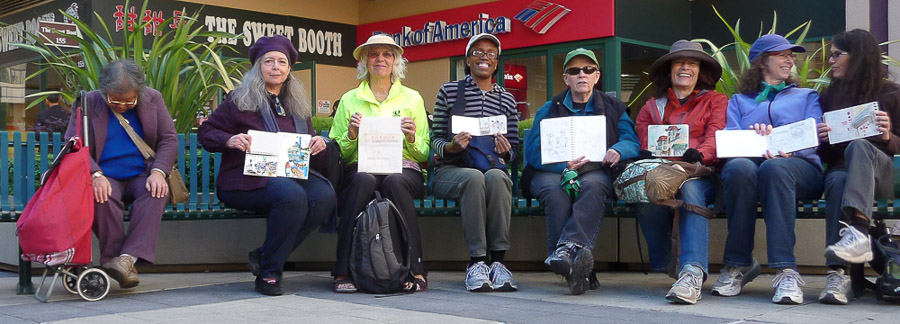
Chinatown-some of the Urban Sketchers plus-1 (that’s me, second to right)
Since many of us were there, we took photos for our group blog. I used the timer on my camera, setting it on the edge of a defunct fountain in the center of this plaza. I didn’t realize I was including the lady on the end. She must have been really tired as she nodded off and slept through our photo session. The photo we ultimately used on the USK blog masthead here was kindly taken by a guy who watched me repeatedly duck under the yellow warning tape around the fountain, set up the camera, and dash back to sit with my friends.
Lucy Painting #2, Watercolor cat portrait on Arches paper, 12×9″
I was asked to make a watercolor portrait of a beloved cat much missed by her family. This post will be their first chance to see what I’ve come up with so far. I’m not sure I’ve captured her appearance or spirit yet as her family knows her.
(UPDATE 6/12/2012) Yay! They loved the painting and are getting it framed.
They sent two beautiful photos of Lucy in different poses to work from. I had to guess a little since the photos only showed one paw and the bottom half of her ears and I wasn’t sure how accurate the colors were. Below are the studies I made before the painting above.
Smiley Skull and Smiley Guy study, HB pencil, 4x6"
In preparation for my Alla Prima Portrait Painting workshop with Rose Frantzen next month, I wanted to work on my drawing skills so I can keep up in class. Although I draw all the time, I discovered I really had no understanding of head and facial construction.
Skulls and Faces in the Same Positions, HB pencil, 11x9"
I usually draw what I see, compare shapes, angles and plumb lines to try to get some accuracy, but I don’t worry about it too much. That wasn’t cutting it when it came to drawing heads.
So I turned to the great book by Andrew Loomis, recently back in print, Drawing the Head and Hands. His books are also available as PDFs here on the web. There is an excellent explanation with clear examples of the Loomis approach here on Stan Propopenko’s blog so I won’t go into it here. All of my drawings in this post started with the Loomis ball divided in thirds with the jaw then added on.
Skulls and Muscles from Loomis book, 11x9"
I worked through the Loomis book and when I came to his skull and muscle drawings in the book I tried copying them (above). I also tried some other books’ methods of constructing heads (using an egg shape, a block, double ovals, etc.) but none worked as well as the Loomis approach.
I wanted to do more than copying sketches so I started drawing skulls and people I found on a Google image search, drawing the people in about the same position as the skulls (the two pics at top of post and the one below).
I’d heard that saying before, “Little Pitchers Have Big Ears,” but without giving it any real consideration, assumed it had something to do with Little League baseball pitchers. Wrong. According to The American Heritage New Dictionary of Cultural Literacy, “Adults must be careful about what they say within the hearing of children. The saying refers to the large handles (ears) sometimes attached to small vessels…” like this little pitcher.
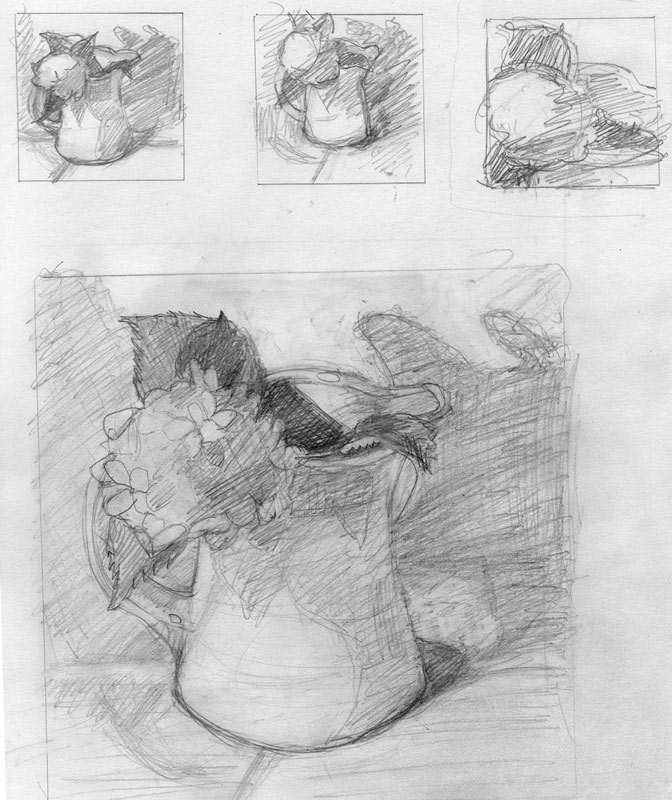
I was looking for flowers to paint and this little lavender hydrangea was hiding at the bottom of the bush all by itself. I did the value/composition sketches above and set about painting, completely forgetting the first step that I usually find helpful: doing a quick and simple 2-value block in using thinned paint in one color (usually Ultramarine Blue) first.
I think it worked out OK anyway, and in the next painting I did (still waiting to get photographed) I remembered to do that.
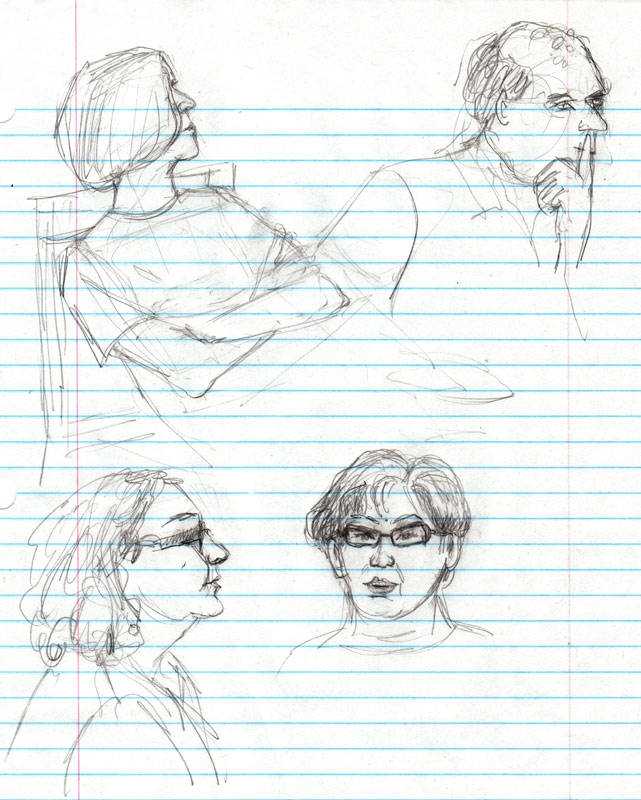
All Day Meeting Sketches #1, graphite on notebook paper
We had an all day staff meeting today at our co-director’s home. It was a wonderful opportunity to catch up with each other, celebrate our accomplishments over the past year and plan for the huge amount of work we’ll be doing over the next year. It was also a chance for some sketching.
The gentleman above rests his finger just below his nose when he’s listening with concentration. (Just had to explain since it looks like he’s doing something else).
All Day Meeting Sketches #2, graphite
I really like the way the woman’s foot in this sketch turned out. She’s quite petite but I think I should have made her legs bigger since they were closer to me.
It felt inappropriate to take out my sketchbook (even though I know I listen well while drawing, I didn’t want others to think I wasn’t paying attention) so I drew in the same cheesy notebook I was using for notetaking. Of course everyone knew I was sketching anyway…
Last year we had our annual all staff meeting in a stuffy conference room. It was so much nicer gathering in a home where we could eat pizza in the backyard and sit in comfy chairs in a pretty living room and kick our shoes off.
I was listening to Ruth Reichl‘s book “Not Becoming My Mother and Other Things She Taught Me Along the Way” while I sketched on a rainy Sunday, feeling a bit mopey. That book was the perfect antidote to mopeyness.
After her mother’s death, Reichl finds her mother’s journals and discovers the story of how her quirky mother tried to make sure her daughter wouldn’t suffer the unfulfilled life she’d had, restricted by the roles available to women of her generation.
The book is full of humor, love and amazing stories. I’m grateful that my public library has great audio books available to download for free. It ends with this great quote:
…and the most important thing I learned is that you are the only one who can make yourself happy. It is never too late to find out how to do it.” ~Ruth Reichl
I drew the frog above (from a photo on my monitor) to practice before I drew the frog on the cover of my journal (below) which I’ve named Froggie:
Froggie Journal, India & gold gel ink
The Legion Multimedia Aquarelle paper the book is bound with is holding up even better than I expected. It’s nice and smooth for writing and drawing with ink from various pens, and accepts watercolor beautifully and even allows for lifting off and repainting and other kinds of abuse.
I love spending time with my journal which is like a dear friend, a place to come for solace when I need to write and sort things out, a library for recording visual and emotional discoveries, ideas, thoughts, and experiments.
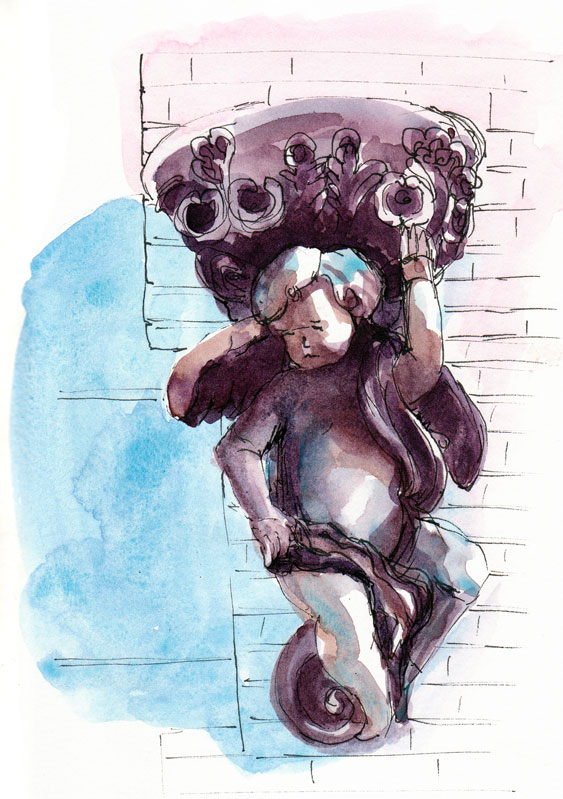
These angels guard the entry of an old residential hotel at 2332 Harrison Street in Oakland between my office and Whole Foods, along with a pair of vicious, brass lions (coming soon). As I passed by on the way to lunch, the light and shadows on the angels intrigued me.
Angel on Harrison, graphite
Although I always prefer to draw from life I didn’t have time on this work day so I took a photo. When I looked at the image on my monitor I found the shape and detail so confusing that I decided to sketch in pencil first instead of my usual ink. It felt like sculpting since as I sketched and shaded shapes of dark and light and saw form began to appear.
My initial drawing needed a lot of correcting because I’d given the angel adult proportions instead of a child’s so it looked like a pot-bellied, naked man instead of a cherub. For some reason we think chubby cherubs are cute holding up pots with their heads on buildings, but fat, naked, old men, not so much.
Then I started over on the facing page in my sketchbook, drawing in ink and adding watercolor. I think I got his proportions better in the second one. The graphite angel still looks too old, like a teen angel maybe?
Questioning Cherubs
I wasn’t raised with religion so I am completely ignorant about angels and their tribe. Are there girl cherubs too or are they all boys? Why? Why are cherubs usually depicted as chubby? What happens to cherubs when they grow up? Do they become angels? Or do they not age?
I googled “Chubby Cherub” looking for the answers and found information about “Chubby Cherub, the worst video game of 1987” and this Wikipedia entry that says according to some linguistic and bible scholars, this is what cherubs are really meant to look like:
A "Real" Cherub?
and that they were often displayed sitting calmly guarding entrances as in this image:
Guarding angels?
If you like reading about the source of words, language, and myths, and how they evolve over time, check out the Wikipedia page about cherubs. I found it fascinating.
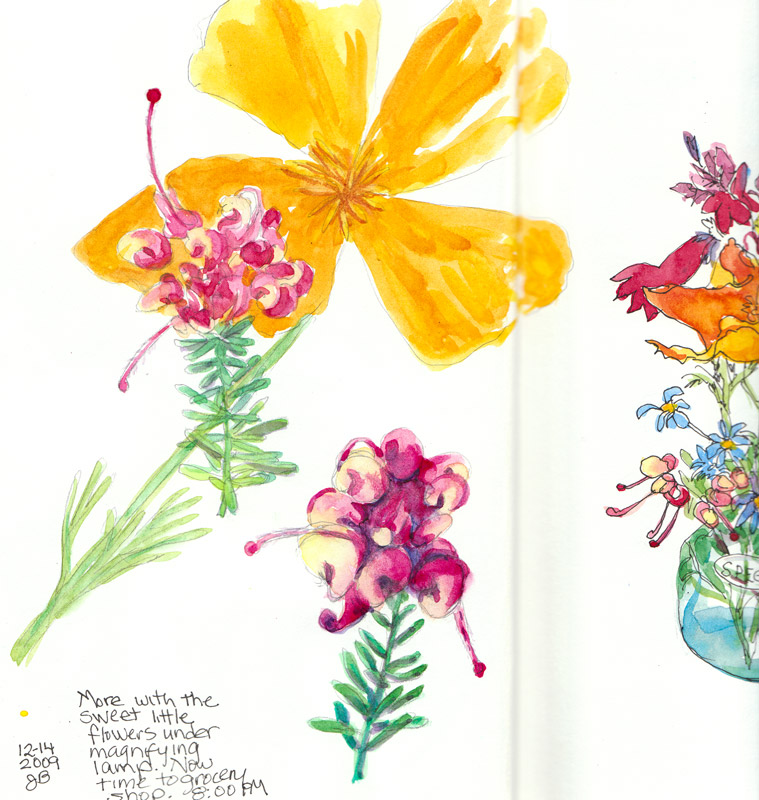
The teensy bouquet was still holding up and the complicated shapes in these flowers intrigued me. So I stuck them under my magnifying lamp and drew them again in sketchbook opposite the bouquet side. The California poppy had opened up and wanted to play too so I stuck him in behind the little flowers after I painted them. It’s fun drawing what’s under the magnifying glass and getting to see all the neat details.
Then it was back to work on the third painting I’ve been asked to do for the book, Must Paint Watercolor Flowers. This time it’s a peach colored begonia with really interesting veiny leaves.
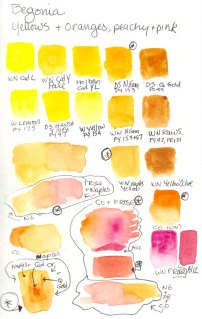
Begonia leaf color tests
My first step was to test colors and try to find the pigments that will mix to the right values, colors and textures. On the tests above I experimented with glazing with different yellows, blues and greens, and tried lifting color for the veins in the leaves to see which worked best for that.
Begonia petal test colors
I found just the right mixture of colors for the petals with a color I’ve rarely ever used because it is more opaque than I usually prefer: Naples Yellow. When mixed with combinations of Cadmium Orange, Permanent rose, and Quinacridone gold, it looks like it will give me perfect petals. But now it’s back to “day job” work for the rest of the week. That will give me time to focus more on how I will approach the painting so once I have brush in hand I’m ready to go.
I don’t always plan things out so carefully, but it can help prevent wasted time and do-overs which becomes more important when I’m also photographing each step and writing about it for the book.
I was given permission to post some of my work on the upcoming book, “Must Paint Watercolor Flowers” (Quarto Publishers, London) for which I’ve been commissioned to paint three floral watercolors. The painting is the easy part; taking the photos, correcting them in Photoshop, and writing about each of the steps takes much more time and isn’t nearly as much as fun. I thought I’d break this into a few posts so they won’t be too long.
My first step after being given my choice from a couple dozen excellent photos (which I’m not permitted to post) was to do some rehearsals in my sketchbook. I used several pages to experiment with how I wanted to approach the metal pitcher, mixing colors for the leaves, the buds and the yellow-green flowers (above). Then I experimented with color mixtures for the orange flowers and the large amount of darks (below — combinations of Winsor Green and Alizarin Crimson, Ultramarine Blue and Burnt Sienna, Sap Green and Sepia, Winsor Green and Winsor Violet).
Rehearsal - Sketchbook p. 2
Next step was to transfer the photo to my watercolor paper. Initially I was going to make the painting small enough to fit on my scanner but decided to use the maximum size the publisher allowed since it was such a complex painting. I chose a 12 x 16″ Arches 140 lb. cold press watercolor block (block is easier to set up for photographing). If I’d been given more time and/or if the photo wasn’t so complex, I probably would have transferred the image by drawing freehand or using a “gridding up” method but with a two-week deadline I used a quicker method.
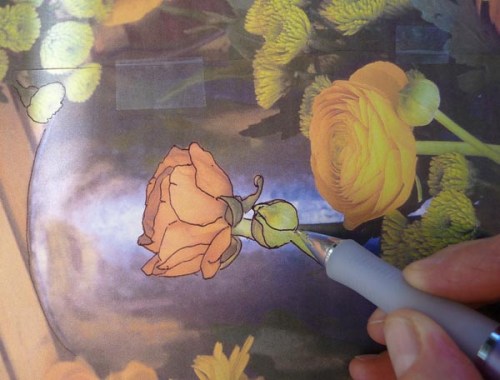
Transferring the photo to watercolor paper
I enlarged the photo in Photoshop and printed it in sections (before figuring out I could have more easily used my copier to do the same) and taped them together. Then I placed a sheet of Saral Transfer Paper on top of my watercolor paper and laid the enlarged print on top of the Saral. Using a ballpoint pen, I traced over the shapes of the flowers, leaves, stems and shadows which transferred graphite lines from the Saral paper onto the watercolor paper.
Cleaning up the drawing
See what I mean about how complicated the image is! I’d left too much of an overlap on the tiled together enlarged photo and some areas didn’t get a good transfer so had to freehand some of the drawing, clean up some lines and darken others. This is my new favorite mechanical pencil, the Papermate PhD Ultra.
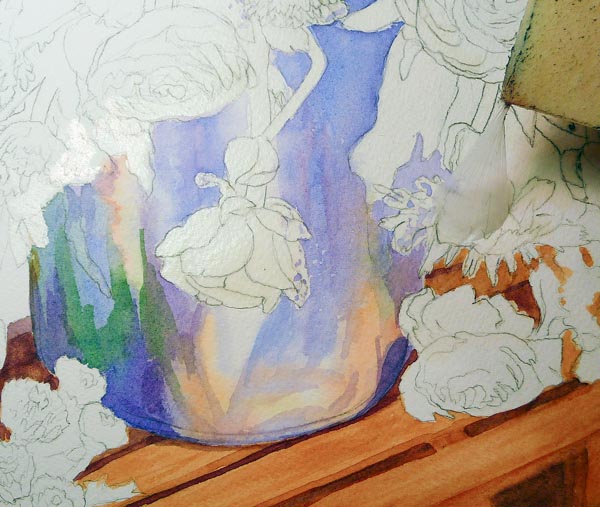
Masking near the pitcher
I wanted to paint the pitcher wet-into-wet and so I applied Winsor and Newton Colourless Art Masking Fluid to some of the shapes around and projecting into the pitcher to make it easier to paint wet into wet more freely. I used a cheap disposable brush to avoid messing up my good ones. I prefer Cheap Joes Golden Fleece rounds for watercolor and even though they aren’t expensive, I don’t want to ruin them with masking fluid.
Detail: Pitcher painted, removing masking fluid
I like pulling off the mask with the rubber cement pick up tool. I think it’s made out of the same stuff Vibram shoe soles are made from. The pitcher and the table have had their first washes. Next step is starting on the flowers and that will be in the next post.
Better Bowl of Fruit, Watercolor on paper, 7" x 10.5"
I’m so much happier with the way this watercolor of my bowl of fruit turned out than the one in my sketchbook. It makes such a difference to use Arches 140 lb cold-pressed watercolor paper. It also helped that I was painting consciously and taking my time, instead of rushing through it, half asleep as I had been when I made the sketch.
Even more fun is that I made the the large porcelain bowl when I was a potter and had glazed it with two of my favorite glazes…and now I was “glazing” it again, in watercolor.
I enjoyed every bit of the process, from planning the composition, to drawing (see below) from life, to masking the whites, then painting one shape at a time, using juicy washes, adding color wet-into-wet, as well as glazing over dried washes, then removing the mask, softening the highlights and some edges.
Fruit bowl pencil sketch on watercolor paper
Since I’m teaching a watercolor class right now, I tried to also pay attention to my process so that I could better explain to my students how and why I did what I did. I surprised myself with the range of techniques I was actually using in one painting. Even though in class we study them as separate techniques (flat wash, graded wash, wet-into-wet, etc.) you often need them all in one painting and sometimes in one passage of a painting.
(Boring technical stuff follows…read at your own risk…) For example, after the fruit, bowl, and shadow were painted I did a flat wash of Ultramarine Blue mixed with Burnt Sienna for the neutral background. Then it felt like the table top, which I’d initially left white with just a light blue shadow, needed paint too. So the first layer was a pale flat wash of Cadmium Yellow. When it dried it didn’t feel warm enough so I glazed over it with a flat wash of Permanent Rose (so that the whole table top was the pale apricot color now only seen on the right of the table top). It still wasn’t warm enough so I did another wash of Permanent Rose mixed with a little Cadmium Yellow and let it fade out 3/4 of the way across. I liked the way that looked but now the shadow was too pale. So I glazed over over the shadow a couple of times and then softened the edges of the shadow where it meets the table top.)



 . His books are also available as












 Jana Bouc, Artist