I was given permission to post some of my work on the upcoming book, “Must Paint Watercolor Flowers” (Quarto Publishers, London) for which I’ve been commissioned to paint three floral watercolors. The painting is the easy part; taking the photos, correcting them in Photoshop, and writing about each of the steps takes much more time and isn’t nearly as much as fun. I thought I’d break this into a few posts so they won’t be too long.
My first step after being given my choice from a couple dozen excellent photos (which I’m not permitted to post) was to do some rehearsals in my sketchbook. I used several pages to experiment with how I wanted to approach the metal pitcher, mixing colors for the leaves, the buds and the yellow-green flowers (above). Then I experimented with color mixtures for the orange flowers and the large amount of darks (below — combinations of Winsor Green and Alizarin Crimson, Ultramarine Blue and Burnt Sienna, Sap Green and Sepia, Winsor Green and Winsor Violet).
Rehearsal - Sketchbook p. 2
Next step was to transfer the photo to my watercolor paper. Initially I was going to make the painting small enough to fit on my scanner but decided to use the maximum size the publisher allowed since it was such a complex painting. I chose a 12 x 16″ Arches 140 lb. cold press watercolor block (block is easier to set up for photographing). If I’d been given more time and/or if the photo wasn’t so complex, I probably would have transferred the image by drawing freehand or using a “gridding up” method but with a two-week deadline I used a quicker method.
Transferring the photo to watercolor paper
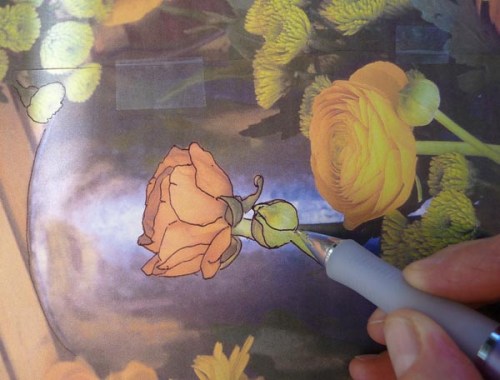
I enlarged the photo in Photoshop and printed it in sections (before figuring out I could have more easily used my copier to do the same) and taped them together. Then I placed a sheet of Saral Transfer Paper on top of my watercolor paper and laid the enlarged print on top of the Saral. Using a ballpoint pen, I traced over the shapes of the flowers, leaves, stems and shadows which transferred graphite lines from the Saral paper onto the watercolor paper.
Cleaning up the drawing
See what I mean about how complicated the image is! I’d left too much of an overlap on the tiled together enlarged photo and some areas didn’t get a good transfer so had to freehand some of the drawing, clean up some lines and darken others. This is my new favorite mechanical pencil, the Papermate PhD Ultra.
Masking near the pitcher
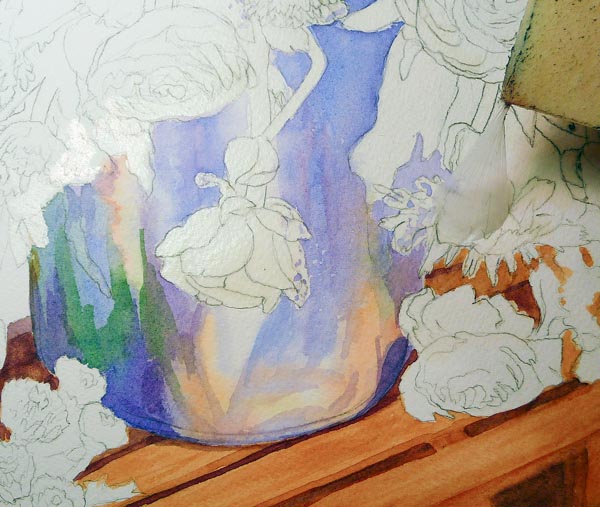
I wanted to paint the pitcher wet-into-wet and so I applied Winsor and Newton Colourless Art Masking Fluid to some of the shapes around and projecting into the pitcher to make it easier to paint wet into wet more freely. I used a cheap disposable brush to avoid messing up my good ones. I prefer Cheap Joes Golden Fleece rounds for watercolor and even though they aren’t expensive, I don’t want to ruin them with masking fluid.
Detail: Pitcher painted, removing masking fluid
I like pulling off the mask with the rubber cement pick up tool. I think it’s made out of the same stuff Vibram shoe soles are made from. The pitcher and the table have had their first washes. Next step is starting on the flowers and that will be in the next post.
Who knew it could be fun to sketch at the hardware store? There were laughs (see end of post) and artistic discoveries galore at our Tuesday night sketchcrawl, now forced to go indoors for the winter. When I first arrived I started to ask one of the helpful employees that Pastime Hardware is famous for, about the part I needed for my toilet. Before he could show me where to find it, my phone rang with the ringtone I made from the Cake song “Never There” (click below to hear the ringtone).
An employee who was standing nearby said, “Hey! That’s Cake.” and then began whistling it. Throughout the evening I could hear him whistling the tune from all around the large store, which gratefully, is one of the few stores in existence that does not play annoying music 24/7 over the loudspeakers.
I had no idea how many differently shaped toilet seats there are. I discovered that looking at the negative shapes between the seats helped me to better find the shape of each seat. Then, looking more deeply and trying not to generalize, I discoverd the piles of boxed and/or wrapped toilet seats on the shelves behind the display. And then I noticed and added the pegboard behind that. I fell in love with the pretty color I mixed from cerulean blue and yellow ochre for the pegboard. This, to me, is the joy of sketching in a nutshell: seeing more and more deeply and the fun of making lines and dots and shapes and playing with color.
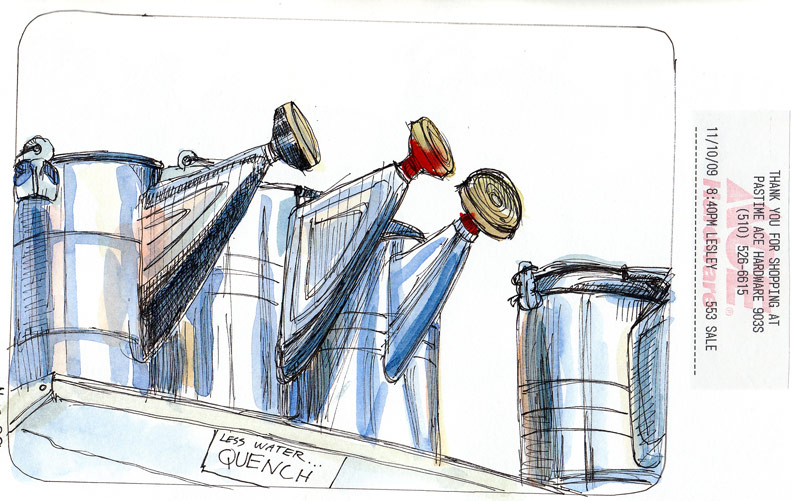
Next I faced the opposite direction and drew and painted these large metal watering cans up on a tall shelf.
Watering Cans version 1, ink and watercolor
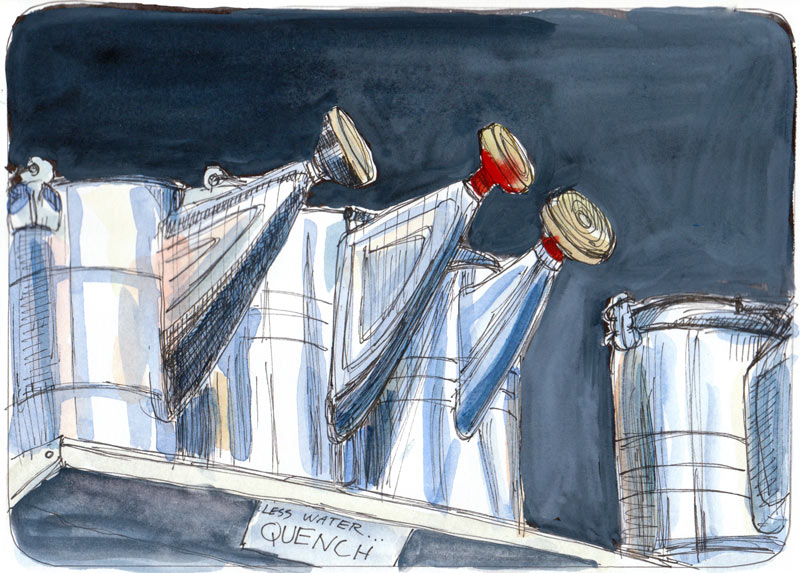
When I got home I glued a bit of my receipt (from the toilet flapper I bought) to the edge of the page in my sketchbook (above). Tonight I thought the page might look better with a dark background so I added some ink, didn’t like that, and then painted with gouache over the ink to get more what I had in mind. (The receipt is still there, I just didn’t scan that part below).
Watering cans, ink, watercolor, gouache
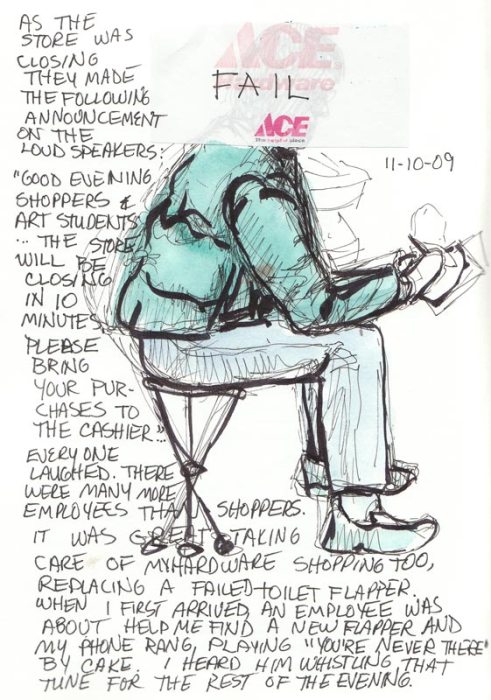
The last sketch I did was of Cathy sketching a row of hand trucks in the room filled with bins of nails. I messed up her face but fixed the FAIL by pasting another piece of receipt over her head.
Last Sketch of Cathy Sketching
I would have liked to sketch more but it was nearly time for the store to close. It had been a lot of fun, and I enjoyed the comments and questions of passing employees and the few customers shopping on a very quiet Tuesday night. Cathy said that when she was sketching outside the employee break room she overheard employees talking about us and saying, “There’s a lady out there painting… TOILET SEATS!”
At 8:45 a man announced over the loudspeakers:
“Good evening customers…and… ART STUDENTS [giggle]. The store will be closing in 15 minutes so please bring your purchases to the [giggle giggle] cashier …[giggle]…”
…and then laughter ensued throughout the store, employees, customers and us artists alike! It was a slow night at Pastime, with twice the employees as customers, so I’d like to think they enjoyed our company as much as we enjoyed theirs.
Better Bowl of Fruit, Watercolor on paper, 7" x 10.5"
I’m so much happier with the way this watercolor of my bowl of fruit turned out than the one in my sketchbook. It makes such a difference to use Arches 140 lb cold-pressed watercolor paper. It also helped that I was painting consciously and taking my time, instead of rushing through it, half asleep as I had been when I made the sketch.
Even more fun is that I made the the large porcelain bowl when I was a potter and had glazed it with two of my favorite glazes…and now I was “glazing” it again, in watercolor.
I enjoyed every bit of the process, from planning the composition, to drawing (see below) from life, to masking the whites, then painting one shape at a time, using juicy washes, adding color wet-into-wet, as well as glazing over dried washes, then removing the mask, softening the highlights and some edges.
Fruit bowl pencil sketch on watercolor paper
Since I’m teaching a watercolor class right now, I tried to also pay attention to my process so that I could better explain to my students how and why I did what I did. I surprised myself with the range of techniques I was actually using in one painting. Even though in class we study them as separate techniques (flat wash, graded wash, wet-into-wet, etc.) you often need them all in one painting and sometimes in one passage of a painting.
(Boring technical stuff follows…read at your own risk…) For example, after the fruit, bowl, and shadow were painted I did a flat wash of Ultramarine Blue mixed with Burnt Sienna for the neutral background. Then it felt like the table top, which I’d initially left white with just a light blue shadow, needed paint too. So the first layer was a pale flat wash of Cadmium Yellow. When it dried it didn’t feel warm enough so I glazed over it with a flat wash of Permanent Rose (so that the whole table top was the pale apricot color now only seen on the right of the table top). It still wasn’t warm enough so I did another wash of Permanent Rose mixed with a little Cadmium Yellow and let it fade out 3/4 of the way across. I liked the way that looked but now the shadow was too pale. So I glazed over over the shadow a couple of times and then softened the edges of the shadow where it meets the table top.)
I have a theory about the paths we take in life, and how important it is to notice what I call “Angels Holding Up Signs” along the way. Sometimes those angels take the form of a person offering helpful information or silently pointing the way by example, an intuitive thought, or an unexpected turn of events that makes you pause. When I see or hear an angel holding up a sign, whether it’s “Yield”, “STOP,” or “Go This Way” with an arrow, I consider it a gift and give it serious consideration.
Disclaimer: I’m not a New-Age angels and crystals sort of girl. But I do believe there are angels all around us; good, kind, generous people, like Adam at Kragen Auto Parts today who helped me dispose of gallons of old motor oil and their containers that had been abandoned in my garage (long story; don’t get me started!). Thanks Adam!
…And like the angels who’ve held up signs in my art life lately, including Kathryn Law and Ed Terpening who’ve both helped me to a breakthrough in my understanding about why simplifying is important in oil painting, especially when painting plein air. I’m always attracted to details, and so I’ve fought against that principle, and then fought my paints trying to put those details into my paintings.
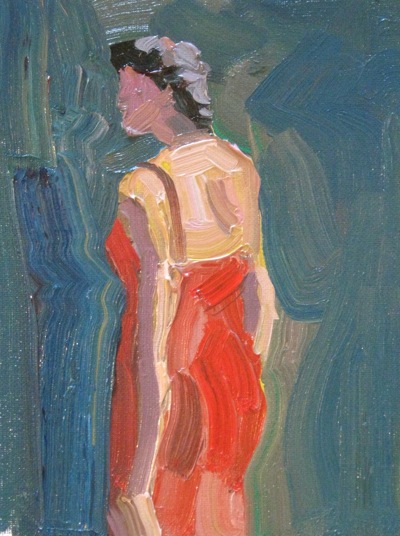
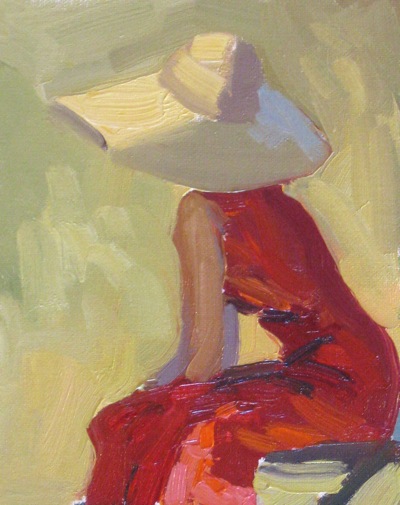
Then I saw these paintings (below) by Ed Terpening on his blog, Life Plein Air, made during a workshop in which the instructor, Peggi Kroll-Roberts, challenged the class to break the scene into as few large shapes as possible and paint those shapes with a large, fully loaded brush in one brush stroke.
Each study evoked in me a mood and my mind created a whole life story for each of these women. A mom at the beach trying to keep her kids in line; a sad, matron, wondering where her life had gone; a glamorous, young society lady at the country club watching a tennis game while sipping a martini….
How did so much come from such simple paintings? Leaving out the details left it to my mind to fill them in. This is something I so needed to learn: that simplifying and omitting detail doesn’t make a painting boring—it lets the viewer’s mind play and be creative, making for an exciting, rewarding experience. Thanks, Ed, for holding up that signpost!
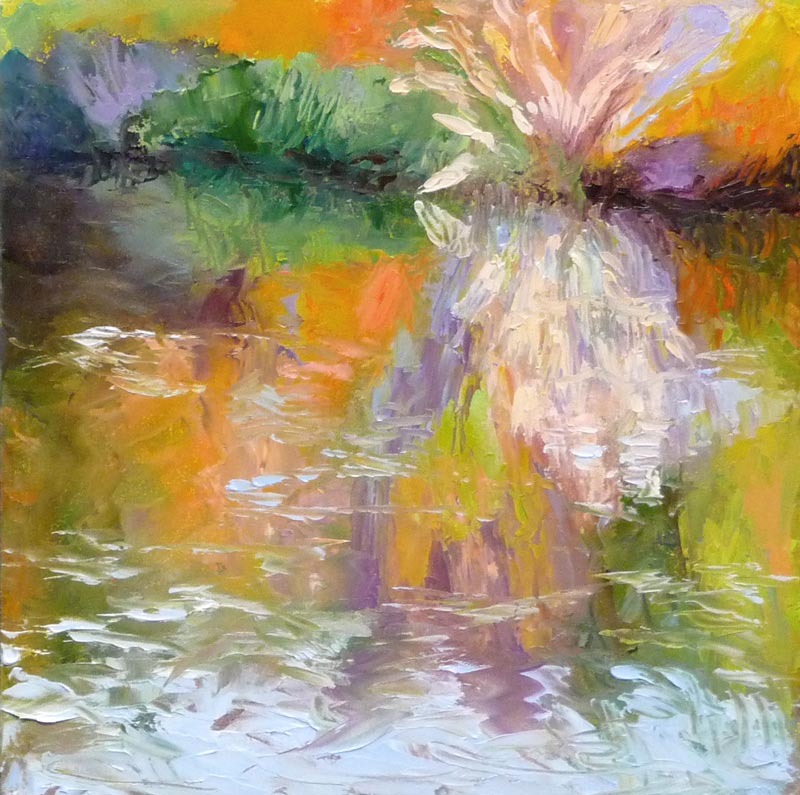
Another sign-toting angel came via email this week: a request to purchase this plein air oil painting I made last summer at Lake Temescal. There I was at the crossroads, wondering whether to give up plein air oil painting, and this angel popped up with a sign saying, “You’re on the right path, don’t turn back.”
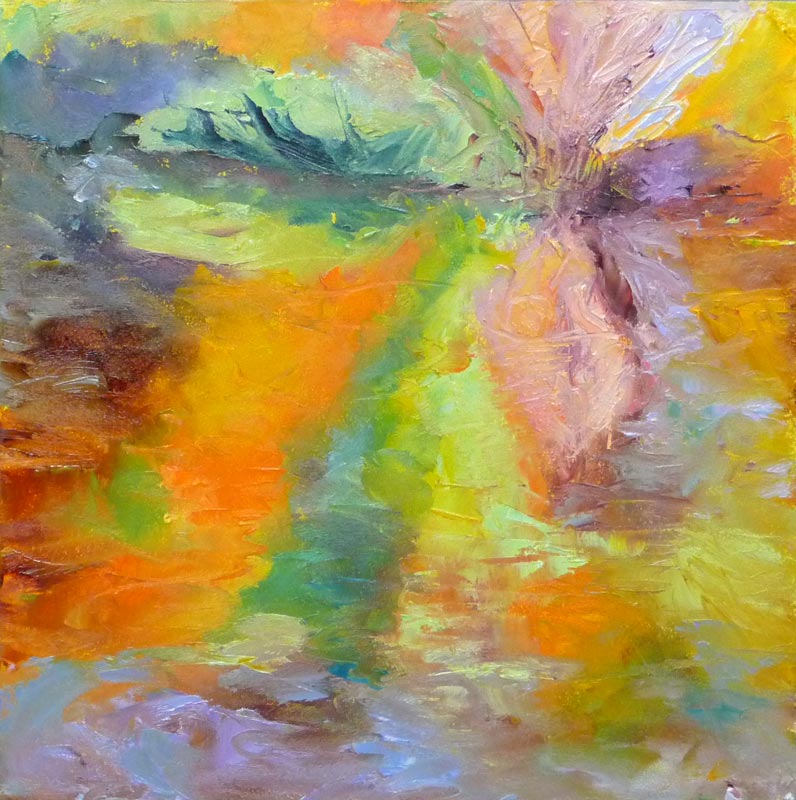
And now about my process with today’s painting. First I tried to simplify by painting large color shapes with the plan to create a color study for a work to be done in the studio. I also focused on the composition, picking a focal point, being careful not to divide the canvas in half as I have a tendency to do, making the subject (the water) the largest portion.
Here’s how it looked when I’d covered the whole panel:
Lake Temescal Reflections, Phase 1
I’d worked quickly, using a palette knife, going for big shapes of color. I should have stopped there and gone for a walk. But instead I messed around for another hour and muddied up the design and the colors:
Temescal Reflections (muddied), Phase 2
But the great thing about palette knife painting is that it’s easy to scrape off passages and repaint them. So later that evening I put the photo of Phase 1 on my computer monitor side-by-side with a photo of the scene and worked on the painting until I was satisfied with it (as posted at top).
And I’m very happy with another breakthrough: the way I was able to enjoy the plein air painting process without worrying about making a Painting with a capital P while I was out there.
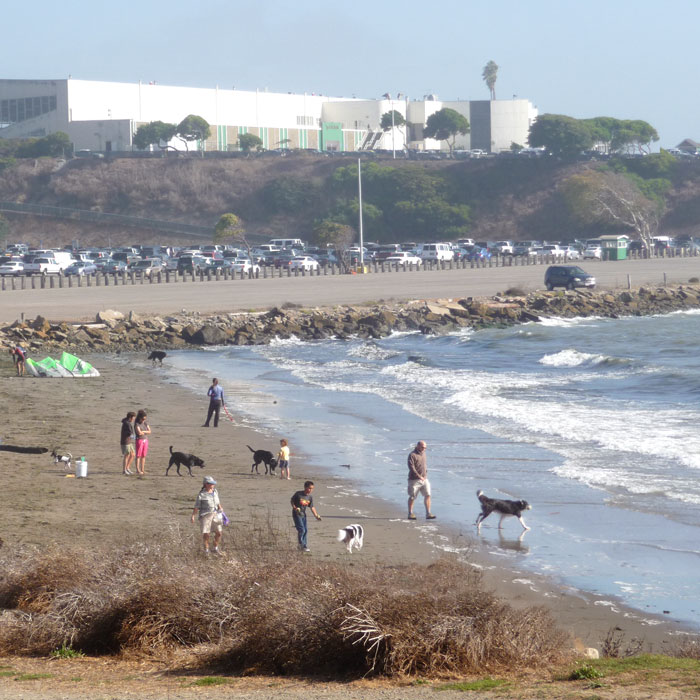
I wanted to try to bring to life the image in my mind from painting last weekend at Albany Bulb because I didn’t feel I’d really captured it in the oil painting I did. Since I’m going to be teaching a watercolor class starting October 17, I thought I’d give it a go in watercolor.
There are so many different approaches one can take when working in watercolor, from very slowly and precisely painting every detail, to working in many layers of transparent glazes, to loose, free and juicy washes, and everything in between. I like all approaches, and especially enjoy the meditative experience of painting each petal of a flower separately, taking weeks to finish a painting. But tonight I just wanted to go for it, working quickly and completing the painting in one session. I started at the sky and worked my way down.
Albany bulb beach photo
For reference I used the image in my mind to Photoshop the photo I’d taken, moving things, deleting things, changing the colors to try to get it to look like I remember the day.
Perhaps the painting needs more or perhaps I should have stopped sooner? I won’t know for sure until I look at it for a few days (or until one of you kindly points out what I’ve missed!)
Meanwhile I have several posts just crying out to be written but this has been a very busy week, with day job overload and catching up on things so they will have to wait until tomorrow.
After I started working on a series of paintings in acrylic I realized I needed to learn more about acrylic technique and materials if I wanted to make better progress. Although I’d read several good books and seen a couple of brief demonstrations I needed more.
Although there are hundreds of oil painting and watercolor videos, I could find only a few for acrylics. I rented a couple of awful ones from Netflix and viewed an online video from Artistsnetwork.tv that I found useless. Then I found the video that provided the lessons from which I did the exercises above. The video is “16 Acrylic Painting Techniques: A Studio Workshop with Jackie Miller.” Miller demonstrates and carefully explains how to prepare the support and create each of the 4.5″ square paintings.
I played the DVD on my computer in my studio, and worked along with it, pausing and rewinding as needed. Below are close-ups of the 4.5″ technique squares with a little information about each.
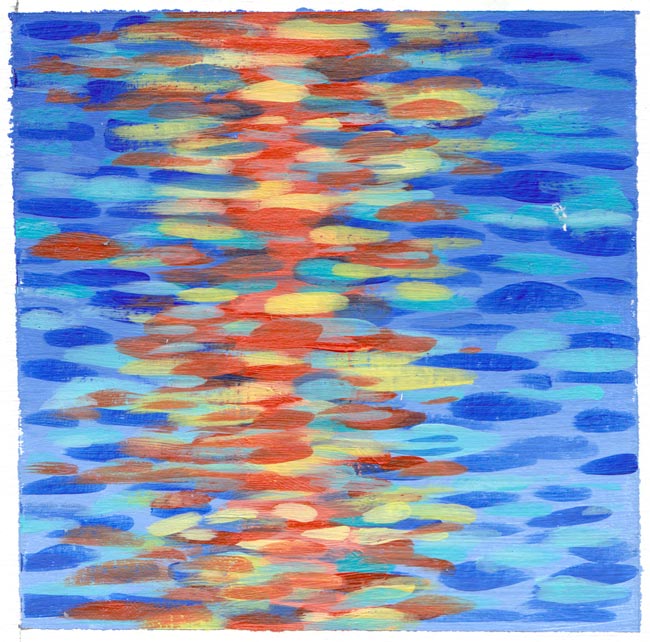
#1: Discrete Brush Strokes
1. Discrete Brush Strokes. Apply a flat, gradated blue background and many layers of individual brush strokes to create optical color mixing (and theoretically the illusion of water and sun reflections).
#2: Stencil and Stamp Painting
2. Stencil and Stamp Painting. Used a variety of materials as stencils, such as plastic embroidery mesh, hardware cloth, plastic decorative stencils. Multiple layers of paint were applied with a stencil brush and with q-tips and a rubber stamp. Fun!
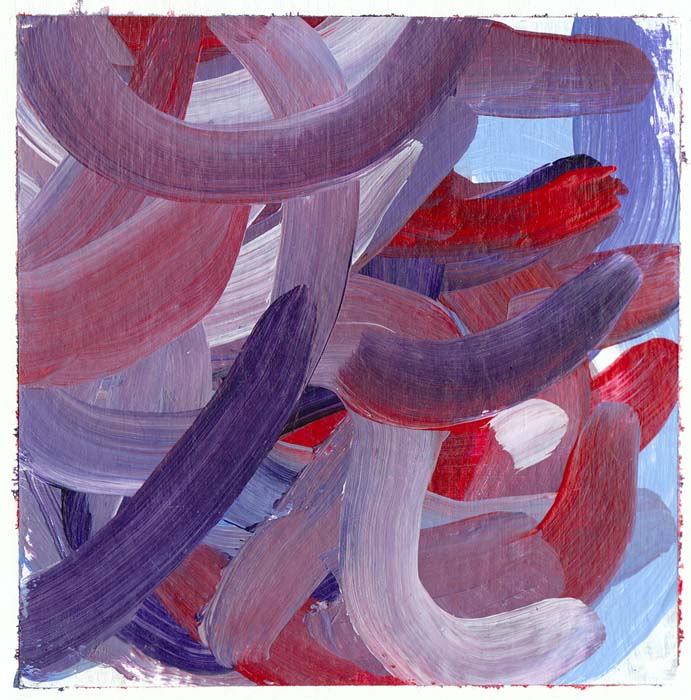
#3: Energized Brush Strokes Alla Prima
3.Energized Brush Strokes Alla Prima. Using glazing liquid to keep paint workable a bit longer, applied layers of brush strokes freely, letting colors blend into each other.
#4: Impasto with Sgraffito
4. Impasto with Sgraffito (scraping). On top of flat underpainting, applied paint mixed with gel medium and before it dried, scraped through it with a variety of implements including popsicle stick, rubber combs, and paint shapers.
#5: Glazing and Scumbling
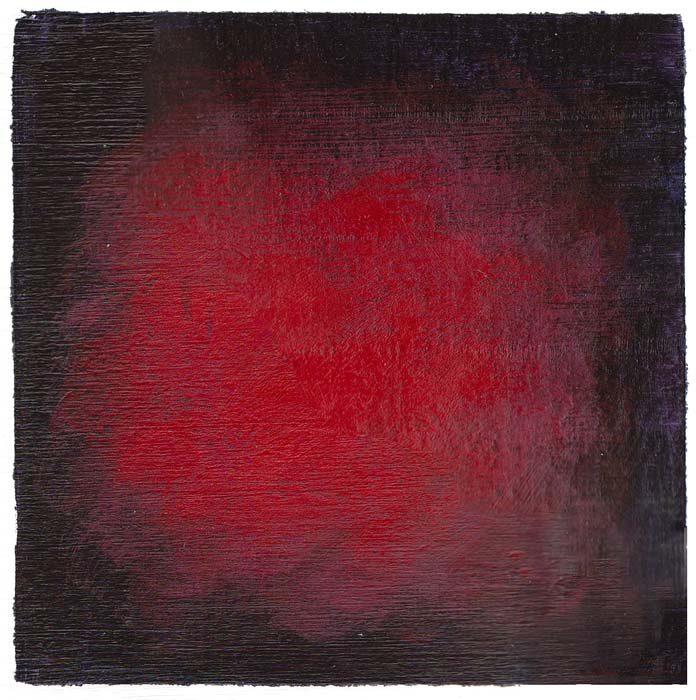
5. Glazing and Scumbling. Applied underpainting of blue, leaving white hole in the center. Then half the blue was glazed with a very thin layer of the same blue mixed with glazing medium (to see how it enriches the color and removes chalkiness). The center hole was painted red. Then turquoise paint was scumbled (scrubbed with a dry brush) on top of the blue and softly over the edge of the red.
#6: Cross-hatch Brush Stroke
6. Cross-hatch Brush Stroke. I need more practice with this one. A flat, dark underpainting was done first and then the idea was to make brush strokes that cross each other in hundreds of little X’s with a fairly dry brush to create soft gradations with many layers. The original actually looks better than this photo shows because of glare, but I still found it difficult to make those X’s.
#7: Soft-edge & Hard-edge
7. Creating soft- and hard-edged transitions. A dark, flat background was painted first and then the edge of the section at the top left was masked with masking tape and lighter red painted in that area. The transition at the bottom was created with layers and layers of softly scumbled paint lightly scrubbed on with a nearly dry brush, always starting at the corner and moving towards the center so there was less paint on the brush as it approached the transition area.
#8: Glazes, Wipe Removal & Combing
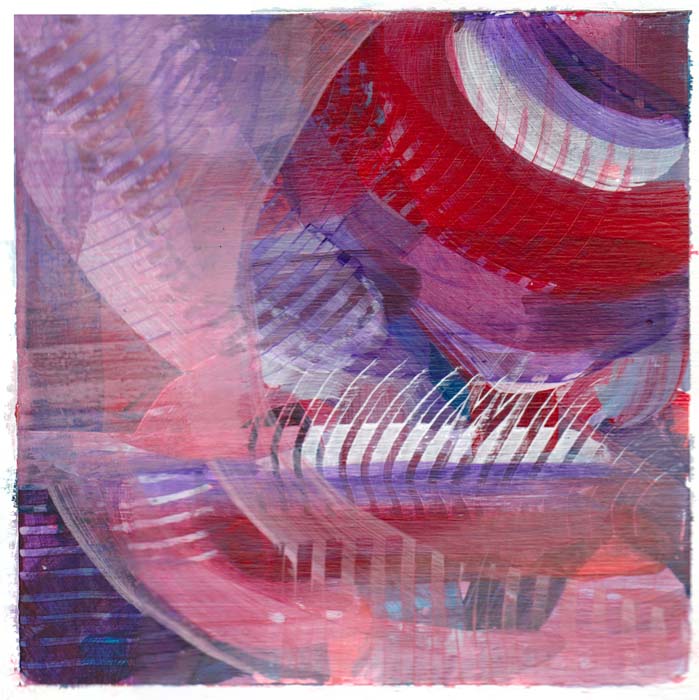
8. Glazes, Wipe Removal & Combing. On top of a flat, mauve background, layers of paint mixed with glazing medium were applied and then wiped back with a damp cloth and combed through using a rubber, multi-sided comb.
#9: Finger Painting & Mixed Media
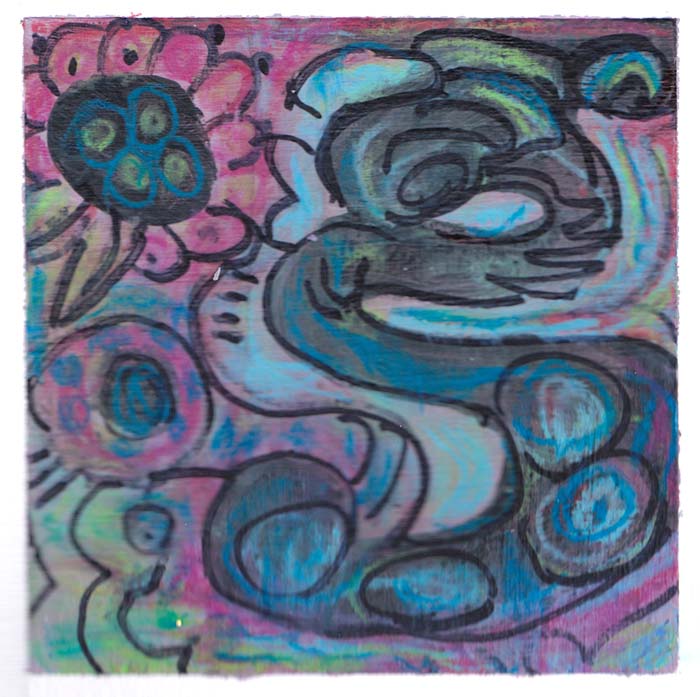
9. Finger Painting & Mixed Media. Started by finger painting with grey paint (she used Graphite Gray meant to look like graphite) and then added water soluable crayons, Sharpie marker, pencil, layer of acrylic medium, and more crayons and pens, finishing with medium to seal the crayon layer.
#10: Staining
10. Staining. On the video she left this square of the canvas raw, but since I was using watercolor paper, I gessoed the whole sheet and then covered this square with Absorbent Ground Medium which creates an absorbent surface, similar to ungessoed paper. The paint was mixed with a high proportion of water and allowed to move and blend wet into wet. It didn’t work as nicely as watercolor does wet into wet. Mixing more than 25% water with acrylics can cause them to fail to bond with other acrylic layers, but that’s not important when working with an absorbent ground since it will sink ito the fibers.
#11. Alla Prima as Underpainting
11. Alla Prima as Underpainting. The underpainting was created like #3 using bold strokes of paint, wet into wet. When dry it was painted over with various techniques including combing and glazing. On the video she did the over-painting with oil paint. I used acrylic.
#12: Painted Gel Relief
12. Painted Gel Relief. First a a pile of heavy clear gel was applied to the surface and then pushed around and smoothed and shaped with various implements. When it was dry to the touch after 24 hours I painted it with Micaceous Iron Oxide, Copper and Bronze acrylic paint.
#13: Found-Object Collage
13. Found-Object Collage. A flat layer of heavy gel was applied and then random stuff stuck into it (twine, match stick, pennies, plastic stretcher bar “key”, electrical wire thingees, some glitter for texture). When dry it was painted.
#14: Rubber Cement & Tape Masking
14. Rubber Cement & Tape Masking. Rubber cement was applied and when dry, the square was painted. Then rubber cement was removed, another layer of rubber cement painted over a different area, another layer of paint, cement removed. Masking tape applied and then painted over, etc.
#15: Paper and Fabric Collage
15. Paper and Fabric Collage. Acrylic medium was used as an adhesive to attach scraps of fabric, string, lace and paper. When dry the surface was painted using various colors and Iridescent Gold paint.
#16: Water Soluble Crayon
16. Water Soluble Crayon. This was supposed to also include bits of dried acrylic paint film but I didn’t quite see the point of using scraps of dried up paint. I’m not sure I really got the point of drawing with the water soluble crayons and then coating them with acrylic medium (they smear) either, but I gave it a try.
IMPRESSIONS:
I was suprised how much I enjoyed the more abstract, random, textural pieces; a nice respite from my usual striving to capture what I see in a somewhat realistic fashion. I can see many possibilities for exploration with acrylics, but I’m still not convinced of their suitability for my work right now, although I haven’t given up yet. I’ve gone back to working on the paintings in progress with more understanding and skill but still feel like I’m fighting the medium. More about that later.
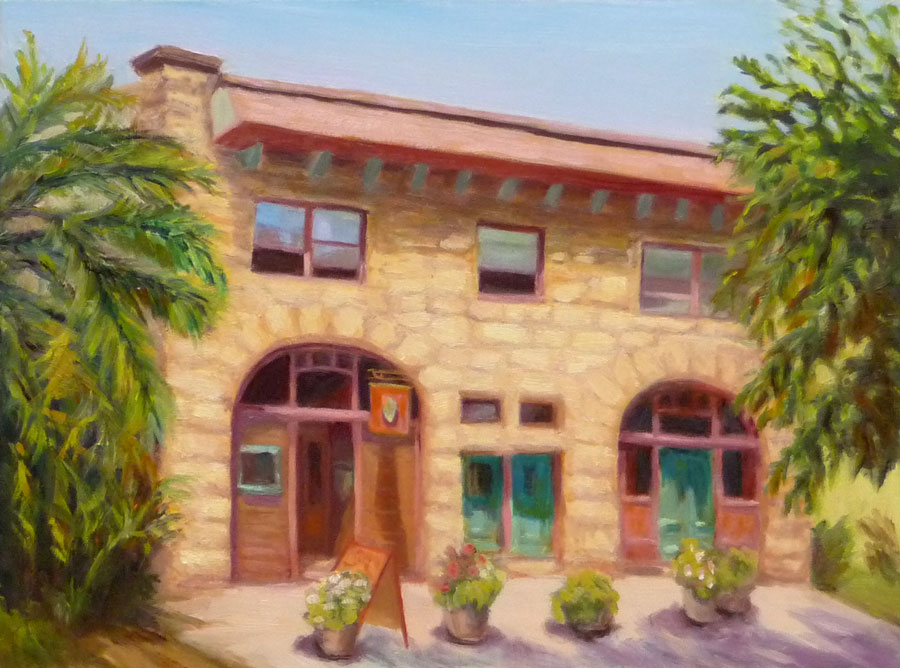
Port Costa's Bull Valley Restaurant, Oil on panel, 9x12
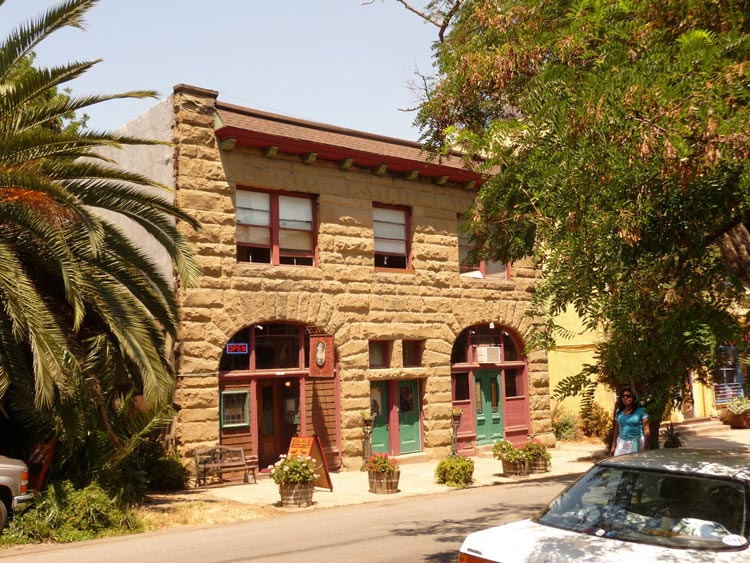
When we gathered for our critique on the patio outside the funky Warehouse Cafe, a biker bar at the end of Port Costa‘s main road, I thought I’d gotten my painting of the Bull Valley Restaurant off to a good start. It was a sunny Saturday and the quirky local residents of the little town had been very welcoming, chatting and joking with the plein air painters.
Just as the critique was getting started the old lady bartender turned up the rock and roll so loud that we couldn’t hear each others’ comments and suggestions. Someone went in and asked her to turn it down and she sneered, “This is a bar. We play rock and roll!” Although some of our group had bought lunch and beer (served in mason jars), I guess we weren’t exactly their preferred clientelle.
Their usual patrons continued to roar in on their Harleys and wanna be Harleys. Some were dressed in full leather or raunchy heavy metal t-shirts and black denim. At least half of them were over 50, the guys paunchy and bald and the women, with their dyed thinning black hair, looked “rode hard and put away wet” as I’ve heard it said.
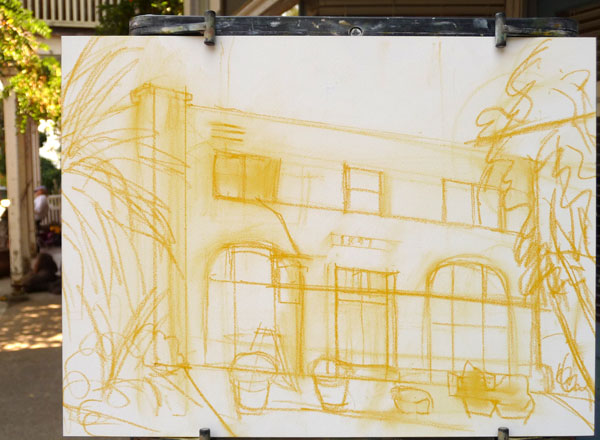
Anyway, back to the painting. As you’ll see from my initial sketch below, my perspective was even further off than it ended up in the finished painting above.
Port Costa-WIP 1
I’m always amazed how often my eyes fool me. Sometimes I’m sure a line slants one way and then I hold up a pencil to check and the line slants in the completely opposite direction.
This is the point when I stopped painting on site, planning to finish at home from photos.
Port Costa WIP 2
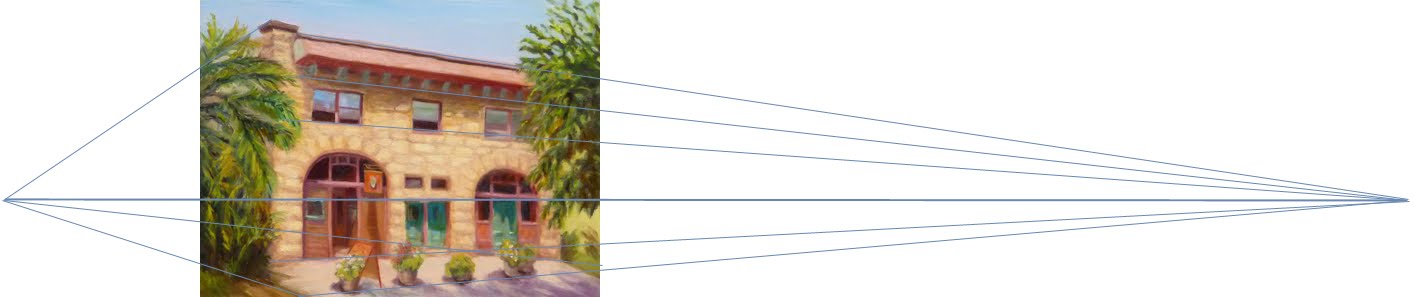
Once home I realized that I had a serious perspective problem with the way the roof line and the line where the building meets the ground were parallel to each other instead of coming towards each other to finally meet at a vanishing point. I worked on the painting for a couple of days and thought I’d fixed it (blind to what was in front of my face from seeing it for too long).
When I shared what I thought was the final painting with some artist friends, they generously pointed out a few things that needed adjusting, including continuing perspective problems. Below M. added lines in Photoshop to demonstrate for me how I’d gone wrong with the perspective. It’s so great to have that kind of support!
Diagram showing how the perspective should have been
In the end I decided I’d taken this painting as far as it needed to go and moved on to the next project. But I promised myself that next time I’d pay more attention to perspective.
El Cerrito Natural Grocery, cobalt Copic multiliner and colored pencils
I had to make my morning coffee with the last drops of non-fat milk (yuck, 1% is OK but non-fat in coffee just doesn’t cut it) and there were no peaches or milk for my Cheerios. A trip to the market couldn’t be put off. But I had a full day of experiments in the studio planned and I needed some exercise. Easy solution:
take the long way around, up and down big hills, to my favorite grocery store, El Cerrito Natural Grocery (cardio)
sketch the market using the cobalt Copic Multiliner I wanted to experiment with (I think I prefer the sepia)
shop
carry groceries home in a loaded backpack plus another full bag (weight lifting)
add colored pencil to the sketches to try out the new Polychromos colored pencils (LOVE THEM!)
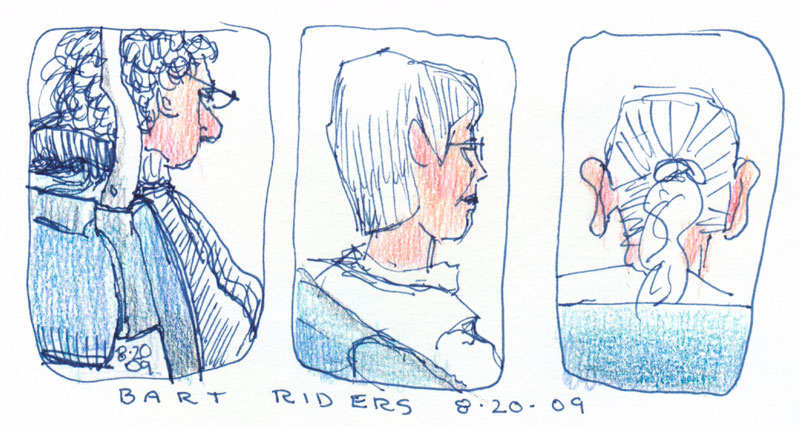
Quick subway sketches with the cobalt Copic Multiliner and colored pencils
I’m trying to simplify my choices with my art supplies, wanting to narrow down the pens, ink, pencils and colored pencils to keep handy and those I’ll give away. I did tests today on drawing pencils, sepia liquid inks and sepia pens and will post them and my preferences tomorrow.
I’m also working on painting a grid of 16 different acrylic painting techniques to improve my understanding of acrylic techniques and possibilities. It became clear this was needed when I started a series of paintings in acrylic and realized I didn’t have the “chops” to accomplish what I wanted. I was trying to use oil painting techniques and was getting nowhere fast (and ruining brushes with all the scrubbing I was doing with them which seemed the only way to get the smooth transitions I wanted).
Each medium has its own capabilities and pitfalls. Why not make good use of the characteristics of the media instead of trying to force it to be something it’s not? Despite people claiming acrylic can be used like oils and like watercolor, I’m going to try to learn to use it like acrylics instead and have fun with all the crazy stuff it can do. This series of large paintings wants to be in acrylic and so it shall, and soon I hope.
Rush Ranch Horses, Sepia Copic Multiliner and watercolor wash
Mariah, a wonderful young artist, accompanied me to my plein air group’s paint-out today at Rush Ranch in Suisin City. She was immediately inspired by a spot, sat down and started sketching. I faced the opposite direction and sketched these horses in the corral.
Before we’d left my house, I showed her a book on drawing animals that demonstrated how to first find and assemble the basic shapes contained in the animal (rectangles, circles, triangles) and then refine them. I decided to practice what I preached and did that with the horses. I’d never noticed what big knees horses have before. I sketched with my sepia Copic Multiliner .03 and then added watercolor washes.
Rush Ranch Vista, ink & watercolor wash
The views from Rush Ranch were tremendous. I could have sketched for hours more but we’d arrived late and after our second sketches it was time for the group critique and lunch.
We were late because I got lost yet again (missed the turnoff and drove forever before turning around — and this was with GPS!) My mind had wandered to thinking about the people fishing (and the fish) in the slough off the little bridge we’d just passed so I missed the entrance sign and decided that the GPS telling me I’d arrived was wrong. This was especially stupid since the printed directions from my group said to go over that bridge and then turn right in 3/4 mile.
Instead I drove and drove, went over another bridge and THEN started looking for the turnoff. I went miles past that bridge, eventually arriving at the gate to a “youth correctional facility” (jail for teens) and admitted I’d blown it again. When we finally found our way back and I saw the huge “Rush Ranch” sign, I couldn’t believe I’d missed it.
Well actually I could believe it. I think I could get lost just walking from one room to another these days!
When my sister looked at the original version of this painting (posted here) she told me her eye kept going to the bright area in the upper right. There was a lot that was distracting in that image, and I thought the ground was too dark and the two little patches of flowers on opposite sides of the path were distracting too. But now maybe I lost some of the sunshine by lightening the ground and darkening that corner? (see original below)
Blake Gardens (version 1, click to enlarge)
So it was back to the drawing board…er easel. I spent some more time working on it and I think it’s done now. Which do you like better? Or do you think the revised version needs more work and if so what?
Yesterday I was out plein air painting in the funky little town of Port Costa, and because I was painting buildings, spent more time drawing than painting to get the perspective right. (Which makes me realize I need to add one more point to my How to Oil Paint Plein Air List: # 5. “Get the drawing right!”). Today I tried to (but didn’t quite ) finish it. While I used to often spend a month or more completing a watercolor painting, for some reason I have the idea that an oil painting should be finished more quickly, like in one session.
Perhaps what bothers me is that when I paint plein air I work small, using a 9×12″ panel. It seems like a waste of time to work such a small painting for days afterward, putting in lots of details (because I like details, darn it, even though plein air oil paintings are supposed to be simplified).
Maybe the trick is to paint the plein air painting as a simplified field study and then if I like it, if it has life and soul and the subject still interests me, grab a bigger canvas and paint big where I can really get into things like reflections in windows and other crunchy details, instead of continuing to work on the study.
But for now, it’s back to overworking yesterday’s study since I just scraped off the bottom 1/4 of the painting and need to redo it before the paint dries.























 Jana Bouc, Artist