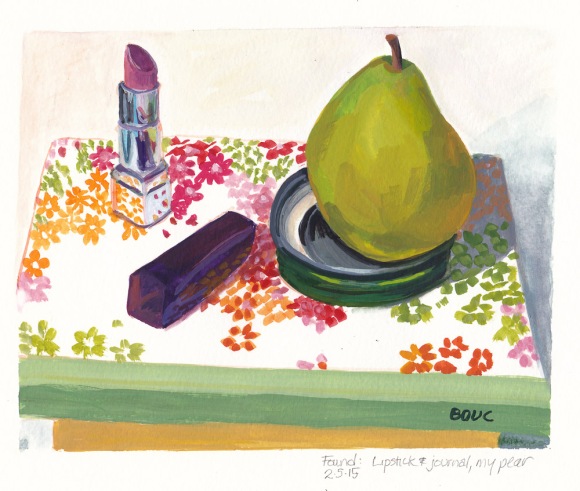
Practicing gouache with found items. The lipstick with purple case I found on the street, the journal at the recycling center’s little “shop” where you leave things you don’t want and take things for free. The pear and jar lid I found in my kitchen so I guess they aren’t officially found items. The cigar box the journal is sitting on was a freebie from the local smoke shop. I love cigar boxes so much! This gouache sketch made me happy…feels like I’m starting to get it.
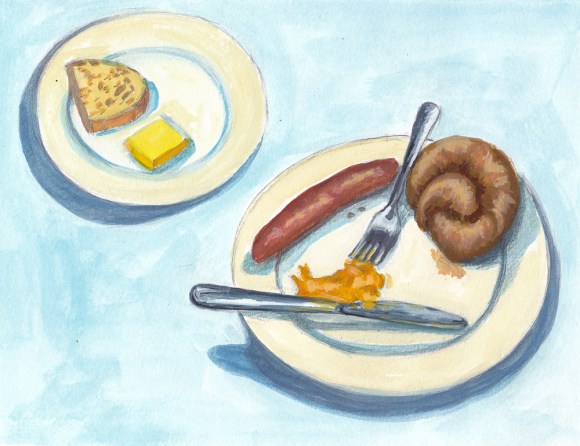
Susan’s Dinner at Gaumenkitzel, graphite and gouache, 7×9 inches
When we met a Gaumentkitzel for sketch night I’d already had dinner so just ordered a decaf and sketched Susan’s dinner instead. I added gouache when I got home.
Zorn Palette color chart in gouache, 10×8 inches in A4 Moleskine
In trying to learn more about gouache I made a few color charts. I’m using mostly M. Graham gouache which I like much better than the Winsor & Newton and Schmincke I used before. The Graham gouache is creamy and brilliant, rewets well and doesn’t smell (like the W&N). I found that using fresh-squeezed gouache is more fun to work with than rewetting dried paint, but frugality keeps me trying to reuse dried. The best solution is to set up a palette for each session, squeezing out tiny blobs, adding more as needed.
Above is an exploration of the Zorn palette in gouache, a limited palette using only Yellow Ochre, Cadmium Red, White, and Black. The black paint, when mixed with white, is meant to serve as blue since it is a cool color that can look blue next to warm colors. Next I want to try using it in an actual painting.
M. Graham Gouache paint chart, gouache in A4 Moleskine, 10×4 inches
Above is a chart of my gouache colors straight from the tube and mixed with white and each other. Sadly when I removed the masking tape it pulled off some of the paper from the extra large Moleskine watercolor notebook that is my current journal. I don’t recall previous Moleskine WC notebooks having that problem but I’ve switched to low-tack tape now.
Before ordering any new brushes specifically for gouache I wanted to see how the brushes I already had might work so did the test below. I found a few that I liked and ordered a couple of others. I’ll do another post about my gouache palette and brushes I’ve settled on soon.
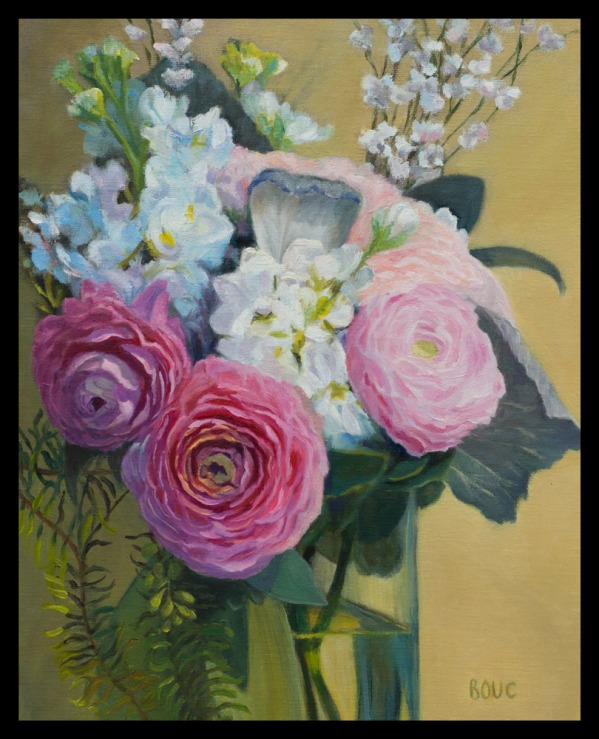
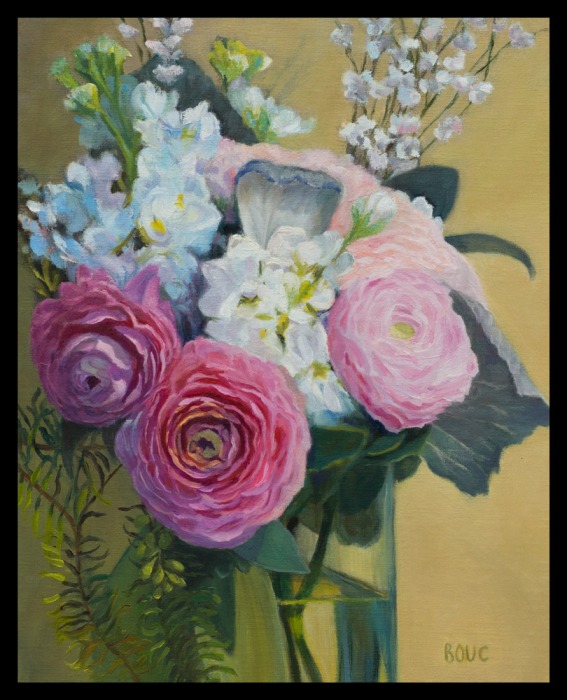
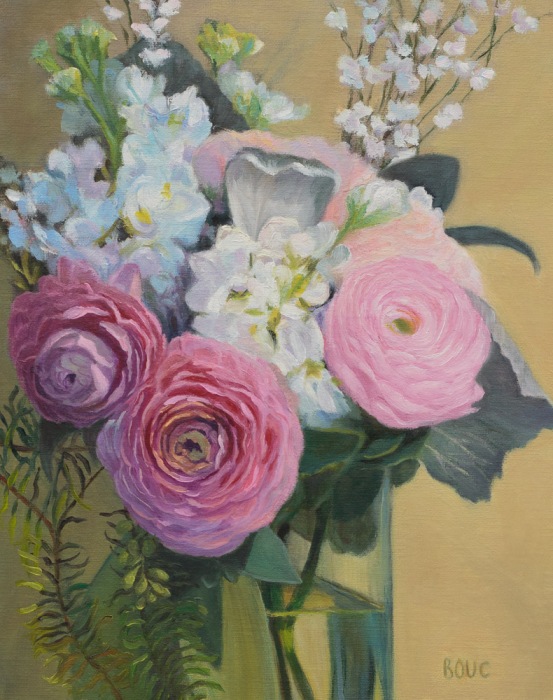
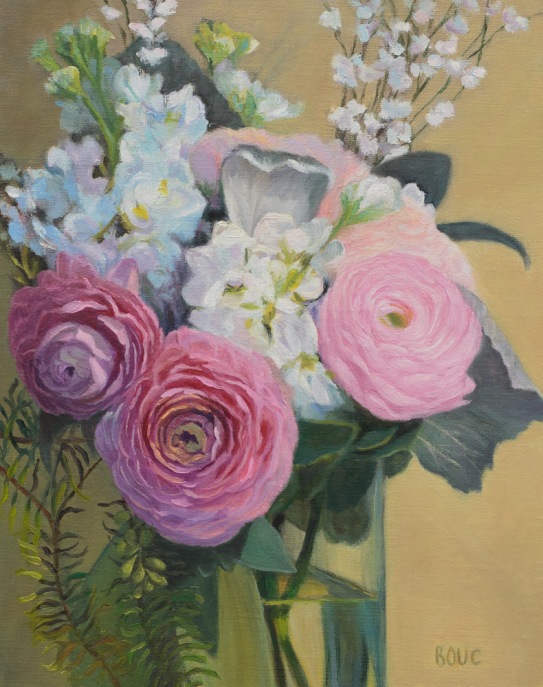
Thank you to everyone who responded to my previous post and offered feedback about whether to try to fix the right-hand rose that was bugging me. I figured if everyone said leave it I would, but if others saw the problem too, I’d try again to fix it. They did, so I did, and now I can look at it without feeling frustrated.
To solve the problems with the rose, I turned the photo and the painting upside down and could immediately see I had the shape wrong. Then I converted the photo to gray-scale to check values. I reshaped and repainted the rose using grayed-down, paler colors. I touched up a few other spots in the painting (back top right flowers, some leaves and small changes to both left roses). I added a black border to simulate how it will be framed.
Now I think the focal point (the middle rose) stands out, and the minor right rose recedes. FYI, the reason these roses don’t look that rose-like is because although I started working from life, I could quickly see that the flowers were about to completely fall apart (it was several days after the wedding) so I took a photo of the almost over roses.
Below Left (AFTER): fixed final painting; Below Right (BEFORE): before adjustments and fixes.
I started this painting of my daughter-in-law’s wedding flowers soon after the wedding in January 2014 but wasn’t thrilled with the way it turned out so set it aside. I began reworking it again recently, and after several times reaching a point of saying, “Finished” and then working on it some more, I remembered the saying, “Art is never finished, only abandoned” and decided it was simply time to stop.
But there’s still one thing that bugs me in this painting: the pink rose on the right just feels too Barbie pink to me. Every time I look at the painting it irks me. But I’ve repainted it 5 times and perhaps because the photo I’m working from isn’t very good, especially of that rose, it keeps turning out the same. I may try one more time. What do you think? Leave it or try again? Or maybe find another photo of the set up with a different view of that rose and try again from that photo?
My challenge in painting is always how to maintain the freshness of my original inspiration, color choices and brush strokes while holding back my inner perfectionist who wants to keep noodling around forever. Another challenge with returning to an older painting is that the fresh flowers are long gone and only a so-so photo remains to work from. Likewise all my new fresh ideas about painting have to be set aside to work on something from the point of view of a year ago.
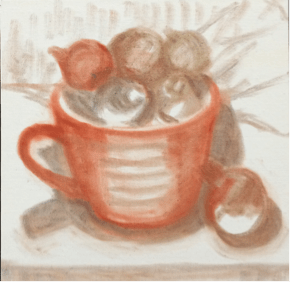
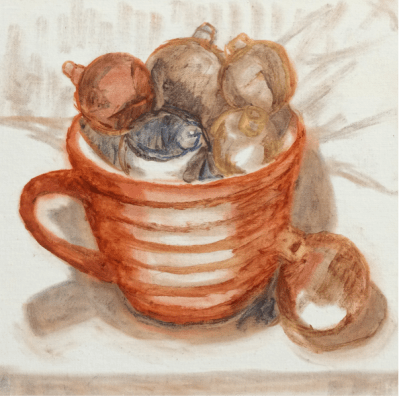
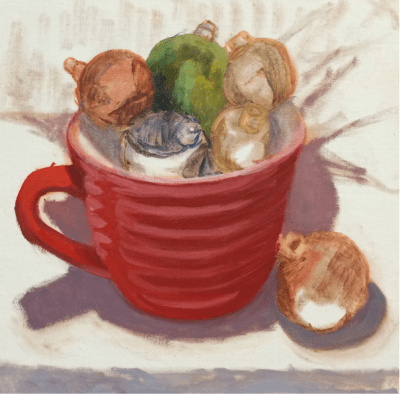
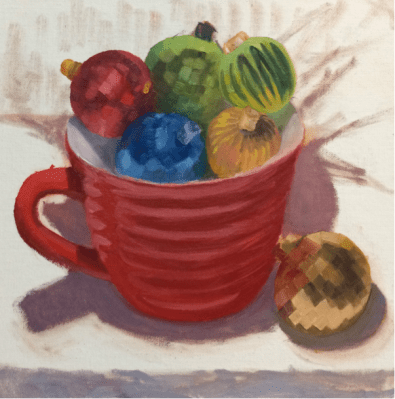
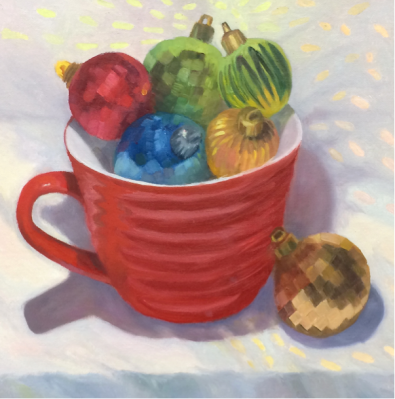
Christmas Balls in Red Cup, oil on panel, 8×8 inches
Happy Holidays! As Leonardo da Vinci said, “Art is never finished, only abandoned.” That’s especially true of this painting because the reflections, ridges and facets kept changing appearance as I moved or the light changed, and I could have worked on it forever. I’d planned to post it before Christmas but just couldn’t “finish” in time.
This is another painting (available here) in my “Found and Free” series: both the cup and ornaments were found on walks in “free” boxes set out on the curb.
You’ll see in the steps below that I was experimenting with using Panpastels and Sofft Tools to do the initial drawing on my panel. They are amazing: the pastels go on smoothly like paint but are completely erasable with any eraser and disappear into the oil paint so there’s no fixative required.
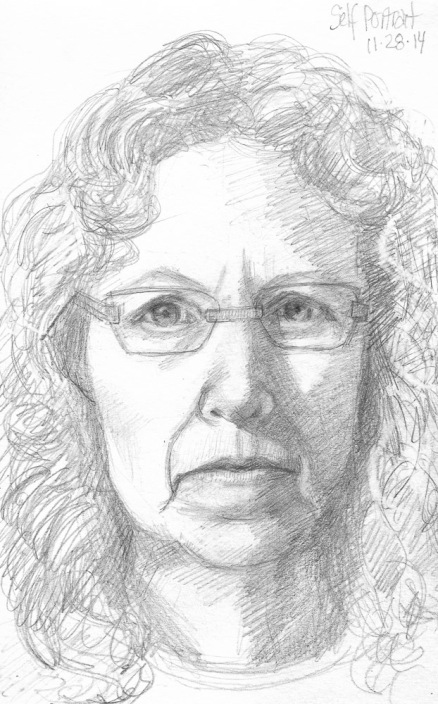
End of Journal Self Portrait with New Glasses, graphite, 8×5″ 11/2014
I’ve been doing more oil painting than sketching lately so it’s taken longer than usual to fill my journal and get to the last page that I always save for a self-portrait (above). It’s interesting how each sketch in the collection below shows a progression upwards in age and (occasionally) in skill and how only bits of them resemble me at all. Also interesting how many of them were done on days I was feeling grumpy and/or tired (probably wisely choosing to sketch myself instead of working on something that “mattered” when I felt that way).
Below is a little gallery of self-portrait end-of-journal sketches since 2009. You can click on any image to see it larger, if you must.
End of Journal Self-Portrait, graphite, 5×7.5 in
End of Journal Self-Portrait, ink & watercolor
End of Journal Self-Portrait, February 2013, Pitt brown Brush Pen and watercolor, 8×5″
End of Journal Self Portrait, graphite and watercolor, 7.5×5″
End of Journal Self-Portrait #1, ink & watercolor, 7×5″
End of Journal Self Portrait, colored pencils, 7×5″
End of sketchbook self portraits, ink & watercolor
End of Journal Self-Portrait #1
End of Journal #2 (Ick!)
Self Portrait B-1, ink & watercolor
Tortured sketch (in mirror), Pretending sweetness (from photo)
Montessori Pink Tower and Turnips, oil on linen panel, 10×10 inches
This painting was inspired by my neighbor’s childhood Montessori Pink Tower blocks arranged like a little cityscape on his coffee table. I found the blocks irresistible and had to paint them. The turnips I’d bought to cook for dinner seemed like a perfect addition (I know, I’m weird, right?) The painting is available on my Daily Paintworks gallery here.
If you’d like to see my full notes with goals and outcomes for each painting session, you can open this small PDF file. Life intervened between sessions which made painting from life difficult as you can see in the photos below taken at the beginning and end of the painting process: the turnips had started to sprout and wrinkle.
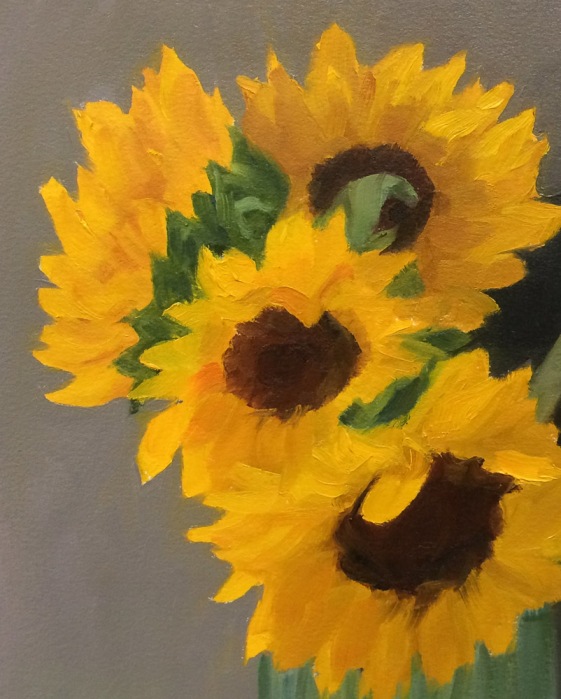
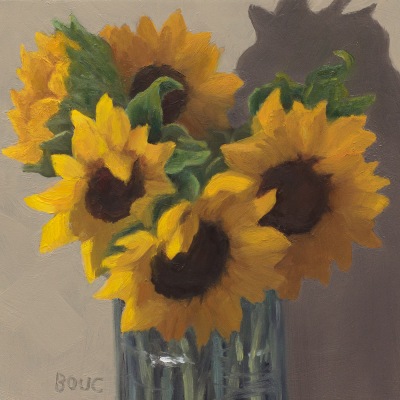
Sunflowers in Spaghetti Jar, oil on panel, 6×6 inches
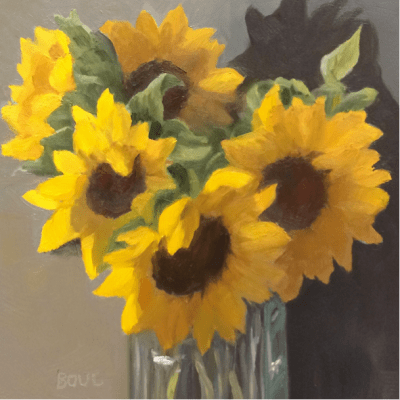
This was supposed to be a quick and easy project that went totally out of control. I wanted to try out Arches Oil Paper and quickly paint a bouquet of sunflowers in a tall glass jar meant for holding spaghetti noodles. I made and transferred a sketch (see below for process) and started painting on the paper, which I absolutely hated. It was dry, absorbent and paint wouldn’t slide or move on it. It just sucked in the paint and I was having no fun. I quit halfway through and cut off the parts of the painting I hadn’t finished. This is where I left it:
Session 1: Sunflowers in Spaghetti Jar, oi study on Arches Oil Paper , 8×10 inches
The next day I started over on a 6×6 inch panel that I’d sanded down from a previous failed painting. Again I intended to paint for an hour or two and move on to something else. Instead I worked and reworked over and over until I finally had a painting I could stand to look at (at top of post). Sometimes I think reusing panels is a mistake because the bad juju from the first one hangs around and messes up the next one.
The one nice thing about Arches Oil Paper is that it can be cut down and cropped easily like watercolor paper. Although it does not need to be gessoed I’m going to try gesso on it next time to see if that will make it more enjoyable to use.
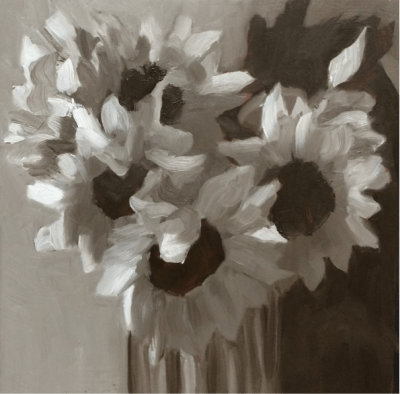
Below are the process photos from start to finish.The painting on paper is Version 1 and on panel is V2. The ones labeled “Photoshopped” were photos of work in progress adjusted in Photoshop to try to solve the problems and then the next image is those changes implemented in the painting. If you’d like more detail about the process you can open this PDF of my full process chart with notes about each step.
Session 1 V 1 Photo
Session 1 V1 Sketch
Session 1: Sunflowers in Spaghetti Jar, Arches Oil Paper
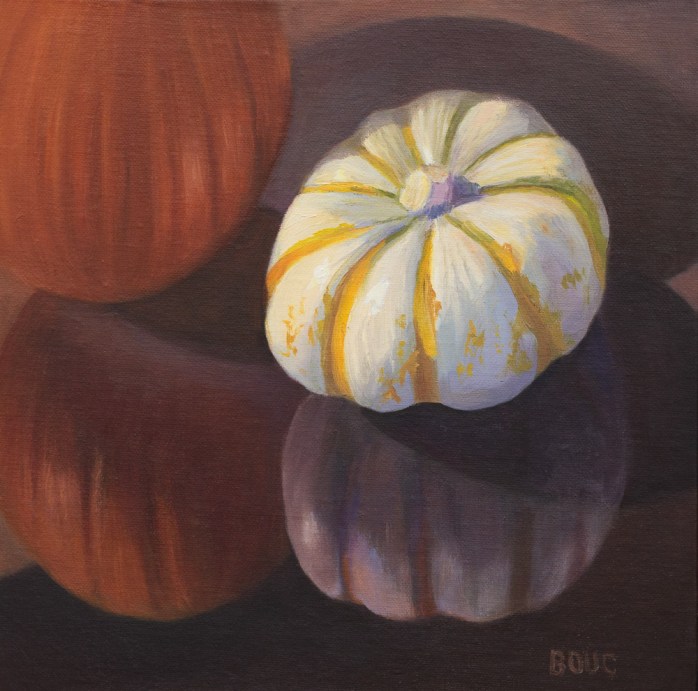
Pumpkin and Gourd on Glass, oil on linen panel, 10×10 inches
What an interesting painting challenge this was: strong warm light on a white gourd and a small pumpkin, with reflections and shadows on a shiny black plexiglass surface. Below are the steps as I worked on this painting (available for purchase on my DailyPaintworks gallery).
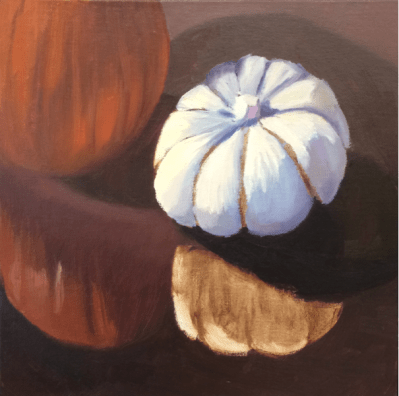
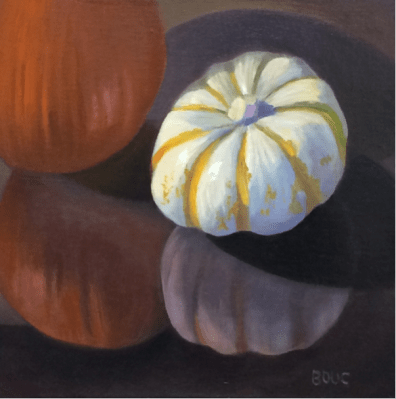
As usual there was one session where I did some “unauthorized painting” (see previous post for explanation) so the next session was all about trying to restore those areas. I’m trying to learn when to preserve the freshness of the “alla prima” first attempt and when to rework it. To see notes about each step and misstep, here is the link (PDF) to the Session Chart at the bottom of the post.
Session 1A: Drawing and block in in burnt umber
Session 1B: Started painting with color
Session 2: Painted all but gourd reflection
Session 3: Colored stripes and made gourd yellower
Session 4: Messed around with everything
Session 5: Done
Photo of set up
To see notes about each step and misstep, here is the link to the PDF Session Chart pictured above.
To see notes about each step and misstep, here is the link to the PDF Session Chart pictured above.
Have you downloaded a Session Chart? Do you find it interesting enough for me to keep uploading them? Do you prefer just seeing the work in progress steps without detailed commentary? Thanks for visiting!

























 Jana Bouc, Artist