Categories
Art supplies Drawing Ink and watercolor wash Painting Product Review Sketchbook Pages

Testing Stillman & Birn Sketchbook Paper with Strawberries: A Review

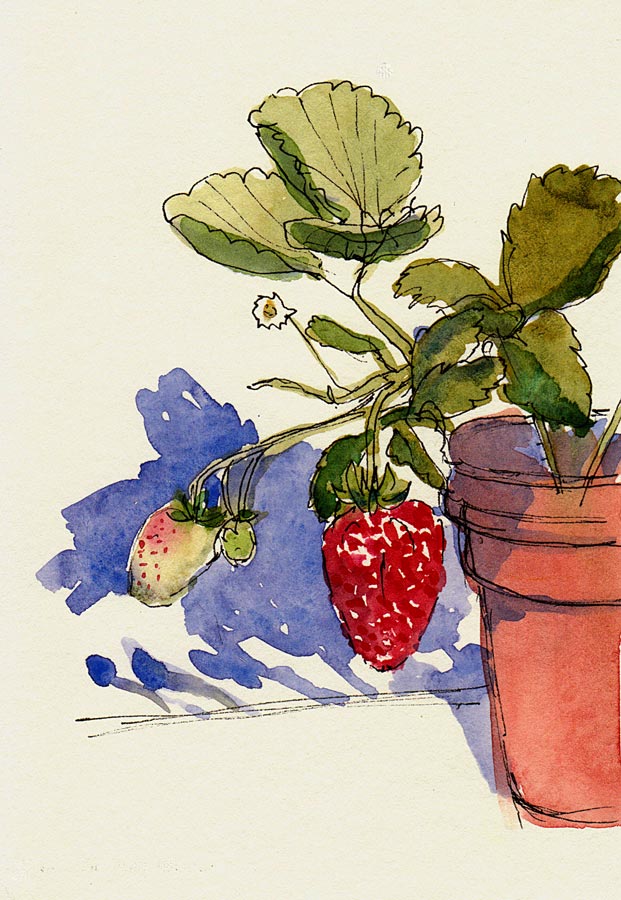
Stillman & Birn Delta 180 lb Ivory paper, ink & watercolor, 6x4"
Stillman & Birn Delta 180 lb Ivory Multi-Media, ink & watercolor, 6×4″

Stillman & Birn sketchbooks are highly rated by other sketchers so I wanted to try one but couldn’t figure out which paper to choose. I emailed the company and they sent me a packet of paper samples. On a sunny afternoon I tested them using potted strawberries and flowers on the deck for my subjects. (Then I ate the strawberry. Yum!)

Stillman & Birn Beta 180 lb white multimedia paper, ink & watercolor, 4x6"
Stillman & Birn Beta 180 lb white Multi-Media Surface, ink & watercolor, 4×6″

The two most likely options were the Multi-Media Surface papers: either the Delta 180 pound ivory (at top) or the Beta 180 pound white paper (above). I liked the way the ink went on smoothly. The watercolor worked well if applied directly in one layer without much water. Otherwise it backwashed like crazy (see splotches above).
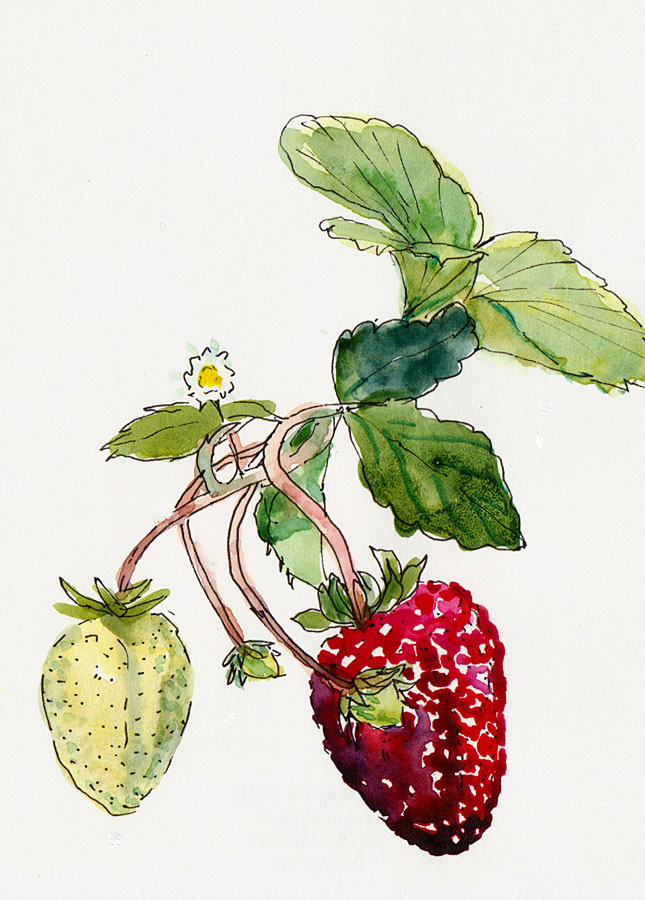
Stillman & Birn Epsilon 100 lb white Plate Surface, ink & watercolor, 4x6"
Stillman & Birn Epsilon 100 lb white Plate Surface, ink & wc, 6×4″

I liked the Epsilon paper (above) but worried that the 100 pound weight wasn’t going to be thick enough. The very smooth finish was nice for both ink and watercolor, similar to hot-pressed watercolor paper.
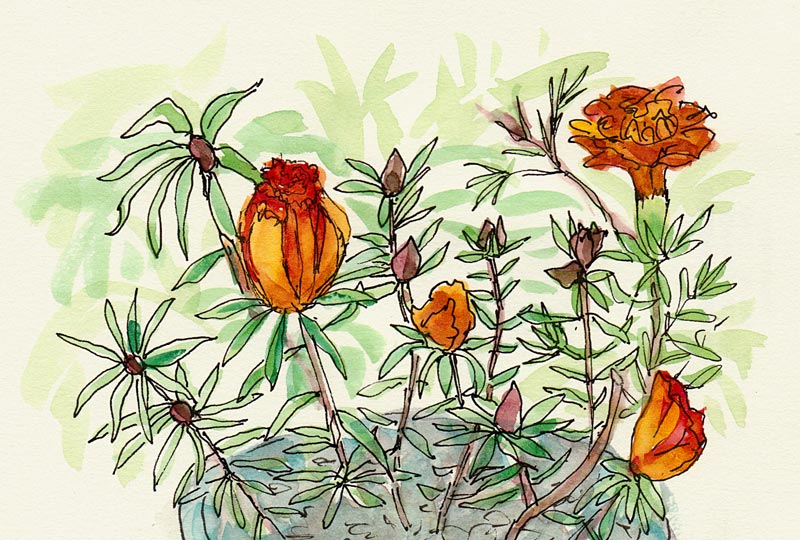
Stillman & Birn Gamma 100 lb white Vellum Surface, ink & watercolor, 4x6"
Stillman & Birn Gamma 100 lb ivory Vellum Surface, ink & watercolor, 4×6″

The 100 pound Gamma (above) and Alpha (below) vellum surface paper was probably my least favorite, although I ended up judging my impressions by how well I liked the way the sketch turned out instead of technical reasons since they all took ink and watercolor somewhat similarly.

Stillman & Birn Alpha 100 pound white Vellum Surface, ink & watercolor, 4x6"
Stillman & Birn Alpha 100 pound white Vellum Surface, ink & watercolor, 4×6″

I chose the ivory Delta paper (at top of the post) in an 8×6″ wire-bound journal  because I liked that paper the best, even though it only comes wirebound. I’ve used that journal for the past month. It works well if I draw in ink and then apply a stroke of paint and leave it alone. I’ve been less successful if I add another layer of paint or try to get a smooth wash over a larger area. The paper pills, previous layers of paint lift off, or it backwashes.

I also keep getting nasty, dirty, thumbprints on the previously painted page when painting on the next page (which has ruined a couple nice sketches). But maybe that’s just me being clumsy. Or maybe I should only paint on one side of the paper even though it’s thick enough to paint on both.

I’m halfway through the journal and have found workarounds to my problems. It’s been good practice for me to be more direct and get it right on the first stroke or else. But I’d still like the option to add more washes when I need to. It’s a beautifully made journal but I don’t think I’ll buy another. I’m going back to binding my own with the watercolor paper I prefer.

If you’ve used a Stillman & Birn journal, which version did you use and why do you love it (or not)?

Categories
Art theory Oil Painting Painting Portrait

Frankie Flathead Finally Painted (Planes of the Head Grisaille Study)

Frankie Flathead Planes of the Head Study, oil on canvas panel, 11x14"
Planes of the Head, Grisaille study, oil on canvas panel, 11×14″

When I bought a “Planes of the Head” life-sized plaster cast two years ago I wanted to learn more about portrait painting. I put it on display in the studio and studied it. I knew I should be drawing and painting from the cast, but hoped learning would happen by osmosis since it didn’t really inspire me as a painting subject.

Planes of the Head Plaster Cast

Then I got curious about grisaille techniques after seeing beautiful paintings that began with that approach. I watched the excellent video “How to Paint: The Grisaille Method” by Jon deMartin (in which he paints from a cast of Julius Caeser) and decided to try grisaille using homely Frankie Flathead, my Planes of the Head cast, as my model. See bottom of post for a clip of the deMartin video.

Planes of the Head Open Grisaille
Open Grisaille in which Frankie resembles a demented old perv

I was going to display all my steps along the way, but my photos weren’t good enough. Above is the first stage, the “open” grisaille, which means it’s painted thinly, using only transparent washes of grey (or in this case, burnt umber) and wiping paint off to achieve the lighter values. At the top of the post is the “closed” grisaille, made by mixing and applying a range of values opaquely, using white and the same burnt umber on top of the original “open” grisaille.

One of the most powerful things I discovered in the video is the way light changes across planes.

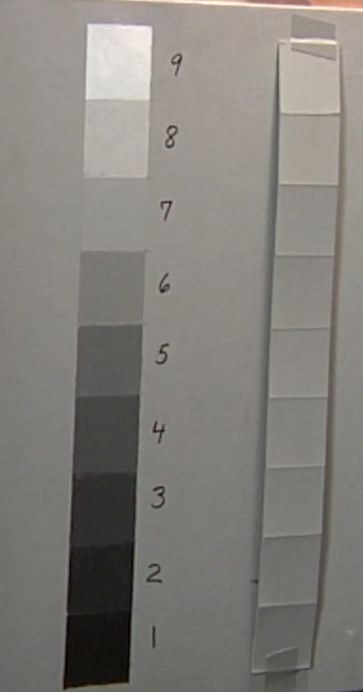
Gray scale and strip painted 50% gray
9-step Value Scale (white to black) on left and strip painted Value 4 Gray on right (screenshot from video)
Same Value 5 gray strip curved to show the range of values as it turns from light
Same Value as image to the left but the Value 4 Gray strip is curved to show the range of values as it turns away from light (screenshot from video)

When bent so planes are at different angles to the light, the gray strip on the right seems to have all the values in the 9-step value strip on the left. Isn’t this a powerful demonstration of the effects of light and shadow?

My first attempt at grisaille was  interesting. I made many mistakes and got lots of good practice.

My finished painting isn’t great, but doing the study helped prepare me for the next lesson I gave myself (and that I enjoyed more and will post soon): starting with a grisaille to set the value structure in a still life and then adding the color in the same values.

Below is a clip from the video. I was very curious about how grisaille works so it was worth the $35 to download the three-hour program, also available here to watch online and DVD.
http://youtu.be/JPar_nzAEL0

(Disclaimer: I have no connection to or receive no benefit from writing about these products)

Categories
Art theory Flower Art Oil Painting Painting Still Life

One Bouquet, 2 Paintings: Generalizing vs. Specifics in Drawing and Painting

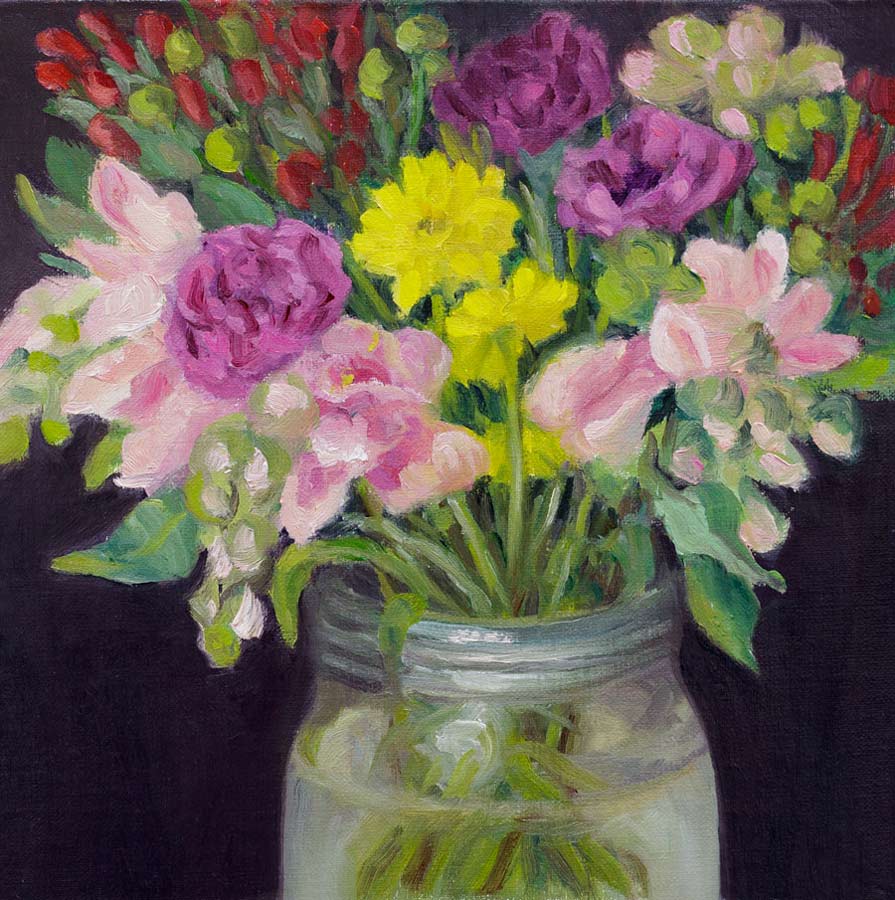
Mothers' Day Bouquet #1, oil on linen panel, 8x8"
Birthday Bouquet #1, oil on linen panel, 8×8″

My three wonderful next-door neighbor children bring me flowers every year for my birthday. This year the bouquet lasted so long I got to make two paintings from it. They come to my door, hand me the flowers and then each one shyly gives me a hug and says “Happy birthday.” I love that they’re still doing it at 10, 13 and 16.

When they were little they would come to the studio and make brilliant expressive paintings. Then school got the better of them and they started drawing the archetypical house under a rainbow with 2 windows, a door and smoke coming out of a chimney).

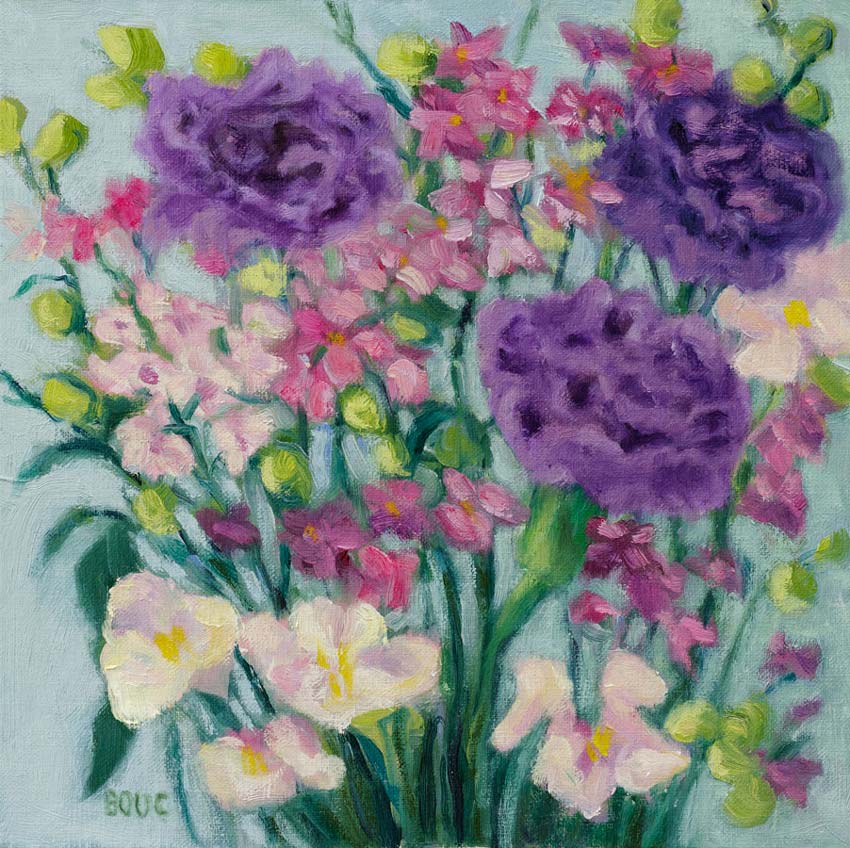
Mothers' Day Bouquet#2, oil on linen panel, 8x8"
Birthday Bouquet #2, oil on linen panel, 8×8″

When I try to work too fast or am tired, I start generalizing, which rarely turns out well, whether in painting or drawing. It’s too easy to do like my neighbor kids and just make a generic house or bunch of flowers rather than these specific ones. I enjoy the process and the results much more when I go for accuracy in drawing, color and value.

Some people are great at simplifying and whipping out gorgeous, impressionistic art. But for me, it’s the individual personality of my subject that interest me; the specifics that make it that particular rose, place or person.

That was the discovery I made when painting these, so they are two more “almost” paintings (see previous post). Each one is just a stepping stone on the long and joyful path that is painting. (And some paintings really are better suited to use as stepping stones in the garden than hanging on the wall!)

Categories
Art theory Oil Painting Painting Still Life

Tea and Lemon, An “Almost” Painting

Tea and Lemon on Lavender, oil on linen panel, 8x8"
Tea and Lemon on Lavender, oil on linen panel, 8×8″

I make a lot of “almost” paintings: they are almost what I intended; I almost like them, if only… (insert painting problem here). I’ve learned to appreciate the learning process and the parts that work and learn from my mistakes. But I haven’t yet learned to leave “almost” paintings alone and start another one.

Instead I keep working them until I reach the point where the underlying problem (e.g. poor composition, icky colors of background or subject, bad drawing, too overworked, or just not enough skill to pull off what I was going for) becomes insurmountable. Then I make a note of what I discover and what went wrong and give myself an assignment of something to study and practice on the next one.

With Tea and Lemon, I was happy with almost everything except the background which I reworked several times. I’m tempted to mess with it some more so I’m posting it to make myself stop.

Categories
Art supplies Mexico Oil Painting Painting Product Review Studio

Painting Sold and Varnished: A Review and How-To with New Pre-Mixed Gamvar Varnish (for oils, acrylics, alkyds)

San Miguel de Allende, Mexico, 9"x12, oil on panel
San Miguel de Allende, Mexico, 9″x12, oil on panel

I just sold the painting above and wanted to varnish it with a protective layer before shipping. I’ve been afraid to try traditional damar-based varnish which is prone to drips, bubbles and yellowing. I knew that somehow at least one cat hair would embed itself. So in the past I used a spray-on varnish (which has its own disadvantagse) or just shipped sold paintings without varnishing.

The ORIGINAL 2-part Gamvar Picture Varnish
The ORIGINAL 2-part Gamvar

I’d read that Gamblin’s Gamvar synthetic varnish was easier to use and very archival, developed based on research at the National Gallery of Art. But it came as a two-part kit that you have to gently mix, every hour over eight hours. For me, that is a recipe for failure. I knew I’d get distracted and miss an hour just like when I make a cup of tea, forget about it, and hours later have to throw it out and start over.

New Gamvar Pre-Mixed Picture Varnish

Now it comes Pre-Mixed! Gamblin just released a pre-mixed version of Gamvar in a 2 oz. bottle containing enough varnish to cover 40 square feet. I called Gamblin with some questions that I didn’t see answered on their website. Their technical support people were on other calls so the operator connected me to their president who cheerfully answered my questions. You can’t beat that for customer service!

My questions and his answers were:

Categories
Art theory Ink and watercolor wash Life in general Outdoors/Landscape Sketchbook Pages

Dawn in Scottsdale and Notes from Portrait Class

Dawn View from my Scottsdale  hotel window, ink & watercolor 5x8"
Dawn View from my Scottsdale hotel window, ink & watercolor 5x8"

I was too excited to sleep much during my week at the Scottsdale Artists School, despite my quiet, comfortable hotel room. One morning I woke as the sun was coming up, with the moon still shining brightly. Everything outside my window was glowing so I immediately grabbed my sketchbook and paints. What a great way to start the day, even if on only a few hours sleep.

I promised to share what I learned from Rose Frantzen but after typing up 5 pages of notes, I’m not sure they will be helpful to anyone without having been there and seen her working and guiding us. That said, here is a bit of my notes:

Categories
Art theory Food sketch Ink and watercolor wash Interiors Places Sketchbook Pages Urban Sketchers

Squid, Vanilla Ale, Noise and Wonky Sketching at Elevation 66

Grilled squid with avocado, rice fritters, grapefruit gel and spicy avocado

I enthusiastically joined my Tuesday night sketch buddies for dinner, beer and sketching at  Elevation 66, the new El Cerrito brew pub. I loved my dinner,  displayed above, (a “small plate” combo so weird I couldn’t resist: grilled squid slices on spicy avocado sauce beside little blobs of grapefruit foam/gel (“to cleanse the palate”) and spicy deep-fried rice fritters. Odd but yummy!

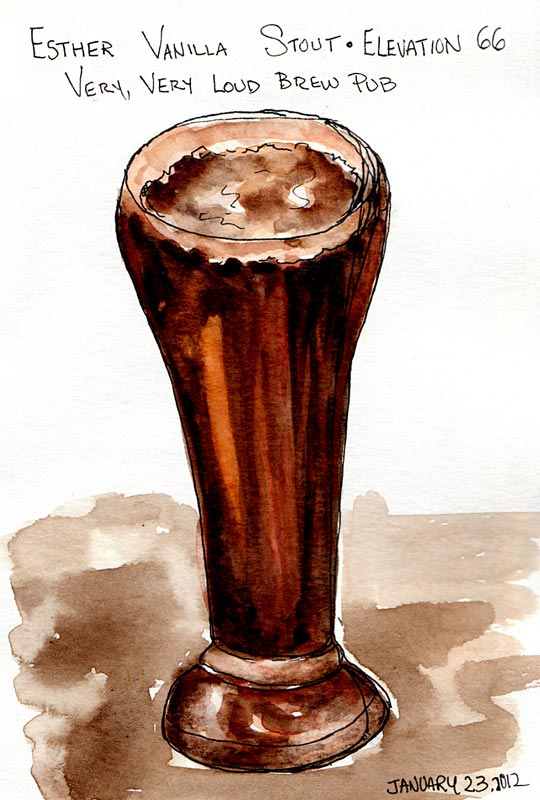
Esther Vanilla Stout Ale, Delicious! ink & watercolor, 7x5"
Esther Vanilla Stout, Delicious! ink & watercolor, 7x5"

Even under the influence of a small glass of Esther Vanilla Stout, a delicious milkshake of a beer, it got so noisy by 8:00 on a Tuesday night that I couldn’t think straight and was ready to leave. I was having a hard time with drawing ellipses and symmetrical shapes (my next drawing subject to practice).

Cathy & Micaela at the bar
Cathy & Micaela sketching at the bar, ink & watercolor 5x7"

And there were lots and lots of symmetrical shapes to practice on! My drawing just kept getting wonkier as the noise got louder.

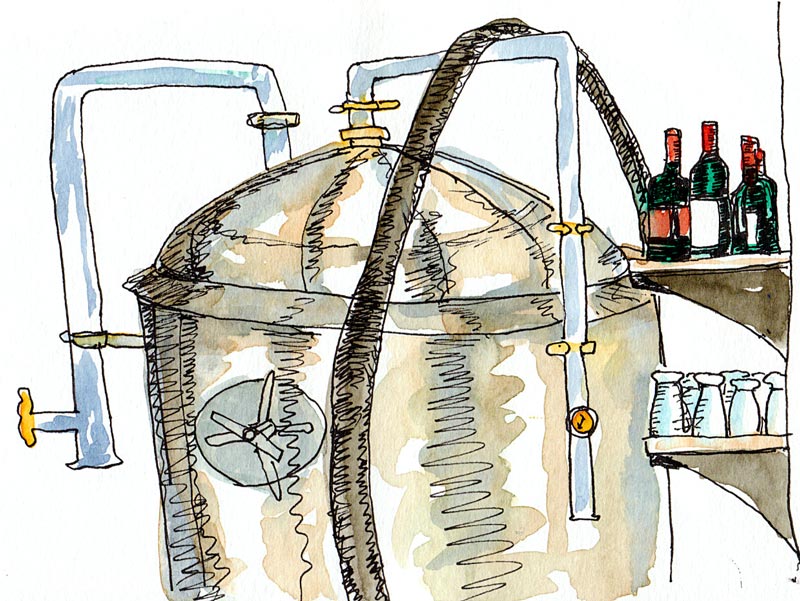
Beer in the vat, wine on the shelf with hoses

I was overly self-critical while I was sketching, wanting to get things right. Then I got my copy of The Art of Urban Sketching: Drawing On Location Around The World and discovered something wonderful: Of the two sketches of mine that Gabi chose for the book, one is very wonky and the other nicely organized. That helped me to see that there is room for both in my art life. Wonky is good! Getting it “right” is good too! Yay!

Please click on their names to see Cathy, Micaela and Beth’s excellent pub sketches from the evening on our Urban Sketchers blog.

Categories
Art theory Book review Drawing Faces People Sketchbook Pages

Learning to Draw Heads: Practice and Study with Skulls and Loomis Method

Smiley Skull and Smiley Guy study, HB pencil, 4x6"

In preparation for my Alla Prima Portrait Painting workshop with Rose Frantzen next month, I wanted to work on my drawing skills so I can keep up in class. Although I draw all the time, I discovered I really had no understanding of head and facial construction.

Skulls and Faces, HB pencil, 11x9"
Skulls and Faces in the Same Positions, HB pencil, 11x9"

I usually draw what I see, compare shapes, angles and plumb lines to try to get some accuracy, but I don’t worry about it too much. That wasn’t cutting it when it came to drawing heads.

So I turned to the great book by Andrew Loomis, recently back in print, Drawing the Head and Hands. His books are also available as PDFs here on the web. There is an excellent explanation with clear examples of the Loomis approach here on Stan Propopenko’s blog so I won’t go into it here. All of my drawings in this post started with the Loomis ball divided in thirds with the jaw then added on.

Skulls and Muscles from Loomis book, 11x9"

I worked through the Loomis book and when I came to his skull and muscle drawings in the book I tried copying them (above). I also tried some other books’ methods of constructing heads (using an egg shape, a block, double ovals, etc.) but none worked as well as the Loomis approach.

I wanted to do more than copying sketches so I started drawing skulls and people I found on a Google image search, drawing the people in about the same position as the skulls (the two pics at top of post and the one below).

Categories
Animals Art theory Drawing Ink and watercolor wash Oil Painting Painting Places Sketchbook Pages

Backyard Llama and Great Drawing Tool: Accurasee Review

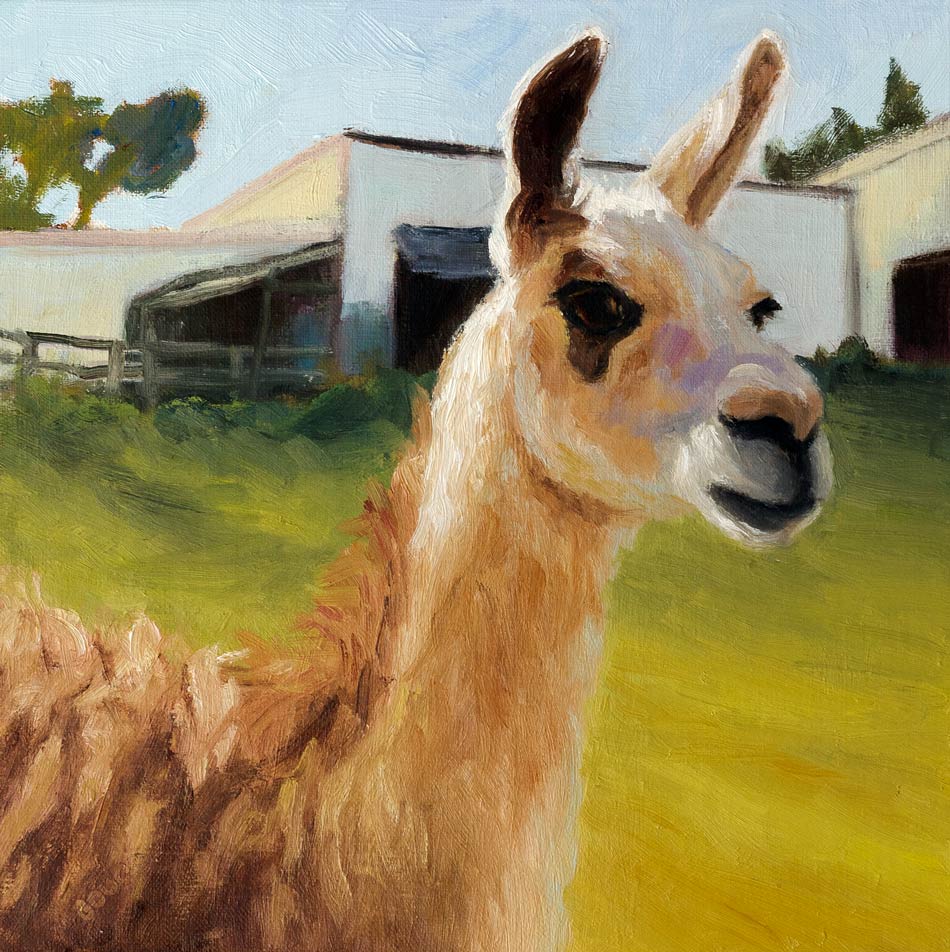
Backyard Lama, oil on panel, 8x8"

When I spotted llamas in a residential neighborhood backyard near the beach in Pacifica I took a few photos of them for painting later. In the process of this painting I experimented with a terrific new drawing tool, Accurasee, and put this llama through its paces.

I started with this watercolor sketch in my journal:

Backyard Lama, ink & watercolor, 5x5"

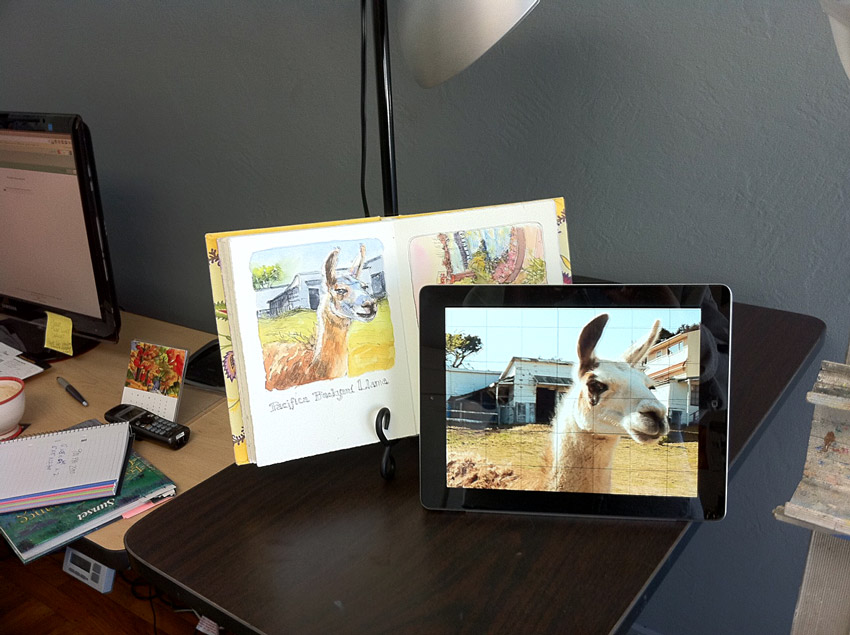
While sketching I edited out the apartment building in the photo and got some understanding of the subject. Then I put the sketch and my iPad displaying the photo on the table by my easel so that I could refer to both as I painted.

Blocking in the values

First I sketched in the llama on the panel (above) with thinned paint (hoping it was fairly accurate) and blocked in where I wanted the darks and lights in the painting.

Lama attempt #1, but drawing wrong
Llama attempt #1, but drawing wrong

I thought I was nearly finished (above) but after a break from it, realized that the drawing was wrong: the face looked more like a dog than a llama and the neck was too short.

Then I discovered Accurasee, a free computer program for Macs and PCs (plus an iPhone app) that helps you be more accurate in your drawing or painting by using an innovative approach to the “grid drawing” method as a way to help you see. Accurasee adds a grid to a photo or scan of your drawing and you create a matching grid on or beside your painting. Then you use the grid coordinates to find the landmarks, height and width of objects in the composition.

You can read more about the history of gridding up here and see how much easier it is using Accurassee in these demos or read their user guide (pdf). (Disclaimer: I have no financial interest in promoting this product or this company, but I think it’s great!)

Photo after gridding in Accurasee

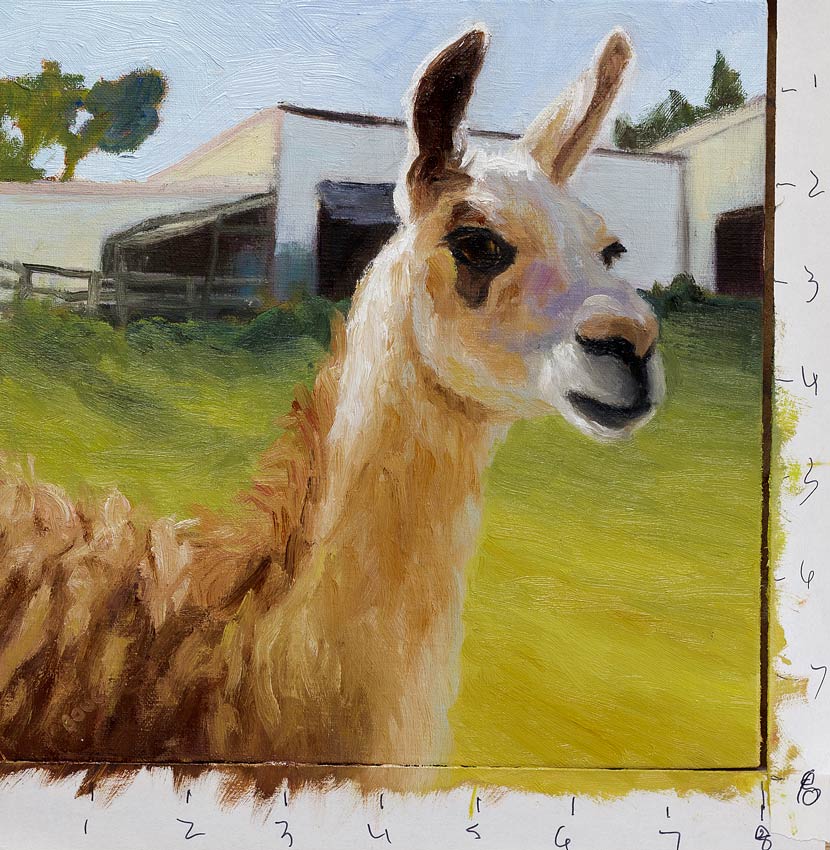
Accurasee offers a collection of clever drawing tools, including special measuring tape but I made my own using masking tape and marked off the inches:

Tape with inches marked to match Accurasee
Llama Attempt #2 Redrawn: Tape marked to match Accurasee grid

By mentally visualizing where the intersection of the lines would be, I redrew a little more accurately (though still not quite right). As they say on their website:

The ultimate goal is not to create a “dot-to-dot” drawing, but a proportionally accurate one. The Accurasee Method and tools are designed to be used as drawing aids, not a crutch. When used correctly, the Accurasee Method can quite literally train you to see more accurately.

Lama attempt #3, almost there
Llama attempt #3, almost there

When comparing the painting to my watercolor concept I saw the ground was too dark so lightened and brightened it, worked some more on the face and neck and all around.

Eventually I just got tired of the whole production and decided that I’d learned everything I was going to learn from this painting, had nothing more to say, and called it done.

UPDATE: Julie asked how I was using the iPad vs my computer monitor and how I had it setup. Here is a picture:

sketchbook and iPad set up by easel
Sketchbook and iPad set up by easel (plus messy desk and computer monitor)

I have in the past used my computer monitor to paint from but the iPad is handier because I can have it right next to the easel or on my drawing table and with two fingers I can enlarge (as in the above photo) or move the section I’m viewing or go back to seeing the full picture. I use the iPad Smart Cover which when folded back works well as a stand.

Categories
Art theory Flower Art Oil Painting Painting Rose Still Life

Blowsy Rosies

Blowsie Roses, oil on Gesobord panel, 6x6"
Blowsy Roses, oil on Gessobord panel, 6x6"

Blowsy. [Adjective: (of a woman) Coarse, untidy, and red-faced.] That’s just what these roses were when I picked them from my poor neglected rose bush: brightly colored but messy and past their prime; yet they were just fine as my model.

It seems like once I gave myself permission to work on a painting as long as I wanted to, I’ve started being able to finish them more quickly. And it’s not just the small size;  I’ve spent hours and days on other 6×6″ paintings in the past.

It could have gone even more quickly than the three hours I spent on it, had I left some of my earliest brushstrokes alone. I just find it hard to believe they were right the first time, even though that was my goal with this painting: to put down the right strokes with the right color, temperature and value and then leave them alone. (Or scrape off the stroke immediately if it’s wrong and replace it with the “right” one, rather than adding more and more paint, which eventually leads to making mud.)

I also tried to focus on using warm and cool colors to shape the form, along with the dark and light values. I’d also like to cite my inspiration for this painting, Kathryn Townsend, whose flower paintings mesmerize me.