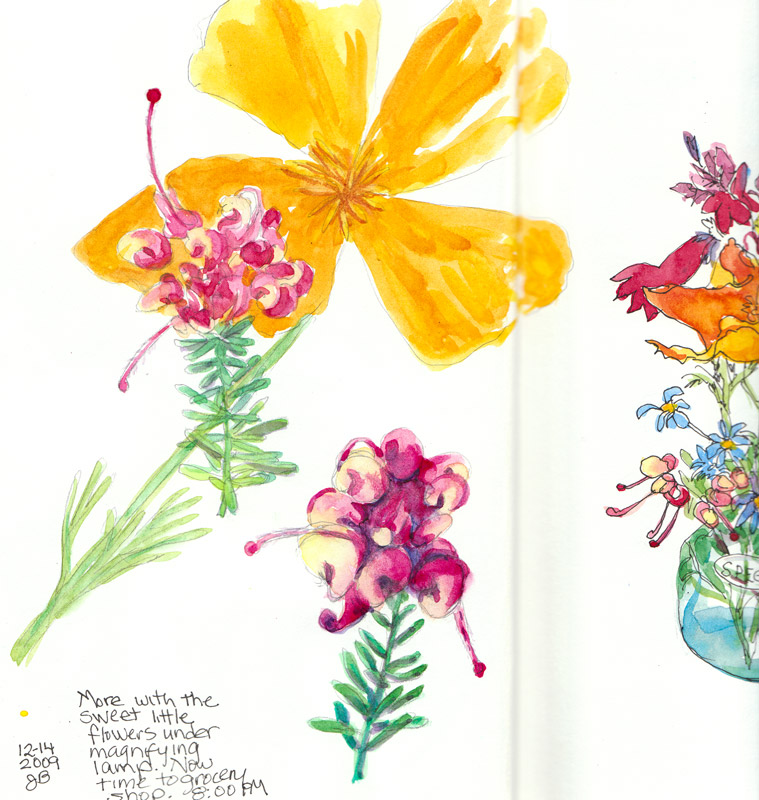
The teensy bouquet was still holding up and the complicated shapes in these flowers intrigued me. So I stuck them under my magnifying lamp and drew them again in sketchbook opposite the bouquet side. The California poppy had opened up and wanted to play too so I stuck him in behind the little flowers after I painted them. It’s fun drawing what’s under the magnifying glass and getting to see all the neat details.
Then it was back to work on the third painting I’ve been asked to do for the book, Must Paint Watercolor Flowers. This time it’s a peach colored begonia with really interesting veiny leaves.
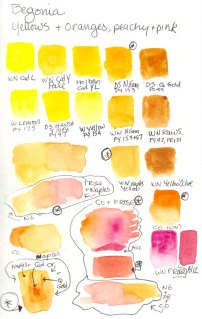
Begonia leaf color tests
My first step was to test colors and try to find the pigments that will mix to the right values, colors and textures. On the tests above I experimented with glazing with different yellows, blues and greens, and tried lifting color for the veins in the leaves to see which worked best for that.
Begonia petal test colors
I found just the right mixture of colors for the petals with a color I’ve rarely ever used because it is more opaque than I usually prefer: Naples Yellow. When mixed with combinations of Cadmium Orange, Permanent rose, and Quinacridone gold, it looks like it will give me perfect petals. But now it’s back to “day job” work for the rest of the week. That will give me time to focus more on how I will approach the painting so once I have brush in hand I’m ready to go.
I don’t always plan things out so carefully, but it can help prevent wasted time and do-overs which becomes more important when I’m also photographing each step and writing about it for the book.
I was surprised to find a variety of colorful teensy flowers growing along the sidewalks on my walk this afternoon in the cool misty weather. It felt so great to be out walking without the icy cold and then pouring rain of the past week and the bright colors were a great bonus.
I felt a little sheepish about picking flowers that didn’t belong to me, but the they were so tiny and since I only took a sprig or two a few inches in length I didn’t think anyone would mind. Some might even have been volunteers (aka weeds?).
When I got home I stuck them in this little glass container some pricey French yogurt had come in (that I bought for the container). Then I got back to working on my website. When I’d finished it was bedtime but I knew these flowers probably wouldn’t last until tomorrow. And I really needed a little fun so I put on a CD and so enjoyed drawing them and painting them.
If you’d like to take a look at my rebuilt website, I’d love your feedback. Although it’s now cleaner and easier to update, I’m disappointed in a couple of features that really bug me. I’ll either get over my perfectionism or sometime later I’ll rebuild it again.
The problem with technology is that by the time you’ve researched the best gizmo, bought it and learned to use it, it’s already obsolete. Aren’t you glad that not everything in life is like that?
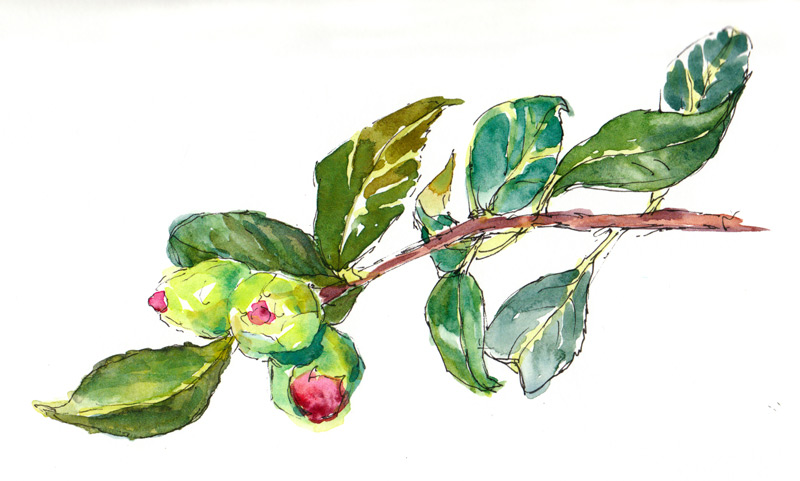
In a momentary memory lapse I wrote “Geranium Getting Going” in large letters in my sketchbook under this image. Then I thought, “Wait a minute, aren’t geraniums those red, ruffled, bitter smelling flowers often found in window boxes or untended and leggy in sad little gardens that someone has given up?”
And then it came back to me, DUH! This is a Camellia, not a Geranium. From a Camellia bush that I planted and that lives right outside my studio door and always blooms in the winter. It’s full of buds now and soon will be blooming madly.
I’ll just blame the memory lapse on the 4 hours of sleep I got last night as a result of working into the wee hours rebuilding my website, which is nearly done. I’m a bit disappointed that after all my work I’m finding some design issues that may be limitations of the platform I chose after much research last summer. I’m even tempted to start over on the system I would have chosen if I knew then what I know now. But this service comp’d me several years of hosting for free (because of all their system screw ups when I first started the build last summer) and I’ve already done so much work that starting over, when I’d rather be painting anyway, seems pointless.
If you would be willing to visit the new site and “beta-test” it a bit before I make it my official webs site, I’d love to have a few extra eyes on it. Just leave me a note if you’re willing to go there and click around a bit. It helps to know whether it looks ok on various computers and monitors or if there are any problems I’ve missed. Thanks!
On Wednesday night I completed the last page in a sketchbook with some writing about the frustrating process I’d been through with the orchid painting. And then, as I did one last sketch of the orchid in the book (below) I realized how I might be able to actually make the painting I’d originally envisioned. It would be one I could do simply and be able to write about as the six-step process the publishers needed.
When I woke up on at 6:00 a.m. on Thanksgiving morning I realized I had to give it another try. The image above is the happy result.
My sketchbook breakthrough
Tonight my watercolor group met for dinner and a chance to share what we’ve been painting this month. When I showed them the two versions of the painting they liked both but Susie said that in the first version they looked like evil man-eating orchids, which is certainly how they felt to me. In the sketch above I thought the orchid looked like it had packed his bags and was running away, suitcases in hand. (Good riddance!)
Here is one of the MANY pages of tests and samples I made in trying to find the right pigment combinations to make this painting work.
Orchid watercolor test page
I decided the pigment that gave me the color I wanted was Winsor Newton’s Quinacridone Magenta but like most quinacridones, it wasn’t very civilized, trying to spread everywhere.
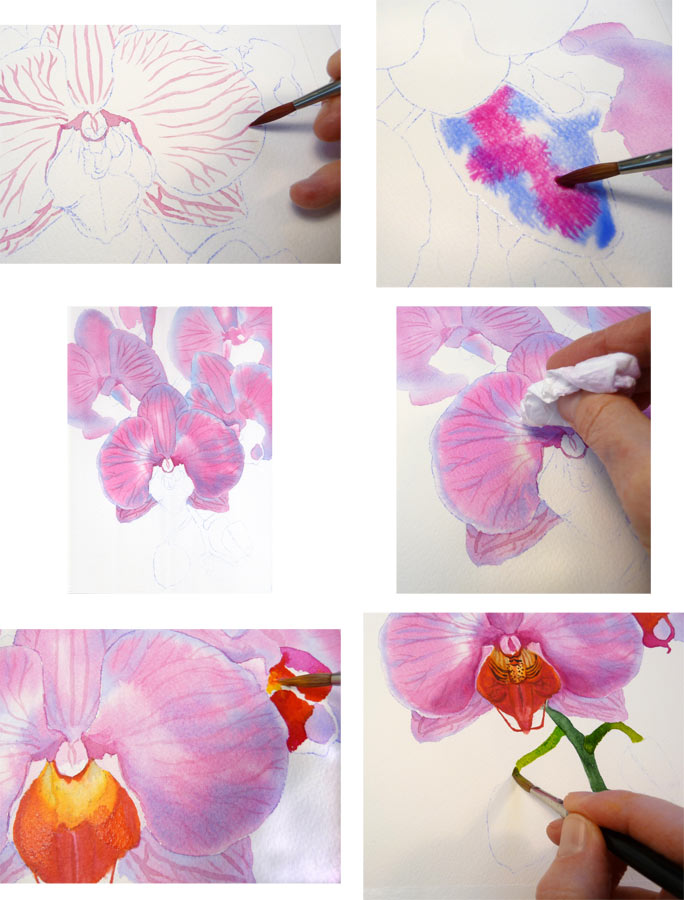
Orchid Painting Steps
What finally worked was painting the veins first on dry paper, wetting a petal, painting cobalt blue just inside the perimeter and then dropping in the Quinacridone Magenta in the center, letting it spread and then blotting up a bit of the paint as needed.
Busby relaxing amidst orchid chaos
At least someone got to relax in the sun. When I left to make a cup of coffee Busby napped amidst the orchid chaos on my desk. You can see the original reference photo peeking out from under him, with a pile of false starts at the painting behind that.
So here’s the frustrating thing: I learned that the publisher wants me to write the text accompanying the step by step photos as instructions (first do this, now do that) rather than a description of what I’ve done. Sometimes watercolors go as planned and that would be simple to do, because what I did is how I would tell someone else to do it. But with this painting there was just as much taking off of paint as there was putting it on. Some of that was about softening edges with a damp brush and then blotting, but some of it was just removing paint that wasn’t working. I’ve never seen a “how to” book that says paint on a nice wash. Now wipe it off.
My biggest problem with this painting was the photo I had to work from. Like many artistic photos of flowers, it was shot without shadows or directional light and therefore everything was very flat with little dimensionality. Even more difficult, everything except the front center flower was intentionally out of focus. That makes for a lovely photo but not an easy watercolor painting project. And there is no variation in color: they’re all just cotton candy pink with dark magenta veins. And I picked the stupid photo and thought it would be easy. But for me, what is easy is lots of detail and variations in color, shape and value.
I started over four times, each time getting a little further and then abandoning ship. If I was just painting for myself any of those starts would have been fine and enjoyable to paint but I was finding myself exaggerating shapes and colors and losing fidelity with the photo.
Now I’m not sure what to do: Paint this again in order to be able to do write a logical “how to” that doesn’t include undoing previous steps? Write a “how to” and leave out the do-overs? Enjoy my vacation this week and forget about the whole project? (the latter sounds most appealing)
I think I’ll send a photo of the painting to my editor and see if she even likes the painting. My persistent (compulsive?) side really wants to paint the painting again, trying to do it more simply and cleanly. But my (sane?) side says “Go have a bowl of ice cream and watch a movie.” I wonder which side will win and how late the ice cream shop is open?
"Sunny Serenade", watercolor, 15.5"x10.5" (click to enlarge)
The editor requested that I name the finished painting (above). Corny painting names are a pet peeve of mine and so I rarely name them. But as I was uploading the image the name “Sunny Serenade” came to me. I know that’s about as sappy a name as you could try to invent, but since it seemed to name itself, so it shall be.
To finish sharing the steps in the painting, here they are in order, continuing from the previous post.
Painting the green leaves, flowers and stems
The next step was to work on all of those leaves, stems, buds and little yellow green flowers. Using a variety of mixed greens, some neutralized with Burnt Sienna, I painted the first layers of the leaves. I also glazed details over the yellow green flowers I’d painted previously.
Adding the darks
I mixed up several puddles of these dark mixtures: Winsor Green, Alizarin Crimson, and Burnt Sienna; Ultramarine Blue and Burnt Sienna; Sap Green and Sepia with a dab of Winsor Red; Winsor Green and Winsor Violet. Then I loaded my brush with one and started painting a section, switching to another one of the puddles as the background colors changed. I was careful to stay within the dark shapes and to negatively paint around lighter shapes. Because watercolor dries lighter, I tried to mix colors that would be dark enough in one layer.
I thought I was finished and signed the painting. The next day I studied the painting with fresh eyes and realized I needed to make some adjustments. I glazed in some more darks on the right of the pitcher and on its handle on the left. I added a middle-dark green mixture to the long leaf that hangs down along the right side of the pitcher and on some other leaves as well. (Compare the pitcher in the top two pictures in this post to see the changes).
While some people have commented that this painting seemed very challenging, in fact an image broken into many small complicated shapes is much easier to paint and more forgiving of “mistakes” than one composed of large simple shapes.
My editor liked the painting and immediately requested the next one, due the end of November. It will be a completely different project: a close up view of some pink orchids with a light background. I will be working much more loosely, mostly wet into wet.
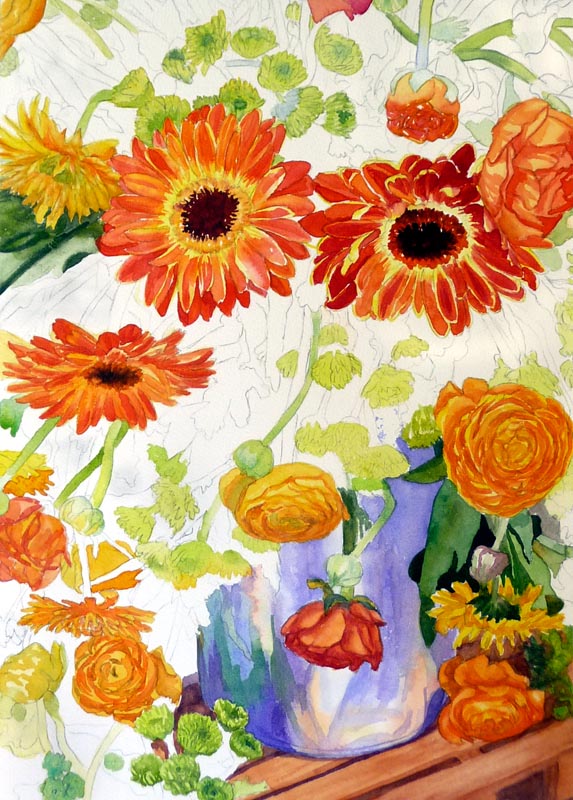
Continuing on from Part I, here is a close up as I began to paint the yellow and orange flowers. For the first layer of this flower I painted the darker sections and then used clear water in a damp brush to pull/feather the color out into the flower so it didn’t make a hard edge.
Yellow underpainting (click to enlarge)
For the three large zinnias, I outlined all the petals with Holbein Cadmium Yellow Light. Then I brushed a ring of clear water around the center of each of those flowers and painted a narrower ring of yellow inside that so the paint would softly spread in the water to not quite the edge of the water, producing a soft edge. When that dried I painted the flower’s very dark center with a mixture of Winsor Newton (WN) Burnt Sienna and Winsor Violet. Then I painted the gold ring between them with WN Cadmium Orange mixed with Daniel Smith (DS) New Gamboge.
Painting one petal at a time
I began applying mixtures of WN Cadmium Orange, WN Permanent Rose and DS New Gamboge to one petal at a time while avoiding painting over the yellow outlines on the petals,. You can see the juicy puddle of color I like to put down. I’m careful to let it dry without shifting the tilt of the paper to avoid backwashes.
Orange flowers completed
I worked all over the paper, turning the painting sideways and upside down instead of reaching across, to complete all of the yellow and orange flowers. Some of them will get touch-ups before the painting is completely finished.
Next time: more greens, the dark background, and the finished painting. Meanwhile, I’ve been assigned the next painting to do: a lovely orchid which I will approach in a completely different manner.
I was given permission to post some of my work on the upcoming book, “Must Paint Watercolor Flowers” (Quarto Publishers, London) for which I’ve been commissioned to paint three floral watercolors. The painting is the easy part; taking the photos, correcting them in Photoshop, and writing about each of the steps takes much more time and isn’t nearly as much as fun. I thought I’d break this into a few posts so they won’t be too long.
My first step after being given my choice from a couple dozen excellent photos (which I’m not permitted to post) was to do some rehearsals in my sketchbook. I used several pages to experiment with how I wanted to approach the metal pitcher, mixing colors for the leaves, the buds and the yellow-green flowers (above). Then I experimented with color mixtures for the orange flowers and the large amount of darks (below — combinations of Winsor Green and Alizarin Crimson, Ultramarine Blue and Burnt Sienna, Sap Green and Sepia, Winsor Green and Winsor Violet).
Rehearsal - Sketchbook p. 2
Next step was to transfer the photo to my watercolor paper. Initially I was going to make the painting small enough to fit on my scanner but decided to use the maximum size the publisher allowed since it was such a complex painting. I chose a 12 x 16″ Arches 140 lb. cold press watercolor block (block is easier to set up for photographing). If I’d been given more time and/or if the photo wasn’t so complex, I probably would have transferred the image by drawing freehand or using a “gridding up” method but with a two-week deadline I used a quicker method.
Transferring the photo to watercolor paper
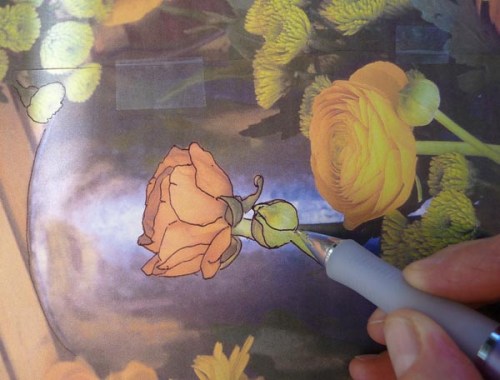
I enlarged the photo in Photoshop and printed it in sections (before figuring out I could have more easily used my copier to do the same) and taped them together. Then I placed a sheet of Saral Transfer Paper on top of my watercolor paper and laid the enlarged print on top of the Saral. Using a ballpoint pen, I traced over the shapes of the flowers, leaves, stems and shadows which transferred graphite lines from the Saral paper onto the watercolor paper.
Cleaning up the drawing
See what I mean about how complicated the image is! I’d left too much of an overlap on the tiled together enlarged photo and some areas didn’t get a good transfer so had to freehand some of the drawing, clean up some lines and darken others. This is my new favorite mechanical pencil, the Papermate PhD Ultra.
Masking near the pitcher
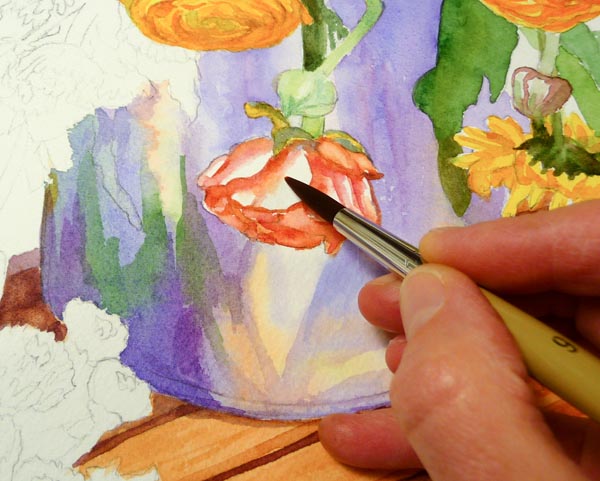
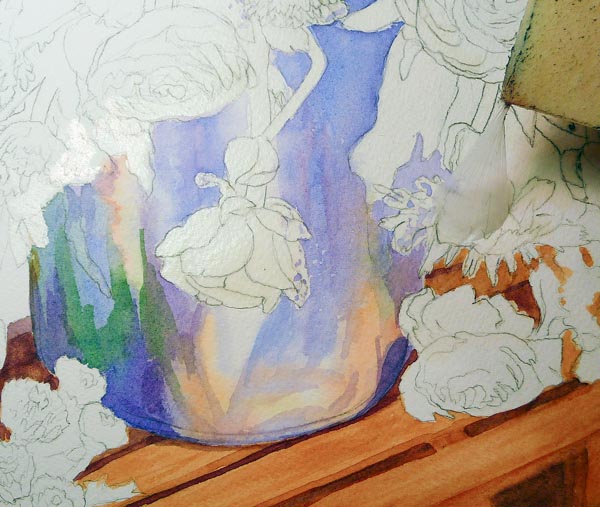
I wanted to paint the pitcher wet-into-wet and so I applied Winsor and Newton Colourless Art Masking Fluid to some of the shapes around and projecting into the pitcher to make it easier to paint wet into wet more freely. I used a cheap disposable brush to avoid messing up my good ones. I prefer Cheap Joes Golden Fleece rounds for watercolor and even though they aren’t expensive, I don’t want to ruin them with masking fluid.
Detail: Pitcher painted, removing masking fluid
I like pulling off the mask with the rubber cement pick up tool. I think it’s made out of the same stuff Vibram shoe soles are made from. The pitcher and the table have had their first washes. Next step is starting on the flowers and that will be in the next post.
Hydrangea in Cow Glass #3, ink and watercolor, 9x6"
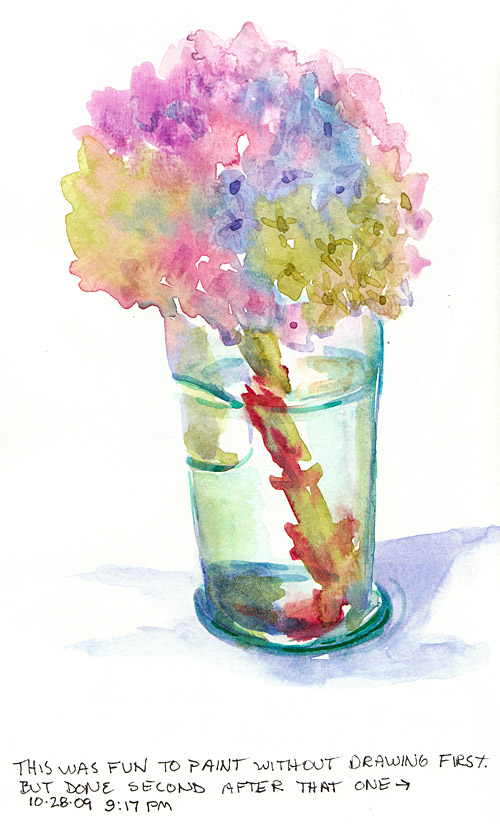
I just needed some peaceful time at my watercolor table tonight to unwind. I’ve been admiring this hydrangea that’s been on my dining table in a little cow glass, the last remaining from a bouquet I’d picked. It’s soft pinks and greens were inspiring so I put on a book on CD and sketched and painted and listened to the story unfold.
Above is the third one, drawn first with a Pitt Artist Pen Sepia Superfine and then painted quickly with watercolor.
Below is the second one, painted directly without drawing first except with my brush and paint.
Hydrangea in Cow Glass #2, watercolor
And here is the first one, drawn first with pencil, then I wet the flower area, dropped in different colors and when dry painted a bit over it. This one got a bit overworked but had some nice moments along the way:
Hydrangea in Cow Glass #1, graphite and watercolor
You can see my notes in my sketchbook about never being able to remember the name of these flowers. I always go through a list of wrong names first and then have to look it up. It’s like the spot on my mental hard drive that once held the name “Hydrangea” has been corrupted and I just can get there anymore. But then I never really learned the name until a few years ago; we always called them “popcorn ball plants” when I was growing up.
I hope the colors look OK. I updated my computer to Windows 7 last night (finishing the final steps this evening) and things look a little different. Windows 7 is fantastic so far and the upgrade process was almost flawless. (Just one glitch with my graphics card driver that got resolved pretty easily.)
It’s been a weird weekend. As the song says, “It never rains in California in the summer” except it did on Saturday morning after a night of thunder and lightening (also rare in the Bay Area). It was supposed to be a plein air painting day but the combination of rain and a headache convinced me to stay home and paint instead.
Then the power went out. It was too dark in the studio to paint without some lights and I needed coffee to try to get rid of the headache so I walked to Peets to sketch there. I used my sepia Copic Multiliner and then did a watercolor wash (mixing a few colors on my mini-watercolor palette to match the ink color.
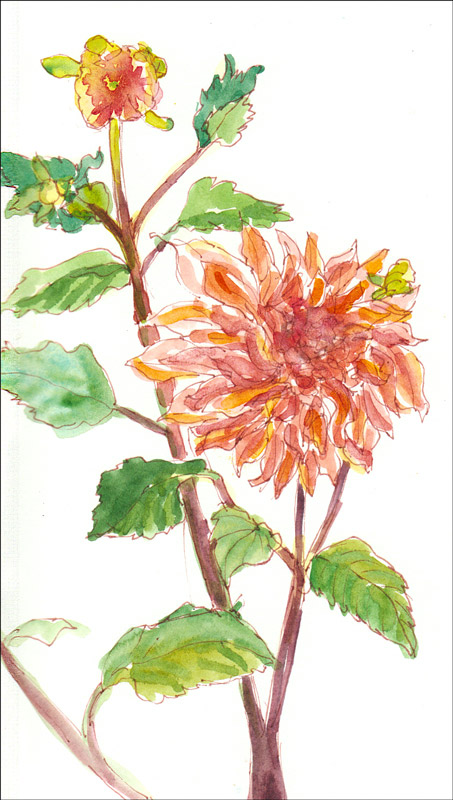
Alejandro's Dahlias, ink & watercolor
When I got home I called the electric company and they said to expect repair or a report by 11:00 p.m. that night so I made plans to go out to dinner and to the movies. I didn’t want to open the fridge so my food would stay cold as long as possible. Then I sat my sketching stool in the driveway next to my neighbor’s flower bed and sketched and painted a couple of his dahlias.
Then I took another long walk with a friend, grabbed a fish burrito and went to see Julie & Julia which I loved! It had been ages since I’d been to the movies and even longer since I’d gone alone. I sat near another woman singleton who had the most infectious laugh and we laughed together throughout the delightful movie.
I appreciated the movie’s nod to the challenges faced by tall women (being one myself). The obsession with eating and cooking rich French food made me curious to know whether Julia Child ever dealt with body image issues or weight problems.I found these quotes from her in an interview in Business Week magazine in 2000:
Q: Could you sum up your feelings about the low-fat food movement? A: I don’t go for that at all…our motto is: “Small helpings. No seconds. No snacking. A little bit of everything, and have a good time.” If you can follow that, it keeps your weight and health in good form. Even if you’re going to have some rich dessert, you can always just have a little spoonful to taste it and keep your spirits up. Then I don’t think you have to go into that miserable, low-fat stuff.
Q: That’s more the French way of eating, I think. Americans always wonder why the French aren’t fat even though they eat rich foods.
A: It’s because the French don’t eat these great big helpings. It’s really horrifying to them to go to Disneyland and see these great big fat Americans plodding along, always eating something. No snacking is very important, I think.
I have a feeling she’s right about the snacking, but I know I find it a lot easier to maintain my weight if I cook and eat simply than if I’m surrounded by delicious, rich food and try to just eat a spoonful to taste it. But then I’d always rather be in the studio than in the kitchen, and am just as happy with a bowl of brown rice, broccoli and tofu than fancy French cooking.
P.S. The electricity came back on the next morning, 24 hours later.
















 Jana Bouc, Artist