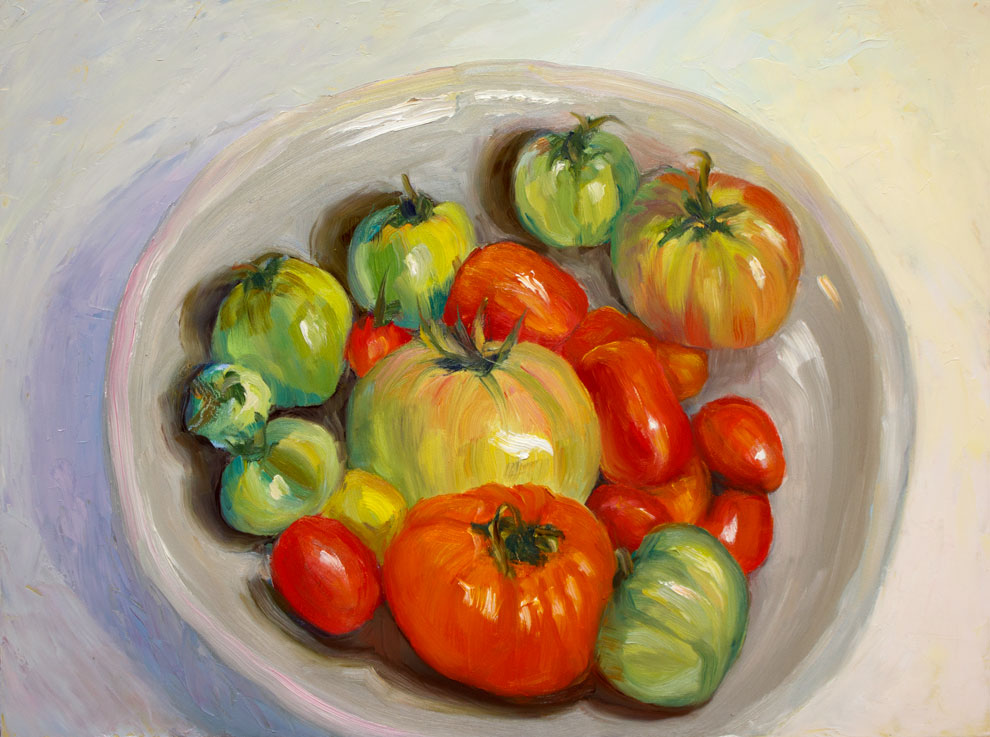
November Tomatoes in Raku Bowl; oil painting on board, 9x12" (click to enlarge)
UPDATE 12-11-10: I revised this painting again and it’s posted here.
At the end of the season we harvest the crops (or in my case, tomatoes). The last green stragglers are picked from their shriveling vines and set near a window to ripen. And that leads me to think about my own ripening as an artist; reflecting on which artistic pursuits have borne fruit, and which are still hard and green despite my best efforts.
After working in a realistic style in watercolor for years I began to explore other media, eventually focusing on oil painting, determined to gain comfort and competence with it. The path felt wide and long because I’m attracted to so many painting styles, from classical realism to impressionism and even expressionistic figurative work.
But as I get closer to competence with oils (while still far from mastery) I’m beginning to narrow the path and here’s why….
Oils vs. Watercolor
I found that trying to paint in oils in the same detailed, realistic style I enjoy so much in watercolor felt like work, not fun. But why, I wondered.
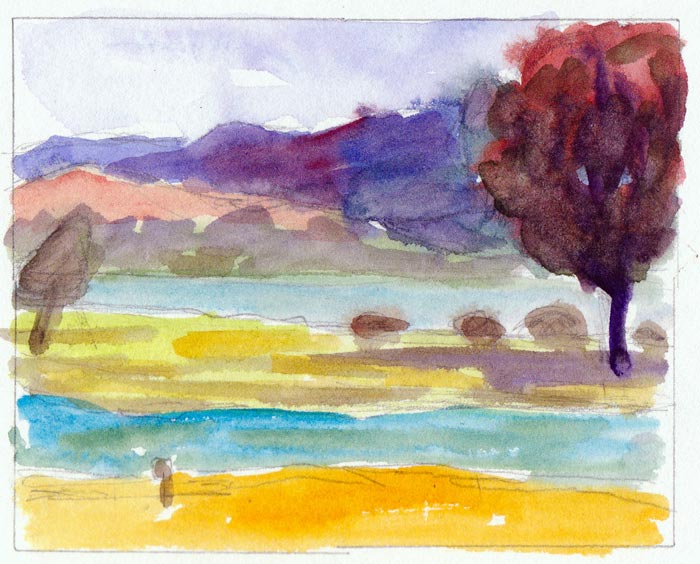
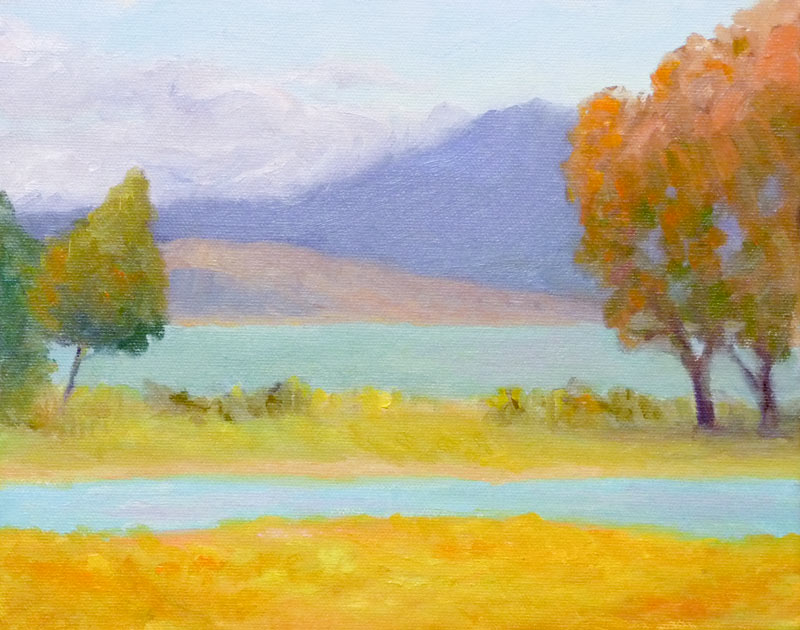
This oil landscape painting started as a poorly drawn, wrongly colored plein air painting which I’ve reworked many times until I am now finally ready to call it done. The painting started on a hot September day when I dragged my painting gear up a trail and set up my easel amidst dried cow pies and weeds near the Bull Valley Staging Area above the hills of Crockett. You can see my learning process below.
First, here is the washed-out reference photo I had to work from back in the studio. It’s really not even an interesting scene and doesn’t at all capture the way the hills were glowing a brilliant end of summer California gold.
Summer Squash & Tired Carrot in bright light, quick study, oil on board, 8x8"
When I was teaching my last session of watercolor classes I saw my students learning so much and was jealous. I realized that I wanted a teacher too! So I began a search for an oil painting mentor to review my work in progress, give me guidance and help me progress.
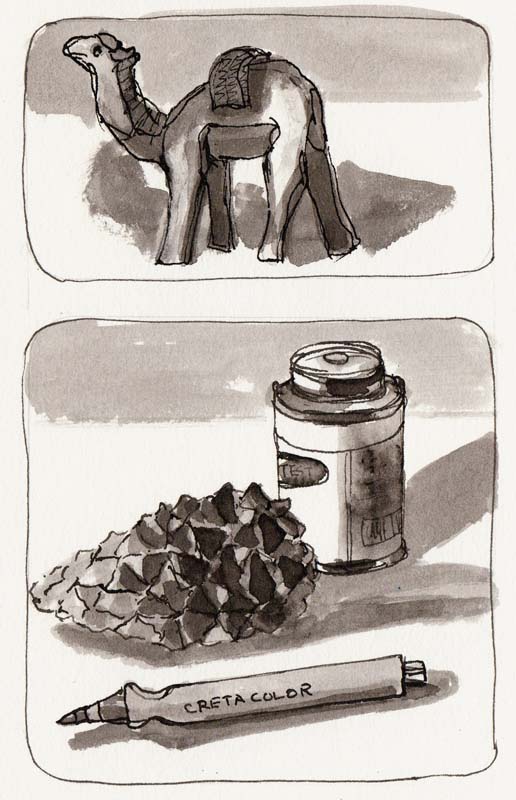
Value study 1, ink washes
First I tried advertising on Craigslist, describing what I needed. But the artists who responded weren’t a good fit. I wanted a mentor whose work excited and inspired me AND who was a good teacher. Then Rebeca Garcia Gonzalez sent me a postcard announcement for her show of portraits of undocumented immigrants and I fell in love with her paintings. I knew she also taught at a local art school so I emailed her my proposal, we met, and she agreed to mentor me.
Value Study 2, ink wash
At our first meeting she reviewed a dozen recent oil paintings and knew right away what I needed to work on. She said that I needed to focus on my values (the range and contrast of light to dark) and I knew she was exactly right.
Value study 3, ink and wash
She asked me to sketch using ink and diluted ink washes and to start paying close attention to values in everything I see, when I’m out walking, or just looking out the window.
Value study 4, ink wash
She suggested I ask myself, “Is this shape darker or lighter than that shape,” noticing the value relationships in everything I see to strengthen that ability. For example, a black object in bright sunlight might look lighter, relatively, than something white that is in shadow.
So much of learning to paint is learning to see, and so much of learning to see involves a kind of “peeling layers of the onion” off of our eyes to see the relationships, shapes, colors, and values in the current light and atmosphere, which can be shockingly different from what we think they are.
When I saw the photo I’d taken of this boy at the Legion of Honor where he was posing for his sister’s Quinceanera party photos, I knew I had to paint him (see my original blog post about that day). He is such a beautiful boy.
When to Stop Painting
Lately I’ve been focusing all of my art time on oil painting, and discovered something that might be of interest to other painters.
One night I’d been painting into the wee hours, trying to “fix” a painting. I’d put on paint, step back, then scrape it off. When I realized I didn’t know why I was doing anything I was doing, I went to bed, frustrated that after hours of painting I’d accomplished very little and in fact, probably just made things worse.
The next day I was driving to a plein air paint-out using my GPS to get me to cross streets near the destination (a little park with no address). Once I passed those cross streets, my GPS began scrolling the words “Driving….driving….driving” on the screen because it no longer had any directions for me—I’d passed the target with no further plan.
That’s when it hit me: When I’m at the point with a painting where I am just driving….driving…driving (or dabbing, scraping, dabbing) I need to STOP.
Without a conscious and specific intention (make this area cooler, warmer, darker, lighter, bigger, smaller, sharper, softer, etc.) and an overall goal, it’s just like trying to reach a general idea of a destination by driving mindlessly and randomly, hoping I’ll get there. Not too likely.
My work in the book: How to Paint Watercolor Flowers
A year ago the English publisher Quarto commissioned me to do a series of paintings for a book (working title) “Must Paint Watercolor Flowers” and at last it arrived in the mail! Now named How to Paint Watercolor Flowers: Create Your Own Masterpiece in 6 Easy Steps, it features my paintings and those of 15 other artists, along with step-by-step instructions showing how we made our paintings.
The book has 160 pages and at 11″x 9.5″ is much bigger than their “Watercolor Artist’s Bible” in which I also had several paintings. It is laid out with a beautiful 8×10 photo of the flower subject on the left side and photo-illustrated step-by-step instructions for creating the finished watercolor beside it. Hard-cover spiral binding allows the book to lay open flat for artists who wish to try the techniques while painting from the photos.
I loved seeing the beautiful work of the other artists and the many ways they approached the wide variety of subjects and techniques. The flower photos are superb, with permission granted to use them for your own paintings. The book also has excellent sections on watercolor technique, color, value, and photographing your own flowers for painting.
I haven’t read all the step-by-steps, but I’m guessing that like me, few of the artists actually created their work in just the six steps that we were limited to when writing up and photographing our work. Instead the editor highlights the key techniques that were especially important to each particular painting.
Disclaimer: I have no financial investment in the book; I was paid per painting for the publisher’s right to print my work, but receive no royalties or other benefit from sales of the book itself from the publisher or via Amazon links.
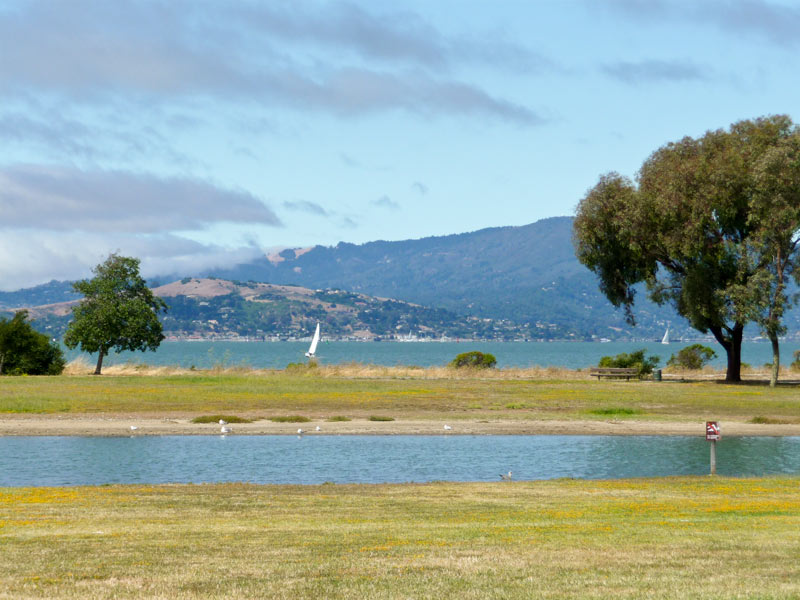
When I arrived at Miller/Knox Regional Shoreline the sky was gray and cloudy but even in the fog the park had so many great views: a salt water lagoon, Mt. Tamalpais across the bay, a fishing pier, an abandoned ferry landing, beautiful trees, and across the road, a railroad museum and a squat yellow building that houses a motorcycle club.
Miller Knox thumbnail
I finally picked a spot and got started with the above thumbnail sketch. I set my ViewCatcher to 8×10 and looked through its “window” to choose the composition. Then I put the ViewCatcher on my sketchbook and traced around the inside of the window to outline a box in my journal of the same proportion. By the time I was ready to add watercolor to the thumbnail sketch most of the fog had lifted except over the hills, and the sun was shining.
After 2-hour plein air session, oil on panel
Above is how the painting looked when I brought it home. The composition needed work: the picture is evenly divided in half with 2 trees on left, 2 trees on right and an empty center. The lagoon and bay should have been different colors. Too bad I’d ignored my thumbnail once I started painting because it had a much better composition.
I tried to continue the painting from a photo but the photo didn’t match my memory of the colors and light, even after Photoshopping it (below). But it did at least offer some clues for fixing the composition, like adding the sailboats (duh!).
Miller/Knox Regional Shoreline photo
Maybe I should add in the little “No Swimming” sign (only putting it on the left side as I did in my thumbnail). What do you think?
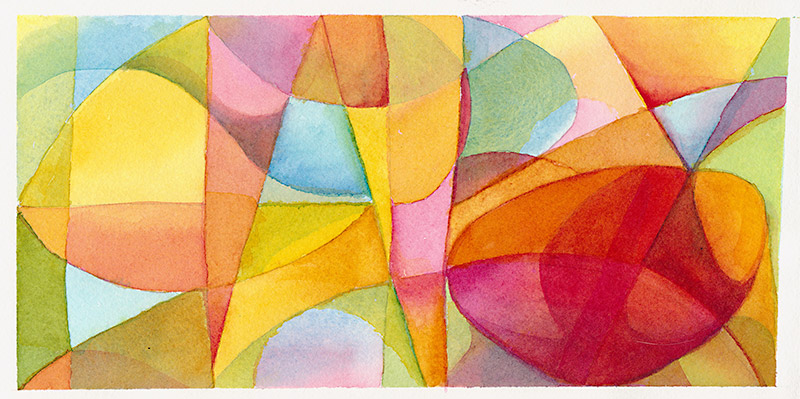
My Sunday morning watercolor class focused on glazing this week. Glazing is applying a transparent layer of paint over painted or unpainted areas. Like a piece of colored glass, a glaze won’t hide what’s below it but will change the way it appears.
I used the study above to demonstrate glazing with gradations. To make the design I printed the word “HAPPY” in big capital letters and then playfully added more pencil lines between and around letters to make more shapes.
Then I glazed each shape individually, adding more glazed layers in various areas until it felt done. I used only transparent primary colors, so that they combined to create secondary colors. You can also use glazing to make colors appear brighter, duller, darker, warmer, cooler or in shadow or to unify an entire painting or a section of it.
Parrot painting strategy sheet, converted to journal entry use
A student who takes individual classes asked for help with painting birds so I used the journal spread above to demonstrate doing a pre-painting strategy session. I tried out various techniques and pigments as I thought about how I might paint the parrot whose photo we downloaded from Morguefile.com (where you are allowed to “copy, distribute, transmit and adapt” the copyright-free photos). Doing this bit of preparation and note-taking really helps to avoid some (but certainly not all) mistakes and corrections during the painting process. LATER I used the spread to write a journal entry (which I’ve blurred here for privacy), right over the feather and color experiments.
I still have these “cheat sheets” for many of my paintings. Recently I came across the one for Cheerios with Strawberries and saw that I’d used a wash of cobalt violet light (a favorite color but very expensive) to make the milk look just like the non-fat that I’d had in that bowl of cereal.
Flat and gradated wash demo
I loved the colors so much on this demo for flat and gradated washes from the previous week that I hung it on my wall as if it was a finished painting (my own mini Rothko).
Watercolor Class Registration
My next 4-week class session begins Sunday August 8. You can register and get more information on my website here. It looks like this session will fill so be sure to sign up soon if you want to join in. I am also planning a new “independent studies” class for people wanting to paint with ongoing coaching. If you’re interested, send me a note to get on the list.
…keep drawing! After feeling so rusty sketching at the county fair I was determined to get my drawing juju back. I knew the only way to find it was to draw more.
I tried sketching at the El Cerrito 4th of July festival (see below) but was all thumbs again. Since I couldn’t make a decent sketch myself, I bought a really nice one at the festival’s art show from my friend Ikuko who had a booth there.
I decided to try again on the walk home. The Hillside Garden Apartments (at top of post) is an ongoing renovation project and labor of love by the owner to convert an old rundown motel into beautifully landscaped apartments. He and the apartment manager were driving by and saw me standing on the corner sketching. They parked and came to see what I doing and we had a nice neighborly chat with much mutual admiration.
Can't Draw; Ink, watercolor, colored pencil (click to enlarge)
Back home I continued drawing. I was happy with this sketch of a rose from my garden (below) but lost focus and overworked the watercolor. So the next day I played around with adding gouache, not worrying about getting the colors “right” since the rose had completely changed anyway.
Love the (Artist) You're With; Ink, gouache & watercolor
Then I wrote myself a little pep talk around the rose, concluding that even if my drawing wasn’t all I wanted it to be, I could at least stop being so self-critical and, to re-phrase the old Crosby, Stills & Nash song: “If you can’t (yet) be the artist you love, then love the one you’re with!”
Study for Kaiser Garden II, watercolor, 6.5" x 4.5"
There are still openings in my watercolor class starting Sunday, June 27; click here for all the information. Ok, business done, now on to the painting above, another study from photos I took at the Kaiser garden.
I learned the hard way to do a study first, after time and again putting hours, days or weeks into a painting that was doomed from the start.
No matter how skillful the painting technique is, if the composition is bad (the viewer’s eye goes to a bright corner and then right off the painting), or you’re trying to work from a photo that doesn’t have enough information, or your colors or values are uninteresting, the painting isn’t likely to succeed. Sketching exactly what you see is great fun, but sometimes nature requires editing to make it a painting.
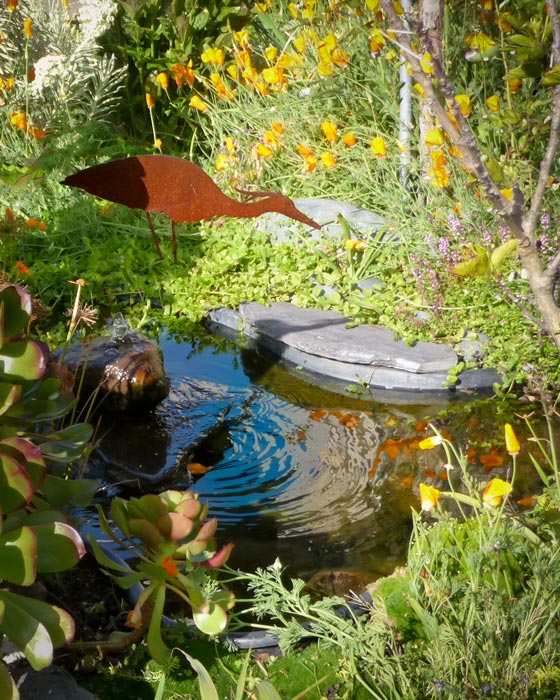
What made me want to paint this scene was the water feature and the bird sculpture but when I looked at my photo I saw big problems with the composition:
Original photo, Kaiser garden
There is way too much going on, the two big succulent plants on the bottom left dominate, a big stem above them leads the eye out of the frame, and the composition seems divided right down the middle, vertically. You barely notice the water.
So I spent some time in Photoshop cropping, rearranging and revising things:
Revised Photo Reference, Kaiser Garden II
Before cropping off the left side, I cut out the bird, moved it to the right, tilted it and gave it legs. Then I darkened the remaining succulents on the left and bottom to use them as a frame for the water feature instead of competing with it. When I started sketching the composition in my journal I decided to get rid of the messy tree branches poking in from the right too.
Although Photoshop is great for preparing a photo reference, so are the scissors, glue, sketches and notes that I used pre-Photoshop. Along with learning Photoshop, I’m also trying to become a better photographer and compose more carefully. I can do that with my digital SLR because it has a viewfinder but my carry-everywhere little Panasonic doesn’t. In the bright sun it was impossible to see anything on the LCD screen, so I guess I’m lucky that I got something I could work from at all.
My notes for the painting are in my journal opposite the study, with reminders about colors and things that worked (or didn’t). I’ve transferred the drawing to the canvas and it’s just waiting for its turn at the easel. I have a feeling it’s really meant to be a watercolor, not an acrylic painting, so may do it both ways.
Kaiser Hospital Tulip painting study, watercolor, 4.5" x 6.5"
I accidentally arrived an hour early for a doctor’s appointment at one of Kaiser Oakland’s medical offices that has an amazing hidden garden. The building is an architectural treasure, built around a courtyard in 1912 by Julia Morgan as a hospital and home for unwed mothers (or so I’ve been told). Instead of reading old, germy magazines, I spent the hour in the courtyard sketching, wandering and taking photos.
After working out the composition and colors, I’ve got two paintings ready to start: a full-size watercolor sheet of the above image and a slightly smaller canvas of another garden scene.
Before starting a large painting I like to do a study first, getting to know the image more intimately, and experimenting with pigments and techniques so when I start the real painting I have a plan of action or at least a sense of direction.
Tulip study and notes for painting, journal spread
Since I only recently began experimenting with opaque watercolor pigments after years of using only transparents, I made some discoveries with this study and took notes as I worked. Here are a couple that might be of interest:
Opaque pigments (Cadmiums, Cerulean, Yellow Ochre) are great when putting down an area of strong color and leaving it (such as when painting in my journal). But they lift too easily when adding layers over them, and become thick and unattractive when trying to mix darks. As I learned in oil painting, darks/shadows are best when thin so they don’t draw attention to themselves with texture. Seems to be the case in watercolor as well: better to use staining, transparent darks that won’t lift or get thick. For the dark green areas in the painting I’ll use Sap Green with Sepia and vary with a bit of Indigo, Winsor Violet and/or Alizarin.
The Legion/Utrecht 100% rag watercolor paper I’m using in my journal lifts incredibly easily. This is great when you actually want to lift paint but not so good when you just want to soften an edge and a bunch of paint lifts off instead!
Here are the original reference photo and the Photoshopped version. As you can see I got rid of some distractions and changed the proportions a bit.
Original reference photo of tulip in gardenPhotoshopped tulip reference photo
Photoshop CS5 has some great new composition tools, such as “Content-Aware Fill” which I used to fill in the windows, white at top right corner and a tulip on the right margin. You just select and delete sections you want to replace and PS fills them with information from the surrounding area. I also narrowed the image to fit the proportions of the 22×30 watercolor paper using Content-Aware Scaling which preserves the proportions of the important stuff while squeezing in (or stretching) the other stuff.








 Jana Bouc, Artist