Categories
Oil Painting Painting Still Life

Trying and Failing to Do 1-Hour Studies

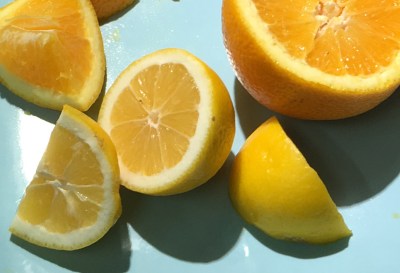
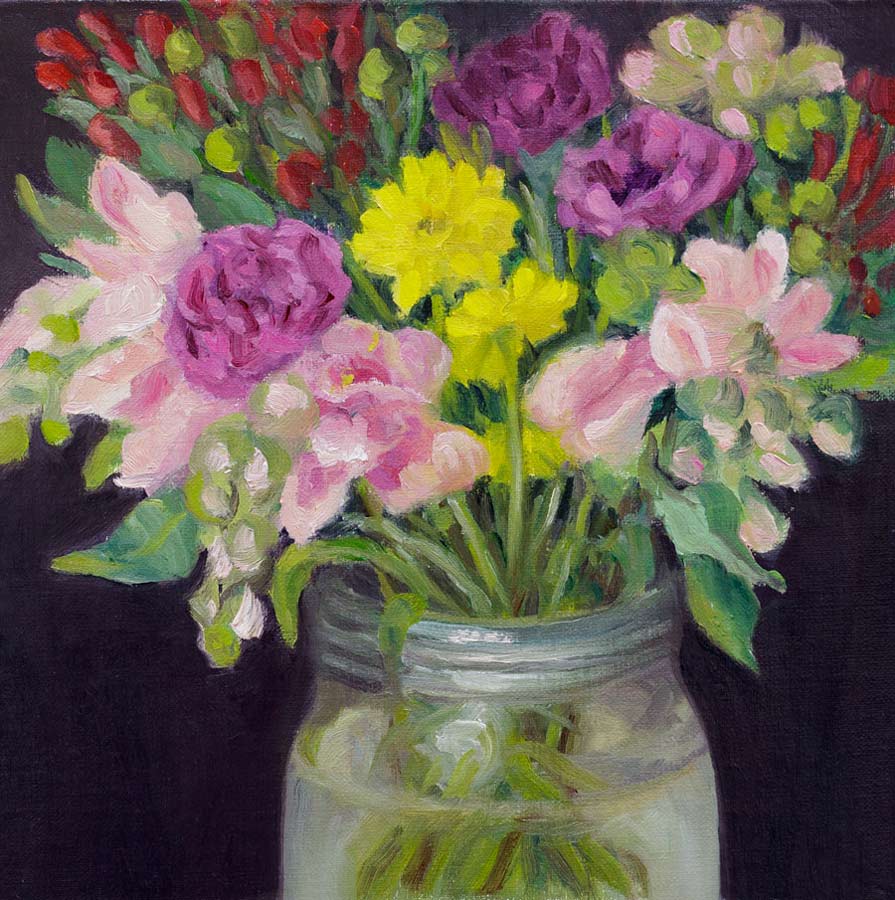
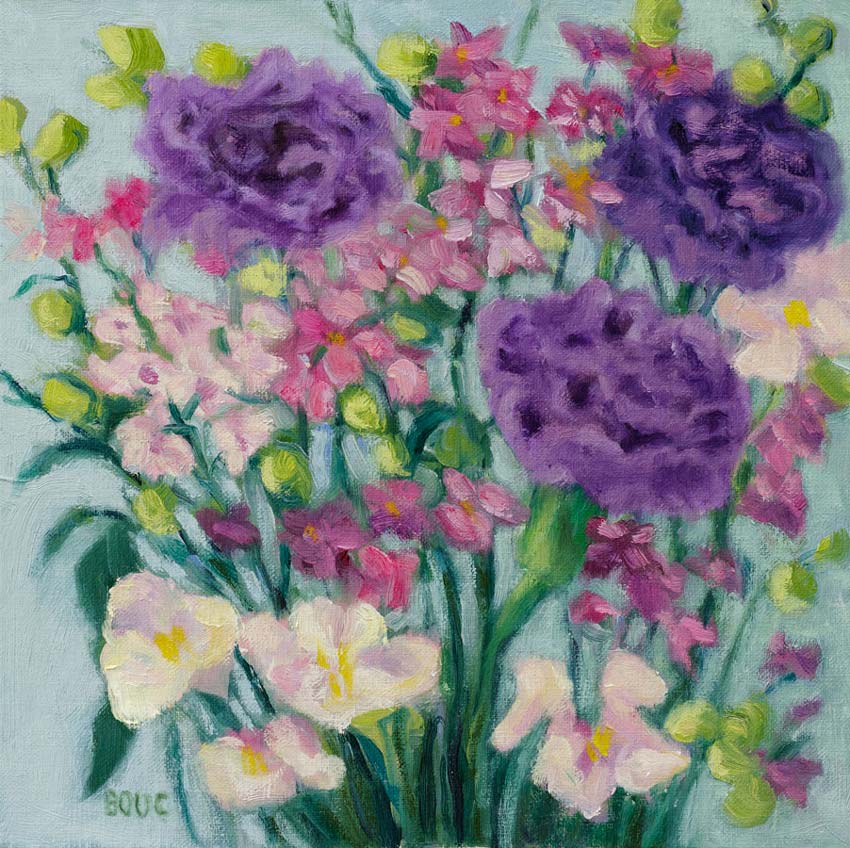
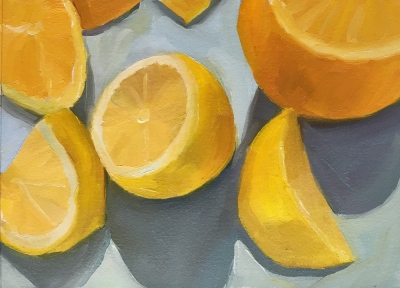
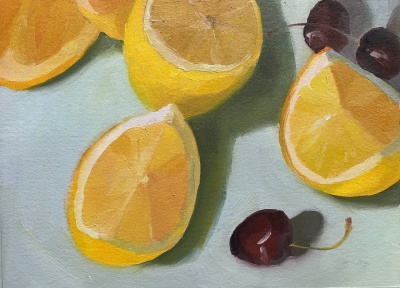
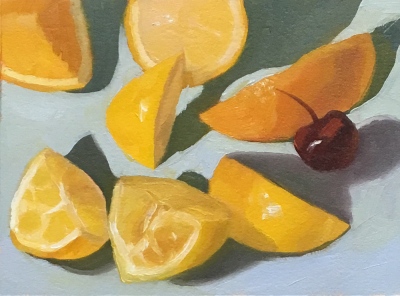
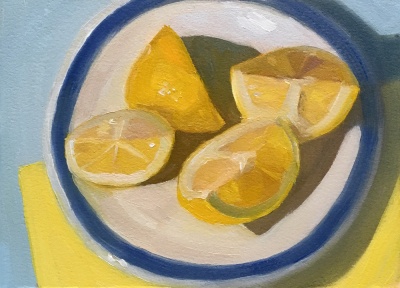
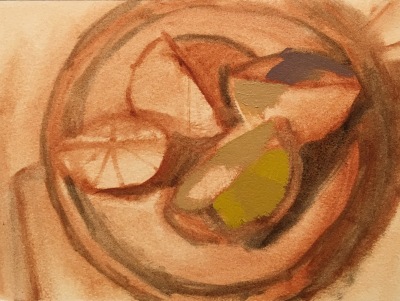
I’ve given myself the gift of working with artist and painting mentor Sarah Sedwick to spur my growth as an artist, learn new techniques, improve skills and get help from an expert who can spot problems that may be hindering me and that I can’t see myself. We’ve been working on value and color mixing with limited palettes, and after an awful bout of reworking a painting to death she challenged me to do three one-hour paintings. Unfortunately I seem to be constitutionally incapable of doing 1-hour studies, although I haven’t given up trying. My 4 studies above are all 7×5 inches on Arches Oil Paper. Below are the work in progress photos including a photo of the still-life set-ups (though these were all done from life) and in some cases, the color palettes used. You can click on any image to see the set enlarged.
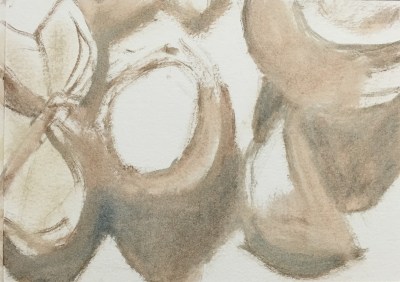
Despite my intention each time to do a one-hour study, I painted three-hour (or more) studies. I worked quickly enough to leave them looking unfinished to me, but slowly enough to lose the freshness and conviction of the original brushstrokes. As Sarah explained, the goal wasn’t to learn to paint fast but rather to loosen up and get out of the rut of perfectionism, to get bold and concise with brushstrokes. She said, “The point of timed paintings is to set a constraint so we can be more free in other ways, not create more struggle. We aren’t attempting to create finished masterpieces in one hour, here – it’s a challenge to yourself to see how much you can do, how freely, how efficiently. Setting a time limit frees you to experiment – to slap on some thick paint in an area and go with it – to not stress as much about the drawing and composition – you can fix any issues in the NEXT painting.”

Part of my problem with these attempts I think, was setting up too complicated of a subject. When I get back to the studio today I’m going to use a simpler subject. And will force myself to stop at one hour no matter what. If I sketch in the composition too quickly it’s inaccurate and I spend my painting time correcting my drawing mistakes. By the time I’ve done a preliminary sketch and/or a careful sketch on the canvas, blocked in the shapes and values with a quick burnt sienna wash/underpainting, the hour is up. I can easily spend another half hour pre-mixing my paint.

Then when I start painting I get interested in all the cool light effects and details I see and want to capture. I forget my plan to go with 3 values per subject, simple planes and shapes, big brushstrokes and instead soar off into the groove of seeing and painting, seeing and painting until I look at the clock and suddenly it’s 8:00 pm and I haven’t had dinner or midnight…and I long ago turned off the timer and have lost it again!

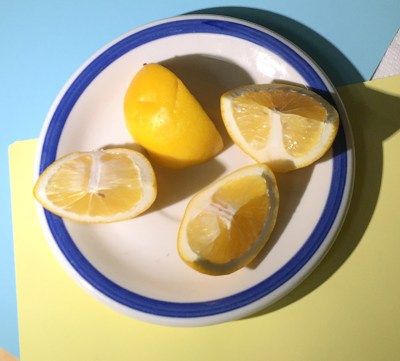
I painted the 4th still life below with a limited 4-color palette (White plus Cad yellow pale, Cadmium Red Medium, Ultramarine blue) but in the end I added in a bit of Cad yellow medium and Phthalo blue) because I just couldn’t get the colors I wanted for the lemons and blue background.
But I am determined, and today I will succeed! I am an optimist, for sure, since that’s what I always say when I go to the studio, but I will obey my timer and see what I can accomplish in one-hour one more time.

Categories
Art theory Faces Oil Painting Painting People Portrait

Revised Post: Color Boot Camp Monochrome Studies

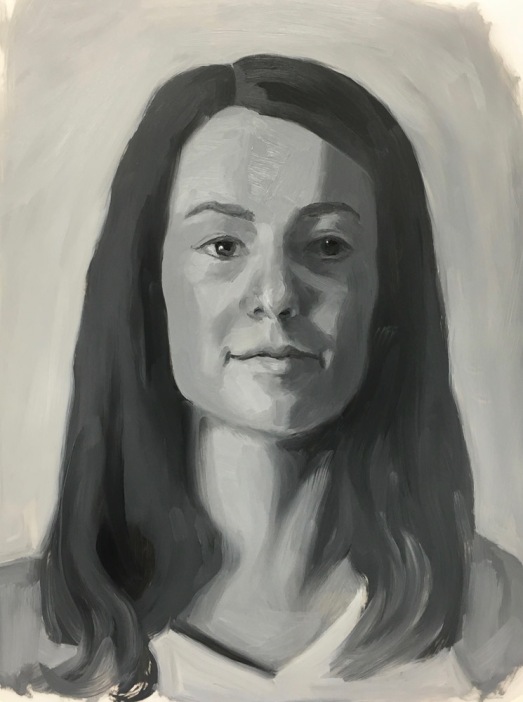
Color Boot Camp Part I Monochrome. Left to right: Color reference photos, B&W converted ref photo, my two studies

When my art friend Chris Beaven commented on the previous version of this post that it would be interesting to see my studies compared to the black and white versions of the photo references, I did a virtual dope slap (Of course! What a perfect way to see if I got the values right!) and then decided to redo this blog post to show that comparison (above).

While I often convert color photos to black and white to see the values, when I did these studies from Bill Perkins’ Color Boot Camp on New Masters Academy I wanted to try to do the conversion in my artist brain instead of using technology. But putting my studies next to the converted photos gives me just the reality check I needed. I can see that I did pretty well in painting the values from the color photos.

In the lesson he set up one model in four different lighting situations and then demonstrated doing a 30-minute painting of each in black and white. He recommends doing the studies in no more than 30 minutes, emphasizing that it’s more important to do many starts, without worrying about getting a likeness or making finished paintings. I have to admit spending longer than 30 minutes, probably up to 3 hours on some, and in retrospect, the longer I worked the less effective the study was.

If you want to see Bill Perkin’s studies and mine in greater detail, click the “read more” link below.

Categories
Art theory Faces Oil Painting Painting People Portrait

Color Boot Camp, Part I: Monochrome Portrait Value Studies

CBC Part 1-3, Janas #1 High Key, High Contrast Painting
CBC Part 1-3, Janas #1 High Key, High Contrast Study (My favorite of 8 below)

Being a member of the New Masters Academy is like having a treasure chest of jewels to explore, with new art classes added all the time. The only downside is that I have to assess my own work and be my own teacher since NMA doesn’t offer feedback to the video lessons’ assignments.

I revised this post by publishing a new version of it so I’ve deleted the content here. Please see the next post for the rest of the content from this post.

Categories
Figure Drawing

Sketching a Posing Pirate: Figure Drawing Tips

Pirate, Cutlass and Whiskey, Conte pencil on black paper
Pirate, Cutlass and Whiskey, Conte pencil on black paper, approx. 20×18 inches

After posing nude for a couple of hours, our wonderful male model dressed in a pirate costume, complete with plastic sword,  with sea shanty and pirate songs playing on the stereo. He was such a delight, with a warm smile and a white beard ending in a long, skinny braid. I used four Conté Pencils in white, black, sepia and sanguine on black pastel paper for this long pose (90 minutes).

I’m finding more ease with life drawing lately as I apply the techniques I’ve been taught over the years but that hadn’t “clicked” until now. Finally I’m willing to do a little measuring of lines, shapes and angles instead of “just going for it,” which is fun, but always wonky (not that my drawing isn’t still wonky, even when I do my best to measure—but I’ve also learned that “wonky” is what gives work our own style and I like my wonky.)

Three resources that have helped me learn to draw better:

  1. The book Sketching – from Square One … to Trafalgar Square that explains better than I can, techniques to improve your drawing.
  2. Sadie Valeri’s excellent student handout that I got when I took a workshop at her studio, which she has generously given me permission to share with you: sadie-valeri_draw_block-in_08-2013-2 (PDF Download).
  3. Sadie Valeri’s free video demonstration of how to do a “Straight Line Block In.” All of her videos are excellent, free or paid. She is one of the most generous and clear teachers that I’ve studied with. She is brilliant at lifting the veil between the subject, your eyes and your brain so that you can see what’s really there and draw it.

Here are the ways I practiced some of these techniques in this drawing:

  • first determined whether the subject is wider or narrower using a skinny stick (e.g. a bamboo skewer or knitting needle) held at arm’s length to compare both directions so I know whether to place the drawing and the paper in portrait (tall) or landscape (wide) orientation.
  • marked where I want the top and bottom of the drawing on the paper (to avoid decapitation or leg/foot amputations).
  • measured the size of the model’s head with the skewer, marking the size on the stick with my thumb and then moving down his body, measuring how many heads fit from his chin to the lowest part of his body (e.g bottom of foot). In this case there were 5 heads.
  • divided the space between the top and bottom marks on the paper into 5 equal sections, using the sepia pencil so it wouldn’t show much.
  • noted where on the models body each of those “head” divisions were (e.g. chin bottom, right knee top, left knee top, right foot bottom, left foot) and indicated that on the paper. I also noted how many “heads” wide the subject was at the widest part and marked that.
  • sketched the head in its section.
  • held up the skewer along the angles from the top of the head out to the sides to find the shape of the imaginary “envelope” that the pirate’s body would fit into and drew those lines lightly on the paper (see Sadie’s handout).
  • broke that envelope down into smaller and more exact shapes, looking for negative space shapes and angles to help find the shapes that made up his body parts.
  • continued doing the same, ending with the feet, which I didn’t quite finish as time ran out.
  • drew the whiskey bottle (which was actually empty) during model breaks.

The model asked to take a photo of my drawing at the end of class. That was a first…and a great payoff to practicing the tools!

Categories
Art supplies Art theory Drawing Faces Gouache People Product Review Sketchbook Pages

Painting with Gouache: Color Charts, Zorn Palette, Brush Tests

Zorn Palette color chart in gouache, 10x8 inches in A4 Moleskine
Zorn Palette color chart in gouache, 10×8 inches in A4 Moleskine

In trying to learn more about gouache I made a few color charts. I’m using mostly M. Graham gouache which I like much better than the Winsor & Newton and Schmincke I used before. The Graham gouache is creamy and brilliant, rewets well and doesn’t smell (like the W&N). I found that using fresh-squeezed gouache is more fun to work with than rewetting dried paint, but frugality keeps me trying to reuse dried. The best solution is to set up a palette for each session, squeezing out tiny blobs, adding more as needed.

Above is an exploration of the Zorn palette in gouache, a limited palette using only Yellow Ochre, Cadmium Red, White, and Black. The black paint, when mixed with white, is meant to serve as blue since it is a cool color that can look blue next to warm colors. Next I want to try using it in an actual painting.

M. Graham Gouache paint chart, gouache in A4 Moleskine, 10x4 inches
M. Graham Gouache paint chart, gouache in A4 Moleskine, 10×4 inches

Above is a chart of my gouache colors straight from the tube and mixed with white and each other. Sadly when I removed the masking tape it pulled off some of the paper from the extra large Moleskine watercolor notebook that is my current journal. I don’t recall previous Moleskine WC notebooks having that problem but I’ve switched to low-tack tape now.

Before ordering any new brushes specifically for gouache I wanted to see how the brushes I already had might work so did the test below. I found a few that I liked and ordered a couple of others. I’ll do another post about my gouache palette and brushes I’ve settled on soon.

Old brushes-testing for gouache
Categories
Art theory Flower Art Oil Painting Painting Still Life

Two Sunflower Survivors with Process Chart

Two Survivors, oil painting of sunflowers and white vase on linen panel, 7x5 in
Two Survivors, oil painting on linen panel, 7×5 in

Persistence, patience, perseverance, determination, curiosity, courage, confidence, wonder…these are all qualities needed to become a better painter. Another essential is learning to really see and understand the subject. I titled this painting (available hereTwo Survivors because only these two survived from the big bouquet during the week I struggled with two previous sunflower “studies” (aka failed paintings). Sometimes it takes a while before the “blinders” fall away so that I can see the shapes, colors, and values instead of the named bits (e.g. petal, leaf, or nose) that interfere with seeing as a painter.

I was inspired by artist Chris Beaven (whose sunflower painting I purchased and love) by his Session Detail charts that he embeds at the end of each post (sample). I modified his chart to create one for myself to focus my goals and intentions for each session and the painting as a whole. Completing  the chart at the end of each painting session with image, results and plans/goals for the next session is making a big difference in my process and helps me avoid random, unfocused messing about with paint.

Below is the chart I used for this painting. If you’d like to see all three session charts for this painting with my notes about goals, composition mistakes and corrections, and corresponding images, click here to open 3-page PDF file.

Session 1 Detail Chart (Click image to enlarge or click PDF link above to see all 3 sessions)

I loved the original painting of the vase in Session 1 above, with wonderful warm highlights and cool shadows created by the new LED lightbulb I’m experimenting with. My intuition told me to leave the vase alone but instead I started adding the pattern from the actual vase. After a few strokes I realized I didn’t like it and tried to wipe the pattern off the still wet paint. Then I tried to return to the original shapes of color, temperature and value.

I revised the chart layout after this painting. In my next post (another sunflower still life) I’ll include the completed chart for that painting’s 6 sessions and a blank template for anyone who wants to experiment using or modifying it for their own artwork sessions.

Categories
Art theory Oil Painting Painting Portrait

Frankie Flathead Finally Painted (Planes of the Head Grisaille Study)

Frankie Flathead Planes of the Head Study, oil on canvas panel, 11x14"
Planes of the Head, Grisaille study, oil on canvas panel, 11×14″

When I bought a “Planes of the Head” life-sized plaster cast two years ago I wanted to learn more about portrait painting. I put it on display in the studio and studied it. I knew I should be drawing and painting from the cast, but hoped learning would happen by osmosis since it didn’t really inspire me as a painting subject.

Planes of the Head Plaster Cast

Then I got curious about grisaille techniques after seeing beautiful paintings that began with that approach. I watched the excellent video “How to Paint: The Grisaille Method” by Jon deMartin (in which he paints from a cast of Julius Caeser) and decided to try grisaille using homely Frankie Flathead, my Planes of the Head cast, as my model. See bottom of post for a clip of the deMartin video.

Planes of the Head Open Grisaille
Open Grisaille in which Frankie resembles a demented old perv

I was going to display all my steps along the way, but my photos weren’t good enough. Above is the first stage, the “open” grisaille, which means it’s painted thinly, using only transparent washes of grey (or in this case, burnt umber) and wiping paint off to achieve the lighter values. At the top of the post is the “closed” grisaille, made by mixing and applying a range of values opaquely, using white and the same burnt umber on top of the original “open” grisaille.

One of the most powerful things I discovered in the video is the way light changes across planes.

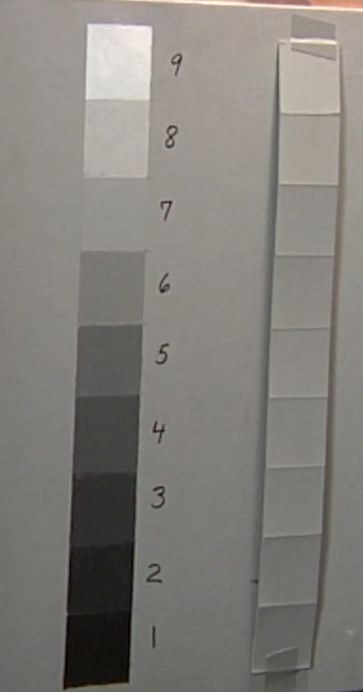
Gray scale and strip painted 50% gray
9-step Value Scale (white to black) on left and strip painted Value 4 Gray on right (screenshot from video)
Same Value 5 gray strip curved to show the range of values as it turns from light
Same Value as image to the left but the Value 4 Gray strip is curved to show the range of values as it turns away from light (screenshot from video)

When bent so planes are at different angles to the light, the gray strip on the right seems to have all the values in the 9-step value strip on the left. Isn’t this a powerful demonstration of the effects of light and shadow?

My first attempt at grisaille was  interesting. I made many mistakes and got lots of good practice.

My finished painting isn’t great, but doing the study helped prepare me for the next lesson I gave myself (and that I enjoyed more and will post soon): starting with a grisaille to set the value structure in a still life and then adding the color in the same values.

Below is a clip from the video. I was very curious about how grisaille works so it was worth the $35 to download the three-hour program, also available here to watch online and DVD.
http://youtu.be/JPar_nzAEL0

(Disclaimer: I have no connection to or receive no benefit from writing about these products)

Categories
Art theory Flower Art Oil Painting Painting Still Life

One Bouquet, 2 Paintings: Generalizing vs. Specifics in Drawing and Painting

Mothers' Day Bouquet #1, oil on linen panel, 8x8"
Birthday Bouquet #1, oil on linen panel, 8×8″

My three wonderful next-door neighbor children bring me flowers every year for my birthday. This year the bouquet lasted so long I got to make two paintings from it. They come to my door, hand me the flowers and then each one shyly gives me a hug and says “Happy birthday.” I love that they’re still doing it at 10, 13 and 16.

When they were little they would come to the studio and make brilliant expressive paintings. Then school got the better of them and they started drawing the archetypical house under a rainbow with 2 windows, a door and smoke coming out of a chimney).

Mothers' Day Bouquet#2, oil on linen panel, 8x8"
Birthday Bouquet #2, oil on linen panel, 8×8″

When I try to work too fast or am tired, I start generalizing, which rarely turns out well, whether in painting or drawing. It’s too easy to do like my neighbor kids and just make a generic house or bunch of flowers rather than these specific ones. I enjoy the process and the results much more when I go for accuracy in drawing, color and value.

Some people are great at simplifying and whipping out gorgeous, impressionistic art. But for me, it’s the individual personality of my subject that interest me; the specifics that make it that particular rose, place or person.

That was the discovery I made when painting these, so they are two more “almost” paintings (see previous post). Each one is just a stepping stone on the long and joyful path that is painting. (And some paintings really are better suited to use as stepping stones in the garden than hanging on the wall!)

Categories
Ink and watercolor wash Interiors Life in general People at Work Sketchbook Pages Urban Sketchers

What I Learned About Art and Life in 2011

Pastime Hardware After Dark, ink & watercolor, 5x7"

Before I get to my reflections on art and life in 2011, a word or two about the sketch above (and below) from our evening at the hardware store. I stood and sketched between the paint solvent and cleaning product aisles (both stinky), using an aisle-end shelf for my paints.

Same Pastime sketch before adding the dark in the windows

When we finished and shared our work, I realized that in the original sketch above, I ignored the fact that it was dark outside. So when I got home I painted all the windows dark. I’m not sure which I like better. What do you think?

Accomplishments and Things Learned in 2011

STUDIO

  • Converted a 440 square foot garage into my new studio including a patio door onto a deck off the studio, insulation, sheet rock, flooring, electrical, and water. Once I have everything moved in I’ll post the story with pictures.

PUBLICATIONS:

ART-LIFE

  • After a brief (and briefly successful) venture into painting things to sell, returned to following my whims and inspiration instead of worrying about making work that would sell. This led to the series of 16×20 portraits of people at work in my community, now well underway.
  • Learned from Rose Frantzen video (see clip here) to say “Oops, made a mistake…but that’s ok I can fix it!” instead of “Now I ruined it!” followed by self-critical name calling. It’s downright liberating!
  • Realized that while I value and enjoy many different artists’ styles and techniques, I’ll never be as good as them at painting like them so I’m focusing on painting like me instead, which I can get good at.
  • Learned to ask myself, “What do I want to do with art today,” and doing that, not what some imaginary critic or the illusion of an audience is demanding that I should be doing.
  • I heard Robert Genn say that one’s style is often the thing one doesn’t do right, that it’s your mistakes or the rules you break that make it yours. I’m learning to relish and appreciate my wonkiness. Perfect is boring.
  • When someone plays piano and finishes a tune, there’s nothing left, just quiet. Why not paint that way too, focused on the line, the brush stroke…enjoy the process and let go of the product.

TECHNIQUE AND MATERIALS

  • Abandoned water-soluble oils and acrylics for regular oils after learning from my friend Kathryn Law how to reduce the use of toxic chemicals and still get the consistency I like.
  • Started watercolor sketching instead of oil painting at plein air paintouts to quickly capture a scene and keep moving instead of standing in one spot for hours while the light changes completely.
  • Tried a bunch of different pens, from expensive Namiki Falcon fountain pen that I didn’t love (sold it) and inexpensive uni-ball Vision Roller Ball, but returned to my favorite, Lamy Safari Extra Fine Point Fountain Pen with Carbon Platinum ink. Both hold up well on the watercolor paper I use in my journals.

STUDY/WORKSHOPS:

  • Registered for a week-long Alla Prima Portraiture class with Rose Frantzen at Scottsdale Artists School in February 2012. (So excited!!!) It is way out of my comfort zone (and budget) but I adore her work  and her book, Portrait of Maquoketa and she is a fabulous teacher.
  • Took a 3-day workshop with Peggi Kroll-Roberts in her studio after studying her series of CDs. Learned how to mix/use juicy luscious paint and more. She said I needed to work on my drawing.
  • Studying the Loomis books Drawing the Head and Hands and Figure Drawing for All It’s Worth to improve my people-drawing skills. Unlike a painting of a pear which can succeed even if the drawing is a bit off, a portrait will fail. It may still be an interesting painting, just not of the person you’re painting.
SKETCHING AND BOOKBINDING

  • Continued to sketch nearly every Tuesday night with my Urban Sketchers group and regularly sketch my world. As a group we have committed to a sketch a day in January.
  • Finally mastered binding journals using the method in my directions and can create a journal in a few hours instead of days.
  • To mix things up I switched to a Moleskine when I finished the last journal and am already missing my handmade sketchbooks with their really nice multimedia paper.

ART BUSINESS/SALES

  • Made the decision to wait until I leave my day job in a year to put effort into art biz/marketing and just concentrate on painting until then.
  • Sold a number of paintings early in the year on DailyPaintWorks.  Recently sold a sketch of Der Wienerschnitzel for their corporate collection.

BLOGGING

  • Found balance by prioritizing making art and living life above blogging about it.
  • Celebrated my six-year blogging anniversary with 180,000 views in 2011 (982,746 total); 141 new posts (total 1,004) and 418 pictures uploaded in 2011.
  • Posted regularly and administered the Urban Sketchers S.F. Bay Area blog.
  • Regularly follow about 30-50 other art blogs.
Categories
Animals Art theory Drawing Ink and watercolor wash Oil Painting Painting Places Sketchbook Pages

Backyard Llama and Great Drawing Tool: Accurasee Review

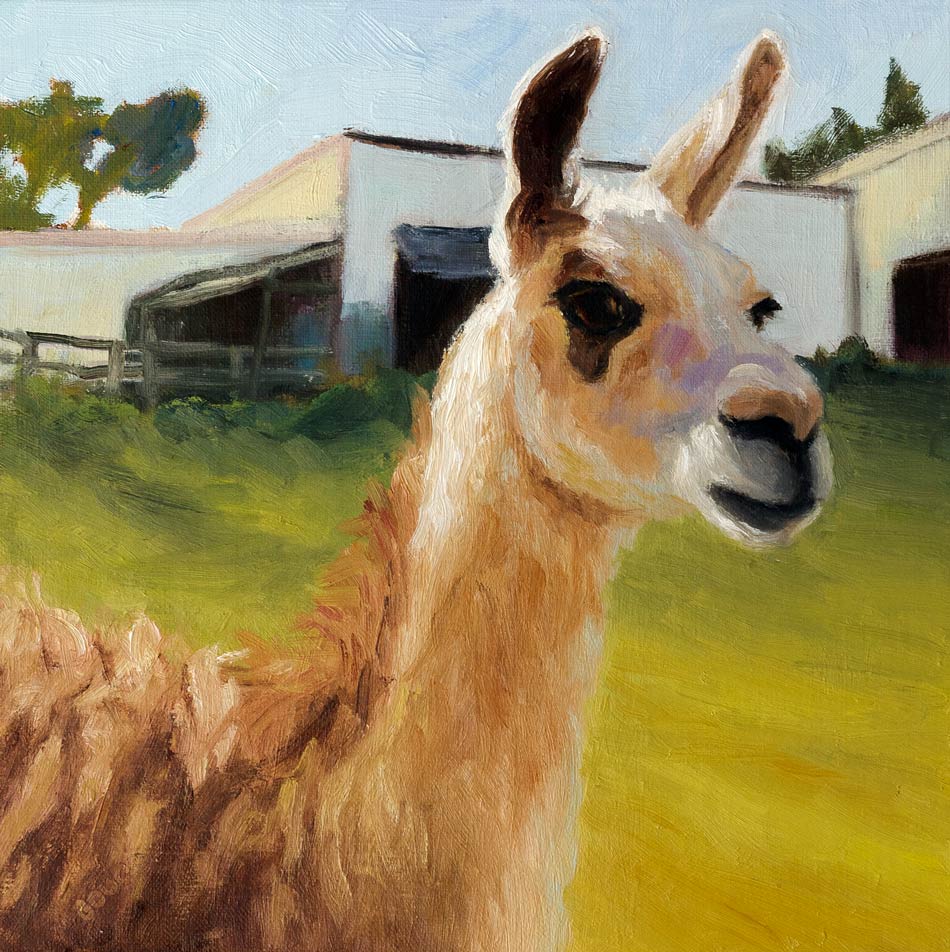
Backyard Lama, oil on panel, 8x8"

When I spotted llamas in a residential neighborhood backyard near the beach in Pacifica I took a few photos of them for painting later. In the process of this painting I experimented with a terrific new drawing tool, Accurasee, and put this llama through its paces.

I started with this watercolor sketch in my journal:

Backyard Lama, ink & watercolor, 5x5"

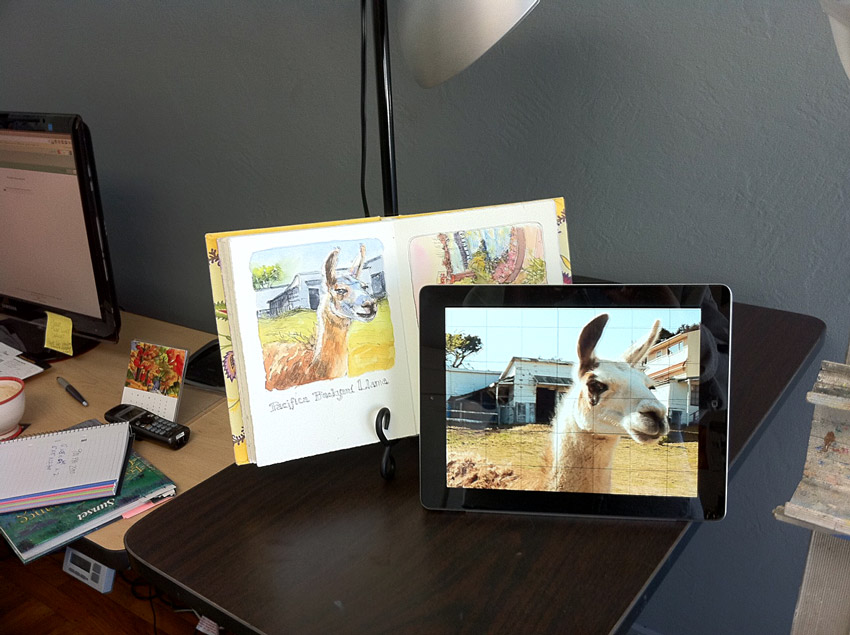
While sketching I edited out the apartment building in the photo and got some understanding of the subject. Then I put the sketch and my iPad displaying the photo on the table by my easel so that I could refer to both as I painted.

Blocking in the values

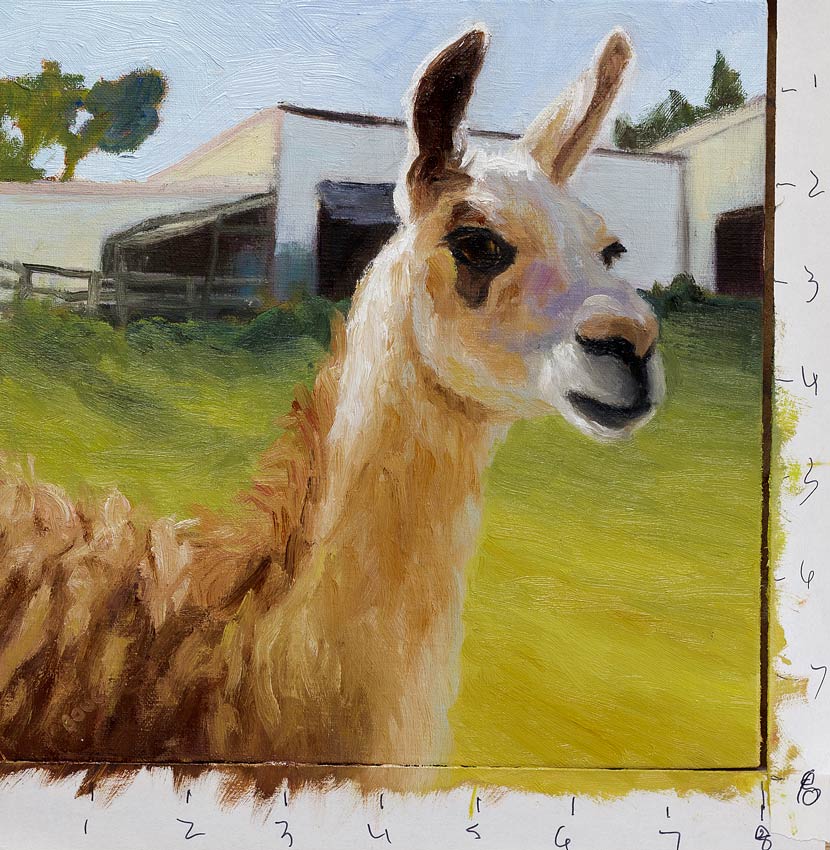
First I sketched in the llama on the panel (above) with thinned paint (hoping it was fairly accurate) and blocked in where I wanted the darks and lights in the painting.

Lama attempt #1, but drawing wrong
Llama attempt #1, but drawing wrong

I thought I was nearly finished (above) but after a break from it, realized that the drawing was wrong: the face looked more like a dog than a llama and the neck was too short.

Then I discovered Accurasee, a free computer program for Macs and PCs (plus an iPhone app) that helps you be more accurate in your drawing or painting by using an innovative approach to the “grid drawing” method as a way to help you see. Accurasee adds a grid to a photo or scan of your drawing and you create a matching grid on or beside your painting. Then you use the grid coordinates to find the landmarks, height and width of objects in the composition.

You can read more about the history of gridding up here and see how much easier it is using Accurassee in these demos or read their user guide (pdf). (Disclaimer: I have no financial interest in promoting this product or this company, but I think it’s great!)

Photo after gridding in Accurasee

Accurasee offers a collection of clever drawing tools, including special measuring tape but I made my own using masking tape and marked off the inches:

Tape with inches marked to match Accurasee
Llama Attempt #2 Redrawn: Tape marked to match Accurasee grid

By mentally visualizing where the intersection of the lines would be, I redrew a little more accurately (though still not quite right). As they say on their website:

The ultimate goal is not to create a “dot-to-dot” drawing, but a proportionally accurate one. The Accurasee Method and tools are designed to be used as drawing aids, not a crutch. When used correctly, the Accurasee Method can quite literally train you to see more accurately.

Lama attempt #3, almost there
Llama attempt #3, almost there

When comparing the painting to my watercolor concept I saw the ground was too dark so lightened and brightened it, worked some more on the face and neck and all around.

Eventually I just got tired of the whole production and decided that I’d learned everything I was going to learn from this painting, had nothing more to say, and called it done.

UPDATE: Julie asked how I was using the iPad vs my computer monitor and how I had it setup. Here is a picture:

sketchbook and iPad set up by easel
Sketchbook and iPad set up by easel (plus messy desk and computer monitor)

I have in the past used my computer monitor to paint from but the iPad is handier because I can have it right next to the easel or on my drawing table and with two fingers I can enlarge (as in the above photo) or move the section I’m viewing or go back to seeing the full picture. I use the iPad Smart Cover which when folded back works well as a stand.