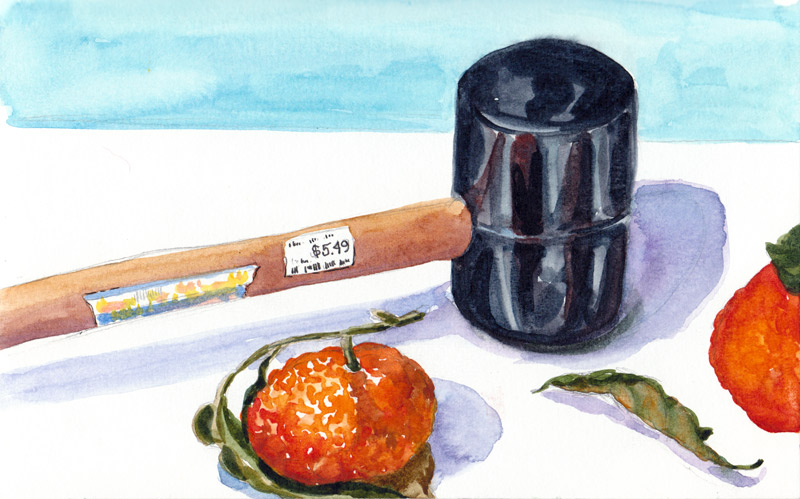
After a lifetime of not even knowing rubber mallets existed outside of cartoons, twice in the past year while working on projects I read directions to “tap with a rubber mallet.” I thought to myself, “Who has a rubber mallet? Not me.” And then used a regular hammer which didn’t work out too well to put it mildly.
So when I was shopping for bookbinding supplies at my local Dick Blick art store and I saw a rubber mallet sitting on a nearby shelf for only $5.95 I couldn’t resist. It was just so funny looking. I have no idea why they were selling it at Blick’s and what artists would be using it for, or how it could sell for less than a toilet plunger at the hardware store.
So I found a good use for it in the studio—as a still life subject—and it fits right in, don’t you think? Tangerines, rubber mallets, why not? Maybe my next still life will be of smashed fruit and a juicy mallet. But that will have to wait for a sunny day. No way I’m smashing fruit in the studio. It’s messy enough as it is.
Meanwhile I thought I’d check out what rubber mallets are really for and I found this on About.com‘s Home Renovation tools page:
“Admittedly, the rubber mallet is not the first thing on your tool list. But once you have a rubber mallet, you begin to discover many uses. Here are some common uses:
For ceramic tile, it helps gently tap tile into place.
Laminate flooring: great for this brittle material.
Tap carpeting onto tacking strips.
A “sounding device” if you need to hear what is behind a wall or in a pipe.
PVC pipe work.
Two tight-fitting sections of drywall.”
I can’t help picturing cartoon versions of each of these uses, especially with me behind the mallet accidentally tapping something into smithereens. And how funny is it that my blog’s spell checker thinks “smithereens” is spelled correctly but that the word “blog’s” is not.
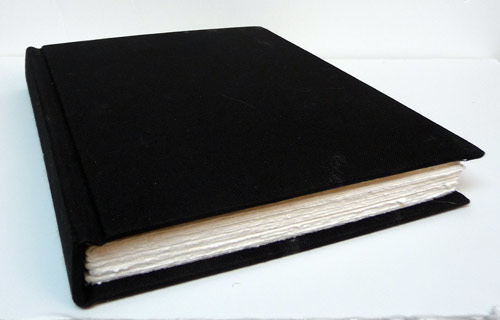
The most important thing I learned in binding my first hardbound sketchbook journal is that the process is very forgiving and not rocket science. In fact, despite making every possible mistake along the way, it still turned out as a quite usable little mutt of a book.
Inside the Mutt
I took notes as I worked: reminders what NOT to do next time, which parts to skip, what really matters and what doesn’t. And now, using the medical school approach for teaching surgery (“See one, do one, teach one”) I’ll share what I’ve learned. Fortunately this isn’t brain surgery, since I’ve literally only seen one and done one.
UPDATE: I have refined the process described below; the most up-to-date version is always available as a download on the Resources page here. You may also find my more recent bookbinding posts by selecting “Bookbinding” from the Categories pull down menu on the right. Now, to continue on with the original post…
Side view
I will simply refer you to the resources I used and try to serve as a sort of docent on the journey through the process. If you are an experienced bookbinder PLEASE share any suggestions, advice or corrections and I will update this post with them.
Open, not perfect, but ready to play
I’ve divided the post here to hide the details since it’s long…
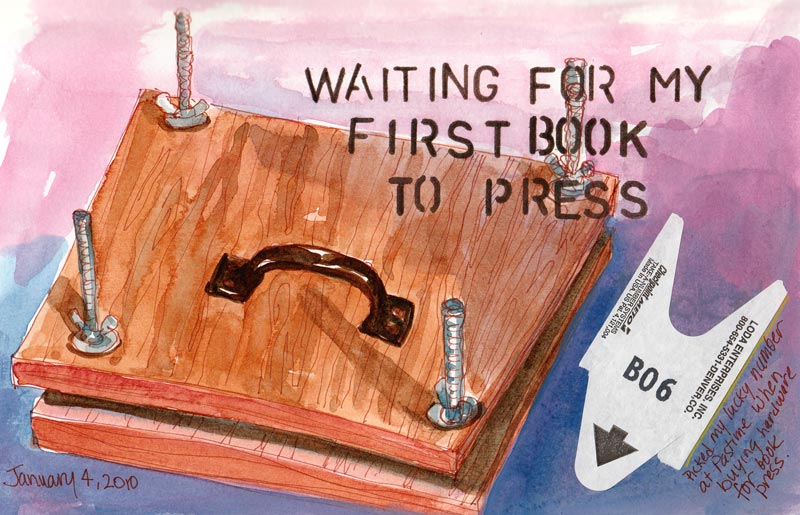
Home-made book press, ink, watercolor, gouache, stencil, hardware store ticket
I made a book press as part of the process of learning to bind my own sketchbook. This of course required a trip to the wonderful Pastime Hardware store. I was so excited that the ticket I pulled from the little red take-a-number thingee for the helpful hardware guy (or in this case gal) had both my initial and my birth month/”lucky” number on it so I saved it for posterity in my sketchbook. (I put quotes around “lucky” since the number has never actually been lucky for anything but I call it my lucky number anyway.)
Just like any project that requires tools, measuring, fractions, or spatial relations, building this simple press was not easy for me. First I had to saw the wood. I didn’t want to have to go to Home Depot (ick) to get someone to do it for me I had a piece of fake oak shelving I’d bought but hadn’t used.
So I used my funky little hand saw (that I bought when I became a home owner and thought I should have a basic set of tools in a toolbox “just in case”) to cut the shelf in half into two one0-foot square pieces. It took forever and my cut was wobbly, uneven and made a mess of the veneer.
Then I measured in from each corner one inch and drilled holes, guessing how big they should be. Unfortunately, since my cut wasn’t even, the holes didn’t line up right and they were too small. So when I assembled all the pieces the boards were all tilty and got stuck. I finally got it all apart again and redrilled the holes larger. This solved the problem and the press worked fine.
Like every step in the bookbinding process, I learned something valuable along the way. In this case I learned I should have clamped the two boards together and just drilled right through both of them to make the holes line up.
In my next post I’ll offer some resources for do-it-yourself bookbinding including the tips I learned from my mistakes.
On Wednesday night I completed the last page in a sketchbook with some writing about the frustrating process I’d been through with the orchid painting. And then, as I did one last sketch of the orchid in the book (below) I realized how I might be able to actually make the painting I’d originally envisioned. It would be one I could do simply and be able to write about as the six-step process the publishers needed.
When I woke up on at 6:00 a.m. on Thanksgiving morning I realized I had to give it another try. The image above is the happy result.
My sketchbook breakthrough
Tonight my watercolor group met for dinner and a chance to share what we’ve been painting this month. When I showed them the two versions of the painting they liked both but Susie said that in the first version they looked like evil man-eating orchids, which is certainly how they felt to me. In the sketch above I thought the orchid looked like it had packed his bags and was running away, suitcases in hand. (Good riddance!)
Here is one of the MANY pages of tests and samples I made in trying to find the right pigment combinations to make this painting work.
Orchid watercolor test page
I decided the pigment that gave me the color I wanted was Winsor Newton’s Quinacridone Magenta but like most quinacridones, it wasn’t very civilized, trying to spread everywhere.
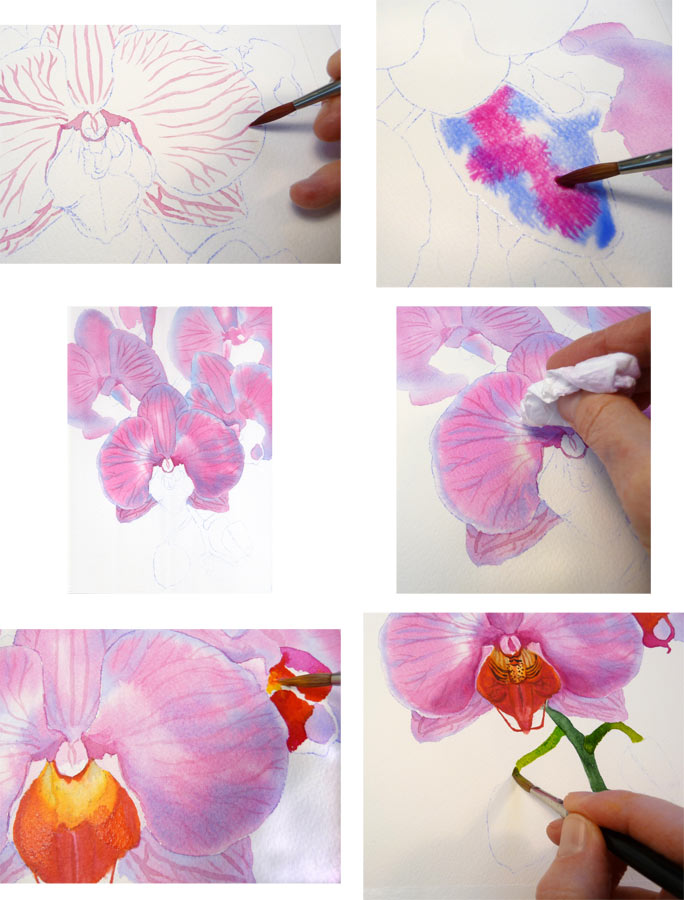
Orchid Painting Steps
What finally worked was painting the veins first on dry paper, wetting a petal, painting cobalt blue just inside the perimeter and then dropping in the Quinacridone Magenta in the center, letting it spread and then blotting up a bit of the paint as needed.
Busby relaxing amidst orchid chaos
At least someone got to relax in the sun. When I left to make a cup of coffee Busby napped amidst the orchid chaos on my desk. You can see the original reference photo peeking out from under him, with a pile of false starts at the painting behind that.
I was given permission to post some of my work on the upcoming book, “Must Paint Watercolor Flowers” (Quarto Publishers, London) for which I’ve been commissioned to paint three floral watercolors. The painting is the easy part; taking the photos, correcting them in Photoshop, and writing about each of the steps takes much more time and isn’t nearly as much as fun. I thought I’d break this into a few posts so they won’t be too long.
My first step after being given my choice from a couple dozen excellent photos (which I’m not permitted to post) was to do some rehearsals in my sketchbook. I used several pages to experiment with how I wanted to approach the metal pitcher, mixing colors for the leaves, the buds and the yellow-green flowers (above). Then I experimented with color mixtures for the orange flowers and the large amount of darks (below — combinations of Winsor Green and Alizarin Crimson, Ultramarine Blue and Burnt Sienna, Sap Green and Sepia, Winsor Green and Winsor Violet).
Rehearsal - Sketchbook p. 2
Next step was to transfer the photo to my watercolor paper. Initially I was going to make the painting small enough to fit on my scanner but decided to use the maximum size the publisher allowed since it was such a complex painting. I chose a 12 x 16″ Arches 140 lb. cold press watercolor block (block is easier to set up for photographing). If I’d been given more time and/or if the photo wasn’t so complex, I probably would have transferred the image by drawing freehand or using a “gridding up” method but with a two-week deadline I used a quicker method.
Transferring the photo to watercolor paper
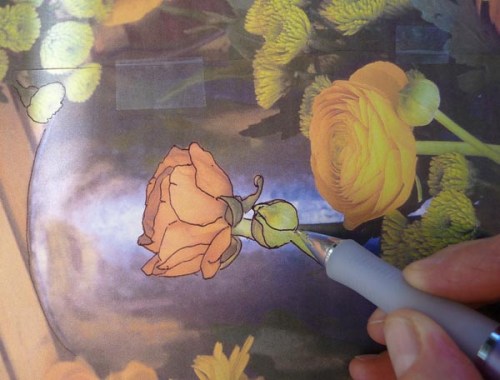
I enlarged the photo in Photoshop and printed it in sections (before figuring out I could have more easily used my copier to do the same) and taped them together. Then I placed a sheet of Saral Transfer Paper on top of my watercolor paper and laid the enlarged print on top of the Saral. Using a ballpoint pen, I traced over the shapes of the flowers, leaves, stems and shadows which transferred graphite lines from the Saral paper onto the watercolor paper.
Cleaning up the drawing
See what I mean about how complicated the image is! I’d left too much of an overlap on the tiled together enlarged photo and some areas didn’t get a good transfer so had to freehand some of the drawing, clean up some lines and darken others. This is my new favorite mechanical pencil, the Papermate PhD Ultra.
Masking near the pitcher
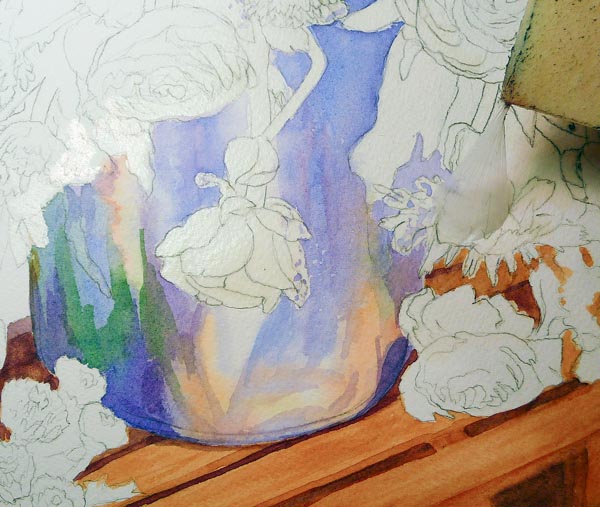
I wanted to paint the pitcher wet-into-wet and so I applied Winsor and Newton Colourless Art Masking Fluid to some of the shapes around and projecting into the pitcher to make it easier to paint wet into wet more freely. I used a cheap disposable brush to avoid messing up my good ones. I prefer Cheap Joes Golden Fleece rounds for watercolor and even though they aren’t expensive, I don’t want to ruin them with masking fluid.
Detail: Pitcher painted, removing masking fluid
I like pulling off the mask with the rubber cement pick up tool. I think it’s made out of the same stuff Vibram shoe soles are made from. The pitcher and the table have had their first washes. Next step is starting on the flowers and that will be in the next post.
After I started working on a series of paintings in acrylic I realized I needed to learn more about acrylic technique and materials if I wanted to make better progress. Although I’d read several good books and seen a couple of brief demonstrations I needed more.
Although there are hundreds of oil painting and watercolor videos, I could find only a few for acrylics. I rented a couple of awful ones from Netflix and viewed an online video from Artistsnetwork.tv that I found useless. Then I found the video that provided the lessons from which I did the exercises above. The video is “16 Acrylic Painting Techniques: A Studio Workshop with Jackie Miller.” Miller demonstrates and carefully explains how to prepare the support and create each of the 4.5″ square paintings.
I played the DVD on my computer in my studio, and worked along with it, pausing and rewinding as needed. Below are close-ups of the 4.5″ technique squares with a little information about each.
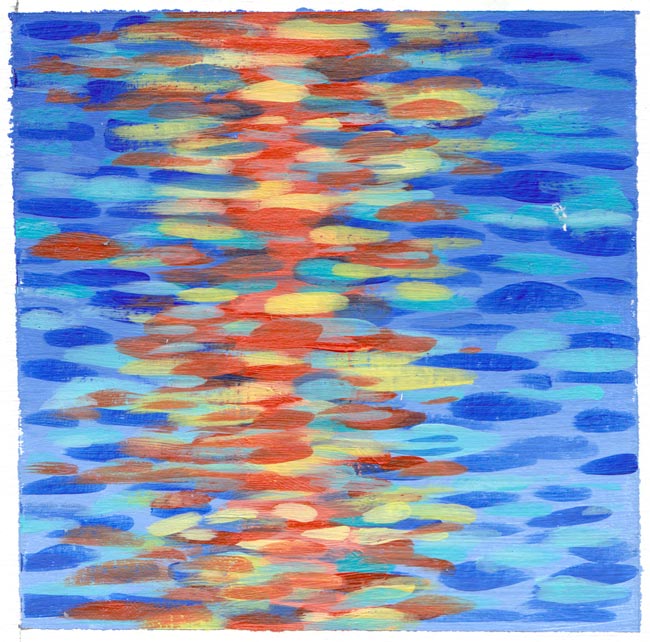
#1: Discrete Brush Strokes
1. Discrete Brush Strokes. Apply a flat, gradated blue background and many layers of individual brush strokes to create optical color mixing (and theoretically the illusion of water and sun reflections).
#2: Stencil and Stamp Painting
2. Stencil and Stamp Painting. Used a variety of materials as stencils, such as plastic embroidery mesh, hardware cloth, plastic decorative stencils. Multiple layers of paint were applied with a stencil brush and with q-tips and a rubber stamp. Fun!
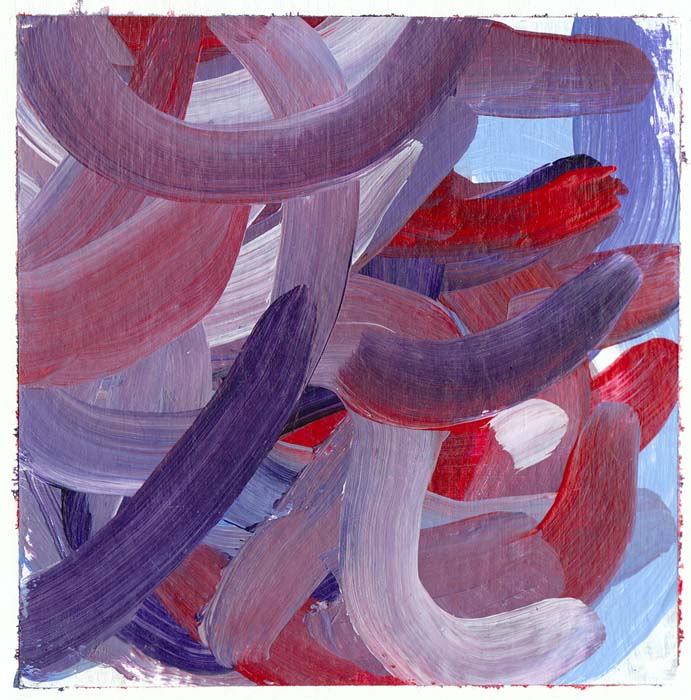
#3: Energized Brush Strokes Alla Prima
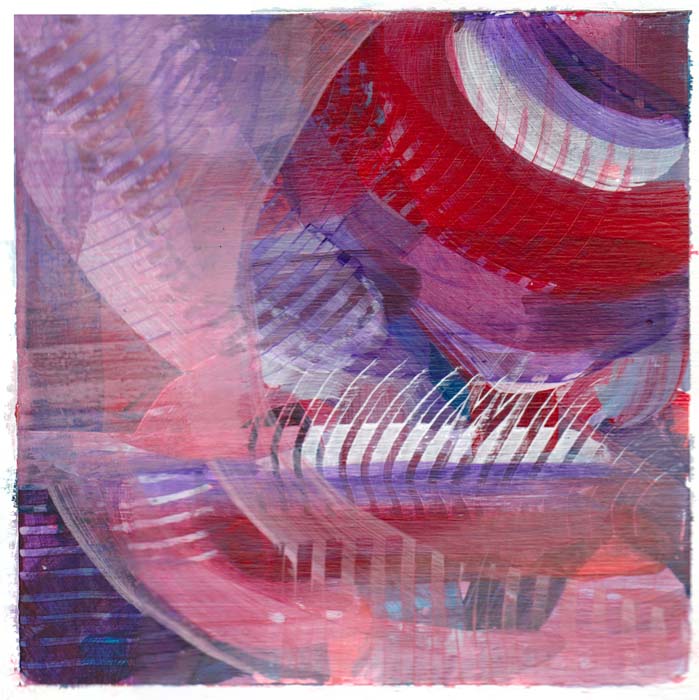
3.Energized Brush Strokes Alla Prima. Using glazing liquid to keep paint workable a bit longer, applied layers of brush strokes freely, letting colors blend into each other.
#4: Impasto with Sgraffito
4. Impasto with Sgraffito (scraping). On top of flat underpainting, applied paint mixed with gel medium and before it dried, scraped through it with a variety of implements including popsicle stick, rubber combs, and paint shapers.
#5: Glazing and Scumbling
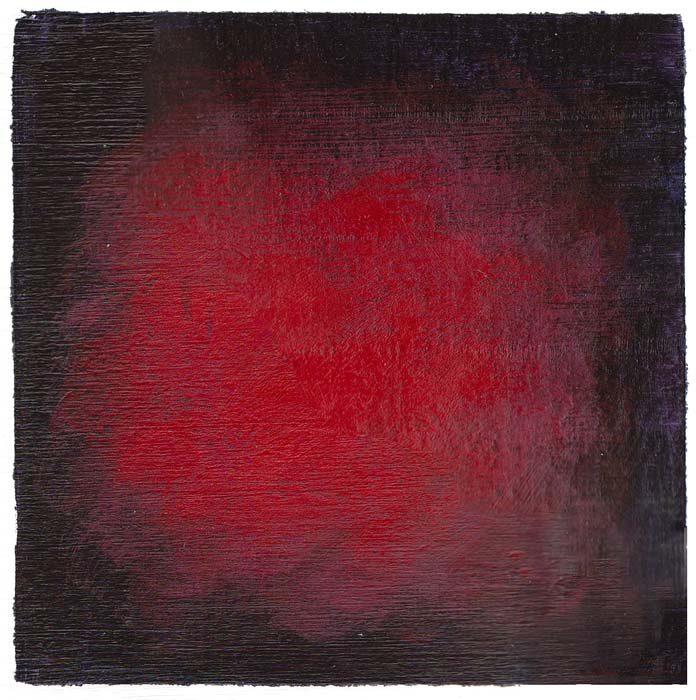
5. Glazing and Scumbling. Applied underpainting of blue, leaving white hole in the center. Then half the blue was glazed with a very thin layer of the same blue mixed with glazing medium (to see how it enriches the color and removes chalkiness). The center hole was painted red. Then turquoise paint was scumbled (scrubbed with a dry brush) on top of the blue and softly over the edge of the red.
#6: Cross-hatch Brush Stroke
6. Cross-hatch Brush Stroke. I need more practice with this one. A flat, dark underpainting was done first and then the idea was to make brush strokes that cross each other in hundreds of little X’s with a fairly dry brush to create soft gradations with many layers. The original actually looks better than this photo shows because of glare, but I still found it difficult to make those X’s.
#7: Soft-edge & Hard-edge
7. Creating soft- and hard-edged transitions. A dark, flat background was painted first and then the edge of the section at the top left was masked with masking tape and lighter red painted in that area. The transition at the bottom was created with layers and layers of softly scumbled paint lightly scrubbed on with a nearly dry brush, always starting at the corner and moving towards the center so there was less paint on the brush as it approached the transition area.
#8: Glazes, Wipe Removal & Combing
8. Glazes, Wipe Removal & Combing. On top of a flat, mauve background, layers of paint mixed with glazing medium were applied and then wiped back with a damp cloth and combed through using a rubber, multi-sided comb.
#9: Finger Painting & Mixed Media
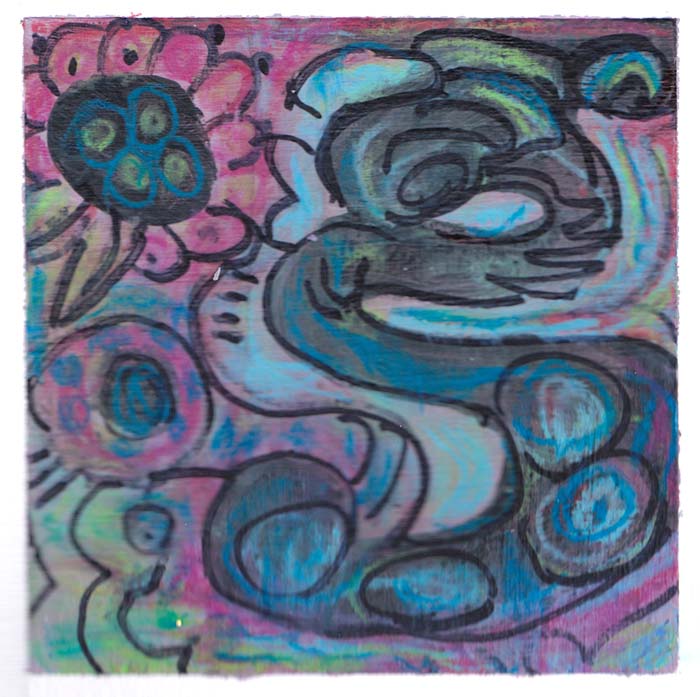
9. Finger Painting & Mixed Media. Started by finger painting with grey paint (she used Graphite Gray meant to look like graphite) and then added water soluable crayons, Sharpie marker, pencil, layer of acrylic medium, and more crayons and pens, finishing with medium to seal the crayon layer.
#10: Staining
10. Staining. On the video she left this square of the canvas raw, but since I was using watercolor paper, I gessoed the whole sheet and then covered this square with Absorbent Ground Medium which creates an absorbent surface, similar to ungessoed paper. The paint was mixed with a high proportion of water and allowed to move and blend wet into wet. It didn’t work as nicely as watercolor does wet into wet. Mixing more than 25% water with acrylics can cause them to fail to bond with other acrylic layers, but that’s not important when working with an absorbent ground since it will sink ito the fibers.
#11. Alla Prima as Underpainting
11. Alla Prima as Underpainting. The underpainting was created like #3 using bold strokes of paint, wet into wet. When dry it was painted over with various techniques including combing and glazing. On the video she did the over-painting with oil paint. I used acrylic.
#12: Painted Gel Relief
12. Painted Gel Relief. First a a pile of heavy clear gel was applied to the surface and then pushed around and smoothed and shaped with various implements. When it was dry to the touch after 24 hours I painted it with Micaceous Iron Oxide, Copper and Bronze acrylic paint.
#13: Found-Object Collage
13. Found-Object Collage. A flat layer of heavy gel was applied and then random stuff stuck into it (twine, match stick, pennies, plastic stretcher bar “key”, electrical wire thingees, some glitter for texture). When dry it was painted.
#14: Rubber Cement & Tape Masking
14. Rubber Cement & Tape Masking. Rubber cement was applied and when dry, the square was painted. Then rubber cement was removed, another layer of rubber cement painted over a different area, another layer of paint, cement removed. Masking tape applied and then painted over, etc.
#15: Paper and Fabric Collage
15. Paper and Fabric Collage. Acrylic medium was used as an adhesive to attach scraps of fabric, string, lace and paper. When dry the surface was painted using various colors and Iridescent Gold paint.
#16: Water Soluble Crayon
16. Water Soluble Crayon. This was supposed to also include bits of dried acrylic paint film but I didn’t quite see the point of using scraps of dried up paint. I’m not sure I really got the point of drawing with the water soluble crayons and then coating them with acrylic medium (they smear) either, but I gave it a try.
IMPRESSIONS:
I was suprised how much I enjoyed the more abstract, random, textural pieces; a nice respite from my usual striving to capture what I see in a somewhat realistic fashion. I can see many possibilities for exploration with acrylics, but I’m still not convinced of their suitability for my work right now, although I haven’t given up yet. I’ve gone back to working on the paintings in progress with more understanding and skill but still feel like I’m fighting the medium. More about that later.
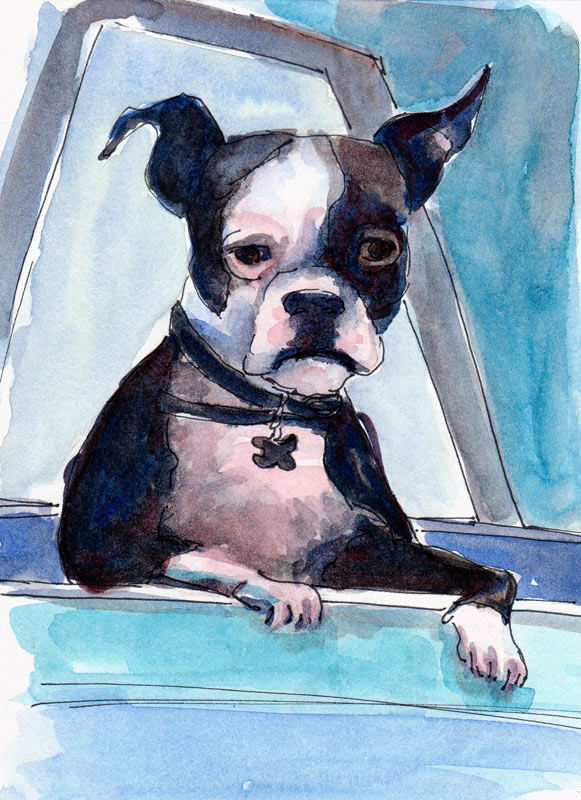
This very hip and cool Boston Terrier was watching me with one eye and watching his hip and cool owners with the other from the open window of their cool 1960’s era blue Cadillac. The two guys were wearing hip and cool hats while digging for cool stuff from a dumpster containing items from a remodeling job at the of the Longs Drugs at El Cerrito Plaza.
I’m always drawn to cool stuff in dumpsters or left out on the street, but have to work hard to control those pack rat tendencies since I’ve seen how that turns out (with a certain family member who shall remain anonymous). Unless a found item is something that I need and would buy if it was in the store, I leave it be. I remind myself that I’m NOT a sculptor who makes things from found objects and that I don’t need to bring home someone else’s garbage, regardless of how cool it might be.
To draw the dog I first sketched in pencil from a photo I took of the dog, and then inked with another pen I was testing: the Prismacolor Premier series Fine Line Marker. It came in a set of five pens with varying points from .005 to .08. They’re “permanent, acid-free, lightfast, water-resistant and archival.” I used the .01 and .05 and found them to be comfortable to hold and smooth to draw with.
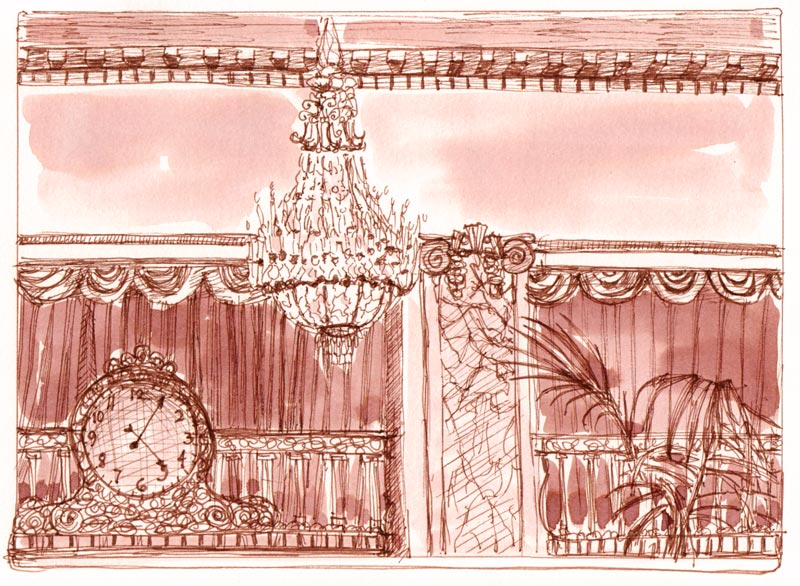
Higgins Calligraphy Ink wash added to Palace Hotel sketch
Yesterday I tested some sepia drawing pens and bottled sepia inks to see which I preferred and did the same with an assortment of graphite pencils. To start the process I added some sepia ink washes to last week’s sketch from the Palace Hotel in San Francisco and like it much better now.
The pens I tested were all permanent, waterproof and lightfast:
Copic Multiliner SP.03 which I used in the sketch above
Micron Pigma .01 (my former favorite pen)
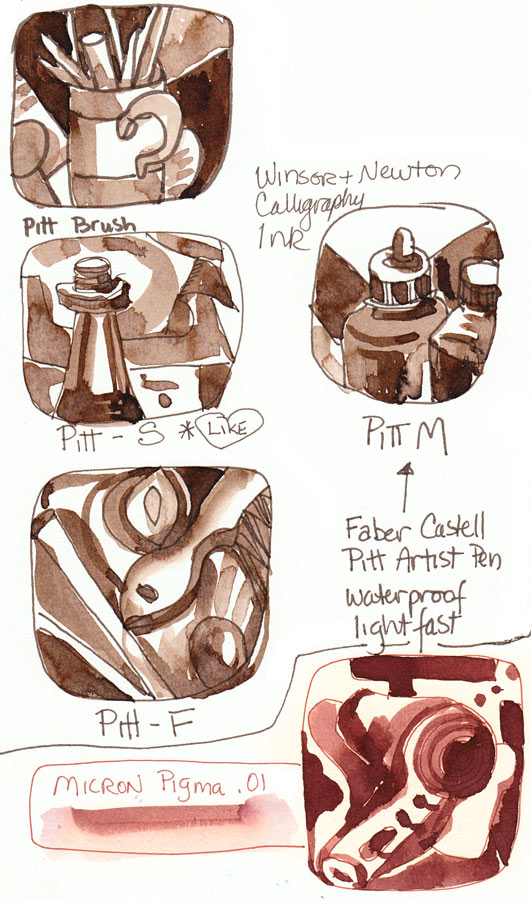
Pitt Artist Penswith various sized nibs including a brush pen.
My favorite was the Copic Multiliner SP .03 because of the way the ink and point just glide across the paper, the wide comfortable pen barrel, and the rich sepia color. Because it’s aluminum, refillable and has a replaceable tip, the Copic Muliliner is the most expensive of the three (around $7.00) and I can only get it via mail order which is annoying.
My second favorite was the Pitt Artist Pen with the “S” (superfine) tip. The Pitts are much more readily available in my local art stores and much less expensive (around $2.00). They have a somewhat wide comfortable barrel and a smooth feel when sketching.
The Sakura Micron Pigma .01, my former favorite, now seems a bit sharp and scratchy, but does offer more control because of the finer line. The barrel is narrower which makes it less comfortable to hold for long periods. It’s reasonably priced (around $2.25) and a good pen.
Traditional sepia ink is made from cuttlefish bladders(!) and mixed with a waterproof shellac base for a transparent waterproof satin finish.
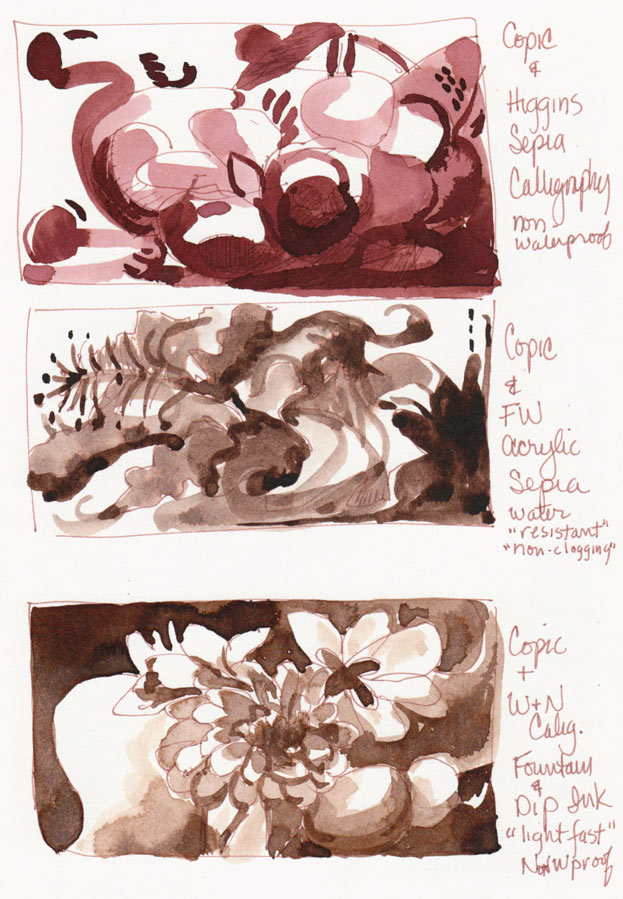
The inks I tested were:
Higgins Sepia Calligraphy Ink (label says “non-waterproof” but provides no information regarding permanence). A beautiful warm color that flows beautifully straight or when mixed with water in washes. It is my favorite of the three, but I’m concerned about it’s archival qualities. I’ve sent the company a request for more information and will update this post when I receive it. Since it was recommended to me by an artist I trust who uses it in her fine art, ink and wash work I will continue to use it for now. It comes in a sad, unattractive, square plastic bottle with little self-esteem, and is without an eye-dropper lid.
[update 8/29/2009: Higgins Inks have been purchased by ChartPak and I was able to speak to the delightful woman in charge of their laboratory where the inks are formulated and tested. I was told that this line of inks is considered “student grade” and that testing is still underway (since it’s a new product to their company). However she was able to tell me that the colorants for this ink are dyes rather than pigments so while the ink bonds “permanently” with the paper, the colors are probably not lightfast and would be subject to fading or changing color. ]
FW Acrylic Artists Ink (label says “water resistant, permanent, highly lightfast”). Ugly chalky dark brown that didn’t work well as a wash, got blotchy and almost seemed sedimentary. It’s made using the same pigments that are in paints, so it’s basically very thin acrylic paint designed to be used in pens. This was the only one of the three with an eye dropper built into the lid and comes in a glass bottle.
Winsor & Newton Calligraphy Ink (label says “non waterproof, lightfast”). It was OK. It’s more traditionally sepia colored than the Higgins ink. I think I could make it work, but preferred the Higgins. It comes in a glass bottle without an eye-dropper lid.
Here is the test page on which I drew with the Copic Multiliner and then added washes of pure ink and ink mixed with water from each of the three bottled inks.
Copic Multiliner and Inks (click to enlarge)
On the following page I drew with the Pitt Artist Pens, including the Brush Tip, S, F, and M tips and to match the color, used the Winsor & Newton Calligraphy Ink for the washes. I liked the Pitt S (for Super-Fine I think) and thought all of them were pretty nice. At the bottom of the same page I used the Micron Pigma sepia .01 and the Higgins ink since they seemed a good pairing.
Ink-test: Pitt Pens, Micron Pigma (click to enlarge)
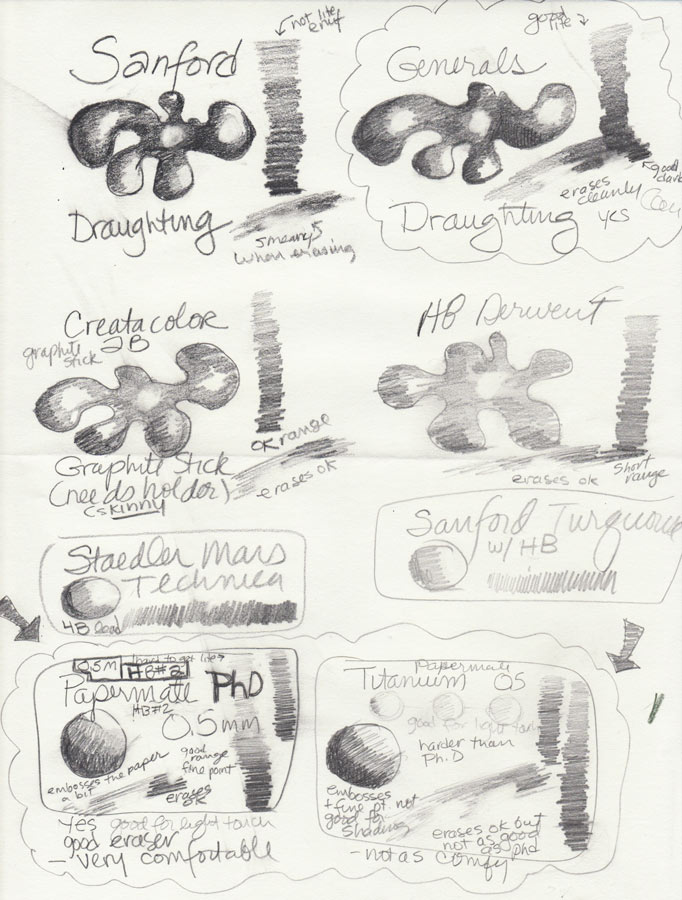
I decided to finally simplify my huge collection of pencils, graphite sticks, mechancal pencils and lead holders and pick one all purpose graphite pencil and one all purpose mechanical pencil. Although I have a full range of drawing pencils from super hard to super soft, I never work in that kind of detail with pencils and they’re just cluttering up my workspace. In the end I settled on these two for my in-studio and in-sketchbag all purpose pencils:
Generals Draughting Pencil went from light to dark easily without getting smeary and erased cleanly with a plastic eraser. I’ll use this one for sketching and planning in the studio, and for doing value studies in the field. (Close second: Sanford Draughting Pencil but it was a little softer/darker, making it more difficult to get a very light shade and it was smearier to erase.)
Papermate Ph.D.0.5m HB#2 Mechanical Pencil. The Papermate Ph.D. has a super comfy barrel that has a rubbery, wide triangular shape “endorsed by physical therapists.” This one is especially good for drawing light outlines before inking or painting in watercolor, although care must be taken to avoid embossing soft paper with the fine point. (Close second: Papermate Titanium .05 Mechanical Pencil. It wasn’t as comfortable and it was harder to get a nice dark.) I like using mechanical pencils because it’s handy having the lead and eraser in one unit.
El Cerrito Natural Grocery, cobalt Copic multiliner and colored pencils
I had to make my morning coffee with the last drops of non-fat milk (yuck, 1% is OK but non-fat in coffee just doesn’t cut it) and there were no peaches or milk for my Cheerios. A trip to the market couldn’t be put off. But I had a full day of experiments in the studio planned and I needed some exercise. Easy solution:
take the long way around, up and down big hills, to my favorite grocery store, El Cerrito Natural Grocery (cardio)
sketch the market using the cobalt Copic Multiliner I wanted to experiment with (I think I prefer the sepia)
shop
carry groceries home in a loaded backpack plus another full bag (weight lifting)
add colored pencil to the sketches to try out the new Polychromos colored pencils (LOVE THEM!)
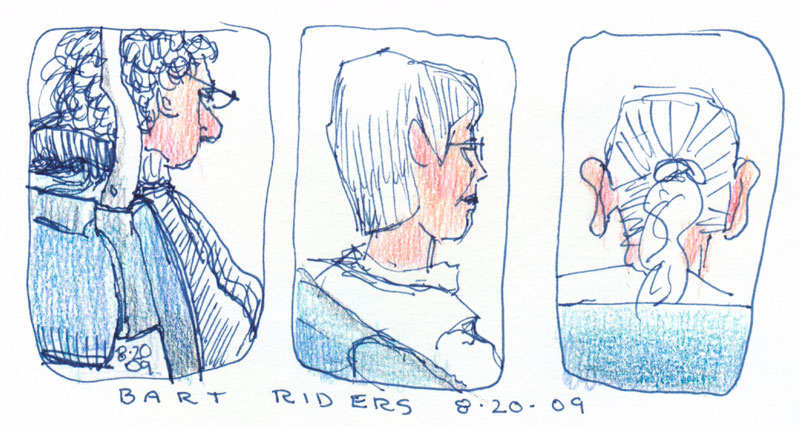
Quick subway sketches with the cobalt Copic Multiliner and colored pencils
I’m trying to simplify my choices with my art supplies, wanting to narrow down the pens, ink, pencils and colored pencils to keep handy and those I’ll give away. I did tests today on drawing pencils, sepia liquid inks and sepia pens and will post them and my preferences tomorrow.
I’m also working on painting a grid of 16 different acrylic painting techniques to improve my understanding of acrylic techniques and possibilities. It became clear this was needed when I started a series of paintings in acrylic and realized I didn’t have the “chops” to accomplish what I wanted. I was trying to use oil painting techniques and was getting nowhere fast (and ruining brushes with all the scrubbing I was doing with them which seemed the only way to get the smooth transitions I wanted).
Each medium has its own capabilities and pitfalls. Why not make good use of the characteristics of the media instead of trying to force it to be something it’s not? Despite people claiming acrylic can be used like oils and like watercolor, I’m going to try to learn to use it like acrylics instead and have fun with all the crazy stuff it can do. This series of large paintings wants to be in acrylic and so it shall, and soon I hope.
I combined walking, errands and sketching this morning, and really enjoyed all three, especially using my new sepia Copic Multiliner to draw these sketches. The pen is made of aluminum, is refillable with a replaceable tip. It’s very comfortable in the hand with a wider barrel than my usual Micron Pigmas, and the pen just glides across the page.
First stop was my little local library where I returned “Chasing Matisse”, a lackluster memoir about a guy who gets a book deal to go visit all of the places where Matisse lived. He fancies himself an artist as well as a journalist, but I didn’t think he was much of either. He basically read Hilary Spurling’s excellent two-part biography of Matisse and repeats stuff from her book in between his boring descriptions of his own experiences seeing what Matisse had seen and sometimes even trying to sketch or paint it.
El Cerrito Post Office
Next was another return of an Amazon purchase to the El Cerrito Post Office. I asked the clerk if she’d stamp my sketchbook with her round postmark stamp, just for fun but she said no and gave me some “airmail” stickers to use instead which I didn’t.
When I was a kid my grandfather had a bunch of rubber stamps and pads of old deposit slips from when he’d been a banker before the bank closed during the depression (but why did he still have them?). I used to love going to his house and playing with the rubber stamps.
I’d planned to add sepia ink washes to these sketches at home tonight because I’d ordered a bottle of that ink, but when I looked at the items that arrived in my order I discovered they’d made a mistake and sent me black ink instead. Rats. One more thing to return.




















 Jana Bouc, Artist