Berkeley Rose Garden & Rose Practice, Ink & Watercolor
When my plein air group met at the Berkeley Rose Garden last Saturday I arrived even later than usual: at noon, only an hour before the session was to end. I found a spot to sit and quickly sketched and painted the complicated, terraced rose garden, finishing just in time for the 1:00 critique.
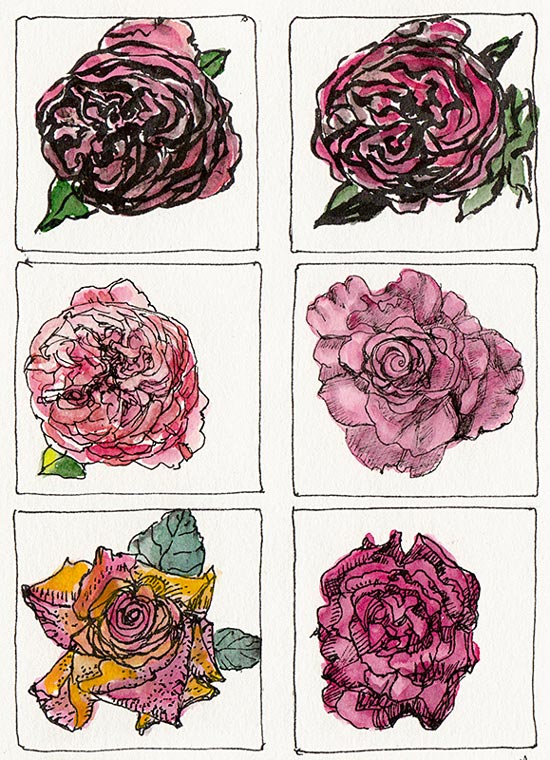
Berkeley Rose Garden, Ink & WatercolorRose Grid, Ink & Watercolor
After the critique I took some photos of the roses that most intrigued me, while guys set up white chairs for a wedding there later in the day. Once home I made a grid in my journal, and displaying the photos on my monitor, tried to understand their design and draw them.
I’ve bound my next journal and named it “Rosie” and want to decorate her with a rose design so this was practice for the rose I’ll draw on the cover. I’ve finished my journal “Froggie” but still have a bunch more pages to post.
I’ve updated my blog template. What do you think of the new design?
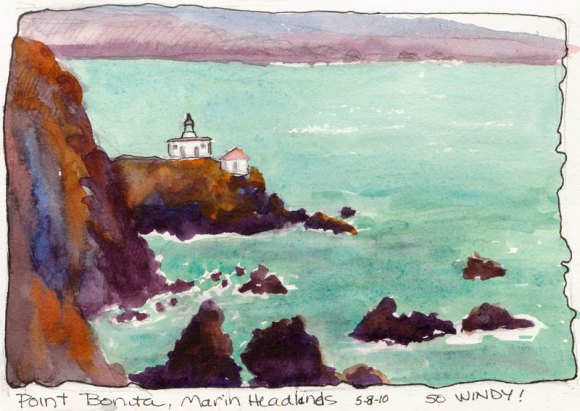
Pt. Bonita Lighthouse, Marin Headlands, watercolor
Sketching at Point Bonita in the Marin Headlands yesterday it was so windy that I could barely hold my sketchbook and all my photos were blurry because my camera was being blow around so much. At one point my watercolor palette blew right off the ledge on the old fort where I perched while another painter’s table blew away from her. I wore several layers of clothes, and had my head wrapped in ear warmers, a hoodie, a jacket hood and over that tied a bandana over most of my face so only my eyes were peeking out.
View from Pt. Bonita, Marin Headlands
I didn’t even try to set up an easel although others did, finding shelter in one of the old forts. I wasn’t thrilled with these or my other sketches but I was pleased that I’d made the effort to go and enjoyed the gorgeous scenery. I’d love to come back some time when it’s not windy, but I’m not sure if there is such a time.
The area is fascinating:
One of the most unique areas in the Golden Gate National Recreation Area, the Marin Headlands covers various types of histories from the Miwok Indians to the Military. Included are historic Fort Barry and Fort Cronkhite, the NIKE Missile site and other military installations and fortifications, dating from 1776 through the Cold War, and the 150 year-old Point Bonita lighthouse. Other attractions include varied hiking trails, dog friendly Rodeo Beach, and astonishing views of the coast and San Francisco. The explosion of wildflowers in the spring and raptor migration in the fall fill the headlands with year round excitement.
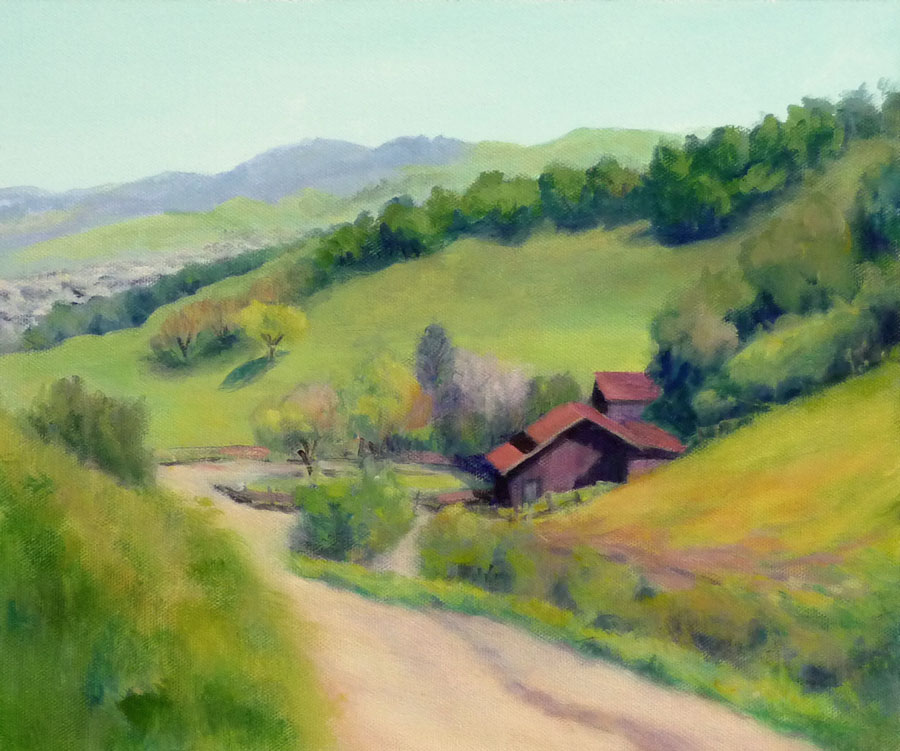
Borges Ranch View, Open Acrylics on canvas panel, 10x12" (studio painting)
It’s springtime in California and those famous “golden rolling hills” are actually a million shades of green right now, thanks to all the rain (which we probably won’t see again until next winter). When my plein air group went to Borges Ranch in Walnut Creek last month for our paint out, I used the time to hike, sketch and take photos. Then I made the painting above in the studio from my photos memories of the day.
You can see my recent sketches of Borges here. The two Borges paintings below from 2009 and 2008 help me see that I am making progress.
I really like going out sketching with the group and experiencing everything about the day without the frustration of trying to make a 2-hour painting as the light and scene changes completely. I’m better suited to doing sketches in the field and paintings in the studio.
Last Sunday I tried again to paint on site. I thoroughly enjoyed the sounds of birds, crickets and frogs in the meadow where I painted in the sun along the bay in Benicia. The painting was a 50-50 flop that might be salvageable but I took some photos which I altered in Photoshop to match my memories, from which I will make a painting
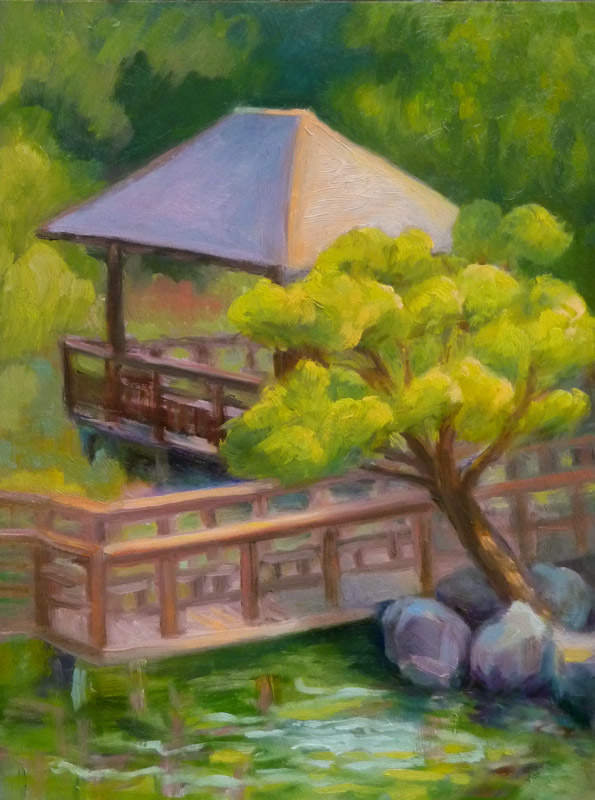
Hayward Japanese Garden (revised), oil on panel, 12x9"
Despite the encouragement to leave this painting and “don’t touch a thing” I wasn’t satisfied with it and made some adjustments to the color. I’m much happier with it now, although I wish my photo was more accurate. In real life the color is less fluorescent than it is appearing on the screen, although the actual scene in person was so brilliant it nearly was fluorescent.
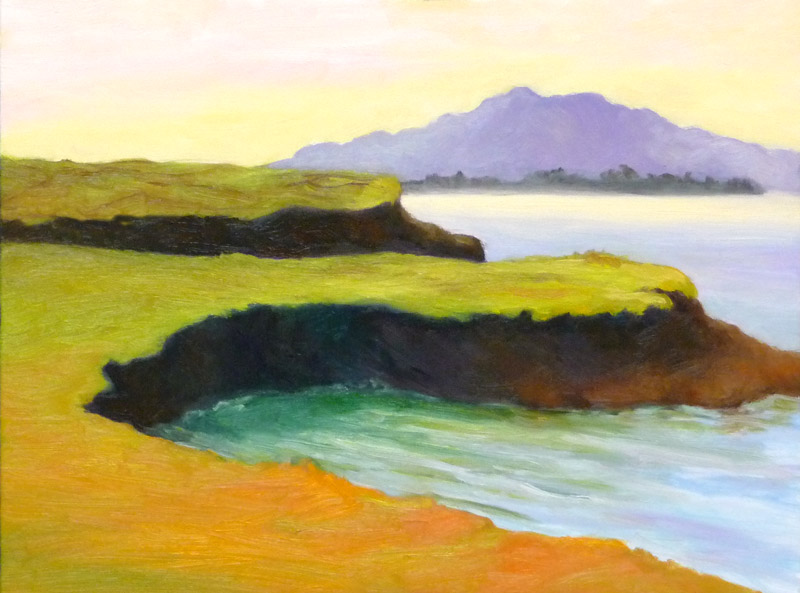
Lone Tree Park, a funky little waterfront spot in the funky little town of Rodeo, CA alongside the railroad tracks. Sunday I joined Benicia Plein Air Painters there for an afternoon of plein air painting. I was determined to simplify, find big shapes, get them down on my panel with bold color, and stop. It was so much fun, made even more so by painting alongside Leslie Wilson, an inspiring watercolor painter.
Today I finished the painting at home from memory (above). I had to work from memory because the photo didn’t even come close to capturing the colors from the setting sun.
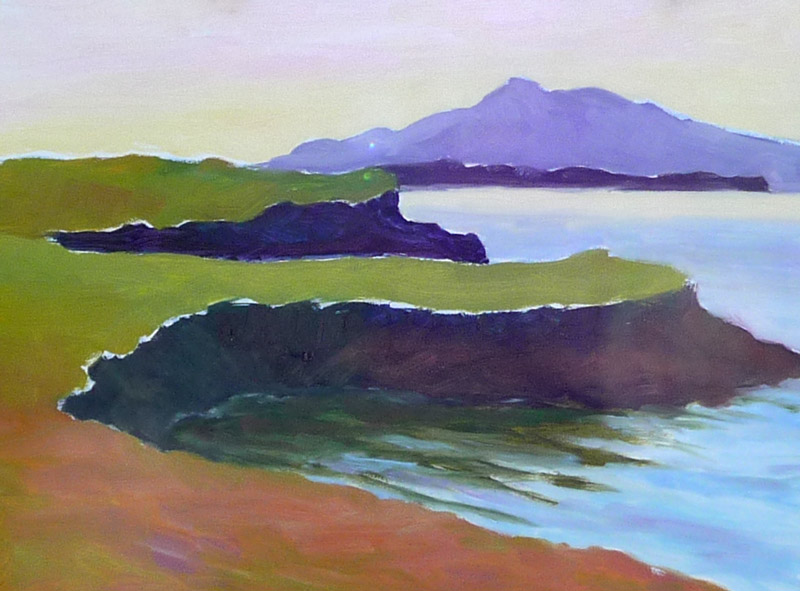
Below is the painting on site, just before I filled the white spaces I’d left between shapes to avoid smearing as I worked.
Lone Tree Park, Rodeo, in progress
And here’s my easel set up at the park. Since we were painting in the afternoon the sun began to set and glow with wonderful hot colors the last half hour of painting.
Painting in Rodeo
It was good practice to finish the painting (at least I think it’s finished) but it also felt good to do what I set out to do on-site, simplifying down to big shapes and colors.
It also felt great to be out painting from real life instead of from a photo as I’ve been doing for the book. I got permission to share some of the steps in progress which I’ll do soon.
The little known Hayward Japanese Garden is a lovely and a very peaceful place. I set up my easel inside one of the little structures sprinkled throughout the gardens as it had a good view and nice shade on a very sunny day last week. It was also a popular spot for wedding and family photos, as two different wedding parties came to take photos at this spot while we painted.
There were a number of challenges with this painting. First was the complicated scene I chose. Also painting under a roof in a shaded area looking directly at a bright scene was tricky.
I was attracted by the rhythm of the crisscrossing diagonals of the bridge, the building, the tree and the reflections. While I was pleased that I met my goal for this session: to focus on composition, I only got as far as an underpainting on site (after starting with thumbnails, value study and a fairly careful drawing). I worked on it some more today from a photo on my computer screen.
Now I see a few things I’d like to adjust (toning down the bright yellow greens, shrinking the rocks under the tree that somehow grew while I was painting, and adding some dark accents). But that will have to wait because…
Book commission
Now it’s time to get to work on the first watercolor for a book commission that is due in two weeks. I’ll be making three paintings for another book about painting flowers in watercolor by my previous publisher. I love the first photo I was assigned to paint from and am excited about the project. It’s so cool getting paid to paint flowers! I’m supposed to photograph 6 stages of the painting and then ship it off to London for them to make the final photo, Then they’ll send me back the painting and the digital file.
I’m hoping I can post some of the steps here, but my guess is that since they get publishing rights, I probably can’t. Either way, first I have to get painting!
I have a theory about the paths we take in life, and how important it is to notice what I call “Angels Holding Up Signs” along the way. Sometimes those angels take the form of a person offering helpful information or silently pointing the way by example, an intuitive thought, or an unexpected turn of events that makes you pause. When I see or hear an angel holding up a sign, whether it’s “Yield”, “STOP,” or “Go This Way” with an arrow, I consider it a gift and give it serious consideration.
Disclaimer: I’m not a New-Age angels and crystals sort of girl. But I do believe there are angels all around us; good, kind, generous people, like Adam at Kragen Auto Parts today who helped me dispose of gallons of old motor oil and their containers that had been abandoned in my garage (long story; don’t get me started!). Thanks Adam!
…And like the angels who’ve held up signs in my art life lately, including Kathryn Law and Ed Terpening who’ve both helped me to a breakthrough in my understanding about why simplifying is important in oil painting, especially when painting plein air. I’m always attracted to details, and so I’ve fought against that principle, and then fought my paints trying to put those details into my paintings.
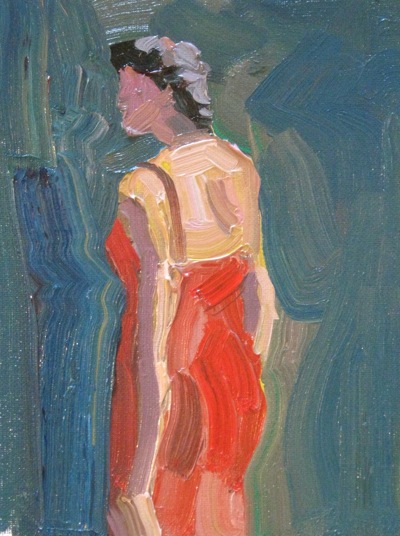
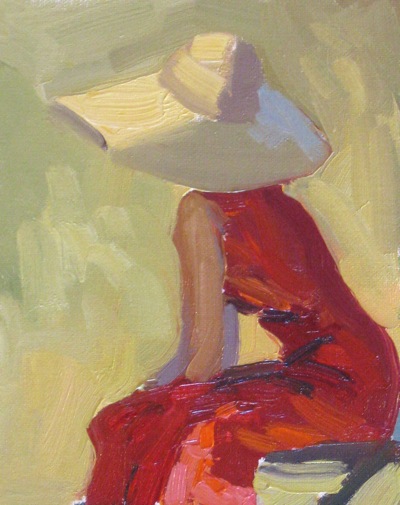
Then I saw these paintings (below) by Ed Terpening on his blog, Life Plein Air, made during a workshop in which the instructor, Peggi Kroll-Roberts, challenged the class to break the scene into as few large shapes as possible and paint those shapes with a large, fully loaded brush in one brush stroke.
Each study evoked in me a mood and my mind created a whole life story for each of these women. A mom at the beach trying to keep her kids in line; a sad, matron, wondering where her life had gone; a glamorous, young society lady at the country club watching a tennis game while sipping a martini….
How did so much come from such simple paintings? Leaving out the details left it to my mind to fill them in. This is something I so needed to learn: that simplifying and omitting detail doesn’t make a painting boring—it lets the viewer’s mind play and be creative, making for an exciting, rewarding experience. Thanks, Ed, for holding up that signpost!
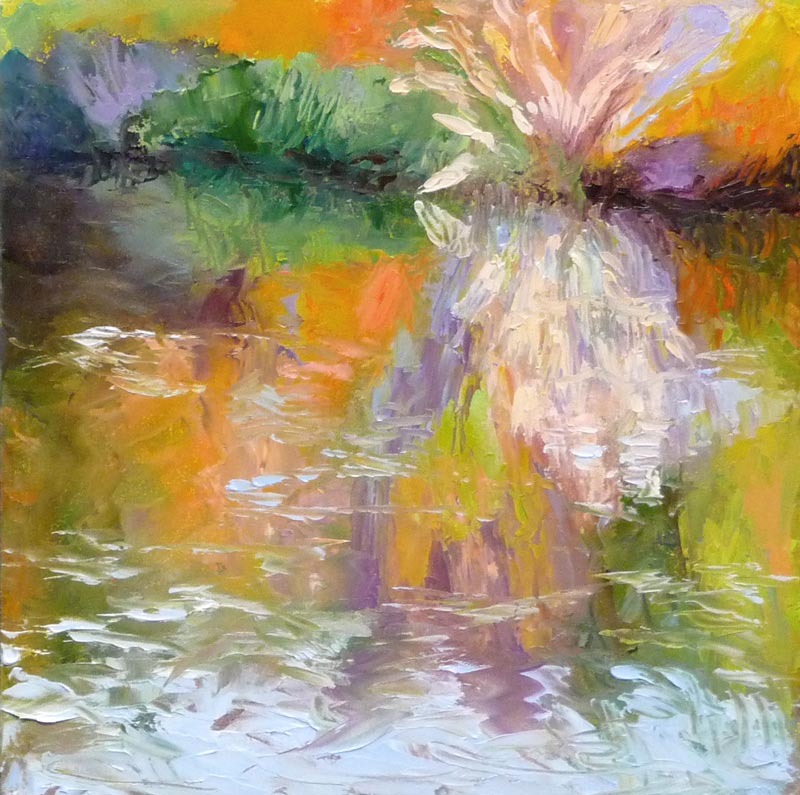
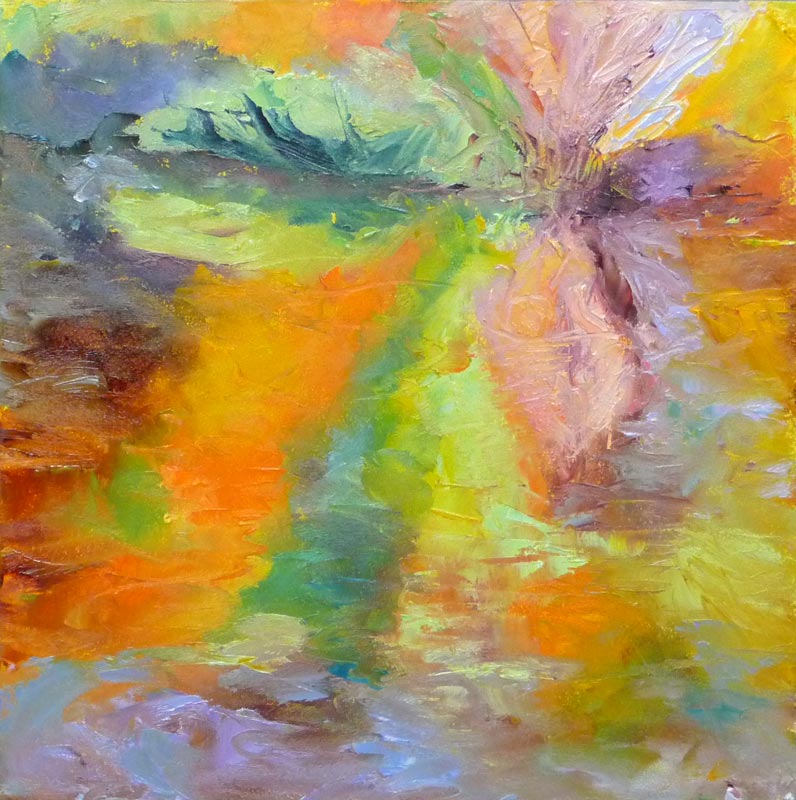
Another sign-toting angel came via email this week: a request to purchase this plein air oil painting I made last summer at Lake Temescal. There I was at the crossroads, wondering whether to give up plein air oil painting, and this angel popped up with a sign saying, “You’re on the right path, don’t turn back.”
And now about my process with today’s painting. First I tried to simplify by painting large color shapes with the plan to create a color study for a work to be done in the studio. I also focused on the composition, picking a focal point, being careful not to divide the canvas in half as I have a tendency to do, making the subject (the water) the largest portion.
Here’s how it looked when I’d covered the whole panel:
Lake Temescal Reflections, Phase 1
I’d worked quickly, using a palette knife, going for big shapes of color. I should have stopped there and gone for a walk. But instead I messed around for another hour and muddied up the design and the colors:
Temescal Reflections (muddied), Phase 2
But the great thing about palette knife painting is that it’s easy to scrape off passages and repaint them. So later that evening I put the photo of Phase 1 on my computer monitor side-by-side with a photo of the scene and worked on the painting until I was satisfied with it (as posted at top).
And I’m very happy with another breakthrough: the way I was able to enjoy the plein air painting process without worrying about making a Painting with a capital P while I was out there.
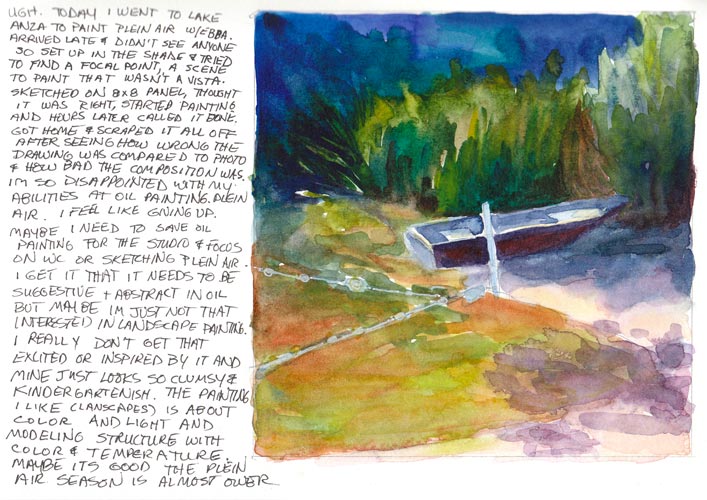
When I brought home today’s plein air oil painting, I spent a few minutes messing with it, tried to fix it, and then just wiped it all off. Then I painted the scene in watercolor instead (above). I’m getting really frustrated with plein air oil painting and I’m starting to reconceptualize how I might approach plein air painting in the future.
I love being out in nature looking closely at it, and trying to capture it in paint. I also really like hiking in these beautiful parks. But when I paint with oils I focus on painting and then when I leave, I’m often envious of the people who hiked past me as I stood there in one spot.
My new idea is to bring my watercolors, sketchbook and my camera and spend half of the time walking and taking photos and the other half making watercolor sketches. Then I can use those studies, photos and my memory and experience of the place to either make larger watercolors or oil paintings in the studio.
I so admire people who can make beautiful oil paintings plein air. I know that there’s nothing that can compare to seeing color and light and painting it right in the midst of nature’s glory. But maybe it’s time to accept that it’s just not my forte and focus on the things that I both enjoy and can do with some modicum of success.
Rush Ranch Horses, Sepia Copic Multiliner and watercolor wash
Mariah, a wonderful young artist, accompanied me to my plein air group’s paint-out today at Rush Ranch in Suisin City. She was immediately inspired by a spot, sat down and started sketching. I faced the opposite direction and sketched these horses in the corral.
Before we’d left my house, I showed her a book on drawing animals that demonstrated how to first find and assemble the basic shapes contained in the animal (rectangles, circles, triangles) and then refine them. I decided to practice what I preached and did that with the horses. I’d never noticed what big knees horses have before. I sketched with my sepia Copic Multiliner .03 and then added watercolor washes.
Rush Ranch Vista, ink & watercolor wash
The views from Rush Ranch were tremendous. I could have sketched for hours more but we’d arrived late and after our second sketches it was time for the group critique and lunch.
We were late because I got lost yet again (missed the turnoff and drove forever before turning around — and this was with GPS!) My mind had wandered to thinking about the people fishing (and the fish) in the slough off the little bridge we’d just passed so I missed the entrance sign and decided that the GPS telling me I’d arrived was wrong. This was especially stupid since the printed directions from my group said to go over that bridge and then turn right in 3/4 mile.
Instead I drove and drove, went over another bridge and THEN started looking for the turnoff. I went miles past that bridge, eventually arriving at the gate to a “youth correctional facility” (jail for teens) and admitted I’d blown it again. When we finally found our way back and I saw the huge “Rush Ranch” sign, I couldn’t believe I’d missed it.
Well actually I could believe it. I think I could get lost just walking from one room to another these days!
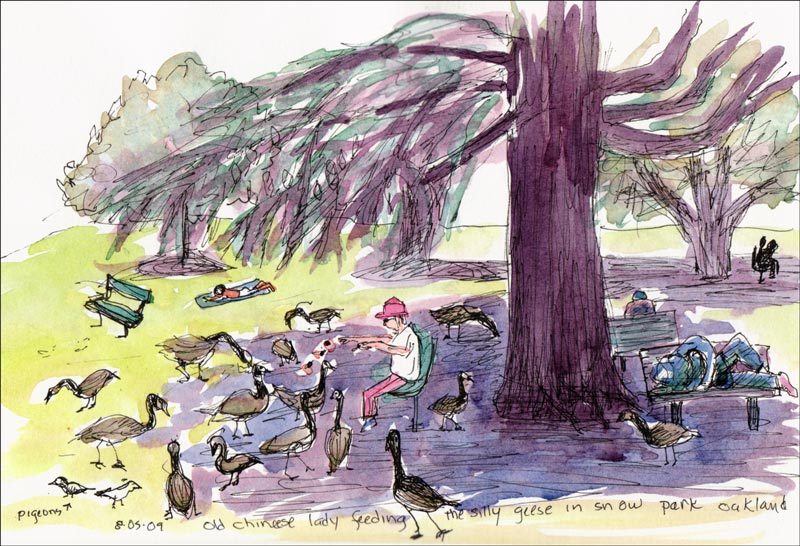
I meant to take a walk at lunch today but when I saw this old lady feeding the geese I had to stop and sketch. This is a little park near my office in downtown Oakland called “Snow Park” but a better name would be “Goose Poop Park” since it’s home to the many Canadian geese who don’t seem to feel the need to head north or south any longer.
Bart faces and feet, ink & watercolor
I drew the faces of these subway riders on my way to work this morning. I drew the feet on the way home. That guy was holding his juice on the floor with his feet.













 Jana Bouc, Artist