Categories
Art theory Flower Art Ink and watercolor wash Painting Sketchbook Pages Still Life

Out Stealing Roses

Stolen Roses, Ink & watercolor, in 5x7" wc Moleskine

As Maya Angelou said her grandmother always told her, “You don’t always get what you pay for, but you always pay for what you get.” As a believer in Karma and Maya Angelou’s grandma, I was a little nervous about stealing my neighbor’s roses.

But that neighbor moved away a year ago and her roses were producing those first magnificent blooms of the year. I just couldn’t resist cutting a few to sketch. I drew them with my Micron Pigma .01 and then added watercolor. I wasn’t happy with the results so experimented with adding white lines with a new white gel pen, a “Y&C Gel Extreme .07” which I like it a lot. I liked the sketch (above) better too.

I decided to sketch them again and used my Micron Pigma with a lot of cross-hatching to try to understand their form in a more sculptural way.

Stolen Roses 2; ink, gouache, watercolor

Then I added watercolor and made a big mess. I couldn’t capture the delicate coloring from white to yellow with red edges of one of the roses . So I tried adding gouache. Yuck, worse mess. I washed off the paint and tried again. More mess, and this time I lost a lot of the black lines. So I got out a Sharpie fine point and went over the black lines with darker ones. More gouache, yuck, some white pen, gave up.

Then I took a bunch of photos of the roses, thinking I’d start an oil painting and keep a photo reference in case the painting took longer than they lived. Pretty soon I was coughing and sneezing and my eyes were watering. These roses were very fragrant and I was allergic to them (unlike the ones in my garden that I selected for their lack of scent). I put them outside and gave up. I guess I paid for what I got!
Categories
Drawing Flower Art Gardening Gouache Outdoors/Landscape Painting Photos Plants Sketchbook Pages

Botanical Sketches: Proteus

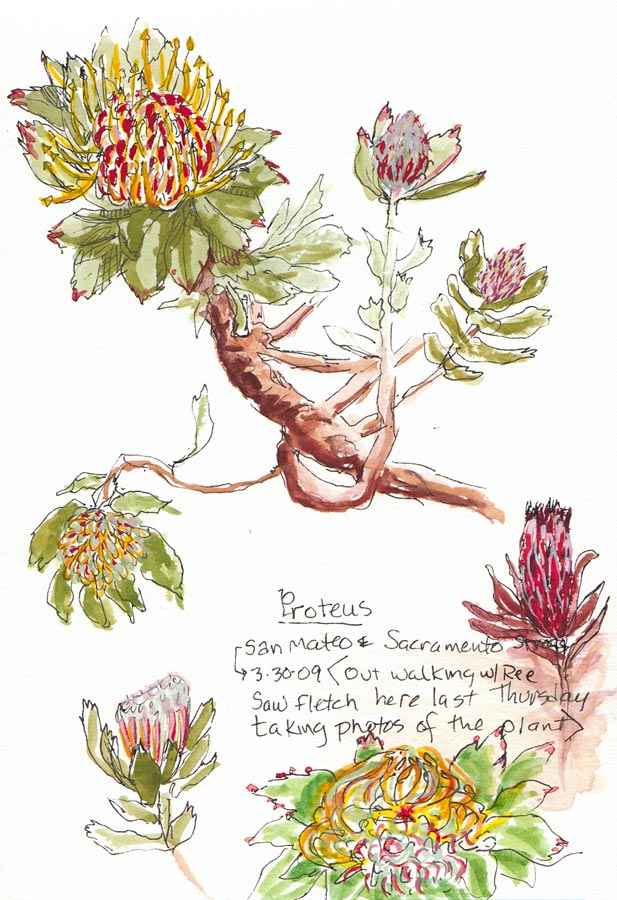
Proteus in Bloom, ink & gouache, Moleskine 5x7 sketchbook

When I was walking to BART last week I ran into Fletch who had just finished shooting photos of an amazing Proteus  a few blocks from my house. I must have walked by this stunning plant a hundred times and never noticed it until he pointed it out to me. I couldn’t stop to sketch that morning but finally got back there this afternoon.

I got as close as I could without trespassing and sketched with my Micron Pigma .01 pen, trying to capture the many different forms the blossoms take along the way to fully blooming. Then I used my mini gouache palette and a tiny brush to paint the details.  Gouache seemed like a perfect medium for doing this kind of detailed botanical sketching.

I also took a bunch of photos of these amazing and diverse flowers. Here are a couple of them:

Photo of Proteus blossom
Proteus in bloom, photo

Note to self: Find proteus at a nursery and plant them! But first I want to do some larger botanical illustrations from my photos (or from life if I can convince the woman who owns the plant to allow me to take some cuttings). Fletch told me she reluctantly allowed him to take one.

And here’s a bit of etymological (word origin) trivia about theProteus:

The Proteus got its name because of its amazing diversity of form: It was named after the Greek sea god, Proteus, who was able to change his appearance at will.  From this comes the adjective “protean,” which means “versatile”, “mutable”, “capable of assuming many forms.” “Protean” has positive connotations of flexibility, versatility and adaptability.

Categories
Art supplies Flower Art Oil Painting Painting

3 Is Not a Charm & Review of Painting Panels/Boards

Camellia #3, Oil painting on panel, 8x8"

So I’m still at it with these camellias, this time in oil.  I have a plan for Camellias #4 as I still haven’t quite got what I’m after. I want to see if I can get bright light colors in oils without the chalkiness of white paint. I think that will mean using thin transparent washes instead of thick paint, even though the usual method in oil is to make lights thick and darks thin.

Review of Painting Panels/Boards

Categories
Art theory Drawing Flower Art Ink and watercolor wash Painting Plants Sketchbook Pages Still Life Watercolor

Happy Spring Camellia

Happy Spring Camellia, Ink & watercolor, 7x5"

I couldn’t resist drawing this one cutting from my camellia bush instead of going straight to the oil painting I was planning to do of the little bouquet of camellias I was assembling. I wanted to enjoy deeply seeing all the shapes and connections and patterns and reflections and colors in the leaves, buds, and flower.

I realize now that I should have gone a little more slowly when I was drawing the flower petals so that I could really capture the personality of this particular flower, the way I did with the leaves and bud. But I think it was making me dizzy, trying to follow all those different curly shapes and ins and outs of the line so I got a little lazy and generalized instead of paying absolute attention and getting it exactly.

I’m always torn between going for the detailed exactitude of botanical illustration and the way oil painters say to skip the detail, skip the individual petals and paint the mass, the form instead. I see the value in both but combining them in one painting rarely satisfies either goal.

Categories
Acrylic Painting Flower Art Glass Gouache Ink and watercolor wash Painting Sketchbook Pages Still Life Watercolor

Painting Camellias with Mariah

Camelia #3, Watercolor on paper, 4x6"
Camellia #3, Watercolor on paper, 4x6"

Last night my step-granddaughter Mariah, a brilliant, almost 10 year-old artist with an enviable  sense of design and assurance and confidence in her work came over for a visit while her parents went out to dinner. Even though she she was sick, she was still up for doing some drawing and painting.

We picked a few camellias from my tree and got to work (or was it play?) drawing. She wanted to use acrylics; I fooled around with gouache and watercolor. Here’s her painting:

Mariah's Camelias, acrylic on paper, 8x8"
Mariah's Camellias, Acrylic & graphite on paper, 8x8"

And here are the two I did last night. (The one at the top top of this post I did this morning, with the flowers beside the window. I wasn’t ready to stop painting these pretty flowers, the first of the flowers to bloom in my garden.)

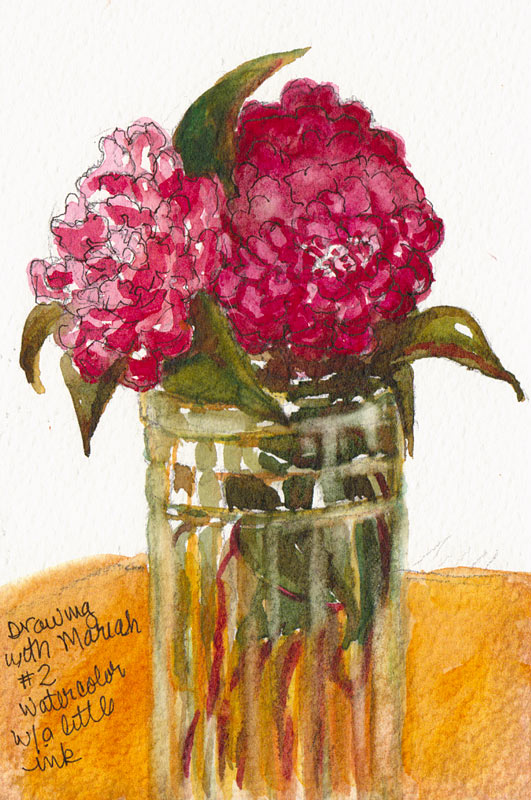
Camelia #2, watercolor on paper, 6x4"
Camellia #2, Watercolor & ink on paper, 6x4"
Camelia #1, Gouache on paper, 6x4"
Camellia #1, Gouache and graphite on paper, 4x6"

I really don’t like the way using white with gouache looks so chaulky.  I much prefer the clear lights in watercolor that you get by leaving areas white or only lightly glazed with color.

Categories
Acrylic Painting Flower Art Monoprint Painting Print making

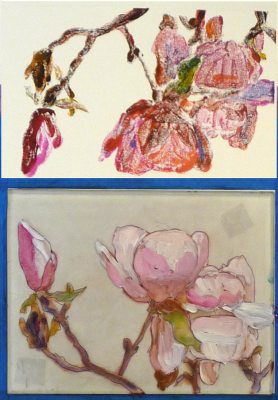
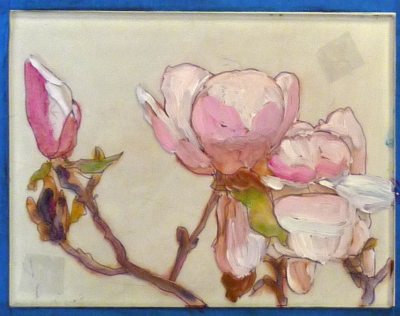
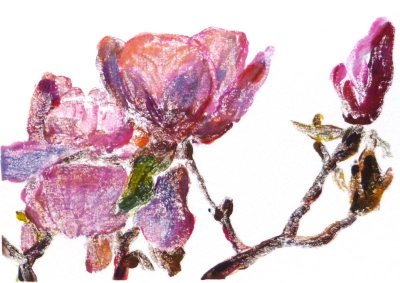
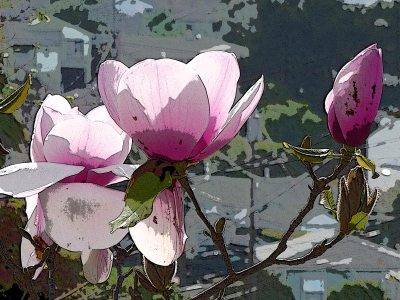
Monoprint Experiment with Golden Open Acrylics

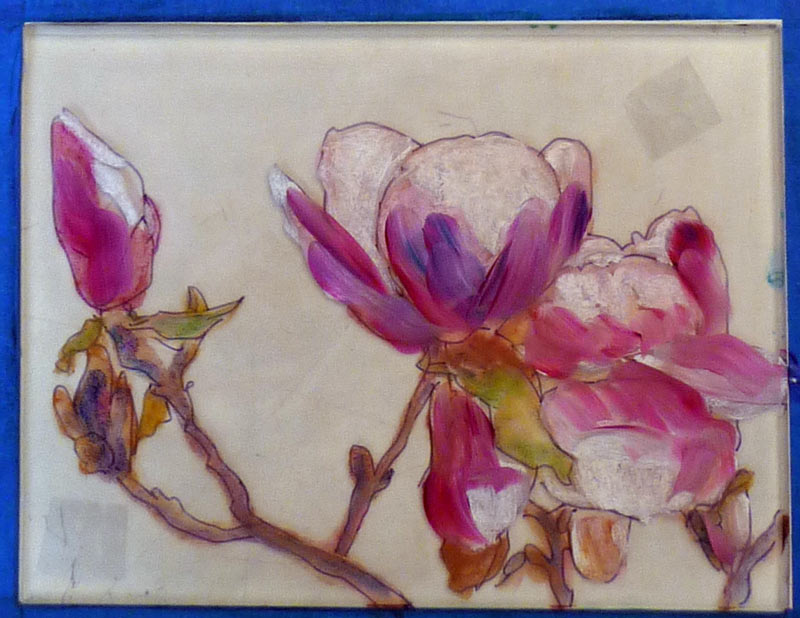
Paint on plexi plate 3

After watching a demo of how Golden’s new Open Acrylics can be used for monoprinting (since they stay wet 10 times longer than regular acrylic paint) I was excited to give  it a try. I love monoprinting but working with oil-based inks can be messy and the cleanup isn’t fun so using acrylics seemed like a great option.

I think Golden’s Open Acrylics have a lot of promise as a painting medium, and seem to combine good features of oil and acrylic, but I wasn’t at all happy with the way they worked with monoprinting. As a matter of fact, these two preliminary painting layers (above and below) on the plexiglass plate, pleased me much more than the prints I pulled from them. I had much better luck previously when I used printing inks (see previous posts  Persimmon Monoprint, Magnolia Monoprint and Turtle to Swan monoprints).

Paint on plexi plate 2

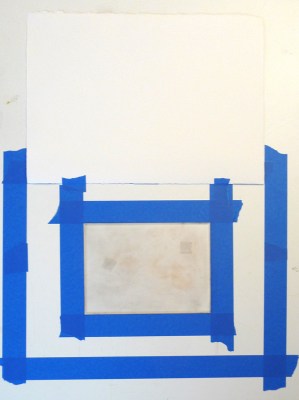
Below are steps along the way:

To read the details about the photos above, or find out how you can watch the video demo that inspired me to try this by artist Tesia Blackburn,  please click Continue:

Categories
Drawing Flower Art Ink and watercolor wash Painting Sketchbook Pages Watercolor

Blinded by the Light…of Tulips

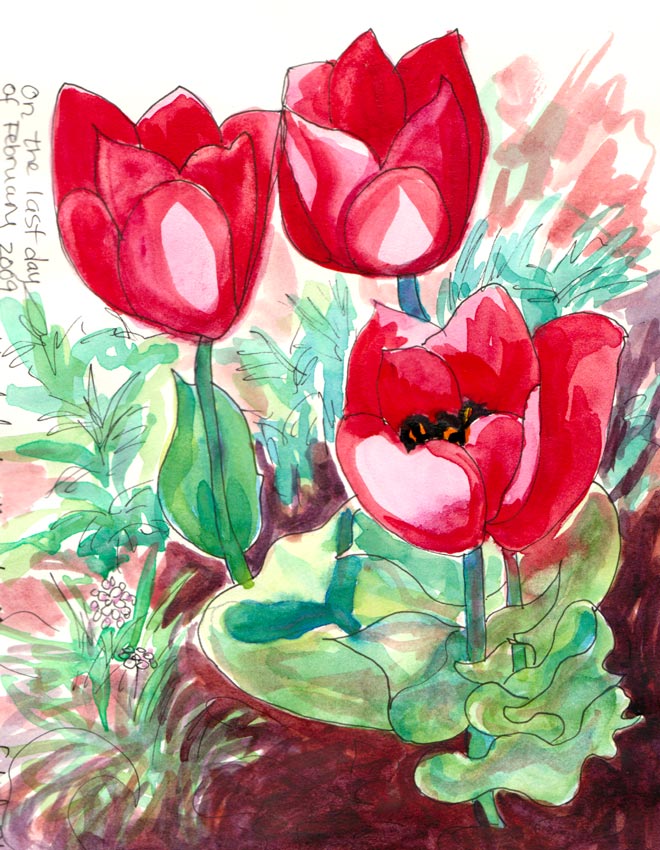
Tulips, Ink & watercolor in sketchbook, 6x8"

I was taking a walk today, trying to find my way back into to the world of the living from the Zombie world I’d been in the past few days, when these tulips seemed to jump out at me. Although I had my sketchbook with me, I was multitasking on this walk, carrying groceries home from the market while talking to my mother on my cellphone. Since I couldn’t really stop and sketch, I took a few pictures and sketched in ink from the image on my computer monitor when I got home.

I’m feeling so grateful for the simple things in life right now: being able to eat and sleep and walk and sketch and breathe and be warm and dry and cozy in my own home. Sometimes it’s worth having a few days of awfulness to be reminded of just how good life is.

Categories
Drawing Flower Art Ink and watercolor wash Landscape Outdoors/Landscape Painting People Photos Sketchbook Pages

Can’t Stop the Seasons: Magnolias in Bloom

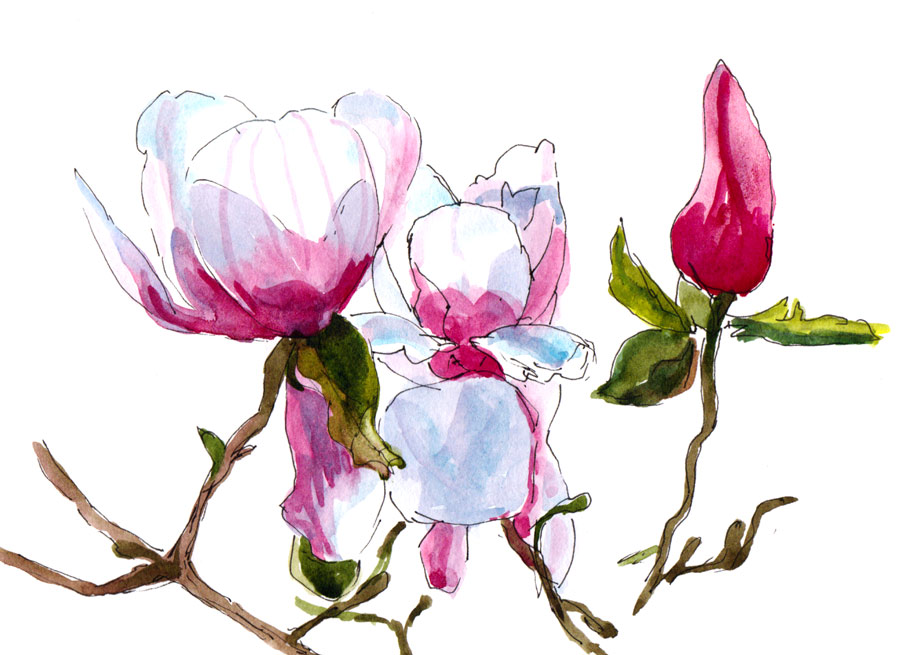
Magnolia Bloom, ink & watercolor wash

A new storm is on its way in but this morning was sunny so I took a walk in the neighborhood and discovered Spring had arrived overnight. The magnolias were blooming along with some other flowering trees.

Spring Trees, ink & watercolor wash

The Jehovah’s Witnesses were also out in full bloom, a whole parade of them canvassing the neighborhood. These folks were waiting while their colleagues knocked on the door of a house on the top of the hill.

Witnesses on the Hill, Ink & watercolor wash

One of their team told me she liked to paint too, and then offered me some reading materials. “No thanks,” I said. “But it’s really, really small,” she said. It was a small pamphlet, but why would she think that would change my mind,  I wonder.

Can't Stop the Seasons
Can't Stop the Seasons, Photo

I thought about drawing this but decided a photo was good enough. Seeing the new season bursting forth in front of a sign saying “STOP” made me think about the ways we try to control things by making laws and rules and posting signs, and yet Mother Nature rolls along, no matter what we puny humans have to say about it.

I’m trying to use one sketchbook at a time and so, despite being tempted to switch to a Moleskine watercolor sketchbook, I continued on in my Strathmore Drawing sketchbook. It’s not watercolor paper but is great for ink, is my favorite size (6×8″) and is light for carrying because it only has 24 sheets. It does wrinkle a bit from the watercolor, and it’s not good for lifting out color or heavy application, but it’s a good compromise between quality of paper and size and weight.

Categories
Flower Art Glass Gouache Painting Sketchbook Pages Still Life Watercolor

My Prickly (Artichoke) Heart

Artichoke Heart, Ink & watercolor on hotpress Arches paper

I think the soft, flowery heart inside a prickly artichoke perfectly illustrates my feelings about Valentines Day. I love artichokes and the heart is always the best part, but you have to work to win the right to savor it. I was surprised how soft, gentle and flexible the leaves were when I peeled them off to get to the heart, compared to how tough they are when they’ve been boiled. I’m sure there’s a good analogy there about love and tenderness, but I’ll leave that to the poets.

I first tried to do this painting using a sketchbook I hadn’t tried before: Maruman Art Spiral, that has what looks like cold press  watercolor paper in it. It started dissolving when I tried to lift paint or glaze more than one layer. Yuck. I wasn’t at all happy with the first try below and started over.

Artichoke heart on crummy paper
First attempt on crummy paper

As I wrote in my last post, the past few weeks have been rough. When I finally got in the studio today. I began by wasting an hour trying to rescue a painting of 3 artichokes I’d started last night and finally decided it was unsalvageable. I felt uninspired, clumsy and like everything I tried to do is crap.

Then my cat jumped on the drawing table to sunbathe under my lamp. I had a brush in my hand, my gouache palette open, a sketchbook I wanted to finish and a willing model. So I did quick kittie sketches with paint, trying to get back in the flow. It helped get the juices flowing again, although my inner critic was still harping at me, telling me these were crap too.

20090214-cat620090214-cat520090214-cat4

20090214-cat320090214-cat2

Maybe they are, maybe they aren’t, but they’re bright and colorful and were fun to do, and the stupid sketchbook is filled and on the shelf.

Categories
Art supplies Flower Art Glass Gouache Sketchbook Pages Still Life

Experimenting with Gouache & Rotring Art Pen

Last roses, ink and gouache

I  saved two rose buds to paint when I pruned my roses last week (in case winter ever comes to the San Francisco Bay Area—it’s been ridiculously hot and sunny). By the time I could get back in the studio, one bud had opened and my order of M. Graham and Schmincke gouache arrived. Although I planned to test the new gouache by making color charts first, I knew the roses wouldn’t hold up much longer. Also included in my art supply order was a new Rotring Art Pen.

I tried out the gouache and pen in the sketch above. I also wrote a quickie review of the Rotring Art Pen and offer some technical information about gouache by experts on the subject. If you’d like to know more about gouache or the pen, please click the “Continue reading” link below.