Categories
Faces Oil Painting Painting People Self Portrait Studio

Alla Prima Self-Portrait in Oil with Steps in Progress

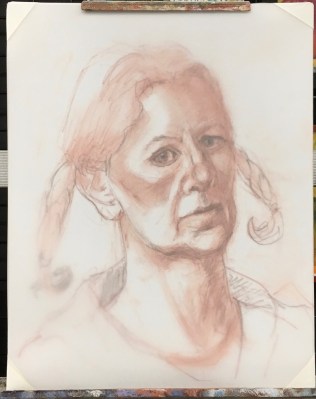
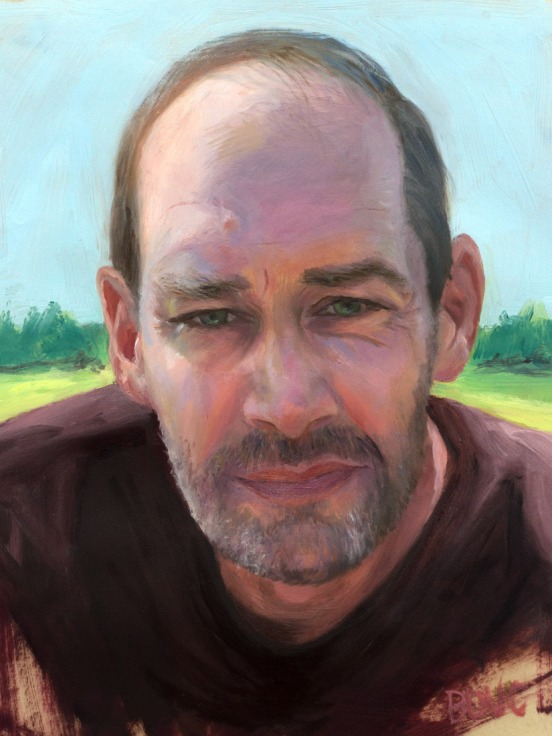
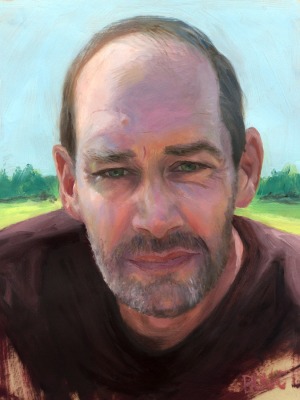
Self-Portrait, Zorn Palette, oil on Mylar, 12x9 inches
Self-Portrait, Zorn Palette, oil on Mylar, 12×9 inches

I might look grumpy or serious from concentrating, a little cross-eyed (eyes drawn too close together), big-nosed and scrawny, but I’m really happy with this painting because it was fun to do! The hardest part was lighting my face without blinding myself with the glare.

Below you can see the setup I used in the studio, with the giant mirror I got for $10 (!) at Home Depot; it was half priced and had a few scratches so they took off another $5. I had a hard time supporting the mirror so that it was tall enough to see myself. Finally I found a solution: propped it up on an open drawer, held in place with two bungee cords wrapped around the studio chest of drawers.

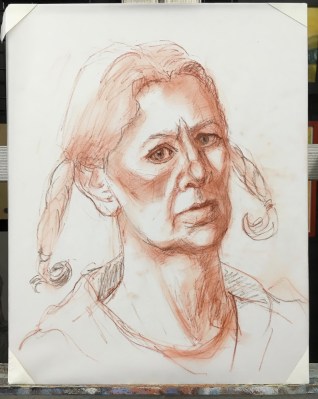
Inspired by Myriam Yee (be sure to check out her amazing series of Zorn palette self-portraits here), I used the “Zorn” limited palette of Ivory Black, Cadmium Red Medium, Yellow Ochre and Titanium White. Myriam uses Williamsburg Cold Black instead of Ivory Black, which has some Ultramarine Blue mixed in and provides a wider range of colors. I bought a tube and am experimenting with it now.

I painted on Dura-Lar Matte Film again but this time (see previous post) I did the drawing on one sheet and then imposed a second sheet over it to paint on. This way, if I wanted to try a second painting of the same drawing or just want to save the drawing I still have it.

Categories
Art supplies Drawing Faces Oil Painting Painting People Portrait Portrait Party

Portrait Process: Start to Fail and Start Again

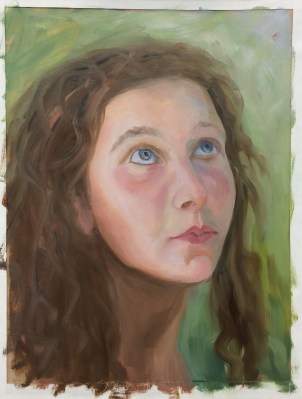
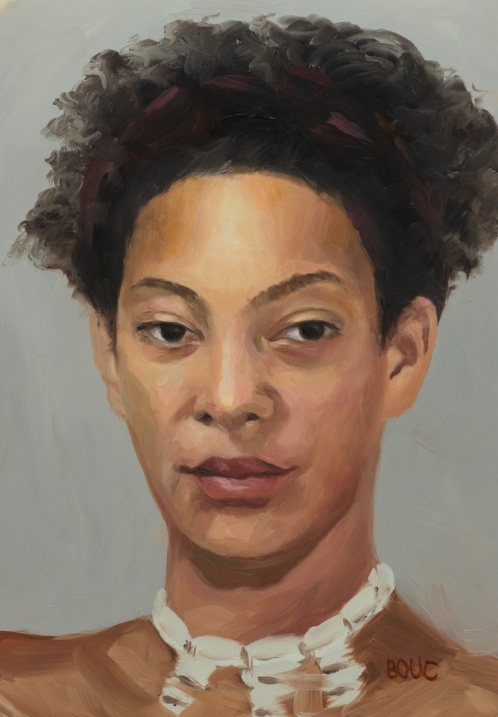
Forest Girl #2-C, Oil Painting on Mylar, 12x8"
Forest Girl #2-C, Oil Painting on Mylar, 12×8″

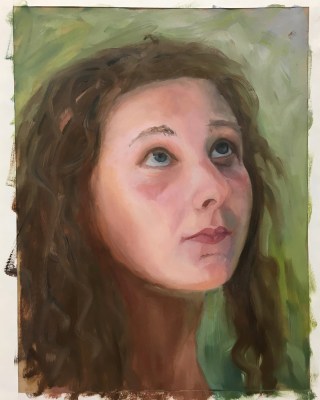
My first attempt at painting Sylvia, a lovely young Bulgarian architecture student, ended in an abandoned failure, displayed at the bottom of this post in 6 steps. I altered my course for the second attempt (above), starting with a better drawing, and was able to complete the study more successfully. I tried to practice for alla prima painting, not going for a “finished” portrait, even though I painted from her reference photo on Julia Kay’s Portrait Party, instead of from life.

What made the difference between failure and success was that I took the time to make a more accurate drawing first (above). I drew on one side of a sheet of Dura-Lar Matte Film (after first reversing the reference photo in Photoshop) and painted on the other side. Then I turned the sheet over, toned it with a transparent umber stain, and reversed the photo back to normal. That way I had the lines of the drawing to refer to, along with the photo without obliterating the drawing. It’s still visible on the back of the painting and could be traced over onto another sheet of Dura-Lar if I wanted to paint her again from the same drawing.

Below is the failed first attempt, where impatience and hubris led to a quick, sloppy drawing (with the evil thought, “I can always correct the drawing when I paint,” which I need to ignore in the future!). The captions describe what went wrong at each step:

Categories
Faces Oil Painting Painting People Portrait Sketchbook Pages

Portrait of Nick for Julia Kay’s Portrait Party

Nick K for JKPP, oil on Mylar, 9x12
Nick K for JKPP, oil on Mylar, 9×12 inches

Wanting to continue my alla prima portrait painting practice but without a live model, I picked a photo of Nick K. from Julia Kay’s Portrait Party to paint.

I recently looked up the saying, “Perfection is the enemy of good” and read about the Pareto principle, the 80/20 rule or the law of diminishing returns that states it “takes 20% of the full time to complete 80% of a task, while to complete the last 20% of a task takes 80% of the effort.” This is so true with my painting. I can enjoy and complete the majority of a painting in 6 hours or less and then easily spend another 60 hours tweaking, finessing details, and overworking it until I’m sick of it. I stopped painting this one as soon as I’d said what I had to say, way before I usually consider a painting “finished,” but also long before it stops being fun.

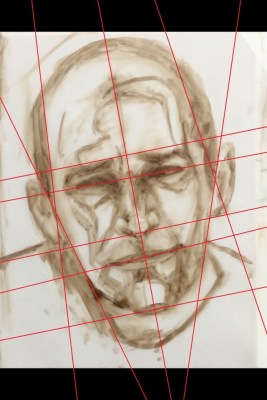
After toning a sheet of Mylar (see previous post) with raw umber and letting it dry, I sketched out the image in thinned raw umber. Then I took a photo on my iPhone and using the Miira app, traced lines on my drawing to compare it to the original photo (first photo below). I could see I’d completely missed the boat and started another sketch on a fresh sheet, tested it again, and decided I was close enough to begin painting.

Later, I realized the mouth was in the wrong place and moved it. I discovered that when you turn a painting on Mylar over you can see the original drawing through the film (see the red arrow on the reversed image below, pointing to where I moved the mouth). I’m really trying to see the shapes and planes that make up the face and head. Holding up a bamboo skewer or knitting needle along the angles and “plumb lines” of the face really helps to visualize what lines up with what, and is helping my drawing tremendously.

Categories
Art supplies Faces Oil Painting Painting People Portrait

Portrait of Pigeon Plumtree III

Portrait of Pigeon, oil on Duralar Matte, 12x9"
Portrait of Pigeon, oil on Mylar Duralar Matte, 12×9″

I took a fantastic 1-day Alla Prima Portrait Workshop with the amazing Elizabeth Zanzinger at her studio in Oakland. I spent most of the day watching and listening to her, which was my goal; to observe and learn from her. It was a revelation to see her approach to alla prima painting, which begins with dots to mark the edges of shapes and features and then proceeds with small tiles of color and value painted along the planes of the form. You can see her completed demo painting on her Instagram.

In the late afternoon I started my own painting but ran out of time. Fortunately, our model, the exquisite Pigeon Plumtree III, generously allowed us to take photos of her for a small fee. Although my iPhone wasn’t quite up to the task because of the lighting, it gave me enough information to make another attempt at painting her.

We painted our portrait studies on Mylar Dura-Lar Matte Film, similar to the Canson Vidalon Vellum that Sadie Valeri uses, but twice as heavy. Elizabeth tones the Duralar first with a thin film of raw umber which she allows to dry before starting to paint. I absolutely love painting on this surface; it is so smooth but not too slippery and very forgiving. It’s archival and can be mounted to a panel later to be framed.

Below are a few steps in the work in progress. Click any image to enlarge or view as slide show (and then click the x in the top left corner to return to this page).

Categories
Drawing Faces Gouache People Portrait Sketchbook Pages

Portrait of Richard for Julia Kay’s Portrait Party

Richard for JKPP, Gouache, 7.5x6 inches
Richard for JKPP, Gouache, 7.5×6 inches

I really tried to focus on two things with this portrait, getting the drawing right and keeping the gouache colors light (gouache dries darker). For once I managed to keep a tilted head tilted in my drawing–for some reason my brain always wants to make everything upright and symmetrical. It doesn’t surprise me since I learned that the image that comes in from our eyes is upside down and it’s our brains that convert it to right-side up. My brain definitely has a mind of its own…oh wait a minute–it is my mind!

Below is the original pencil drawing over which I painted the gouache. I wish I could show you the photo I worked from, but I think those are only meant to be visible to members of Julia Kay’s Portrait Party, which you can apply to join on Flickr and play too, if you want to.

Richard for JKPP, Graphite, 7.5x6 inches
Richard for JKPP, Graphite, 7.5×6 inches
Categories
Faces Oil Painting Painting People Portrait

Meet Morton Skullman

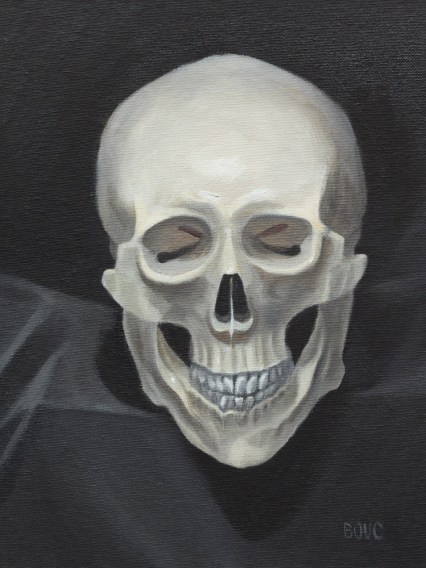
Morton Skullman the Man Skull, oil on panel, 12x9"
Morton Skullman the Man Skull study, oil on panel, 12×9″

I painted my skull model, whom I call Mortie Skullman, to kick off my painting for 2015 since my plan for this year is to focus on portraits, mostly of people (but also of dogs of course, my favorite subject). The process I followed for this study was based on the approach David Jon Kassan takes on his online skull painting video, “Premier Coup” (only $1.95 to rent for 1 week). It was fun painting along with him, taking inspiration from the thoughts he shared as he worked.

The process starts by drawing and blocking in with PanPastels using Sofft Tools and then moves on to oil paints. You can paint over PanPastels without need for drying time or fixative and they can be completely erased with any eraser, making them ideal for underpainting.

Below is the setup and most of the painting sessions in progress.

Categories
Digital art Faces Life in general Oil Painting People Portrait

Two Very Different Portraits of Very Different Women

Portrait of Cyndy, oil on panel, 8x10"
Portrait of Cyndy, oil on panel, 8×10″

I painted this oil painting from a 2nd generation scan of a difficult photo. The harsh shadows, eyes hidden behind sunglasses, and brilliant fall foliage in the background created a challenge. But this was the photo her husband wanted painted so I did my best. The subject of the painting is a beautiful woman, a brilliant researcher and educator, a terrific hostess and a wonderful mother. It was a pleasure to paint her, even with the technical challenges.

Caricature of Cristina, sketched on iPad in Art Studio
Caricature of Christina Aguilera, sketched on iPad in Art Studio

Like I said, very different portraits, very different women. I sketched this on my iPad while watching The Voice, a singing competition TV show on which Christina Aguilera was a judge. I don’t understand why the women on these shows wear skin-tight clothes and so much make up that they look like cartoon characters, but at least it makes them easy to sketch since they already look like caricatures of themselves.

I’m enjoying Nicki Minaj on American Idol. She goes even further in the makeup, false eyelashes and wigs department, looking even more like a cartoon character…and acts like one too, the way she says absolutely any random crazy thing that goes through her mind. Sometimes she’s really funny.

I guess not just movie stars are wearing false eyelashes now. The receptionist at my eye doctor’s office gets hers glued in at the salon when she has her nails done. I’d rather buy those hairs glued into a handle of a brush to paint with. Much more practical, don’t you think?

Categories
Drawing Oil Painting Painting People People at Work photoshop Portrait Series

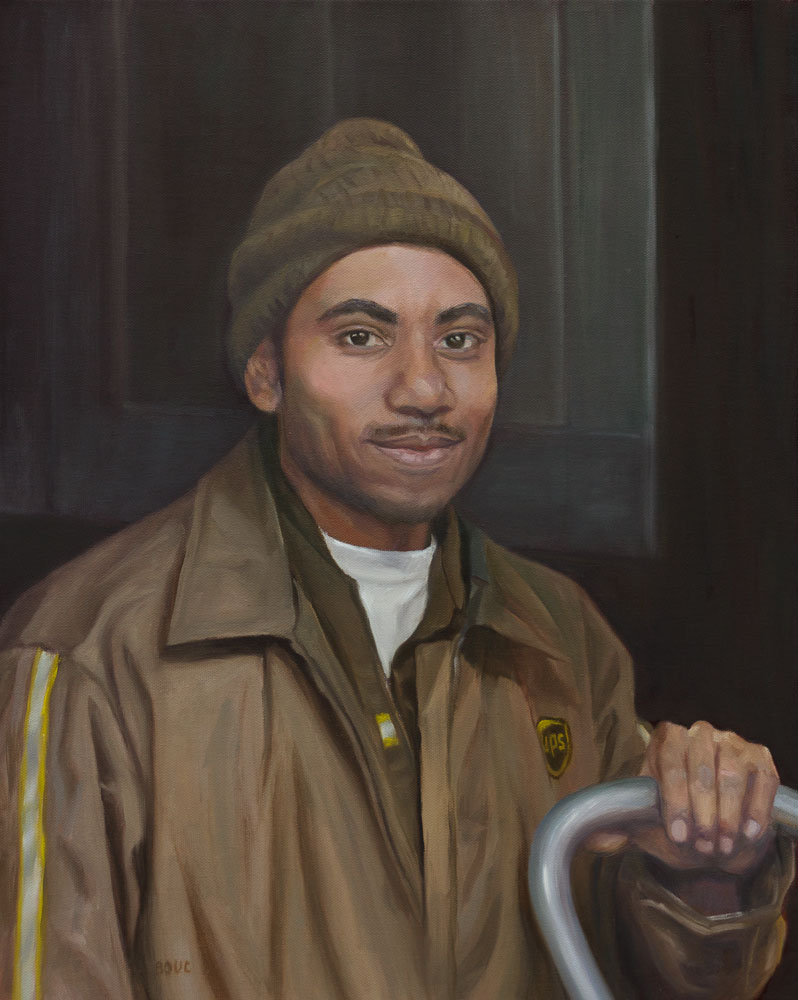
Brown Delivers…in the Dark (portrait in oil with steps in the process)

UPS Delivers at Night, Oil on Canvas, 20×16

(Update: This painting won second place for Portrait of the Year on Making a Mark in 2012.)

One night last winter two UPS guys arrived in the dark to deliver a dozen boxes of the flooring materials for my studio. I had started a series of paintings of people at work (still in progress) and asked if I could take their photo to use for a painting. They agreed and were great models!

A couple of months ago he called, asking about the painting, inspiring me to finally finish it. There were some magic moments along the way (see process photos below), such as the one where I did a quick first pass on his hand and then stepped back and said “Wow! That works and I’m not touching it again.”

Since I took the photos at night without flash outside lit only by the fluorescent lights from inside the studio, the photo was dark and the colors were, well, mostly brown. But the UPS slogan is right, BROWN really does deliver! Who knew there were so many shades of brown? I must have mixed a hundred different browns.

Below are photos showing the process of drawing and painting this portrait.

Categories
Art theory Oil Painting Painting Portrait

Frankie Flathead Finally Painted (Planes of the Head Grisaille Study)

Frankie Flathead Planes of the Head Study, oil on canvas panel, 11x14"
Planes of the Head, Grisaille study, oil on canvas panel, 11×14″

When I bought a “Planes of the Head” life-sized plaster cast two years ago I wanted to learn more about portrait painting. I put it on display in the studio and studied it. I knew I should be drawing and painting from the cast, but hoped learning would happen by osmosis since it didn’t really inspire me as a painting subject.

Planes of the Head Plaster Cast

Then I got curious about grisaille techniques after seeing beautiful paintings that began with that approach. I watched the excellent video “How to Paint: The Grisaille Method” by Jon deMartin (in which he paints from a cast of Julius Caeser) and decided to try grisaille using homely Frankie Flathead, my Planes of the Head cast, as my model. See bottom of post for a clip of the deMartin video.

Planes of the Head Open Grisaille
Open Grisaille in which Frankie resembles a demented old perv

I was going to display all my steps along the way, but my photos weren’t good enough. Above is the first stage, the “open” grisaille, which means it’s painted thinly, using only transparent washes of grey (or in this case, burnt umber) and wiping paint off to achieve the lighter values. At the top of the post is the “closed” grisaille, made by mixing and applying a range of values opaquely, using white and the same burnt umber on top of the original “open” grisaille.

One of the most powerful things I discovered in the video is the way light changes across planes.

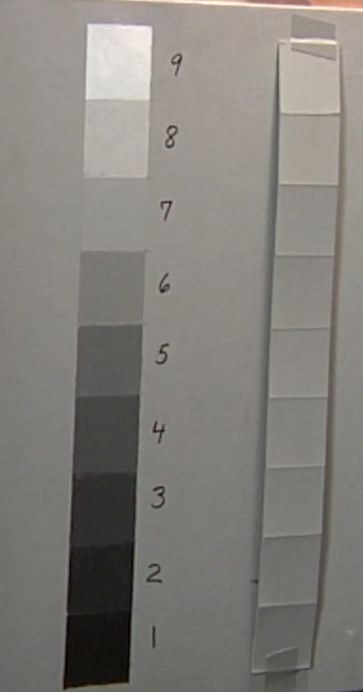
Gray scale and strip painted 50% gray
9-step Value Scale (white to black) on left and strip painted Value 4 Gray on right (screenshot from video)
Same Value 5 gray strip curved to show the range of values as it turns from light
Same Value as image to the left but the Value 4 Gray strip is curved to show the range of values as it turns away from light (screenshot from video)

When bent so planes are at different angles to the light, the gray strip on the right seems to have all the values in the 9-step value strip on the left. Isn’t this a powerful demonstration of the effects of light and shadow?

My first attempt at grisaille was  interesting. I made many mistakes and got lots of good practice.

My finished painting isn’t great, but doing the study helped prepare me for the next lesson I gave myself (and that I enjoyed more and will post soon): starting with a grisaille to set the value structure in a still life and then adding the color in the same values.

Below is a clip from the video. I was very curious about how grisaille works so it was worth the $35 to download the three-hour program, also available here to watch online and DVD.

(Disclaimer: I have no connection to or receive no benefit from writing about these products)

Categories
Oil Painting Painting People Portrait

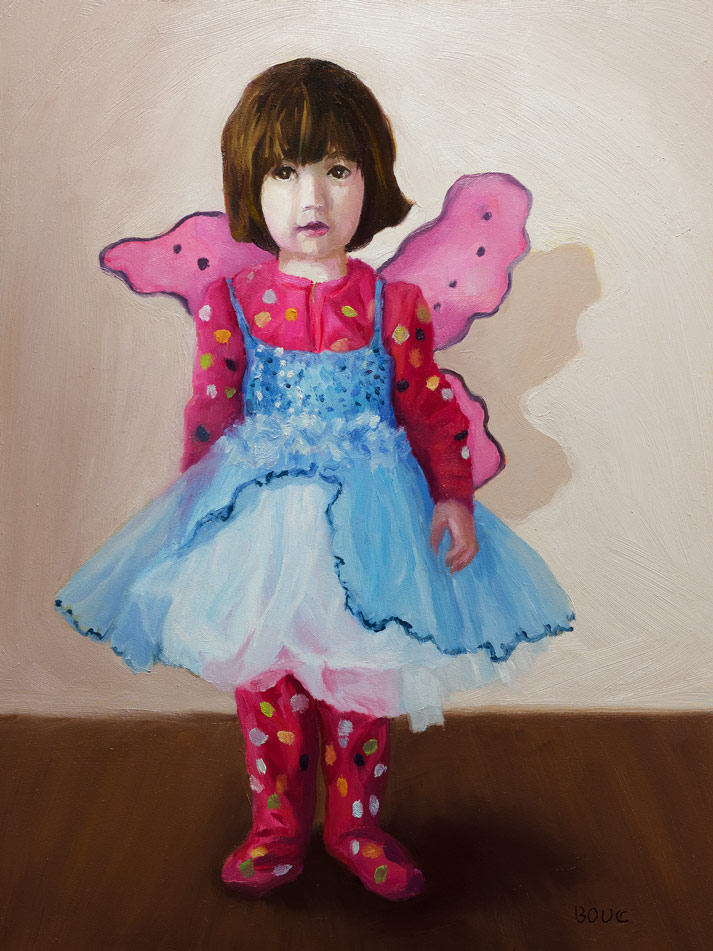
Portrait of Violet: An Angel in Jammies and Tutu

Portrait of Violet: An Angel in Jammies and Tutu; a little girl playing dress-up.

When one of my sketch group members sent me this photo of her little girl, I had to paint it, despite having never painted my own kids (except as they appeared in a dream once, as a bear and a tiger).

The original photo was taken on an iPhone with a busy background of kid’s toys and furniture. I experimented in Photoshop with different backgrounds and color schemes. I tried some in paint. But in the end I chose this simple grayish-warmish-whitish background.

I thought about putting some of her toys from the photo in the painting but decided I like the way she’s alone in an empty space. It reminds me of my own childhood photos where I usually looked kind of alone and perplexed about the big world around me. I guess that’s an example of how whatever the artist paints, she’s painting herself too.