My wonderful sister Marcy and niece Sophie gave me this little succulent garden in a bowl for my birthday, wrapped with twine with a little ticket for a card. When the plants outgrow the bowl she said I could just stick them in the ground and break off little pieces to stick back in the bowl.
They’re easy to care for: very little water and some sun. A week later they’re still alive and well; a good sign. I only have one other houseplant, an orchid I was given as a remembrance of my father’s passing. It’s been nearly 10 years and that orchid continues to thrive and bloom nearly constantly, despite my lack of a green thumb and tendencies toward plant abuse. (I tend to enjoy drawing plants more than caring for them, but I think that’s changing: I repotted my orchid last week and that was quite satisfying).
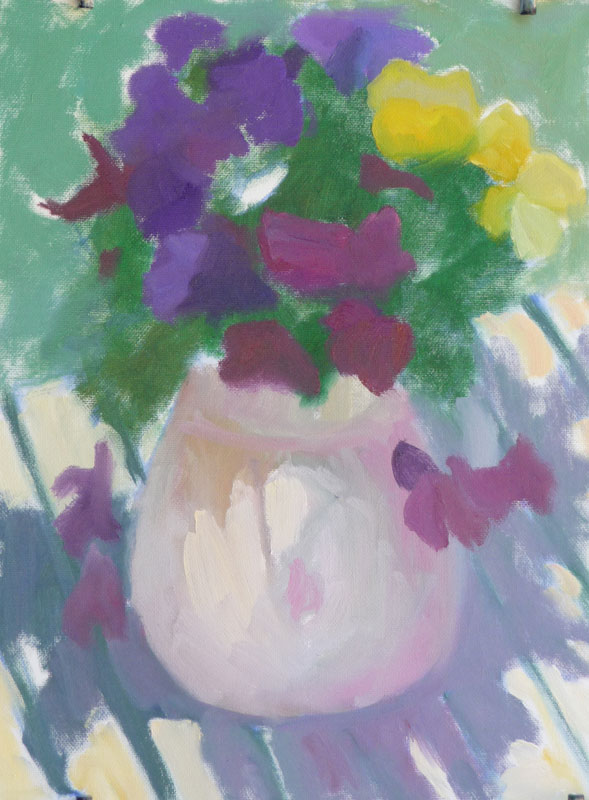
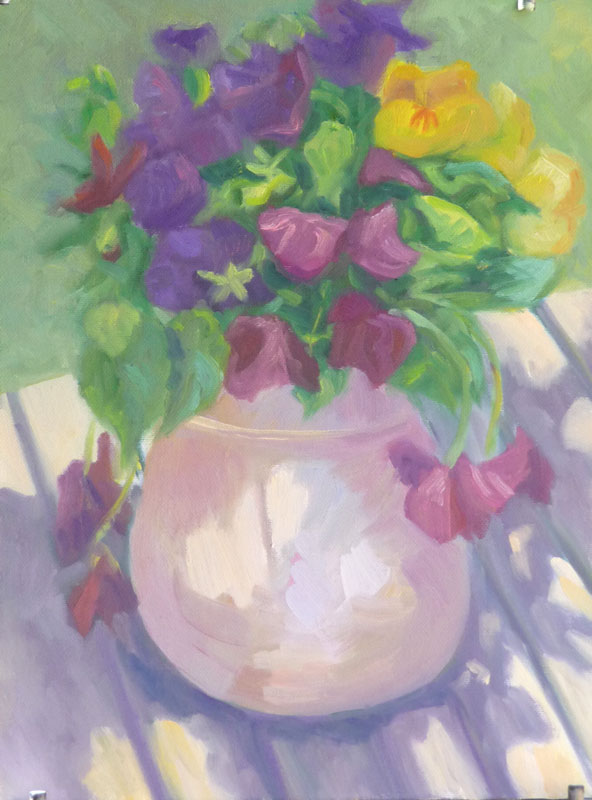
The weather was too perfect to paint indoors but I didn’t feel like driving anywhere. My next door neighbor was out pruning his pansies and he’d pulled out a whole bucketful he was about to put in the compost bin. Voila! A perfect painting subject. I stuffed a big clump of the pansies into a pitcher and set them on a table in the backyard.
I’d made the pitcher as a gift for my friend Barbara in the late 70s when I was a ceramic artist and she was a silversmith. She’s now a brilliant and prolific ceramic artist herself and she recently gave me the pitcher back. She was no longer using it due to a leaky crack and a house full of her own ceramics. I’ve been enjoying using it in still life set ups while fondly remembering it being filled with Mimosas every year for the annual Easter egg hunt and brunch her family held every year while our kids were growing up.
I knew that time was very limited before the shade moved across the yard onto the table so I worked quickly and had a great time.
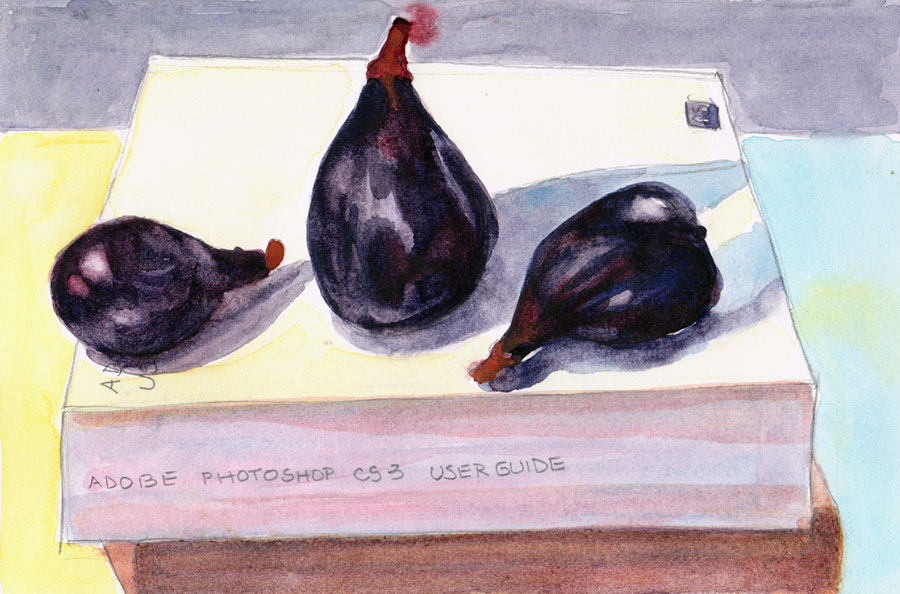
Figs on Photoshop Manual, Pencil and watercolor, 6x9
These organic figs were disappointingly tasteless and so they became still life subjects instead of eating objects. I’ve been using the heavy Photoshop manual (seen under the figs) as a weight on top of the the Fabriano Venezia sketchbook when I scan it. My new copy of Photoshop CS4 doesn’t come with a manual, although there is one online that can be downloaded and saved.
I’m one of those weird people who actually read manuals. When I get a new application I always read the manual first, to find out what the program can do and then I refer to it when I need to figure out how to do one of those things.
I don’t like reading on the computer but I refuse to pay another $55 for a manual that should have been included in the first place. In the meantime, the old manual makes a very nice paperweight or doorstop (or still life holder). 824 pages! And I read/skimmed the whole thing when I got it.
The first hydrangeas of the season provided an opportunity to try out ink and watercolor in the Fabriano Venezzia sketchbook I posted about yesterday. First I drew directly in ink and then tried painting the flower on the right by wetting the paper there, and painting into it. I didn’t like the results and tried lifting off the paint with a tissue and was pleased and surprised that it came right off, leaving only a slight stain. Then I painted back into the damp area and got the results I wanted and completed the rest of the painting working very loosely.
The painting was easy compared to trying to get the image in the sketchbook scanned or photographed for posting. The image above was the result of clamping the edges of the sketchbook to photograph it (see below) and then using Photoshop’s Clone Stamp tool to “erase” the clamps and then using the Levels and Dodge tools to clean up the shadows caused by the paper buckling and some reflections from the light source.
Ready to photograph
I also tried scanning the page in the sketchbook but encountered the same problems I had yesterday with severe blurring plus shadow from the seam. I (want to) like this sketchbook, but preparing the images for posting is really a hassle. Even if I wasn’t working across the spread and just painted on one page I’d still have the problem with the shadow and blurring since it happens on the righthand page.
Scanned version, after major touch-up
Have you had this problem and solved it? I’d be so grateful for suggestions!
Stripey Still Life with Lemon, 10x8", oil on Gessobord
Getting the drawing right before beginning to paint is so important when trying to paint realistically. Although it’s theoretically easier to correct drawing errors with oil paint than watercolor, it’s still a lot less fun than painting with a good drawing. As you can see from the start of this painting below, I hadn’t quite nailed the elipse on the top of the pitcher before I started painting.
Stripey Still Life start
I wanted to get started with the painting quickly because I knew the leaves from the lemon tree were going to change wilt, even though I had inserted the stems in a little florist tube with water (and they did!). But by not getting the elipse on the top of the pitcher drawn correctly, I ended up redoing it over and over and finally giving up. I am happy with the way the fabric under the pitcher turned out, as well as the lemon and didn’t have to do any repainting on those areas, although I did change some of the fabric as I painted.
Stripey still life photo of set up with wilted leaves
On my next still life, I’m going to sketch the composition on tracing paper first, and then transfer it to the painting panel, rather than trying to sketch it on the panel. Maybe that will make the painting more fun and less of a struggle.
On Mothers’s Day my wonderful neighbors brought me this lovely bouquet of roses in a crystal vase. Then all three sweet kids wished me Happy Mothers’ Day and gave me hugs. I have the best neighbors. I took the flowers outside and sketched them twice, sitting on my studio porch steps.
The sketch above was done by painting directly with no drawing. The one below was drawn first with my Pentel Brush Pen and then painted with watercolor. Both are in the large Moleskine watercolor sketchbook.
Mothers' Day Flowers #1, ink & watercolor
It was a pretty special day. Son #1 asked his girlfriend of 5 years to marry him (and she accepted) atop a tower in Turkey, son #2 grilled a delicious dinner for me and his family, and I started the day with a great hike with my best friend Barbara. Life is good!
Inspired by Casey’s success with the Carder Method and frustrated with my own slow progress at oil painting, I bought the Carder Method video and Color Checker tool. Below are step by step photos of my using the method to paint this still life, a brief review of the Carder Method and photos of my studio set up for working with it.
The Carder Method is designed to eliminate many of the problems that can make painting difficult. By creating an carefully lit, controlled environment, a painter can focus on learning to clearly see color and value differences while eliminating problems caused by variables such as changing light.
Click “Continue Reading” to see photos and read more….
Stolen Roses, Ink & watercolor, in 5x7" wc Moleskine
As Maya Angelou said her grandmother always told her, “You don’t always get what you pay for, but you always pay for what you get.” As a believer in Karma and Maya Angelou’s grandma, I was a little nervous about stealing my neighbor’s roses.
But that neighbor moved away a year ago and her roses were producing those first magnificent blooms of the year. I just couldn’t resist cutting a few to sketch. I drew them with my Micron Pigma .01 and then added watercolor. I wasn’t happy with the results so experimented with adding white lines with a new white gel pen, a “Y&C Gel Extreme .07” which I like it a lot. I liked the sketch (above) better too.
I decided to sketch them again and used my Micron Pigma with a lot of cross-hatching to try to understand their form in a more sculptural way.
Stolen Roses 2; ink, gouache, watercolor
Then I added watercolor and made a big mess. I couldn’t capture the delicate coloring from white to yellow with red edges of one of the roses . So I tried adding gouache. Yuck, worse mess. I washed off the paint and tried again. More mess, and this time I lost a lot of the black lines. So I got out a Sharpie fine point and went over the black lines with darker ones. More gouache, yuck, some white pen, gave up.
Then I took a bunch of photos of the roses, thinking I’d start an oil painting and keep a photo reference in case the painting took longer than they lived. Pretty soon I was coughing and sneezing and my eyes were watering. These roses were very fragrant and I was allergic to them (unlike the ones in my garden that I selected for their lack of scent). I put them outside and gave up. I guess I paid for what I got!
I couldn’t resist drawing this one cutting from my camellia bush instead of going straight to the oil painting I was planning to do of the little bouquet of camellias I was assembling. I wanted to enjoy deeply seeing all the shapes and connections and patterns and reflections and colors in the leaves, buds, and flower.
I realize now that I should have gone a little more slowly when I was drawing the flower petals so that I could really capture the personality of this particular flower, the way I did with the leaves and bud. But I think it was making me dizzy, trying to follow all those different curly shapes and ins and outs of the line so I got a little lazy and generalized instead of paying absolute attention and getting it exactly.
I’m always torn between going for the detailed exactitude of botanical illustration and the way oil painters say to skip the detail, skip the individual petals and paint the mass, the form instead. I see the value in both but combining them in one painting rarely satisfies either goal.
I spent hours and hours standing at the easel this weekend, determined to once again try to paint a portrait of a little boy whose photograph I took a couple years ago at the San Francisco Museum of Art. After many hours and sore feet, below is how the painting turned out:
Canvas painted over with white paint
It had a few promising phases but I just couldn’t “execute” any of them to completion. At the end of the day I gave up and saved the lovely linen canvas to reuse by painting it over with white paint.
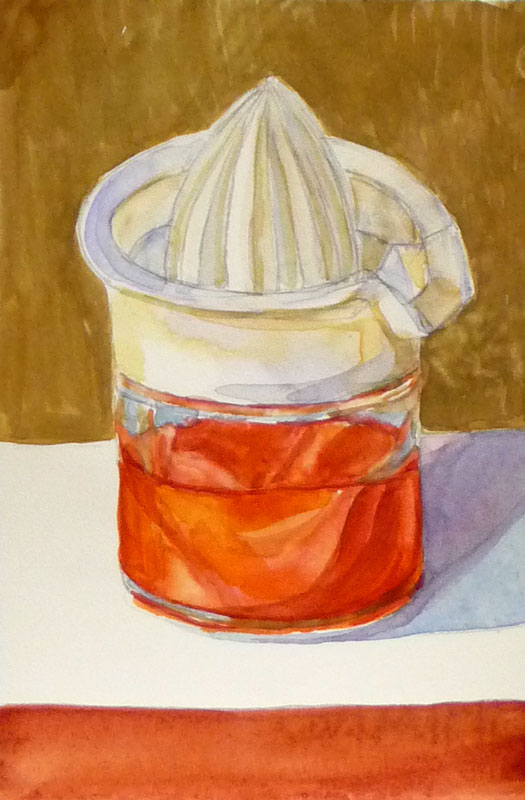
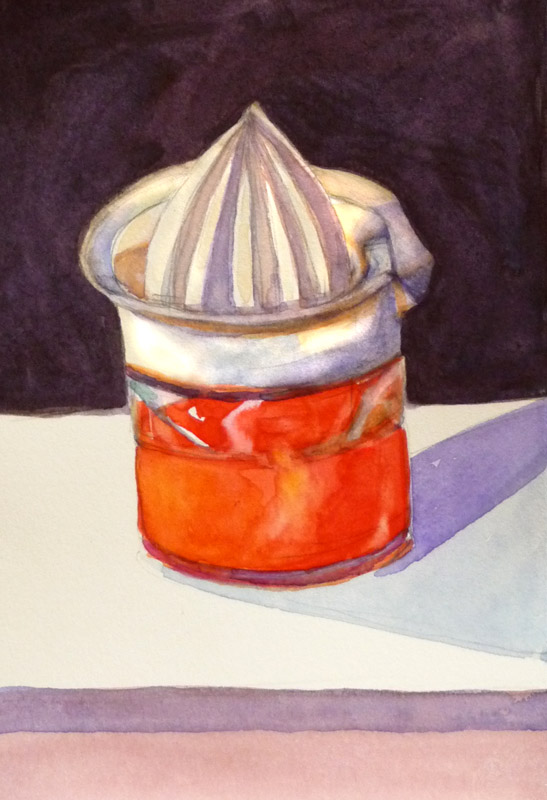
Tonight I decided to do something in watercolor just to try to have a little fun. When I went looking for a subject to paint everything seemed tired and insipid. I think I’ve seen one too many meaningless little still lifes with a clove of garlic, a lemon slice, or an apple. I started wondering, “What’s the point?” so the pointy juicer seemed a perfect subject.
I wasn’t happy with the first (overworked) version below, so I tried it again and the second version is at the top of the post. I didn’t have an orange to juice so I made pretend orange juice with watercolor paint.
What's the Point? watercolor on hotpress paper, 6x4"
Since I’ve been in a stuck place for a couple weeks I’ve been trying to figure out what kind of artwork would bring back my creative juices. Just making pretty pictures, developing good enough technique to be able to make classical still lifes or impressionist landscapes or traditional portraits isn’t it. So I made a list of what I do enjoy:
going out sketching with ink, watercolor and sketchbook
painting subjects with emotional content (like the two autobiographical series I’m planning)
painting large, getting lost in the painting, having unexpected things appear and running with them
drawing complicated subjects or painting details in watercolor
painting my crazy dreams
creative thinking to come up with concepts and images based on one-word challenges like Illustration Friday offers
painting without a lot of planning, just jumping in and seeing what happen
I was stuck on #2 because I was envisioning working with large canvases (30×40″) but thinking about the cost of the canvases and the paint to cover them, and where I’d hang them or store them if I actually made as many in the series as I intend…. and then as I was writing about this in my journal I realized the solution:
Just start! Go for it! Go wild! Play! Forget about the product and enjoy the process. So I’m going to START with the bigger of the canvases I have on hand and just keep going from there. And I’m going to get out and sketch more.





 Jana Bouc, Artist