Categories
Art supplies Art theory Flower Art Published work Sketchbook Pages Still Life Studio Watercolor

Refusing to Fail or Quit: It was either me or the orchid…


Orchid in watercolor #2, 12x9"


On Wednesday night I completed the last page in a sketchbook with some writing about the frustrating process I’d been through with the orchid painting. And then, as I did one last sketch of the orchid in the book (below) I realized how I might be able to actually make the painting I’d originally envisioned. It would be one I could do simply and be able to write about as the six-step process the publishers needed.

When I woke up on at 6:00 a.m. on Thanksgiving morning I realized I had to give it another try. The image above is the happy result.


Oh Oh Orchid!
My sketchbook breakthrough

Tonight my watercolor group met for dinner and a chance to share what we’ve been painting this month. When I showed them the two versions of the painting they liked both but Susie said that in the first version they looked like evil man-eating orchids, which is certainly how they felt to me. In the sketch above I thought the orchid looked like it had packed his bags and was running away, suitcases in hand. (Good riddance!)

Here is one of the MANY pages of tests and samples I made in trying to find the right pigment combinations to make this painting work.

Orchid watercolor test page

I decided the pigment that gave me the color I wanted was Winsor Newton’s Quinacridone Magenta but like most quinacridones,  it wasn’t very civilized, trying to spread everywhere.
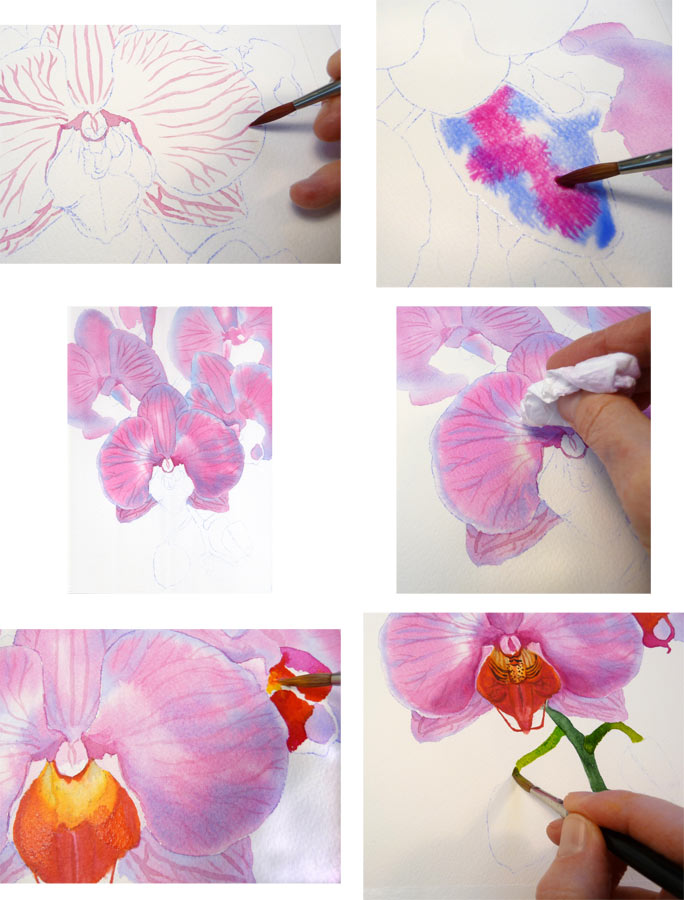
Orchid Painting Steps

What finally worked was painting the veins first on dry paper, wetting a petal, painting cobalt blue just inside the perimeter and then dropping in the Quinacridone Magenta in the center, letting it spread and then blotting up a bit of the paint as needed.

Busby relaxing amidst orchid chaos

At least someone got to relax in the sun. When I left to make a cup of coffee Busby napped amidst the orchid chaos on my desk. You can see the original reference photo peeking out from under him, with a pile of false starts at the painting behind that.


Categories
Art theory Flower Art Painting Still Life Watercolor

Orchid Painting in Watercolor for the book but….

Orchid painting in watercolor, 8.5" x 11.5"

So here’s the frustrating thing: I learned that the publisher wants me to write the text accompanying the step by step photos as instructions (first do this, now do that) rather than a description of what I’ve done. Sometimes watercolors go as planned and that would be simple to do, because what I did is how I would tell someone else to do it.  But with this painting there was just as much taking off of paint as there was putting it on. Some of that was about softening edges with a damp brush and then blotting, but some of it was just removing paint that wasn’t working. I’ve never seen a “how to” book that says paint on a nice wash. Now wipe it off.

My biggest problem with this painting was the photo I had to work from. Like many artistic photos of flowers, it was shot without shadows or directional light and therefore everything was very flat with little dimensionality. Even more difficult, everything except the front center flower was intentionally out of focus. That makes for a lovely photo but not an easy watercolor painting project. And there is no variation in color: they’re all just cotton candy pink with dark magenta veins. And I picked the stupid photo and thought it would be easy. But for me, what is easy is lots of detail and variations in color, shape and value.

I started over four times, each time getting a little further and then abandoning ship. If I was just painting for myself any of those starts would have been fine and enjoyable to paint but I was finding myself exaggerating shapes and colors and losing fidelity with the photo.

Now I’m not sure what to do: Paint this again in order to be able to do write a logical “how to” that doesn’t include undoing previous steps? Write a “how to” and leave out the do-overs? Enjoy my vacation this week and forget about the whole project? (the latter sounds most appealing)

I think I’ll send a photo of the painting to my editor and see if she even likes the painting. My persistent (compulsive?) side really wants to paint the painting again, trying to do it more simply and cleanly. But my (sane?) side says “Go have a bowl of ice cream and watch a movie.” I wonder which side will win and how late the ice cream shop is open?

Categories
Art theory Flower Art Painting Plants Still Life Watercolor

Painting for the book: Part III ~ Finale

"Sunny Serenade", watercolor, 15.5"x10.5"
"Sunny Serenade", watercolor, 15.5"x10.5" (click to enlarge)

The editor requested that I name the finished painting (above). Corny painting names are a pet peeve of mine and so I rarely name them. But as I was uploading the image the name “Sunny Serenade” came to me. I know that’s about as sappy a name as you could try to invent, but since it seemed to name itself, so it shall be.

To finish sharing the steps in the painting, here they are in order, continuing from the previous post.

Painting the green leaves, flowers and stems

The next step was to work on all of those leaves, stems, buds and little yellow green flowers. Using a variety of mixed greens, some neutralized with Burnt Sienna, I painted the first layers of the leaves. I also glazed details over the yellow green flowers I’d painted previously.

Adding the darks
Adding the darks

I mixed up several puddles of these dark mixtures: Winsor Green, Alizarin Crimson, and Burnt Sienna; Ultramarine Blue and Burnt Sienna; Sap Green and Sepia with a dab of Winsor Red; Winsor Green and Winsor Violet. Then I loaded my brush with one and started painting a section, switching to another one of the puddles as the background colors changed. I was careful to stay within the dark shapes and to negatively paint around lighter shapes. Because watercolor dries lighter, I tried to mix colors that would be dark enough in one layer.

I thought I was finished and signed the painting. The next day I studied the painting with fresh eyes and realized I needed to make some adjustments. I glazed in some more darks on the right of the pitcher and on its handle on the left. I added a middle-dark green mixture to the long leaf that hangs down along the right side of the pitcher and on some other leaves as well. (Compare the pitcher in the top two pictures in this post to see the changes).

While some people have commented that this painting seemed very challenging, in fact an image broken into many small complicated shapes is much easier to paint and more forgiving of “mistakes” than one composed of large simple shapes.

My editor liked the painting and immediately requested the next one, due the end of November. It will be a completely different project: a close up view of some pink orchids with a light background. I will be working much more loosely, mostly wet into wet.


Categories
Art theory Flower Art Painting Published work Still Life Watercolor

Painting for the book: “Must Paint Watercolor Flowers” – Part II

Starting orange flowers; softening an edge

Continuing on from Part I, here is a close up as I began to paint the yellow and orange flowers. For the first layer of this flower I painted the darker sections and then used clear water in a damp brush to pull/feather the color out into the flower so it didn’t make a hard edge.

Yellow underpainting of some flowers
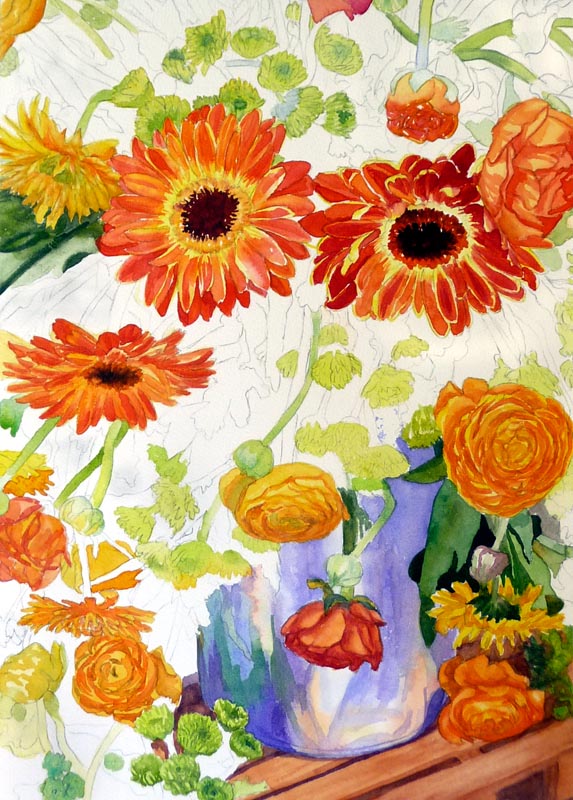
Yellow underpainting (click to enlarge)

For the three large zinnias, I outlined all the petals with Holbein Cadmium Yellow Light. Then I brushed a ring of clear water around the center of each of those flowers and painted a narrower ring of yellow inside that so the paint would softly spread in the water to not quite the edge of the water, producing a soft edge. When that dried I painted the flower’s very dark center with a mixture of Winsor Newton (WN) Burnt Sienna and Winsor Violet. Then I painted the gold ring between them with WN Cadmium Orange mixed with Daniel Smith (DS) New Gamboge.

Painting one petal at a time

I began applying mixtures of WN Cadmium Orange, WN Permanent Rose and DS New Gamboge to one petal at a time while avoiding painting over the yellow outlines on the petals,. You can see the juicy puddle of color I like to put down. I’m careful to let it dry without shifting the tilt of the paper to avoid backwashes.

Orange flowers completed

I worked all over the paper, turning the painting sideways and upside down instead of reaching across, to complete all of the yellow and orange flowers. Some of them will get touch-ups before the painting is completely finished.

Next time: more greens, the dark background, and the finished painting. Meanwhile, I’ve been assigned the next painting to do: a lovely orchid which I will approach in a completely different manner.

Categories
Art supplies Art theory Drawing Flower Art Painting Published work Sketchbook Pages Still Life Watercolor

Painting for the book: “Must Paint Watercolor Flowers” – Part I

Rehearsal: Sketchbook pages

I was given permission to post some of my work on the upcoming book, “Must Paint Watercolor Flowers” (Quarto Publishers, London) for which I’ve been commissioned to paint three floral watercolors.  The painting is the easy part; taking the photos, correcting them in Photoshop, and writing about each of the steps takes much more time and isn’t nearly as much as fun. I thought I’d break this into a few posts so they won’t be too long.

My first step after being given my choice from a couple dozen excellent photos (which I’m not permitted to post) was to do some rehearsals in my sketchbook. I used several pages to experiment with how I wanted to approach the metal pitcher,  mixing colors for the leaves, the buds and the yellow-green flowers (above). Then I experimented with color mixtures for the orange flowers and the large amount of darks (below — combinations of Winsor Green and Alizarin Crimson, Ultramarine Blue and Burnt Sienna, Sap Green and Sepia, Winsor Green and Winsor Violet).

Rehearsal - Sketchbook p. 2

Next step was to transfer the photo to my watercolor paper. Initially I was going to make the painting small enough to fit on my scanner but decided to use the maximum size the publisher allowed since it was such a complex painting.  I chose a 12 x 16″ Arches 140 lb. cold press watercolor block  (block is easier to set up for photographing). If I’d been given more time and/or if the photo wasn’t so complex, I probably would have transferred the image by drawing freehand or using a “gridding up” method but with a two-week deadline I used a quicker method.

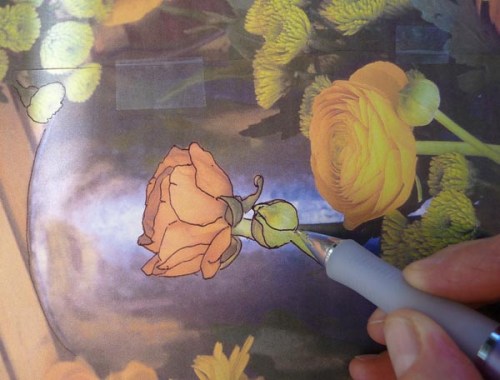
Transferring the photo to watercolor paper

I enlarged the photo in Photoshop and printed it in sections (before figuring out I could have more easily used my copier to do the same) and taped them together. Then I placed a sheet of Saral Transfer Paper on top of my watercolor paper and laid the enlarged print on top of the Saral. Using a ballpoint pen, I traced over the shapes of the flowers, leaves, stems and shadows which transferred graphite lines from the Saral paper onto the watercolor paper.

Cleaning up the drawing

See what I mean about how complicated the image is! I’d left too much of an overlap on the tiled together enlarged photo and some areas didn’t get a good transfer so had to freehand some of the drawing, clean up some lines and darken others. This is my new favorite mechanical pencil, the Papermate PhD Ultra.

Masking near the pitcher

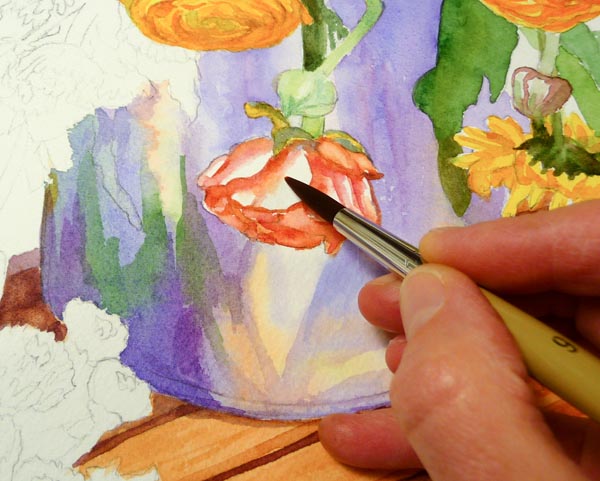
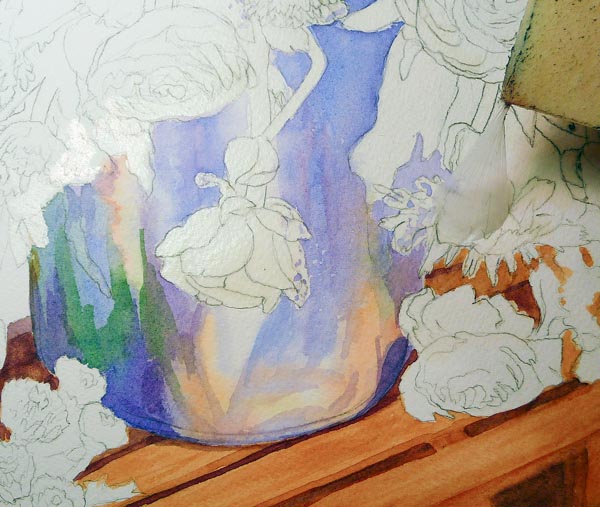
I wanted to paint the pitcher wet-into-wet and so I applied Winsor and Newton Colourless Art Masking Fluid to some of the shapes around and projecting into the pitcher to make it easier to paint wet into wet more freely. I used a cheap disposable brush to avoid messing up my good ones. I prefer Cheap Joes Golden Fleece rounds for watercolor and even though they aren’t expensive, I don’t want to ruin them with masking fluid.

Pitcher painted, removing masking fluid
Detail: Pitcher painted, removing masking fluid

I like pulling off the mask with the rubber cement pick up tool. I think it’s made out of the same stuff Vibram shoe soles are made from. The pitcher and the table have had their first washes. Next step is starting on the flowers and that will be in the next post.

Categories
Food sketch Painting Sketchbook Pages Watercolor

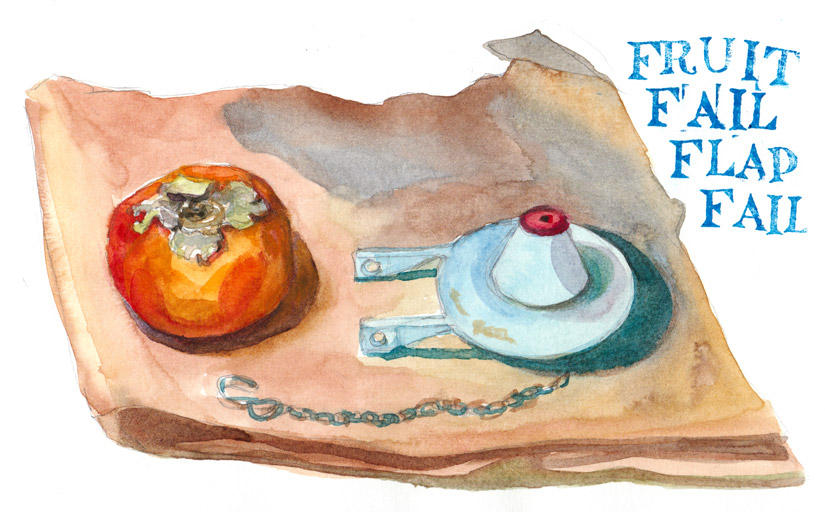
Fruit Fail, Flap Fail

Fruit Fail Flap Fail, graphite and watercolor 9x6"

When my toilet decided to start saving water by only doing half flushes, a knowledgeable friend took a look and said I needed a new flapper. He showed me how to remove the old one and told me to take it to my wonderful neighborhood hardware store, Pastime Hardware in El Cerrito, to get a replacement. I knew I would be going to Pastime to sketch with my Tuesday Night Sketchcrawl buddies so I waited until then to remove it.

Tonight was our sketchcrawl and it was so much fun. When I got home I wanted to sketch this intriguing failed flapper and thought it would be an interesting juxtaposition to pair it with this failed persimmon. (I waited too long to eat it and now it’s squishy and I just can’t eat squishy fruit.) This is the kind of persimmon meant to be eaten crisp.

I will post my hardware store sketches and a couple of amusing stories from our evening there, next time as sleep seems more important right now.

Meanwhile, if you aren’t familiar with the concept of something being “FAIL,” and have never seen the hilarious FAIL blog, I highly recommend a visit! Who knew there were so many ways for things to go wrong, from stupid signs, to stupid people. It always makes me laugh.

Categories
Drawing Flower Art Ink and watercolor wash Painting Plants Sketchbook Pages Still Life Watercolor

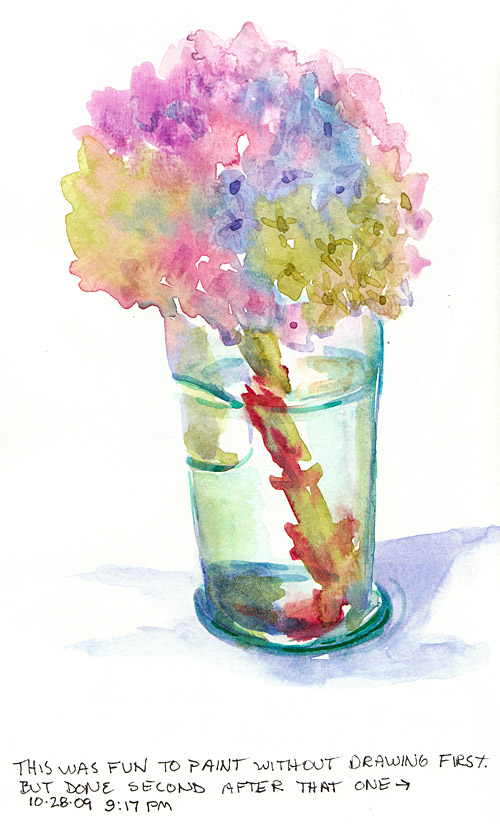
Wednesday Night with Hydrangeas and Windows 7

Hydrangea #3, ink and watercolor, 9x6"
Hydrangea in Cow Glass #3, ink and watercolor, 9x6"

I just needed some peaceful time at my watercolor table tonight to unwind. I’ve been admiring this hydrangea that’s been on my dining table in a little cow glass, the last remaining from a bouquet I’d picked. It’s soft pinks and greens were inspiring so I put on a book on CD and sketched and painted and listened to the story unfold.

Above is the third one, drawn first with a Pitt Artist Pen Sepia Superfine and then painted quickly with watercolor.

Below is the second one, painted directly without drawing first except with my brush and paint.

Hydrangea in Cow Glass #2, watercolor

And here is the first one, drawn first with pencil, then I wet the flower area, dropped in different colors and when dry painted a bit over it. This one got a bit overworked but had some nice moments along the way:

Hydrangea in Cow Glass #1, graphite and watercolor

You can see my notes in my sketchbook about never being able to remember the name of these flowers. I always go through a list of wrong names first and then have to look it up. It’s like the spot on my mental hard drive that once held the name “Hydrangea” has been corrupted and I just can get there anymore. But then I never really learned the name until a few years ago; we always called them “popcorn ball plants” when I was growing up.

I hope the colors look OK. I updated my computer to Windows 7 last night (finishing the final steps this evening) and things look a little different. Windows 7 is fantastic so far and the upgrade process was almost flawless. (Just one glitch with my graphics card driver that got resolved pretty easily.)

Categories
Art supplies Art theory Painting Still Life Watercolor

Better Bowl of Fruit, Better Watercolor: Now I Can Eat the Fruit!

Better Bowl of Fruit, Watercolor on paper, 7" x 10.5"

I’m so much happier with the way this watercolor of my bowl of fruit turned out than the one in my sketchbook. It makes such a difference to use Arches 140 lb cold-pressed watercolor paper. It also helped that I was painting consciously and taking my time, instead of rushing through it, half asleep as I had been when I made the sketch.

Even more fun is that I made the the large porcelain bowl when I was a potter and had glazed it with two of my favorite glazes…and now I was “glazing” it again, in watercolor.

I enjoyed every bit of the process, from planning the composition, to drawing (see below) from life, to masking the whites, then painting one shape at a time, using juicy washes, adding color wet-into-wet, as well as glazing over dried washes, then removing the mask, softening the highlights and some edges.

Fruit bowl pencil sketch on watercolor paper

Since I’m teaching a watercolor class right now, I tried to also pay attention to my process so that I could better explain to my students how and why I did what I did. I surprised myself with the range of techniques I was actually using in one painting. Even though in class we study them as separate techniques (flat wash, graded wash, wet-into-wet, etc.) you often need them all in one painting and sometimes in one passage of a painting.

(Boring technical stuff follows…read at your own risk…) For example, after the fruit, bowl, and shadow were painted I did a flat wash of Ultramarine Blue mixed with Burnt Sienna for the neutral background. Then it felt like the table top, which I’d initially left white with just a light blue shadow, needed paint too. So the first layer was a pale flat wash of Cadmium Yellow. When it dried it didn’t feel warm enough so I glazed over it with a flat wash of Permanent Rose (so that the whole table top was the pale apricot color now only seen on the right of the table top). It still wasn’t warm enough so I did another wash of Permanent Rose mixed with a little Cadmium Yellow and let it fade out 3/4 of the way across. I liked the way that looked but now the shadow was too pale. So I glazed over over the shadow a couple of times and then softened the edges of the shadow where it meets the table top.)

Categories
Gouache Ink and watercolor wash Sketchbook Pages Still Life Watercolor

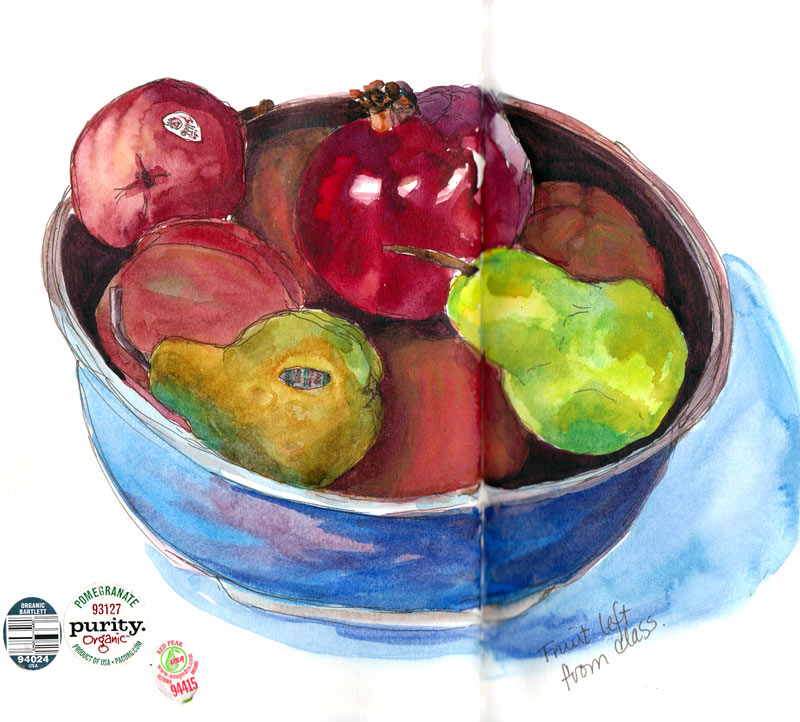
Just a Bowl of Fruit

Fruit bowl, ink, watercolor & gouache

It’s been such a busy week that I haven’t had  a moment for my blog until now. When my work week ended Friday afternoon it was time to prepare the studio for my watercolor class that started today. I’ve converted a second room to studio space for the duration of the class and I think everyone fit comfortably.

I feel so privileged to have such a great group of wonderful women artists in the class. And what troopers they were today, so determined to get the hang of doing flat washes, graded washes and glazing. By the end of the class everyone was doing beautiful, abundant, juicy washes.

I’d put out a couple of bowls of fresh fruit for class but nobody was hungry. So now I get to paint (and eat) all those yummy pears, apples and pomegranates.

After all the work on good paper today, I got frustrated by sketchbook paper that quickly muddies and doesn’t allow  reworking.  But I was so tired tonight it was either a quick sketch or nothing and since there’s been way too much nothing on my blog this week, here, at least, is something, as funky as it may be.

Tomorrow, rested up, I will try again on good paper.

Categories
Bay Area Parks Landscape Outdoors/Landscape Painting Places Plein Air Sketchbook Pages Watercolor

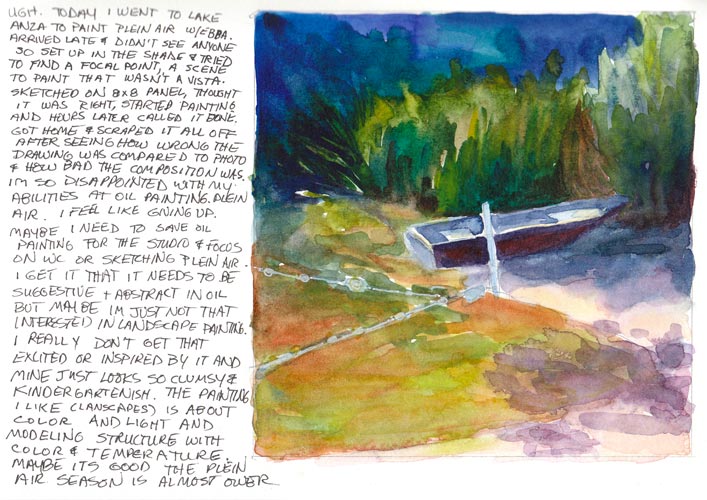
Lake Anza Watercolor Sketch

Lake Anza Row Boat, watercolor

When I brought home today’s plein air oil painting, I spent a few minutes messing with it, tried to fix it, and then just wiped it all off. Then I painted the scene in watercolor instead (above). I’m getting really frustrated with plein air oil painting and I’m starting to reconceptualize how I might approach plein air painting in the future.

I love being out in nature looking closely at it, and trying to capture it in paint. I also really like hiking in these beautiful parks. But when I paint with oils I focus on painting and then when I leave, I’m often envious of the people who hiked past me as I stood there in one spot.

My new idea is to bring my watercolors, sketchbook and my camera and spend half of the time walking and taking photos and the other half making watercolor sketches. Then I can use those studies, photos and my memory and experience of the place to either make larger watercolors or oil paintings in the studio.

I so admire people who can make beautiful oil paintings plein air.  I know that there’s nothing that can compare to seeing color and light and painting it right in the midst of nature’s glory.  But maybe it’s time to accept that it’s just not my forte and focus on the things that I both enjoy and can do with some modicum of success.

Lake Anza with notes
Lake Anza with notes in sketchbook