After a weekend of making paintings, scraping the canvas and starting over (with nothing to show for it but some learning) I accidentally knocked a 12 oz latte off the table, splattering the studio with milky coffee, requiring a major cleanup job. So tonight I thought it might be nice to stare at a pretty calla lilly that popped up in the garden, sketch it a couple of times and just calm down.
I drew the one above first, starting with a little pencil to get the shape right and then drawing with a Micron .03. When I finished I wished I’d skipped the ink.
Calla Lilly 2, ink & watercolor
With this second one I drew directly with the pen, but I liked the scratchy line even less (I think the pen is running low on ink or doesn’t like the paper) so went over it with a Pentel Brush Pen afterwards.
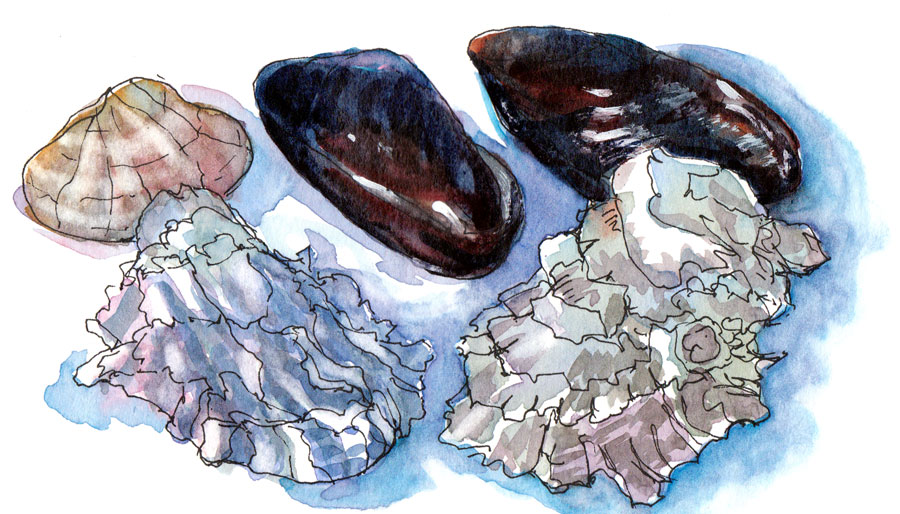
Shellfish Shells, original version, ink & watercolor, 5x8"
A shellfish company saw a previous shell painting of mine and commissioned me to paint one for them to use as a background on their business cards. They shipped me a box of their oyster, clam and mussel shells to use as reference. I created the above sketch in my Moleskine watercolor notebook and sent them the file for their review.
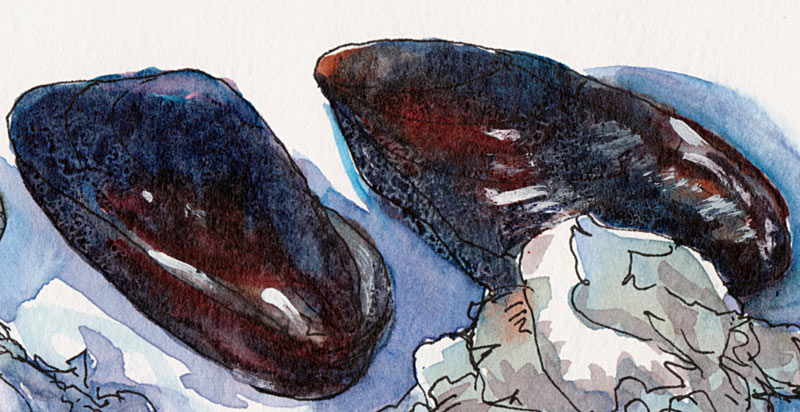
Close up: Accidental texture caused by painting on reverse page
On the next page in my Moleskine, I sketched a landscape and painted it with juicy washes, something I do on the 140 lb watercolor paper in my hand-bound sketchbooks all the time. Without my noticing, the water seeped through the lighter-weight Moleskine paper, wetting the shell painting on the previous page.
Some of the mussels’ paint lifted, creating the wonderful texture (close up above) that I probably couldn’t have achieved if I had I tried. The only downside to this “technique” is that some of the lifted paint printed on the opposite (fortunately blank) page.
I wasn’t worried about the change in the art for my client because I’d already created a high-resolution file of the original. And as it turned out, they asked me to do another version with two different kinds of oyster shells and more clams, apologizing for changing their directions. I’m happy to paint as many versions as it takes since shells are one of my favorite subjects.
Bay Area Urban Sketchers took a little field trip by train to Sacramento to see some art, connect with another Urban Sketcher and have some good sketching fun. We arrived early to sketch the Emeryville Amtrak station (above) and then it was “All On Board!”
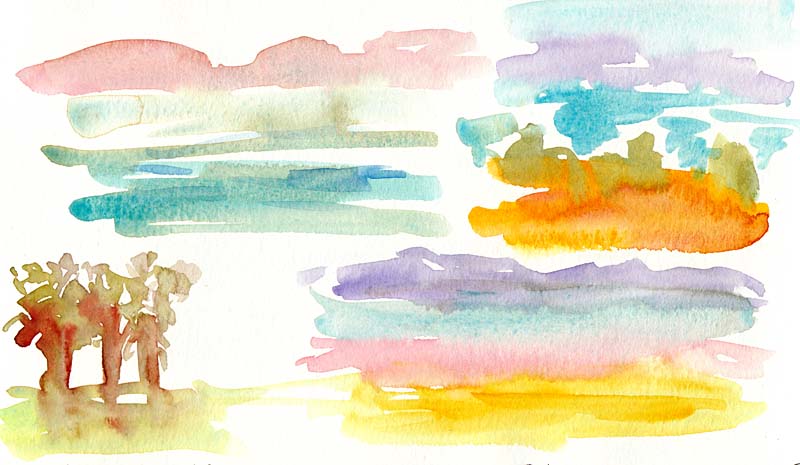
Once we got underway I experimented with doing VERY quick watercolor sketches of the scenery as we traveled, with about 30 seconds to capture each lovely view flying by:
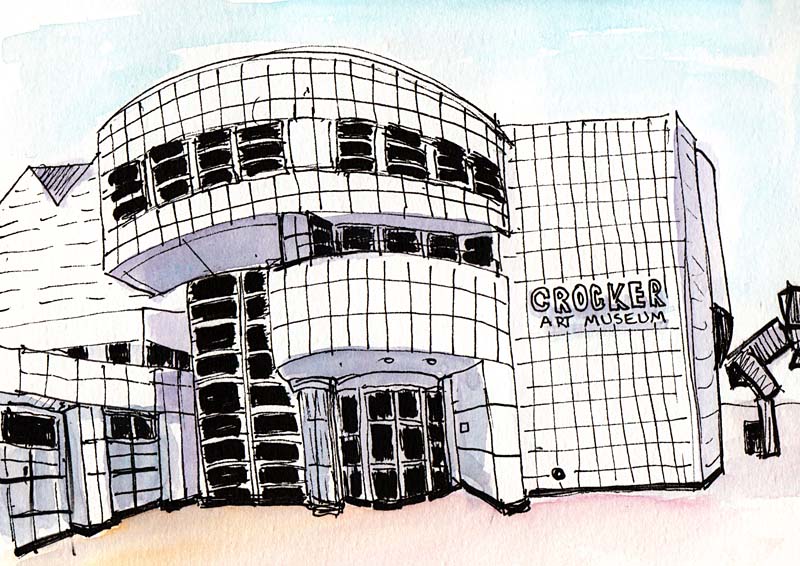
Once we arrived the weather was perfect so we walked the 6 blocks to the Crocker Art Museum to see the Wayne Thiebaud “Homecoming” retrospective show (ends November 28). One of the great things about the show was seeing that at almost 90, Thiebaud is still painting and innovating. The work in his show range from the 1960s to 2010.
Crocker Art Museum New Building, ink & watercolor
We explored both the Crocker’s permanent collection and the Thiebaud show. I was a bit perplexed by the way the shows were curated. Works seemed to be hung randomly, in no particular order that I could discern. I would have really liked to see Thiebaud’s paintings arranged by date to see the progression of his work.
In the permanent galleries I had the sense that they had tried to just hang everything they had, regardless of quality, condition or style. There was something both amateurish and charmingly small-town about the museum and even the demeanor of the guards who were refreshingly friendly, enthusiastic and proud of the work they protect. The Crocker has paintings by many of my favorites from the Bay Area Figurative Movement of the 1970s and I enjoyed seeing those “old friends” again.
Next post tomorrow will be Part II of the trip…meeting up with Pete Scully for a sketching visit to Old Town Sacramento.
My work in the book: How to Paint Watercolor Flowers
A year ago the English publisher Quarto commissioned me to do a series of paintings for a book (working title) “Must Paint Watercolor Flowers” and at last it arrived in the mail! Now named How to Paint Watercolor Flowers: Create Your Own Masterpiece in 6 Easy Steps, it features my paintings and those of 15 other artists, along with step-by-step instructions showing how we made our paintings.
The book has 160 pages and at 11″x 9.5″ is much bigger than their “Watercolor Artist’s Bible” in which I also had several paintings. It is laid out with a beautiful 8×10 photo of the flower subject on the left side and photo-illustrated step-by-step instructions for creating the finished watercolor beside it. Hard-cover spiral binding allows the book to lay open flat for artists who wish to try the techniques while painting from the photos.
I loved seeing the beautiful work of the other artists and the many ways they approached the wide variety of subjects and techniques. The flower photos are superb, with permission granted to use them for your own paintings. The book also has excellent sections on watercolor technique, color, value, and photographing your own flowers for painting.
I haven’t read all the step-by-steps, but I’m guessing that like me, few of the artists actually created their work in just the six steps that we were limited to when writing up and photographing our work. Instead the editor highlights the key techniques that were especially important to each particular painting.
Disclaimer: I have no financial investment in the book; I was paid per painting for the publisher’s right to print my work, but receive no royalties or other benefit from sales of the book itself from the publisher or via Amazon links.
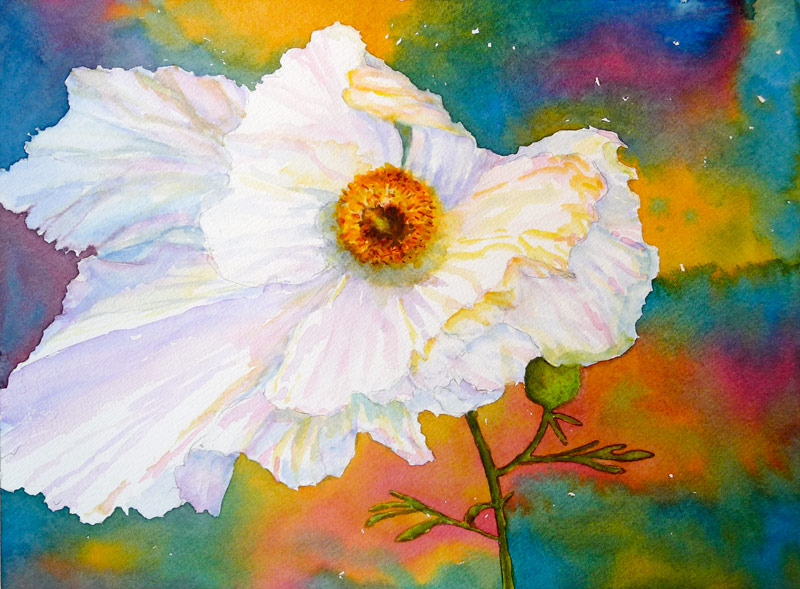
Today in the my watercolor class I demonstrated painting white flowers and soft-focus bright or dark backgrounds. A neighbor graciously allowed me to pick a huge bouquet of Matalija poppies from her gigantic bush so each artist had their own flower to paint.
To save time I only painted a quarter of the flower before going on to paint the background. This made it a little difficult to finish the painting after the class since by then the flower had completely changed so I just pretended a little.
To paint the background I started by making three different puddles in little bowls: Permanent Alizarin Crimson, Quinacridone Gold and Winsor (phthalo) Blue. I used a separate brush for each color to keep the colors clean. Then I just worked my way around, washing on little gold, a patch of red beside it, a splotch of blue, letting the colors touch and mingle.
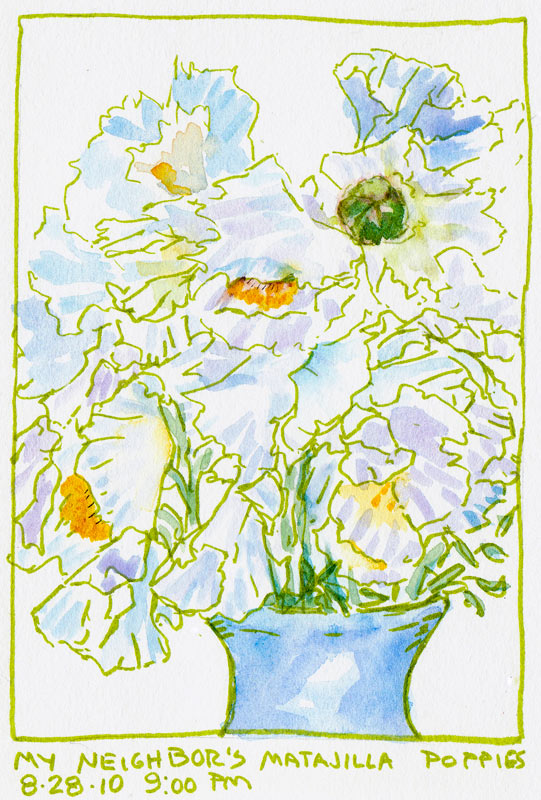
Matalija Poppy Sketch, green brush pen & watercolor
To warm up for today’s demo I did this sketch last night using my fun new green Pitt Artists Brush Pen and then added watercolor. And I spelled the flower name wrong. Which I’ve been doing forever, or at least since I painted the first one several years ago found on my website here.
I dreamed that Bob Dylan was having dinner with my friend Michael and he invited me to tag along. They talked seriously about music trivia for hours in the old wood-paneled café. I was surprised at how much better Dylan looked in person. I was going to tell him but decided it sounded too dumb. So I just sat there silently, trying to inconspicuously flirt with him.
Then my calico cat Fiona woke me up, making those telltale, pre-puking sounds cats make. I pushed her off the bed and tried to go back to sleep since it was still dark. Just as I’d finally fallen back asleep she started licking my eyebrow. I gave up trying to sleep and spent the day feeling dopey and too tired to do the oil painting I had planned.
Instead it seemed like a really good idea to wash off the entire background of the Big Tulip painting I thought I’d “finished.” More about that later…now off to get some sleep!
Big Tulip started with this journal sketch and photo which led to a craving to work big for a change. I jumped right in with a full sheet (22×30″) of watercolor paper, reminding myself that it’s not that different: just use bigger brushes, bigger puddles of paint, and bigger movements.
Of course there’s more to it than that. In planning the painting I decided I’d be free and loose with the background, just go for it and see what happens rather than draw it in. It was fun, but there was a lot of background. I’d like to try the painting again, doing it a little differently.
I’d draw the background plantings with more specificity and I would also use different pigments. I’ve been experimenting with using cadmiums for the yellows, orange and red instead of my usual transparent colors in my palette.
The cadmiums are perfect for journal painting when I want to try to get a rich color down in one layer. They’re stable and easy to work with so they will remain in my travel palette.
But when trying to work with juicy wet-into-wet washes, the cadmiums just sit there and don’t move, like stodgy, Wednesday night meatloaf. For painting close-up flowers I like the excitement and challenge of colors that charge into each other and zip around. It’s fun to paint a petal with lots of water and then drop in rich, bright colors, let them mingle, and try to get them to go where you want by tilting the painting.
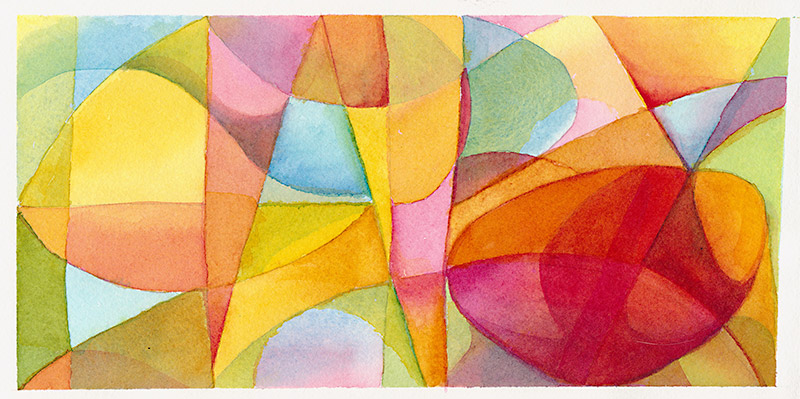
My Sunday morning watercolor class focused on glazing this week. Glazing is applying a transparent layer of paint over painted or unpainted areas. Like a piece of colored glass, a glaze won’t hide what’s below it but will change the way it appears.
I used the study above to demonstrate glazing with gradations. To make the design I printed the word “HAPPY” in big capital letters and then playfully added more pencil lines between and around letters to make more shapes.
Then I glazed each shape individually, adding more glazed layers in various areas until it felt done. I used only transparent primary colors, so that they combined to create secondary colors. You can also use glazing to make colors appear brighter, duller, darker, warmer, cooler or in shadow or to unify an entire painting or a section of it.
Parrot painting strategy sheet, converted to journal entry use
A student who takes individual classes asked for help with painting birds so I used the journal spread above to demonstrate doing a pre-painting strategy session. I tried out various techniques and pigments as I thought about how I might paint the parrot whose photo we downloaded from Morguefile.com (where you are allowed to “copy, distribute, transmit and adapt” the copyright-free photos). Doing this bit of preparation and note-taking really helps to avoid some (but certainly not all) mistakes and corrections during the painting process. LATER I used the spread to write a journal entry (which I’ve blurred here for privacy), right over the feather and color experiments.
I still have these “cheat sheets” for many of my paintings. Recently I came across the one for Cheerios with Strawberries and saw that I’d used a wash of cobalt violet light (a favorite color but very expensive) to make the milk look just like the non-fat that I’d had in that bowl of cereal.
Flat and gradated wash demo
I loved the colors so much on this demo for flat and gradated washes from the previous week that I hung it on my wall as if it was a finished painting (my own mini Rothko).
Watercolor Class Registration
My next 4-week class session begins Sunday August 8. You can register and get more information on my website here. It looks like this session will fill so be sure to sign up soon if you want to join in. I am also planning a new “independent studies” class for people wanting to paint with ongoing coaching. If you’re interested, send me a note to get on the list.
I’m back on the blog after an intense week spent alternately deep in the bowels of a massive garage clean up/reorganization, and obsessively fighting the acrylic version of the watercolor sketch above. After finishing the garage on Saturday afternoon it was time to clean up in the house and studio and prep for my Sunday morning watercolor class (which went great with a terrific group of artists who left me feeling inspired).
Virtual Paintout: Hawaii
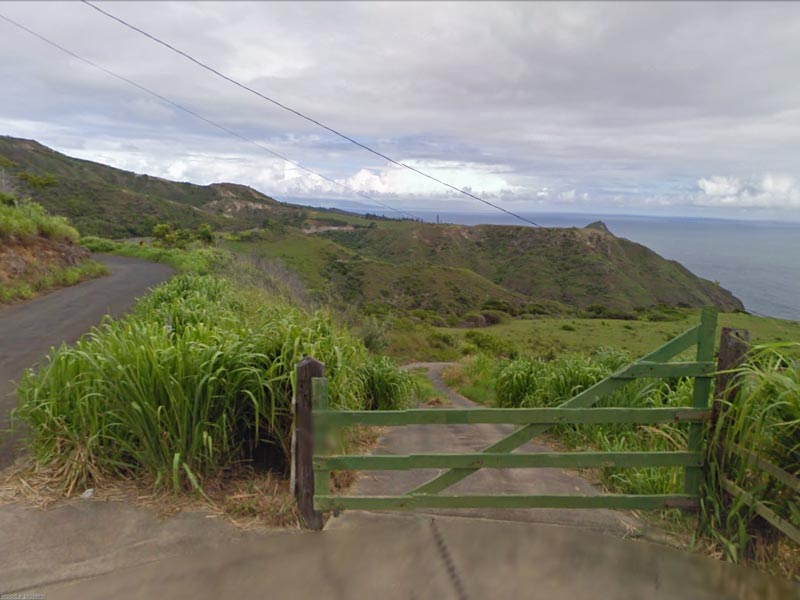
For the Virtual Paintout we went to Hawaii this month via the very cheap Google Air (just kidding—to participate you use Google Maps’ Street View feature to find your painting spot and all travels are virtual). Here’s the original scene:
Hawaii - near West Maui Forest Reserve
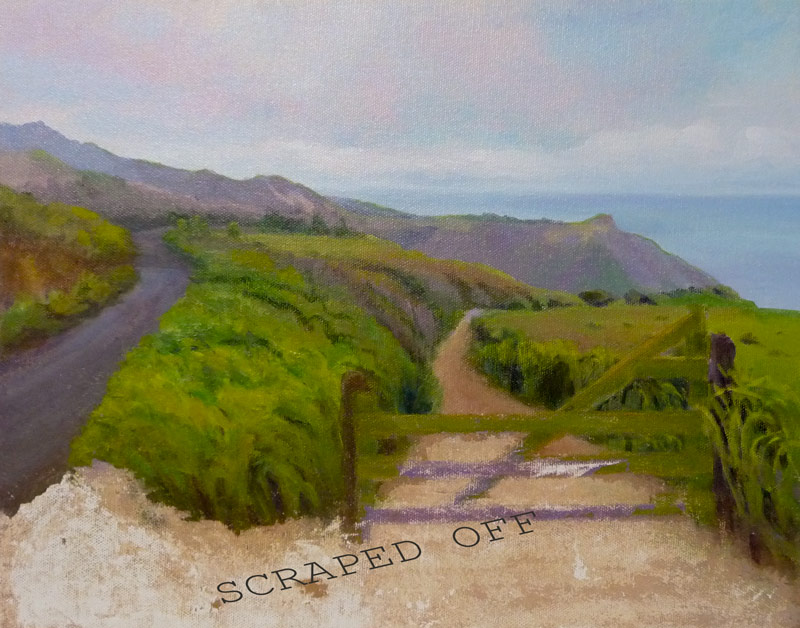
The painting got off to a good start with Golden Open Acrylics. I was trying to work from both my watercolor sketch above in which I’d changed the colors, warming up the scene, and also from the Google photo which just has a blur for the foreground. I first painted the gate purple for fun, but nearing completion realized the gate was too prominent and acting as roadblock into the painting so I repainted it green.
Then I started fighting the foreground. Over and over I painted, repainted, scraped, repainted. Here it is in its current state with the foreground (and some of the fence) scraped off again .
Hawaii with Scraped Off Foreground, Acrylic, 11x14"
Part of the problem may be the Utrecht Masters canvas panel that I was experimenting with. The canvas texture is too coarse and too absorbent so first I painted a layer of regular acrylic to smooth it out and reduce the absorbency (which is OK to do according to Golden). But then I had a paint adhesion problem, easily peeling off several layers where I’d painted thickly or repainted over not quite dry paint.
Since I wasted so much time messing with this painting and because I really love the top half of it I just didn’t want to give up. But to enjoy the second half of my vacation I’ve banished it to the closet and have gone back to working on a big watercolor of a tulip that is going great and makes me happy when I paint, not frustrated. I’m becoming convinced that I’m meant to be a watercolor painter and should forget about oils and acrylics.
The Garage
Cody unloading and saying "Bye" to his junk at the dump
When I bought my house 10 years ago it had been a rental for many years before that and the standalone garage probably hadn’t been cleaned forever. Then for 9 years my son used it to dismantle and rebuild his 71 Firebird, leaving grease, car parts, tires, miscellaneous junk, and bondo dust on top of years of grime, cobwebs, and worse (we found a literal rats’ nest made of fluffy chewed up shop towels in one corner behind a piece of plywood but no sign of recent rodents).
After moving most of his stuff out and the initial trip to the dump above, the real clean up began. I hired the smart, hardworking 15-year old boy next door to help me clean and we worked together most of Friday and Saturday. He vacuumed the wood walls and concrete floors after cleaning out the Bondo-filled ShopVac, removed and cleaned all my storage bins from the shelving units and then cleaned the shelving too. Meanwhile I sorted my junk and took a carload to the recycling/donation center and made another pile for the dump.
Finally the garage is ready for its new life as studio annex and multipurpose room. And I’m ready for my last week of vacation which I will fill with art fun, rest and recreation!
Study for Kaiser Garden II, watercolor, 6.5" x 4.5"
There are still openings in my watercolor class starting Sunday, June 27; click here for all the information. Ok, business done, now on to the painting above, another study from photos I took at the Kaiser garden.
I learned the hard way to do a study first, after time and again putting hours, days or weeks into a painting that was doomed from the start.
No matter how skillful the painting technique is, if the composition is bad (the viewer’s eye goes to a bright corner and then right off the painting), or you’re trying to work from a photo that doesn’t have enough information, or your colors or values are uninteresting, the painting isn’t likely to succeed. Sketching exactly what you see is great fun, but sometimes nature requires editing to make it a painting.
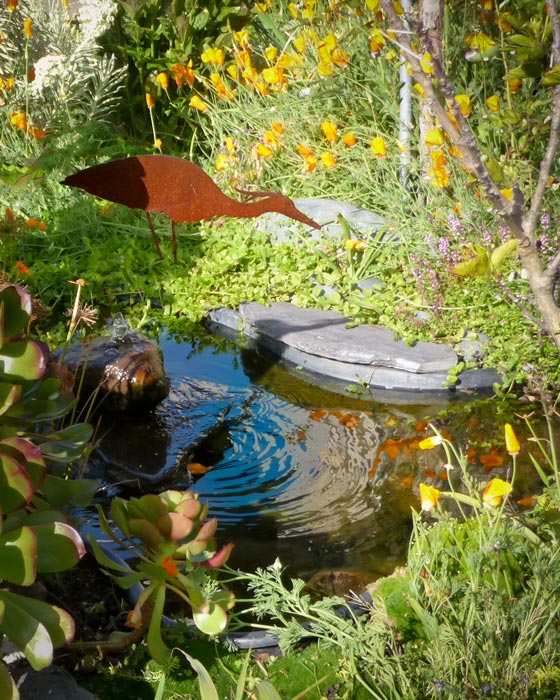
What made me want to paint this scene was the water feature and the bird sculpture but when I looked at my photo I saw big problems with the composition:
Original photo, Kaiser garden
There is way too much going on, the two big succulent plants on the bottom left dominate, a big stem above them leads the eye out of the frame, and the composition seems divided right down the middle, vertically. You barely notice the water.
So I spent some time in Photoshop cropping, rearranging and revising things:
Revised Photo Reference, Kaiser Garden II
Before cropping off the left side, I cut out the bird, moved it to the right, tilted it and gave it legs. Then I darkened the remaining succulents on the left and bottom to use them as a frame for the water feature instead of competing with it. When I started sketching the composition in my journal I decided to get rid of the messy tree branches poking in from the right too.
Although Photoshop is great for preparing a photo reference, so are the scissors, glue, sketches and notes that I used pre-Photoshop. Along with learning Photoshop, I’m also trying to become a better photographer and compose more carefully. I can do that with my digital SLR because it has a viewfinder but my carry-everywhere little Panasonic doesn’t. In the bright sun it was impossible to see anything on the LCD screen, so I guess I’m lucky that I got something I could work from at all.
My notes for the painting are in my journal opposite the study, with reminders about colors and things that worked (or didn’t). I’ve transferred the drawing to the canvas and it’s just waiting for its turn at the easel. I have a feeling it’s really meant to be a watercolor, not an acrylic painting, so may do it both ways.












 Jana Bouc, Artist