Categories
Art supplies Drawing Flower Art Ink and watercolor wash Painting Photos photoshop Sketchbook Pages Still Life Watercolor

Hydrangeas: More Testing Fabriano Venezia Sketchbook

Hydrangeas in Pitcher, 9x11", ink & watercolor

The first hydrangeas of the season provided an opportunity to try out ink and watercolor in the Fabriano Venezzia sketchbook I posted about yesterday. First I drew directly in ink and then tried painting the flower on the right by wetting the paper there, and painting into it.  I didn’t like the results and tried lifting off the paint with a tissue and was pleased and surprised that it came right off, leaving only a slight stain.  Then I painted back into the damp area and got the results I wanted and completed the rest of the painting working very loosely.

The painting was easy compared to trying to get the image in the sketchbook scanned or photographed for posting. The image above was the result of clamping the edges of the sketchbook to photograph it (see below) and then using Photoshop’s Clone Stamp tool to “erase” the clamps and then using the Levels and Dodge tools to clean up the shadows caused by the paper buckling and some reflections from the light source.

Ready to photograph

I also tried scanning the page in the sketchbook but encountered the same problems I had yesterday with severe blurring plus shadow from the seam. I (want to) like this sketchbook, but preparing the images for posting is really a hassle. Even if I wasn’t working across the spread and just painted on one page I’d still have the problem with the shadow and blurring since it happens on the righthand page.

Scanned version, after touch-up
Scanned version, after major touch-up

Have you had this problem and solved it? I’d be so grateful for suggestions!

Hydrangeas and sketchbook
Categories
Berkeley Flower Art Ink and watercolor wash Interiors People Places Sketchbook Pages Watercolor

Celebrating 3 Years, 600 Blog Posts… and a winning book cover

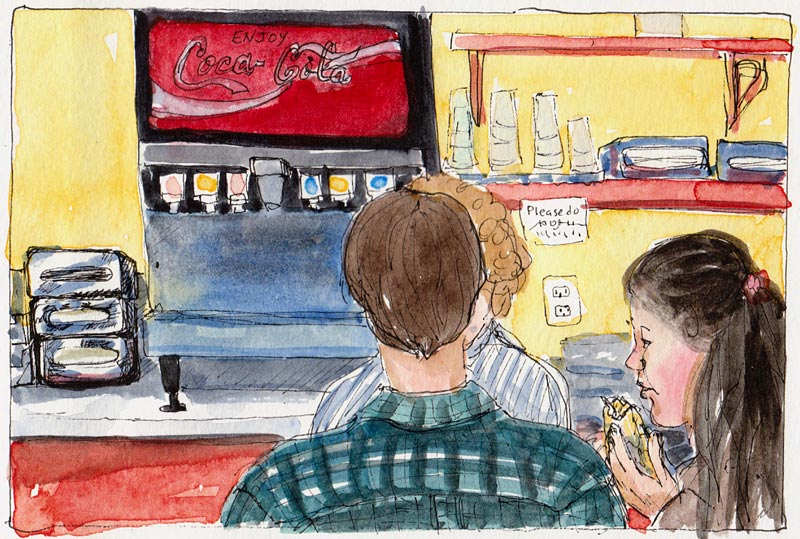
Cactus Taqueria, Berkeley, ink & w/c, 4x6"

On Monday night I completed another sketchbook and three years of sketch-blogging. Cathy and I had dinner at Cactus Taqueria on Solano Avenue in Berkeley and sketched the other diners.  Then we started walking to see what else looked like fun to draw.

It was cold and foggy outside, and the lobby of the old Oaks Theatre looked warm and  inviting so we walked in and asked if we could sketch. This confused the woman working there who had nothing to do but sit and chat with a younger woman. It was a Monday night and they were showing a French movie and it was a bad French movie and so there were few customers. She told the manager we wanted to sketch (with a tone of voice that implied we might be deranged) and he said it was fine.

Oaks Theatre Popcorn Machine, Berkeley, ink & w/c

We sat on carpeted stairs (the only place to sit except the already occupied bench) and sketched the  popcorn machine directly in front of us. At first it seemed like a stupid, boring subject, but within minutes I was captivated by all the odd mechanical bits inside the machine. Oddly, despite the strong scent of hot popcorn, the machine was completely empty.

At first we sketched listening to the inane conversation of the two women which even they seemed bored by. They left and the manager came over and asked us whether drawing can be learned or if is just an inborn talent (definitely can be learned!). Then he wandered off and we listened to him being lectured to by a customer (inspired by the movie she’d just left?) about race, culture, history, and her philosophies on life,  while he listened patiently, saying “OK.” I jotted down a few of her pronouncements on the sketch.

Three Years of JanasJournal.com

Posts: 600
Total views:
490,331
Comments:
6,203
Most popular posts:

Ladies, Stand Up for Your Right to Pee Standing Up (7,198)
Monoprint experiment
(6,096)
Better than Plastic: Blue Glass Water Bottle (5,597)
Black Lilly (aka Devil’s Tongue or Snake (4,597)

THANK YOU DEAR VISITORS, READERS, FRIENDS!

My Art on Winning  Bookcover

White Lilac Love Book Cover
Winning bookcover

About a year ago, I received an email from Croatian poet and author Sonja Smolec, asking for permission to use one of my watercolors on the cover of her new book of poetry, “White Lilac Love.” Of course I agreed, and was delighted when she sent me a copy of the book.

A week ago I received an email from Sonja telling me that her publisher had held a bookcover contest and her book had won! The 73 poems in White Lilac Love weave a beautiful and tender love story with all the soaring emotions from hope to despair to true love along the way. One of the poems was so evocative and full of wonderful imagery that it inspired a painting (in progress — more about that later).

It’s been a great three years!

Categories
Animals Art supplies Gouache Illustration Painting photoshop

How Maira Kalman (and I) Create Gouache Paintings with Ink Lettering

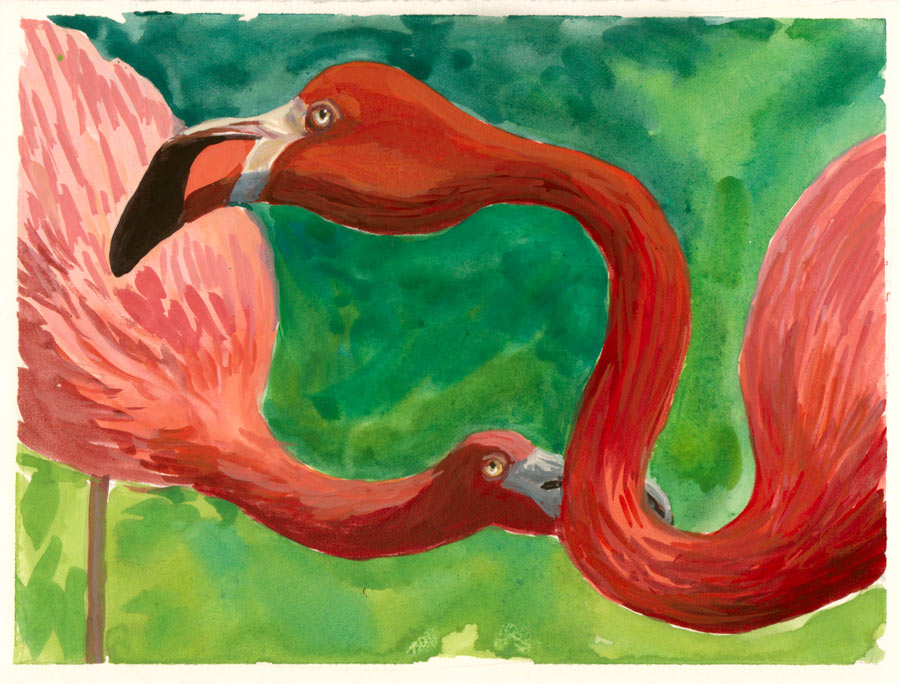
Why Are Flamingoes Pink? Gouache on hot press paper, 5.5x7.5"

Why Flamingoes Are Pink (Hint: You Are What You Eat!)

Why Are Flamingoes Pink? Gouache & Ink, 5.5x7.5"

I adore Maira Kalman‘s wonderfully quirky gouache and ink illustrations. When I’ve tried to use ink on my own gouache paintings, the ink always got sucked into the paint and blurred, or the pen clogged immediately (or both). I searched every way I could on the internet and finally found this link to India Amos’s blog. India, as Art Director, was responsible for preparing some of Maira’s artwork for print. In the post she wrote that Maira creates the painting and lettering separately. Then they’re scanned and layered together electronically using Photoshop.

So yesterday I investigated this approach. I painted the flamingoes above from a photo I took at Six Flags last month. Then I tried various pens and tracing papers. I also sent a message to India asking if she’d be willing to provide more information about the process.

Categories
Bay Area Parks Drawing Flower Art Ink and watercolor wash Landscape Outdoors/Landscape Painting Places Plants Plein Air Sketchbook Pages

Tilden Botanical Garden Sketches

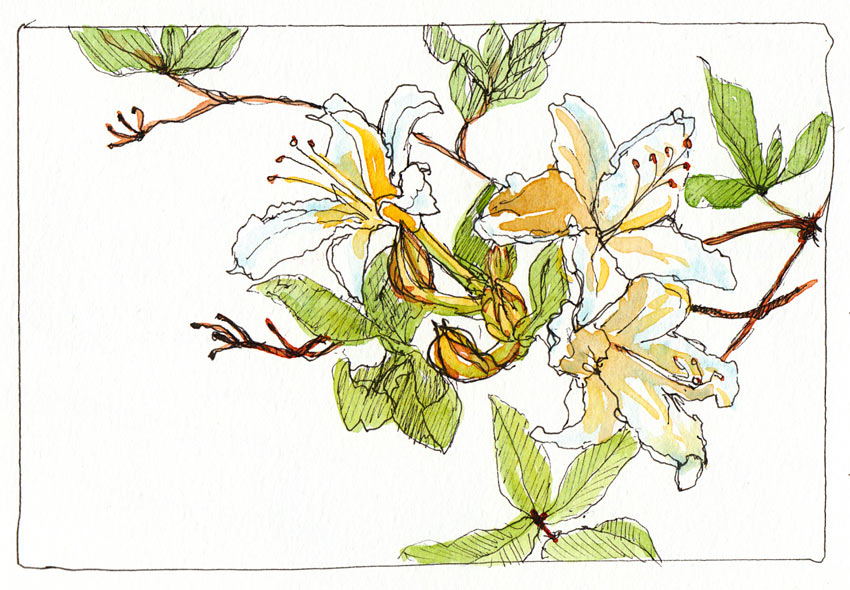
Pacific May Lilly at Tilden Botanical Garden, ink & watercolor, 4x6"

My plein air group met at Tilden Regional Parks Botanical Garden this cold and foggy morning. Since I wasn’t familiar with the park I explored a bit and then decided to sketch instead of trying to drag my painting gear around the hilly, pebbly paths. Since I only had my large Moleskine and a Micron Pigma .01 pen with me, I added watercolor later at home. The May Lilly above was so sweetly but delicately scented that drawing beside it was like breathing in a dessert.

Bridge & Creek, ink & watercolor, 5x7"

This bridge and creek was the first thing I sketched when I arrived, still arguing with myself about whether to go get my painting cart, whether to go home because it was too cold, whether to go home because I arrived late, how I should have brought my watercolors, how the scene was so complicated and so maybe I should just go home.

But as I drew,  I started noticing interesting details, how dark and light shapes lined up,  where one puzzle piece fit against the next, the design the water was making as it poured over rocks and down the creek, the sound of frogs and birds, and before I knew it that busy, chattering mind had shut off and I was having fun.

Manzanita Tree, Ink & watercolor, 5x16"

As I sketched this spectacular Manzanita, I began noticing how much like strong lean muscles the branches were, with their smooth, polished red surface. Then I found other human attributes: the knotholes looked like eyes while the bends in the branches looked just like elbows. This led me to consider the oneness of all things and I felt very connected to all the nature around me. During our critique at the end of the paint-out, we each take a turn showing our work and talking about our process. When I shared these thoughts someone laughingly asked what I’d eaten for breakfast! I was high on drawing, not Cheerios!

Cat Napping in the Buckwheat, rev2, Ink and watercolor
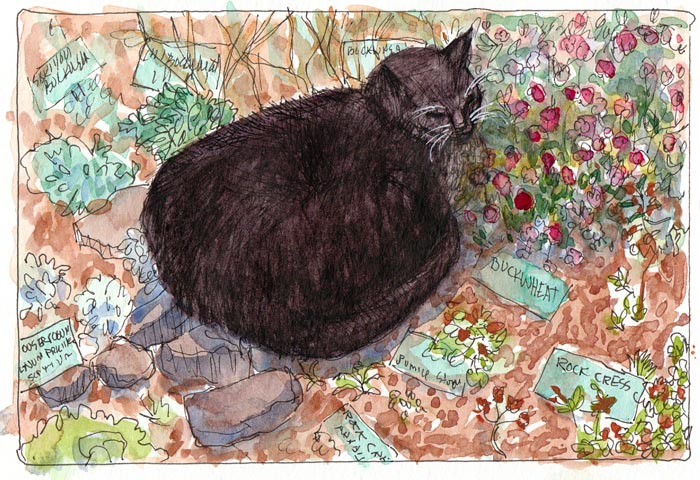
Cat Napping in the Buckwheat, Ink & watercolor, 4x6"

Walking to our critique, I spotted this garden kittie, having a nice nap in the buckwheat section of the garden and had to stop and sketch it. Nothing bothered this plump pussy who slept amidst the plants, little signs, wood chips and stones near the garden entrance. I added the whiskers with white gel pen.

Categories
Animals Cartoon art Drawing Gouache Illustration Ink and watercolor wash International Fake Journal Month Life in general Other Art Blogs I Read Painting People Sketchbook Pages

Thank You Roz & Boris the Dragonly Critic

Thank You Roz! (Gouache & Ink)

As second place winner in the International Fake Journal Month contest, I won this amazing t-shirt from Roz Stendahl, the inventor of IFJM. I tried to sketch myself sketching myself myself wearing it. I didn’t do the t-shirt (or myself) justice, but I do like the way the bird and I both seem to have the same expression! THANK YOU ROZ! I love it! (My IFJM posts are here and here.)

I’ve been having one of those crises of artistic self-confidence in my drawing the past couple weeks. I’m not sure if the drawing difficulties are real or I’ve just somehow allowed that nasty internal critic out of his cage and back on my shoulder.

Boris the Dragonly Critic, ink & watercolor

I know the cure though: put him back in his cage and do a whole bunch of drawing until he is so bored he falls asleep for a nice long summer nap. And I’ll start by drawing HIM!  Here he is now, safely back in his cage and starting to get very sleepy….

Categories
Drawing Oil Painting Painting Photos Still Life

Stripey Still Life with Lemon: The importance of getting the drawing right first

Stripey Still Life with Lemon
Stripey Still Life with Lemon, 10x8", oil on Gessobord

Getting the drawing right before beginning to paint is so important when trying to paint realistically. Although it’s theoretically easier to correct drawing errors with oil paint than watercolor, it’s still a lot less fun than painting with a good drawing. As you can see from the start of this painting below, I hadn’t quite nailed the elipse on the top of the pitcher before I started painting.

Stripey Still Life start

I wanted to get started with the painting quickly because I knew the leaves from the lemon tree were going to change wilt, even though I had inserted the stems in a little florist tube with water (and they did!). But by not getting the elipse on the top of the pitcher drawn correctly, I ended up redoing it over and over and finally giving up. I am happy with the way the fabric under the pitcher turned out, as well as the lemon and didn’t have to do any repainting on those areas, although I did change some of the fabric as I painted.

Stripey still life photo of set up
Stripey still life photo of set up with wilted leaves

On my next still life, I’m going to sketch the composition on tracing paper first, and then transfer it to the painting panel, rather than trying to sketch it on the panel. Maybe that will make the painting more fun and less of a struggle.

Win some, lose some, learn some, move on.

Categories
Art theory Ink and watercolor wash Life in general People Sketchbook Pages

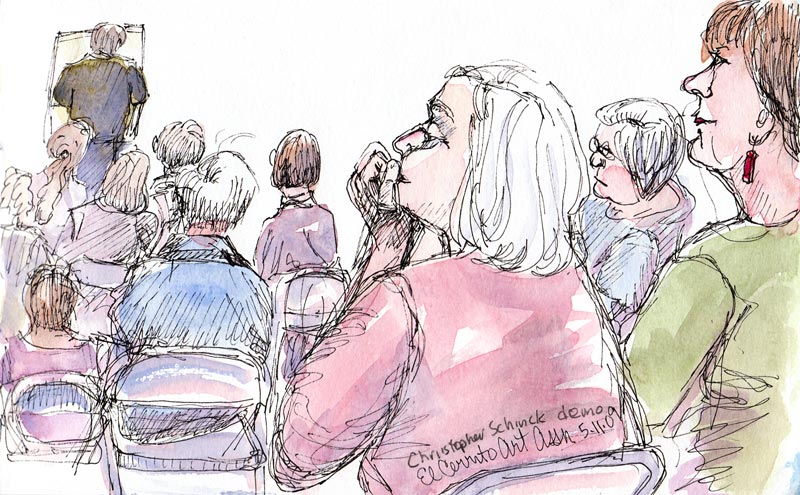
At the Christopher Schinck Demo

Art Demo, ink & watercolor

Last week the El Cerrito Art Association hosted an excellent watercolor painting demonstration by Christopher Schinck. Mr. Schink has a unique way of painting with watercolor and a wonderful sense of humor. He both entertained and amazed the group with his bold use of color, thick paint applied opaquely using large china bristle brushes and extraordinary knowledge of art history, composition and painting technique. I alternately watched the demo and sketched the audience (above), enjoying both equally.

I jotted down a few of his comments:

“Don’t paint objects. Paint relationships” [of design elements, like light & dark].

“It’s better to quit early than to quit late.” (In other words, stop painting before you’ve overworked it!)

“Sarget said watercolor was ‘making the best of an emergency.'”

“When you first start painting you tend to strive for accuracy and people like it. The more you paint and explore as an artist, the less your family likes it. Push yourself so it’s still identifiable, but have fun!” (Encouraging us to abstract and simplify.)

Then a few nights later my watercolor group got together for dinner and sketching. Dinner was fabulous! Not so my sketches, but here they are anyway.

Ink wash sketch; no likeness
 Maple sugar candy dessert, ink & wash
Maple sugar candy dessert, ink & wash

What’s funny about this sketch is that I’d drawn the box and then gotten really into the details of each little packet of candy. When I finished the first row I realized there were only three across and I still had room for one more. So I just made the box smaller and left the odd lines from the original ghost box. I added color at home to the top and bottom sketches.

Categories
Berkeley Drawing Ink and watercolor wash Other Art Blogs I Read Painting People Photos Places Sketchbook Pages

Jana and Casey Do Berkeley

4th Street Jazz Festival- by Jana
4th Street Jazz Festival by Casey
4th Street Jazz Festival-by Casey

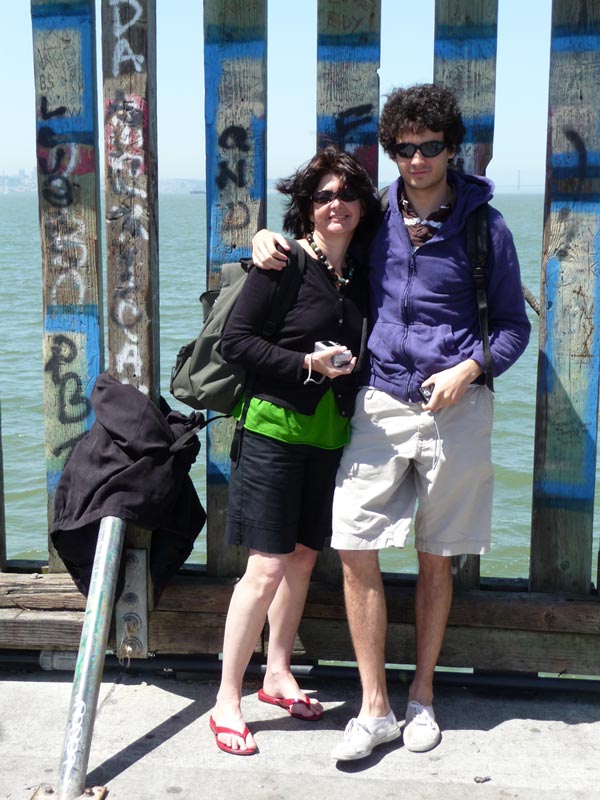
Casey Toussaint and her son Paul are visiting from France and I had the pleasure of spending Sunday with them. After a quick visit to my house and studio, we headed down to the Berkeley Marina to cool off on an unseasonably hot day.

Casey & Paul on Berkeley Pier

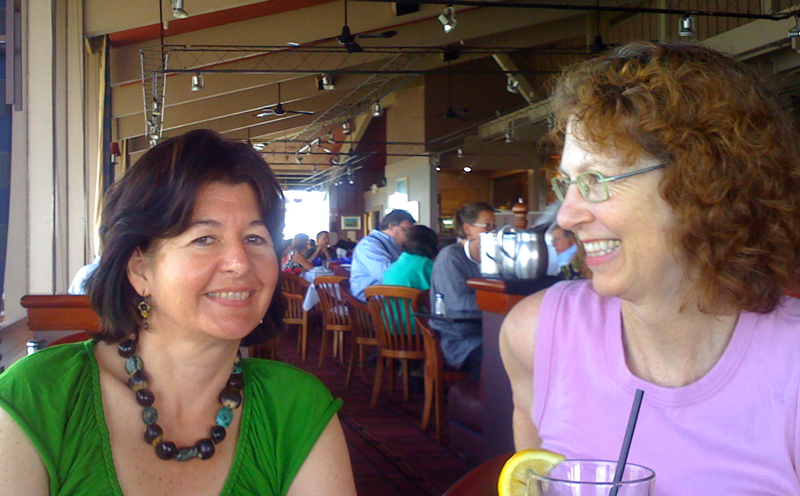
We walked to the end of Berkeley’s long pier on San Francisco Bay with views of the Golden Gate Bridge (which Paul wanted to see) and there was a wonderful cool breeze coming in off the ocean. Then we had a delicious lunch at Skates on the Bay, where we had a window seat and watched birds nesting under the eaves and sailboats tacking back and forth on the choppy bay.

Casey & Jana @ Skates

On the way to our next stop (Dick Blick Art Supplies to pick up a large sketchbook to bring to the afternoon session of the  figure drawing marathon sponsored by the Bay Area Models Guild at Merritt College in Oakland) we passed Berkeley’s Fourth Street boutique/foodie shopping area. We saw that the street was blocked off with a sign, “Fourth Street Jazz Festival” and decided to nix the figure drawing and sketch at the festival instead.

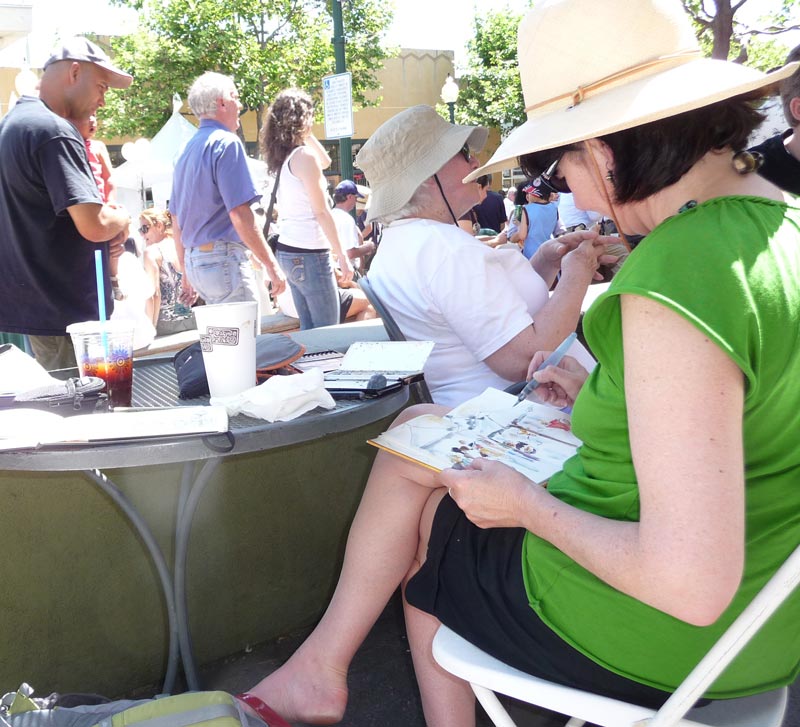
Casey sketching at Peets Fourth Street

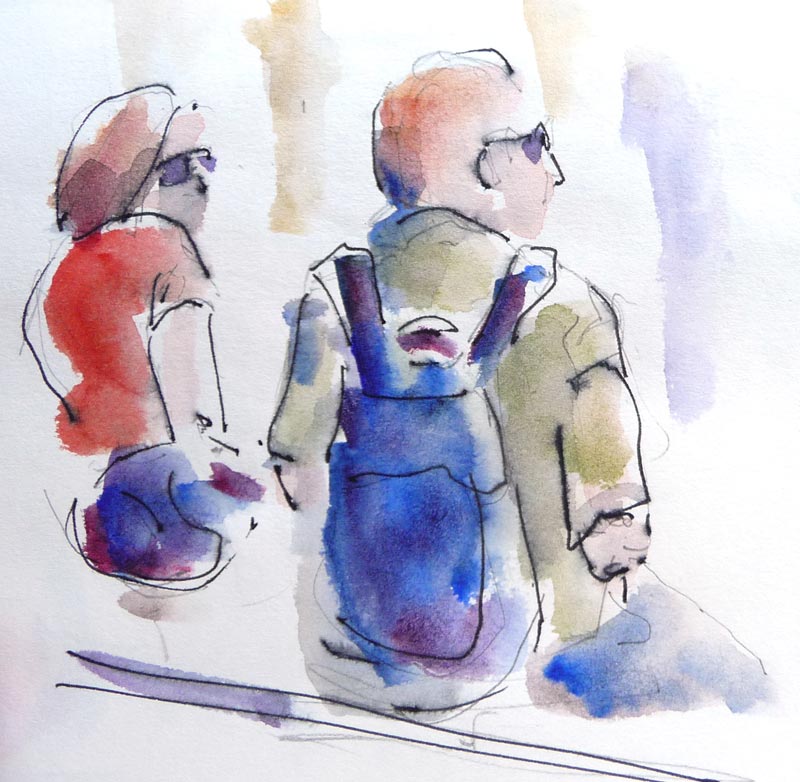
We strolled the street and then settled at Peets Coffee for coffee and sketching where we did the two sketches at the top of the post. Casey works quickly, with wonderfully expressive lines, and got in a few more sketches from Peets:

4th Street people by Casey
More 4th St people by Casey

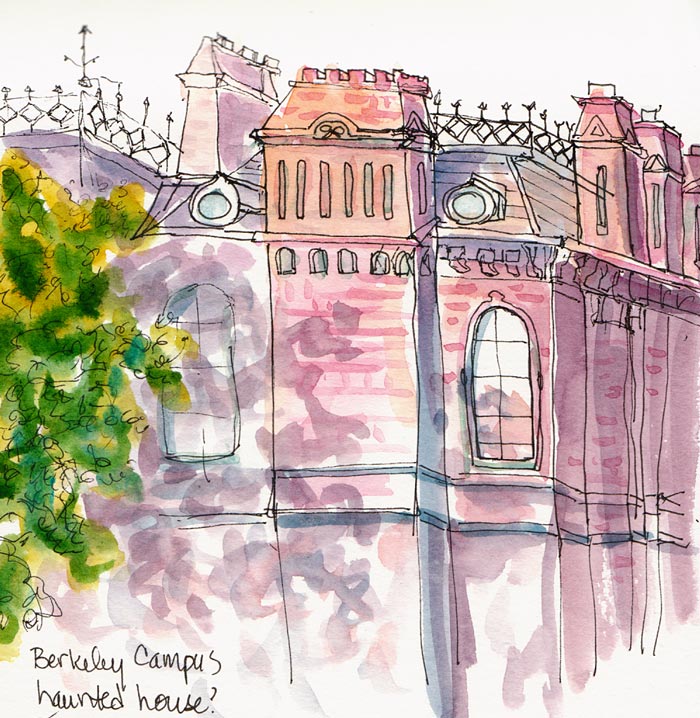
After an hour or two we connected with Paul again, walked over to Blick’s for Casey’s art supply shopping and then headed to Telegraph Avenue and the University of California campus. Casey and I found a spot we wanted to sketch on campus so Paul headed back down Telegraph to Amoeba Records, a huge used CD/record store.

UC Campus building by Jana
Jana's sketch and building
Casey's sketch of the building

When we met Paul back at Amoeba a couple hours later, I was hungry and we decided to head out for dinner. We all felt like Mexican food so I took them to Solano Avenue’s Cactus Taqueria. Paul was quite impressed by the size of the burrito he was served, and took photos of it. I learned that servings are much smaller in French restaurants and that it takes 5 or 6 years of serious study before someone can become a baker. He was surprised that here all one need do to beome a baker is to open a bakery and start baking.

Casey at UC Berkeley

As the sun was setting I drove them back to San Francisco. The fog had rolled in, ending the heat wave, and as we traveled across the Bay Bridge we had amazing views of San Francisco rising up out of the fog bank, sillouhetted by the setting sun. I drove really slowly across the bridge so Paul could take pictures and he got some great ones.

Categories
Flower Art Ink and watercolor wash Painting Sketchbook Pages Still Life Watercolor

Bouquet of Mothers’ Day Roses

Mothers' Day Flowers #2, ink & watercolor

On Mothers’s Day my wonderful neighbors brought me this  lovely bouquet of roses in a crystal vase. Then all three sweet kids wished me Happy Mothers’ Day and gave me hugs. I have the best neighbors. I took the flowers outside and sketched them twice, sitting on my studio porch steps.

The sketch above was done by painting directly with no drawing. The one below was drawn first with my Pentel Brush Pen and then painted with watercolor. Both are in the large Moleskine watercolor sketchbook.

Mothers' Day Flowers #1, ink & watercolor

It was a pretty special day. Son #1 asked his girlfriend of 5 years to marry him (and she accepted) atop a tower in Turkey,  son #2 grilled a delicious dinner for me and his family, and I started the day with a great hike with my best friend Barbara. Life is good!

Categories
Art supplies Art theory Glass Lighting Oil Painting Painting Photos Still Life Studio

Painting a Still Life Using The Carder Method”

Still Life with Tangelo, oil on gessobord, 12x12"

Inspired by Casey’s success with the Carder Method and frustrated with my own slow progress at oil painting, I bought the Carder Method video and  Color Checker tool. Below are step by step photos of my using the method to paint this still life, a brief review of the Carder Method and photos of my studio set up for working with it.

The Carder Method is designed to eliminate many of the problems that can make painting difficult. By creating an carefully lit, controlled environment, a painter can focus on learning to clearly see color and value differences while eliminating problems caused by variables such as changing light.

Click “Continue Reading” to see photos and read more….