At Tuesday night sketchcrawl last week we started at the top of Fairmount Avenue in El Cerrito. I went from sketching an empty storefront to a tree in a cemetery parking lot to a church facade as the sun went down. It was poignant being at the Sunset View Cemetery again, after attending a funeral there just a couple weeks ago.
For Lease, ink & watercolor
This is my sketchbuddy Cathy sketching from across the street on a hill in front of an empty storefront. On all of these I drew with a blue Copic Multi-liner and then added watercolor wash at home. I tried to mix a similar blue but got swayed by some purple.
The sun is setting so much earlier now; we’re going to have to move indoors soon for our after-work sketchcrawls. We’re making a list of places to sketch: a bowling alley, a bingo parlor, a new rock-climbing gym, Pastime Hardware and the library are at the top of my list.
St. Jeromes Church, Ink & Watercolor
It got too dark to finish drawing this church so we headed over to Fat Apples Restaurant for tea and Cathy shared her notes and images from an amazing workshop she took in Maine from Susan Abbott. I love Susan’s work and after seeing Cathy’s paintings from the week and hearing about Susan’s wisdom and generosity as a teacher, I am even more determined to get to New England and take a workshop from her next year!
It’s been a weird weekend. As the song says, “It never rains in California in the summer” except it did on Saturday morning after a night of thunder and lightening (also rare in the Bay Area). It was supposed to be a plein air painting day but the combination of rain and a headache convinced me to stay home and paint instead.
Then the power went out. It was too dark in the studio to paint without some lights and I needed coffee to try to get rid of the headache so I walked to Peets to sketch there. I used my sepia Copic Multiliner and then did a watercolor wash (mixing a few colors on my mini-watercolor palette to match the ink color.
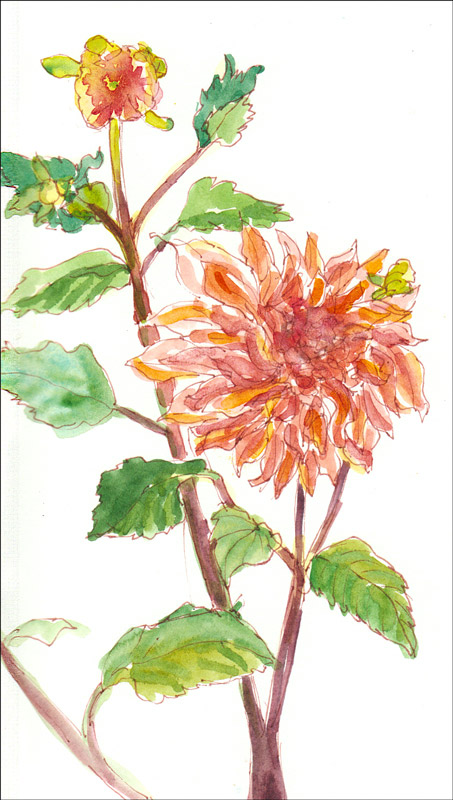
Alejandro's Dahlias, ink & watercolor
When I got home I called the electric company and they said to expect repair or a report by 11:00 p.m. that night so I made plans to go out to dinner and to the movies. I didn’t want to open the fridge so my food would stay cold as long as possible. Then I sat my sketching stool in the driveway next to my neighbor’s flower bed and sketched and painted a couple of his dahlias.
Then I took another long walk with a friend, grabbed a fish burrito and went to see Julie & Julia which I loved! It had been ages since I’d been to the movies and even longer since I’d gone alone. I sat near another woman singleton who had the most infectious laugh and we laughed together throughout the delightful movie.
I appreciated the movie’s nod to the challenges faced by tall women (being one myself). The obsession with eating and cooking rich French food made me curious to know whether Julia Child ever dealt with body image issues or weight problems.I found these quotes from her in an interview in Business Week magazine in 2000:
Q: Could you sum up your feelings about the low-fat food movement? A: I don’t go for that at all…our motto is: “Small helpings. No seconds. No snacking. A little bit of everything, and have a good time.” If you can follow that, it keeps your weight and health in good form. Even if you’re going to have some rich dessert, you can always just have a little spoonful to taste it and keep your spirits up. Then I don’t think you have to go into that miserable, low-fat stuff.
Q: That’s more the French way of eating, I think. Americans always wonder why the French aren’t fat even though they eat rich foods.
A: It’s because the French don’t eat these great big helpings. It’s really horrifying to them to go to Disneyland and see these great big fat Americans plodding along, always eating something. No snacking is very important, I think.
I have a feeling she’s right about the snacking, but I know I find it a lot easier to maintain my weight if I cook and eat simply than if I’m surrounded by delicious, rich food and try to just eat a spoonful to taste it. But then I’d always rather be in the studio than in the kitchen, and am just as happy with a bowl of brown rice, broccoli and tofu than fancy French cooking.
P.S. The electricity came back on the next morning, 24 hours later.
After I started working on a series of paintings in acrylic I realized I needed to learn more about acrylic technique and materials if I wanted to make better progress. Although I’d read several good books and seen a couple of brief demonstrations I needed more.
Although there are hundreds of oil painting and watercolor videos, I could find only a few for acrylics. I rented a couple of awful ones from Netflix and viewed an online video from Artistsnetwork.tv that I found useless. Then I found the video that provided the lessons from which I did the exercises above. The video is “16 Acrylic Painting Techniques: A Studio Workshop with Jackie Miller.” Miller demonstrates and carefully explains how to prepare the support and create each of the 4.5″ square paintings.
I played the DVD on my computer in my studio, and worked along with it, pausing and rewinding as needed. Below are close-ups of the 4.5″ technique squares with a little information about each.
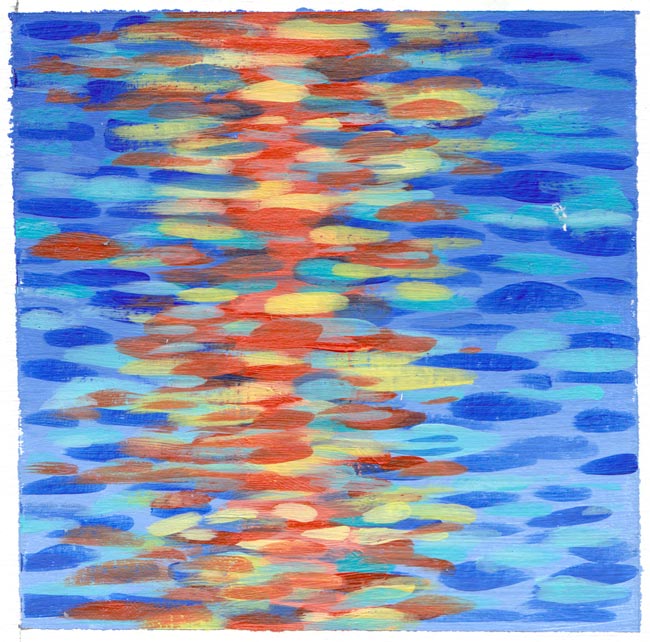
#1: Discrete Brush Strokes
1. Discrete Brush Strokes. Apply a flat, gradated blue background and many layers of individual brush strokes to create optical color mixing (and theoretically the illusion of water and sun reflections).
#2: Stencil and Stamp Painting
2. Stencil and Stamp Painting. Used a variety of materials as stencils, such as plastic embroidery mesh, hardware cloth, plastic decorative stencils. Multiple layers of paint were applied with a stencil brush and with q-tips and a rubber stamp. Fun!
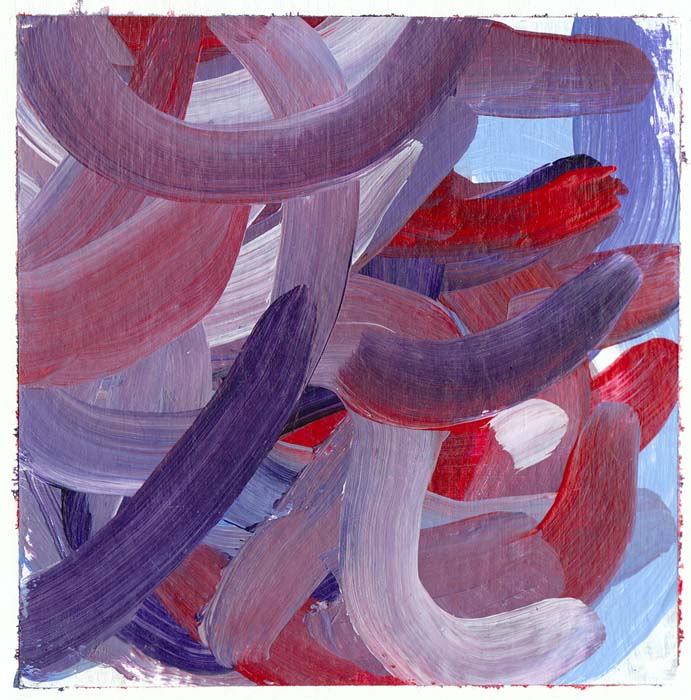
#3: Energized Brush Strokes Alla Prima
3.Energized Brush Strokes Alla Prima. Using glazing liquid to keep paint workable a bit longer, applied layers of brush strokes freely, letting colors blend into each other.
#4: Impasto with Sgraffito
4. Impasto with Sgraffito (scraping). On top of flat underpainting, applied paint mixed with gel medium and before it dried, scraped through it with a variety of implements including popsicle stick, rubber combs, and paint shapers.
#5: Glazing and Scumbling
5. Glazing and Scumbling. Applied underpainting of blue, leaving white hole in the center. Then half the blue was glazed with a very thin layer of the same blue mixed with glazing medium (to see how it enriches the color and removes chalkiness). The center hole was painted red. Then turquoise paint was scumbled (scrubbed with a dry brush) on top of the blue and softly over the edge of the red.
#6: Cross-hatch Brush Stroke
6. Cross-hatch Brush Stroke. I need more practice with this one. A flat, dark underpainting was done first and then the idea was to make brush strokes that cross each other in hundreds of little X’s with a fairly dry brush to create soft gradations with many layers. The original actually looks better than this photo shows because of glare, but I still found it difficult to make those X’s.
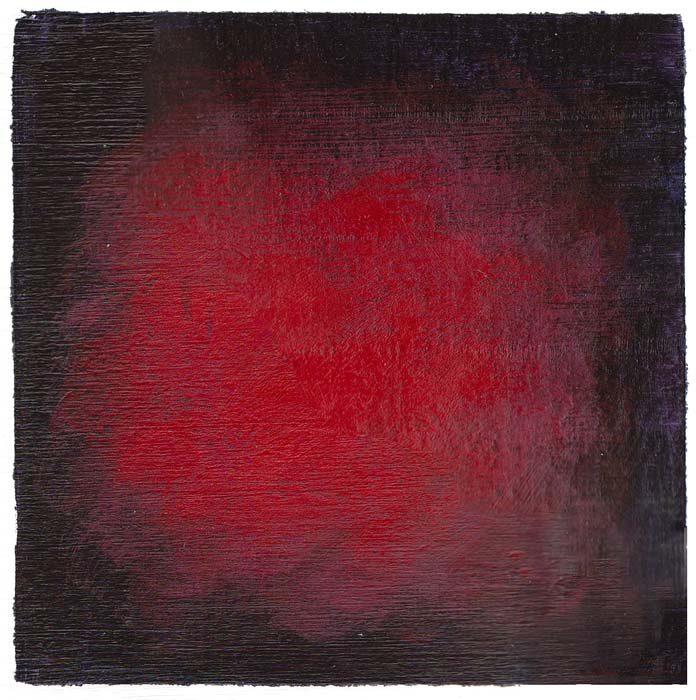
#7: Soft-edge & Hard-edge
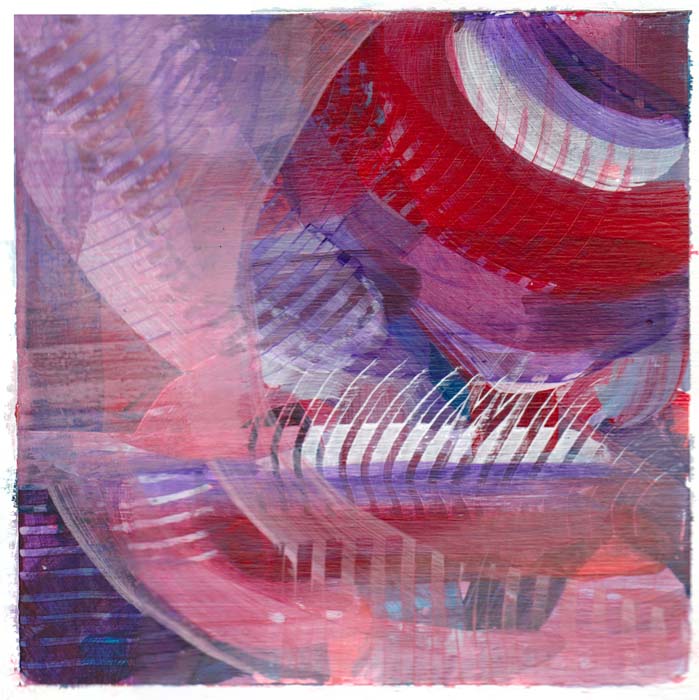
7. Creating soft- and hard-edged transitions. A dark, flat background was painted first and then the edge of the section at the top left was masked with masking tape and lighter red painted in that area. The transition at the bottom was created with layers and layers of softly scumbled paint lightly scrubbed on with a nearly dry brush, always starting at the corner and moving towards the center so there was less paint on the brush as it approached the transition area.
#8: Glazes, Wipe Removal & Combing
8. Glazes, Wipe Removal & Combing. On top of a flat, mauve background, layers of paint mixed with glazing medium were applied and then wiped back with a damp cloth and combed through using a rubber, multi-sided comb.
#9: Finger Painting & Mixed Media
9. Finger Painting & Mixed Media. Started by finger painting with grey paint (she used Graphite Gray meant to look like graphite) and then added water soluable crayons, Sharpie marker, pencil, layer of acrylic medium, and more crayons and pens, finishing with medium to seal the crayon layer.
#10: Staining
10. Staining. On the video she left this square of the canvas raw, but since I was using watercolor paper, I gessoed the whole sheet and then covered this square with Absorbent Ground Medium which creates an absorbent surface, similar to ungessoed paper. The paint was mixed with a high proportion of water and allowed to move and blend wet into wet. It didn’t work as nicely as watercolor does wet into wet. Mixing more than 25% water with acrylics can cause them to fail to bond with other acrylic layers, but that’s not important when working with an absorbent ground since it will sink ito the fibers.
#11. Alla Prima as Underpainting
11. Alla Prima as Underpainting. The underpainting was created like #3 using bold strokes of paint, wet into wet. When dry it was painted over with various techniques including combing and glazing. On the video she did the over-painting with oil paint. I used acrylic.
#12: Painted Gel Relief
12. Painted Gel Relief. First a a pile of heavy clear gel was applied to the surface and then pushed around and smoothed and shaped with various implements. When it was dry to the touch after 24 hours I painted it with Micaceous Iron Oxide, Copper and Bronze acrylic paint.
#13: Found-Object Collage
13. Found-Object Collage. A flat layer of heavy gel was applied and then random stuff stuck into it (twine, match stick, pennies, plastic stretcher bar “key”, electrical wire thingees, some glitter for texture). When dry it was painted.
#14: Rubber Cement & Tape Masking
14. Rubber Cement & Tape Masking. Rubber cement was applied and when dry, the square was painted. Then rubber cement was removed, another layer of rubber cement painted over a different area, another layer of paint, cement removed. Masking tape applied and then painted over, etc.
#15: Paper and Fabric Collage
15. Paper and Fabric Collage. Acrylic medium was used as an adhesive to attach scraps of fabric, string, lace and paper. When dry the surface was painted using various colors and Iridescent Gold paint.
#16: Water Soluble Crayon
16. Water Soluble Crayon. This was supposed to also include bits of dried acrylic paint film but I didn’t quite see the point of using scraps of dried up paint. I’m not sure I really got the point of drawing with the water soluble crayons and then coating them with acrylic medium (they smear) either, but I gave it a try.
IMPRESSIONS:
I was suprised how much I enjoyed the more abstract, random, textural pieces; a nice respite from my usual striving to capture what I see in a somewhat realistic fashion. I can see many possibilities for exploration with acrylics, but I’m still not convinced of their suitability for my work right now, although I haven’t given up yet. I’ve gone back to working on the paintings in progress with more understanding and skill but still feel like I’m fighting the medium. More about that later.
Sunday I got into one of those funks where no matter what I was doing I felt like I should be doing something else. It was a beautiful day: I should be out painting plein air. But there were paintings in progress in the studio that were calling to me. And then there were shoulds about the medium to use: I should be painting in oil, no acrylic, no watercolor…I was driving myself nuts!
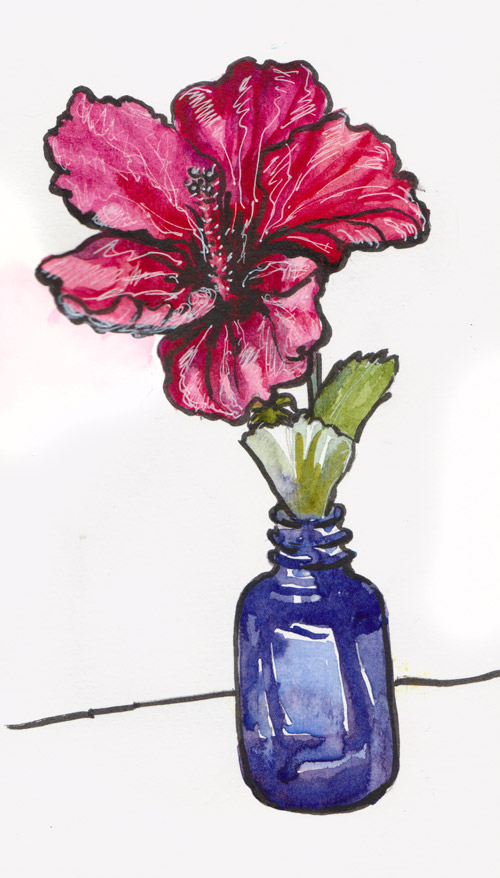
So I sat myself down at the drawing table and just started writing in my sketchbook journal all the shoulds I was hearing in my mind (but who was saying them–aren’t I the only one in there?). When all else fails I default to flowers. I picked a hibiscus, stuck it in a little bottle and started sketching. I got it wrong. I drew with a pen dipped in ink, I added wax crayon, watercolor crayon, rubbed it with a paper towel, rubber stamps, more ink, more crayon, and just kept angrily abusing the page, trying to dump the shoulds.
Attack of the Shoulds #2, Ink and watercolor
I wrote on the page: “Accept that it is all impossible.It will be wrong. It will be bad. It is pointless. And do it anyway. Because you can. And doing it badly is better than not doing it. Break the cycle. Stop the nonsense!” When there was nothing more to do the first page spread I started on the next, feeling freer. I tackled the hibiscus again, and did #2 above.
Attack of the Shoulds #3, watercolor and ink
For #3 above, I sketched with pencil, added watercolor and then outlined everything afterwards with a Pitt Sepia F pen.
Attack of the Shoulds #4, ink & watercolor
It was almost time to go to a dinner party but I squeezed in one more, which I mucked up a bit with too heavy outlining so added some fun scribbly white pen. The good news is that I did break the cycle, got over the shoulds and got back to having fun in the studio today.
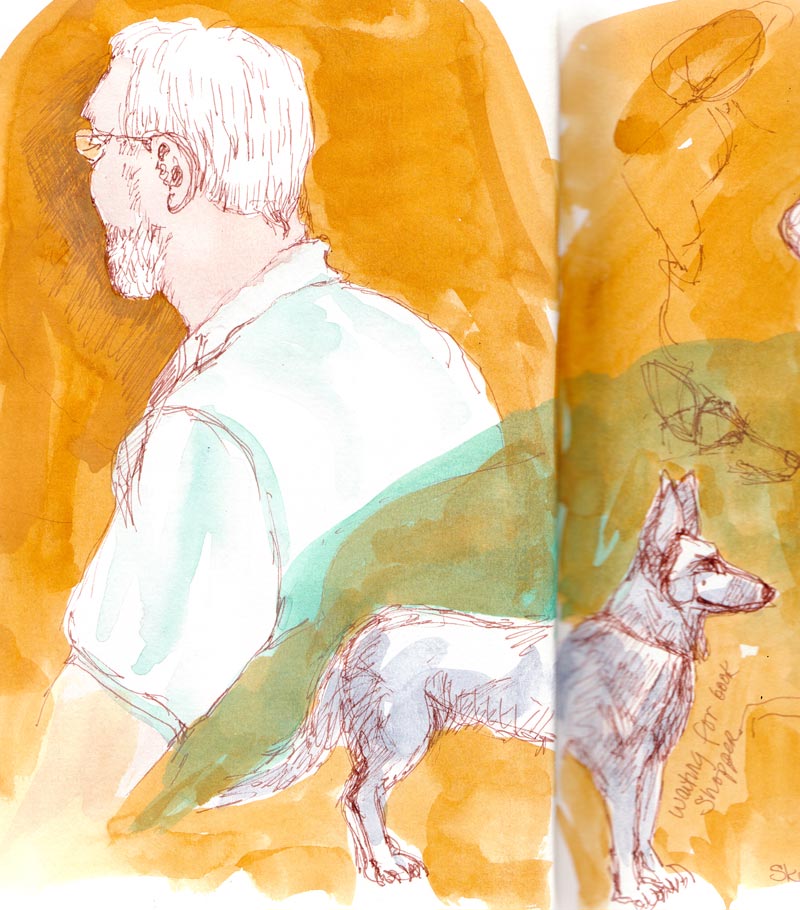
Waiting for his stop; waiting for her owner; ink and gouache
He was waiting for his stop on the subway ride and she was waiting for her owner to come out of the book store on Solano. I used the gouache to hide the guy’s nose that I added by mistake. (It wasn’t visible at this angle but he turned his head and I said, “Oh, there’s his nose,” and sketched it in, and immediately saw it was wrong.) The gouache also nicely hides the false start of the dog and the waiter (see last picture below) too.
North Berkeley Fire Station, copic sepia ink
The North Berkeley Fire Station is round. The fire truck barn is a large round concrete building with pillars and attached round buildings where the firemen (and women) live when they’re on duty. At the bottom left of the sketch is the very back of the waiting fire truck, with flag flying, just returned from one call and ready and waiting for the next.
Waiting waiter, ink and gouache
This waiter was on a break from the Inidan restaurant in front of which I was sketching. Although he was only about 20 feet away, he was so engaged in his phone call that he didn’t seem to notice me sitting on my little sketching stool, frantically trying to catch his gesture before he walked away. There’s another quickie of the waiting dog on this page too.
These were all from last Tuesday night’s sketchcrawl. I sketched in pen on site and then added the gouache at home.
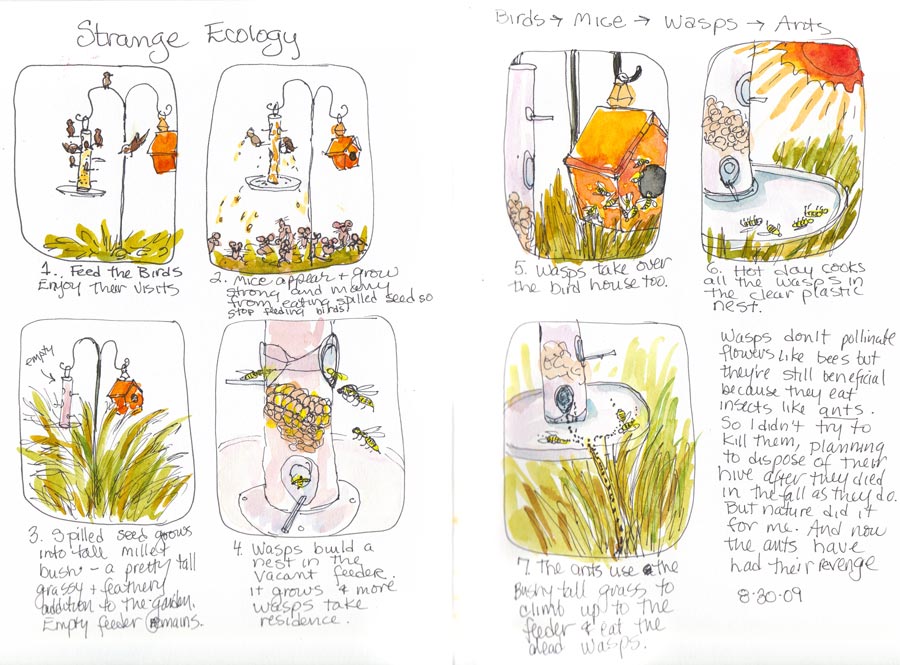
Strange Ecology, ink & watercolor (click to enlarge or see big images below)
I used to love feeding the birds and seeing my little customers flocking to the feeder. But one day I thought I saw the wood chip ground covering moving under the feeder. When I looked closely I saw it wasn’t the tan bark moving, it was dozens of mice! By feeding the birds I was also nourishing a growing army of mice with all the seed the birds scattered!
1. Feed the Birds ---> ---> ---> ---> ---> ---> ---> 2. Mice grow strong and prosper
I called “Vector Control” (a euphemism for the county rat patrol) and an interesting female rat inspector came out and inspected. She told me the only way to get rid of the mice was to stop feeding the birds and that for each mouse I saw there were 50 more I wasn’t seeing. I was sad to stop feeding the birds but it was better than the alternative (which included multiple mouse traps, even sadder).
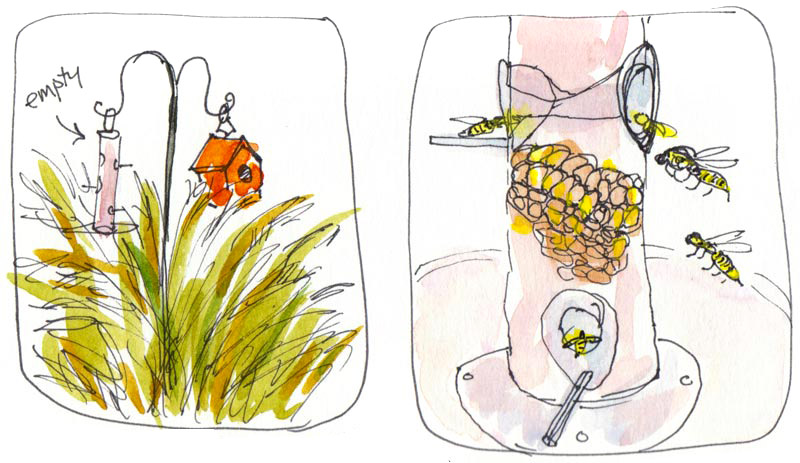
Meanwhile, the spilled millet seed grew into a lovely, tall, feathery bush under the feeder, which I left hanging in a bit of wishful thinking that one day I’d be able to return to feeding my feathery friends.
3. Millet grass grows under feeder ---> ---> ---> --->4. Wasps move in.
A couple years pass, the feeder and bird house remain empty and the millet bush continues to be a pretty garden feature. One day I notice something odd: wasps are buzzing in and out of the feeder and have built a nest inside it. I learned that while wasps do not pollinate like bees, they are still beneficial because they eat insect pests in the garden. I decided to leave them alone and enjoyed watching them care for their babies (larvae) in the nest.
Wasps eat potential garden pests including the venomous black widow spider. Adult wasps eat only pollen and nectar (or your soda at picnics). They only hunt for meat (insects, worms, your barbequed hamburgers) to feed their larvae. Wasps nests have only one purpose: to ensure the production of young. At the end of the nest’s cycle, every member of the nest, except emerging queens, dies.
5. The wasps move in next door ---> ---> ---> 6. The Greenhouse Effect
I guess things got a little crowded in the nest because the wasps started hanging out at the neighboring empty bird house too. Then one day we had a scorcher of a summer day. The temperature in my usually cool and foggy neighborhood by the Bay was in the 90s (f). The clear plastic bird feeder turned into a greenhouse and cooked all the wasps in the nest. So sad. All those poor little larvae, all that building and hunting and gathering of food.
But it wasn’t entirely wasted…
7. The millet bush becomes ladder to an ant party
The stalks of tall millet grass made a perfect ladder for the gazillions of ants who live in my garden (and don’t even get me started about the ants and their nasty aphid ranches). The ants were streaming up the grass onto the feeder and having a lovely dinner party of roasted wasp.
And because my garden is well stocked with ants and aphids, I am, in a way, still feeding the birds. They still flock to my garden, but now they eat the ants and aphids off the rose bushes and it doesn’t even cost a penny in bird seed.
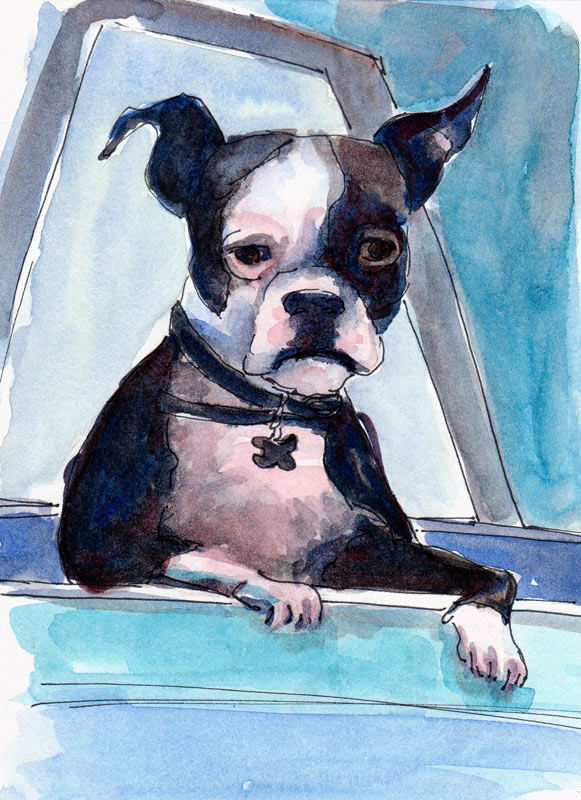
This very hip and cool Boston Terrier was watching me with one eye and watching his hip and cool owners with the other from the open window of their cool 1960’s era blue Cadillac. The two guys were wearing hip and cool hats while digging for cool stuff from a dumpster containing items from a remodeling job at the of the Longs Drugs at El Cerrito Plaza.
I’m always drawn to cool stuff in dumpsters or left out on the street, but have to work hard to control those pack rat tendencies since I’ve seen how that turns out (with a certain family member who shall remain anonymous). Unless a found item is something that I need and would buy if it was in the store, I leave it be. I remind myself that I’m NOT a sculptor who makes things from found objects and that I don’t need to bring home someone else’s garbage, regardless of how cool it might be.
To draw the dog I first sketched in pencil from a photo I took of the dog, and then inked with another pen I was testing: the Prismacolor Premier series Fine Line Marker. It came in a set of five pens with varying points from .005 to .08. They’re “permanent, acid-free, lightfast, water-resistant and archival.” I used the .01 and .05 and found them to be comfortable to hold and smooth to draw with.
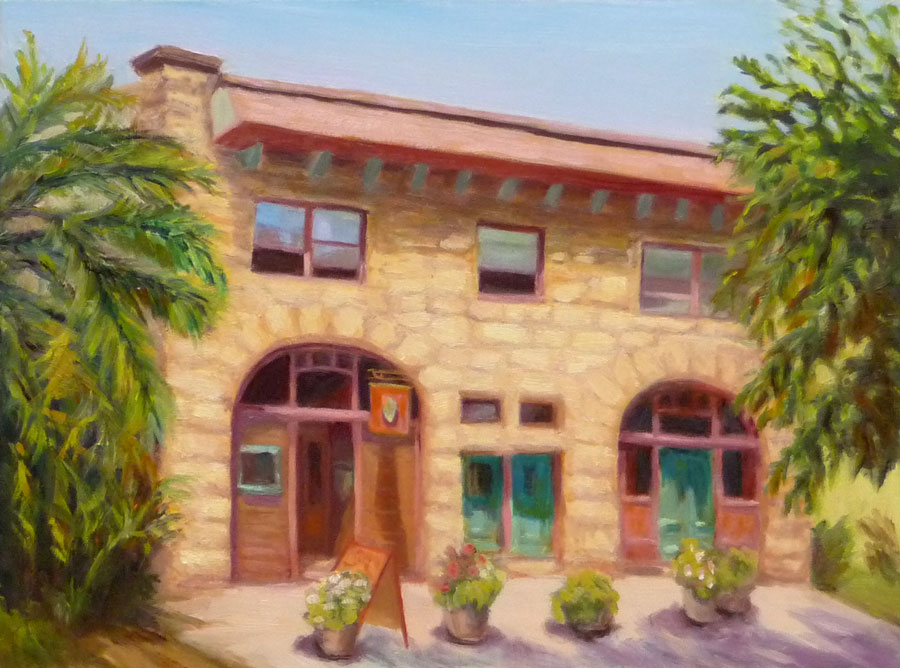
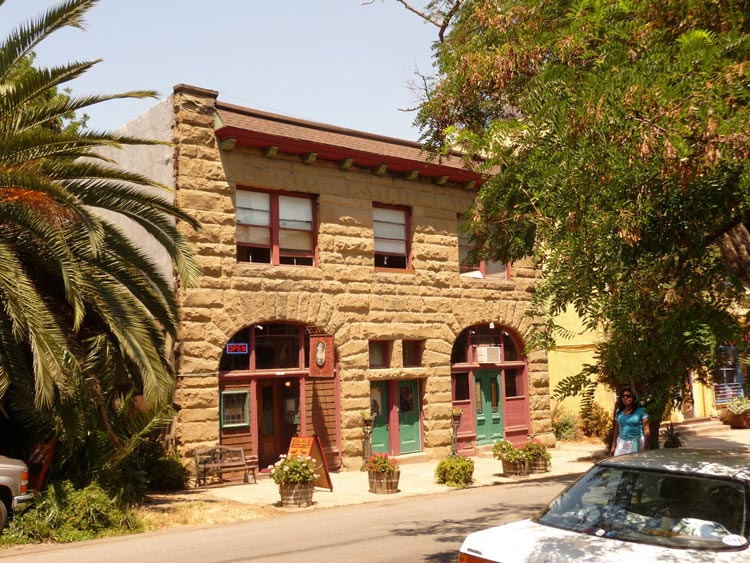
Port Costa's Bull Valley Restaurant, Oil on panel, 9x12
When we gathered for our critique on the patio outside the funky Warehouse Cafe, a biker bar at the end of Port Costa‘s main road, I thought I’d gotten my painting of the Bull Valley Restaurant off to a good start. It was a sunny Saturday and the quirky local residents of the little town had been very welcoming, chatting and joking with the plein air painters.
Just as the critique was getting started the old lady bartender turned up the rock and roll so loud that we couldn’t hear each others’ comments and suggestions. Someone went in and asked her to turn it down and she sneered, “This is a bar. We play rock and roll!” Although some of our group had bought lunch and beer (served in mason jars), I guess we weren’t exactly their preferred clientelle.
Their usual patrons continued to roar in on their Harleys and wanna be Harleys. Some were dressed in full leather or raunchy heavy metal t-shirts and black denim. At least half of them were over 50, the guys paunchy and bald and the women, with their dyed thinning black hair, looked “rode hard and put away wet” as I’ve heard it said.
Anyway, back to the painting. As you’ll see from my initial sketch below, my perspective was even further off than it ended up in the finished painting above.
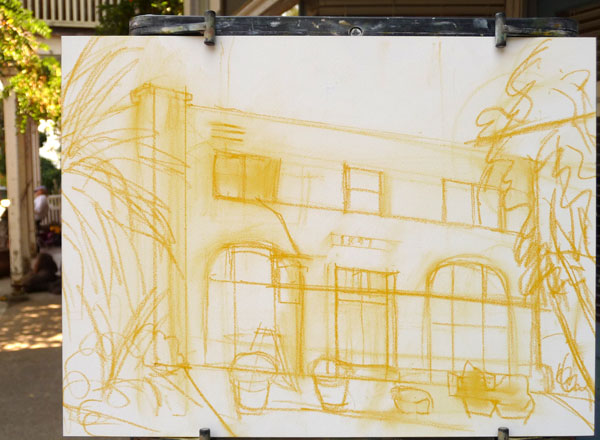
Port Costa-WIP 1
I’m always amazed how often my eyes fool me. Sometimes I’m sure a line slants one way and then I hold up a pencil to check and the line slants in the completely opposite direction.
This is the point when I stopped painting on site, planning to finish at home from photos.
Port Costa WIP 2
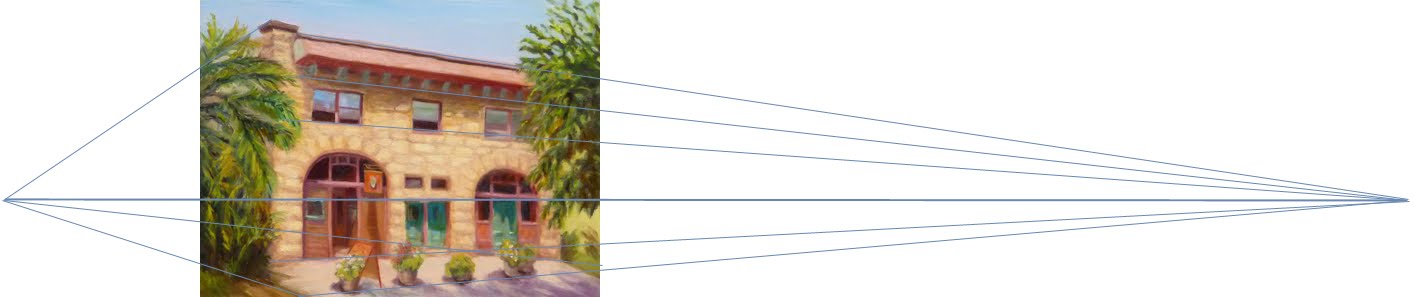
Once home I realized that I had a serious perspective problem with the way the roof line and the line where the building meets the ground were parallel to each other instead of coming towards each other to finally meet at a vanishing point. I worked on the painting for a couple of days and thought I’d fixed it (blind to what was in front of my face from seeing it for too long).
When I shared what I thought was the final painting with some artist friends, they generously pointed out a few things that needed adjusting, including continuing perspective problems. Below M. added lines in Photoshop to demonstrate for me how I’d gone wrong with the perspective. It’s so great to have that kind of support!
Diagram showing how the perspective should have been
In the end I decided I’d taken this painting as far as it needed to go and moved on to the next project. But I promised myself that next time I’d pay more attention to perspective.
Rush Ranch Horses, Sepia Copic Multiliner and watercolor wash
Mariah, a wonderful young artist, accompanied me to my plein air group’s paint-out today at Rush Ranch in Suisin City. She was immediately inspired by a spot, sat down and started sketching. I faced the opposite direction and sketched these horses in the corral.
Before we’d left my house, I showed her a book on drawing animals that demonstrated how to first find and assemble the basic shapes contained in the animal (rectangles, circles, triangles) and then refine them. I decided to practice what I preached and did that with the horses. I’d never noticed what big knees horses have before. I sketched with my sepia Copic Multiliner .03 and then added watercolor washes.
Rush Ranch Vista, ink & watercolor wash
The views from Rush Ranch were tremendous. I could have sketched for hours more but we’d arrived late and after our second sketches it was time for the group critique and lunch.
We were late because I got lost yet again (missed the turnoff and drove forever before turning around — and this was with GPS!) My mind had wandered to thinking about the people fishing (and the fish) in the slough off the little bridge we’d just passed so I missed the entrance sign and decided that the GPS telling me I’d arrived was wrong. This was especially stupid since the printed directions from my group said to go over that bridge and then turn right in 3/4 mile.
Instead I drove and drove, went over another bridge and THEN started looking for the turnoff. I went miles past that bridge, eventually arriving at the gate to a “youth correctional facility” (jail for teens) and admitted I’d blown it again. When we finally found our way back and I saw the huge “Rush Ranch” sign, I couldn’t believe I’d missed it.
Well actually I could believe it. I think I could get lost just walking from one room to another these days!
I’ve been away from my blog this past week, for a number of reasons, including setting up a new computer, an extended family member suddenly hospitalized in a coma with no brain activity, plus other more positive family events.
So in this brief intermission, here is a page from Costa Rica’s Zoom magazine I received recently. My sketches illustrate an article about Leaf Cutter Ants (amazing creatures that live in Costa Rica). When the editor was looking for illustrations she came across my sketches on my blog and asked for permission to use them in the article. It’s fun seeing them in print:
(Click image to enlarge)
I’m looking forward to some solid studio time for the next two days and getting back to regular posting. Meanwhile, life goes on…




















 Jana Bouc, Artist