Better Bowl of Fruit, Watercolor on paper, 7" x 10.5"
I’m so much happier with the way this watercolor of my bowl of fruit turned out than the one in my sketchbook. It makes such a difference to use Arches 140 lb cold-pressed watercolor paper. It also helped that I was painting consciously and taking my time, instead of rushing through it, half asleep as I had been when I made the sketch.
Even more fun is that I made the the large porcelain bowl when I was a potter and had glazed it with two of my favorite glazes…and now I was “glazing” it again, in watercolor.
I enjoyed every bit of the process, from planning the composition, to drawing (see below) from life, to masking the whites, then painting one shape at a time, using juicy washes, adding color wet-into-wet, as well as glazing over dried washes, then removing the mask, softening the highlights and some edges.
Fruit bowl pencil sketch on watercolor paper
Since I’m teaching a watercolor class right now, I tried to also pay attention to my process so that I could better explain to my students how and why I did what I did. I surprised myself with the range of techniques I was actually using in one painting. Even though in class we study them as separate techniques (flat wash, graded wash, wet-into-wet, etc.) you often need them all in one painting and sometimes in one passage of a painting.
(Boring technical stuff follows…read at your own risk…) For example, after the fruit, bowl, and shadow were painted I did a flat wash of Ultramarine Blue mixed with Burnt Sienna for the neutral background. Then it felt like the table top, which I’d initially left white with just a light blue shadow, needed paint too. So the first layer was a pale flat wash of Cadmium Yellow. When it dried it didn’t feel warm enough so I glazed over it with a flat wash of Permanent Rose (so that the whole table top was the pale apricot color now only seen on the right of the table top). It still wasn’t warm enough so I did another wash of Permanent Rose mixed with a little Cadmium Yellow and let it fade out 3/4 of the way across. I liked the way that looked but now the shadow was too pale. So I glazed over over the shadow a couple of times and then softened the edges of the shadow where it meets the table top.)
After I started working on a series of paintings in acrylic I realized I needed to learn more about acrylic technique and materials if I wanted to make better progress. Although I’d read several good books and seen a couple of brief demonstrations I needed more.
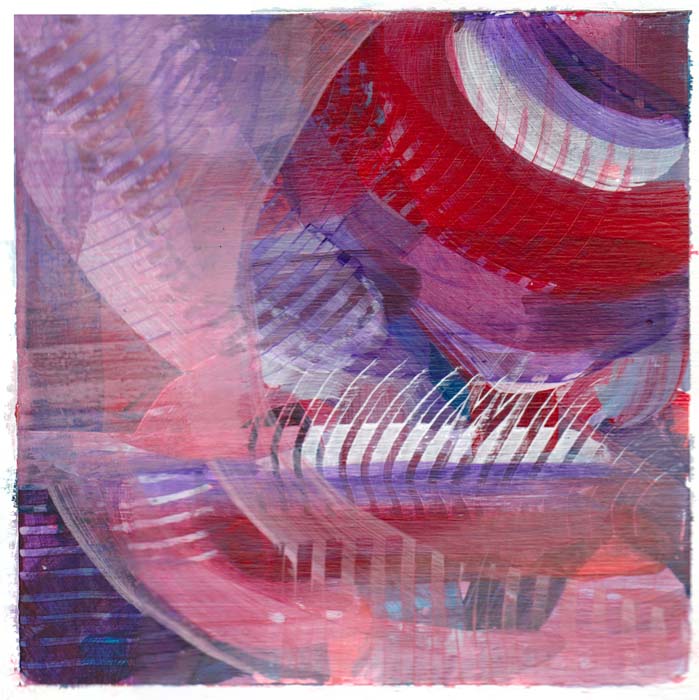
Although there are hundreds of oil painting and watercolor videos, I could find only a few for acrylics. I rented a couple of awful ones from Netflix and viewed an online video from Artistsnetwork.tv that I found useless. Then I found the video that provided the lessons from which I did the exercises above. The video is “16 Acrylic Painting Techniques: A Studio Workshop with Jackie Miller.” Miller demonstrates and carefully explains how to prepare the support and create each of the 4.5″ square paintings.
I played the DVD on my computer in my studio, and worked along with it, pausing and rewinding as needed. Below are close-ups of the 4.5″ technique squares with a little information about each.
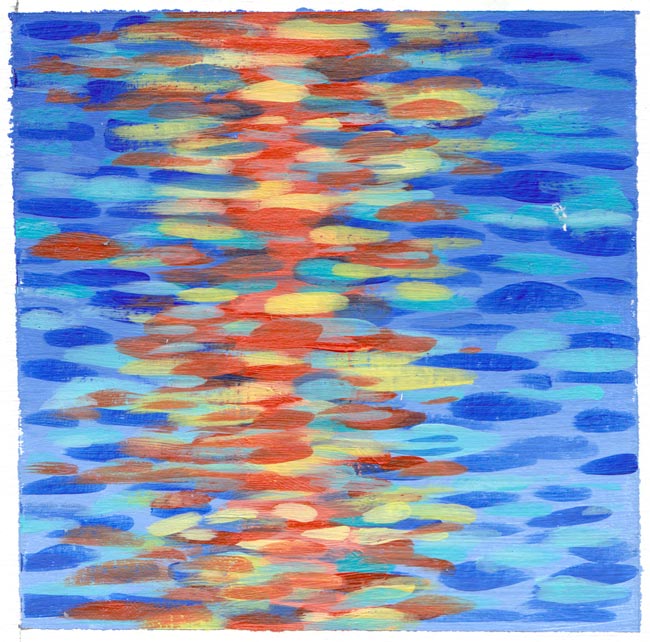
#1: Discrete Brush Strokes
1. Discrete Brush Strokes. Apply a flat, gradated blue background and many layers of individual brush strokes to create optical color mixing (and theoretically the illusion of water and sun reflections).
#2: Stencil and Stamp Painting
2. Stencil and Stamp Painting. Used a variety of materials as stencils, such as plastic embroidery mesh, hardware cloth, plastic decorative stencils. Multiple layers of paint were applied with a stencil brush and with q-tips and a rubber stamp. Fun!
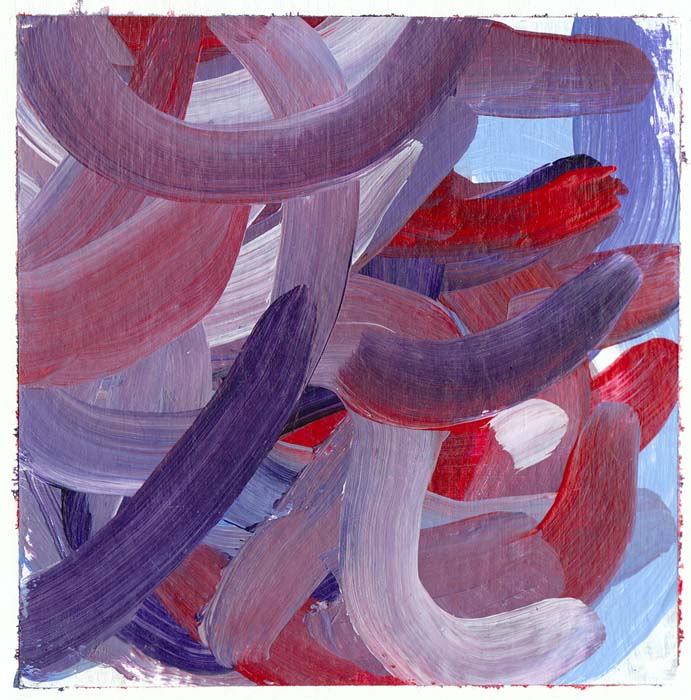
#3: Energized Brush Strokes Alla Prima
3.Energized Brush Strokes Alla Prima. Using glazing liquid to keep paint workable a bit longer, applied layers of brush strokes freely, letting colors blend into each other.
#4: Impasto with Sgraffito
4. Impasto with Sgraffito (scraping). On top of flat underpainting, applied paint mixed with gel medium and before it dried, scraped through it with a variety of implements including popsicle stick, rubber combs, and paint shapers.
#5: Glazing and Scumbling
5. Glazing and Scumbling. Applied underpainting of blue, leaving white hole in the center. Then half the blue was glazed with a very thin layer of the same blue mixed with glazing medium (to see how it enriches the color and removes chalkiness). The center hole was painted red. Then turquoise paint was scumbled (scrubbed with a dry brush) on top of the blue and softly over the edge of the red.
#6: Cross-hatch Brush Stroke
6. Cross-hatch Brush Stroke. I need more practice with this one. A flat, dark underpainting was done first and then the idea was to make brush strokes that cross each other in hundreds of little X’s with a fairly dry brush to create soft gradations with many layers. The original actually looks better than this photo shows because of glare, but I still found it difficult to make those X’s.
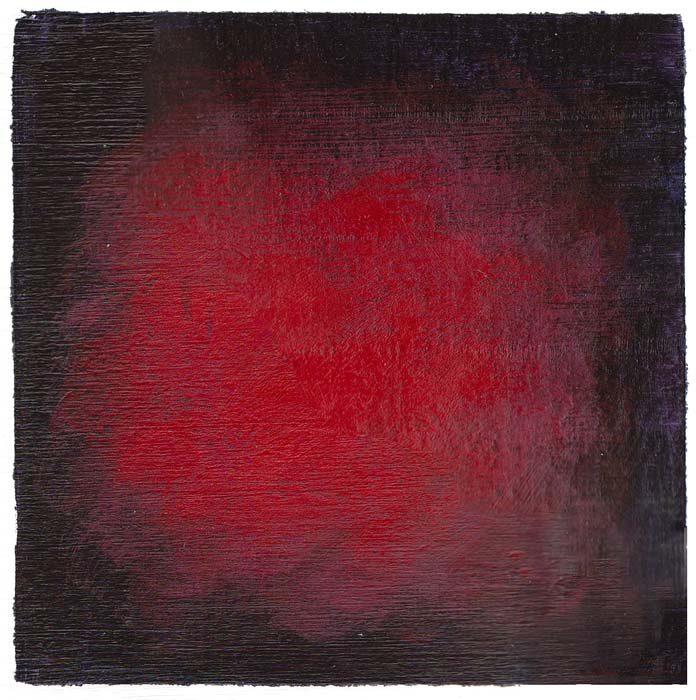
#7: Soft-edge & Hard-edge
7. Creating soft- and hard-edged transitions. A dark, flat background was painted first and then the edge of the section at the top left was masked with masking tape and lighter red painted in that area. The transition at the bottom was created with layers and layers of softly scumbled paint lightly scrubbed on with a nearly dry brush, always starting at the corner and moving towards the center so there was less paint on the brush as it approached the transition area.
#8: Glazes, Wipe Removal & Combing
8. Glazes, Wipe Removal & Combing. On top of a flat, mauve background, layers of paint mixed with glazing medium were applied and then wiped back with a damp cloth and combed through using a rubber, multi-sided comb.
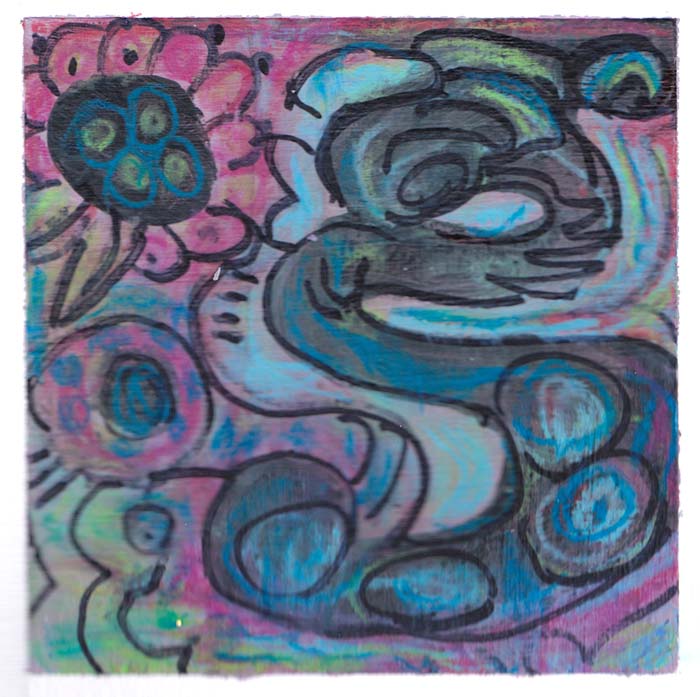
#9: Finger Painting & Mixed Media
9. Finger Painting & Mixed Media. Started by finger painting with grey paint (she used Graphite Gray meant to look like graphite) and then added water soluable crayons, Sharpie marker, pencil, layer of acrylic medium, and more crayons and pens, finishing with medium to seal the crayon layer.
#10: Staining
10. Staining. On the video she left this square of the canvas raw, but since I was using watercolor paper, I gessoed the whole sheet and then covered this square with Absorbent Ground Medium which creates an absorbent surface, similar to ungessoed paper. The paint was mixed with a high proportion of water and allowed to move and blend wet into wet. It didn’t work as nicely as watercolor does wet into wet. Mixing more than 25% water with acrylics can cause them to fail to bond with other acrylic layers, but that’s not important when working with an absorbent ground since it will sink ito the fibers.
#11. Alla Prima as Underpainting
11. Alla Prima as Underpainting. The underpainting was created like #3 using bold strokes of paint, wet into wet. When dry it was painted over with various techniques including combing and glazing. On the video she did the over-painting with oil paint. I used acrylic.
#12: Painted Gel Relief
12. Painted Gel Relief. First a a pile of heavy clear gel was applied to the surface and then pushed around and smoothed and shaped with various implements. When it was dry to the touch after 24 hours I painted it with Micaceous Iron Oxide, Copper and Bronze acrylic paint.
#13: Found-Object Collage
13. Found-Object Collage. A flat layer of heavy gel was applied and then random stuff stuck into it (twine, match stick, pennies, plastic stretcher bar “key”, electrical wire thingees, some glitter for texture). When dry it was painted.
#14: Rubber Cement & Tape Masking
14. Rubber Cement & Tape Masking. Rubber cement was applied and when dry, the square was painted. Then rubber cement was removed, another layer of rubber cement painted over a different area, another layer of paint, cement removed. Masking tape applied and then painted over, etc.
#15: Paper and Fabric Collage
15. Paper and Fabric Collage. Acrylic medium was used as an adhesive to attach scraps of fabric, string, lace and paper. When dry the surface was painted using various colors and Iridescent Gold paint.
#16: Water Soluble Crayon
16. Water Soluble Crayon. This was supposed to also include bits of dried acrylic paint film but I didn’t quite see the point of using scraps of dried up paint. I’m not sure I really got the point of drawing with the water soluble crayons and then coating them with acrylic medium (they smear) either, but I gave it a try.
IMPRESSIONS:
I was suprised how much I enjoyed the more abstract, random, textural pieces; a nice respite from my usual striving to capture what I see in a somewhat realistic fashion. I can see many possibilities for exploration with acrylics, but I’m still not convinced of their suitability for my work right now, although I haven’t given up yet. I’ve gone back to working on the paintings in progress with more understanding and skill but still feel like I’m fighting the medium. More about that later.
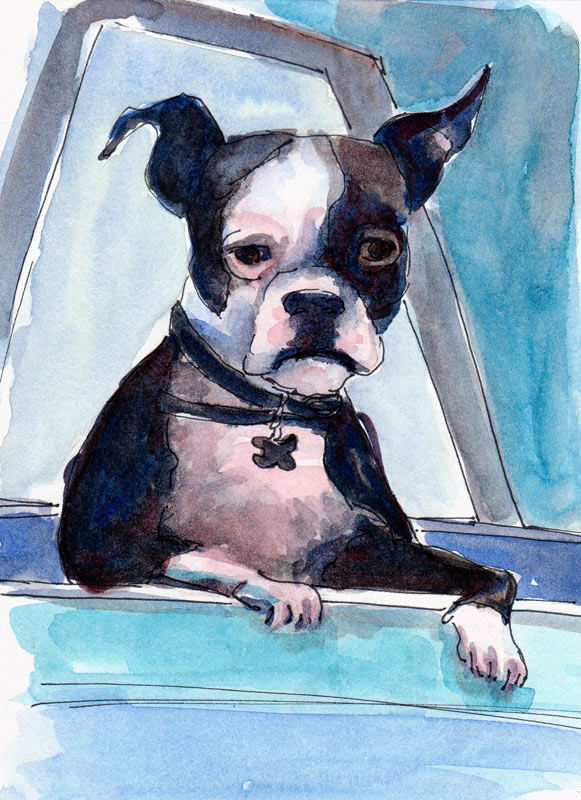
This very hip and cool Boston Terrier was watching me with one eye and watching his hip and cool owners with the other from the open window of their cool 1960’s era blue Cadillac. The two guys were wearing hip and cool hats while digging for cool stuff from a dumpster containing items from a remodeling job at the of the Longs Drugs at El Cerrito Plaza.
I’m always drawn to cool stuff in dumpsters or left out on the street, but have to work hard to control those pack rat tendencies since I’ve seen how that turns out (with a certain family member who shall remain anonymous). Unless a found item is something that I need and would buy if it was in the store, I leave it be. I remind myself that I’m NOT a sculptor who makes things from found objects and that I don’t need to bring home someone else’s garbage, regardless of how cool it might be.
To draw the dog I first sketched in pencil from a photo I took of the dog, and then inked with another pen I was testing: the Prismacolor Premier series Fine Line Marker. It came in a set of five pens with varying points from .005 to .08. They’re “permanent, acid-free, lightfast, water-resistant and archival.” I used the .01 and .05 and found them to be comfortable to hold and smooth to draw with.
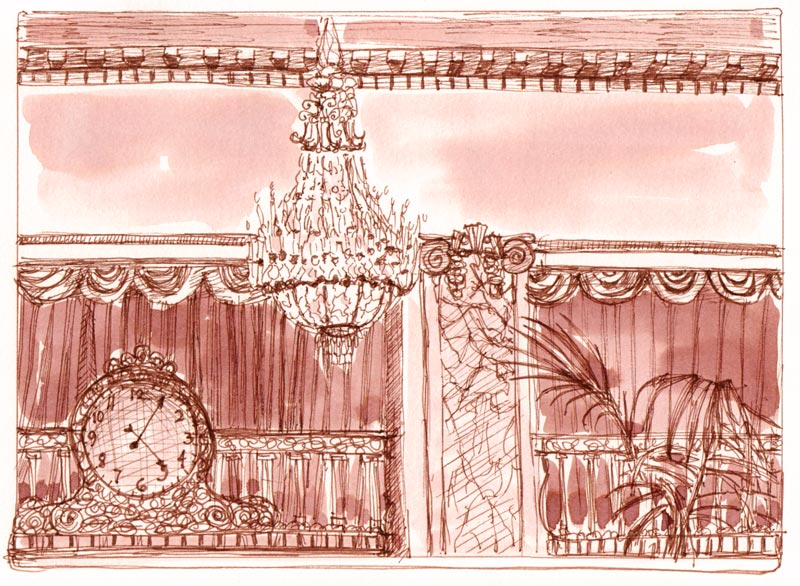
Higgins Calligraphy Ink wash added to Palace Hotel sketch
Yesterday I tested some sepia drawing pens and bottled sepia inks to see which I preferred and did the same with an assortment of graphite pencils. To start the process I added some sepia ink washes to last week’s sketch from the Palace Hotel in San Francisco and like it much better now.
The pens I tested were all permanent, waterproof and lightfast:
Copic Multiliner SP.03 which I used in the sketch above
Micron Pigma .01 (my former favorite pen)
Pitt Artist Penswith various sized nibs including a brush pen.
My favorite was the Copic Multiliner SP .03 because of the way the ink and point just glide across the paper, the wide comfortable pen barrel, and the rich sepia color. Because it’s aluminum, refillable and has a replaceable tip, the Copic Muliliner is the most expensive of the three (around $7.00) and I can only get it via mail order which is annoying.
My second favorite was the Pitt Artist Pen with the “S” (superfine) tip. The Pitts are much more readily available in my local art stores and much less expensive (around $2.00). They have a somewhat wide comfortable barrel and a smooth feel when sketching.
The Sakura Micron Pigma .01, my former favorite, now seems a bit sharp and scratchy, but does offer more control because of the finer line. The barrel is narrower which makes it less comfortable to hold for long periods. It’s reasonably priced (around $2.25) and a good pen.
Traditional sepia ink is made from cuttlefish bladders(!) and mixed with a waterproof shellac base for a transparent waterproof satin finish.
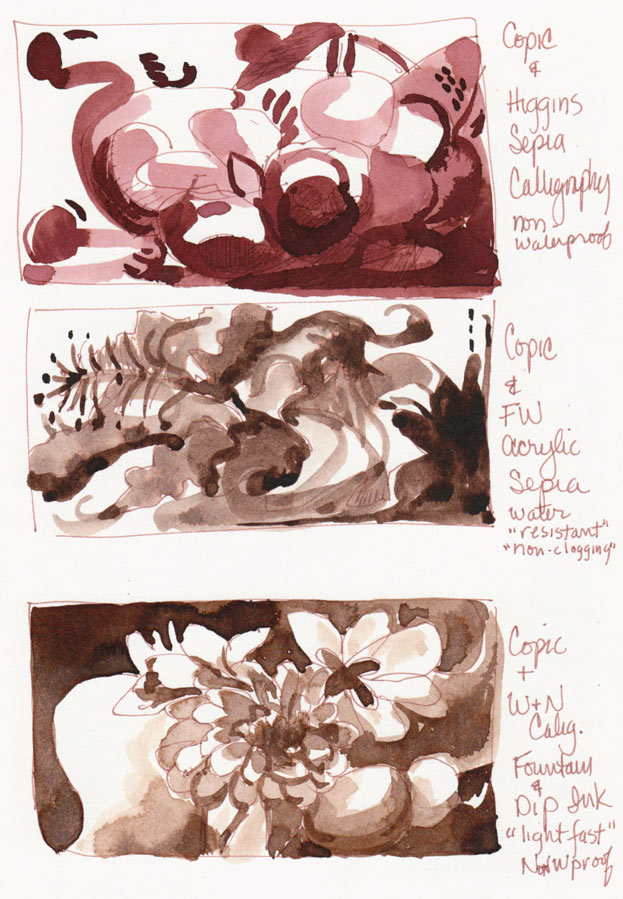
The inks I tested were:
Higgins Sepia Calligraphy Ink (label says “non-waterproof” but provides no information regarding permanence). A beautiful warm color that flows beautifully straight or when mixed with water in washes. It is my favorite of the three, but I’m concerned about it’s archival qualities. I’ve sent the company a request for more information and will update this post when I receive it. Since it was recommended to me by an artist I trust who uses it in her fine art, ink and wash work I will continue to use it for now. It comes in a sad, unattractive, square plastic bottle with little self-esteem, and is without an eye-dropper lid.
[update 8/29/2009: Higgins Inks have been purchased by ChartPak and I was able to speak to the delightful woman in charge of their laboratory where the inks are formulated and tested. I was told that this line of inks is considered “student grade” and that testing is still underway (since it’s a new product to their company). However she was able to tell me that the colorants for this ink are dyes rather than pigments so while the ink bonds “permanently” with the paper, the colors are probably not lightfast and would be subject to fading or changing color. ]
FW Acrylic Artists Ink (label says “water resistant, permanent, highly lightfast”). Ugly chalky dark brown that didn’t work well as a wash, got blotchy and almost seemed sedimentary. It’s made using the same pigments that are in paints, so it’s basically very thin acrylic paint designed to be used in pens. This was the only one of the three with an eye dropper built into the lid and comes in a glass bottle.
Winsor & Newton Calligraphy Ink (label says “non waterproof, lightfast”). It was OK. It’s more traditionally sepia colored than the Higgins ink. I think I could make it work, but preferred the Higgins. It comes in a glass bottle without an eye-dropper lid.
Here is the test page on which I drew with the Copic Multiliner and then added washes of pure ink and ink mixed with water from each of the three bottled inks.
Copic Multiliner and Inks (click to enlarge)
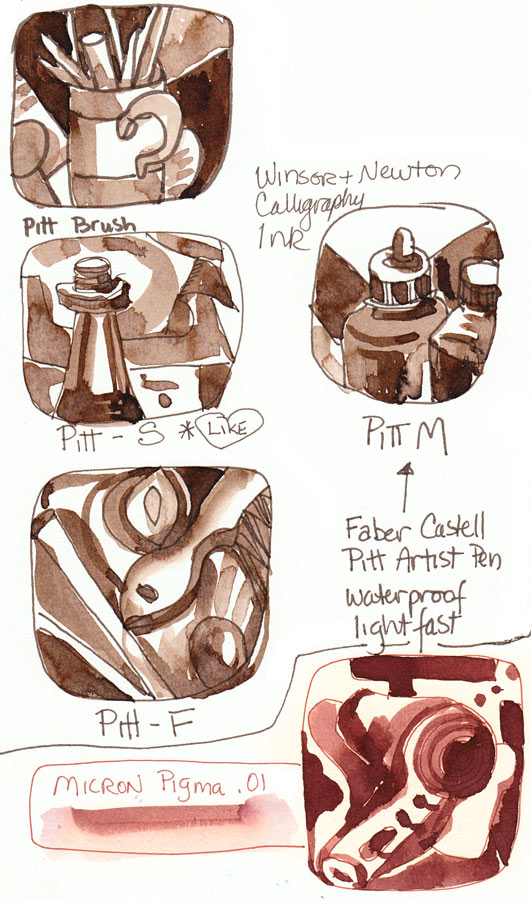
On the following page I drew with the Pitt Artist Pens, including the Brush Tip, S, F, and M tips and to match the color, used the Winsor & Newton Calligraphy Ink for the washes. I liked the Pitt S (for Super-Fine I think) and thought all of them were pretty nice. At the bottom of the same page I used the Micron Pigma sepia .01 and the Higgins ink since they seemed a good pairing.
Ink-test: Pitt Pens, Micron Pigma (click to enlarge)
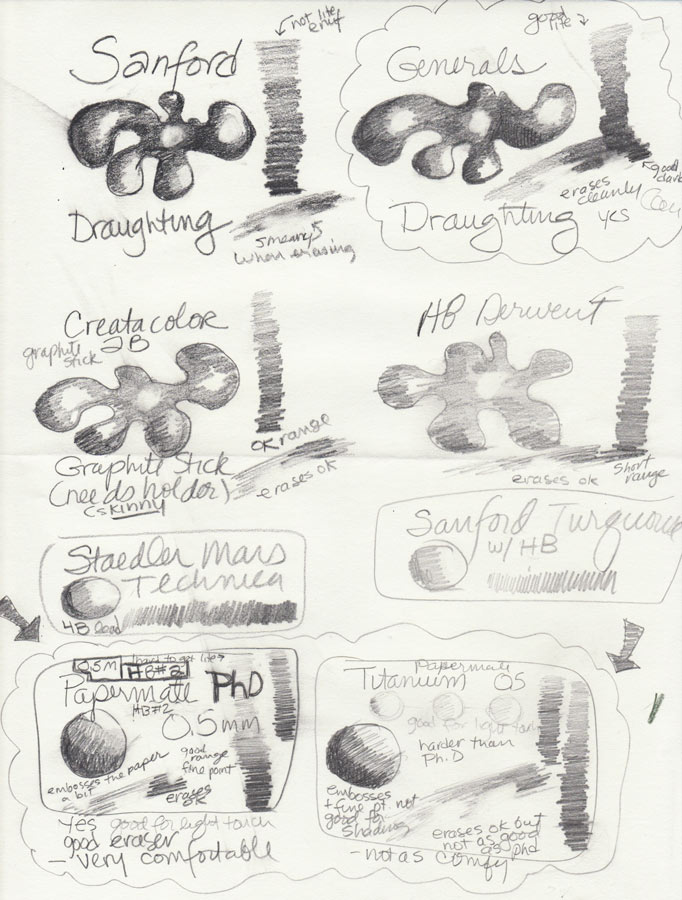
I decided to finally simplify my huge collection of pencils, graphite sticks, mechancal pencils and lead holders and pick one all purpose graphite pencil and one all purpose mechanical pencil. Although I have a full range of drawing pencils from super hard to super soft, I never work in that kind of detail with pencils and they’re just cluttering up my workspace. In the end I settled on these two for my in-studio and in-sketchbag all purpose pencils:
Generals Draughting Pencil went from light to dark easily without getting smeary and erased cleanly with a plastic eraser. I’ll use this one for sketching and planning in the studio, and for doing value studies in the field. (Close second: Sanford Draughting Pencil but it was a little softer/darker, making it more difficult to get a very light shade and it was smearier to erase.)
Papermate Ph.D.0.5m HB#2 Mechanical Pencil. The Papermate Ph.D. has a super comfy barrel that has a rubbery, wide triangular shape “endorsed by physical therapists.” This one is especially good for drawing light outlines before inking or painting in watercolor, although care must be taken to avoid embossing soft paper with the fine point. (Close second: Papermate Titanium .05 Mechanical Pencil. It wasn’t as comfortable and it was harder to get a nice dark.) I like using mechanical pencils because it’s handy having the lead and eraser in one unit.
Rush Ranch Horses, Sepia Copic Multiliner and watercolor wash
Mariah, a wonderful young artist, accompanied me to my plein air group’s paint-out today at Rush Ranch in Suisin City. She was immediately inspired by a spot, sat down and started sketching. I faced the opposite direction and sketched these horses in the corral.
Before we’d left my house, I showed her a book on drawing animals that demonstrated how to first find and assemble the basic shapes contained in the animal (rectangles, circles, triangles) and then refine them. I decided to practice what I preached and did that with the horses. I’d never noticed what big knees horses have before. I sketched with my sepia Copic Multiliner .03 and then added watercolor washes.
Rush Ranch Vista, ink & watercolor wash
The views from Rush Ranch were tremendous. I could have sketched for hours more but we’d arrived late and after our second sketches it was time for the group critique and lunch.
We were late because I got lost yet again (missed the turnoff and drove forever before turning around — and this was with GPS!) My mind had wandered to thinking about the people fishing (and the fish) in the slough off the little bridge we’d just passed so I missed the entrance sign and decided that the GPS telling me I’d arrived was wrong. This was especially stupid since the printed directions from my group said to go over that bridge and then turn right in 3/4 mile.
Instead I drove and drove, went over another bridge and THEN started looking for the turnoff. I went miles past that bridge, eventually arriving at the gate to a “youth correctional facility” (jail for teens) and admitted I’d blown it again. When we finally found our way back and I saw the huge “Rush Ranch” sign, I couldn’t believe I’d missed it.
Well actually I could believe it. I think I could get lost just walking from one room to another these days!
I combined walking, errands and sketching this morning, and really enjoyed all three, especially using my new sepia Copic Multiliner to draw these sketches. The pen is made of aluminum, is refillable with a replaceable tip. It’s very comfortable in the hand with a wider barrel than my usual Micron Pigmas, and the pen just glides across the page.
First stop was my little local library where I returned “Chasing Matisse”, a lackluster memoir about a guy who gets a book deal to go visit all of the places where Matisse lived. He fancies himself an artist as well as a journalist, but I didn’t think he was much of either. He basically read Hilary Spurling’s excellent two-part biography of Matisse and repeats stuff from her book in between his boring descriptions of his own experiences seeing what Matisse had seen and sometimes even trying to sketch or paint it.
El Cerrito Post Office
Next was another return of an Amazon purchase to the El Cerrito Post Office. I asked the clerk if she’d stamp my sketchbook with her round postmark stamp, just for fun but she said no and gave me some “airmail” stickers to use instead which I didn’t.
When I was a kid my grandfather had a bunch of rubber stamps and pads of old deposit slips from when he’d been a banker before the bank closed during the depression (but why did he still have them?). I used to love going to his house and playing with the rubber stamps.
I’d planned to add sepia ink washes to these sketches at home tonight because I’d ordered a bottle of that ink, but when I looked at the items that arrived in my order I discovered they’d made a mistake and sent me black ink instead. Rats. One more thing to return.
I’ve been testing pens that I have on hand, trying to find one that is permanent or archival but also will bleed when water is brushed across it. I haven’t found it yet, so if you have any suggestions, send them my way. While I was testing I was hungry and annoyed that I was going to have to stop and go cook dinner, and then clean up after dinner.
I’d recently learned that cats don’t need variety in their food (assuming they’re being fed a high quality cat food) and that in fact, switching their food around gives them digestive problems. Cats only have about 500 taste buds compared to our 9,000 so they make their eating decisions based on smell (and how hungry they are), not so much on flavor. When I stopped constantly changing their food, Busby’s chronic digestive problems disappeared and he became much nicer to have to around.
Since veterinary science has determined exactly what nutrients are required for cats, why hasn’t medical science discovered something similar for humans? I’m not saying I’d want to eat kibble 3 times a day (although my beloved Cheerios do look an awful lot like kibble and my cat Fiona has been known to rip open the Cheerios box and eat them) but wouldn’t it be nice to be able to just take a meal replacement pill, beverage or bar and have all the nutrients needed to nourish the body and stave off hunger until the next mealtime? Take the poll at the bottom of the post and tell me if you agree.
I was also thinking about how much more I enjoy sketches and sketching when they’re about something other than making a copy of something, and when there are words included. Pretty pictures are nice, but when something is just about being a pretty picture it feels soul-less to me. I want some meat in my sketches, not just pretty (or at least some kibble, if not meat).
Have you had bad experiences with plein air umbrellas that were flimsy, funky, poorly designed, or just plain hazardous when it gets windy? Often when my plein air group is out painting, a gust blows over an easel or two when the umbrellas attached to them turn into sails. When I felt my old umbrella about to carry off my easel I started attaching it to the tall handles of my rolling cart (which also got pulled over once) but I had a hard time adjusting my small umbrella to be in the right place, at the right height or at the right angle.
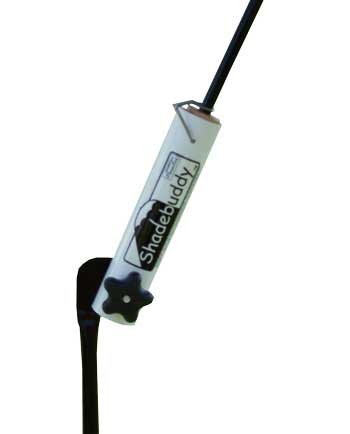
Now I have a ShadeBuddy Umbrella and Stand and the problem is solved. In the picture above the umbrella is set up in my backyard next to my Soltek easel. (Also pictured, is my trash container (a mesh pop-up laundry basket that folds flat to a circle about 8″ in diameter) clipped to my easel, a folding brush holder, and a plastic shoe box that holds my paint palette and paints. You can see the large area of shade the umbrella provides.
The pansies and pitcher on a table I was preparing to paint are on the far right.
Cylinder that holds umbrella
The umbrella and the stand are two separate sections that fit together into the sturdy black zippered bag with a shoulder that comes with them. At the top of the stand is a white cylinder (above) into which you stick the umbrella’s wooden handle. There is a secure locking mechanism for keeping the umbrella in the cylinder and a knob that allows you adjust the angle of the umbrella and then holds it in firmly at that angle.
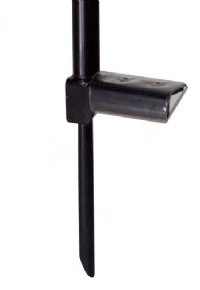
Foot pedal
The cylinder is attached to a metal pole that has a pedal about six inches from the bottom that you step on to push the pointed end of the pole into the ground. When I set mine up for the first time I was surprised how well it all worked and how easy it was. I tend to be spatial-relations challenged and am always prepared for difficulty when assembling things but this was a snap. I was able to adjust the tilt and direction of the umbrella as the sun moved, and the vented umbrella handled the afternoon wind gusts with without even a flutter!
The umbrella is very well made, with a 48″ diameter with “wind vented construction combined with a nonreflective black lining to keep your colors true and a reflective silver outer shell to keep you cool.” Both the closed umbrella and the pole are 48″ long and, when stashed together in the bag, weigh a little over 4 pounds.
The umbrella and pole are manufactured and sold by Judsons Art Outfitters and are also sold at several major online art supply stores. I checked prices and availability on the web and bought mine on sale from Dakota Art Pastels. It was my first purchase from Dakota (in Washington state) and they provided excellent service. My new umbrella arrived two days after I ordered it.
Having the easel made my previously posted painting, “Pansies in Pitcher Plein Air” a pleasure to paint, even under the hot sun in my windy backyard.
Because I really appreciate good tools and well-made products that just work (and that experience is so rare!), and because I know that many other plein air painters struggle with lousy umbrellas that flop or fly, I wanted to share my positive experience. I have no other connections with the manufacturer or store (except that I think highly of both). Judson Art Outfitters also manufacturers the Guerilla Painter line of plein air products and is a family-run business with very helpful and knowledgable staff who can answer most plein air outfitting questions with expertise.
The first hydrangeas of the season provided an opportunity to try out ink and watercolor in the Fabriano Venezzia sketchbook I posted about yesterday. First I drew directly in ink and then tried painting the flower on the right by wetting the paper there, and painting into it. I didn’t like the results and tried lifting off the paint with a tissue and was pleased and surprised that it came right off, leaving only a slight stain. Then I painted back into the damp area and got the results I wanted and completed the rest of the painting working very loosely.
The painting was easy compared to trying to get the image in the sketchbook scanned or photographed for posting. The image above was the result of clamping the edges of the sketchbook to photograph it (see below) and then using Photoshop’s Clone Stamp tool to “erase” the clamps and then using the Levels and Dodge tools to clean up the shadows caused by the paper buckling and some reflections from the light source.
Ready to photograph
I also tried scanning the page in the sketchbook but encountered the same problems I had yesterday with severe blurring plus shadow from the seam. I (want to) like this sketchbook, but preparing the images for posting is really a hassle. Even if I wasn’t working across the spread and just painted on one page I’d still have the problem with the shadow and blurring since it happens on the righthand page.
Scanned version, after major touch-up
Have you had this problem and solved it? I’d be so grateful for suggestions!
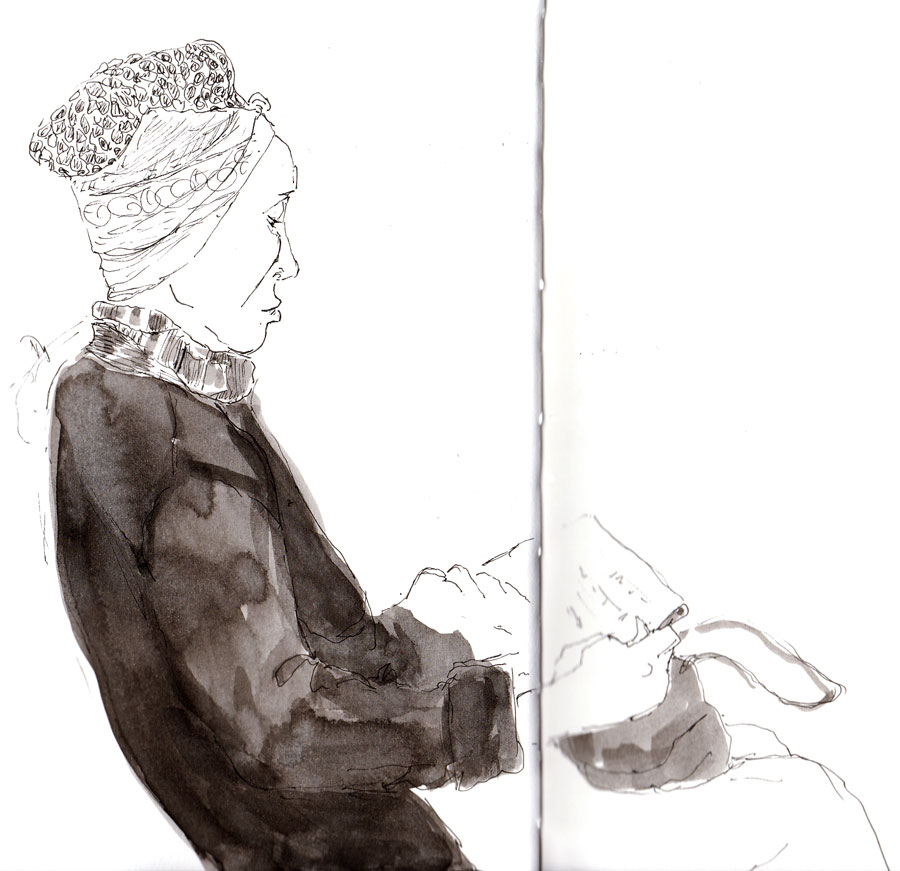
When I saw this woman reading on BART I had to draw her. She seemed to express the essence of dignity to me. She was carefully dressed and groomed, all in white, grey and black, with her hair covered in a white crocheted net and that wrapped with a perfectly ironed bandana, tied in a tiny bow in front.
This was my first drawing in my new Fabriano Venezia sketchbook that Roz had tested and praised and that I bought in a couple of sizes from Wet Paint. This is in the 9×6″ size. I left the first page blank to serve as a title page/table of contents later and did this drawing on the next page. I was totally in love with the sketchbook, writing a little rave review on the page of this first sketch about how wonderfully smooth and thick the paper was, and how nicely it worked with the Micron Pigma .01.
I was a little concerned about how much larger and heavier to carry around it is than the Moleskine watercolor notebooks I’ve been using, but thought it would be worth it. BUT when I tried to scan my drawing and the book didn’t quite fit on the scanner, cropping off part of the image, and the middle seam caused half the image to blur and have a dark shadow, no matter what I tried.
Then tonight I tried adding a watered down ink wash to her jacket, which had been black. The paper acted very strangely, not at all like I’d expected. I knew it wasn’t watercolor paper, and thus wasn’t sized, but now I’m now worried how these books will react with watercolor. I guess I’ll find out soon.
Here’s the same image with the ink wash that went all splotchy.
Less Dignity with ink wash
She was so carefully groomed, with everything perfectly ironed and smooth and now she looks much less dignified with her splotchy jacket. I don’t think the ink wash added anything positive to the drawing, do you? And I don’t think adding more ink to try to make it smoother or darker would be a good thing either.














 Jana Bouc, Artist