Ginger Ale and Saltines Namiki Falcon pen, Carbon Platinum Ink, and watercolor
Today was a bad news, good news day. It started with a migraine that eventually passed enough to work most of the day (despite the internet going down, fixing that and then a little later the electricity went out long enough to shut down the computer with several projects in progress). The migraine left behind a tummy ache. I couldn’t deal with the supermarket so went to the little health food store and bought some natural Ginger Ale, organic saltines and candied ginger (all supposed to be good for tummy aches).
Candied Ginger in an Egg Cup
The good news is that this morning my reliable but grumpy mailman delivered my new Namiki Falcon fine point fountain pen and this evening I felt well enough to fill it with ink and give it a spin. I LOVE IT! The nib floats like a dream over the page with control and flexibility and a really nice fine line. It’s the best pen I’ve ever used. UPDATE June 2011: After using the pen for a few weeks I discovered that I didn’t really like it that much and sold it. I felt I had too little control of the ink flow, which went to fast for me, even with the extra fine nib. I’ve gone back to my Lamy Safari extra fine point which I LOVE!
The other good news is that with these sketches I finally finished filling the Moleskine watercolor sketch book that I’ve so detested using during the interim between binding sketchbooks. Tomorrow I get to start using the one I bound a couple of weeks ago. Yay!
My friend Kathryn Law wrote on her blog about the workshop she took with Peggi Kroll-Roberts and about Peggi’s instructional DVDs. The videos focus on the things I most wanted to learn, especially creating strong value patterns and making rich painterly brush strokes, along with loosening up and having fun. I ordered the videos and watched them. Wow!
The Buddhist proverb, “When the student is ready the teacher will appear” is so true. I had to have tried and given up on so many other approaches to oil painting to become very clear on what I didn’t want, what I did want (working with the freedom and looseness I have when I sketch) and what I needed to get there (all the things Peggi teaches).
Watching Peggi demonstrate and explain what she’s thinking and doing as she does it is such a rare ability in painting teachers in my experience. Her videos answered many questions I’ve had for so long. I’ve read dozens of books and gotten great advice from artist friends, but until I watched Peggi’s videos, I just didn’t get it.
I’d almost given up oil painting in frustration but now… Yippee! Oil painting is fun again!
About the painting:
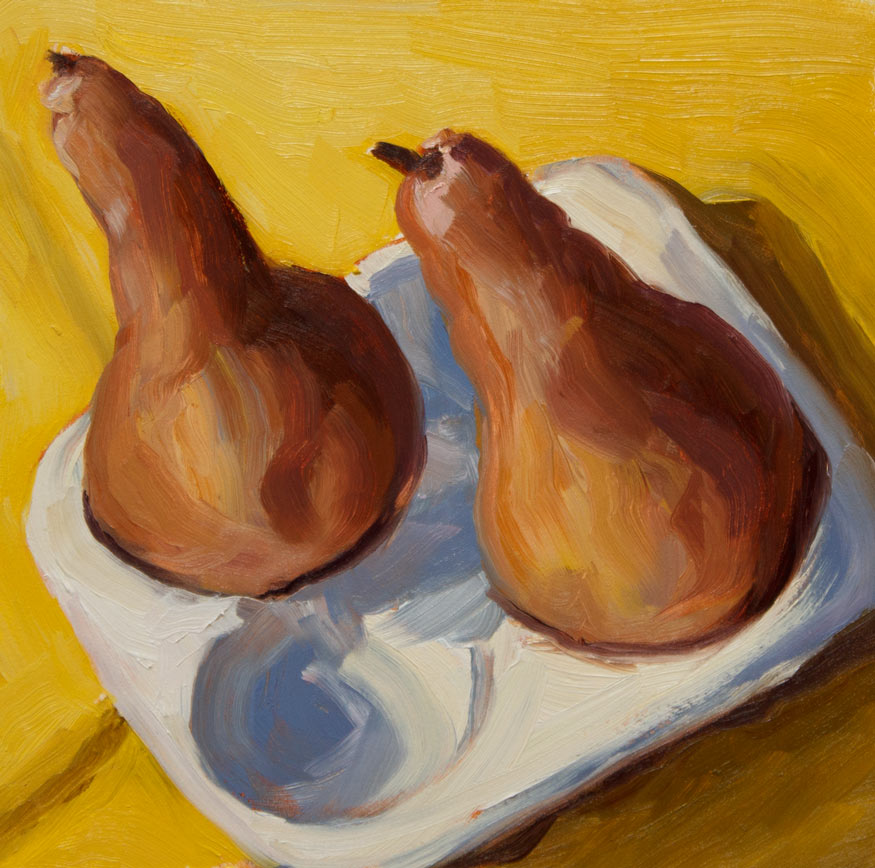
While bosc pears aren’t as pretty or colorful as other types, when I saw the way they were sitting in their container, one seeming like it was “striving” to reach, copy, or catch up with the other, I had to paint them. I used the techniques/tools I learned in Peggi’s videos and really enjoyed the painting process (and the results).
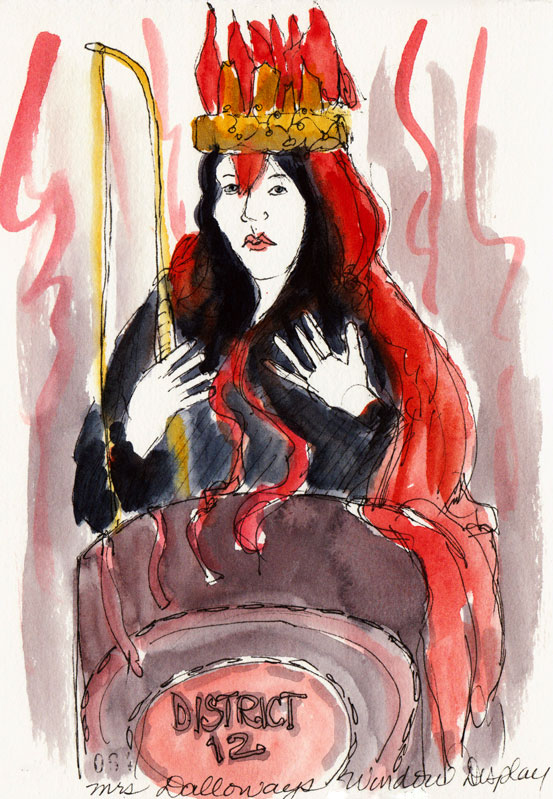
District 12 at Mrs. Dalloway's Bookstore, Ink & watercolor
Since I’d read, and surprisingly enjoyed, The Hunger Games, Suzanne Collins’ first book in her dystopian futuristic trilogy, I understood why this display was in the Mrs. Dalloway’s Bookstore window: it was advertising the third book in the series, Mockingjay.
The Hunger Games trilogy is about a boy and a girl struggling to survive an annual contest where teenagers from 12 impoverished districts are forced to fight for their lives in the ultimate televised reality show, with the winner bringing honor to her district. When a reliable friend recommended this young adult novel, I was highly skeptical on so many levels. But I found it to be a good read (or listen really–I borrowed the book on CD from the library).
Goorin Hats, Berkeley
Before sketching Mrs. Dalloways, this little brown craft-paper sketchbook from the UC Davis college bookstore (a gift from my friend Pete Scully) was perfect for warm-up sketches with a brush pen. College Avenue is full of interesting, upscale little shops like this hat shop.
This previous sketch of Mrs. Dalloway’s is one of my favorites. It’s a wonderful bookstore with a special focus on books about gardens.
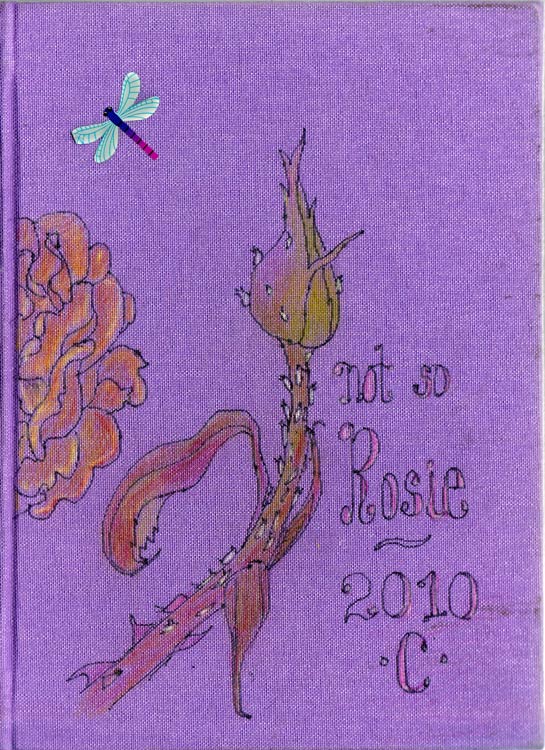
This is the cover of the journal I’ve just filled. I name my journals and I’d planned on calling this one “Rosie” because I started it at the same time my roses started blooming like mad in June. But given the struggles I’ve gone through, written about, and resolved in this journal, I named it “Not So Rosie” instead.
If you wonder what those weird white bumps are on the rose bud, when I put the tiny rose bud under my magnifying lamp to draw it I discovered it was covered with aphids. Yick! I enjoyed drawing it anyway until I noticed an aphid jumping ship and landing on my drawing table. I declared the artwork and the journal done, dumped the roses and spent a little time admiring my newly bound journal (below), its blank pages full of promise.
This is the fourth case-bound sewn-signature journal I’ve bound. With each one I’ve made fewer mistakes and learned more. I’ve continued to update my illustrated instruction sheet I wrote for myself, simplifying and correcting it. So many people have helped me that I wanted to share what I’ve learned in case it might help someone else. If you’d like a copy, it’s available to download on my website’s “Comments & Resources page.
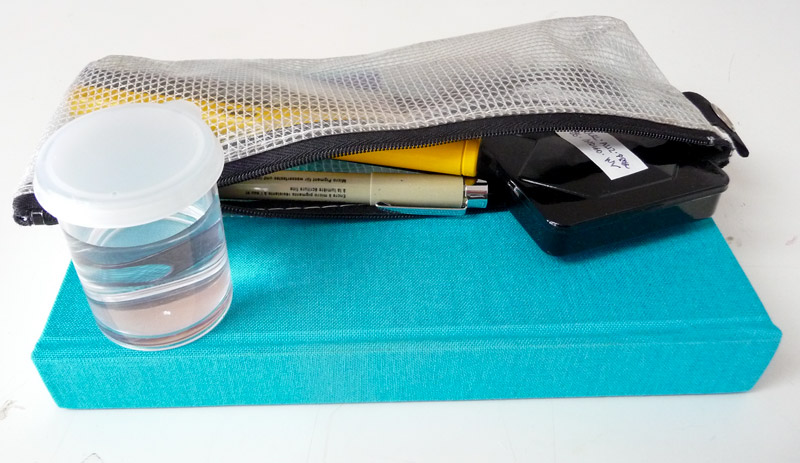
Meanwhile, my sketch kit has been shrinking. A friend brought back a tiny, $13 watercolor travel palette from a recent journey to Minnesota that included a stop at famous Wet Paint. I had to call them and order one for myself.
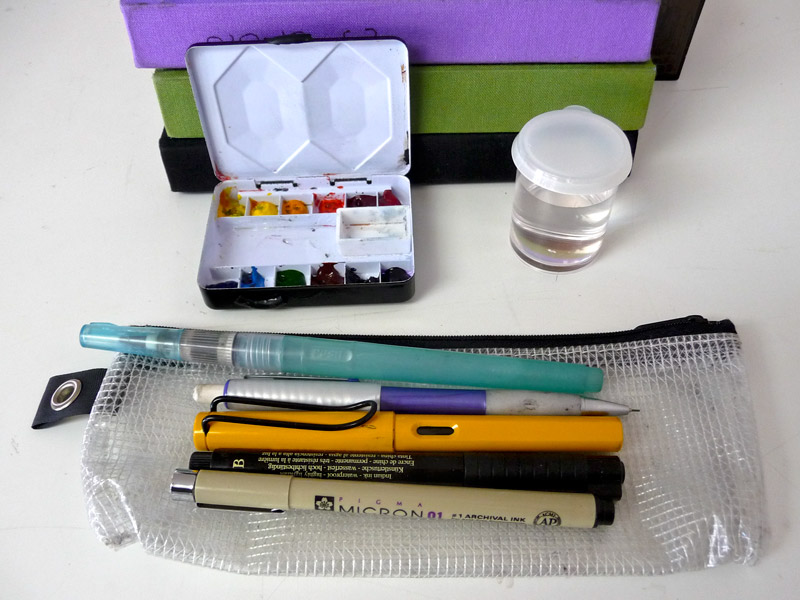
Mini-Palette and Sketch Kit
The palette is 2 1/2″ x 3 1/2″ and has a ring on the bottom for easy holding. I found it a little hard to open and so super-glued 2 little wedge-shaped pieces of a rubber washer on the front edge of the lid and base which gives me a better grip to snap it open. Another customization suggested by Cathy was gluing an empty watercolor pan inside for holding water (sticking up on the right side).
My favorite pens are (from the front) a Micron Pigma, a Lamy Safari fountain pen filled from a jar of Platinum Carbon ink (waterproof and safe for fountain pens), a Pitt Artist Brush Pen, a Papermate Titanium .07 pencil with F lead, and a Niji Waterbrush. All of this fits nicely in a little zipper pencil case, including the palette.
Newly Bound Journal and sketch kit ready to go
This little water container is surprisingly spill proof, and about the size and shape of a film canister. I can actually do just fine with the water in my water brush and/or the bottle of drinking water I carry around. The tape on top of the palette is a list of the pigments I’ve filled it this time.
Early Morning at Kaiser Garden, oil on canvas, 20x16"
I think I’ve finished this painting (but then I thought that several times before). The last time I thought I was finished, I looked back at the notes I’d written opposite my journal sketch about what interested me in the scene and my goals for the painting. I saw I’d missed a point or two and worked on it some more.
Now I’d really appreciate some honest feedback:
Do you think it’s finished or does it still need something, and if so, what do you suggest to improve it?
This was painted with Holbein Aqua Duo water-soluble oil paints. It’s such a joy to oil paint without odor, to thin paint to a wash without solvents, and to mix water instead of turpentine with the Duo linseed oil to make painting medium. The pigment quality, drying time and consistency is identical to regular oils.
I was feeling so proud of myself for finally setting up a compost bin for food scraps and thought tonight’s red bell pepper contribution looked pretty enough to paint. After I drew the contents in ink, I grabbed what I thought was a spray bottle of water and sprayed all the colors in my palette to wet them. Then I smelled the bleach.
Refusing to believe there could be bleach in there since I remembered emptying the bottle and washing all the bleach out, I sniffed the contents, and stupidly even tasted the end of the sprayer tube, convinced it must be water. Nope, it still had bleach in it and now I have the taste of bleach in my mouth, even after a cup of cinnamon tea.
Finally I remembered that I’d “temporarily” re-filled the spray bottle with a bleach/water mixture again when I needed to spray something to de-germ it, and that time, hadn’t emptied it.
The next day
Although I painted this sketch with the bleachified paint, I decided it wasn’t worth taking the chance to continue using the paint. I soaked my palette overnight in the sink, and then used paper towels to soak up and scoop out the big blobs of paint remaining.
And now I have a nice clean palette, filled with nice fresh watercolor paint. And I used the spray bottle of bleach mixture to clean the sink afterward. The sink is nice and white. And the bottle is now marked “BLEACH!”
I got inspired to try water-soluble (aka water-miscible) so researched which brand had artist quality paints made with real, archival pigments that performed most like regular oils. From my reading, Holbein Duo Aqua Oils was the answer.
I bought 3 colors (Cad Yellow, Napthol Red, and Ultramarine Blue) and white and gave them a go with this happy little painting above from a photo and watercolor sketch. I really, REALLY enjoyed working with them.
Indeed they worked exactly like oils, but with no solvents, no odor, and brushes clean up with water! To thin the paint you can use a little water or Duo Linseed Oil. The consistency was nearly perfect but I used a tiny bit of water because I like my paint smooth. Next time I’ll try the oil.
After working with the Golden Open Acrylics for several months I became frustrated with the way they dry darker and how sometimes the paint gets tacky or dry in minutes (outdoors) and other times stays sticky for days.
When I paint, I like trying to match the colors and values I see, so I’m disappointed when I paint with Open Acrylics and the painting dries to look completely different. Supposedly they only shift 10% but I just don’t seem to be able to guess right when mixing (and don’t want to have to guess!)
With the Duo oils I loved being able to mix colors and have them not change, and to not worry about the paint getting sticky during a painting session. I spent about 2 hours on the painting above last night and it’s still wet today. And, because I could clean the brushes with a swish of water while I worked, I only used a few. Clean up was quick and easy, with a little Masters Brush Cleaner for the brushes and a spritz of water and a paper towel across the palette.
Holbein Duo paints are more expensive than the other water-soluble brands because of their higher pigment load and use of more expensive pigments. Their prices are about the same as regular artist-quality oil paint. From my research and my first experiment with them, they’re worth it. I’ve ordered a few more colors and look forward to trying them out for plein air painting too, where I think they should be ideal.
P.S. I know you can use regular oils without any solvents, and that you can clean up regular oils using walnut oil followed by soap and water. But it means painting with thick paint and spending even more time in the clean up process.
I’m back on the blog after an intense week spent alternately deep in the bowels of a massive garage clean up/reorganization, and obsessively fighting the acrylic version of the watercolor sketch above. After finishing the garage on Saturday afternoon it was time to clean up in the house and studio and prep for my Sunday morning watercolor class (which went great with a terrific group of artists who left me feeling inspired).
Virtual Paintout: Hawaii
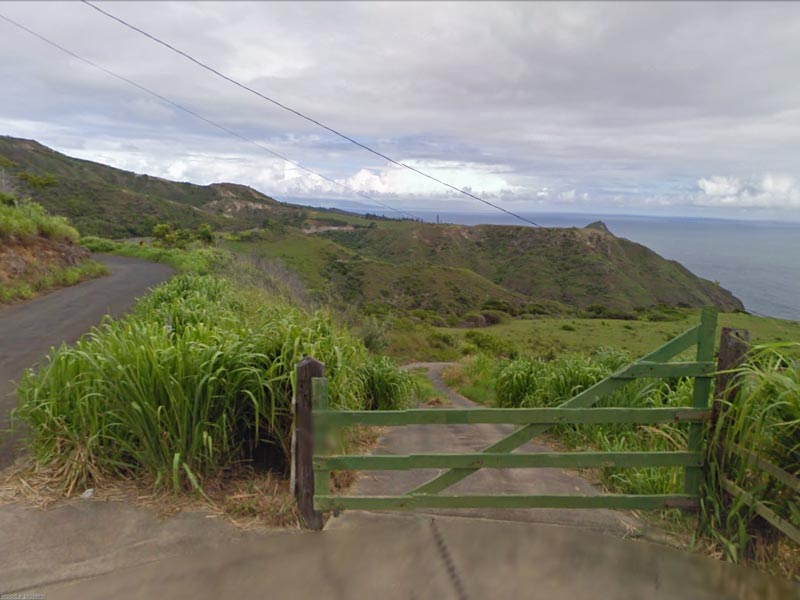
For the Virtual Paintout we went to Hawaii this month via the very cheap Google Air (just kidding—to participate you use Google Maps’ Street View feature to find your painting spot and all travels are virtual). Here’s the original scene:
Hawaii - near West Maui Forest Reserve
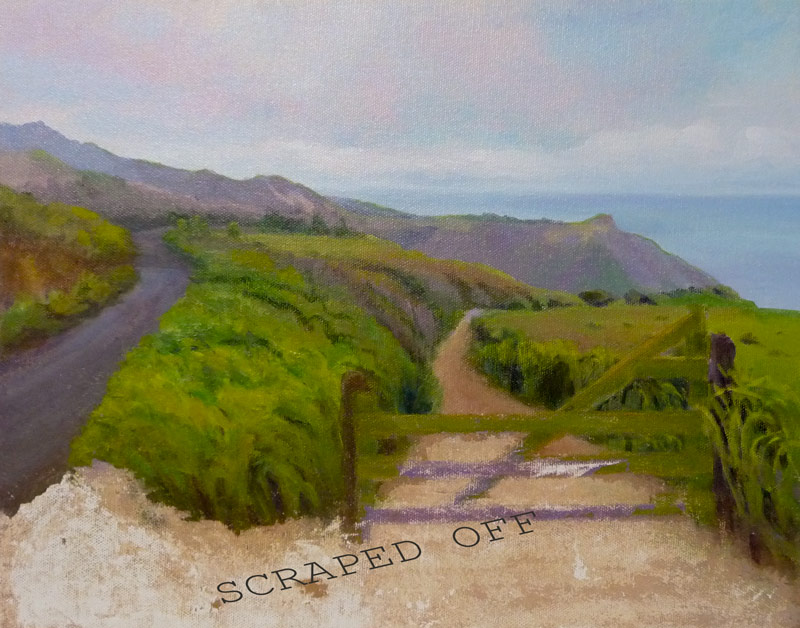
The painting got off to a good start with Golden Open Acrylics. I was trying to work from both my watercolor sketch above in which I’d changed the colors, warming up the scene, and also from the Google photo which just has a blur for the foreground. I first painted the gate purple for fun, but nearing completion realized the gate was too prominent and acting as roadblock into the painting so I repainted it green.
Then I started fighting the foreground. Over and over I painted, repainted, scraped, repainted. Here it is in its current state with the foreground (and some of the fence) scraped off again .
Hawaii with Scraped Off Foreground, Acrylic, 11x14"
Part of the problem may be the Utrecht Masters canvas panel that I was experimenting with. The canvas texture is too coarse and too absorbent so first I painted a layer of regular acrylic to smooth it out and reduce the absorbency (which is OK to do according to Golden). But then I had a paint adhesion problem, easily peeling off several layers where I’d painted thickly or repainted over not quite dry paint.
Since I wasted so much time messing with this painting and because I really love the top half of it I just didn’t want to give up. But to enjoy the second half of my vacation I’ve banished it to the closet and have gone back to working on a big watercolor of a tulip that is going great and makes me happy when I paint, not frustrated. I’m becoming convinced that I’m meant to be a watercolor painter and should forget about oils and acrylics.
The Garage
Cody unloading and saying "Bye" to his junk at the dump
When I bought my house 10 years ago it had been a rental for many years before that and the standalone garage probably hadn’t been cleaned forever. Then for 9 years my son used it to dismantle and rebuild his 71 Firebird, leaving grease, car parts, tires, miscellaneous junk, and bondo dust on top of years of grime, cobwebs, and worse (we found a literal rats’ nest made of fluffy chewed up shop towels in one corner behind a piece of plywood but no sign of recent rodents).
After moving most of his stuff out and the initial trip to the dump above, the real clean up began. I hired the smart, hardworking 15-year old boy next door to help me clean and we worked together most of Friday and Saturday. He vacuumed the wood walls and concrete floors after cleaning out the Bondo-filled ShopVac, removed and cleaned all my storage bins from the shelving units and then cleaned the shelving too. Meanwhile I sorted my junk and took a carload to the recycling/donation center and made another pile for the dump.
Finally the garage is ready for its new life as studio annex and multipurpose room. And I’m ready for my last week of vacation which I will fill with art fun, rest and recreation!
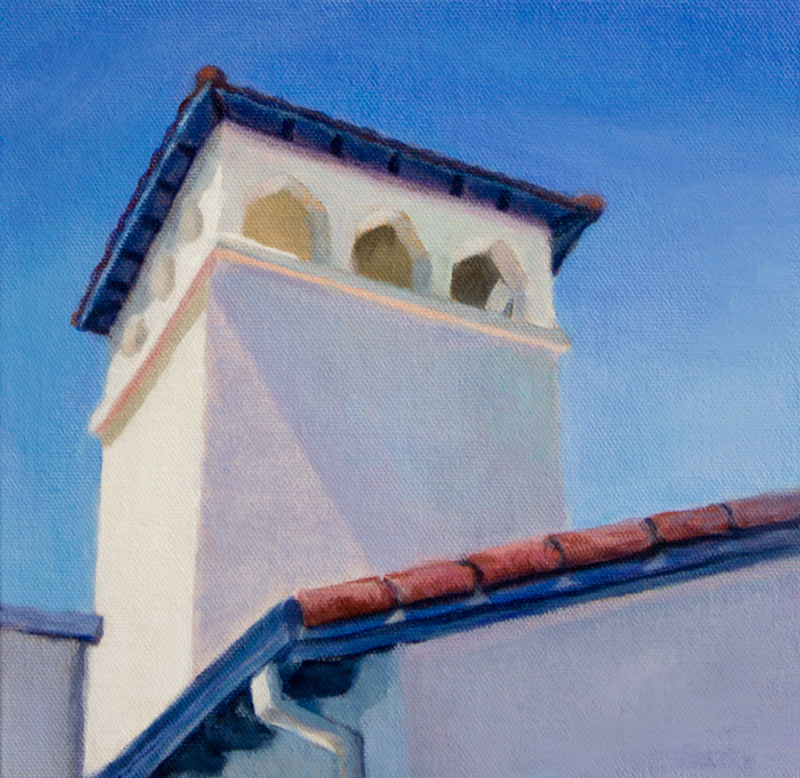
On Solano Avenue in Albany to do an errand I looked up and saw the bell tower of this church against the very blue sky and was sorry I’d accidentally left my sketchbook and paints at home. Fortunately I did have my little camera and took a few photos I could paint from.
The title of the painting is actually the name of the church. According to their website this 100-year old church community changed their name from “First Baptist Church of Albany” to “Church on the Corner” in 2005 because “many people in the community refer to it that way.”
I can’t stop pondering the implications of this: like what if other businesses started dropping their identities and brand names and Apple Computer became “Big Corporation in Cupertino” or Starbucks became “That Coffee Place on Every Corner.”
Golden Open Acrylics and Utrecht Masters Panels
This painting had been nearly finished when I tried glazing over the sky and it failed miserably, lifting off some of the previous layer. So I painted the sky again. Not sure if it was something I did wrong or that the Open Acrylic Gloss Medium doesn’t work well for glazing over layers.
For this painting I used an archival-quality Utrecht Masters panel which is medium-textured canvas on MDF (medium density fiberboard). The surface seemed too absorbent and coarse for the soft Golden Open Acrylics so I applied a first layer of regular acrylic.
That solved the absorbency problem but the texture is still a little too rough for the way I like to paint in thin layers. I have several more of these panels so will continue to experiment with them, using paint more abundantly so the texture isn’t as problematic.
I was listening to Ruth Reichl‘s book “Not Becoming My Mother and Other Things She Taught Me Along the Way” while I sketched on a rainy Sunday, feeling a bit mopey. That book was the perfect antidote to mopeyness.
After her mother’s death, Reichl finds her mother’s journals and discovers the story of how her quirky mother tried to make sure her daughter wouldn’t suffer the unfulfilled life she’d had, restricted by the roles available to women of her generation.
The book is full of humor, love and amazing stories. I’m grateful that my public library has great audio books available to download for free. It ends with this great quote:
…and the most important thing I learned is that you are the only one who can make yourself happy. It is never too late to find out how to do it.” ~Ruth Reichl
I drew the frog above (from a photo on my monitor) to practice before I drew the frog on the cover of my journal (below) which I’ve named Froggie:
Froggie Journal, India & gold gel ink
The Legion Multimedia Aquarelle paper the book is bound with is holding up even better than I expected. It’s nice and smooth for writing and drawing with ink from various pens, and accepts watercolor beautifully and even allows for lifting off and repainting and other kinds of abuse.
I love spending time with my journal which is like a dear friend, a place to come for solace when I need to write and sort things out, a library for recording visual and emotional discoveries, ideas, thoughts, and experiments.









 Jana Bouc, Artist