Categories
Glass Oil Painting Still Life Watercolor

What’s the Point?

Juicer #2, watercolor on hotpress, 6x4

I spent hours and hours standing at the easel this weekend, determined to once again try to paint a portrait of a little boy whose photograph I took a couple years ago at the San Francisco Museum of Art. After many hours and sore feet, below is how the painting turned out:

Canvas painted over with white paint

It had a few promising phases but I just couldn’t “execute” any of them to completion. At the end of the day I gave up and saved the lovely linen canvas to reuse by painting it over with white paint.

Tonight I decided to do something in watercolor just to try to have a little fun.  When I went looking for a subject to paint everything seemed tired and insipid. I think I’ve seen one too many meaningless little still lifes with a clove of garlic, a lemon slice, or an apple.  I started wondering, “What’s the point?” so the pointy juicer seemed a perfect subject.

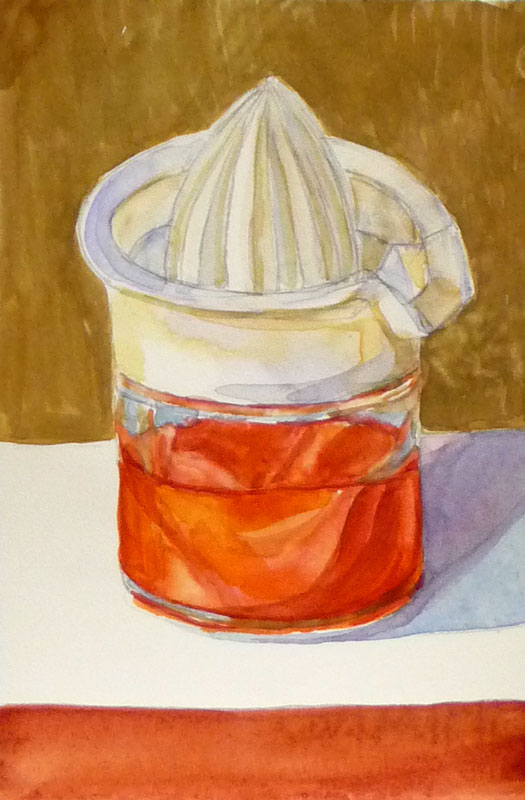
I wasn’t happy with the first (overworked) version below, so I tried it again and the second version is at the top of the post. I didn’t have an orange to juice so I made pretend orange juice with watercolor paint.
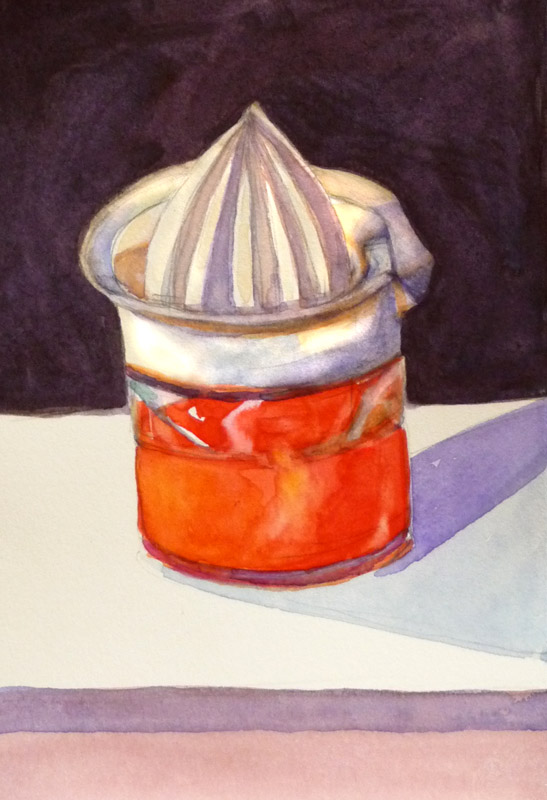
What's the Point? watercolor on hotpress paper, 6x4"

Since I’ve been in a stuck place for a couple weeks I’ve been trying to figure out what kind of artwork would bring back my creative juices. Just making pretty pictures, developing good enough technique to be able to make classical still lifes or impressionist landscapes or traditional portraits isn’t it. So I made a list of what I do enjoy:

  1. going out sketching with ink, watercolor and sketchbook
  2. painting subjects with emotional content (like the two autobiographical series I’m planning)
  3. painting large, getting lost in the painting, having unexpected things appear and running with them
  4. drawing complicated subjects or painting details in watercolor
  5. painting my crazy dreams
  6. creative thinking to come up with concepts and images based on one-word challenges like Illustration Friday offers
  7. painting without a lot of planning, just jumping in and seeing what happen

I was  stuck on #2 because I was envisioning working with large canvases (30×40″) but thinking about the cost of the canvases and the paint to cover them, and where I’d hang them or store them if I actually made as many in the series as I intend…. and then as I was writing about this in my journal I realized the solution:

Just start! Go for it! Go wild! Play! Forget about the product and enjoy the process. So I’m going to START with the bigger of the canvases I have on hand and just keep going from there.  And I’m going to get out and sketch more.

Categories
Acrylic Painting Flower Art Glass Gouache Ink and watercolor wash Painting Sketchbook Pages Still Life Watercolor

Painting Camellias with Mariah

Camelia #3, Watercolor on paper, 4x6"
Camellia #3, Watercolor on paper, 4x6"

Last night my step-granddaughter Mariah, a brilliant, almost 10 year-old artist with an enviable  sense of design and assurance and confidence in her work came over for a visit while her parents went out to dinner. Even though she she was sick, she was still up for doing some drawing and painting.

We picked a few camellias from my tree and got to work (or was it play?) drawing. She wanted to use acrylics; I fooled around with gouache and watercolor. Here’s her painting:

Mariah's Camelias, acrylic on paper, 8x8"
Mariah's Camellias, Acrylic & graphite on paper, 8x8"

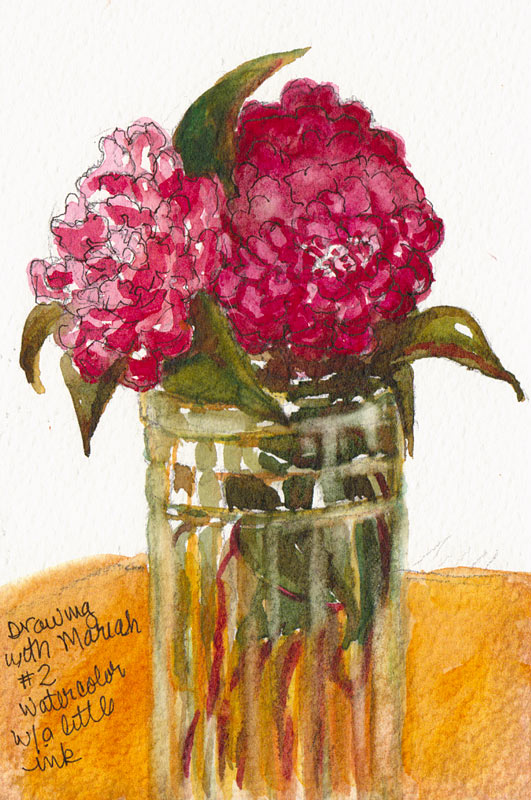
And here are the two I did last night. (The one at the top top of this post I did this morning, with the flowers beside the window. I wasn’t ready to stop painting these pretty flowers, the first of the flowers to bloom in my garden.)

Camelia #2, watercolor on paper, 6x4"
Camellia #2, Watercolor & ink on paper, 6x4"
Camelia #1, Gouache on paper, 6x4"
Camellia #1, Gouache and graphite on paper, 4x6"

I really don’t like the way using white with gouache looks so chaulky.  I much prefer the clear lights in watercolor that you get by leaving areas white or only lightly glazed with color.

Categories
Glass Oil Painting Painting Still Life

Balsamic Vinegar from Trader Joes

Balsamic Vinegar Bottles, Oil on Gessobord, 6x6"

I love Trader Joe’s Balsamic Vinegar. It’s delicious as a salad dressing all by itself; it’s not too tart or bitter and has a pleasant, mild sweetness. I bought a second bottle to take to my office and when I saw them sitting side by side on the counter I thought they looked cute and wanted to paint them.

Then, just as I was nearly finished with the painting, the panel  popped off the easel, and seeming to be in slow motion, bounced off the brush holder  and landed on the floor, right side UP! I was so surprised, since nothing I drop ever lands right side up, but it did. I was really relieved and went back to doing some final touch ups.

The next thing I knew it was sailing through the air again, flipped, bounced twice, and finally hit the floor painted side DOWN this time. I was ready to get really sad, but amazingly there wasn’t too much damage. The biggest problem was the cat hair. I’d been meaning to vacuum sometime soon….

I touched up the areas that lost paint, picked out all the cat hair using a clean soft brush, wiped the paint off the floor and declared the painting done. I may work on it some more after it dries. But for now, it’s time to clean up, make dinner and then (ugh) do my taxes.

Categories
Art theory Oil Painting Painting Still Life

Artichokes Redux, Improved?

Artichokes Redux, oil on Gessobord, 8x8"

My artist friend Laura (of Laurelines) offered some wonderful suggestions for improving the original version of this painting.

Artichokes, Oil painting on 8x8" Gessobord
Original version

Laura said:

“One thing I’ve noticed about your oil paintings is that you don’t have the same strong value differences within objects that you do in your watercolors.”

I agreed with her and gave it another go-around, this time adding some dark glazes in the dark area and more lights in the light area. I was working from a photo (since the original artichokes are long gone), so the colors were a little different than the original.

I am so appreciative of the wonderful community of art bloggers and the sharing we do with each other. Laura and I continued the conversation, and talked a bit about plein air painting and impressionism. Then she said:

Your watercolors are pure 21st century YOU. They are clear, strong, bold, and sometimes, though not always, quirky. Your flower paintings are YOU. In oil, it seems to me, anyway, that you’re trying to be someone else or are being encouraged to try to be someone else. That way lies horrible frustration. YOU can use oils in transparent glazes, with shimmering lights and darks, that will feel like you. YOU can use complements to create shadows. YOU can do all those nifty things in oil that you do in watercolor.

What a gift it is to have someone speak from the heart like that. She so hit the nail on the head about what I was struggling with in oil painting. I told her that in watercolor I found my direction early on, knew what I liked, what I wanted to do and developed the skill to do it. In oil I started out wanting to paint like I do in watercolor and everybody told me that “you don’t do that” in oils. I had to learn about the importance of brush strokes, edges, filling the canvas rather than putting an interesting object on a white page, etc. All the books and blogs stressed alla prima, completing a painting a day, impressionism, etc. Somewhere along the way I lost my direction.

I sometimes picture life as a series of turns made when angels have perched on the signpost and pointed in the next  good direction to take (sometimes the guides aren’t angels but rather tricksters saying turn left when the correct direction is right — heaven knows I’ve made many unfortunate turns in my life). I think she might have been one of those angels, pointing me back to my right path.

I’m not sure if this version is better than the first. There are definitely more darks, but it seems to have lost its glow, partly due to working from a photo rather than the brightly lit subject. What do you think? Does it need more work or is it overworked?

Categories
Oil Painting Painting Photos photoshop Still Life Studio

Artichokes in Oil (paint) & Color correcting in Photoshop

Artichokes, Oil painting on 8x8" Gessobord

After deconstructing one artichoke to paint in watercolor (previous post) I decided they were too old and worn out to bother cooking them, so why not paint them instead. I’m finding how important it is to take breaks when I’m painting. Each time I took one (because someone came to the door, I had to go to sleep or have lunch) I was surprised at seeing the painting with fresh eyes. It gave me a chance to strategize, stop futzing around in one area that wasn’t working and just needed to be scraped off and started over, notice that the values needed strengthening, etc.

At a certain point I recognized that this is as good as I can do for now. I’ll learn a little more and be able to a better on the next piece. That is so much more satisfying than trying to bring the piece to the level of the bar I keep raising or trying to make it as  good as the painting of other artists’ work I admire.  As a good friend said to me yesterday, “Compare…and despair!” and he was so right. Another friend pointed me to this from Desiderata:

If you compare yourself with others,
you may become vain or bitter,
for always there will be greater and lesser persons than yourself.

Artichokes, easel & palette in the studio

The multi-colored card on my easel is a Gretagmacbeth ColorChecker that I use when I photograph art work. Sometimes I use the white square to set my cameras “white balance. I always include some or all of the card when I take the photograph so I can compare the colors on the card to the colors on my monitor to see if I’ve got it right.

With the card included in the photo, I can correct the colors in the photo using the Levels tool in Photoshop:

  1. Select the “white” eyedropper in the Levels menu and click it on the white square. This sets the white level so that white in the photo is pure white, not greyish. Sometimes this is all that’s needed.
  2. If the black square doesn’t look black enough, I do the same with the black eyedropper in the black square. Setting this range of black to white really helps, especially when there is no black or white in the painting.
  3. To remove a color cast (e.g. when the gray square looks greenish pinkish) I use the grey eyedropper on various spots on any of the gray squares until the color cast is gone and gray is gray.
Categories
Flower Art Glass Gouache Painting Sketchbook Pages Still Life Watercolor

My Prickly (Artichoke) Heart

Artichoke Heart, Ink & watercolor on hotpress Arches paper

I think the soft, flowery heart inside a prickly artichoke perfectly illustrates my feelings about Valentines Day. I love artichokes and the heart is always the best part, but you have to work to win the right to savor it. I was surprised how soft, gentle and flexible the leaves were when I peeled them off to get to the heart, compared to how tough they are when they’ve been boiled. I’m sure there’s a good analogy there about love and tenderness, but I’ll leave that to the poets.

I first tried to do this painting using a sketchbook I hadn’t tried before: Maruman Art Spiral, that has what looks like cold press  watercolor paper in it. It started dissolving when I tried to lift paint or glaze more than one layer. Yuck. I wasn’t at all happy with the first try below and started over.

Artichoke heart on crummy paper
First attempt on crummy paper

As I wrote in my last post, the past few weeks have been rough. When I finally got in the studio today. I began by wasting an hour trying to rescue a painting of 3 artichokes I’d started last night and finally decided it was unsalvageable. I felt uninspired, clumsy and like everything I tried to do is crap.

Then my cat jumped on the drawing table to sunbathe under my lamp. I had a brush in my hand, my gouache palette open, a sketchbook I wanted to finish and a willing model. So I did quick kittie sketches with paint, trying to get back in the flow. It helped get the juices flowing again, although my inner critic was still harping at me, telling me these were crap too.

20090214-cat620090214-cat520090214-cat4

20090214-cat320090214-cat2

Maybe they are, maybe they aren’t, but they’re bright and colorful and were fun to do, and the stupid sketchbook is filled and on the shelf.

Categories
Glass Oil Painting Painting Still Life

Adding Injury to Insult

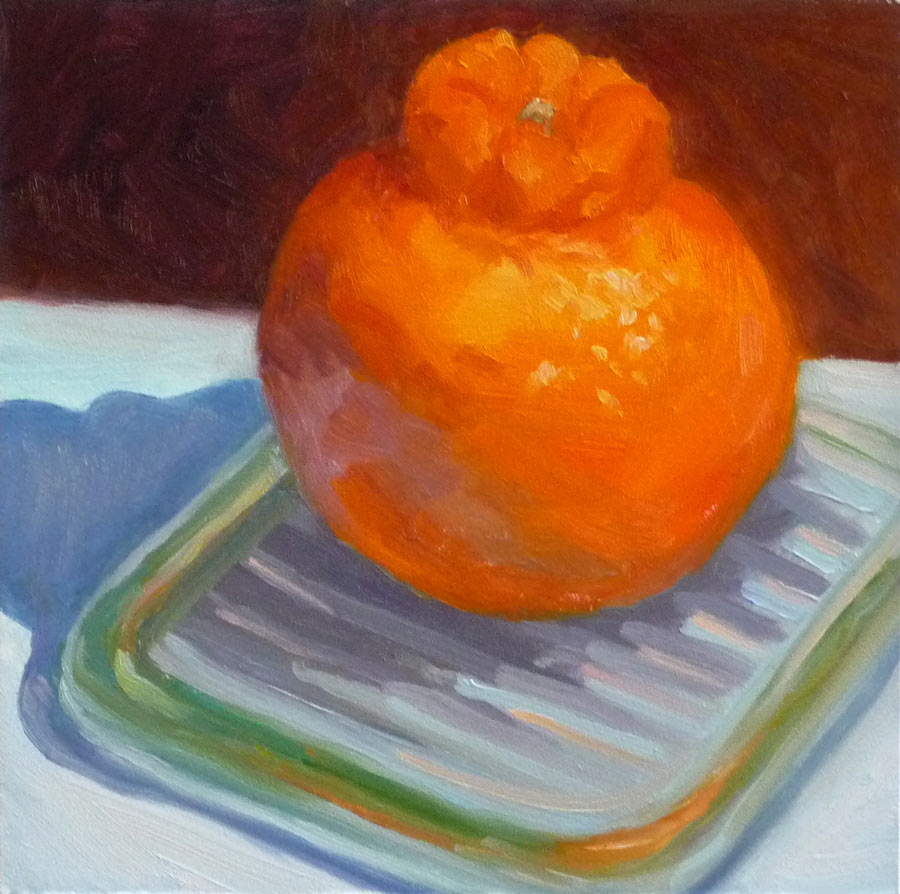
Minneola tangelo, 6x6", oil on panel

No, the injury and insult referred to in the title of this post does not refer to this painting of a Tangelo. It explains why I haven’t posted lately.

First I had the stomach flu (or was it food poisoning from the dreaded peanut/salmonella scare?) The next week  while waiting at the doctor’s for my flu shot, I felt a little tickle in my throat and wondered if I might be getting a cold. I was. It wasn’t terrible, and went to work all week.

When the weekend arrived I expected to feel better and get to paint. But the cold (or was it the flu?) hit full force. For the next 5 days it hurt to think, let alone do anything creative. On day 10 my doctor prescribed antibiotics and I began to recover.

That Friday night after a 10-hour work day, my cat Fiona begged me to come play tag with her. She loves to run through the house chasing me, and me, her. My house is perfect for this game because it’s quite long. It was originally two flats, mirror images, that I connected with a doorway, so it’s a nice long run.

We look completely ridiculous, but it gets us both a bit of exercise. We’ve tried to teach Busby, my other cat, to play, but he doesn’t get it. He comes out of the closet that he’s been sleeping in to watch us, with a confused look on his face.

So there I was running after Fiona when I felt a “snap” in my calf and then a sharp pain that made it nearly impossible to walk, except with a sort of peg-leg gait. When I called the advice nurse he ruled out all the really bad possibilities  (broken things, torn apart things, blood clots, etc.) so apparently it’s just going to take some time to heal. It’s been four days and I’m still limping (and coughing).

Despite the limp I was determined to paint this weekend, and chose a delicious Minneola tangelo sitting on the lid of a glass refrigerator container. I liked its funny little poofy crown. I learned that Minneola is both a city in New York and a combination of a Duncan grapefruit and a Dancy tangerine.

I wish I could push rewind and go back one stage on this painting. Knowing when to stop is one of the hardest things in painting.

Categories
Art supplies Flower Art Glass Gouache Sketchbook Pages Still Life

Experimenting with Gouache & Rotring Art Pen

Last roses, ink and gouache

I  saved two rose buds to paint when I pruned my roses last week (in case winter ever comes to the San Francisco Bay Area—it’s been ridiculously hot and sunny). By the time I could get back in the studio, one bud had opened and my order of M. Graham and Schmincke gouache arrived. Although I planned to test the new gouache by making color charts first, I knew the roses wouldn’t hold up much longer. Also included in my art supply order was a new Rotring Art Pen.

I tried out the gouache and pen in the sketch above. I also wrote a quickie review of the Rotring Art Pen and offer some technical information about gouache by experts on the subject. If you’d like to know more about gouache or the pen, please click the “Continue reading” link below.

Categories
Gardening Life in general Oil Painting Painting Photos Plants Still Life

Humble Hydrangeas; Antidote to Procrastination

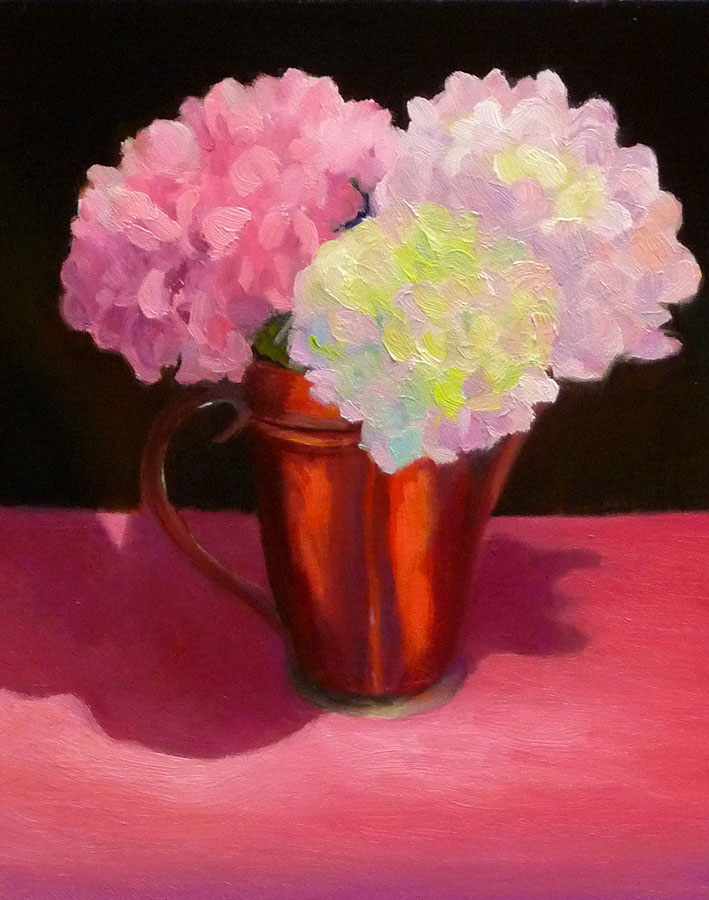
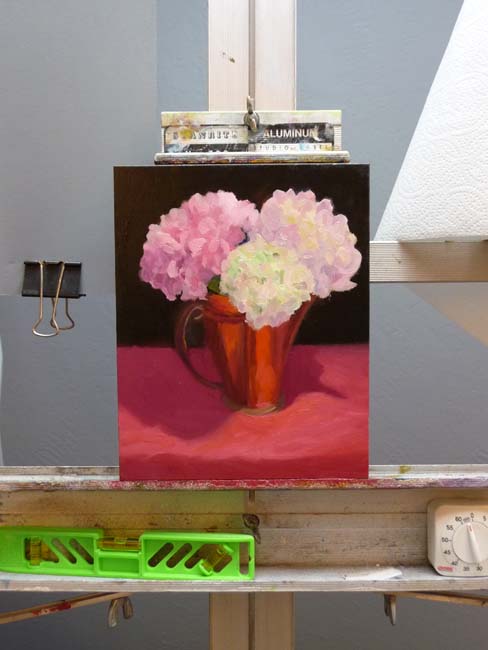
Humble Hydrangeas
Humble Hydrangeas

These humble but persistent hydrangeas were still blooming outside my kitchen window, despite suffering through drought then rain and cold.  Their leaves were few, gray and blotchy and the stems were bent and woody but the flowers just weren’t giving up.

While I worked on the painting I was thinking about humility. I’ve discovered that being humble is a good antidote to procrastination.

When I think that I have to be “good” at something (especially painting), it creates fear that I won’t be. Then I find myself either procrastinating or, if it strikes while I’m painting, reworking a painting again and again because it’s not “perfect” yet.

I’ve found that the best way to step out of that rut of perfectionism is to focus on being honestly humble and not worry about being good, better, best, or perfect. All I have to be is humble little me and like the hydrangeas, just hang in there and shine forth.

About the painting:

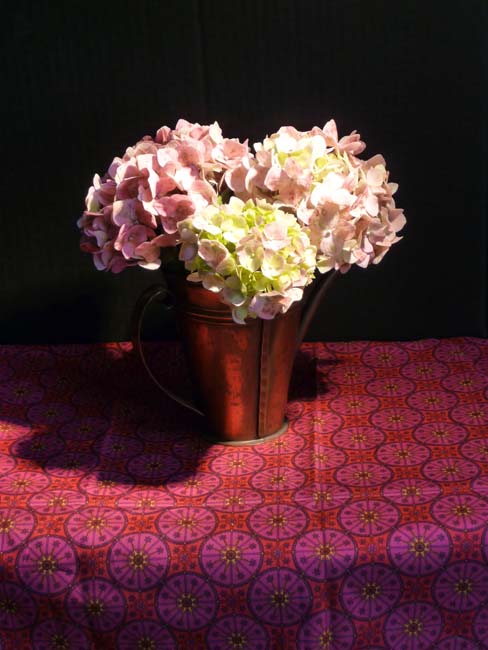
I was trying to see and paint light and make good use of color temperature and value contrasts to model the form. I started by doing a monochrome underpainting in acrylic, but didn’t really like the way the acrylic paint kind of ruined the wonderful texture of the ArtBord.  Here are the steps along the way:

1 & 2 are photos of the still life set up, the second in black and white to look at values.

Categories
Art supplies Every Day Matters Ink and watercolor wash Sketchbook Pages Still Life Watercolor

Salad Remains with Danny: Finishing Sketchbooks

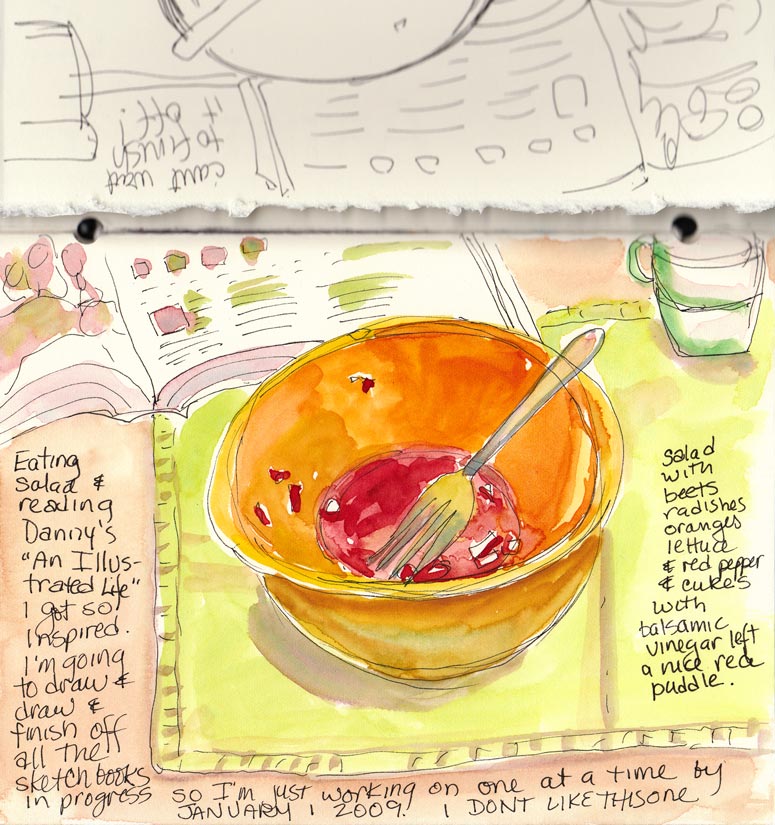
Salad Remains with Danny's Book (ink & watercolor)

I was feasting my eyes on Danny Gregory‘s new book, “An Illustrated Life” while I was eating a delicious salad in my big yellow salad bowl for lunch today. When I finished eating I had to sketch the colorful remains. The first drawing didn’t work (partially seen on the previous sketchbook page above), though I took it as far as I could and then drew it again and painted it (happily using up two pages in this sketchbook I don’t like).

I love reading about all the other sketchbook artists in Danny’s book and the way they think about sketching and their sketchbooks. It inspired me to finally finish off all of the random sketchbooks I have going. I have at least half a dozen unfinished sketchbooks, some that I’ve made (like the one used above) and some that I’ve bought. I keep them in a special open box and grab the one that calls to me.

There are several that I don’t like for a variety of reasons (e.g. don’t like the paper, don’t like the dimensions, don’t lay flat, don’t scan well, too fancy…) and they’ve been partially used and abandoned. I’m making it my goal to fill them all by January 1 so that I can put them on a shelf and start working in one book at a time in a chronological order. I like order.