San Miguel de Allende, Mexico, 9″x12, oil on panel
I just sold the painting above and wanted to varnish it with a protective layer before shipping. I’ve been afraid to try traditional damar-based varnish which is prone to drips, bubbles and yellowing. I knew that somehow at least one cat hair would embed itself. So in the past I used a spray-on varnish (which has its own disadvantagse) or just shipped sold paintings without varnishing.
The ORIGINAL 2-part Gamvar
I’d read that Gamblin’s Gamvar synthetic varnish was easier to use and very archival, developed based on research at the National Gallery of Art. But it came as a two-part kit that you have to gently mix, every hour over eight hours. For me, that is a recipe for failure. I knew I’d get distracted and miss an hour just like when I make a cup of tea, forget about it, and hours later have to throw it out and start over.
New Gamvar Pre-Mixed Picture Varnish
Now it comes Pre-Mixed!Gamblin just released a pre-mixed version of Gamvar in a 2 oz. bottle containing enough varnish to cover 40 square feet. I called Gamblin with some questions that I didn’t see answered on their website. Their technical support people were on other calls so the operator connected me to their president who cheerfully answered my questions. You can’t beat that for customer service!
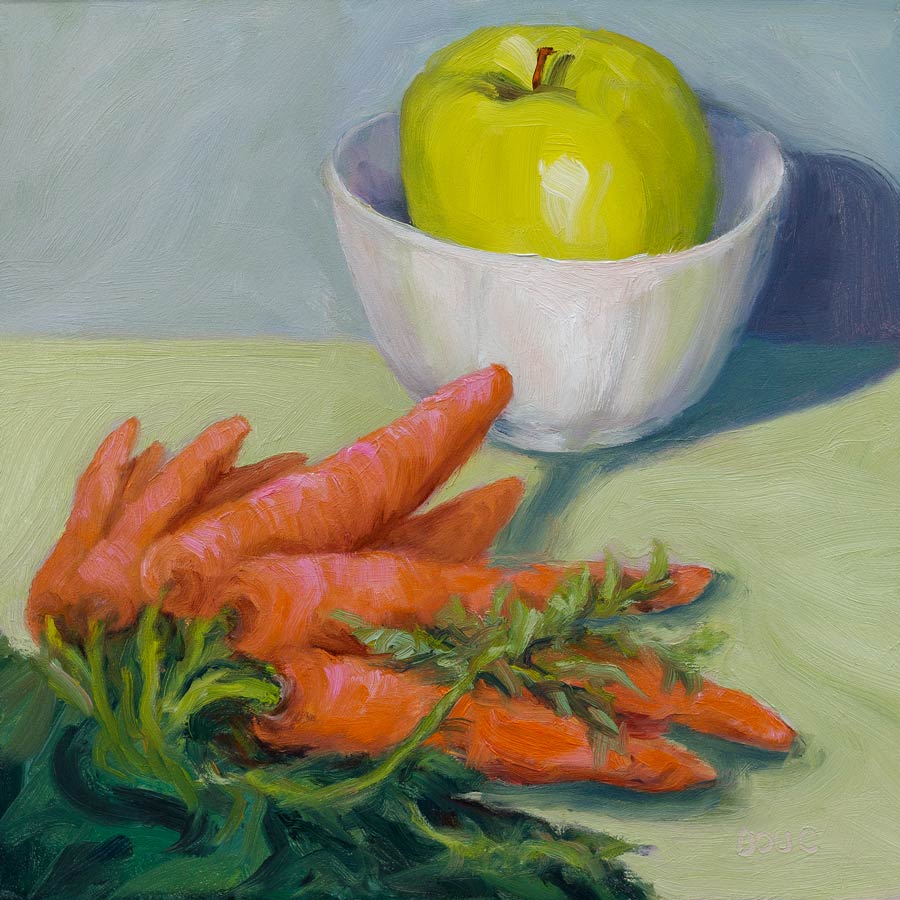
Stumpy Carrot Study #2 with Apple, oil on Gessobord panel, 8×8″
A fresh bunch of colorful, stumpy, little carrots with greens still attached: a great still life subject, I thought. But after two days of painting carrots I had my doubts. I was happier with the one above, my second attempt.
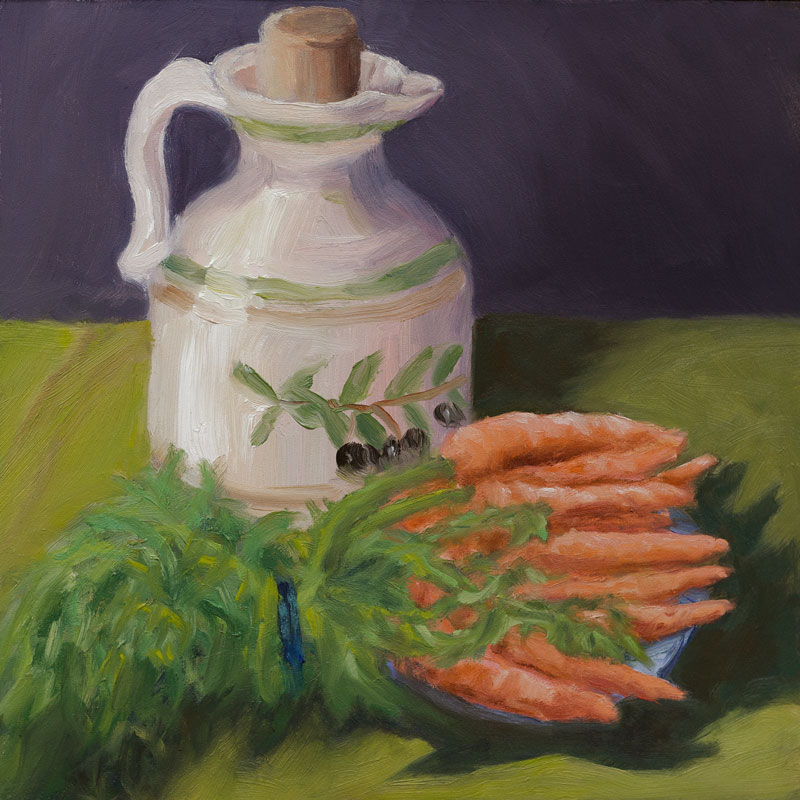
Stumpy Carrot Study #1 with Olive Oil Jug, oil on Gessobord panel, 8×8″
After the first try (Study #1) above, I wasn’t so sure. I tried and tried with the first one but it just wasn’t happening. In a rare moment of painting sanity, I decided to abandon the first one and try another composition (Study #2 at top).
I questioned whether to even post the first study since I’m not happy with the carrots. What do you think? Is it interesting or helpful to show the ones I don’t like? Or should I only post my best work that I’m proud of?
I don’t know if it was their hours under the lights or my hours struggling with them, but by the time I finished the carrots were looking an awful lot less appealing to me. I ate them anyway. Sliced and steamed with a little butter. They tasted better than they painted.
There’s a mysterious house on my block that has been empty but well maintained for several years. The mailman delivers mail and the gardening service keeps things nice and neat but I never see anyone go in or out.
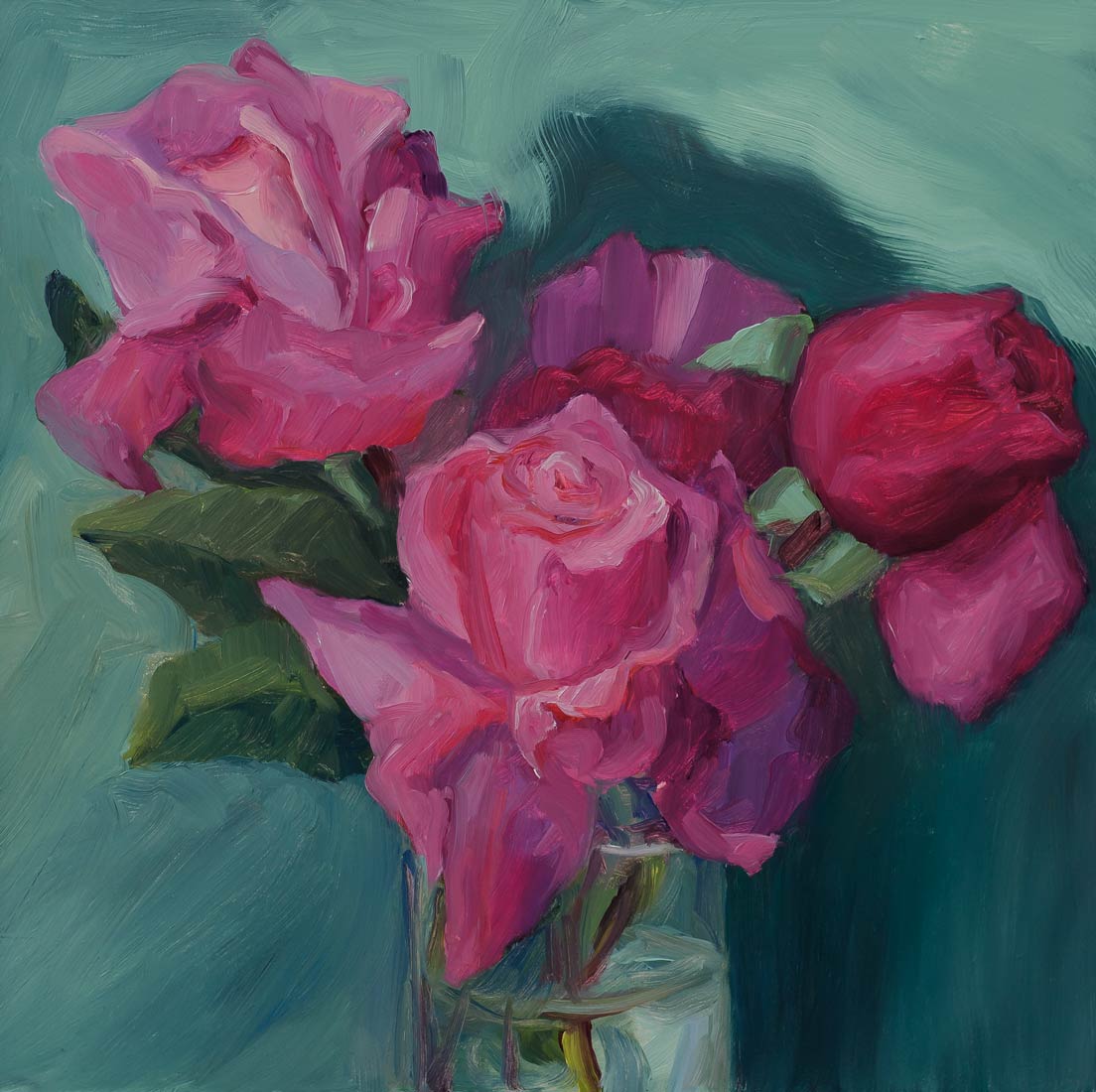
Their roses and fruit trees are blooming but there’s nobody home to enjoy them. So I stopped by with my scissors to give the roses a little respect by painting them, even if it means stealing them (as I’ve done before). These were yummy fun to paint!
Dandelions and Wine, Oil Painting on Gessobord, 10×8″
It was time to take a break from portraits and do some still life painting after ten failed attempts at painting a friend from a not-great photo. I gathered some dandelions from my neighbor’s yard (I’m sure he didn’t mind) and stuck a few in my favorite old French Cognac bottle (that I found in the street years ago). With the addition of a bottle of Spanish wine, I had a still life ready to paint.
Dandelions & Wine, Watercolor, 7.5″x5″
But first I did this watercolor sketch. Even if I plan to finish an oil painting in one go, it always helps do a sketch first to get to know my subject. And since I’m eager to get started with the oil painting, I work quickly which keeps my watercolor fresh and not overworked.
It was a relief to turn out something I liked after my frustrating journey with the portrait. But I haven’t given up on it. There are still two failed canvases facing the wall, waiting for me to make them work (or smash them to bits!)
I did this a few weeks ago when I needed to do a warm-up sketch in oils to get back in the flow after not using them for a while. I tried to work quickly and not go back over areas. I had fun and like the colors.
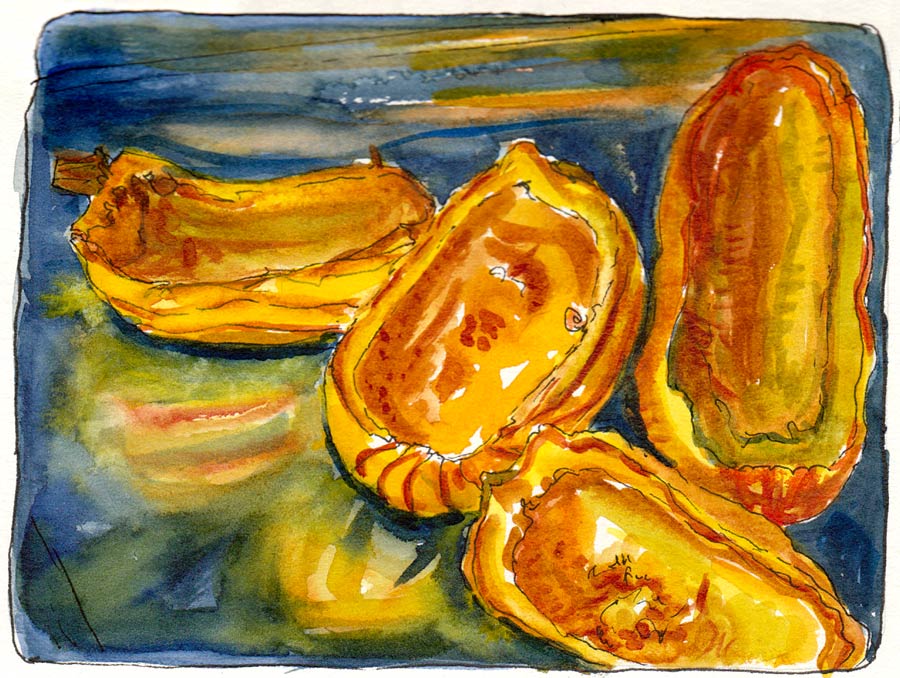
The Delicata squash were so pretty I wanted to paint them. And then I wanted to cook them (a first time for me). Exploring new produce is an adventure. First draw it, then cut it open and see what’s inside.
Delicata cut, ink & watercolor, 7x5"
The texture of squash doesn’t really appeal to me too much. Especially the slimy parts before it’s cooked. But it makes an interesting sketching subject.
Delicata Cooked on Metal Pan, ink & watercolor, 7x5"
I like this sketch best, with the squash sitting in the reflective, stainless steel roasting pan. I ate a couple of their brethren with my dinner and then brought the leftovers to the studio to sketch.
I’m still not a huge fan . It was OK, roasted with some butter and a little cinnamon. But I think next time (if there is one) I will go for a more savory flavor, with lots of garlic instead.
UPDATE 10/23/11: My art blogger friend Jana Botkin shared these thoughts on squash and art that I had to share here:
A friend once said to me “Squash is the past tense of squish, and squish is not a food”.
We full-time artists could theoretically write off the cost of our groceries if we paint them first!
Garlic, oregano and parmesan cheese are almost the only way I find squash palatable. Without it, it is only palette-able!
After I did the watercolors I posted yesterday, I set up the sketch, the watercolor and my iPad displaying the photo on the table beside my easel and painted the scene once again, this time with oil paint. After a month or two of being totally frustrated with oil painting, trashing everything I made and about ready to give it up, suddenly painting was easy and I was loving it!
Point Bonita Painting set up in studio
The entire painting worked like a charm except the foreground mount of dirt and ice plant which was the last thing I painted and which I did over and over. It kept trying to call too much attention to itself. I think I finally successfully muted that foreground while still keeping the light on it.
Then I was looking at some delightfully free and vibrant oil pastel work on Aletha Kuschan’s blog which inspired me to try the scene in oil pastels too. I know nothing about oil pastels so I quickly read a few how-to’s on the web and dug in.
BUT before I show you the drawing, I have to say that I made a fatal misstep: I chose a sheet of the totally wrong paper to work on. Instead of starting small on a sheet of white or blue pastel paper, I chose a large sheet of brown Stonehenge drawing paper. What was I thinking? Brown under a turquoise sea?
Point Bonita #4, Oil pastel on Stonehenge paper, 17x13"
It was impossible to cover all the brown paper because even though the oil pastels got really thick in some areas—so thick that no more could be applied—in other spots they just wouldn’t cover.
Although my Holbein Oil Pastels are very old, purchased for a small project I did more than 20 years ago, they were still in good shape. But I didn’t have the right colors, and I had trouble blending. I didn’t have blending stumps, didn’t want to use my fingers and was wearing gloves which didn’t work. I tried a paper towel but it just smeared and left paper towel lint.
Compared to paint, oil pastels seems like a lot of extra work, having to fill in so much area by scribbling over and over. And it was messy; my gloves and the pastels got dirty from colors transferring onto them.
But maybe if I knew what I was doing, or had used the right paper it would have been easier or less messy? (Not to say that oil painting isn’t messy! Everything I own has paint on it!) I like the look of oil pastels done well so I’ll try another experiment with them. But on the right paper this time! Any tips?
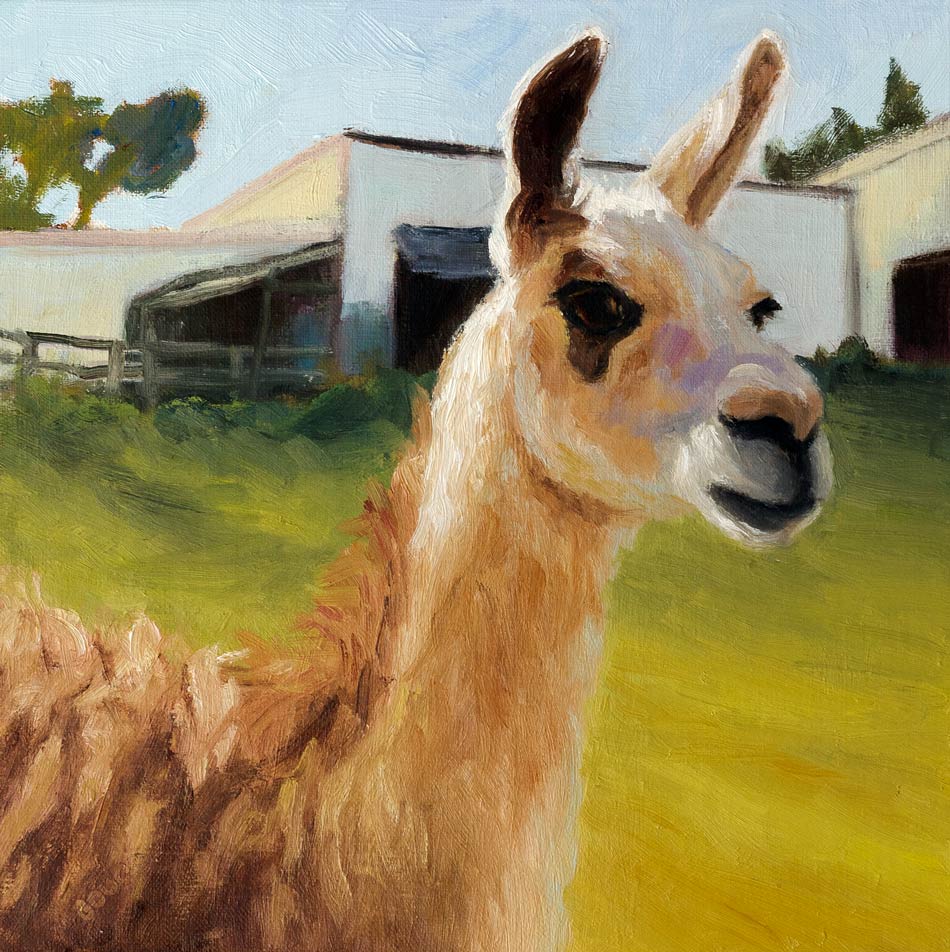
When I spotted llamas in a residential neighborhood backyard near the beach in Pacifica I took a few photos of them for painting later. In the process of this painting I experimented with a terrific new drawing tool, Accurasee, and put this llama through its paces.
I started with this watercolor sketch in my journal:
Backyard Lama, ink & watercolor, 5x5"
While sketching I edited out the apartment building in the photo and got some understanding of the subject. Then I put the sketch and my iPad displaying the photo on the table by my easel so that I could refer to both as I painted.
Blocking in the values
First I sketched in the llama on the panel (above) with thinned paint (hoping it was fairly accurate) and blocked in where I wanted the darks and lights in the painting.
Llama attempt #1, but drawing wrong
I thought I was nearly finished (above) but after a break from it, realized that the drawing was wrong: the face looked more like a dog than a llama and the neck was too short.
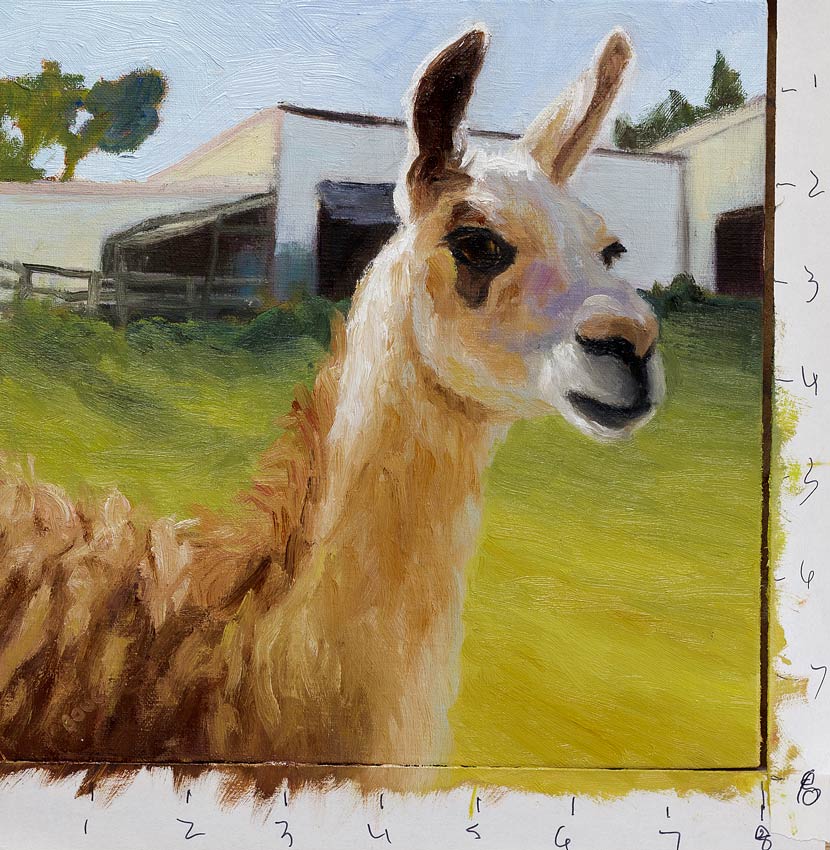
Then I discovered Accurasee, a free computer program for Macs and PCs (plus an iPhone app) that helps you be more accurate in your drawing or painting by using an innovative approach to the “grid drawing” method as a way to help you see. Accurasee adds a grid to a photo or scan of your drawing and you create a matching grid on or beside your painting. Then you use the grid coordinates to find the landmarks, height and width of objects in the composition.
You can read more about the history of gridding up here and see how much easier it is using Accurassee in these demos or read their user guide (pdf). (Disclaimer: I have no financial interest in promoting this product or this company, but I think it’s great!)
Photo after gridding in Accurasee
Accurasee offers a collection of clever drawing tools, including special measuring tape but I made my own using masking tape and marked off the inches:
Llama Attempt #2 Redrawn: Tape marked to match Accurasee grid
By mentally visualizing where the intersection of the lines would be, I redrew a little more accurately (though still not quite right). As they say on their website:
The ultimate goal is not to create a “dot-to-dot” drawing, but a proportionally accurate one. The Accurasee Method and tools are designed to be used as drawing aids, not a crutch. When used correctly, the Accurasee Method can quite literally train you to see more accurately.
Llama attempt #3, almost there
When comparing the painting to my watercolor concept I saw the ground was too dark so lightened and brightened it, worked some more on the face and neck and all around.
Eventually I just got tired of the whole production and decided that I’d learned everything I was going to learn from this painting, had nothing more to say, and called it done.
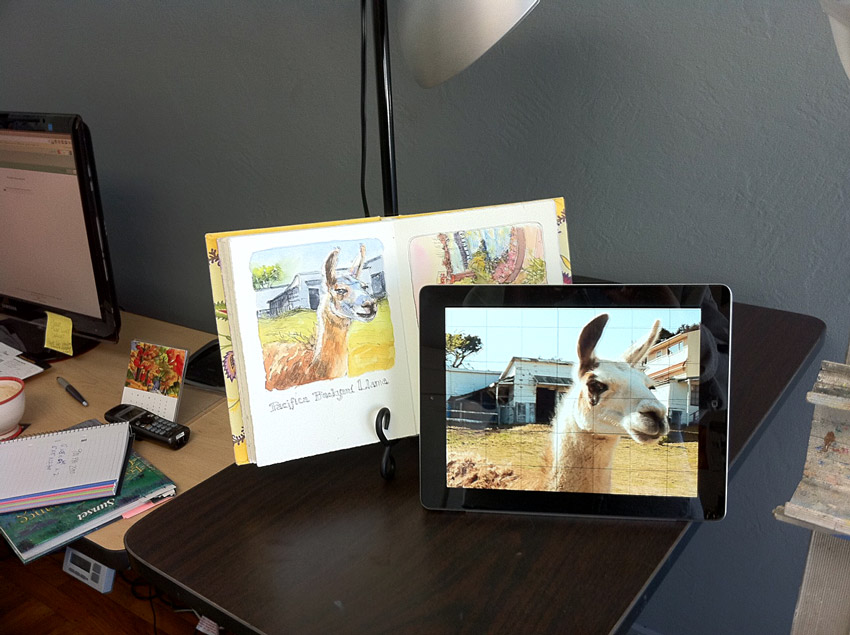
UPDATE: Julie asked how I was using the iPad vs my computer monitor and how I had it setup. Here is a picture:
Sketchbook and iPad set up by easel (plus messy desk and computer monitor)
I have in the past used my computer monitor to paint from but the iPad is handier because I can have it right next to the easel or on my drawing table and with two fingers I can enlarge (as in the above photo) or move the section I’m viewing or go back to seeing the full picture. I use the iPad Smart Cover which when folded back works well as a stand.
“Here Comes the Fog” is an all too common saying around here. It can be a hot, sunny day like this one at Linda Mar Beach in Pacifica. Then the fog comes rolling in, the sun disappears, and you need your jacket instead of your bathing suit. It was one of the first things I learned when I moved to the Bay Area: never leave home without a jacket, no matter what. (Painting available here).
Watercolor & Gouache preliminary study
This was a quick study in my sketchbook from the photo I took when I visited the beach in June. I used watercolor and gouache to ease back into that day at the beach.
I’ve been trying to eat a healthier diet and choosing produce and meat that has been sustainably grown. Unfortunately, while the farming may be sustainable, often the prices aren’t.
I bought one dozen eggs from a Marin County farm at the local farmers’ market. The vendor explained how the chickens were totally free-range and so got to eat greens and bugs along with their organic vegetarian feed.
“In fact,” he bragged as he took my money, “the chickens follow the cows around and eat the maggots from their dung!” Yum! Protein!
Despite their fine, buggy diet, these eggs seemed neither fresher nor tastier than the free-range organic eggs I get at Trader Joes for less than half the $8.00 I paid for this dozen.
To try to get a little more value out of my investment, I made one of the pretty light blue eggs pose for a still life. I like the way that the lighting coming from below gives the painting a slightly spooky look.










 Jana Bouc, Artist