Tuesday night we sketched at UC Berkeley’s Clark Kerr Campus. Built in the 1930’s as a residential school for the deaf, it now serves as home to hundreds of university students and 200 low-income seniors in a peaceful setting of mission style architecture, courtyards and sunny lawns, located just behind rowdy Fraternity Row.
Clark Kerr at Sunset, ink & watercolor
With the students gone for the summer and few of the elderly out and about, we had the place to ourselves. We met at Derby and Claremont and tried to stay in the light, moving west to follow the sun as it set. I enjoyed painting on site, trying to capture the light instead of making many drawings and adding color later as my sketching pals like to do.
Read this brief, wonderfully scandalous “get-even” taleby one of the facility’s elder low-income residents about her earlier life as a mistress to a rich, powerful man who was a member of the Bohemian Club (as was Bush). What a story and how bizarre to find it while Googling for info about the campus.
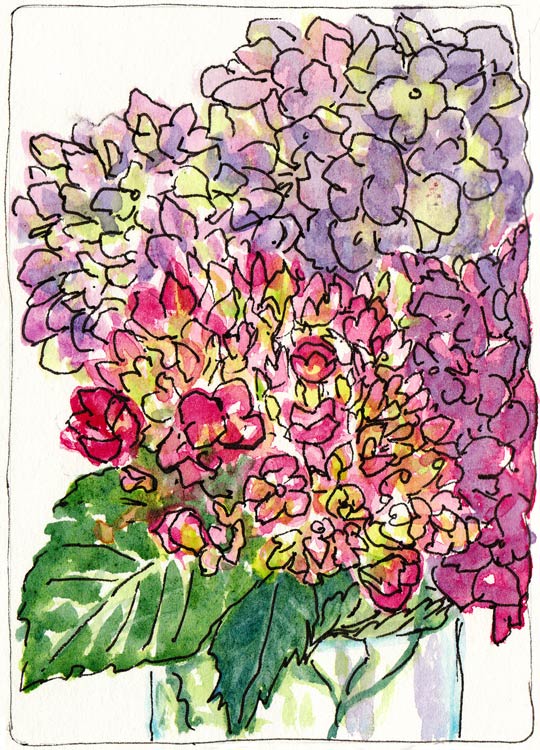
Hydrangeas Attempt #2; Painted directly without drawing and ink lines added after finishing attempt #3
During days of dismay at my disappointingly dismal drawing dexterity I determined to draw ’til I improved. But I was under the influence of migraine medicine which fixed the headache but left me drowsy. I actually fell asleep at the drawing table, dropped my brush on the page which woke me up, and had to go lie down for a spell between drawings.
Hydrangeas Attempt #1; drawn in ink, painted with ugly dark background which was then sponged off and a bit more paint added
My hydrangeas are bursting with vibrant blooms so I made them my subject. The first attempt got off to a decent start until I painted a nearly black background, probably due to my really dark mood and being too doped up to know when to stop.
I couldn’t stand the way it looked, so before scanning tonight took a soft, wet sponge and washed off the dark background. Then I dropped a little more color into the wet background.
Hydrangeas Attempt #3, ink & watercolor
I had the most fun with this last attempt, where I drew and painted more loosely, trying to capture the flavor and personality of the flowers.
Study for Kaiser Garden II, watercolor, 6.5" x 4.5"
There are still openings in my watercolor class starting Sunday, June 27; click here for all the information. Ok, business done, now on to the painting above, another study from photos I took at the Kaiser garden.
I learned the hard way to do a study first, after time and again putting hours, days or weeks into a painting that was doomed from the start.
No matter how skillful the painting technique is, if the composition is bad (the viewer’s eye goes to a bright corner and then right off the painting), or you’re trying to work from a photo that doesn’t have enough information, or your colors or values are uninteresting, the painting isn’t likely to succeed. Sketching exactly what you see is great fun, but sometimes nature requires editing to make it a painting.
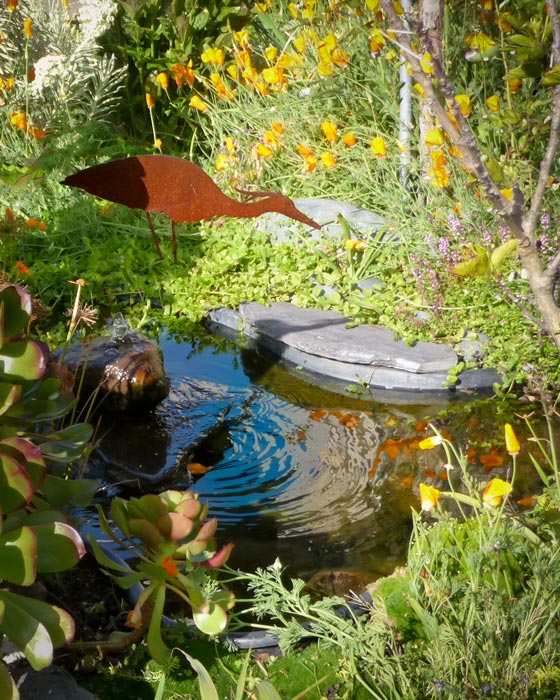
What made me want to paint this scene was the water feature and the bird sculpture but when I looked at my photo I saw big problems with the composition:
Original photo, Kaiser garden
There is way too much going on, the two big succulent plants on the bottom left dominate, a big stem above them leads the eye out of the frame, and the composition seems divided right down the middle, vertically. You barely notice the water.
So I spent some time in Photoshop cropping, rearranging and revising things:
Revised Photo Reference, Kaiser Garden II
Before cropping off the left side, I cut out the bird, moved it to the right, tilted it and gave it legs. Then I darkened the remaining succulents on the left and bottom to use them as a frame for the water feature instead of competing with it. When I started sketching the composition in my journal I decided to get rid of the messy tree branches poking in from the right too.
Although Photoshop is great for preparing a photo reference, so are the scissors, glue, sketches and notes that I used pre-Photoshop. Along with learning Photoshop, I’m also trying to become a better photographer and compose more carefully. I can do that with my digital SLR because it has a viewfinder but my carry-everywhere little Panasonic doesn’t. In the bright sun it was impossible to see anything on the LCD screen, so I guess I’m lucky that I got something I could work from at all.
My notes for the painting are in my journal opposite the study, with reminders about colors and things that worked (or didn’t). I’ve transferred the drawing to the canvas and it’s just waiting for its turn at the easel. I have a feeling it’s really meant to be a watercolor, not an acrylic painting, so may do it both ways.
Kaiser Hospital Tulip painting study, watercolor, 4.5" x 6.5"
I accidentally arrived an hour early for a doctor’s appointment at one of Kaiser Oakland’s medical offices that has an amazing hidden garden. The building is an architectural treasure, built around a courtyard in 1912 by Julia Morgan as a hospital and home for unwed mothers (or so I’ve been told). Instead of reading old, germy magazines, I spent the hour in the courtyard sketching, wandering and taking photos.
After working out the composition and colors, I’ve got two paintings ready to start: a full-size watercolor sheet of the above image and a slightly smaller canvas of another garden scene.
Before starting a large painting I like to do a study first, getting to know the image more intimately, and experimenting with pigments and techniques so when I start the real painting I have a plan of action or at least a sense of direction.
Tulip study and notes for painting, journal spread
Since I only recently began experimenting with opaque watercolor pigments after years of using only transparents, I made some discoveries with this study and took notes as I worked. Here are a couple that might be of interest:
Opaque pigments (Cadmiums, Cerulean, Yellow Ochre) are great when putting down an area of strong color and leaving it (such as when painting in my journal). But they lift too easily when adding layers over them, and become thick and unattractive when trying to mix darks. As I learned in oil painting, darks/shadows are best when thin so they don’t draw attention to themselves with texture. Seems to be the case in watercolor as well: better to use staining, transparent darks that won’t lift or get thick. For the dark green areas in the painting I’ll use Sap Green with Sepia and vary with a bit of Indigo, Winsor Violet and/or Alizarin.
The Legion/Utrecht 100% rag watercolor paper I’m using in my journal lifts incredibly easily. This is great when you actually want to lift paint but not so good when you just want to soften an edge and a bunch of paint lifts off instead!
Here are the original reference photo and the Photoshopped version. As you can see I got rid of some distractions and changed the proportions a bit.
Original reference photo of tulip in gardenPhotoshopped tulip reference photo
Photoshop CS5 has some great new composition tools, such as “Content-Aware Fill” which I used to fill in the windows, white at top right corner and a tulip on the right margin. You just select and delete sections you want to replace and PS fills them with information from the surrounding area. I also narrowed the image to fit the proportions of the 22×30 watercolor paper using Content-Aware Scaling which preserves the proportions of the important stuff while squeezing in (or stretching) the other stuff.
After a delicious breakfast on the patio at Rudy’s Can’t Fail Diner in Emeryville last Sunday, my friend Michael and I walked around the Emeryville Marine. He’s very patient with my need to stop and pet dogs and to take photos of things when I can’t sketch (can’t because he doesn’t have that much patience). I loved this cute little guy’s Joe Casual pose. When I got home I sketched him and his portrait now has the place of honor as the first page in my new journal.
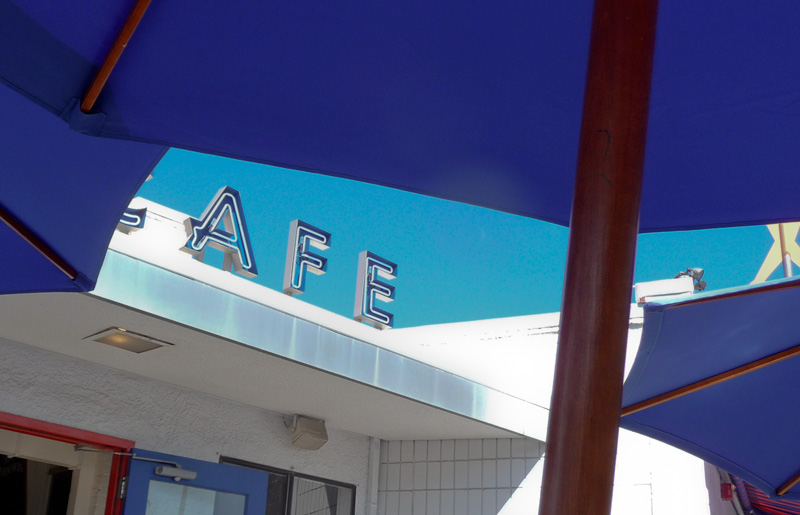
Rudy's Can't Fail Cafe, Emeryville, color photo (I so wanted to sketch the scene when I was there, but also wanted to socialize so I took a photo and made a note to come sketch at Rudy's on a Tuesday night with my sketch buddies.)
Mysterious Hole
Meanwhile something dug a 6″ wide hole and tunnel under the grass in my backyard. I searched online, trying to find out what kind of animal dug the hole. I found this website that tells you, based on the diameter of the hole and the mounding of the dirt around it. According to that site and this one, the most likely options were armadillo, fox or badger.
Except I live in urban northern California where we definitely don’t have armadillos, badgers or foxes. We do have opossums and raccoons, but possums live in trees, not burrows, and both raccoons and possums have soft hands so their only digging is for grubs just under the sod.
Worried that it could be some huge kind of rat, I called the county’s Vector Control Department (love the euphemism “vector” for nasty critters that spread disease). A very nice gentleman came out this morning but he couldn’t figure it out either, although he mumbled something about skunks but then said not.
I followed his instructions to dig up and fill in the hole, lay a board next to it, sprinkle the board with baby powder and check it mornings looking for footprints in the powder. If the critter comes back he’ll leave his footprint and then we’ll know what it was. Maybe it’s a very small heffalump.
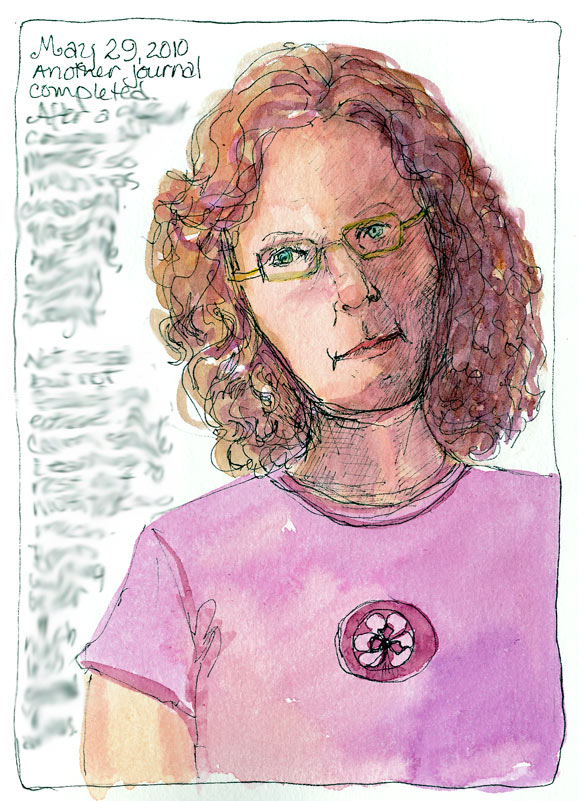
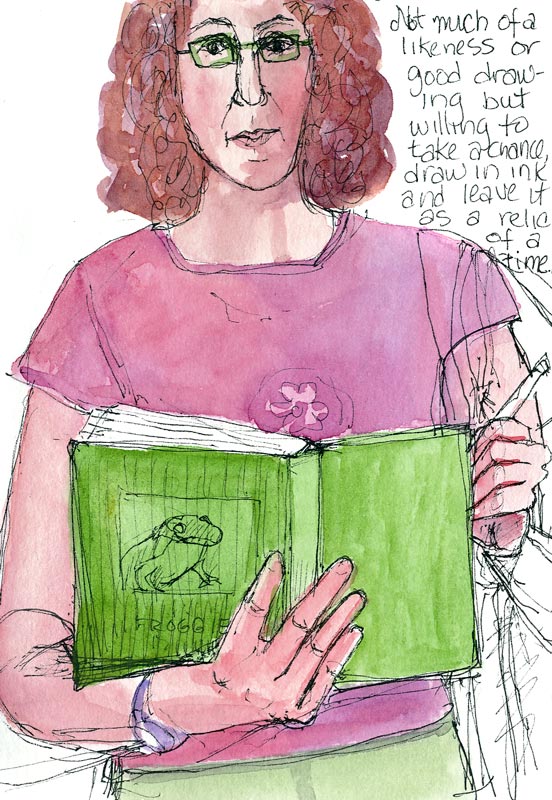
At the end of each journal I like to do a self portrait or two and write a little wrap up about my life during the period that journal was active. I blurred some of the writing so I could say what I wanted without worrying about “over sharing” personal stuff.
Self Portrait with Froggie Journal B-2, ink & watercolor
I was inspired by Raena’s wonderful self-portraits to try sketching standing in front of a mirror instead of just sitting down and drawing my face. While I didn’t get a real likeness I did get two images that capture how I felt and saw myself that day. And even better, I was willing to take a chance, draw in ink, leaving the “mistakes” and accept that while my sketches weren’t as “good” as I wanted them to be, I was OK with letting them exist as a point on a journey.
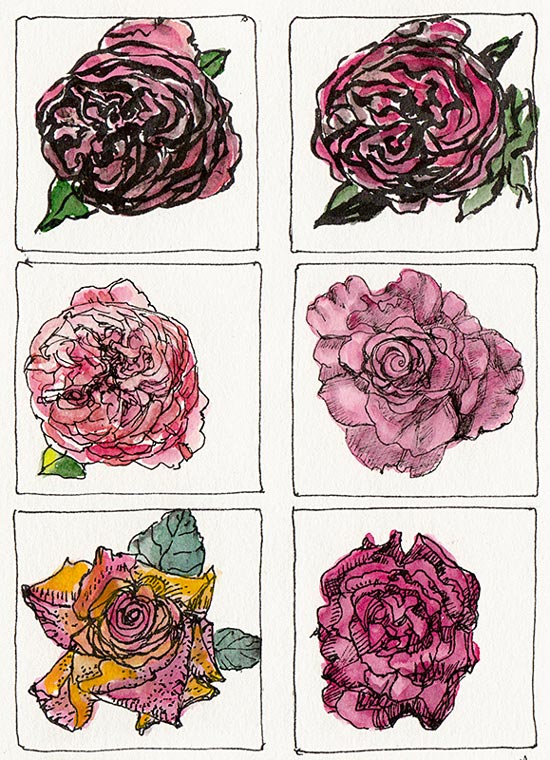
Berkeley Rose Garden & Rose Practice, Ink & Watercolor
When my plein air group met at the Berkeley Rose Garden last Saturday I arrived even later than usual: at noon, only an hour before the session was to end. I found a spot to sit and quickly sketched and painted the complicated, terraced rose garden, finishing just in time for the 1:00 critique.
Berkeley Rose Garden, Ink & WatercolorRose Grid, Ink & Watercolor
After the critique I took some photos of the roses that most intrigued me, while guys set up white chairs for a wedding there later in the day. Once home I made a grid in my journal, and displaying the photos on my monitor, tried to understand their design and draw them.
I’ve bound my next journal and named it “Rosie” and want to decorate her with a rose design so this was practice for the rose I’ll draw on the cover. I’ve finished my journal “Froggie” but still have a bunch more pages to post.
I’ve updated my blog template. What do you think of the new design?
Berkeley Bagels was closed but their café tables and chairs were conveniently chained to the sidewalk, creating a nice spot to sit and sketch as the sun was going down a couple Tuesday nights ago.
I had so much fun drawing as more and more of the landscape revealed itself to me. First I was just going to draw the umbrella , but then there were the chairs behind it, and the next table and umbrella. The telephone pole appeared and had to be drawn and then the elevated concrete BART tracks and the electric pole behind it. When a BART train streaked by I added it, trying to remember what I saw.
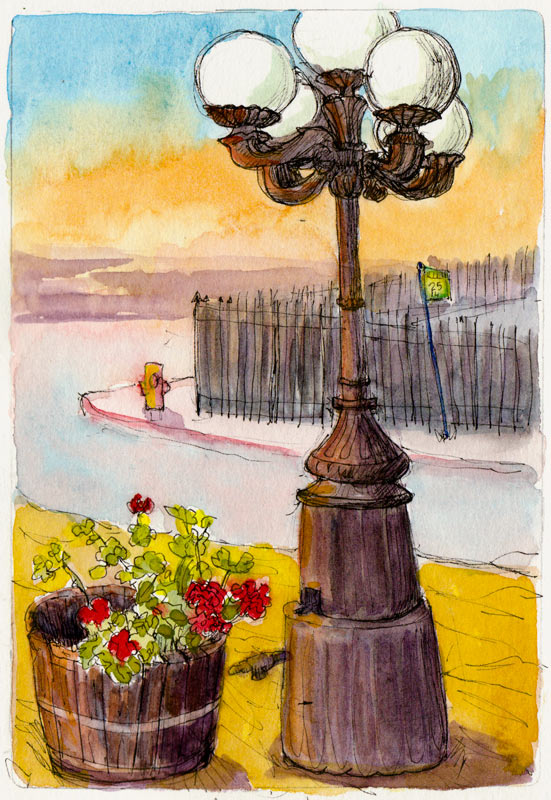
Corner of Gilman and Northside, Berkeley
I sketched this standing in the street on Northside, my back to Berkeley Natural Grocery. The street lamp must be left over from some previous incarnation of the corner. There are two of them, standing incongruously on each side of a funky little car repair shop. It took so long to draw the lamp that my sketchbuddies were ready to move on before I could draw the buildings on the next corner beyond the fence so I just threw in some paint for the sunset and the “distance.”
I’m enjoying using the stronger color I can get from adding some more opaque colors to my palette, such as cadmium orange, cad red light and cerulean blue. I used to have a “rule” about using only the most transparent colors but after working with oil paints I wanted to be able to get some of that “body” in my watercolors too.
After much trial and error I figured out just the right steps and ingredients to make delicious yogurt and so of course had to sketch the process. I wanted to make my own yogurt so that I could get the mild, creamy flavor I like without adding more plastic to the landfill; I already have a lifetime supply of empty yogurt containers.
Ingredients for 7 cups:
48 oz. Organic 1% Milk
6 oz. yogurt at room temperature (I like Clover 1.5% Plain Yogurt) or use 1 cup from previous batch
2 T. Organic powdered low-fat milk (optional)
Pour 48 oz. of milk into Pyrex casserole dish, or pot (if using stove)
Cook until 180° F. (almost boiling, 15 minutes in my microwave)
Remove from microwave and allow to cool until 110° F. or room temperature. If skin forms on top, use a fork to skim it off.
Turn on the yogurt maker* and put the jars in place so they can pre-warm.
Pour a cup or so of the milk into the 1 quart measuring cup.
Whisk the 6 oz. container of yogurt (should be at room temperature) and the powdered milk (optional) into the milk in the measuring cup.
Pour the milk/yogurt mixture back into the big bowl of milk and whisk all until completely blended.
Pour the mixture into the individual jars.
Put the dome lid on the yogurt maker and set timer for 8 hours.
When it turns off, place lids on jars and put in the refrigerator to cool.
When cold, eat as is or add fresh fruit.
Yum.
*The Waring Pro Yogurt Maker comes with reusable plastic containers but I replaced them with 1 cup glass canning jars which are more appealing. I eat the yogurt right out of the jars, wash them and use them again. The Waring helps to make the process simple: it has a timer and holds the yogurt at the right temperature for the number of hours you set it to run and then it turns off. The longer it “cooks” the more tart it becomes. But you don’t really need equipment to make yogurt; you can use a thermos, an oven pilot light or even a crock pot, but for consistent results the Waring is great.
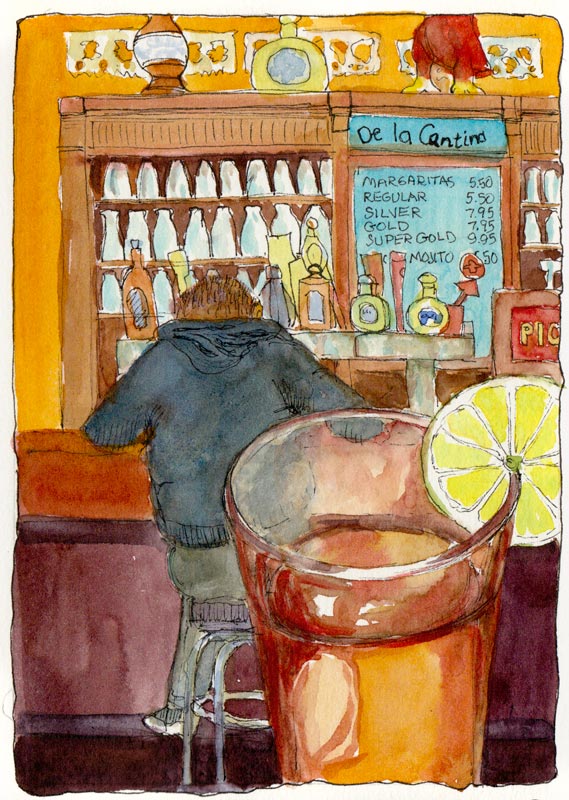
Another rainy Tuesday night, another indoor sketching session for the Tuesday Night Sketchers. We emailed back and forth today, negotiating for an agreeable place to sketch. Finally Picante came to mind and everyone agreed it was perfect, with their great food and friendly neighborhood feel.
Usually we move around sketching from different viewpoints, even within a restaurant. But with four of us tonight ( Micaela joined Sonia, Cathy and I) we parked ourselves in a comfy booth to eat and ended up staying in the same spot all evening. I started by drawing the iced tea in front of me and then turned to the right and drew the bar 10 feet away, putting it behind my tea. In reality, Sonia was sitting across the table from me and she was behind my tea.
Everyone else made several sketches but I spent the whole evening on just one. It felt luxurious to take my time and savor each visual discovery, line and color. But then I felt a bit sheepish when I realized it was 9:00 and everyone else was done and waiting for me to finish so we could do our end of evening show and tell and go home.











 Jana Bouc, Artist