Categories
Art supplies Lighting Oil Painting Painting Still Life Studio

Meyer Lemons Bowled and New Adjustable Still Life Table

Meyer Lemons Bowled, oil on linen, 8x8"
Meyer Lemons Bowled, oil on linen panel, 8x8"

These lemons came from my little Meyer Lemon tree which produces the sweetest, plumpest lemons. I planted the tree from a small pot about 5 years ago and now it’s as tall as me. I really like the Centurion Oil Primed Linen Panel I painted this on, except that it takes much longer for the paint to dry than when painting on Gessobord because it doesn’t sink in to the oil priming.

Still life table beside easel
A= Still life table beside easel

I set up the bowl of lemons on my new rolling, adjustable (from 28″ to 45″ high) still life stand, also known as an Over the Bed Table on Amazon where I got it with free shipping (good thing because it’s not light). Since I was taking a picture of it I thought I’d also describe the other items in the photo since I’m so happy with my painting set up.

A = Rolling, adjustable height Still life stand/Over the Bed Table

B = Karen Jurick’s “Alter Easel” which I love for holding thin panels instead of trying to balance them between the narrow supports on my easel. Works great!

C = Daylight Studio Lamp for lighting the still life (not visible is the Daylight Artists Easel Lamp that is attached to the top of my easel to light the painting (that I was given for free by the company and liked so much I bought the standing light).

D = A silly maul stick (just the top shows) that doesn’t work very well. I’ve seen people using canes instead, hooked over the top of the painting to provide support for your hand when painting details.

E = Masterson Artist Palette Seal with a lid that seals like Tupperware and with a pad of palette paper inside (the palette paper is a recent discovery that I LOVE because it saves so much time from having to clean the palette.) I keep the palette in my freezer when I have paint left over. Once thawed (in a few minutes) it’s in perfect condition for the next painting session. The palette is on top of an upside down plastic drawer from a defunct rolling cart to raise it up high enough for me to use without bending over (I’m 5’10”).

Not lettered but in the picture is the beautiful silk sari fabric my friend Barbara gave me for my birthday for just this purpose and the ancient microwave cart that holds my palette and supplies. Not shown is the rolling plastic taboret I’ve had for 20 years that holds my brushes and other stuff.

OK, I know I’m a gadget girl and many of these things are not necessary. But I feel like painting (and life) are hard enough, why not have great tools to make it easier? There are lots more pictures of my studio under the category “Studio.”
Categories
Art supplies Art theory Drawing Food sketch Ink and watercolor wash Oil Painting Painting Sketchbook Pages Still Life

Learning Leaning Apples on Grannie’s Linen

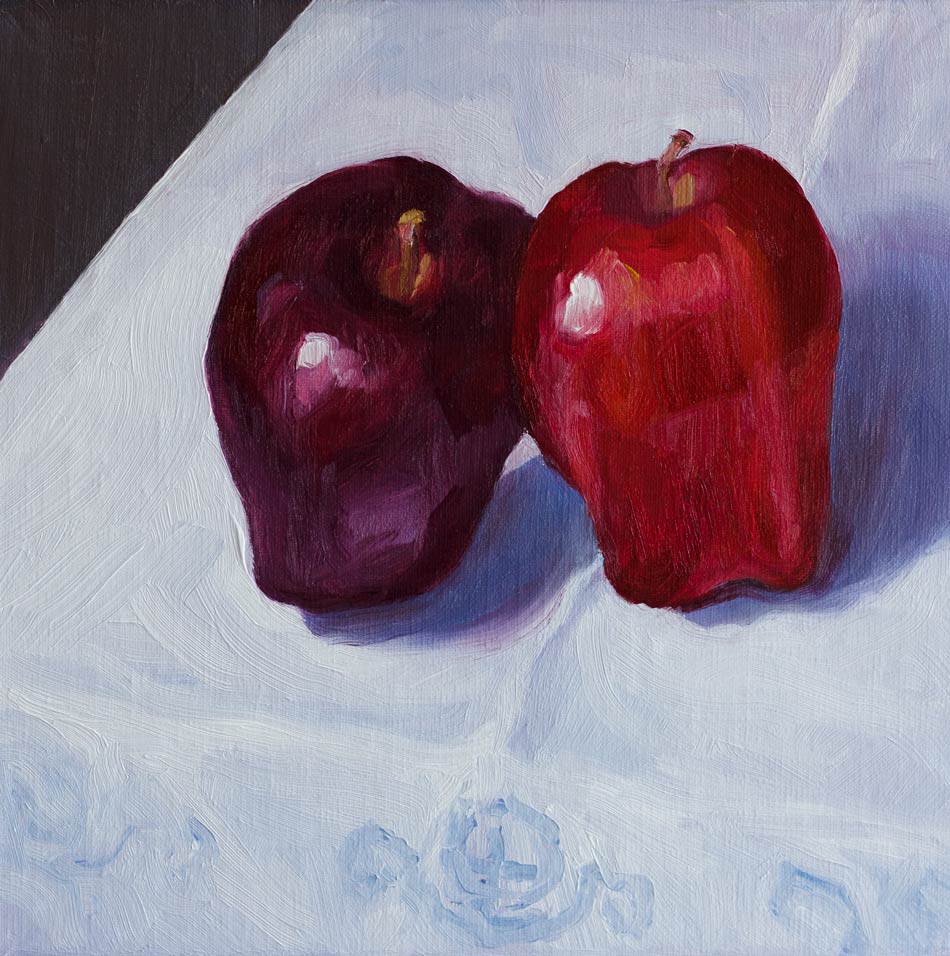
"Leaning Learning Apples", oil on linen, 8x8"
"Learning Leaning Apples", oil painting on linen panel, 8x8"

I’m happier with this painting of apples on a linen tablecloth embroidered by my grandmother. After the mighty fail of my cringe-worthy zombie apple painting, I got really curious. What was I missing? Clearly my drawing hadn’t been careful enough, per my friend Michael’s appraisal of the painting: “Uh, what is it?” And I know it was way overworked.

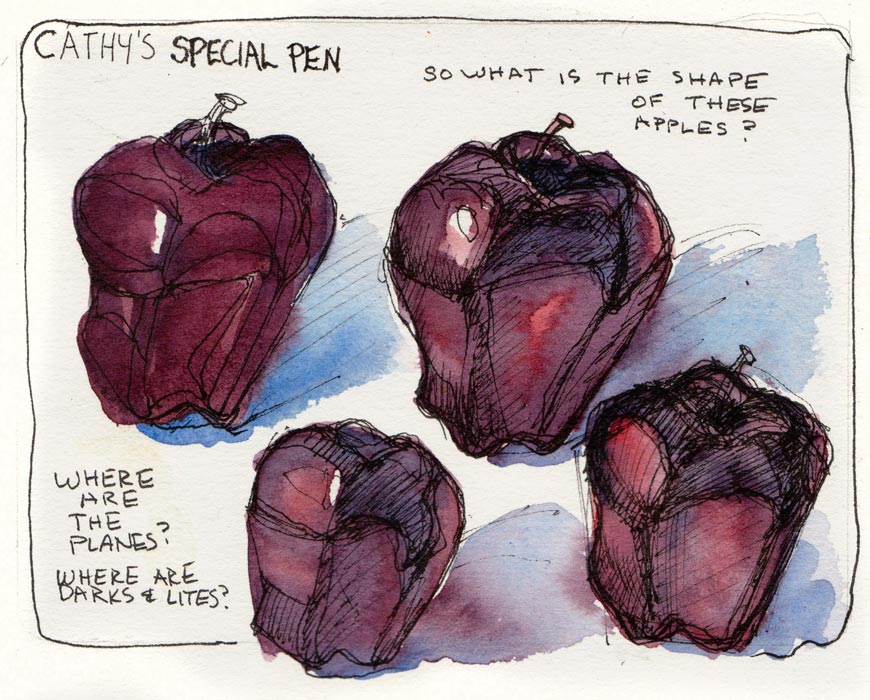
So before trying to paint these apples again I sat down with my sketchbook, an apple and my Lamy Safari pen. (The note below about Cathy’s special pen was just me grabbing any old page in the sketchbook to try out her strange new pen when she handed it to me.)

Study for "Leaning and Learning Apples," ink & watercolor
Study for "Leaning Learning Apples," ink & watercolor

I sketched one very dark purple delicious apple over and over in ink, trying to understand what I was seeing, where the planes changed, where the darks and lights were, trying not to get tricked by the reflections. That gave me a little more courage to try to paint the apples again in oil.

The painting at the top of the post was the result. This was a new painting surface for me: oil-primed linen on panel, surprisingly inexpensive (for linen), on sale at Jerrys Artarama. It was quite lovely to paint on. It was slippier than I was used to; the Ampersand Gessobord panels I usually use kind of “bite” the paint right off the brush and the oil primed linen allows it glide.

This painting is available on my DailyPaintworks gallery.

Categories
Art supplies Art theory Drawing Every Day Matters Ink and watercolor wash Painting Plants Sketchbook Pages

Last Day of EDiM: “Fresh” Hydrangeas and L.L. Bean “Flashlight” Hat

Baby Hydrangea for "Something Fresh" EDM #112, ink & Watercolor, 6x4.5"
Baby Hydrangea for EDM #112: Fresh, ink & Watercolor, 6"x4.5"

I’d never been able to sketch this hydrangea plant before because once the teensy little buds open they shed piles of equally teensy little petals and make a big mess. But this one was so fresh I was able to cut and draw it without the mess. (Although it did end up making a mess anyway when my cat ate one of the leaves and then delivered it later to the rug.)

EDM #120 Flashlight (L.L. Bean Pathfinder Flashlight Hat), ink & watercolor
EDM #120 Flashlight (Hat), ink & watercolor

The cue was to draw a flashlight. My favorite flashlight is my wonderful L.L. Bean Pathfinder Cap. It has two LED lights in the brim. One points straight down and is perfect for lighting your sketchbook when painting when it’s dark, and the other points ahead to light your path. You just squeeze a spot on the brim and it toggles between down, ahead or both. When painting in a dark pub it perfectly lit my sketchbook page but nobody could tell where the light was coming from. Someone came over to try to figure it out because it just looked like my page was illuminated.

The hat is sitting on a plaster “Planes of the Head” cast, a tool for learning how to really see and draw heads (good article about this here).

Although I wasn’t a faithful follower of  “Sketch Every Day in May,” it reinforced how much I enjoy drawing. Some of the cues sounded boring but I discovered that no matter how dull a subject may seem, drawing it rarely is.

Categories
Art supplies Drawing Every Day Matters Glass Ink and watercolor wash Sketchbook Pages

Lightbulb Moment and Mini-Review of Stonehenge Wirebound Journal

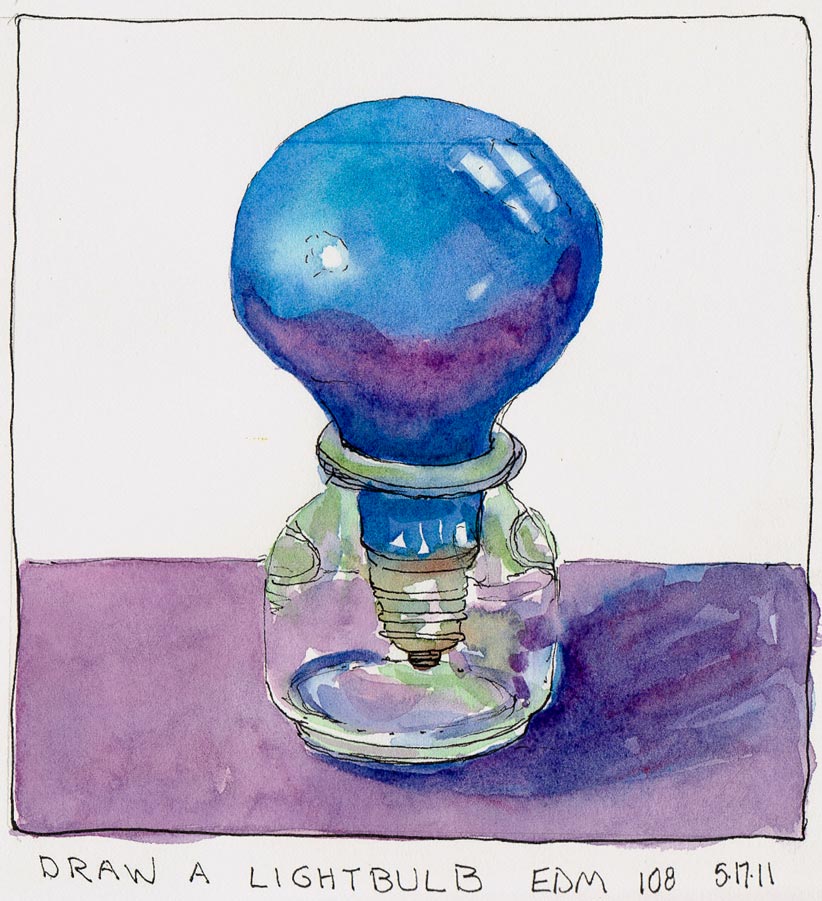
Lightbulb, ink & watercolor, in 7x7" Stonehenge Wirebound Journall
Lightbulb, ink & watercolor, in 7x7" Stonehenge Wirebound Journal

I was trying to find a way to make this old blue photography light bulb (purchased back in the days of film) stand up so I could sketch it. I tried using tape rolled into a double-sided ball and sticking it to the table but it fell over. Then I found this little glass yogurt container about the size of a baby food jar that I’d bought primarily for the jar. Perfect. (Sketched for Every Day in May, EDM #108).

Stonehenge Wirebound Journal Mini-Review

The short version: Nope.

I loved the idea of a 7″ square journal and the paper seemed like it would be nice for pen and watercolor. The description on JerrysArtarama included this bullet point:

  • Excellent surface for graphite, colored pencil, printmaking, pen and ink, pastel, silverpoint, watercolor and more! [italic/bold added]

But it’s a no-go for watercolor. I couldn’t get a rich smooth wash anywhere on the page. When I tried to add a darker glaze over the first wash for the shadow on the table, no matter how light a touch I had, my brush picked up the first layer of paint instead. On the underside of the bulb I had a similar problem. And then there’s the mystery line across the top of the bulb. Something embossed the page in the brand new book and the color sank into it. Perhaps the edge of the ruler I used to pencil in a border before drawing in ink left an imprint, but I’ve never had that happen before.

When I ordered the sketchbook I thought I remembered Roz writing a couple of positive reviews of the paper but when I checked again, I saw that her third and final review came to much the same conclusion for watercolor.

Categories
Animals Art supplies Drawing Every Day Matters Illustration

Ostrich with Hole in the Sand (How I Get My News)

Ostrich with Hole in the Sand, ink on Stonehenge paper

One of the Everyday in May drawing cues is “Draw How You Get Your News.” The image that immediately came to mind was an ostrich with its head in the sand. I am the opposite of a news junkie. I cancelled my newspaper subscription years ago when I realized it made me cry nearly every day. TV news is even worse, with “If it bleeds, it leads” as the guiding principle.

So I just stick my head in the sand instead of consuming all the fear-based media, and do what I can to create better news. Avoiding the news means I can continue to believe that most people are mostly good and that it’s great to be alive.

About the paper: Stonehenge just started making their wonderfully soft drawing paper in this color called “Kraft” except unlike regular Kraft paper it’s archival 100% cotton. It’s fun to draw on with black ink and white gel pen.

About ostriches: They don’t really bury their heads in the sand. When frightened they try to hide by lying low and pressing their long necks to the ground which could look like they have buried their heads in the sand.

Categories
Art supplies Lighting Studio

Reviews: Daylight Easel Lamp and Karin Jurick Tabletop Easel / Panel Holder

Daylight Easel Lamp and Karin Jurick Panel Holder
Daylight Professional Artists Lamp & Karin Jurick Easel Panel Holder with painting in progress

Two recent discoveries have made my painting life easier, brighter and more enjoyable: the new Daylight Artists Professional Lamp and a new prototype version of Karin Jurick’s tabletop easel that serves as a panel holder in a regular easel.

Categories
Art supplies Bookbinding Drawing Ink and watercolor wash People Self Portrait Sketchbook Pages

The End of Harlequin

Harlequin cover, Sketchbook 2011 A

When I finished the journal above I decorated the cover and sketched a self-portrait as I do for the last page of each sketchbook. This journal is called Harlequin (theoretically because of the multi-colored cover–the back is turquoise, the front is lavender with black spine covering). I know the word “harlequin” has nothing to do with patching together leftover bits of bookcloth to make a cover, but I let my sketchbooks name themselves and this one wanted to be called Harlequin.

I used (expensive, oil-based) Sharpie Paint markers for the color on the cover but they didn’t show up at all on the black and required several layers on the lavender. Despite the art store clerk’s recommendation, Sharpie Paint markers are not meant to be used on fabric. Annoyed with the markers, I switched to a gold gel pen for the words and lines.

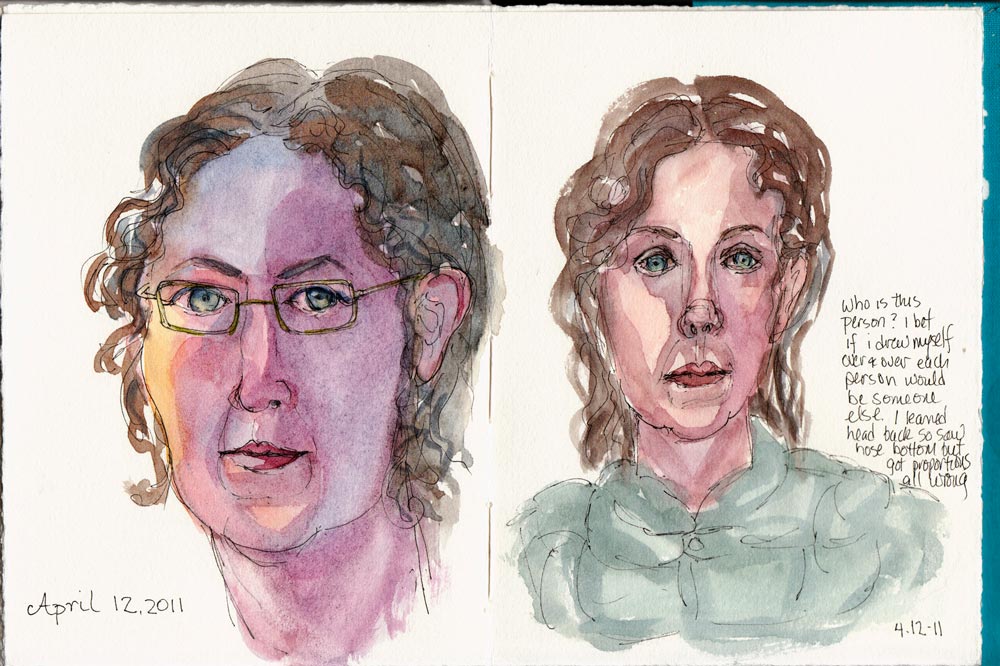
End of sketchbook self portraits, ink & watercolor

These are the two journal-ending self-portraits sketched on the last spread of the book above. I don’t know why I refuse to try for accuracy when I sketch self-portraits. I just draw and see what happens instead. The first one (on the left) feels like me, even though the proportions are wrong. The one on the right is wrong in so many ways I might as well have been drawing a completely different person.

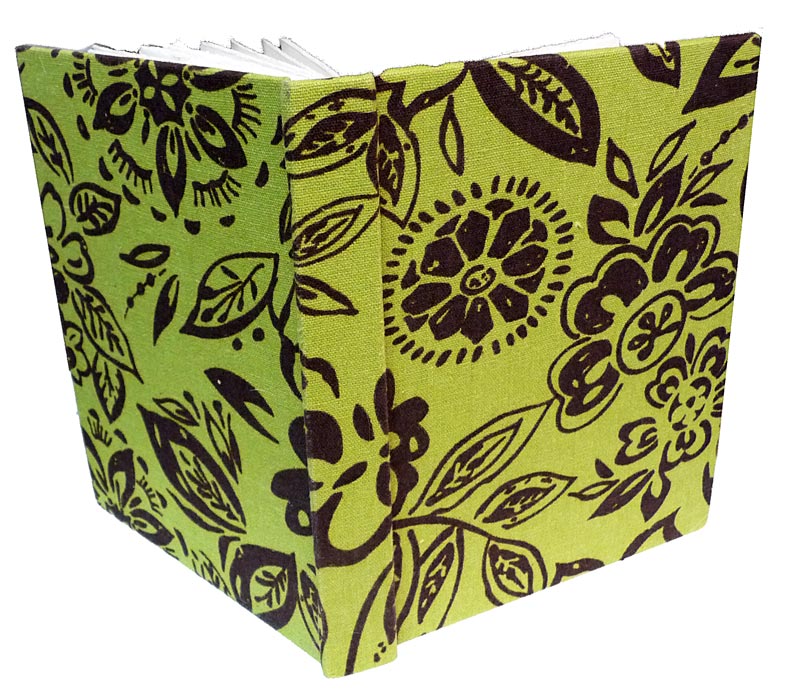
Newly bound journal
Newly bound journal

I’d planned to experiment with dying my own bookcloth for the new journal like Shirley does, but when I went to the store to get the Wonder-Under (iron-on stuff to fuse fabric to paper backing) I fell for this linen fabric and used it instead. My adventure on the previous journal was figuring out how to patch the bookcloth together. This one was figuring out how to fuse the fabric to the Thai Mulberry paper per Shirley’s instructions (the hardest part was figuring out how to peel the almost invisible paper backing off the Wonder-Under). Maybe next time I’ll dye fabric.

I’ve also updated my file How to Bind a Watercolor Journal (as I do each time I bind a journal and learn more) and it’s available to download on the Comments & Resources page of my website, JanaBouc.com.

Categories
Art business Art supplies Bay Area Parks Building Drawing Ink and watercolor wash Kensington Landscape Painting Places Sketchbook Pages

Amazing Art/Materials Resource Site + How to Store Paintings

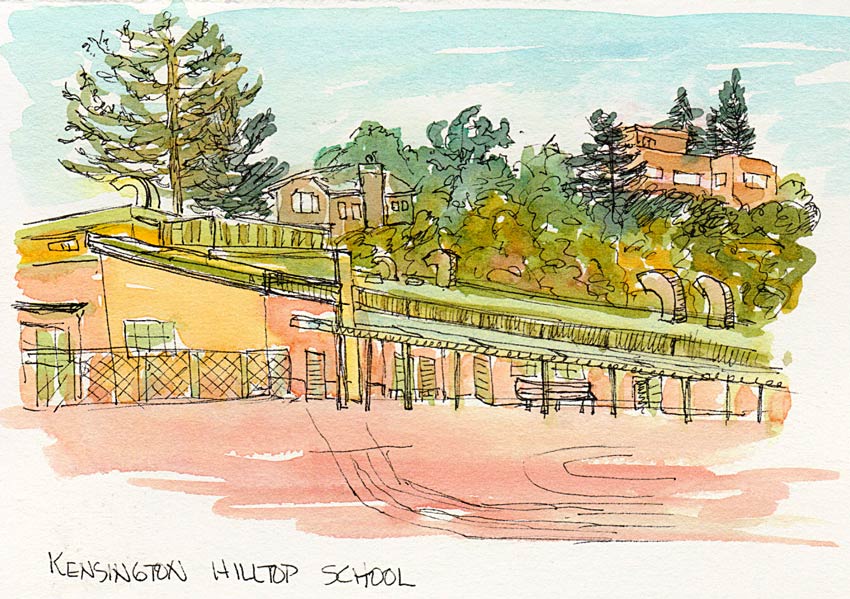
Kensington Hilltop School, ink & watercolor
Kensington Hilltop School, ink & watercolor (a beautiful school above a wonderful park at the very tip-top of Kensington hills)

In my last post I asked for advice on sorting and storing completed oil paintings on panels. Along with the good suggestions from readers,  I found a fantastic website that provides the answers to these and many other questions about proper handling of artwork and art materials of all kinds.

The website is AMIEN.org (Art Materials Information and Education Network), “a resource for artists dedicated to providing the most comprehensive, up-to-date, accurate, and unbiased factual information about artists’ materials.”  They are part of the education department of the Intermuseum Conservation Association.

AMIEN’s forums are the place to find information to all our questions about proper use, handling, storage, shipping, application, etc. of art materials and finished art work or all kinds. Here is a portion of what they say (more here) about storing oil paintings on panels:

Store your paintings standing on edge, one next to the other, with a piece of acid-free paper loosely covering the face of each painting. You can tape the paper to the back of the panel and fold it over the front.

Ideally, you will put these paintings in a rack, elevated off the floor, in some location that is relatively dust-free and not subject to wild swings of temperature and relative humidity. Even more ideally, each painting ought to be separated from the others, but that would take a very large rack. Second best: You should not have more than about 5 paintings leaning against each other; separate the groups of paintings.

AMIEN’s forums cover topics like Watercolors, Pastel, Encaustics, Acrylic Paints, Supports, Grounds, Solvents and Thinners, Varnishes, Pigments, Color charts, Oil Paints and Mediums, Alkyds, Mural Paints and Techniques, Colored Pencils, Printmaking, Photography and Printed Digital Media, Matting, Framing and Labeling, Picture Protection, Crating, Shipping, Storage, Conservation, Hazards and much more.

About the sketch at top: Friday afternoons I have the pleasure of spending time with two lovely 11-year-old girls who still like to swing and play make-believe games on playground equipment. I discovered Kensington Hilltop School while hiking in the hills on the weekend and brought them there the next week. They played, I sketched, we had fun.

Categories
Art supplies Drawing Food sketch Ink and watercolor wash Painting Still Life Watercolor

Sea Shells: Accidental Watercolor Texture

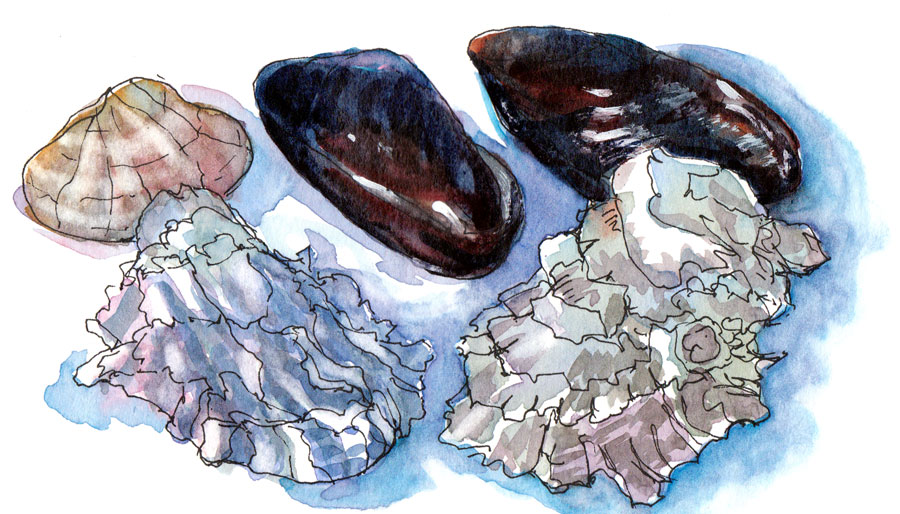
Shellfish Shells, ink & watercolor, 5x8"
Shellfish Shells, original version, ink & watercolor, 5x8"

A shellfish company saw a previous shell painting of mine and commissioned me to paint one for them to use as a background on their business cards. They shipped me a box of their oyster, clam and mussel shells to use as reference. I created the above sketch in my Moleskine watercolor notebook and sent them the file for their review.

Accidental texture from working on reverse of page
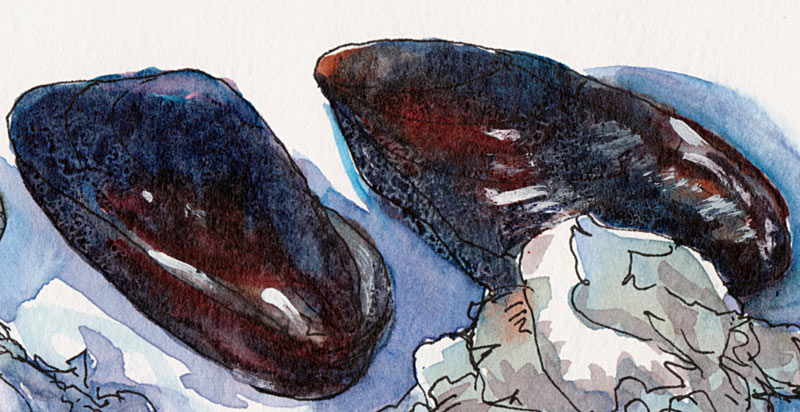
Close up: Accidental texture caused by painting on reverse page

On the next page in my Moleskine, I sketched a landscape and painted it with juicy washes, something I do on the 140 lb watercolor paper in my hand-bound sketchbooks all the time. Without my noticing, the water seeped through the lighter-weight Moleskine paper, wetting the shell painting on the previous page.

Some of the mussels’ paint lifted, creating the wonderful texture (close up above) that I probably couldn’t have achieved if I had I tried. The only downside to this “technique” is that some of the lifted paint printed on the opposite (fortunately blank) page.

I wasn’t worried about the change in the art for my client because I’d already created a high-resolution file of the original. And as it turned out, they asked me to do another version with two different kinds of oyster shells and more clams, apologizing for changing their directions. I’m happy to paint as many versions as it takes since shells are one of my favorite subjects.

Categories
Art supplies Drawing Food sketch Glass Ink and watercolor wash Life in general Sketchbook Pages Still Life

Ginger for a Tummy Ache: Sketched with Namiki Falcon

Ginger Ale and Saltines, Namiki Falcon pen, Carbon Platinum Ink, and watercolor
Ginger Ale and Saltines Namiki Falcon pen, Carbon Platinum Ink, and watercolor

Today was a bad news, good news day. It started with a migraine that eventually passed enough to work most of the day (despite the internet going down, fixing that and then a little later the electricity went out long enough to shut down the computer with several projects in progress). The migraine left behind a tummy ache. I couldn’t deal with the supermarket so went to the little health food store and bought some natural Ginger Ale, organic saltines and candied ginger (all supposed to be good for tummy aches).

Candied Ginger in an Egg Cup

The good news is that this morning my reliable but grumpy mailman delivered my new Namiki Falcon fine point fountain pen and this evening I felt well enough to fill it with ink and give it a spin. I LOVE IT! The nib floats like a dream over the page with control and flexibility and a really nice fine line. It’s the best pen I’ve ever used. UPDATE June 2011: After using the pen for a few weeks I discovered that I didn’t really like it that much and sold it. I felt I had too little control of the ink flow, which went to fast for me, even with the extra fine nib. I’ve gone back to my Lamy Safari extra fine point which I LOVE!

The other good news is that with these sketches I finally finished filling the Moleskine watercolor sketch book that I’ve so detested using during the interim between binding sketchbooks. Tomorrow I get to start using the one I bound a couple of weeks ago. Yay!