Handsome Guy at Peet's; Lamy Safari pen, Carbon Platinum Ink in Med. Watercolor Moleskine
I could have reached out and touched his face. But he was so absorbed in his computer he didn’t notice me drawing him at the next table, our knees almost touching. The lady at the table on my other side was watching me and said I captured his likeness perfectly and should show him. I didn’t though, just in case he might not find it flattering. Our own ideas of our appearance often don’t match others’.
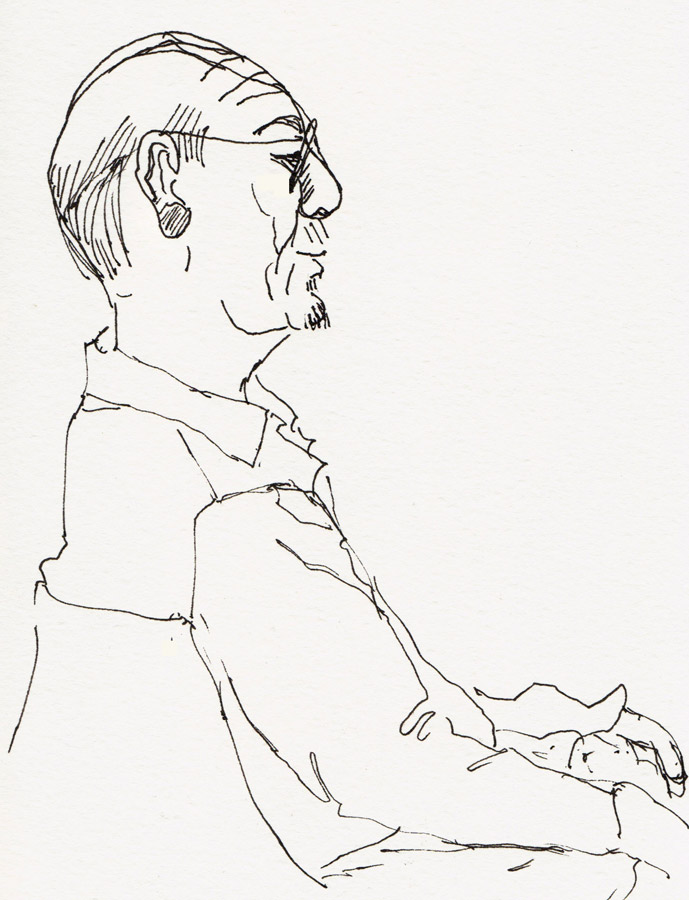
Older Guy at Peet's, same tools as above
This gentleman was sitting at the table after the guy above. I think he might have noticed me sketching but didn’t seem to mind. I think he needed the coffee as he dozed off reading his newspaper at one point. I missed on the shape of his head and just redrew it taller. And then in drawing his large ear lobes I’m afraid my shading there might have made it look like a big hole.
Some fashion victims actually do have big holes in their ear lobes that they intentionally create by inserting devices that gradually stretch them so they look like this. What a weird fad. There are many websites like this one that sell such devices. Why would anyone want to do that?
Yesterday I bound a new journal and updated my instruction sheet on how to bind a 5.5″ x 7.5″ sewn-signature casebound journal with watercolor paper. Each time I bind a journal I learn a little more and update my how-to sheet as I work so that the next time it will get easier for me.
I created the instruction sheet as a guide for myself, compiled from many sources* but you are welcome to download the file if you’d like to make a journal like these. I keep it on my website’s Resources page here on JanaBouc.com because having it in one place makes it easier to find and update.
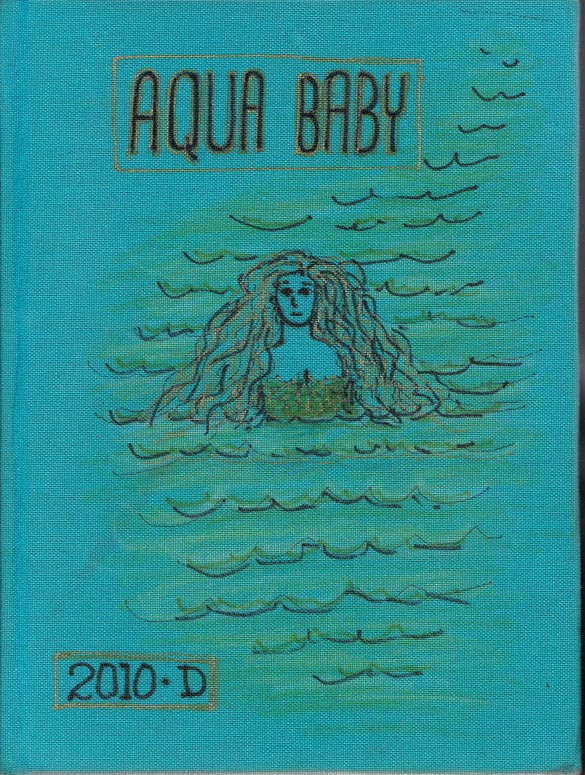
Aqua Baby Journal (with black & gold ink)
I name each journal (actually they seem to name themselves as I’m binding them) and decorate the cover after I’ve filled it with an image fitting the name. My last journal named itself “Aqua Baby” and is pictured above.
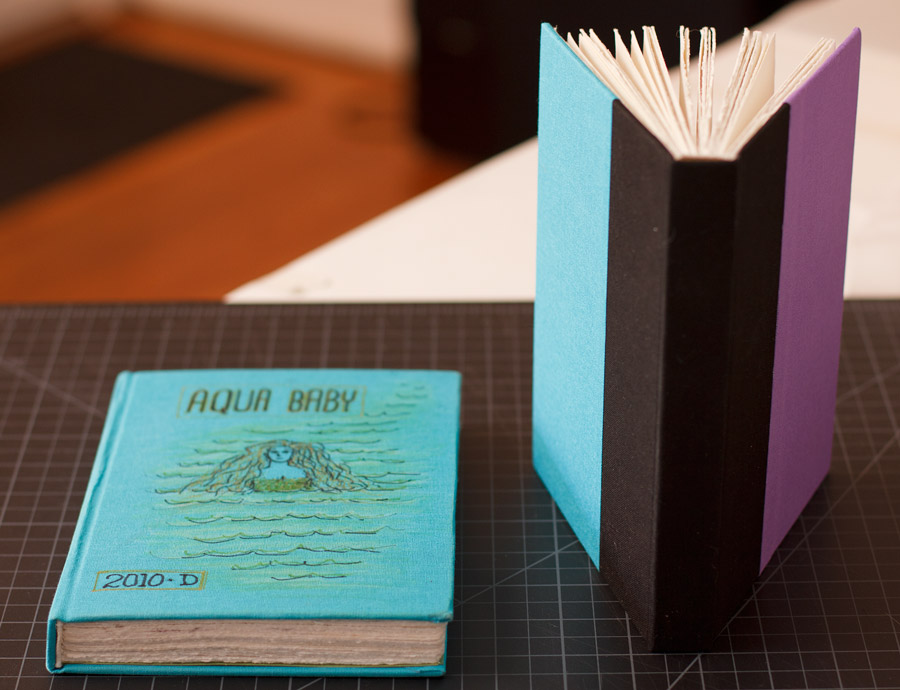
New Journal: "Scrappy" covered with 3 scraps of book cloth
I wanted to try (for the first time) to bind a cover made from pieces of book cloth, one for the spine and two for the fore edges. I thought I had a big enough scrap of the purple but mis-measured (as usual). So I had to use some of the turquoise cloth to cover the other side. This journal has named itself “Scrappy” as it’s covered with scraps and was scrappy enough to demand to get made despite everything working against that right now.
Five Case-bound Journals Made So Far
Although I’ve bound other journals using a variety of methods, here are the five sewn-signature case-bound journals I’ve made and here’s another look at their covers. I love the paper, the dimensions, the feel in my hand, the way they’re easy to use sketching standing and for scanning. They are humble and a little plain, but I’ve always appreciate function more than fancy.
I can’t wait to finish the hated Moleskine watercolor sketchbook (which would be fine if it was just portrait, not landscape) that I’ve used since I got behind on binding. Watch for a flurry of sketching to finish it off!
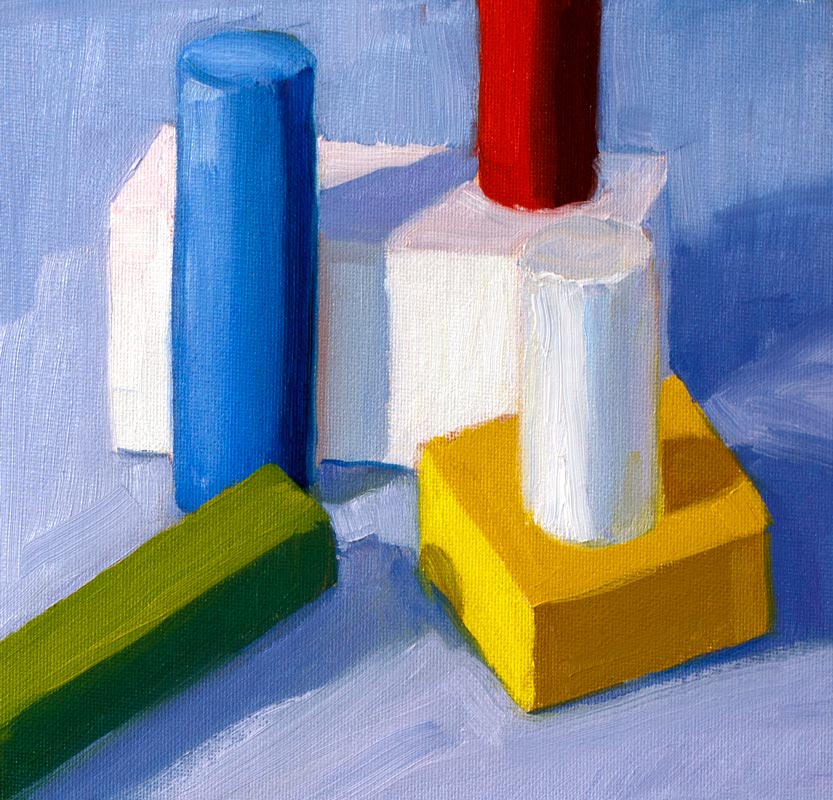
Block Study 5, from value to color, oil on canvas, 9x9"
After viewing and savoring my Peggi Kroll-Roberts DVDs, I’m doing the exercises she teaches in them, starting with value studies. To keep it simple and focus on values I used colored blocks for my subject. Above is the last study of the day in which I tried to apply to color what I’d learned by doing the gray-scale value studies below.
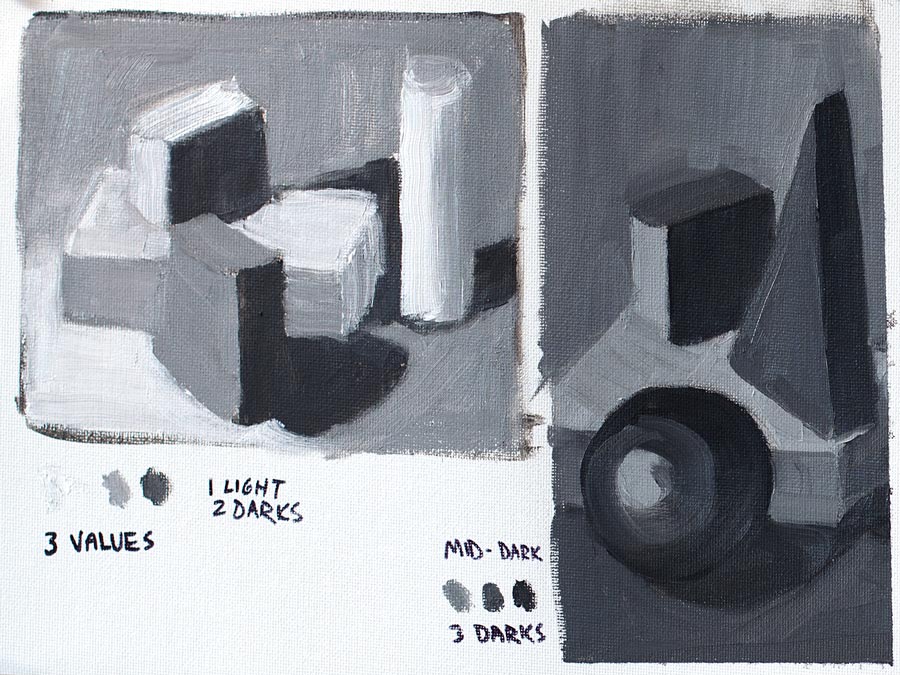
Value Study with blocks # 1, oil on canvas, 9x12"
One of the huge new (to me) things I learned from the Simple Value Plan DVD is that when you make a value plan for a painting, you can choose a range of values for the painting, such as making it high-key (mostly light) or low-key (predominantly dark), rather than copying the values as you see them. Kroll-Roberts compares this to playing music in different keys.
She recommends making a value plan before starting a painting by simplifying and grouping shapes in the image into two or three values, with 1/3 light and 2/3 dark or vice versa for a more interesting design. In the study above on the right I used only mid to dark grays, for a low-key, predominantly dark study.
Value Study with blocks #2, oil on canvas, 9x12"
Another tool she demonstrates is to first mix a value scale and put it at the bottom of your value plan study as I did above on the bottom right, and select your values from that scale. You can see the 3 blobs of paint at the bottom of most of these studies that indicate the values I intended to use.
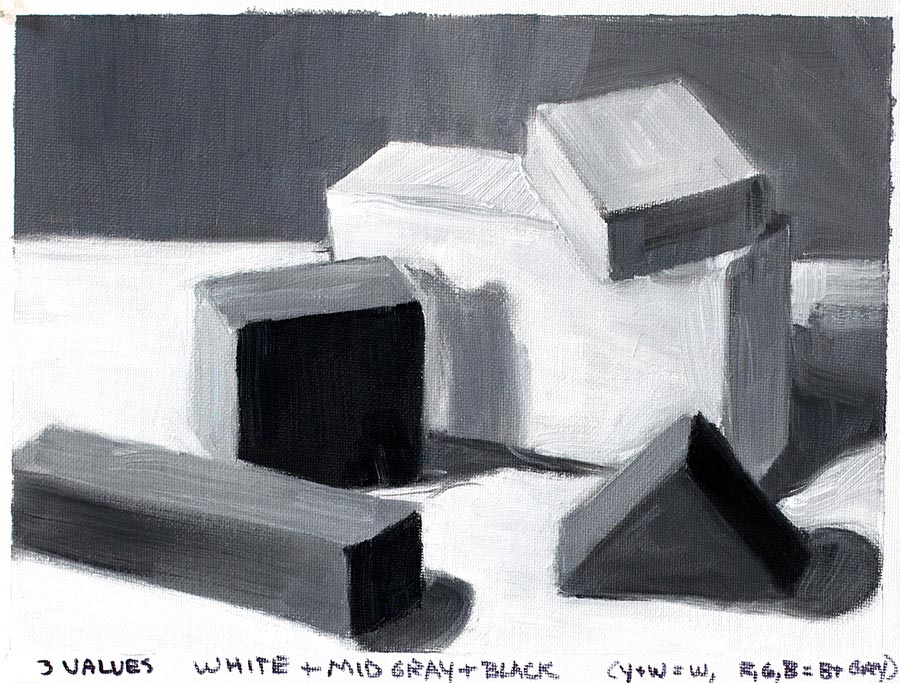
Value study with blocks #3, oil on canvas, 9x12"
Above I wanted the study to use the full value scale, black, white and mid-gray. I noted the colors of the blocks and how I was interpreting their values (yellow and white blocks and beige table top = white/gray; red, green and blue = gray/black, depending on if they were in light or shadow). I did some more adjusting of value once I had it blocked in so there are more than 3 values.
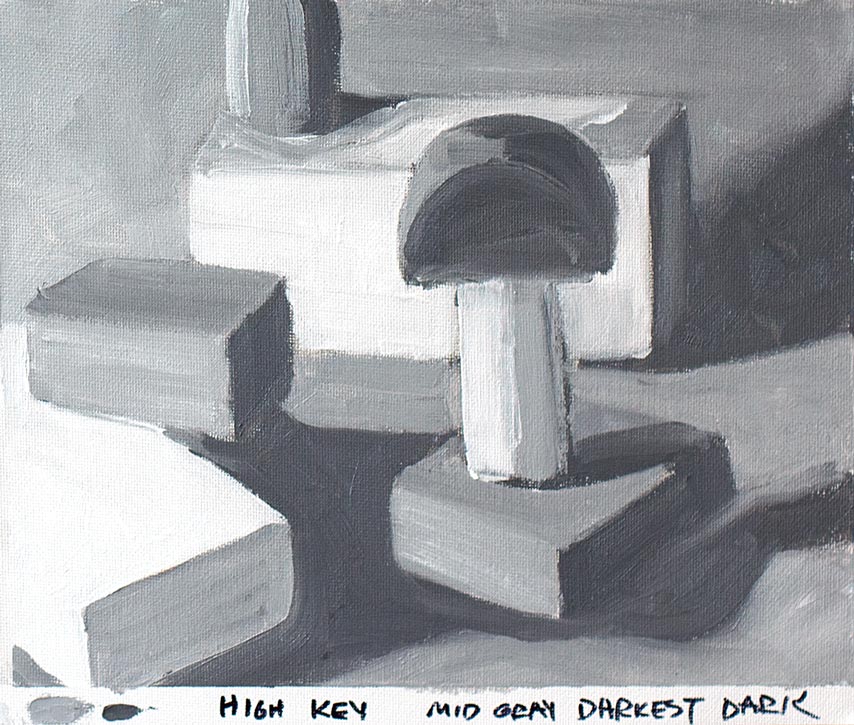
Value Study with blocks #4 - High Key, oil on canvas, 9x12"
On Peggi’s DVD High Key Value, she demonstrates creating a high key (mostly light values) painting by simply selecting the values that are mostly very light. I tried doing that with this study, and I think it works, but could have used an even lighter “darkest dark.”
All those 1’s in today’s date: 1 a good number for beginnings. So even though I’m still under the weather, it felt important to focus on my goals for the new year, the accomplishments of the past year, and to start the year right with a little sketching.
I grabbed some of my new best friends to pose for me: tissues, Vitamin C, Sudafed and my Neti pot with which I have a love/hate relationship. It really helps, but it’s weird (leaning over the sink you pour salty water in one nostril and it flows out the other).
New Years Still Life #2New Years Still Life #3New Years Still Life #4
I’m very grateful to have finished the year with a clear understanding of where I want to go with my art, how to get there, and a feeling that it is a reachable destination. A couple of months ago that seemed impossible but thanks to the advice and encouragement of our wonderful community of online (and in person) artists who have supported me through my questioning, frustration, and struggles I seem to have found my way.
2011 Goals
I wrote in my journal about the year past (not shown), and more or less doodled my goals for the new year, appropriate since they’re all about being more playful and in the moment. Being in that doodling, right-brained place, I wrote “goles” and thought wait, that’s wrong, tried golse, wrong, is it golze? No! Oh yeah, GOALS! Sheesh! I used to be a champion speller.
I want to be a more analog* person in 2011, less digital*. I want to move my body, not my mouse; I want to draw and paint with intention, a sense of adventure, and playfulness; I will spend less time on the computer. I want to slow down and appreciate each moment instead of rushing because “there’s not enough time.”
I want to experience the feeling of abundance that comes from “enough-ness” which you get by wanting what you have and not wanting what you don’t have. And I will practice being gentle: to myself, the earth, and others.
*Analog vs. digital makes sense to me, but technically really doesn’t in this context:
Analog describes a continuous system like a clock in which the hands move continuously around the face. Such a clock is capable of indicating every possible time of day. In general, humans experience the world analogically. Vision is an analog experience because we perceive infinitely smooth gradations of shapes and colors.
In contrast, a digital clock is capable of representing only a finite number of times (every tenth of a second, for example). Computers are digital because they consist of discrete units, a series of zeroes and ones, called bits that are either on or off. (from Webopedia).
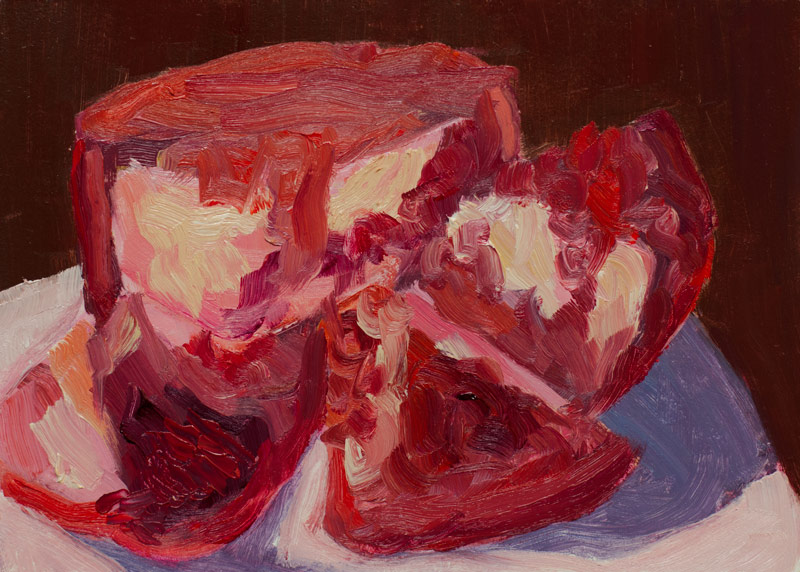
Happy New Year! Thanks for hanging out with me this past year! Even though I’ve had a nasty cold all week I managed to get in some pomegranate painting between nose blowing, naps, and chicken soup breaks, but not nearly as much as I’d hoped to do over my year-end vacation.
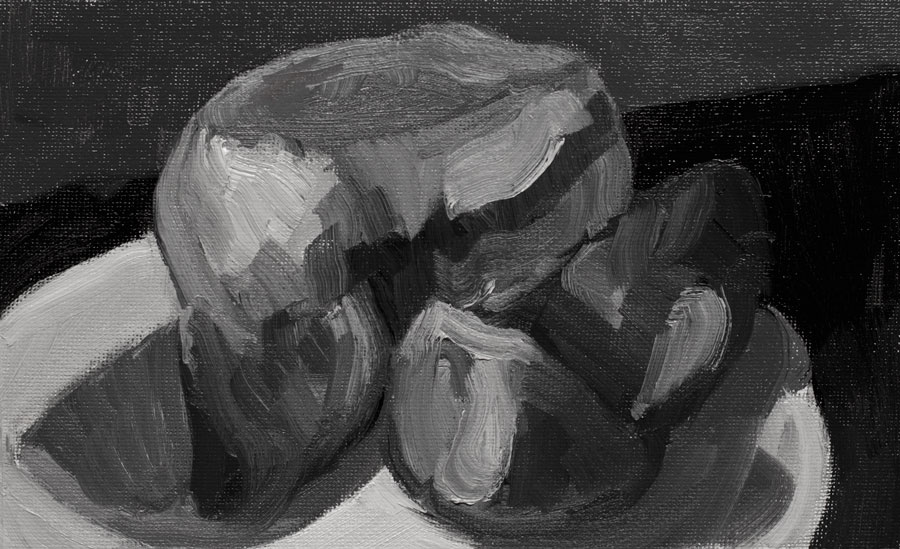
Pomegranate value study in oils, 8x5"
I only had enough energy to be in the studio for a couple of hours a day but fortunately the pom waited nicely for me. I started by doing a value study in oils (above), trying to sort out where the darkest darks and lightest lights are and just how dark and light they are.
Pomegranate quick study, oil on board, 5x7"
I did a small study next since I knew I didn’t have more than an hour or so of painting energy. I had fun with this and feel like I’m starting to find a way to get loose and sketchy with oils.
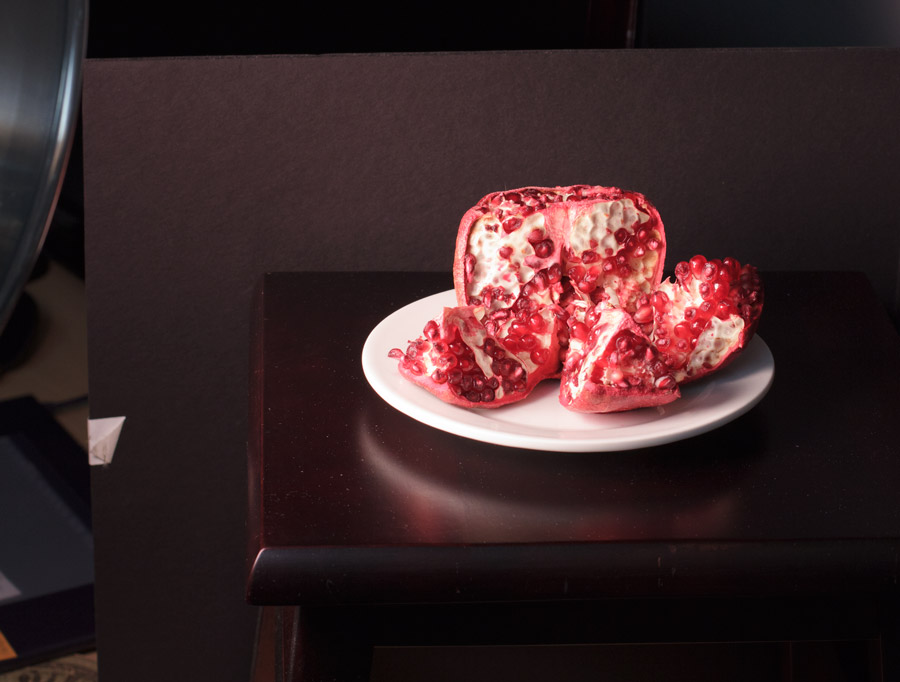
Pom under Reveal bulb
I used a GE Reveal light bulb in my lamp which gave everything a pinkish-lavender cast and that’s why I named the painting “Pomegranate Revealed.” GE says they are “specially made to filter out the dull yellow rays produced by standard incandescent bulbs.” I’d bought it originally thinking it would simulate daylight but it doesn’t at all. I usually use a fluorescent 5000K bulb 40 watt bulb (equal to 150 watts) which does a better job of producing clean light.
Cropped in Photoshop to 8x10"
When I compared the final painting and the studies I realized I liked the original composition with less background better so I experimented with cropping the painting in Photoshop. It’s not hard to cut the board down if I decide to crop it for real.
What do you think? Do you like this cropped version or the “final” version at the top of the post better?
There’s something about this sketch that really says winter in Northern California to me: bundled up, boots on, bare trees out the window, and a sense of quiet.
Now that I only work in the office two days a week I have fewer opportunities for sketching on my 13 minute subway ride but always enjoy the adventure of trying to sketch someone, not knowing if they’ll get off in a minute at the next stop.
Yesterday, despite feeling otherwise perfectly fine, my nose turned into a broken faucet that wouldn’t stop running. I was trying to paint and it was becoming impossible to work for more than a few seconds without sneezing, wiping, or blowing my nose.
Necessity is the mother of invention: the only solution was to stop the flow. So I made little nose “tampons” by tearing a sheet of Kleenex into about thirds and then folded and rolled it into a size that would fit my nostrils and I was set. I could paint for at least 10 minutes before it was time to replace the nose-pons.
Today it’s turned into a real cold with the full range of symptoms which is sad because it’s a rare sunny day and I’d planned to paint outdoors. Instead I’ll be indoors bundled up, drinking tea and chicken soup.
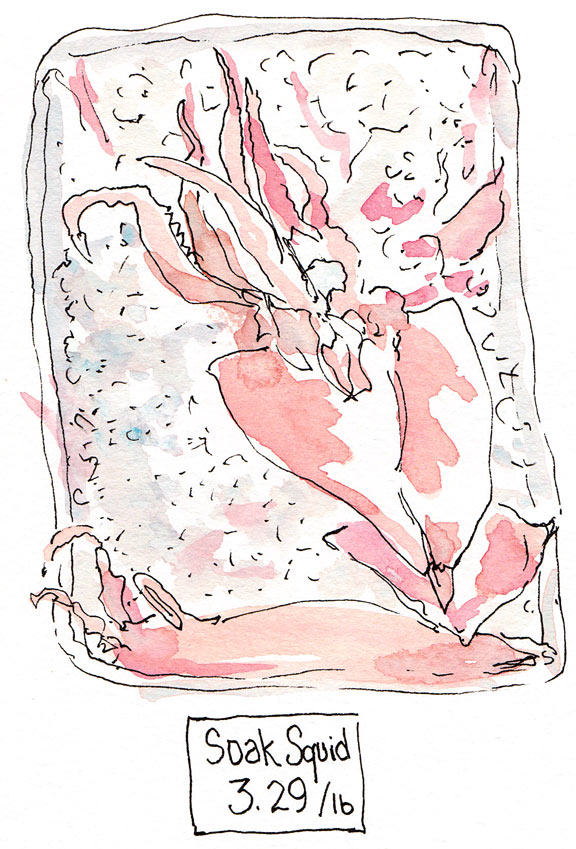
Ranch 99 Asian Market is a great place to sketch on a dark rainy night. The delicate pink of these cleaned whole squids on crushed ice was the first thing to grab my attention. I Googled “soak squid” to see if it was a variety of squid but from what I read, I think it was pre-soaked in milk or buttermilk for several hours to tenderize it.
Hanging fowl, ink & watercolor
Even though I’ve sketched their hanging fowl before, there were a greater variety this time including one on the right that I thought looked like a rabbit.
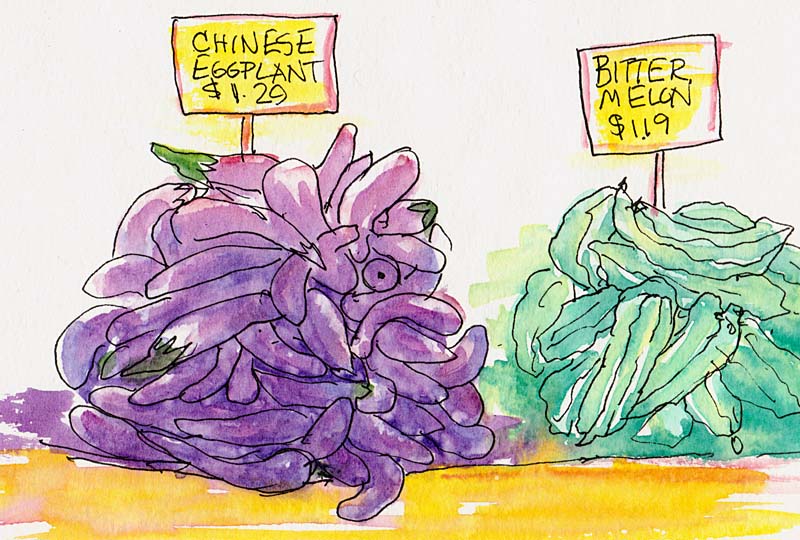
Eggplant and Bitter Melon, ink & watercolor
I enjoyed the juxtaposition of the similar shapes but different colors piled beside each other. I was running out of time before we were to meet but still tried to draw each individual shape as they appeared rather than generalize.
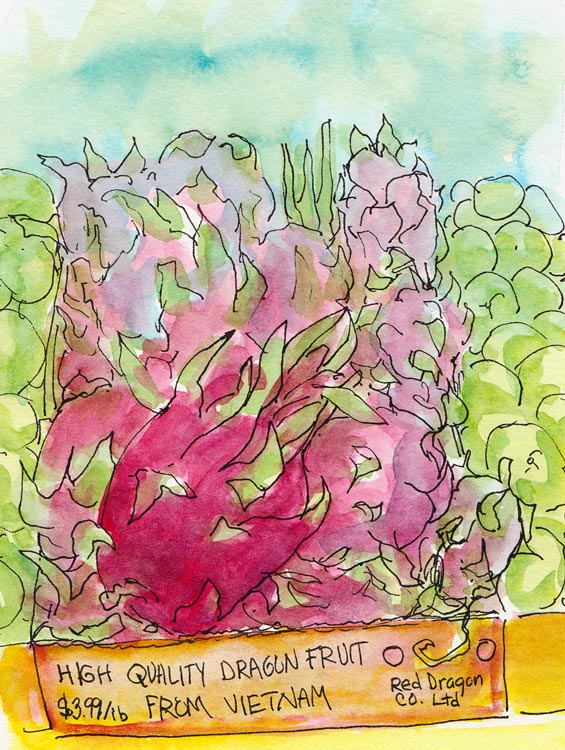
Dragon fruit, ink & watercolor
The Dragon Fruit again grabbed my attention and one of these days I’ll get around to eating one. I fought the temptation to shop instead of sketching so didn’t bring anything home this time.
Merry Christmas Santa (version 6), oil on panel, 8x6
People are living in the park known as the Albany Bulb again. On a walk we saw more than a dozen homemade shelters, tree houses and tents hidden away in the brush, this one (below) complete with Christmas tree.
Christmas at the Albany Bulb
Although I no longer celebrate Christmas with trees and gifts myself, I always like to get out my Santa (at top of post) that was given to me by a wonderful former student who died not long after in a motorcycle crash. The funny, cheery Santa always reminds me of the value of generosity and the transitory nature of life.
I hope Santa finds the homeless families living in the park and makes their Christmas bright. It can’t be much fun camping out in the mud, pouring rain and wind we’ve been having.
And I hope all of you are having a wonderful winter holiday too!
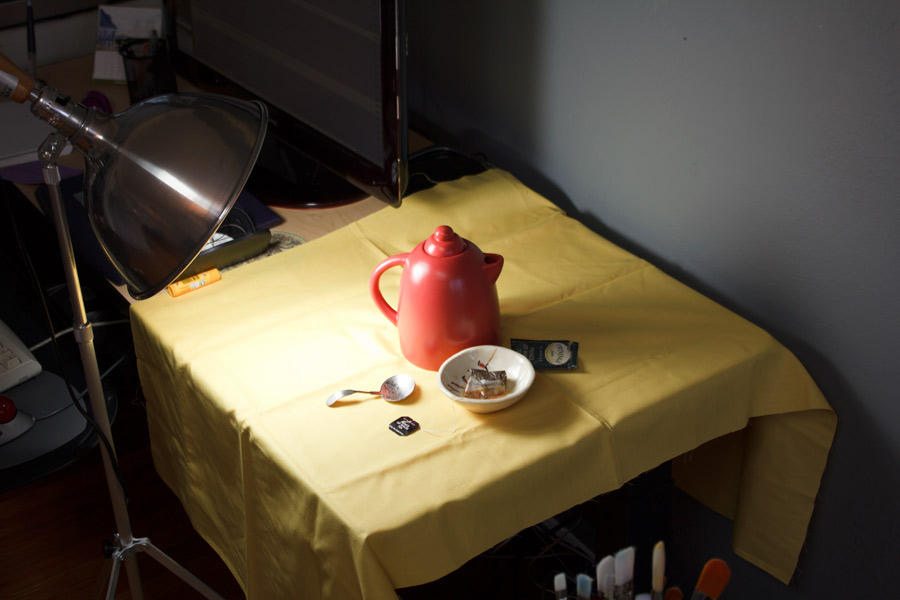
My favorite parts of this painting are where I put the paint down and left it alone (like in the little white dish and teabag). I don’t know what comes over me at the end of a painting session when I start adjusting things that don’t need it. The spoon had been fabulous but after a “teensy” fix that wasn’t, and led to repainting, it lost it’s zing.
One of the many things I’ve learned from the Peggi Kroll-Roberts videos is to use a mirror to look at the painting to check for problems. You stand with your back to the painting and hold up the mirror as if to look at yourself. I’d heard of this technique before but didn’t really “get it” until now. Problems with values, perspective and unequal sides of an object really stand out when you see your work backwards in the mirror.
View from the easel of the set up
The teapot was my gift at my office’s “Silly Santa” gift exchange. Everyone brings one wrapped gift, we draw numbers and select from the pile in the order of the numbers drawn. You can pick a new gift or steal from someone who has already opened one. It’s always fun with much laughter and misbehavior.











 Jana Bouc, Artist