Categories
Art theory Landscape Oil Painting Outdoors/Landscape Painting Plants Plein Air

My “How-To Oil Paint Plein Air” Cheat Sheet

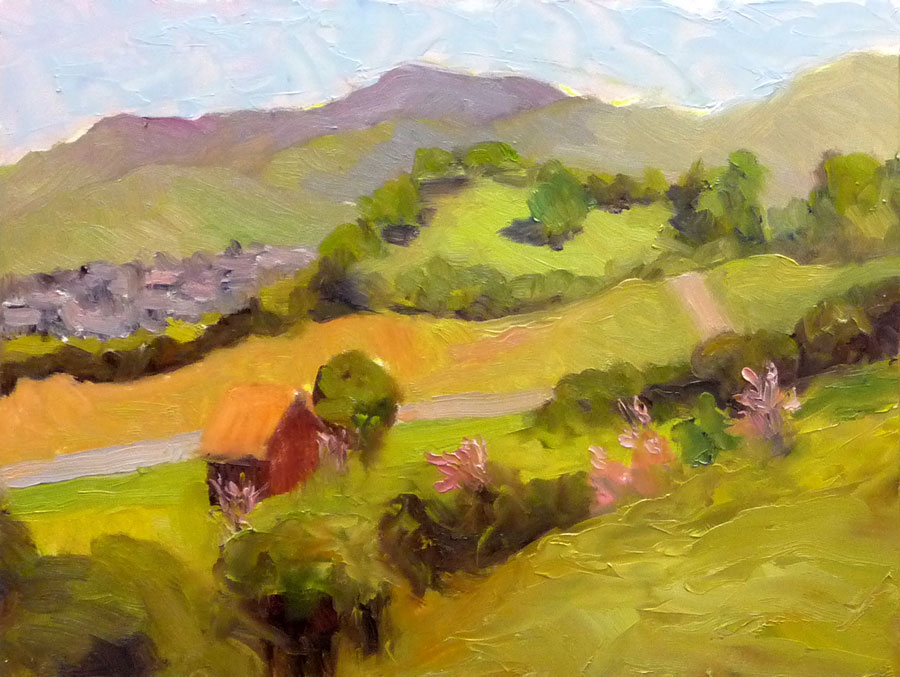
Blake Gardens Late Afternoon, oil on panel, 9x12"

After my flop of a painting on Saturday, I was determined to have another go at plein air painting. But first I wanted to put together a cheat sheet; a personalized “How to Paint Plein Air” based on what I’ve learned from teachers, books, experience, mistakes, successes and goals. I started jotting down notes as ideas and images came to me and then when the list felt complete, I typed it up and taped it to my paint box so that it will always be with me when I’m out painting. I posted another on the studio wall.

Then I went out to paint. First I drove to a site I’d been wanting to try out, a hillside cemetery in El Sobrante with what I thought would be  interesting views. But once I found a spot where I could be off the road and away from mourners, it was so windy, and the view so boring, that I left and headed for Blake Gardens.

By the time I got there and set up, I only had an hour and a half to paint before they closed at 4:30. It was so serene and beautiful there and the weather was perfect, warm sunny and no wind. I worked as fast as I could, finished all of the main areas, and added the final touches at home.

It was a confusing scene with all sorts of trees and foliage, but not having enough time helped me to simplify rather than draw all the trees in the background. I took artistic license to move things a bit to improve my composition and to delete something that wasn’t working. I’m learning!

Here is my Oil Painting Plein Air Process Cheat Sheet. I imagine it will change as I learn and grow, but it definitely helped me with this painting.

  1. FOCAL POINT: Choose one!
  2. COLOR KEY: Decide: Will the painting be predominantly Warm or Cool, High key or Low key, Predominant hue?
  3. SQUINT! to see values, simplify
  4. THUMBNAIL: Keep making them until there’s a good composition with leading lines in to focal point. A bad composition can only lead to a bad painting.
  5. CANVAS: Transpose thumbnail to canvas, creating large puzzle piece shapes, using pastel pencil or thin paint.
  6. UNDERPAINT: Loose, sketchy monochrome underpainting of shapes, darks with very diluted paint (optional)
  7. DARKS: Thinly paint the darks but MATCH values and colors using value scale and testing paint first on edge of little cards held up to compare to actual color. Just because it’s dark doesn’t mean it’s black.
  8. PAINT LARGE SHAPES: Match or exagerate the average (VIBRANT) color in  large shapes, using not too thick paint.
  9. COLOR PATCHES: Break larger shapes into smaller patches of color and light, matching or slightly exagerating the color.
  10. HIGHLIGHTS & ACCENTS: Add thick LIGHT paint, thin dark accents, and occasional splashes of “broken” color  for VIBRANCY.
  11. EDGES: Put a dab of COMPLEMENTARY colors around edges of focal points to pop, SOFTEN and/or cool receding edges.
  12. STOP: It’s a field study!

If you have discovered other things that have helped you and are willing to share them, I’d love to hear about them. And if you’d like more information about any of the items on my list, let me know and I’ll do another post with more explanation and details.

Categories
Art theory Berkeley Drawing Ink and watercolor wash Outdoors/Landscape Painting Places Sketchbook Pages

Monday Night Sketchcrawl: Shattuck and Vine, Berkeley

Vine Street Pumping Station, Ink and watercolor

Cathy and I met at Shattuck and Vine to sketch, and started with this historic building, now a wine shop called Vintage Berkeley, converted from the former utility district’s Vine Street Pumping Station. Actually we’d started a little further up the street, but my sketch was terrible so no point in posting it.

By the time we finished drawing there, I was getting hungry so we looked around for somewhere to sketch and eat but that ate up sketching time too. We ended up at Dara Thai/Lao Cusine where we sat outdoors and sketched and I ate grilled calamari on shredded lettuce with cilantro sauce. It was warm, filling and delicious.

Dara Thai/Lao Cuisine, ink 9x6

I didn’t get to finish this sketch because it got dark and cold…and because I spent so much time drawing details in the fancy roof of the little shelter. Despite hearing from great art teachers, “Simplify, reduce details, draw only what you see when squinting, see how much you can leave out,” I love details. That’s just how it is.

But the funny thing is that because I got so absorbed in the details on that one roof, I didn’t have time to draw all the roofs of all the shelters behind this one, which would have filled the whole page with details.

So maybe those teachers are right….?

Categories
Art theory Ink and watercolor wash Life in general People Sketchbook Pages

At the Christopher Schinck Demo

Art Demo, ink & watercolor

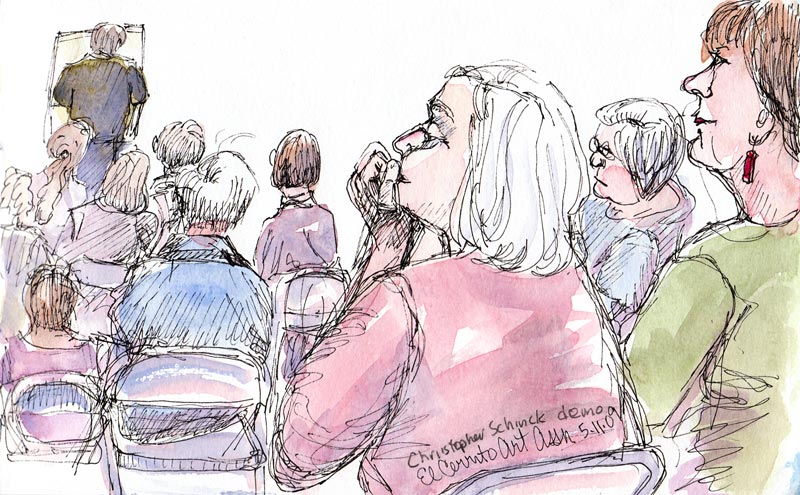
Last week the El Cerrito Art Association hosted an excellent watercolor painting demonstration by Christopher Schinck. Mr. Schink has a unique way of painting with watercolor and a wonderful sense of humor. He both entertained and amazed the group with his bold use of color, thick paint applied opaquely using large china bristle brushes and extraordinary knowledge of art history, composition and painting technique. I alternately watched the demo and sketched the audience (above), enjoying both equally.

I jotted down a few of his comments:

“Don’t paint objects. Paint relationships” [of design elements, like light & dark].

“It’s better to quit early than to quit late.” (In other words, stop painting before you’ve overworked it!)

“Sarget said watercolor was ‘making the best of an emergency.'”

“When you first start painting you tend to strive for accuracy and people like it. The more you paint and explore as an artist, the less your family likes it. Push yourself so it’s still identifiable, but have fun!” (Encouraging us to abstract and simplify.)

Then a few nights later my watercolor group got together for dinner and sketching. Dinner was fabulous! Not so my sketches, but here they are anyway.

Ink wash sketch; no likeness
 Maple sugar candy dessert, ink & wash
Maple sugar candy dessert, ink & wash

What’s funny about this sketch is that I’d drawn the box and then gotten really into the details of each little packet of candy. When I finished the first row I realized there were only three across and I still had room for one more. So I just made the box smaller and left the odd lines from the original ghost box. I added color at home to the top and bottom sketches.

Categories
Art supplies Art theory Glass Lighting Oil Painting Painting Photos Still Life Studio

Painting a Still Life Using The Carder Method”

Still Life with Tangelo, oil on gessobord, 12x12"

Inspired by Casey’s success with the Carder Method and frustrated with my own slow progress at oil painting, I bought the Carder Method video and  Color Checker tool. Below are step by step photos of my using the method to paint this still life, a brief review of the Carder Method and photos of my studio set up for working with it.

The Carder Method is designed to eliminate many of the problems that can make painting difficult. By creating an carefully lit, controlled environment, a painter can focus on learning to clearly see color and value differences while eliminating problems caused by variables such as changing light.

Click “Continue Reading” to see photos and read more….

Categories
Art theory Ink and watercolor wash Oil Painting People Sketchbook Pages

Painting Demo at El Cerrito Art Association

Watching the Demo, Ink & watercolor in 6x8" sketchbook
Watching the Demo, Ink & watercolor in 8x6" sketchbook

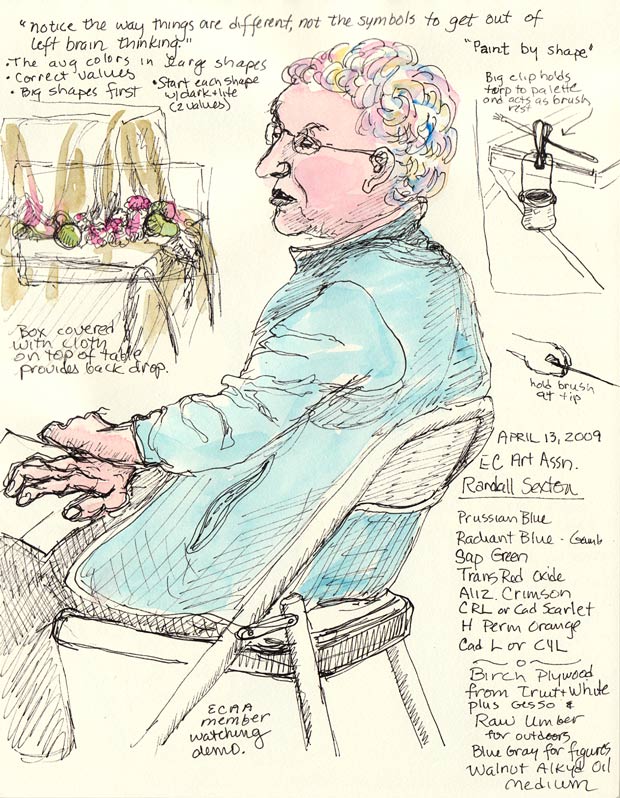
Monday night Randall Sexton did a still life demo at the El Cerrito Art Association meeting. It was my first time attending an ECAA meeting but my second time with Randy, as I’d taken a weekend figure painting workshop with him last summer. He is an excellent painter and a gentle teacher. He was ready to start painting right on time and waited patiently for at least half an hour while the friendly group took care of business matters and announcements.

Randy Sexton demonstrating, Ink & watercolor in 8x6" sketchbook

I’d been struggling with a still life painting that day so the demo came at a perfect time and I left knowing exactly where I’d gone wrong with the painting. Some days, just  knowing where I’ve gone wrong is as good as it gets.

(To read my notes from the demo, click the image to enlarge it.)

Categories
Art theory Flower Art Ink and watercolor wash Painting Sketchbook Pages Still Life

Out Stealing Roses

Stolen Roses, Ink & watercolor, in 5x7" wc Moleskine

As Maya Angelou said her grandmother always told her, “You don’t always get what you pay for, but you always pay for what you get.” As a believer in Karma and Maya Angelou’s grandma, I was a little nervous about stealing my neighbor’s roses.

But that neighbor moved away a year ago and her roses were producing those first magnificent blooms of the year. I just couldn’t resist cutting a few to sketch. I drew them with my Micron Pigma .01 and then added watercolor. I wasn’t happy with the results so experimented with adding white lines with a new white gel pen, a “Y&C Gel Extreme .07” which I like it a lot. I liked the sketch (above) better too.

I decided to sketch them again and used my Micron Pigma with a lot of cross-hatching to try to understand their form in a more sculptural way.

Stolen Roses 2; ink, gouache, watercolor

Then I added watercolor and made a big mess. I couldn’t capture the delicate coloring from white to yellow with red edges of one of the roses . So I tried adding gouache. Yuck, worse mess. I washed off the paint and tried again. More mess, and this time I lost a lot of the black lines. So I got out a Sharpie fine point and went over the black lines with darker ones. More gouache, yuck, some white pen, gave up.

Then I took a bunch of photos of the roses, thinking I’d start an oil painting and keep a photo reference in case the painting took longer than they lived. Pretty soon I was coughing and sneezing and my eyes were watering. These roses were very fragrant and I was allergic to them (unlike the ones in my garden that I selected for their lack of scent). I put them outside and gave up. I guess I paid for what I got!

Categories
Art theory Landscape Oil Painting Outdoors/Landscape Painting Places Plein Air

Now I Am Having Fun!

View from Old Borges Ranch; Plein air, Oil on panel, 9x12"

I’m celebrating a bit of progress I saw today when I painted plein air at Old Borges Ranch in Walnut Creek. I painted at this site a year ago and had a terrible time, titling the post of the awful painting I did that day, “Am I Having Fun Yet? Uh…no!”

Today was a lot more fun. I started the painting with a plan (described below) and stuck with it until I started rushing to wrap it up in time for our group critique at 1:00 when I muddied things up a bit since the light had changed in the scene from when I first started at 10:30.

When I put the painting in the line up with the other 14 paintings, I didn’t even cringe or feel embarrassed. It helped too, that I now understand that my plein air paintings are sketches, not finished works of art.

Here are the steps I took that seemed to work for me:

Categories
Art theory Drawing Flower Art Ink and watercolor wash Painting Plants Sketchbook Pages Still Life Watercolor

Happy Spring Camellia

Happy Spring Camellia, Ink & watercolor, 7x5"

I couldn’t resist drawing this one cutting from my camellia bush instead of going straight to the oil painting I was planning to do of the little bouquet of camellias I was assembling. I wanted to enjoy deeply seeing all the shapes and connections and patterns and reflections and colors in the leaves, buds, and flower.

I realize now that I should have gone a little more slowly when I was drawing the flower petals so that I could really capture the personality of this particular flower, the way I did with the leaves and bud. But I think it was making me dizzy, trying to follow all those different curly shapes and ins and outs of the line so I got a little lazy and generalized instead of paying absolute attention and getting it exactly.

I’m always torn between going for the detailed exactitude of botanical illustration and the way oil painters say to skip the detail, skip the individual petals and paint the mass, the form instead. I see the value in both but combining them in one painting rarely satisfies either goal.

Categories
Art theory Colored pencil art Drawing Landscape Life in general Oil Painting Outdoors/Landscape Painting People

Hannah’s Reflection Revised

Hannah's reflection, oil on Gessobord 12x16"
Hannah's Reflection, oil on Gessobord 12x16"

After I posted this painting a few weeks ago I realized I’d left off the foamy bubbles on top of the water. Last weekend I worked on the painting some more, at first planning to just add the bubbles but ended up adding a whole new layer of paint. I gave Hannah another haircut and slimmed down her dress a bit. I felt a little afraid to go back in and start messing with things, but told myself to just have fun and see what happens.

I don’t think I quite got the essence of the foam, it looks more like rose petals floating on the surface, but I decided I liked that idea and left it alone.

I’m wondering if there is a problem with the grasses behind the rust colored reeds on the middle right that sort of point towards her head. Should that patch of yellow-green grasses have less texture, be cooler and more blurry so that they recede more? I think so.

Here’s what it looked like before in the original post:

Hannah's Reflection, Oil on Gessobord, 16x12

I’m trying to get over the idea that paintings need to be completed in one painting session or in one day. Alla prima and plein air painting is great,  but so is letting layers dry and adding more more until the painting says it’s done. Sometimes it forgets to say “When” though, and then it’s overdone.

I have the same trouble with steaming vegetables. I lose my concentration and before I know it my broccoli has turned to mush. So is the revision mushy broccoli or an improvement? Do you think I should soften those grasses or move on?

Thinking about painting and broccoli reminds me of this poster I made a long time ago:

Listen to Your Broccoli, Colored Pencil, 24x18"
"Listen to Your Broccoli and It Will Tell You How to Eat It," Colored Pencil, 24x18"
Categories
Art theory Oil Painting Painting Still Life

Artichokes Redux, Improved?

Artichokes Redux, oil on Gessobord, 8x8"

My artist friend Laura (of Laurelines) offered some wonderful suggestions for improving the original version of this painting.

Artichokes, Oil painting on 8x8" Gessobord
Original version

Laura said:

“One thing I’ve noticed about your oil paintings is that you don’t have the same strong value differences within objects that you do in your watercolors.”

I agreed with her and gave it another go-around, this time adding some dark glazes in the dark area and more lights in the light area. I was working from a photo (since the original artichokes are long gone), so the colors were a little different than the original.

I am so appreciative of the wonderful community of art bloggers and the sharing we do with each other. Laura and I continued the conversation, and talked a bit about plein air painting and impressionism. Then she said:

Your watercolors are pure 21st century YOU. They are clear, strong, bold, and sometimes, though not always, quirky. Your flower paintings are YOU. In oil, it seems to me, anyway, that you’re trying to be someone else or are being encouraged to try to be someone else. That way lies horrible frustration. YOU can use oils in transparent glazes, with shimmering lights and darks, that will feel like you. YOU can use complements to create shadows. YOU can do all those nifty things in oil that you do in watercolor.

What a gift it is to have someone speak from the heart like that. She so hit the nail on the head about what I was struggling with in oil painting. I told her that in watercolor I found my direction early on, knew what I liked, what I wanted to do and developed the skill to do it. In oil I started out wanting to paint like I do in watercolor and everybody told me that “you don’t do that” in oils. I had to learn about the importance of brush strokes, edges, filling the canvas rather than putting an interesting object on a white page, etc. All the books and blogs stressed alla prima, completing a painting a day, impressionism, etc. Somewhere along the way I lost my direction.

I sometimes picture life as a series of turns made when angels have perched on the signpost and pointed in the next  good direction to take (sometimes the guides aren’t angels but rather tricksters saying turn left when the correct direction is right — heaven knows I’ve made many unfortunate turns in my life). I think she might have been one of those angels, pointing me back to my right path.

I’m not sure if this version is better than the first. There are definitely more darks, but it seems to have lost its glow, partly due to working from a photo rather than the brightly lit subject. What do you think? Does it need more work or is it overworked?