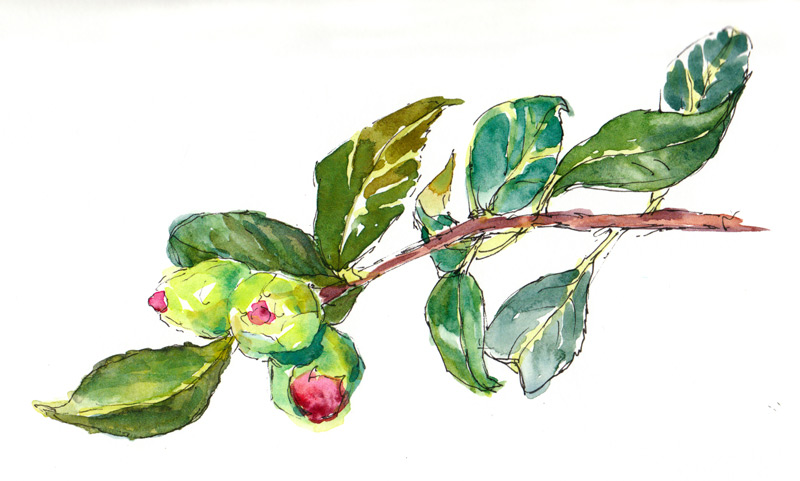
In a momentary memory lapse I wrote “Geranium Getting Going” in large letters in my sketchbook under this image. Then I thought, “Wait a minute, aren’t geraniums those red, ruffled, bitter smelling flowers often found in window boxes or untended and leggy in sad little gardens that someone has given up?”
And then it came back to me, DUH! This is a Camellia, not a Geranium. From a Camellia bush that I planted and that lives right outside my studio door and always blooms in the winter. It’s full of buds now and soon will be blooming madly.
I’ll just blame the memory lapse on the 4 hours of sleep I got last night as a result of working into the wee hours rebuilding my website, which is nearly done. I’m a bit disappointed that after all my work I’m finding some design issues that may be limitations of the platform I chose after much research last summer. I’m even tempted to start over on the system I would have chosen if I knew then what I know now. But this service comp’d me several years of hosting for free (because of all their system screw ups when I first started the build last summer) and I’ve already done so much work that starting over, when I’d rather be painting anyway, seems pointless.
If you would be willing to visit the new site and “beta-test” it a bit before I make it my official webs site, I’d love to have a few extra eyes on it. Just leave me a note if you’re willing to go there and click around a bit. It helps to know whether it looks ok on various computers and monitors or if there are any problems I’ve missed. Thanks!
I just needed to sketch something, anything, yesterday, and this rubber tree plant outside my studio window was glowing in the sun. My son Robin gave it to me as a housewarming gift 10 years ago when I bought my combo home/studio (a duplex; one unit is my house, one is my studio).
I wanted a rubber tree because of that catchy old song about an ant who believes he can move a rubber tree plant ; buying my own house was a dream about as big as that little ant’s and I did it. (Sinatra sings the song below, but be warned, you won’t be able to get it out of your head after you listen.)
The plant got too big for the living room so I cut half off half and stuck that in the ground. I took the other half to my office. The plant in my downtown Oakland office is sorely abused but just keeps on growing anyway.
I spent most of the day yesterday working on rebuilding my website which seemed like a very indoor thing to be doing on such a sunny day. But after sketching outdoors for half an hour I realized how deceptive that sunshine was: it was cold out there! And then I was happy to be indoors.
Yesterday I signed up for Bookbinding I on January 9-10 at the San Francisco Center for the Book. Maybe when I can bind my own sketchbooks I’ll be able to make one that fits on my scanner and doesn’t leave a big blurry section in the middle. While I love the Fabriano Venezia sketchbooks I’ve been using the past 6 months or so, they’re just half an inch too big to fit.
"Sunny Serenade", watercolor, 15.5"x10.5" (click to enlarge)
The editor requested that I name the finished painting (above). Corny painting names are a pet peeve of mine and so I rarely name them. But as I was uploading the image the name “Sunny Serenade” came to me. I know that’s about as sappy a name as you could try to invent, but since it seemed to name itself, so it shall be.
To finish sharing the steps in the painting, here they are in order, continuing from the previous post.
Painting the green leaves, flowers and stems
The next step was to work on all of those leaves, stems, buds and little yellow green flowers. Using a variety of mixed greens, some neutralized with Burnt Sienna, I painted the first layers of the leaves. I also glazed details over the yellow green flowers I’d painted previously.
Adding the darks
I mixed up several puddles of these dark mixtures: Winsor Green, Alizarin Crimson, and Burnt Sienna; Ultramarine Blue and Burnt Sienna; Sap Green and Sepia with a dab of Winsor Red; Winsor Green and Winsor Violet. Then I loaded my brush with one and started painting a section, switching to another one of the puddles as the background colors changed. I was careful to stay within the dark shapes and to negatively paint around lighter shapes. Because watercolor dries lighter, I tried to mix colors that would be dark enough in one layer.
I thought I was finished and signed the painting. The next day I studied the painting with fresh eyes and realized I needed to make some adjustments. I glazed in some more darks on the right of the pitcher and on its handle on the left. I added a middle-dark green mixture to the long leaf that hangs down along the right side of the pitcher and on some other leaves as well. (Compare the pitcher in the top two pictures in this post to see the changes).
While some people have commented that this painting seemed very challenging, in fact an image broken into many small complicated shapes is much easier to paint and more forgiving of “mistakes” than one composed of large simple shapes.
My editor liked the painting and immediately requested the next one, due the end of November. It will be a completely different project: a close up view of some pink orchids with a light background. I will be working much more loosely, mostly wet into wet.
I celebrate this day each year as a sacred holiday because of the precious gift of an extra hour. I wait until Sunday to change my clock. Then I pick an hour and spend it consciously, savoring every one of those 60 minutes by doing something especially satisfying.
And then at the end of the hour, if it was a good one, I set the clock back, feeling grateful. If the hour didn’t live up to my expectations, I just pick another hour and try again.
What are you going to do with your shiny new hour?
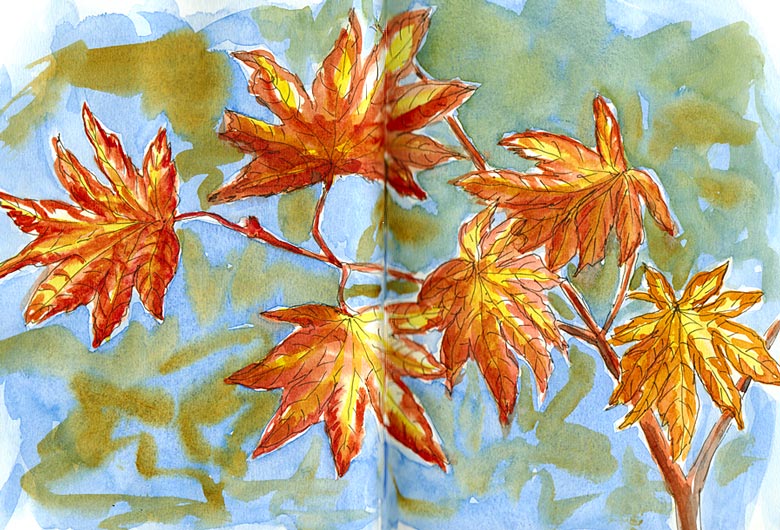
I wanted to sketch fall colors in honor of halloween and the end of daylight savings even though it’s warm enough here that my roses and hibiscus are still blooming and the grass is green from recent rains. This is a branch from the Japanese maple tree near my front door. It was a gift from my-coworkers in honor of my father’s death, who passed away 9 years ago today.
Update: Instead of picking an hour, I ended up doing it differently: Sunday afternoon I decided I would take a walk and if I timed it right, I could be home before I left. But I’d been having so much fun playing with taking that hour again and again that I didn’t change it on Sunday. I didn’t change it on Monday either, just hung out in the studio still relishing the possibilities. But Tuesday I had to work (from home) and realized I didn’t want another hour of WORK and since I needed to be at the restaurant to sketch at 6:30 I finally changed my clocks. Instead of one free hour though, I probably experienced at least a couple dozen over those three days. Goofy but fun!
Hydrangea in Cow Glass #3, ink and watercolor, 9x6"
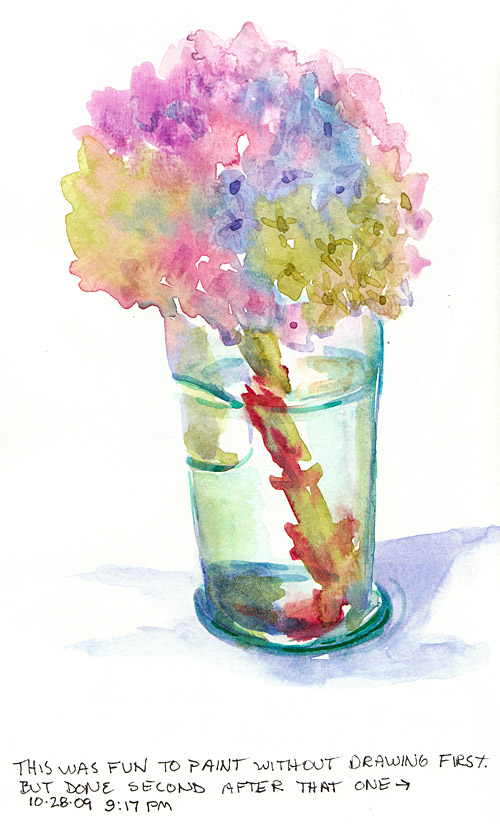
I just needed some peaceful time at my watercolor table tonight to unwind. I’ve been admiring this hydrangea that’s been on my dining table in a little cow glass, the last remaining from a bouquet I’d picked. It’s soft pinks and greens were inspiring so I put on a book on CD and sketched and painted and listened to the story unfold.
Above is the third one, drawn first with a Pitt Artist Pen Sepia Superfine and then painted quickly with watercolor.
Below is the second one, painted directly without drawing first except with my brush and paint.
Hydrangea in Cow Glass #2, watercolor
And here is the first one, drawn first with pencil, then I wet the flower area, dropped in different colors and when dry painted a bit over it. This one got a bit overworked but had some nice moments along the way:
Hydrangea in Cow Glass #1, graphite and watercolor
You can see my notes in my sketchbook about never being able to remember the name of these flowers. I always go through a list of wrong names first and then have to look it up. It’s like the spot on my mental hard drive that once held the name “Hydrangea” has been corrupted and I just can get there anymore. But then I never really learned the name until a few years ago; we always called them “popcorn ball plants” when I was growing up.
I hope the colors look OK. I updated my computer to Windows 7 last night (finishing the final steps this evening) and things look a little different. Windows 7 is fantastic so far and the upgrade process was almost flawless. (Just one glitch with my graphics card driver that got resolved pretty easily.)
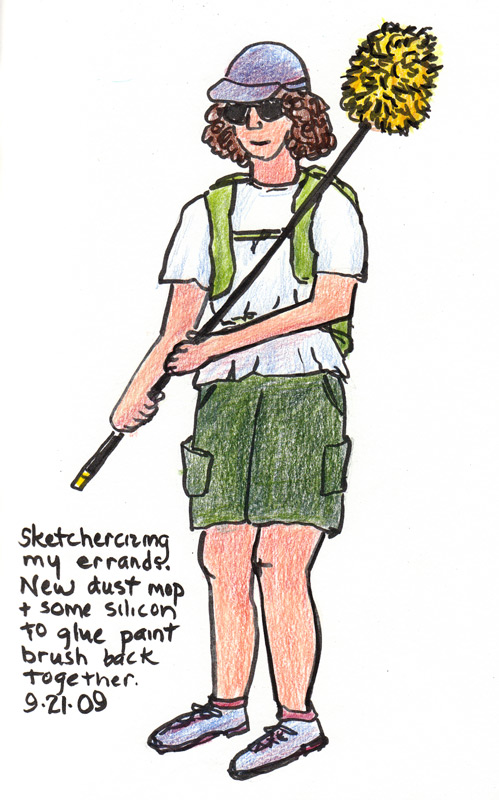
I needed a new dust mop, a tube of silicon adhesive and some exercise, so I put them together and walked to Pastime Hardware, a large family-owned hardware store that has everything, including their famously helpful employees.
The sketch above actually closely resembles me when I’m out walking, with my green backpack that is so comfy, even when loaded with junk, my nifty purple cap, and old green shorts.
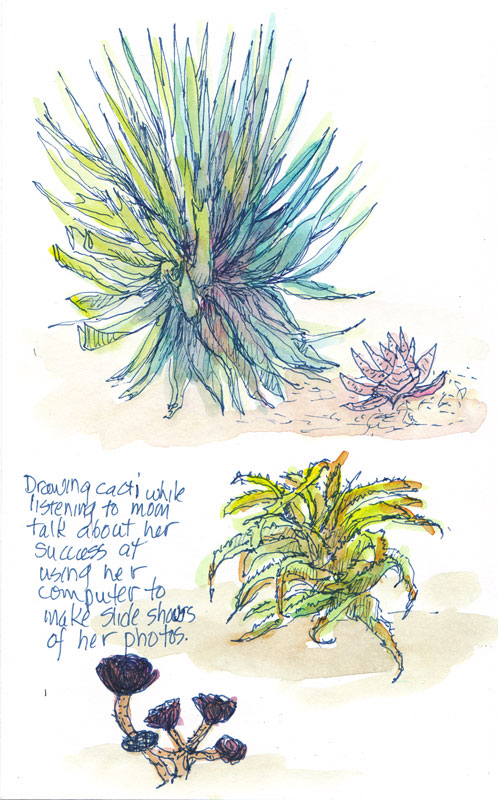
On the way to the store I called my mom on my iPhone, getting that task done as well. As she told me tales of her adventures with her new, and first computer, I stopped to draw some cacti I spotted along the way.
Cacti, ink and watercolor
My last stop was at the video store to pick up a copy of Local Color which never came out in theaters in Northern California and is finally available on DVD. Then I walked home with the mop over my shoulder feeling like I should be whistling a little tune.
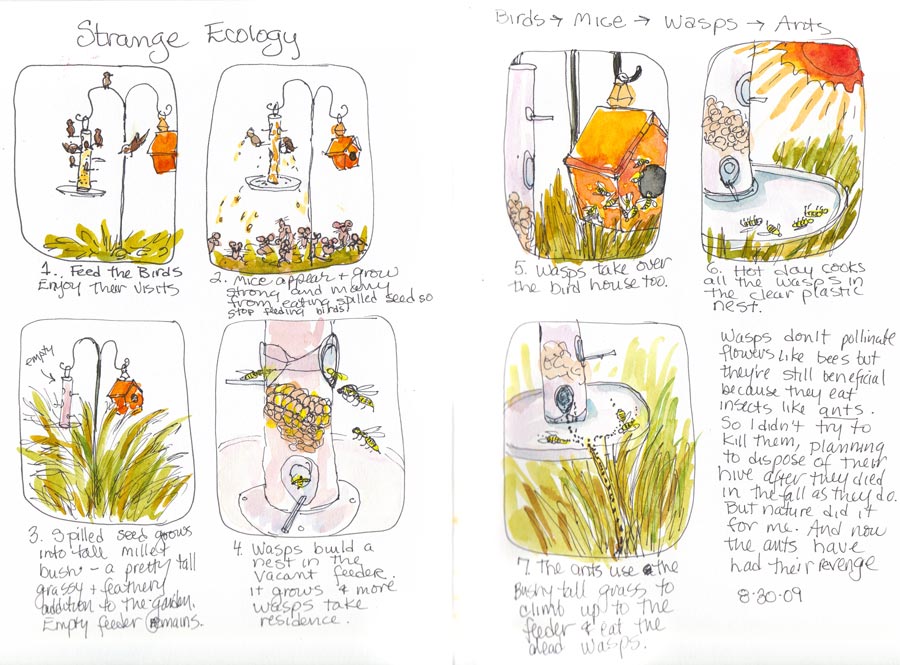
Strange Ecology, ink & watercolor (click to enlarge or see big images below)
I used to love feeding the birds and seeing my little customers flocking to the feeder. But one day I thought I saw the wood chip ground covering moving under the feeder. When I looked closely I saw it wasn’t the tan bark moving, it was dozens of mice! By feeding the birds I was also nourishing a growing army of mice with all the seed the birds scattered!
1. Feed the Birds ---> ---> ---> ---> ---> ---> ---> 2. Mice grow strong and prosper
I called “Vector Control” (a euphemism for the county rat patrol) and an interesting female rat inspector came out and inspected. She told me the only way to get rid of the mice was to stop feeding the birds and that for each mouse I saw there were 50 more I wasn’t seeing. I was sad to stop feeding the birds but it was better than the alternative (which included multiple mouse traps, even sadder).
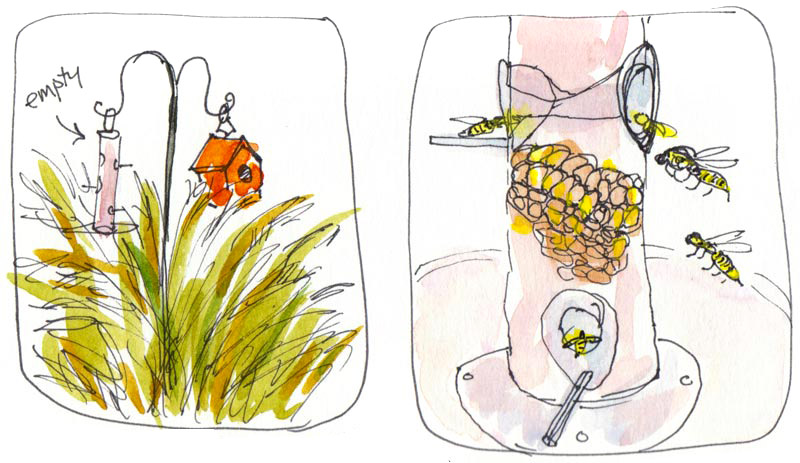
Meanwhile, the spilled millet seed grew into a lovely, tall, feathery bush under the feeder, which I left hanging in a bit of wishful thinking that one day I’d be able to return to feeding my feathery friends.
3. Millet grass grows under feeder ---> ---> ---> --->4. Wasps move in.
A couple years pass, the feeder and bird house remain empty and the millet bush continues to be a pretty garden feature. One day I notice something odd: wasps are buzzing in and out of the feeder and have built a nest inside it. I learned that while wasps do not pollinate like bees, they are still beneficial because they eat insect pests in the garden. I decided to leave them alone and enjoyed watching them care for their babies (larvae) in the nest.
Wasps eat potential garden pests including the venomous black widow spider. Adult wasps eat only pollen and nectar (or your soda at picnics). They only hunt for meat (insects, worms, your barbequed hamburgers) to feed their larvae. Wasps nests have only one purpose: to ensure the production of young. At the end of the nest’s cycle, every member of the nest, except emerging queens, dies.
5. The wasps move in next door ---> ---> ---> 6. The Greenhouse Effect
I guess things got a little crowded in the nest because the wasps started hanging out at the neighboring empty bird house too. Then one day we had a scorcher of a summer day. The temperature in my usually cool and foggy neighborhood by the Bay was in the 90s (f). The clear plastic bird feeder turned into a greenhouse and cooked all the wasps in the nest. So sad. All those poor little larvae, all that building and hunting and gathering of food.
But it wasn’t entirely wasted…
7. The millet bush becomes ladder to an ant party
The stalks of tall millet grass made a perfect ladder for the gazillions of ants who live in my garden (and don’t even get me started about the ants and their nasty aphid ranches). The ants were streaming up the grass onto the feeder and having a lovely dinner party of roasted wasp.
And because my garden is well stocked with ants and aphids, I am, in a way, still feeding the birds. They still flock to my garden, but now they eat the ants and aphids off the rose bushes and it doesn’t even cost a penny in bird seed.
After my flop of a painting on Saturday, I was determined to have another go at plein air painting. But first I wanted to put together a cheat sheet; a personalized “How to Paint Plein Air” based on what I’ve learned from teachers, books, experience, mistakes, successes and goals. I started jotting down notes as ideas and images came to me and then when the list felt complete, I typed it up and taped it to my paint box so that it will always be with me when I’m out painting. I posted another on the studio wall.
Then I went out to paint. First I drove to a site I’d been wanting to try out, a hillside cemetery in El Sobrante with what I thought would be interesting views. But once I found a spot where I could be off the road and away from mourners, it was so windy, and the view so boring, that I left and headed for Blake Gardens.
By the time I got there and set up, I only had an hour and a half to paint before they closed at 4:30. It was so serene and beautiful there and the weather was perfect, warm sunny and no wind. I worked as fast as I could, finished all of the main areas, and added the final touches at home.
It was a confusing scene with all sorts of trees and foliage, but not having enough time helped me to simplify rather than draw all the trees in the background. I took artistic license to move things a bit to improve my composition and to delete something that wasn’t working. I’m learning!
Here is my Oil Painting Plein Air Process Cheat Sheet. I imagine it will change as I learn and grow, but it definitely helped me with this painting.
FOCAL POINT: Choose one!
COLOR KEY: Decide: Will the painting be predominantly Warm or Cool, High key or Low key, Predominant hue?
SQUINT! to see values, simplify
THUMBNAIL: Keep making them until there’s a good composition with leading lines in to focal point. A bad composition can only lead to a bad painting.
CANVAS: Transpose thumbnail to canvas, creating large puzzle piece shapes, using pastel pencil or thin paint.
UNDERPAINT: Loose, sketchy monochrome underpainting of shapes, darks with very diluted paint (optional)
DARKS: Thinly paint the darks but MATCH values and colors using value scale and testing paint first on edge of little cards held up to compare to actual color. Just because it’s dark doesn’t mean it’s black.
PAINT LARGE SHAPES: Match or exagerate the average (VIBRANT) color in large shapes, using not too thick paint.
COLOR PATCHES: Break larger shapes into smaller patches of color and light, matching or slightly exagerating the color.
HIGHLIGHTS & ACCENTS: Add thick LIGHT paint, thin dark accents, and occasional splashes of “broken” color for VIBRANCY.
EDGES: Put a dab of COMPLEMENTARY colors around edges of focal points to pop, SOFTEN and/or cool receding edges.
STOP: It’s a field study!
If you have discovered other things that have helped you and are willing to share them, I’d love to hear about them. And if you’d like more information about any of the items on my list, let me know and I’ll do another post with more explanation and details.
My wonderful sister Marcy and niece Sophie gave me this little succulent garden in a bowl for my birthday, wrapped with twine with a little ticket for a card. When the plants outgrow the bowl she said I could just stick them in the ground and break off little pieces to stick back in the bowl.
They’re easy to care for: very little water and some sun. A week later they’re still alive and well; a good sign. I only have one other houseplant, an orchid I was given as a remembrance of my father’s passing. It’s been nearly 10 years and that orchid continues to thrive and bloom nearly constantly, despite my lack of a green thumb and tendencies toward plant abuse. (I tend to enjoy drawing plants more than caring for them, but I think that’s changing: I repotted my orchid last week and that was quite satisfying).
Pacific May Lilly at Tilden Botanical Garden, ink & watercolor, 4x6"
My plein air group met at Tilden Regional Parks Botanical Garden this cold and foggy morning. Since I wasn’t familiar with the park I explored a bit and then decided to sketch instead of trying to drag my painting gear around the hilly, pebbly paths. Since I only had my large Moleskine and a Micron Pigma .01 pen with me, I added watercolor later at home. The May Lilly above was so sweetly but delicately scented that drawing beside it was like breathing in a dessert.
Bridge & Creek, ink & watercolor, 5x7"
This bridge and creek was the first thing I sketched when I arrived, still arguing with myself about whether to go get my painting cart, whether to go home because it was too cold, whether to go home because I arrived late, how I should have brought my watercolors, how the scene was so complicated and so maybe I should just go home.
But as I drew, I started noticing interesting details, how dark and light shapes lined up, where one puzzle piece fit against the next, the design the water was making as it poured over rocks and down the creek, the sound of frogs and birds, and before I knew it that busy, chattering mind had shut off and I was having fun.
Manzanita Tree, Ink & watercolor, 5x16"
As I sketched this spectacular Manzanita, I began noticing how much like strong lean muscles the branches were, with their smooth, polished red surface. Then I found other human attributes: the knotholes looked like eyes while the bends in the branches looked just like elbows. This led me to consider the oneness of all things and I felt very connected to all the nature around me. During our critique at the end of the paint-out, we each take a turn showing our work and talking about our process. When I shared these thoughts someone laughingly asked what I’d eaten for breakfast! I was high on drawing, not Cheerios!
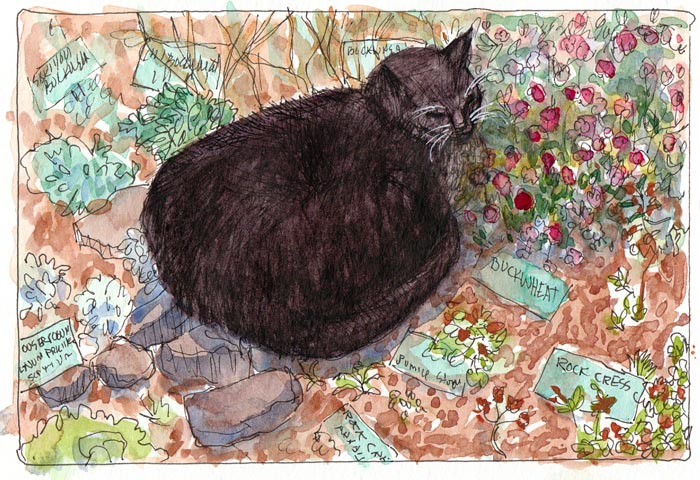
Cat Napping in the Buckwheat, Ink & watercolor, 4x6"
Walking to our critique, I spotted this garden kittie, having a nice nap in the buckwheat section of the garden and had to stop and sketch it. Nothing bothered this plump pussy who slept amidst the plants, little signs, wood chips and stones near the garden entrance. I added the whiskers with white gel pen.









 Jana Bouc, Artist