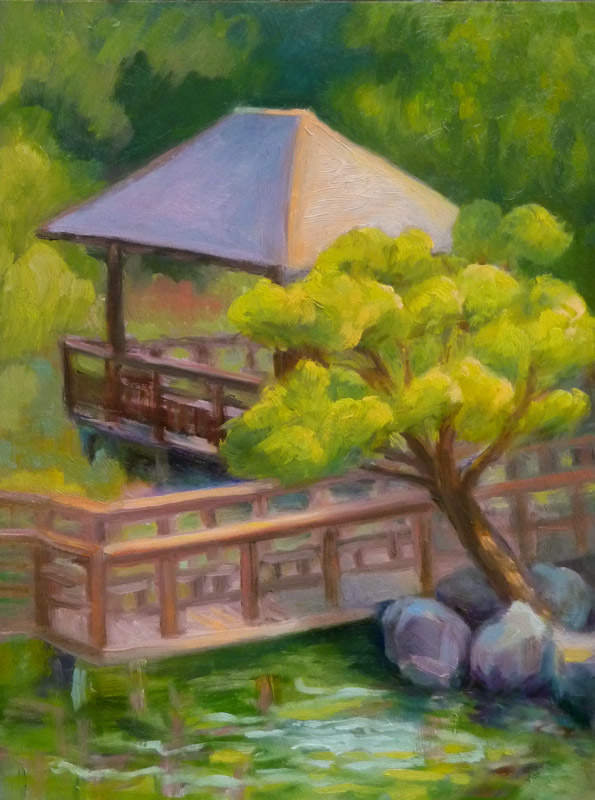
Hayward Japanese Garden (revised), oil on panel, 12x9"
Despite the encouragement to leave this painting and “don’t touch a thing” I wasn’t satisfied with it and made some adjustments to the color. I’m much happier with it now, although I wish my photo was more accurate. In real life the color is less fluorescent than it is appearing on the screen, although the actual scene in person was so brilliant it nearly was fluorescent.
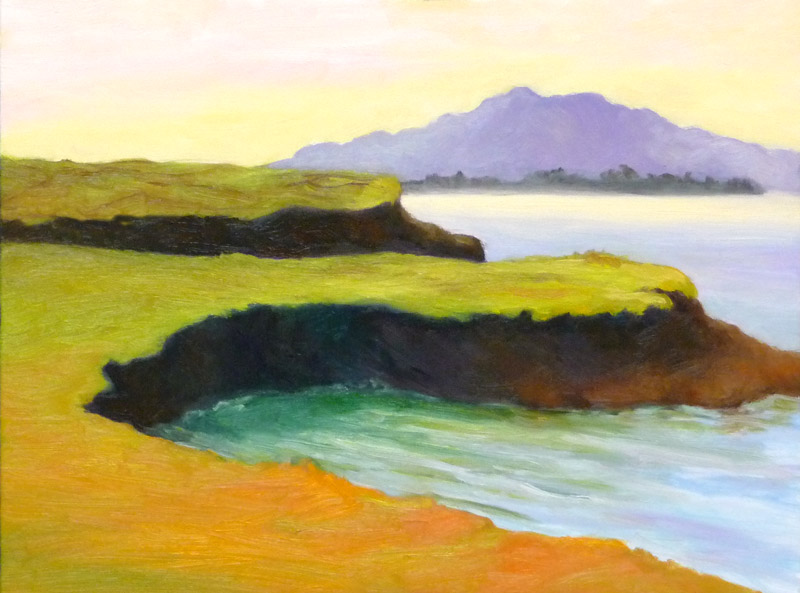
Lone Tree Park, a funky little waterfront spot in the funky little town of Rodeo, CA alongside the railroad tracks. Sunday I joined Benicia Plein Air Painters there for an afternoon of plein air painting. I was determined to simplify, find big shapes, get them down on my panel with bold color, and stop. It was so much fun, made even more so by painting alongside Leslie Wilson, an inspiring watercolor painter.
Today I finished the painting at home from memory (above). I had to work from memory because the photo didn’t even come close to capturing the colors from the setting sun.
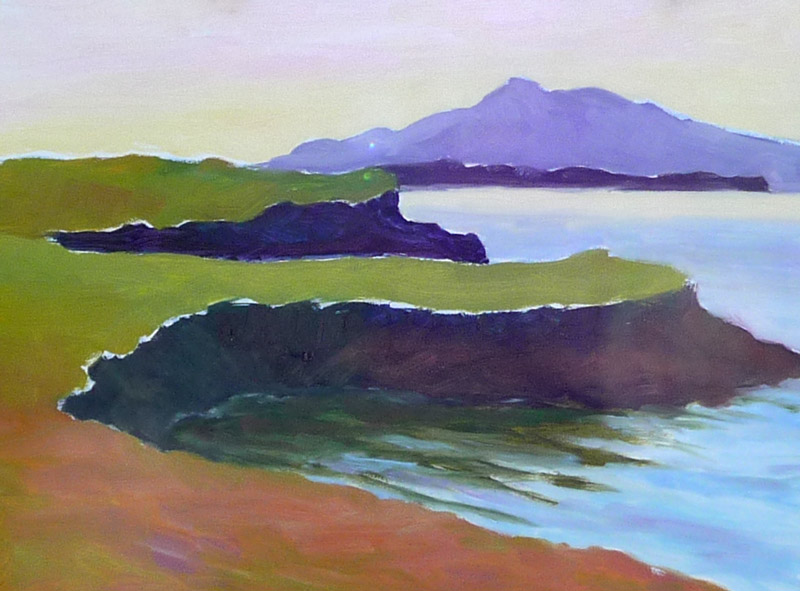
Below is the painting on site, just before I filled the white spaces I’d left between shapes to avoid smearing as I worked.
Lone Tree Park, Rodeo, in progress
And here’s my easel set up at the park. Since we were painting in the afternoon the sun began to set and glow with wonderful hot colors the last half hour of painting.
Painting in Rodeo
It was good practice to finish the painting (at least I think it’s finished) but it also felt good to do what I set out to do on-site, simplifying down to big shapes and colors.
It also felt great to be out painting from real life instead of from a photo as I’ve been doing for the book. I got permission to share some of the steps in progress which I’ll do soon.
The little known Hayward Japanese Garden is a lovely and a very peaceful place. I set up my easel inside one of the little structures sprinkled throughout the gardens as it had a good view and nice shade on a very sunny day last week. It was also a popular spot for wedding and family photos, as two different wedding parties came to take photos at this spot while we painted.
There were a number of challenges with this painting. First was the complicated scene I chose. Also painting under a roof in a shaded area looking directly at a bright scene was tricky.
I was attracted by the rhythm of the crisscrossing diagonals of the bridge, the building, the tree and the reflections. While I was pleased that I met my goal for this session: to focus on composition, I only got as far as an underpainting on site (after starting with thumbnails, value study and a fairly careful drawing). I worked on it some more today from a photo on my computer screen.
Now I see a few things I’d like to adjust (toning down the bright yellow greens, shrinking the rocks under the tree that somehow grew while I was painting, and adding some dark accents). But that will have to wait because…
Book commission
Now it’s time to get to work on the first watercolor for a book commission that is due in two weeks. I’ll be making three paintings for another book about painting flowers in watercolor by my previous publisher. I love the first photo I was assigned to paint from and am excited about the project. It’s so cool getting paid to paint flowers! I’m supposed to photograph 6 stages of the painting and then ship it off to London for them to make the final photo, Then they’ll send me back the painting and the digital file.
I’m hoping I can post some of the steps here, but my guess is that since they get publishing rights, I probably can’t. Either way, first I have to get painting!
I have a theory about the paths we take in life, and how important it is to notice what I call “Angels Holding Up Signs” along the way. Sometimes those angels take the form of a person offering helpful information or silently pointing the way by example, an intuitive thought, or an unexpected turn of events that makes you pause. When I see or hear an angel holding up a sign, whether it’s “Yield”, “STOP,” or “Go This Way” with an arrow, I consider it a gift and give it serious consideration.
Disclaimer: I’m not a New-Age angels and crystals sort of girl. But I do believe there are angels all around us; good, kind, generous people, like Adam at Kragen Auto Parts today who helped me dispose of gallons of old motor oil and their containers that had been abandoned in my garage (long story; don’t get me started!). Thanks Adam!
…And like the angels who’ve held up signs in my art life lately, including Kathryn Law and Ed Terpening who’ve both helped me to a breakthrough in my understanding about why simplifying is important in oil painting, especially when painting plein air. I’m always attracted to details, and so I’ve fought against that principle, and then fought my paints trying to put those details into my paintings.
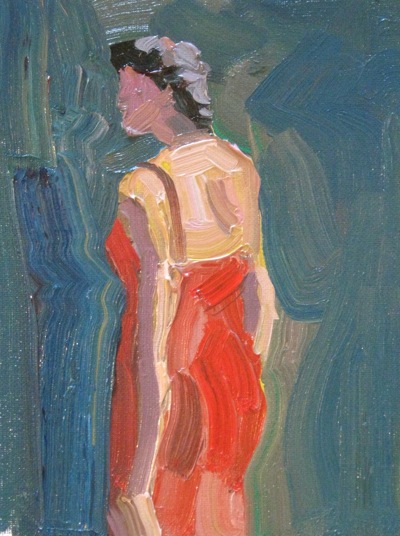
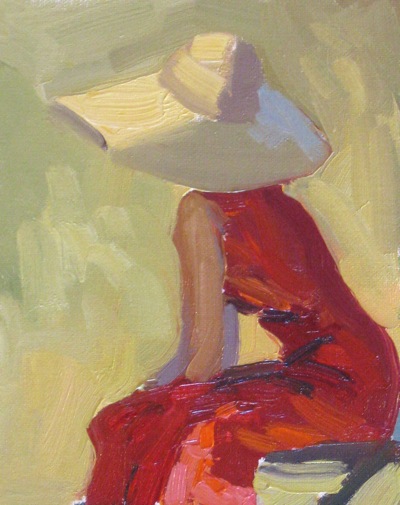
Then I saw these paintings (below) by Ed Terpening on his blog, Life Plein Air, made during a workshop in which the instructor, Peggi Kroll-Roberts, challenged the class to break the scene into as few large shapes as possible and paint those shapes with a large, fully loaded brush in one brush stroke.
Each study evoked in me a mood and my mind created a whole life story for each of these women. A mom at the beach trying to keep her kids in line; a sad, matron, wondering where her life had gone; a glamorous, young society lady at the country club watching a tennis game while sipping a martini….
How did so much come from such simple paintings? Leaving out the details left it to my mind to fill them in. This is something I so needed to learn: that simplifying and omitting detail doesn’t make a painting boring—it lets the viewer’s mind play and be creative, making for an exciting, rewarding experience. Thanks, Ed, for holding up that signpost!
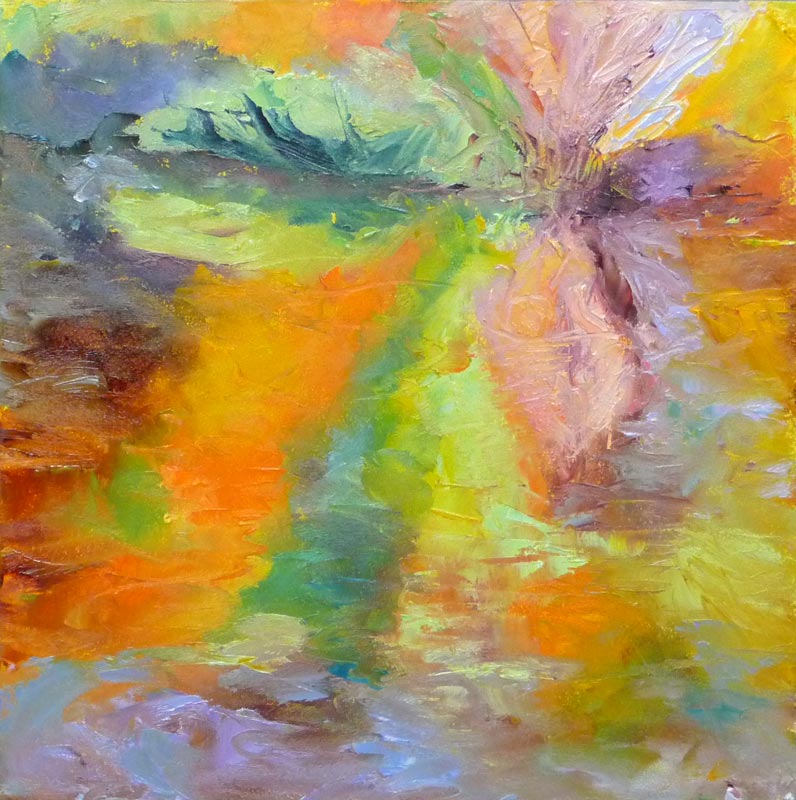
Another sign-toting angel came via email this week: a request to purchase this plein air oil painting I made last summer at Lake Temescal. There I was at the crossroads, wondering whether to give up plein air oil painting, and this angel popped up with a sign saying, “You’re on the right path, don’t turn back.”
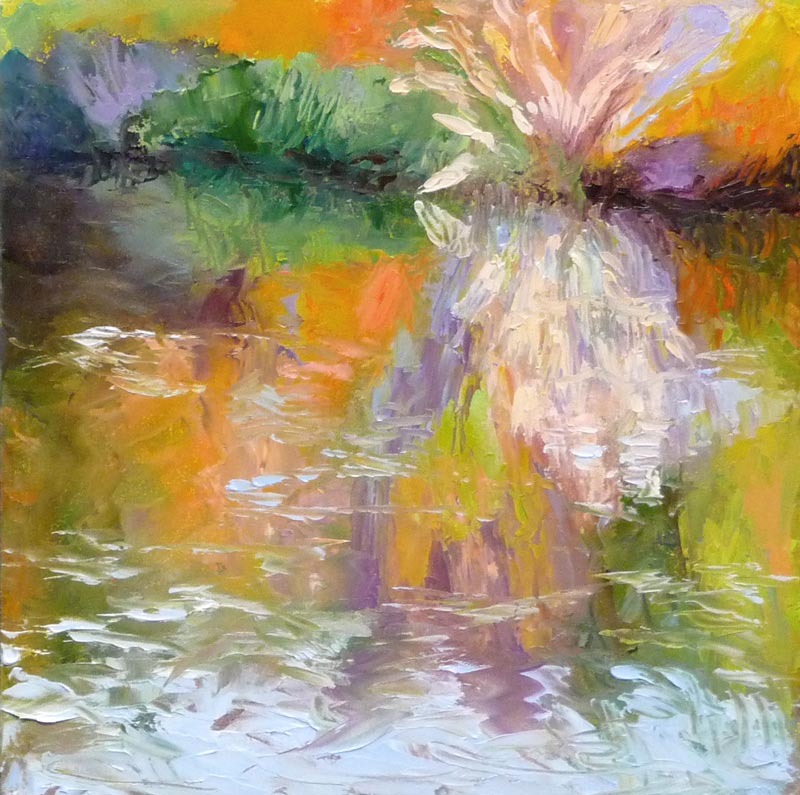
And now about my process with today’s painting. First I tried to simplify by painting large color shapes with the plan to create a color study for a work to be done in the studio. I also focused on the composition, picking a focal point, being careful not to divide the canvas in half as I have a tendency to do, making the subject (the water) the largest portion.
Here’s how it looked when I’d covered the whole panel:
Lake Temescal Reflections, Phase 1
I’d worked quickly, using a palette knife, going for big shapes of color. I should have stopped there and gone for a walk. But instead I messed around for another hour and muddied up the design and the colors:
Temescal Reflections (muddied), Phase 2
But the great thing about palette knife painting is that it’s easy to scrape off passages and repaint them. So later that evening I put the photo of Phase 1 on my computer monitor side-by-side with a photo of the scene and worked on the painting until I was satisfied with it (as posted at top).
And I’m very happy with another breakthrough: the way I was able to enjoy the plein air painting process without worrying about making a Painting with a capital P while I was out there.
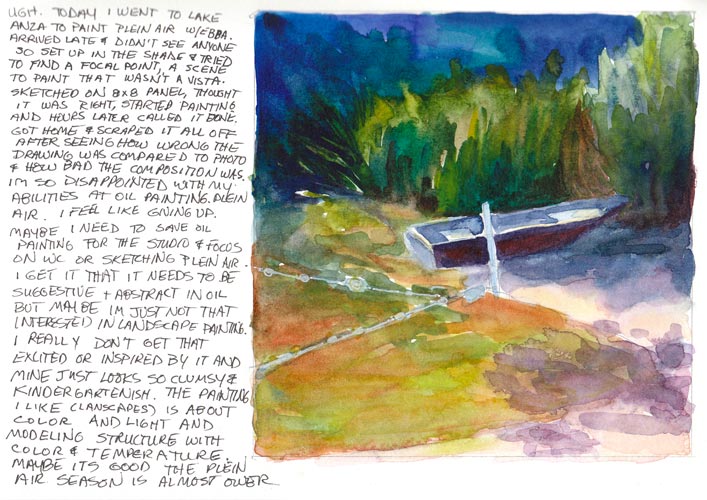
When I brought home today’s plein air oil painting, I spent a few minutes messing with it, tried to fix it, and then just wiped it all off. Then I painted the scene in watercolor instead (above). I’m getting really frustrated with plein air oil painting and I’m starting to reconceptualize how I might approach plein air painting in the future.
I love being out in nature looking closely at it, and trying to capture it in paint. I also really like hiking in these beautiful parks. But when I paint with oils I focus on painting and then when I leave, I’m often envious of the people who hiked past me as I stood there in one spot.
My new idea is to bring my watercolors, sketchbook and my camera and spend half of the time walking and taking photos and the other half making watercolor sketches. Then I can use those studies, photos and my memory and experience of the place to either make larger watercolors or oil paintings in the studio.
I so admire people who can make beautiful oil paintings plein air. I know that there’s nothing that can compare to seeing color and light and painting it right in the midst of nature’s glory. But maybe it’s time to accept that it’s just not my forte and focus on the things that I both enjoy and can do with some modicum of success.
View from Stege Marsh, Richmond Bay Trail, oil 6x8"
This isn’t the painting I made at Sunday’s plein air location in a funky old marina in Crockett, beside the Carquinez Bridge. I was mad at that painting so I did this one to get even. I worked from a photo I took on the Bay Trail near my house to give myself a chance to paint in easier circumstances (no wasps buzzing around my hands, no trains going by every half an hour only 10 feet away, no cars rumbling overhead, no sweaty heat, and light that doesn’t move).
Feeling a little more confident after that, I tried to fix up the painting I’d done under the bridge (where the only shade could be found on that hot day). What made me mad about the painting was primarily that I didn’t come close to meeting the goal I’d set for myself that day: to SIMPLIFY and also that it is just a stupid composition. The view was tricky as everything was in direct afternoon sun except the foreground which was in shade.
Under Carquinez Bridge, Crocket, REVISED, oil 6x8"
I will keep working on the goal of simplifying in my oil paintings, as I’ve had a major breakthrough in my understanding about why it’s important, which I’ll write about in my next post.
Albany Bulb Beach and Golden Gate Fields, 8x10", oil on Gessobord
Today I spent the afternoon painting in the bright windy sunshine at Albany Bulb across the way from the Golden Gate Fields racetrack. I could hear the announcer calling the races while I painted. And I was visited by numerous dogs and curious children and the occasional art critic.
It felt so good to be out painting again–it had been too long. The only downside was that I was painting in the bright sun because I was too lazy to walk back to my car to get my umbrella. And it was so windy the umbrella probably would have blown away anyway. When the canvas and/or palette are in the bright sun it’s really easy to mix all the colors too dark.
So of course when I got home and took the painting out of its box everything was too dark. Although I’d taken photos, they were pretty boring so I mostly worked from my memory this evening to to make some corrections and add a bit of artistic license.
Last week I took advantage of quick sketchers Martha and Cathy being away to spend an hour working on one image instead of constantly moving from one spot to the next. This was a really complex scene and the more I drew the more details appeared to draw.
By the time I finished, Sonia (who did several sketches of different views from the same spot) and I were so cold we decided to head home. I work right across the street from the lake and doing this drawing helped me to see what an amazing resource I have for sketching right outside my door.
Lunchtime Sketching Lake Merritt Birds
The next day at lunch, instead of eating in the kitchen with my colleagues, I took my sketchbook and went for a walk by the lake. My plan was to sketchercize: walk for 15 minutes, do a sketch, and walk 15 minutes back, getting in a 30 minute walk. But 5 minutes from the office I saw a row of Double-Crested Cormorants all lined up drying their wings in the sun as if they were on clotheslines.
(Cormorants are easily identified because they’re the only waterbirds that sit in the sun with their wings spread, hanging their feathers out to dry. They lack an oil gland for preening, so their feathers get waterlogged when they swim under water.)
After I sketched a cormorant and walked a few minutes more, a gaggle of goofy geese were all lined up at the edge of the sidewalk, waiting for someone to decide what to do next, and they needed sketching.
Walking back to the office I came across a foot-high rock with a bronze plaque on it that said “Leon Olsen loved to walk here.” What a great way to honor someone. A memorial walk rock!
Port Costa's Bull Valley Restaurant, Oil on panel, 9x12
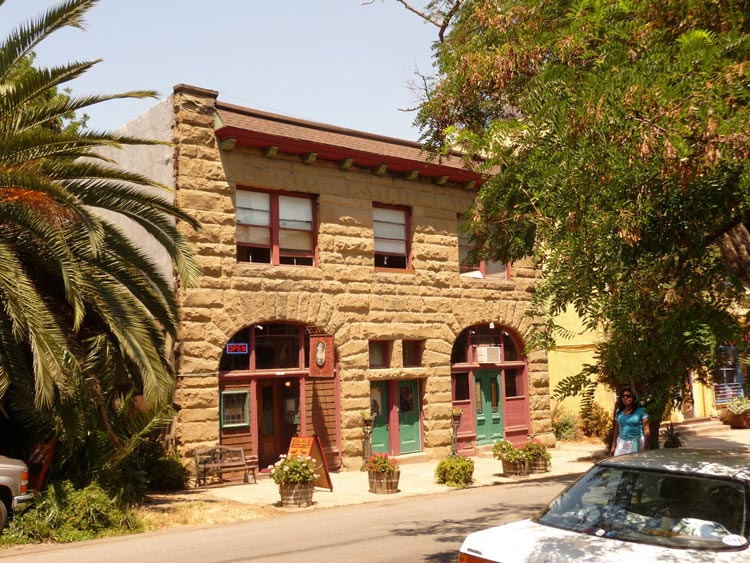
When we gathered for our critique on the patio outside the funky Warehouse Cafe, a biker bar at the end of Port Costa‘s main road, I thought I’d gotten my painting of the Bull Valley Restaurant off to a good start. It was a sunny Saturday and the quirky local residents of the little town had been very welcoming, chatting and joking with the plein air painters.
Just as the critique was getting started the old lady bartender turned up the rock and roll so loud that we couldn’t hear each others’ comments and suggestions. Someone went in and asked her to turn it down and she sneered, “This is a bar. We play rock and roll!” Although some of our group had bought lunch and beer (served in mason jars), I guess we weren’t exactly their preferred clientelle.
Their usual patrons continued to roar in on their Harleys and wanna be Harleys. Some were dressed in full leather or raunchy heavy metal t-shirts and black denim. At least half of them were over 50, the guys paunchy and bald and the women, with their dyed thinning black hair, looked “rode hard and put away wet” as I’ve heard it said.
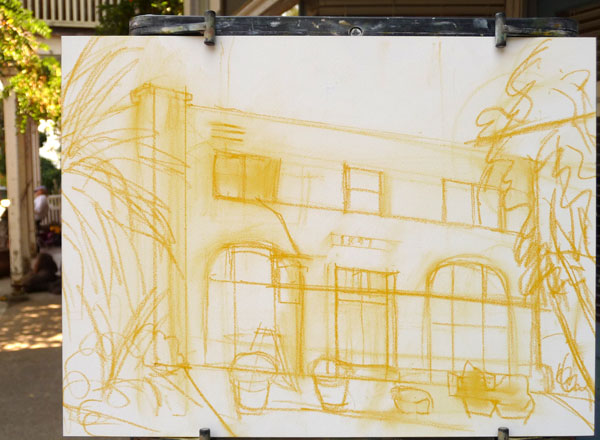
Anyway, back to the painting. As you’ll see from my initial sketch below, my perspective was even further off than it ended up in the finished painting above.
Port Costa-WIP 1
I’m always amazed how often my eyes fool me. Sometimes I’m sure a line slants one way and then I hold up a pencil to check and the line slants in the completely opposite direction.
This is the point when I stopped painting on site, planning to finish at home from photos.
Port Costa WIP 2
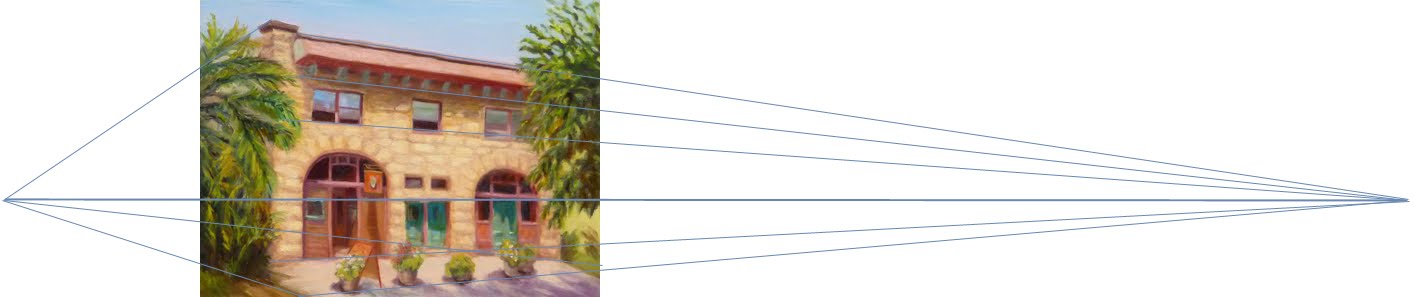
Once home I realized that I had a serious perspective problem with the way the roof line and the line where the building meets the ground were parallel to each other instead of coming towards each other to finally meet at a vanishing point. I worked on the painting for a couple of days and thought I’d fixed it (blind to what was in front of my face from seeing it for too long).
When I shared what I thought was the final painting with some artist friends, they generously pointed out a few things that needed adjusting, including continuing perspective problems. Below M. added lines in Photoshop to demonstrate for me how I’d gone wrong with the perspective. It’s so great to have that kind of support!
Diagram showing how the perspective should have been
In the end I decided I’d taken this painting as far as it needed to go and moved on to the next project. But I promised myself that next time I’d pay more attention to perspective.
Rush Ranch Horses, Sepia Copic Multiliner and watercolor wash
Mariah, a wonderful young artist, accompanied me to my plein air group’s paint-out today at Rush Ranch in Suisin City. She was immediately inspired by a spot, sat down and started sketching. I faced the opposite direction and sketched these horses in the corral.
Before we’d left my house, I showed her a book on drawing animals that demonstrated how to first find and assemble the basic shapes contained in the animal (rectangles, circles, triangles) and then refine them. I decided to practice what I preached and did that with the horses. I’d never noticed what big knees horses have before. I sketched with my sepia Copic Multiliner .03 and then added watercolor washes.
Rush Ranch Vista, ink & watercolor wash
The views from Rush Ranch were tremendous. I could have sketched for hours more but we’d arrived late and after our second sketches it was time for the group critique and lunch.
We were late because I got lost yet again (missed the turnoff and drove forever before turning around — and this was with GPS!) My mind had wandered to thinking about the people fishing (and the fish) in the slough off the little bridge we’d just passed so I missed the entrance sign and decided that the GPS telling me I’d arrived was wrong. This was especially stupid since the printed directions from my group said to go over that bridge and then turn right in 3/4 mile.
Instead I drove and drove, went over another bridge and THEN started looking for the turnoff. I went miles past that bridge, eventually arriving at the gate to a “youth correctional facility” (jail for teens) and admitted I’d blown it again. When we finally found our way back and I saw the huge “Rush Ranch” sign, I couldn’t believe I’d missed it.
Well actually I could believe it. I think I could get lost just walking from one room to another these days!










 Jana Bouc, Artist