Categories
Flower Art Ink and watercolor wash Oil Painting Painting Sketchbook Pages Still Life

Sunflowers: Studies, Struggles, Stubborness

Sunflowers #4, oil painting on panel, 8x8"
Sunflowers #4, oil painting on panel, 8×8″

It seems like I’ve been struggling with painting sunflowers forever but with each attempt I understand them a little better. I’m very stubborn and will continue trying until the sunflowers and I are really good friends.

I lit the flowers above with very warm light which made the olive-green backdrop cloth look gold and kind of bleached out the color of the flowers. The pictures in this post are in the reverse order I made them, with the last first.

Sunflower #3, ink & watercolor, 5x8"
Sunflower #3, ink & watercolor, 5×8″

I did the sketch above after having such difficulty with the two below, trying to better understand the shapes of the flowers and their structure.

Sunflowers in Vase (#2), Oil painting on canvas, 16x12"
Sunflowers in Vase (#2), Oil painting on canvas, 16×12″

After working for hours on the vase in the painting above I looked at it in the mirror to check the symmetry and couldn’t stop laughing. It was completely off kilter, slanted to one side as if it had melted. It’s just amazing how our eyes and brain work together to correct things and fool us. I had to completely start the vase over to get it close to right. I experimented with using a dark background and tried to paint duller, darker colors for flowers not in the light but vibrant color kept sneaking back in. After days of repainting I called it done so I could move on.
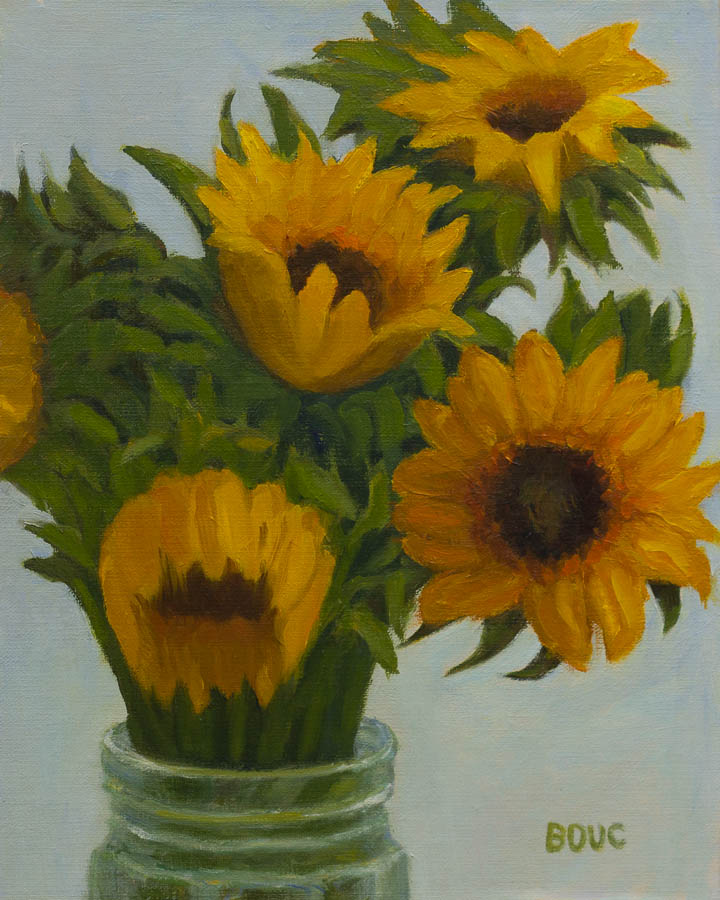
Sunflower #1, Oil painting on panel, 10x8"
Sunflower #1, Oil painting on panel, 10×8″

The first problem with the one above was my drawing. Instead of taking the time to carefully draw these sunflowers I jumped into painting, combining a few specifics with some generic version of flowers. All the pointy, sharp shapes and droopy flowers are a good visual representation of my struggle, frustration, and ultimately, disappointment with this painting.

I completed these pieces at the end of last year and had to give up when I couldn’t find any more sunflowers. Soon sunflowers will be available and I can start painting them again.

I have a feeling it’s going to go better this time around. I am studying nature drawing with John Muir Laws at his Bay Area Nature Journal Club. This month’s session was all about drawing flowers and I learned all sorts of cool stuff. More about that another time.
Categories
Art supplies Drawing Ink and watercolor wash Painting Product Review Sketchbook Pages

Testing Stillman & Birn Sketchbook Paper with Strawberries: A Review

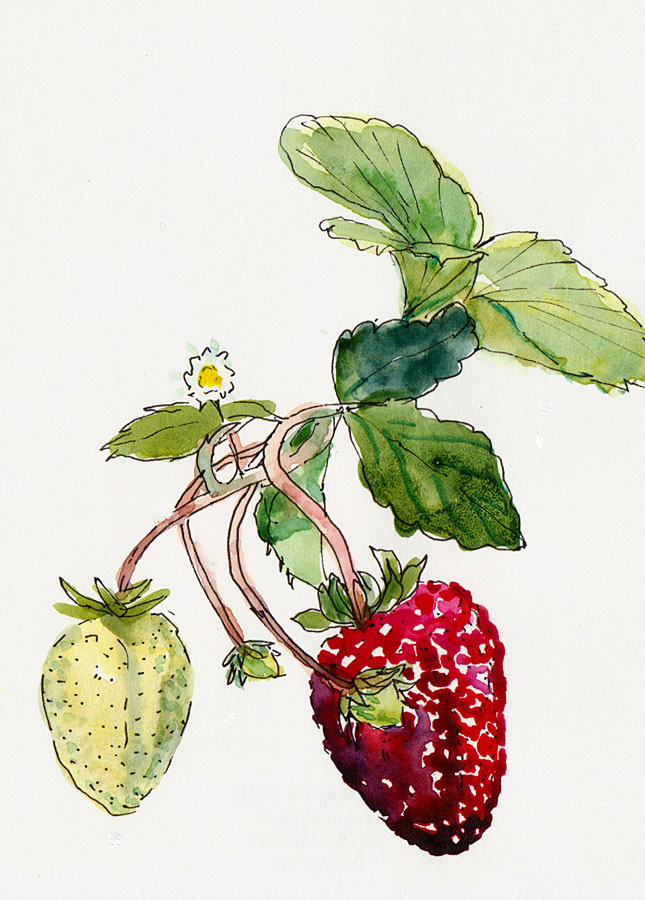
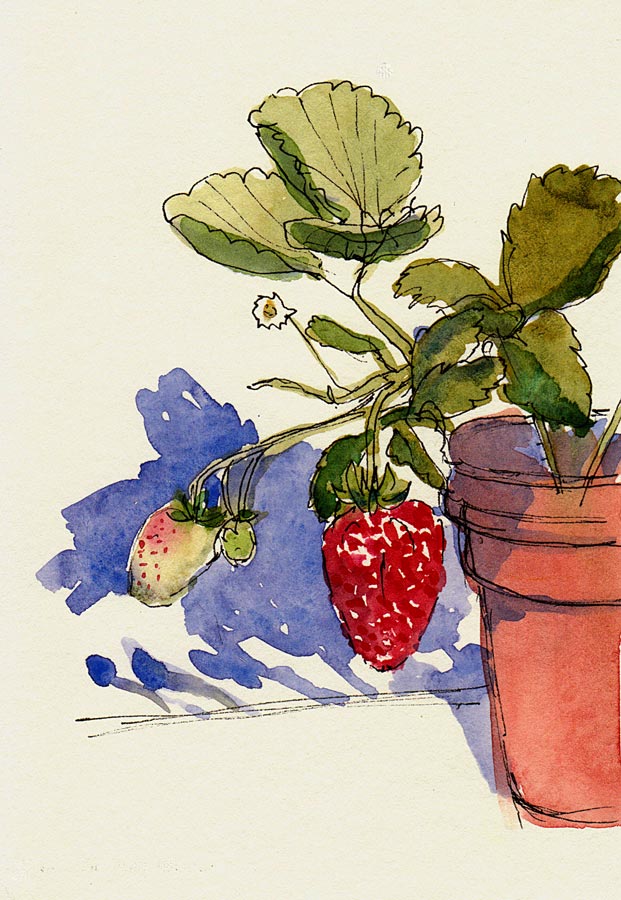
Stillman & Birn Delta 180 lb Ivory paper, ink & watercolor, 6x4"
Stillman & Birn Delta 180 lb Ivory Multi-Media, ink & watercolor, 6×4″

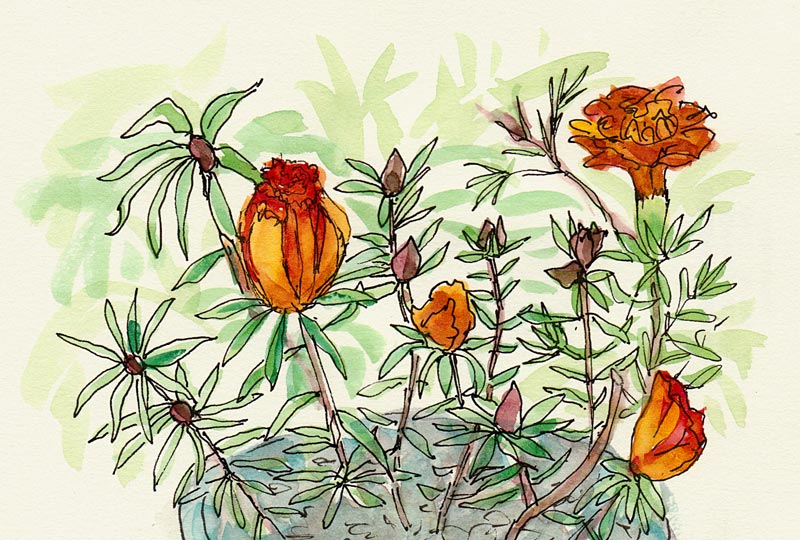
Stillman & Birn sketchbooks are highly rated by other sketchers so I wanted to try one but couldn’t figure out which paper to choose. I emailed the company and they sent me a packet of paper samples. On a sunny afternoon I tested them using potted strawberries and flowers on the deck for my subjects. (Then I ate the strawberry. Yum!)

Stillman & Birn Beta 180 lb white multimedia paper, ink & watercolor, 4x6"
Stillman & Birn Beta 180 lb white Multi-Media Surface, ink & watercolor, 4×6″

The two most likely options were the Multi-Media Surface papers: either the Delta 180 pound ivory (at top) or the Beta 180 pound white paper (above). I liked the way the ink went on smoothly. The watercolor worked well if applied directly in one layer without much water. Otherwise it backwashed like crazy (see splotches above).

Stillman & Birn Epsilon 100 lb white Plate Surface, ink & watercolor, 4x6"
Stillman & Birn Epsilon 100 lb white Plate Surface, ink & wc, 6×4″

I liked the Epsilon paper (above) but worried that the 100 pound weight wasn’t going to be thick enough. The very smooth finish was nice for both ink and watercolor, similar to hot-pressed watercolor paper.

Stillman & Birn Gamma 100 lb white Vellum Surface, ink & watercolor, 4x6"
Stillman & Birn Gamma 100 lb ivory Vellum Surface, ink & watercolor, 4×6″

The 100 pound Gamma (above) and Alpha (below) vellum surface paper was probably my least favorite, although I ended up judging my impressions by how well I liked the way the sketch turned out instead of technical reasons since they all took ink and watercolor somewhat similarly.

Stillman & Birn Alpha 100 pound white Vellum Surface, ink & watercolor, 4x6"
Stillman & Birn Alpha 100 pound white Vellum Surface, ink & watercolor, 4×6″

I chose the ivory Delta paper (at top of the post) in an 8×6″ wire-bound journal  because I liked that paper the best, even though it only comes wirebound. I’ve used that journal for the past month. It works well if I draw in ink and then apply a stroke of paint and leave it alone. I’ve been less successful if I add another layer of paint or try to get a smooth wash over a larger area. The paper pills, previous layers of paint lift off, or it backwashes.

I also keep getting nasty, dirty, thumbprints on the previously painted page when painting on the next page (which has ruined a couple nice sketches). But maybe that’s just me being clumsy. Or maybe I should only paint on one side of the paper even though it’s thick enough to paint on both.

I’m halfway through the journal and have found workarounds to my problems. It’s been good practice for me to be more direct and get it right on the first stroke or else. But I’d still like the option to add more washes when I need to. It’s a beautifully made journal but I don’t think I’ll buy another. I’m going back to binding my own with the watercolor paper I prefer.

If you’ve used a Stillman & Birn journal, which version did you use and why do you love it (or not)?

Categories
Drawing Flower Art Glass Ink and watercolor wash Painting Plants Sketchbook Pages Still Life

Gone Wild With Wildflowers, Part 1

Bachelors Buttons (I think), ink & watercolor, 8x5"
Bachelors Buttons (I think), ink & watercolor, 8×5″

Just days before the city mowed down all the “dangerous” wildflowers on Carlson Boulevard for the second time, finally killing them, I walked along the narrow median strip with cars zooming by, and snipped specimens of each to paint. (I previously wrote here about why they were dangerous. They grew back after that first trimming.)

Pink Wildflowers, ink and watercolor, 5x8"
Pink Wildflowers, ink and watercolor, 5×8″
Pink Wildflower sketch with photo
Pink wildflower sketch with photo

I took them home and went wild, putting them in pretty bottles and vases, then sketching and painting them all day long.

Pink & Yellow Wildflowers, ink and watercolor, 5x8"
Pink & Yellow Wildflowers, ink and watercolor, 5×8″
Pink and yellow wildflowers with photo

My goal was to make free and fresh sketches of each flower that captured its personality while keeping composition in mind.

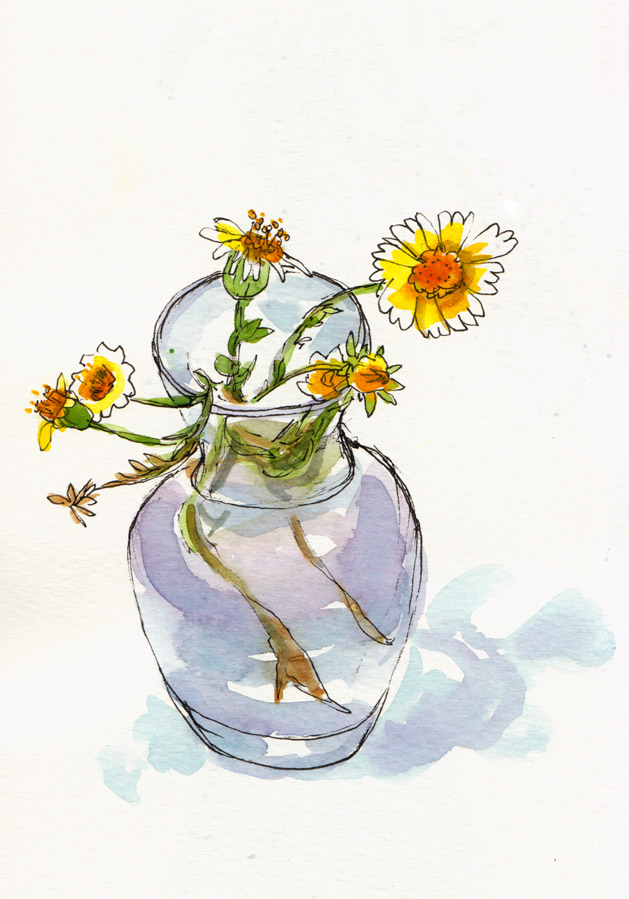
Little Daisy-Like Wildflowers, ink & watercolor, 8x5"
Little Daisy-Like Wildflowers, ink & watercolor, 8×5″
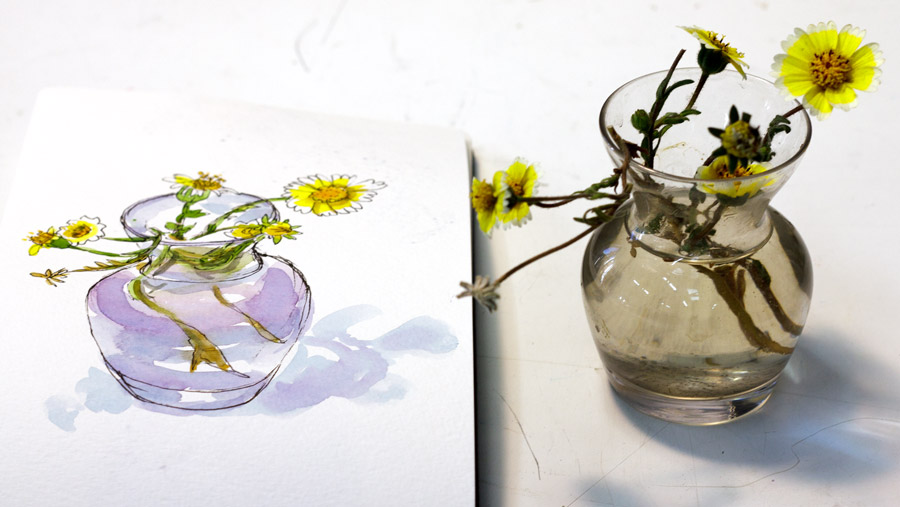
Little Daisy-Like Wildflowers with photo, ink & watercolor, 8x5"
Little Daisy-Like Wildflowers with photo

I postponed posting because of the time it would take to prepare the many sketches, scans and photos from that glorious day. I finally made the time; I didn’t want to be posting spring wildflowers in the Fall!

Lacy Wildflowers in Blue Bottle, ink & watercolor, 8x5"
Lacy Wildflowers in Blue Bottle, ink & watercolor, 8×5″
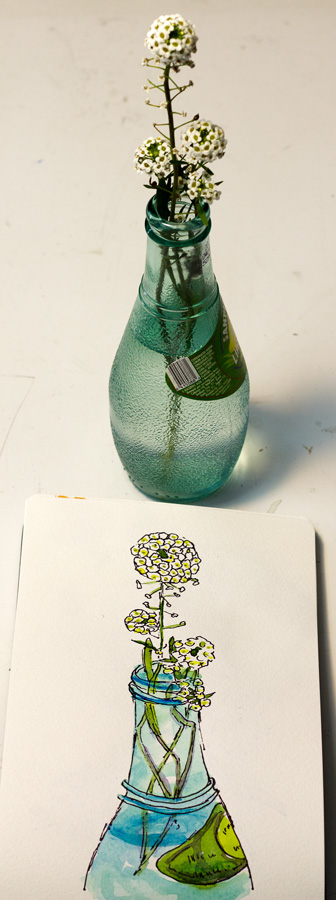
Lacy Wildflowers in Blue Bottle with photo

Do you know the names of any of these flowers? If you do, please leave a comment and tell me and I’ll change the captions with the correct names.

There are many more wildflower sketches to come, which I will post in Part 2.

Categories
Drawing Gardening Ink and watercolor wash Life in general

The Light at the End of the Tunnel Is Getting Brighter

Lilly Amid the Pruned Hydrangeas, ink & watercolor, 7x5"
Volunteer Lilly Amid the Pruned Hydrangeas, ink & watercolor, 7x5"

All my time and creative energy for the past few weeks has been given to sorting, discarding, organizing and moving things as I downsize my living space and move to my new studio. All the studio furniture and most of the painting supplies and gear are in and I’ve emptied and removed almost all the big plastic bins on my steel shelving in the former garage, readying the space for art stuff and still life objects.

One bin was filled with 70+ old paintings on panels that I’d saved over the past few years after my annual January review-and-dump sessions. I’m keeping just 20 of the old ones and another 20 from last year that I like and dumping the rest. One cool thing about this process is that I could easily see where each reject painting went wrong, whether it was drawing, values, composition, and/or color choices. Hopefully that knowledge will help prevent making those mistakes so often in the future.

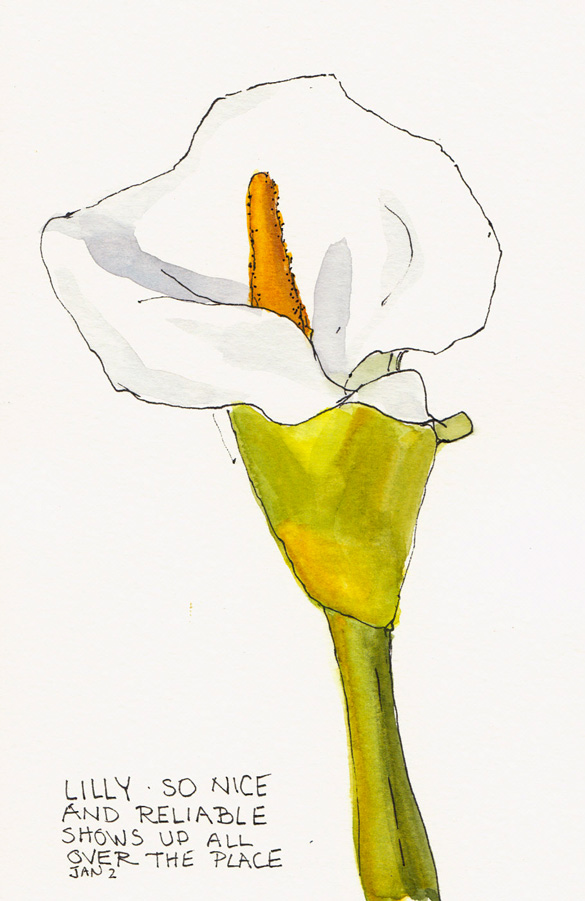
The Reliable Lilly, ink & watercolor, 7x5"

I also emptied a huge bin filled with family photos that never made it into albums. I filled a trash can with negatives and pics of pretty places and blurry faces. Now all the photos in their envelopes fit in one large file cabinet drawer. Those photos are still in great shape, but the ones in the family albums (with the sticky stuff behind the photos) are fading badly. Later I’ll pull those photos out of the albums and put them in envelopes or boxes too, as they suggest on Small Notebook, a great organizing/simplifying website.

My house is pretty much sorted out now, and in a week or so I should be back to “normal” life, painting and sketching regularly again. The rental unit still needs some finish work, but that can go on behind the scenes, without messes in my living space or cat-terrorizing-power tools and men in boots stomping through the house.

Categories
Art supplies Drawing Flower Art Ink and watercolor wash Painting Plants Plein Air Sketchbook Pages

Lavatera Clippings In Amaretti Cookie Can

Lavatera Clippings in Amaretti Cookie Can, ink & watercolor,7x5"

I love this old can that once held Amaretti cookies. After trimming some branches off the giant Lavatera bush by my deck, I decided to paint the cuttings. The cookie can was the first thing I spotted that would hold water and flowers.

I used the new Schmincke watercolors palette I recently bought on sale at Wet Paint. I love the palette but after a few trials, added and replaced some colors which I’ll write about next time. The Schmincke pan paints worked beautifully in the hot sun, releasing juicy flowing paint with just a touch of a wet brush.

I think the sketch captured the feeling of heat and strong light and the funky little table with a dirty glass top looks just like itself.

Categories
Berkeley Ink and watercolor wash Places Sketchbook Pages Urban Sketchers

Monterey Market and Berkeley Horticultural Nursery

Monterey Market Sunflowers, ink & watercolor, 5x7"
Monterey Market Sunflowers, ink & watercolor, 7x5"

My Tuesday night sketch group met at North Berkeley’s Monterey Market to sketch just before the produce store was closing. My friends started indoors while I stood and sketched the buckets of sunflowers in the parking lot, using a handy shopping cart as my table.

Berkeley Horticultural Nursery, ink & watercolor, 7x5"

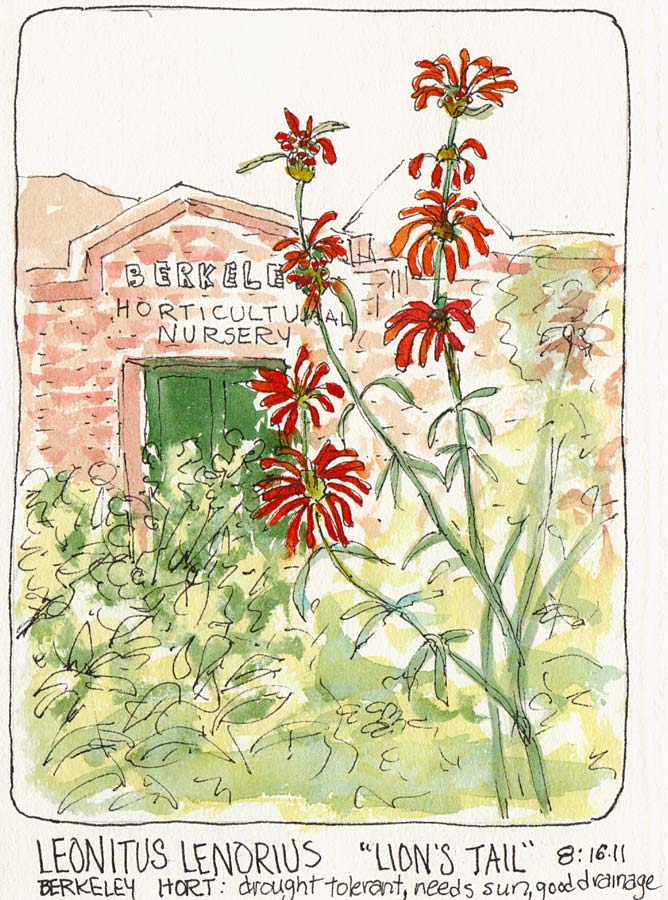
When the store closed at 7:00 they joined me in sketching the sunflowers. Then I walked around the block to the entrance of the wonderful Berkeley Horticultural Nursery. I saw this crazy Dr. Seuss-like plant along their fence and had to sketch it. Each fuzzy orange-red flower grows out of a stalk that comes up from the flower below it.

The next morning I called Berkeley Hort to ask about the plant. The guy who answered went outside to check and told me it is a Leonitus Lenorius or “Lion’s Tail,” a drought-resistant, sun-loving plant.

You can see Micaela’s market sketches here and Cathy’s market, melon and sunflower sketches here on our Urban Sketchers blog.

Categories
Flower Art Ink and watercolor wash Landscape Outdoors/Landscape Painting Places Plants Sketchbook Pages

Water Lilies Part II: In Sun and Shade at the Cemetery

Lily in the Sun, ink & watercolor, 5x5"

When I was sketching the lily pond at the cemetery the only camera I had with me was my iPhone. I took a few photos even though I didn’t expect them to come out well (which they didn’t since I was too far away). But I was able to get enough information from them to do two more little studies when I got home of the lilies in sun (above) and in shade (below).

Lily in the Shade, ink & watercolor, 5x5"

Sunday, just one week later, I returned to the cemetery with my good camera, looking forward to taking some good photos from which to paint and continue my water lily investigation. Sadly our recent warm weather had dried up half of the pond. I couldn’t get a single good photo and was uninspired to sketch the tangles that remained.

I’m surprised the cemetery owners don’t replenish the water in the pond. Although we’re supposed to conserve water, I know they water the lawns or they’d all be brown since it doesn’t rain in the summer here. What’s a few more gallons to maintain the lovely water lilies?

I guess I’ll have to wait until next spring or summer to continue my lily studies unless I can find another lily pond nearby.

Categories
Drawing Ink and watercolor wash Landscape Outdoors/Landscape Painting Places Plein Air Sketchbook Pages

Sketching Lily Ponds at Sunset View Cemetery, Part I

Sunset View Cemetery Lily Pond #2, ink & watercolor 5x7"
Sunset View Cemetery Lily Pond Sketch #1, ink & watercolor 5x7"

When I was hiking with a friend in the large, beautiful, hilly cemetery near my house, we discovered a small pond full of lily pads and flowers. That afternoon I drove back up to the cemetery with my sketchbook and paints and set up my chair beside the pond. It was such a peaceful spot; quiet, serene and green.

Sorting out the shape of lily pads and flowers with Pentel Pocket  brush pen
Sorting out lily pads and flowers with Pentel Pocket brush pen

I took a break to figure out the shape of lily pads and flowers, filling up a page of lily shapes, first with my regular pen and then the Pentel Pocket Brush Pen, until I understood the lilies.

Sunset View Cemetery Lily Pond Sketch #1, ink & watercolor 5x7"

The water was really confusing because of all the reflections of the sky, trees and shrubbery, and the quickly encroaching shadows since it was nearing sunset.

Sunset View Cemetery Trees, ink & watercolor 7x5"

When the pond was completely in shadow, I turned my chair around to face the other direction and do a quick sketch of a meadow glowing in the sunset, surrounded by shadows.

Categories
Art theory Flower Art Oil Painting Painting Rose Still Life

Blowsy Rosies

Blowsie Roses, oil on Gesobord panel, 6x6"
Blowsy Roses, oil on Gessobord panel, 6x6"

Blowsy. [Adjective: (of a woman) Coarse, untidy, and red-faced.] That’s just what these roses were when I picked them from my poor neglected rose bush: brightly colored but messy and past their prime; yet they were just fine as my model.

It seems like once I gave myself permission to work on a painting as long as I wanted to, I’ve started being able to finish them more quickly. And it’s not just the small size;  I’ve spent hours and days on other 6×6″ paintings in the past.

It could have gone even more quickly than the three hours I spent on it, had I left some of my earliest brushstrokes alone. I just find it hard to believe they were right the first time, even though that was my goal with this painting: to put down the right strokes with the right color, temperature and value and then leave them alone. (Or scrape off the stroke immediately if it’s wrong and replace it with the “right” one, rather than adding more and more paint, which eventually leads to making mud.)

I also tried to focus on using warm and cool colors to shape the form, along with the dark and light values. I’d also like to cite my inspiration for this painting, Kathryn Townsend, whose flower paintings mesmerize me.

Categories
Art theory Flower Art Oil Painting Painting Still Life

Baby Hydrangea: Little Pitchers Have Big Ears

Baby Hydrangea, oil on panel, 6x6"

I’d heard that saying before, “Little Pitchers Have Big Ears,” but without giving it any real consideration, assumed it had something to do with Little League baseball pitchers. Wrong. According to The American Heritage New Dictionary of Cultural Literacy, “Adults must be careful about what they say within the hearing of children. The saying refers to the large handles (ears) sometimes attached to small vessels…” like this little pitcher.

My other reference for the saying is the refrain in John Prine’s touching song, “Sam Stone” about a Viet Nam vet returning home.

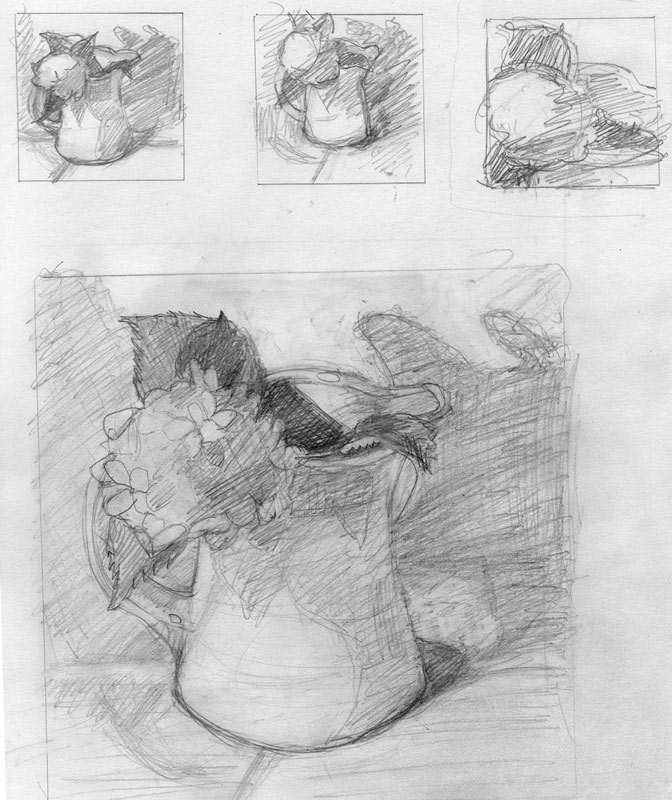
Hydrangea and pitcher preliminary sketches

I was looking for flowers to paint and this little lavender hydrangea was hiding at the bottom of the bush all by itself. I did the value/composition sketches above and set about painting, completely forgetting the first step that I usually find helpful: doing a quick and simple 2-value block in using thinned paint in one color (usually Ultramarine Blue) first.

I think it worked out OK anyway, and in the next painting I did (still waiting to get photographed) I remembered to do that.