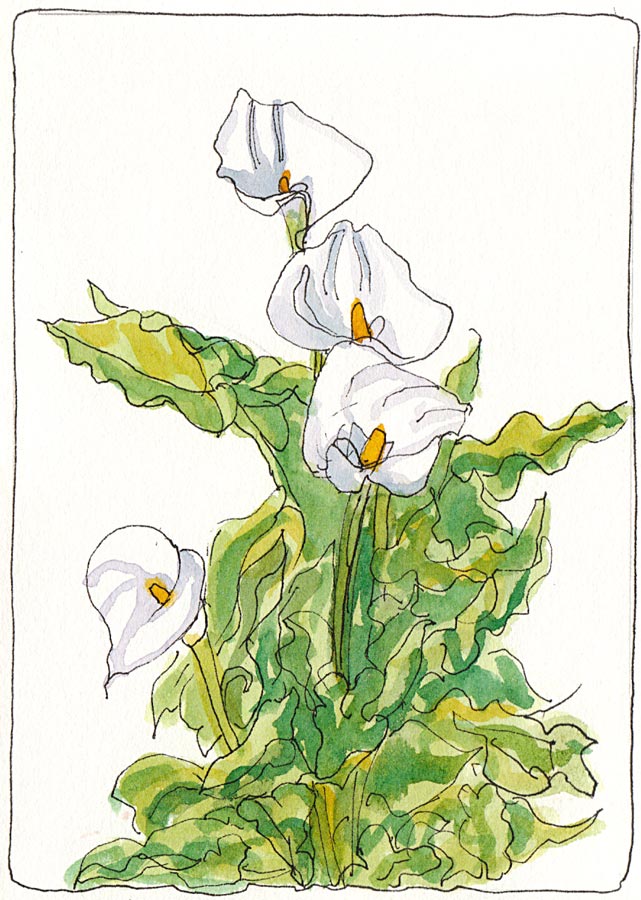
After a weekend of making paintings, scraping the canvas and starting over (with nothing to show for it but some learning) I accidentally knocked a 12 oz latte off the table, splattering the studio with milky coffee, requiring a major cleanup job. So tonight I thought it might be nice to stare at a pretty calla lilly that popped up in the garden, sketch it a couple of times and just calm down.
I drew the one above first, starting with a little pencil to get the shape right and then drawing with a Micron .03. When I finished I wished I’d skipped the ink.
Calla Lilly 2, ink & watercolor
With this second one I drew directly with the pen, but I liked the scratchy line even less (I think the pen is running low on ink or doesn’t like the paper) so went over it with a Pentel Brush Pen afterwards.
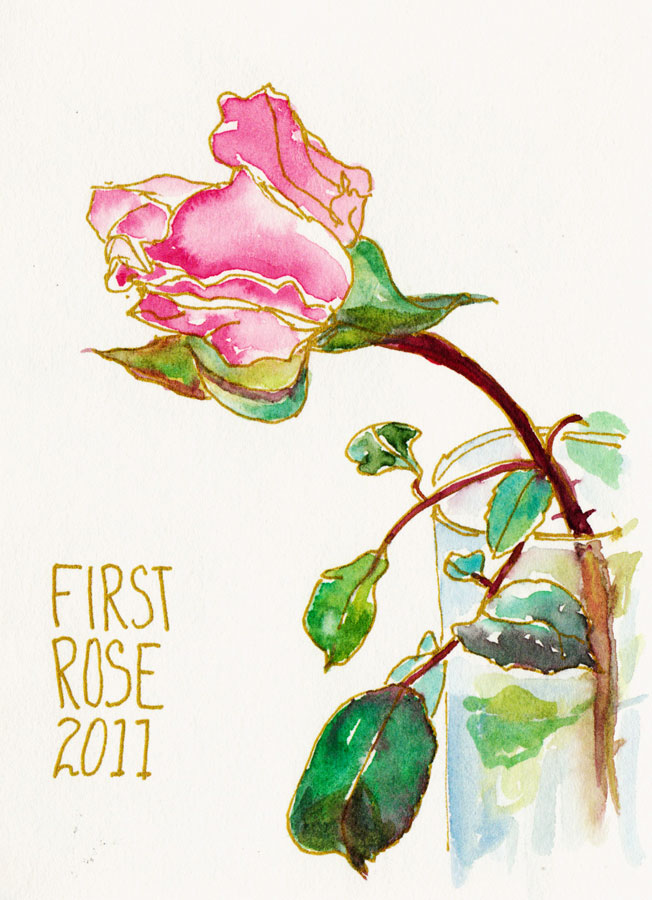
This was the first rose I cut from my rose bushes this year which led to the first cut on my hands from the rose thorns (likely not the last). And it was the first sketch I did of the first rose. My intention was get the essence of the delicate rose with as few lines and as few washes as possible. I drew it with a gold gel pen, painted directly in one layer and stopped.
Rose Reverence, oil on Gessobord panel, 10x10" - SOLD
My riotously rampant roses were bursting forth from their bushes so I had to put other plans aside and paint them. Their fruity scent was as intoxicating as their vibrant colors. These were two different kinds of roses, both of which change colors and shape as they open so I had to work quickly to complete this painting in one session.
I left the still life set up just in case I needed to fix anything the next morning. But of course by then they were completely different roses. And the painting was complete.
Tonight it is thundering and lightening and pouring down buckets of rain. But there was a warm sunny day last week when I was able get out in the garden and sketch a bit. Callas are so graceful and such lovely volunteers, popping up all on their own wherever they please.
My tiny fig tree, ink & watercolor
Just after my friend Barbara finished writing her book about growing fruit trees and delivered the manuscript to the publisher, she also delivered to me a baby fig tree that she couldn’t find a space for her in garden.
I was so excited to see that my new baby tree made it through the worst of the winter and was no longer just a stick. It now has actual leaves sprouting from the tip. In case you can’t tell from my sketchy drawing, those are random rocks and bricks I placed around the baby tree as a warning to the gardeners so they wouldn’t mow over it.
My work in the book: How to Paint Watercolor Flowers
A year ago the English publisher Quarto commissioned me to do a series of paintings for a book (working title) “Must Paint Watercolor Flowers” and at last it arrived in the mail! Now named How to Paint Watercolor Flowers: Create Your Own Masterpiece in 6 Easy Steps, it features my paintings and those of 15 other artists, along with step-by-step instructions showing how we made our paintings.
The book has 160 pages and at 11″x 9.5″ is much bigger than their “Watercolor Artist’s Bible” in which I also had several paintings. It is laid out with a beautiful 8×10 photo of the flower subject on the left side and photo-illustrated step-by-step instructions for creating the finished watercolor beside it. Hard-cover spiral binding allows the book to lay open flat for artists who wish to try the techniques while painting from the photos.
I loved seeing the beautiful work of the other artists and the many ways they approached the wide variety of subjects and techniques. The flower photos are superb, with permission granted to use them for your own paintings. The book also has excellent sections on watercolor technique, color, value, and photographing your own flowers for painting.
I haven’t read all the step-by-steps, but I’m guessing that like me, few of the artists actually created their work in just the six steps that we were limited to when writing up and photographing our work. Instead the editor highlights the key techniques that were especially important to each particular painting.
Disclaimer: I have no financial investment in the book; I was paid per painting for the publisher’s right to print my work, but receive no royalties or other benefit from sales of the book itself from the publisher or via Amazon links.
Scruffy Roses Instead of Ice Cream, ink & watercolor
Sometimes when I’m tired and grumpy it feels like the solution to all my problems could be found in a bowl of ice cream. I know I’m not alone in this because I’ve noticed that movies and TV often show female characters heading for the Haagendaz when they’re upset.
I’ve also learned that despite those crossed wires in my brain* that say tired = eat sugar, dessert is rarely the solution, and only creates other problems for me. So I try to do something else and it usually works. On this occasion I spent the evening sketching some scruffy little roses from my garden. By the time I finished, the nearby ice cream shop had closed and I was ready to go to bed.
*Sleep Deprivation and Carbohydrate Craving
In a Harvard Magazine report on sleep research they explain how and why being sleep deprived creates a physiological craving for sugar. In one study, healthy, male college students who were subjected to sleep interruptions over a couple of weeks became carb-loading sugar fiends and even developed pre-diabetes. In the article the Harvard researchers say:”It could be that a good chunk of our epidemic of obesity is actually an epidemic of sleep deprivation.”
They say that most of us now sleep less than people did a century ago, or even 50 years ago although our biological need for 8 hours of sleep a night hasn’t changed. “We are living in the middle of history’s greatest experiment in sleep deprivation and we are all a part of that experiment,” says Stickgold. “It’s not inconceivable to me that we will discover that there are major social, economic, and health consequences to that experiment. Sleep deprivation doesn’t have any good side effects.”
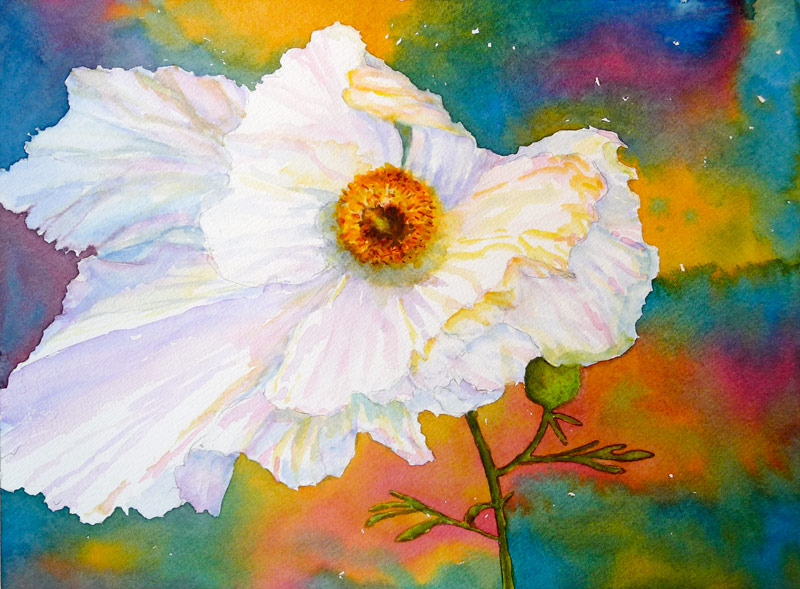
Today in the my watercolor class I demonstrated painting white flowers and soft-focus bright or dark backgrounds. A neighbor graciously allowed me to pick a huge bouquet of Matalija poppies from her gigantic bush so each artist had their own flower to paint.
To save time I only painted a quarter of the flower before going on to paint the background. This made it a little difficult to finish the painting after the class since by then the flower had completely changed so I just pretended a little.
To paint the background I started by making three different puddles in little bowls: Permanent Alizarin Crimson, Quinacridone Gold and Winsor (phthalo) Blue. I used a separate brush for each color to keep the colors clean. Then I just worked my way around, washing on little gold, a patch of red beside it, a splotch of blue, letting the colors touch and mingle.
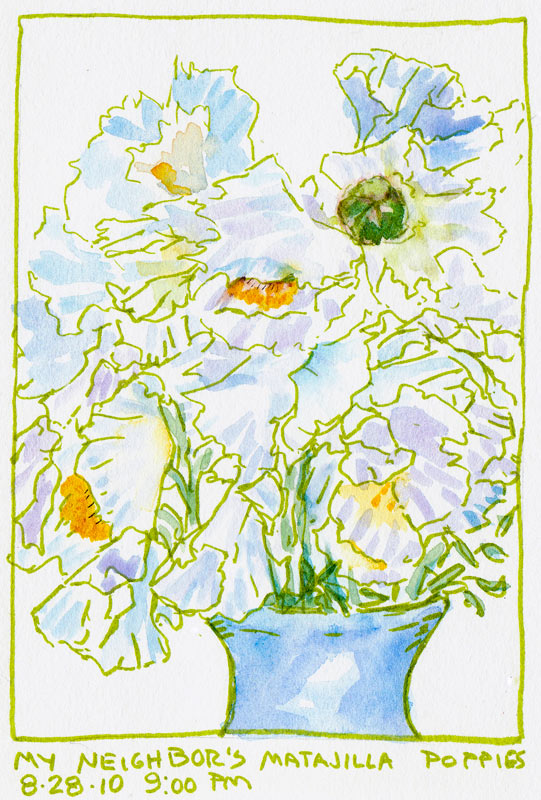
Matalija Poppy Sketch, green brush pen & watercolor
To warm up for today’s demo I did this sketch last night using my fun new green Pitt Artists Brush Pen and then added watercolor. And I spelled the flower name wrong. Which I’ve been doing forever, or at least since I painted the first one several years ago found on my website here.
Early Morning at Kaiser Garden, oil on canvas, 20x16"
I think I’ve finished this painting (but then I thought that several times before). The last time I thought I was finished, I looked back at the notes I’d written opposite my journal sketch about what interested me in the scene and my goals for the painting. I saw I’d missed a point or two and worked on it some more.
Now I’d really appreciate some honest feedback:
Do you think it’s finished or does it still need something, and if so, what do you suggest to improve it?
This was painted with Holbein Aqua Duo water-soluble oil paints. It’s such a joy to oil paint without odor, to thin paint to a wash without solvents, and to mix water instead of turpentine with the Duo linseed oil to make painting medium. The pigment quality, drying time and consistency is identical to regular oils.
Big Tulip started with this journal sketch and photo which led to a craving to work big for a change. I jumped right in with a full sheet (22×30″) of watercolor paper, reminding myself that it’s not that different: just use bigger brushes, bigger puddles of paint, and bigger movements.
Of course there’s more to it than that. In planning the painting I decided I’d be free and loose with the background, just go for it and see what happens rather than draw it in. It was fun, but there was a lot of background. I’d like to try the painting again, doing it a little differently.
I’d draw the background plantings with more specificity and I would also use different pigments. I’ve been experimenting with using cadmiums for the yellows, orange and red instead of my usual transparent colors in my palette.
The cadmiums are perfect for journal painting when I want to try to get a rich color down in one layer. They’re stable and easy to work with so they will remain in my travel palette.
But when trying to work with juicy wet-into-wet washes, the cadmiums just sit there and don’t move, like stodgy, Wednesday night meatloaf. For painting close-up flowers I like the excitement and challenge of colors that charge into each other and zip around. It’s fun to paint a petal with lots of water and then drop in rich, bright colors, let them mingle, and try to get them to go where you want by tilting the painting.
Hydrangeas Attempt #2; Painted directly without drawing and ink lines added after finishing attempt #3
During days of dismay at my disappointingly dismal drawing dexterity I determined to draw ’til I improved. But I was under the influence of migraine medicine which fixed the headache but left me drowsy. I actually fell asleep at the drawing table, dropped my brush on the page which woke me up, and had to go lie down for a spell between drawings.
Hydrangeas Attempt #1; drawn in ink, painted with ugly dark background which was then sponged off and a bit more paint added
My hydrangeas are bursting with vibrant blooms so I made them my subject. The first attempt got off to a decent start until I painted a nearly black background, probably due to my really dark mood and being too doped up to know when to stop.
I couldn’t stand the way it looked, so before scanning tonight took a soft, wet sponge and washed off the dark background. Then I dropped a little more color into the wet background.
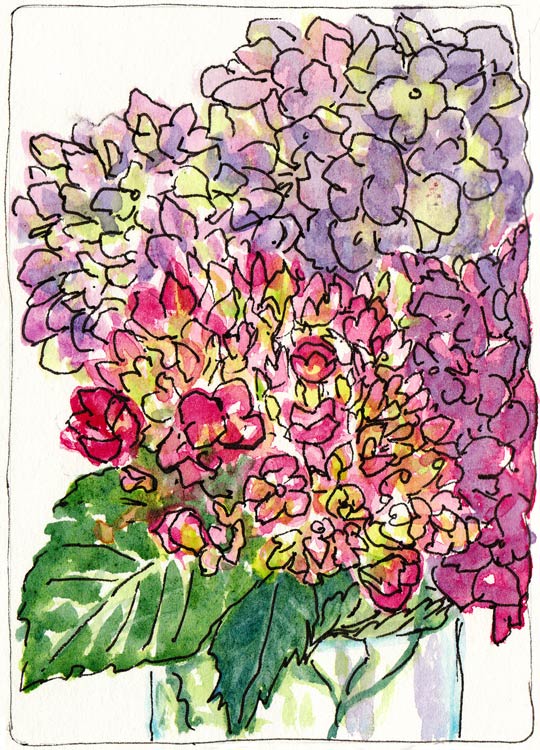
Hydrangeas Attempt #3, ink & watercolor
I had the most fun with this last attempt, where I drew and painted more loosely, trying to capture the flavor and personality of the flowers.









 Jana Bouc, Artist