Categories
Art theory Colored pencil art Drawing Landscape Life in general Oil Painting Outdoors/Landscape Painting People

Hannah’s Reflection Revised

Hannah's reflection, oil on Gessobord 12x16"
Hannah's Reflection, oil on Gessobord 12x16"

After I posted this painting a few weeks ago I realized I’d left off the foamy bubbles on top of the water. Last weekend I worked on the painting some more, at first planning to just add the bubbles but ended up adding a whole new layer of paint. I gave Hannah another haircut and slimmed down her dress a bit. I felt a little afraid to go back in and start messing with things, but told myself to just have fun and see what happens.

I don’t think I quite got the essence of the foam, it looks more like rose petals floating on the surface, but I decided I liked that idea and left it alone.

I’m wondering if there is a problem with the grasses behind the rust colored reeds on the middle right that sort of point towards her head. Should that patch of yellow-green grasses have less texture, be cooler and more blurry so that they recede more? I think so.

Here’s what it looked like before in the original post:

Hannah's Reflection, Oil on Gessobord, 16x12

I’m trying to get over the idea that paintings need to be completed in one painting session or in one day. Alla prima and plein air painting is great,  but so is letting layers dry and adding more more until the painting says it’s done. Sometimes it forgets to say “When” though, and then it’s overdone.

I have the same trouble with steaming vegetables. I lose my concentration and before I know it my broccoli has turned to mush. So is the revision mushy broccoli or an improvement? Do you think I should soften those grasses or move on?

Thinking about painting and broccoli reminds me of this poster I made a long time ago:

Listen to Your Broccoli, Colored Pencil, 24x18"
"Listen to Your Broccoli and It Will Tell You How to Eat It," Colored Pencil, 24x18"
Categories
Art theory Oil Painting Painting Still Life

Artichokes Redux, Improved?

Artichokes Redux, oil on Gessobord, 8x8"

My artist friend Laura (of Laurelines) offered some wonderful suggestions for improving the original version of this painting.

Artichokes, Oil painting on 8x8" Gessobord
Original version

Laura said:

“One thing I’ve noticed about your oil paintings is that you don’t have the same strong value differences within objects that you do in your watercolors.”

I agreed with her and gave it another go-around, this time adding some dark glazes in the dark area and more lights in the light area. I was working from a photo (since the original artichokes are long gone), so the colors were a little different than the original.

I am so appreciative of the wonderful community of art bloggers and the sharing we do with each other. Laura and I continued the conversation, and talked a bit about plein air painting and impressionism. Then she said:

Your watercolors are pure 21st century YOU. They are clear, strong, bold, and sometimes, though not always, quirky. Your flower paintings are YOU. In oil, it seems to me, anyway, that you’re trying to be someone else or are being encouraged to try to be someone else. That way lies horrible frustration. YOU can use oils in transparent glazes, with shimmering lights and darks, that will feel like you. YOU can use complements to create shadows. YOU can do all those nifty things in oil that you do in watercolor.

What a gift it is to have someone speak from the heart like that. She so hit the nail on the head about what I was struggling with in oil painting. I told her that in watercolor I found my direction early on, knew what I liked, what I wanted to do and developed the skill to do it. In oil I started out wanting to paint like I do in watercolor and everybody told me that “you don’t do that” in oils. I had to learn about the importance of brush strokes, edges, filling the canvas rather than putting an interesting object on a white page, etc. All the books and blogs stressed alla prima, completing a painting a day, impressionism, etc. Somewhere along the way I lost my direction.

I sometimes picture life as a series of turns made when angels have perched on the signpost and pointed in the next  good direction to take (sometimes the guides aren’t angels but rather tricksters saying turn left when the correct direction is right — heaven knows I’ve made many unfortunate turns in my life). I think she might have been one of those angels, pointing me back to my right path.

I’m not sure if this version is better than the first. There are definitely more darks, but it seems to have lost its glow, partly due to working from a photo rather than the brightly lit subject. What do you think? Does it need more work or is it overworked?

Categories
Art theory Oil Painting Other Art Blogs I Read Painting

Still Learning to See Color: Block Study (after Hensche)

Color study painted under halogen light, 9x12 in
Color study of blocks under halogen light, 9x12 in, oil on panel
Photo of setup (I painted from for blocks, not photo)
I painted from this setup (not from this bad photo)

This study was done to practice seeing, mixing and and painting the relationships of color and light on different planes. Theoretically these colored block studies should be done outdoors with natural light, but it was a cold windy day and I wasn’t feeling well (and still don’t—first it was stomach flu and now a cold) and so worked indoors. When I compare this indoor painting to those I did outdoors and posted here, I can see why it’s better to work outdoors.

This practice is based on the work of Henry Hensche. As Professor Sammy Britt says about Hensche on the Hensche Foundation website:

Charles Hawthorne was the first painter…to put the “Impressionist concept of seeing” into a teaching principle. Hawthorne spent the last fifteen years of his life trying to understand what Monet looked for and how he painted.

Henry Hensche, an assistant to Hawthorne, perfected the concept of seeing and teaching color after Hawthorne’s death in 1930. Mr. Hensche taught and practiced this visual language of color from that first Summer in 1930 until his death in 1992.” [emphasis added]

I’ve studied on and off the past year with Camille Przewodek, a fantastic plein air colorist and former student of Hensche and I think I’m beginning to comprehend the concepts at a basic level (although the study above is a poor representation of that). Another painter who studied with Hensche, John Ebersberger, has created a Hensche Facebook group that is open to the public, for former Hensche students and others who are interested in Hensche’s approach to seeing and painting color relationships.  There are wonderful photos posted there of Hensche paintings and paintings by the artists who have carried on his approach to color, and to my mind, have  advanced it even further. Their discussions and critiques on the groups discussion board are also quite illuminating.

Painting colored blocks under different light is one of the techniques Hensche used to teach students to see that in every plane change there is also a hue or color change (not just a tone or value change), and how these colors change according to the light key (foggy grey light, bright sunlight,  early morning light, afternoon light).

This is not an easy approach and takes years of practice and study, best done with an experienced teacher like Camille Przewodek, John Ebersberger, Carole Gray-Weihman, Dale Axelrod (great links and examples on his website), and others at Atelier aux Couleurs Art Academy who offer workshops locally and internationally. I have found one book, Painting the Impressionist Landscape, that does explains the concepts (although I don’t think that author’s paintings provide stellar examples, especially compared to those listed above).

Even if I never learn to see and paint like they do, I’m sure the concepts I am learning will enrich my painting and it has already changed the way I think about light and color and form.

Categories
Art theory Landscape Other Art Blogs I Read Sketchbook Pages Subway drawings

Finding my way as an artist

Thumbnails of BART view

Who am I as an artist? What really interests me enough to spend hours painting it? Do I really like painting landscapes? Do I really like painting plein air? Do I even like looking at plein air landscape paintings?

After making 100 plein air landscape studies and only liking 2 of them, it seemed like a good time to reevaluate and those are the questions I’ve been asking myself.

Before I took up oils a year or so ago I was fascinated by details and enjoyed seeing and painting the reflections in glass, faces that told stories (human and non-human animals), the world inside a flower, urban scenes from around my quirky home town.

Then I started painting mostly plein air landscapes in oils and was told I needed to lose the details; simplify;  just paint the big shapes; soften the edges, go for design and composition rather than content. But the more I simplified the less I enjoyed painting. I started to question whether I wanted to continue with oil painting and plein air painting.

Then I serendipitously discovered a book of Charles Sheeler‘s paintings at a used book store. I’d never been much interested in his work before, but when I looked at the images and started reading I was led to the answers I’d been looking for. I saw in his landscapes (mostly urban/industrial), still lifes and interior scenes a specificity, strong point of view, personality, AND great design. I saw a way I could translate what gave me joy in watercolor into my oil painting.

I realized that what interests me is the PARTICULAR, not the general; the close up, personal view that tells a story; a portrait of an object, a person or a place; not the general widescreen view as I’ve been doing.

In trying to better define my thoughts, while waiting for my train at the at the El Cerrito Plaza BART station I sketched the thumbnails at the top and bottom of this post (which can be enlarged by clicking either image).  Below is a photo of the scene, though a slightly different point of view:

Photo of similar view from BART
Photo of similar view from BART minus foreground

And here is what I discovered and wrote in my sketchbook, thumbnail by thumbnail:

1: No focus, BORING. What I’ve been doing: including every single detail from the window frame in the foreground to the cars, parking lot, city, bay, hills across the bay, and the sky.

2. A little more interesting. Focus on the Cerrito Theatre marquis sticking up with foreground and background being less important.

3. A close up view but no focal point, still boring. 3 trees. Who cares?

4. BORING. Sky mountain water. Big Fat So What!

5. Maybe… a portrait of specific trees and lamp post but still not interesting enough to bother painting.

6. Now this interests me! A person waiting, a bench, a sign, a particular tree.

Thumbnails of BART view

Now I just hope I can find a way to implement this new way of viewing and painting with oil paints. I wrote several more pages about these ideas in my sketchbook, but I’ve probably bored you enough for today. Now off to paint!

Categories
Art theory Flower Art Glass Oil Painting Other Art Blogs I Read Painting Still Life

Dahlias after Painting Class

Dahlias in Oil

Larger
Oil paint on gessoed mat board, 12×7.5″

Sunday was my first plein air oil painting workshop with Elio Camacho and it was fabulous! Elio is not only a wonderful painter, but he’s a fantastic teacher — so energetic, enthusiastic and generous in sharing everything he knows (which is a lot!).

Although Elio covered a huge amount of artistic territory in his conversations with us, what really sunk in for me at this session was the importance of temperature (warm vs cool colors) and value (dark vs light) and how to use those relationships to paint the effects of light in the landscape.

To better understand this concept and practice seeing color temperature, he suggested doing a still life of all yellow objects as homework so I painted these dahlias from my garden (after scrubbing all the nasty aphids and ants off them–ick!). Yellow is a good color to practice with because there are many yellow pigments from cool to warm and dark to light and you can successfully lighten it with white, unlike red which turns pastel pink when white is added.

Since I started this journey to learn oil painting, I’ve read many books, watched a dozen oil painting videos, and received wonderful support from my online painting mentor, Nel. There were so many concepts, “rules”, and techniques that I understood intellectually but in class they came to life! Seeing the process demonstrated and being able to ask questions each step of the way was great.

And even better was having Elio checking on me every 15 minutes or so during the three hours I was painting. He demonstrated what he meant when I didn’t understand; he recommended I quit dabbling– put down a stroke and leave it; he showed me how to hold my brush correctly and at what angle, so I was putting paint down without scraping it off at the same time (hold the tip of the brush and keep it at a low angle to the canvas, not perpendicular as I was doing). So many things just clicked.

The painting I did in class isn’t worth posting, though it had some nice moments along the way. Now that I know how to hold my brush properly and understand the importance of the direction of the brush stroke, and am learning to see color temperature and value better, I’m can’t wait to start my next painting!

Categories
Art theory Flower Art Glass Oil Painting Painting Sketchbook Pages Still Life

Wax On, Wax Off (Breathe In, Breathe Out)

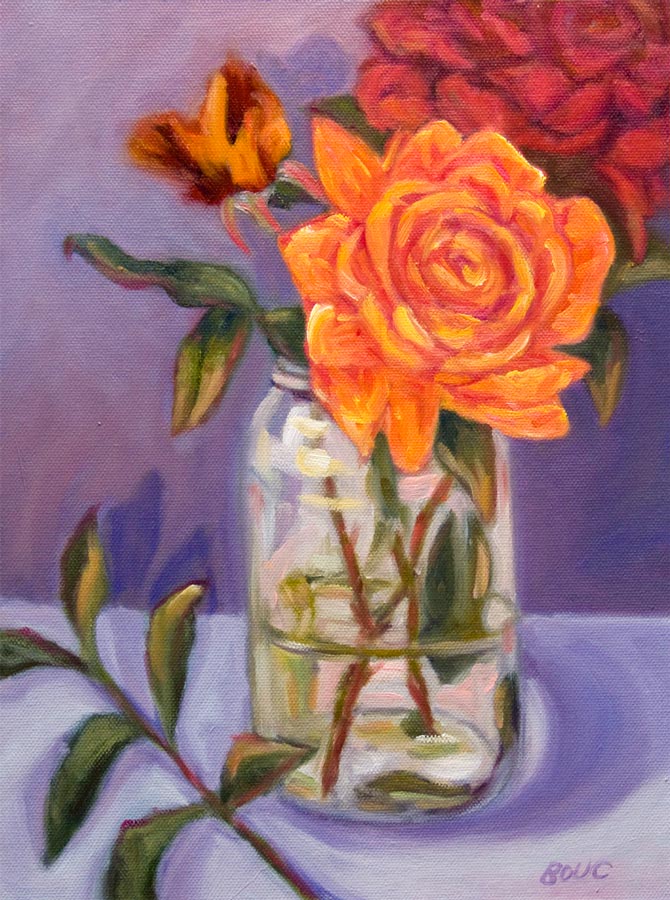
Rose in a Jar

Oil on panel, 12×9″
Larger

The title of this post refers to words from the 1984 movie Karate Kid and also my process in this painting except for the painting it would be more like “Paint On, Wipe Off (Breathe!) Paint On, Wipe Off… ” (click on “Keep Reading” below to see photos of the steps). I’m not happy with the front flower but I’m ready to move on to the next painting. With each one I learn so much more, including how much more there is to learn!!!!

I had two main goals for this painting/learning experience:

  • Think in terms of “Whole Canvas”
  • Keep trying to understand how to work with oil paint so that I’m taking advantage of its wonderful qualities rather than fighting them. (I’ll keep trying!)

In my many years of watercolor painting, I worked hard to capture what excited me about my subject. I often worked close focus without much background, or just using the lovely white of the paper as my background to set off the glittering glass or glowing flowers I was painting. If the composition didn’t quite work out–no problem, just crop as needed with a mat and frame.

In oil painting the background has to be an integral part of the painting–you can’t just leave the glaring white of the gessoed canvas as your background. And you can’t crop a stretched canvas or panel like you can paper. I was struggling with this concept and finally it clicked. It’s just another way of seeing and, like peeling layers of the onion, the haze peeled from eyes and I could see that a painting is not subject & background — they fit together to complete the picture, just as night completes day. While an object that interests me enough to paint it is the focal point, I need (for now) to think of the PAINTING as the subject.