After waking up way too early and having loads of extra time before I needed to leave for my plain air painting session today, I somehow managed to get late anyway. When I finally got to our meeting place—Borges Ranch on the Shell Ridge Open Space in Walnut Creek—I decided to leave my easel and acrylics in the car and hike the ridge trail with my sketchbook, watercolor kit and camera.Then when I was heading back for the critique, I stopped at the barn and painted the quick sketch above.
Often when I’m plein air painting I’m jealous of all the people who are enjoying the day by hiking the hills instead of standing in one spot trying to capture all the abundant nature in two dimensions on a little piece of canvas. So this time I joined them and it was heavenly. After exploring for an hour or so I found a spot on the trail beside a large muddy pond where I sat and painted the picture below. It doesn’t make sense as a picture but when I look at it I can hear the buzzing bees (must have been a hive in a nearby tree), the birds chirping, and can feel the warm sun shining on me.
Warm sun, buzzing bees, a pond, a cyclist
This was the first sketch in my new journal with the Legion Multimedia paper. It’s a dream to sketch on; the pen slides right along. The paper is nicely sized and while it won’t take the abuse that Arches cold press will, it does hold up pretty well as long as you don’t try to do more than 2 or 3 layers. This slight limitation will hopefully me keep me moving on to the next sketch instead of overworking one to death.
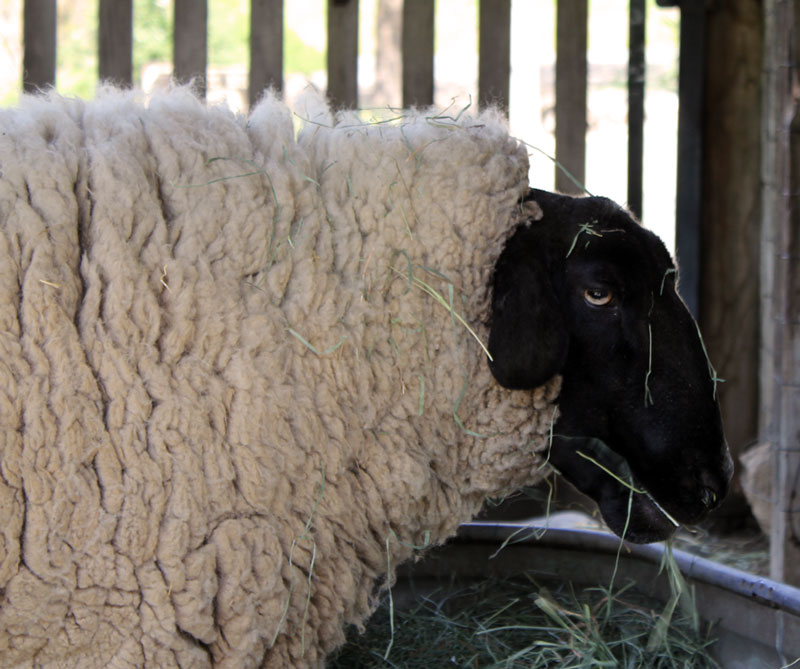
After the critique (and my lunch) it was mealtime for the farm animals and I couldn’t get any of their attention. This guy looked at me like I was really annoying.
Borges sheep chowing down
Only the rooster seemed to have places to go and things to do.
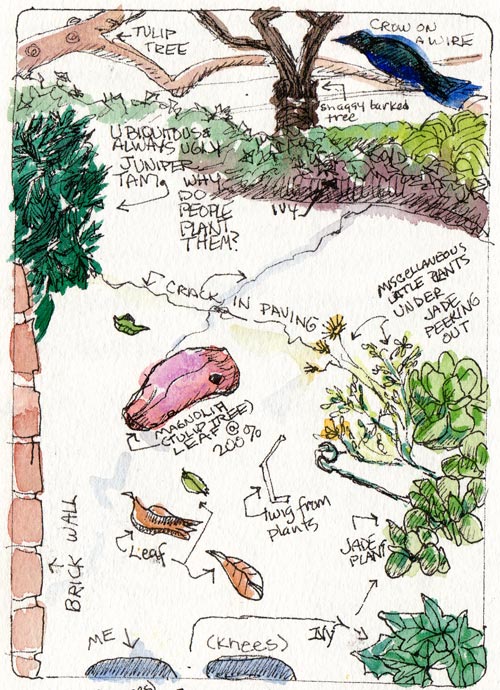
After having a rough day, I met Cathy in front of the Northbrae Church at the top of Solano in Berkeley to sketch. I considered staying home, feeling crummy, but knew if I went out sketching I would start feeling better. So I sat on some steps and drew a sort of map (above) of all the nature around me to get warmed up.
Next I sketched the street signs in front of my parked car (below).
Parking and Ferrari Foods, Ink & Watercolor
Then we walked a block north to Solano and sketched the interior of Ferrari Foods (above), which was closed. One worker was inside cleaning up. When he finished and turned off the lights we walked around a bit looking for our next target, realized we were freezing and moved indoors to Cactus Taqueria.
Don't Play With the Fountain, ink and watercolor
Despite the sign on the fountain telling parents not to let their children play with the fountain, children wandering around while their parents finished dinner in the family-friendly Mexican cafeteria found it irresistable. One tot helped himself to a nice long drink of water from one of the streams while the young man sitting beside me yelled “No!” and asked around whose kid it was, dismayed to see him drinking the recycled water. Nobody responded and the kid eventually wandered back to his family, who seemed unworried.
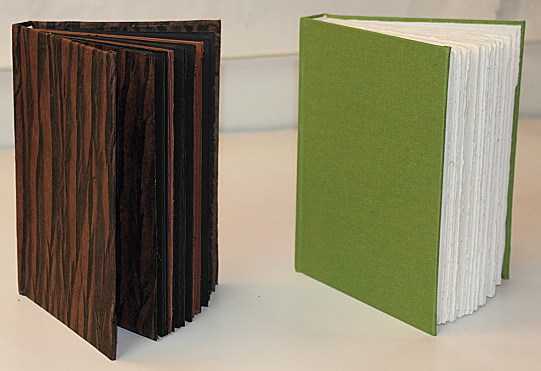
On the left is the new journal I bound for International Fake Journal Month and on the right is my next all purpose journal that I bound with Legion Multimedia 140 pound watercolor paper.
Since it had been a few months since my epic journal binding learning experience, I had to replay many of the videos and look at my notes to figure things out. And I made a bunch of new mistakes to learn from.
I have one big, confusing question. (UPDATE: See Comments for answer from Roz and note from Shirley) When I punched sewing holes I followed Roz’s video, along with Shirley’s tip to use a phone book to support the signatures. I punched four holes just like Roz did in her video demo, instead of the five I punched last time. But when it was time to sew the signatures together I couldn’t figure out how an even number of holes could work. When you have an odd number of holes and you start on the outside of the folded signature you always end up on the outside at the end of each row so you can attach each signature to the next. But with four, if you start on the outside you end on the inside. I’m guessing Roz was preparing a different sort of book.
Fortunately I had torn down extra sheets, thinking I’d bind two journals but I put aside the set I’d punched with four holes and punched five holes in the second set. Either I’ll find out how to bind with four holes or I’ll go back and make one more hole in each signature before binding them.
I also used Shirley’s tip to glue up the binding board and then place it down on the book cloth instead of putting glue all over the cloth and that was sooo much easier.
Some new mistakes I’ve learned from this time:
MEASURE TWICE, CUT ONCE! (or in my case measure 3 times just to be sure).
After gluing down the board pieces to the book cloth, I should have burnished them with the bone folder to ensure a consistently strong bond (a few small wrinkles showed up in the cover where it didn’t bond 100%).
Don’t make the book so thick; use fewer signatures so it is lighter and less tiring to hold when sketching standing up.
When you use “self-endpapers” that doesn’t mean adding yet another folded sheet, making the book even thicker. It means just gluing the book block directly to the covers (I think–correct me if I’m wrong). I had picked an ancient map print to use as end papers in the green journal but decided I didn’t like it at the last minute. I liked Shirley’s idea of just using colored drawing paper instead.
Make the sewing thread long enough so you don’t have to join it in the middle (thus having to once again struggle with knot-tying from diagrams that are totally confusing).
Don’t use white thread and white headband ribbons on black books.
Now I’m coming to the end of my journal bound with 90 lb Arches cold press paper. I will be sad to put “The Mutt” as I named it, on the shelf, as it has become a trusted friend and companion. And I really came to enjoy the paper, once I started using my Lamy Safari fountain pen to draw with.
Soon I’ll be getting to know a new journal, with new paper and new possibilities. I think I shall name it Froggie, given its green color, warts, and all. Someday maybe I’ll make a journal that is elegant and give it a posh name but for now, mutts and toads R Us.
And I’ll write more about the black/brown journal in April when I start using it for International Fake Journal Month.
Tuesday night we met at Cathy’s house instead of a public place where moving every two minutes with a timer ringing would be a nuisance. We started on her deck to the sound of burbling water and birds singing and lovely sights all around and warmed up with an untimed sketch. Drawing this little bonsai on the table in front of me was just what I needed to unwind from the crazy day. The sun went down and it was nearly dark when I painted it.
Then we went inside and started the timed two-minute sketches.
Cathy’s Berkeley Craftsman style home is a serene oasis decorated with simplicity and a Japanese zen style. Open space and emptiness balances still-life displays of special objects, art and her wonderful collections. She set the timer for two minutes and said “Go” and we moved through the house, our eyes and pens devouring tender new morsels around every corner every two minutes.
I added the watercolor at home later for these two sketches.
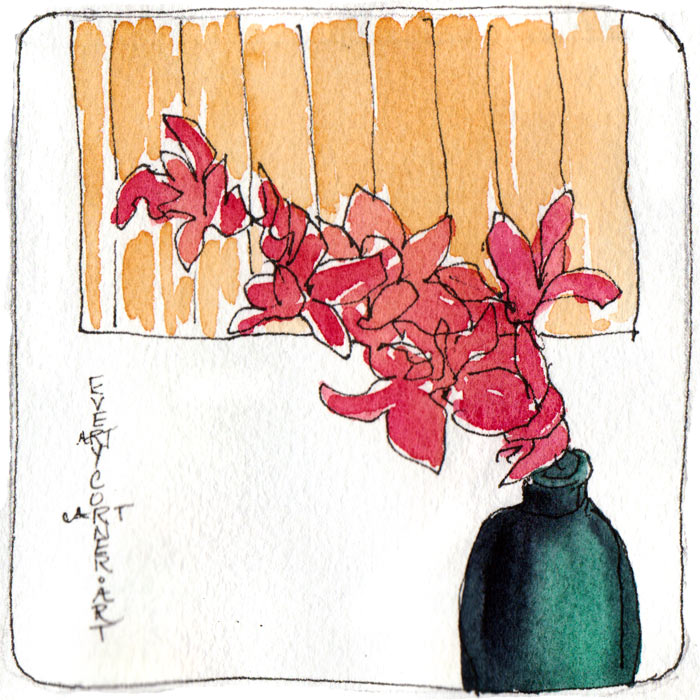
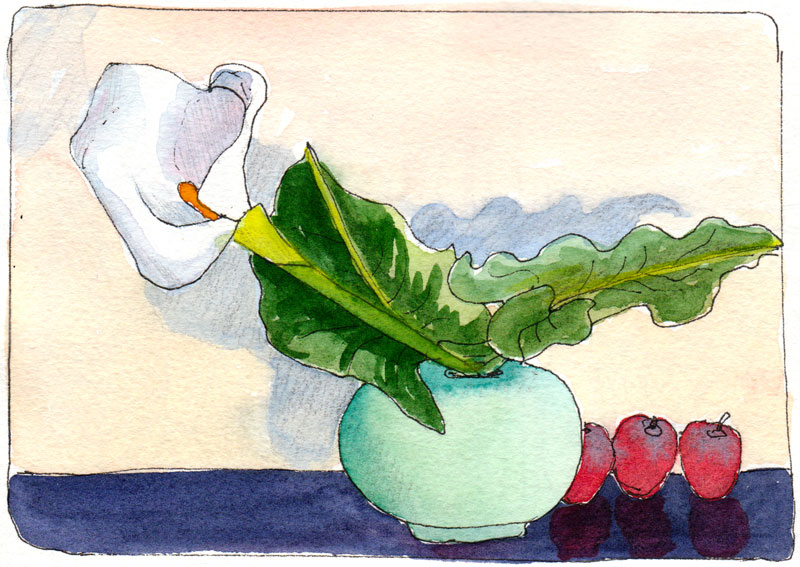
After each set of 6 two-minutes sketches we met back at the dining room table to look at each other’s sketches. When I saw Sonia’s calla lily and apples sketch I realized I’d missed that corner. I liked that display so much I chose to ignore the two-minute bells and spent six minutes enjoying drawing this one.
I’ll post the rest of the sketches after I add color to them. I am soooo lucky to have such great, dedicated sketching buddies!
I went to my dance class early this morning but burglars had broken into the studio in the wee hours and stolen the sound equipment and the computer. The teacher tried to switch to a Stretch/Strengthen class since it’s hard to dance without music but the police told us we had to leave.
So I came home to work, determined to get in a lunch-time walk in the sun (it’s spring at last!). But there was more weirdness. In between web-based staff meetings and conference calls I finalized a fancy email newsletter for the organization and sent it out to 2,000 people. Half an hour later I learned that an important link in the newsletter was broken. I learned more than I ever wanted to know about sub-domains and URLs, fixed the link, and sent it out again. So far no complaints. But no walk, either.
Yesterday was weird too. I was determined to finish binding two new journals that I’d started on Sunday, one for general use and one for next month’s International Fake Journal Month. While it wasn’t as hard as the first binding experience, I broke the “measure twice, cut once” rule (measuring only once and so having to cut twice, wasting good binder board and end papers), and ran into a couple of other problems.
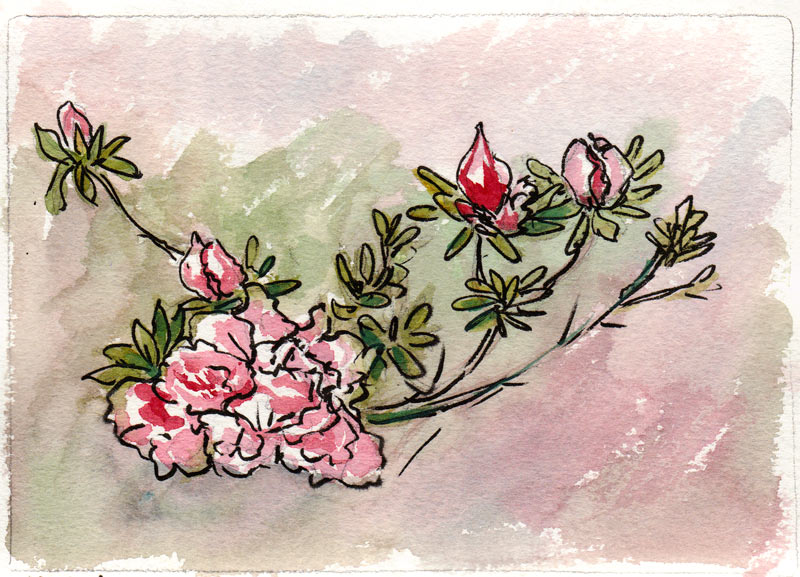
Meanwhile outside the sun was shining, the best weather in months, and I was sad that I was spending it indoors. Finally I finished the journal binding and went outside. This little plant (don’t know what it is; got it as a gift for my birthday last year and stuck it in the garden) was flowering and looked happy so I sat on the sidewalk in front of my house and quickly sketched and painted a bit of it as the sun went down.
Front yard flowers, ink & watercolor
The water filter at the top of the post is another broken thing. It used to live on the faucet in the studio sink but it snapped off one day and I couldn’t put it back on. Procter and Gamble (who make PUR filters) sent me a bunch of adapters but none would stay on the threads of the spout. I called my local hardware store and they told me that I was probably out of luck.
They said if I tried to just replace the spout it was likely that other parts would get broken in the process. And since modern faucets mount on the sink, not in tile on the wall like mine, I would probably have to rip out the wall, and the old sink, and replumb the faucet, and buy a new faucet. And then I would be broke. So I’ll just continue carrying in fresh water from the filter in the kitchen, 40 feet away.
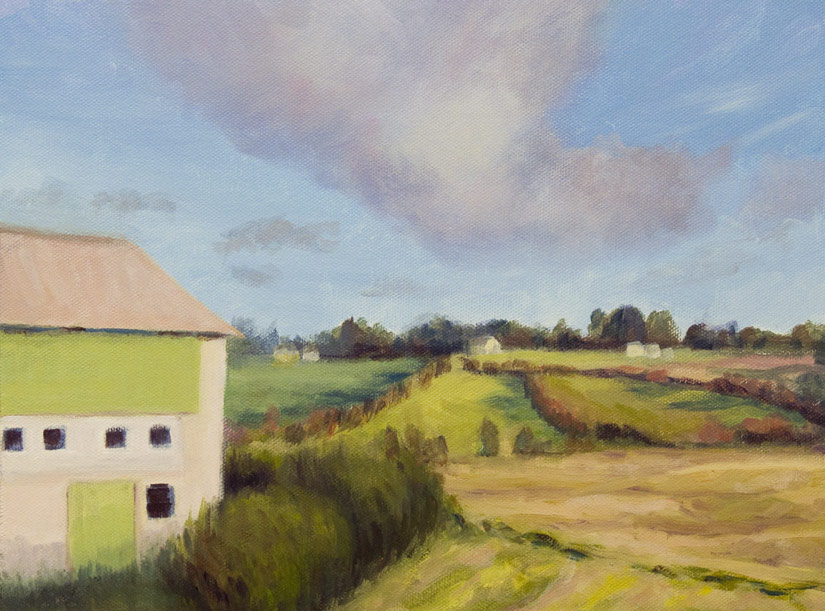
This month’s Virtual Paint-out is taking place in Norway. When I picture Norway it’s always snowing—silly me. I was amazed to wander the roads and see the beautiful summer light and perfectly maintained buildings and fields. There was so much gorgeous scenery it was hard to pick, but I couldn’t resist all the different greens in this scene.
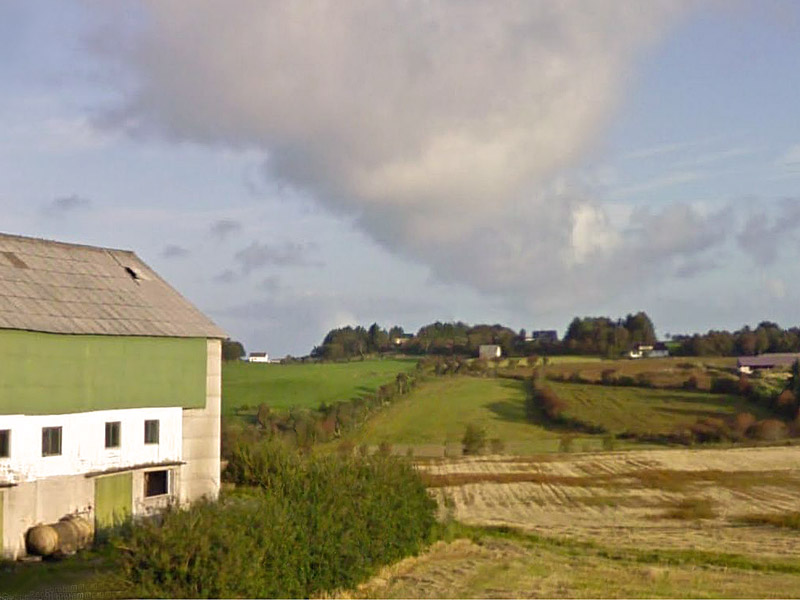
Here is the original scene from Google Earth. I used Windows 7 cool “Snipping Tool” that lets you select an area of the screen to copy and save:
Original Google photo
If you click to enlarge the image you will see the address of this farm in the top left. I played around in Photoshop to compose and crop the scene. Then I used the “Content Aware Scaling” feature in CS4 that allows you to compress a scene without distorting elements such as buildings or people. I wanted to fit the image on a 9×12″ canvas:
Cropped/Scaled in Photoshop
What’s really exciting to me about this painting is that I used Golden Open Acrylics to paint it. I am in love with these paints! [SEE less enthusiastic UPDATE AT BOTTOM]. They have all features that I love about oils and acrylics with none of the features I don’t like. I’ve been struggling with both those mediums for months and was going through an artistic crisis, considering giving them both up.
The problem with acrylics
I couldn’t stand working with regular acrylics because I like to layout a palette of paint and work intuitively, mixing as I go. Acrylics dry too fast to do this. (Yes I know you can mist the paint regularly and that there are special stay-wet palettes but I found they turn the paint to soup and smell bad after a couple of days). I also like to blend colors on the canvas and to be able to wipe off a passage if it’s not quite right. None of this is easy to do with regular acrylics.
The problem with oils
Because I try to use solvents as little as possible with oils due to their toxicity and smell, I can’t start with juicy washes for the first layer as I like to do when sketching out the composition with oils. And even with the minimal use of the least toxic odorless solvent (Gamsol mineral spirits) I found there was an odor (probably from linseed oil going rancid that was left in the solvent) that bothered me anyway. And then there’s the cleanup up dozens of brushes after a painting session.
Why I love[d] Golden Open Acrylics
Golden Open Acrylics do not smell, stay workable about as long as oil paints [update: they don’t really], can be diluted with medium and/or water, clean up with water, do not dry on brushes (for 24 hours at least), blend nicely and are just a dream to work with. When I quit painting last weekend I stuck a small, damp sponge on the palette, and closed my Masterson “Palette Seal” box. I opened it today, a week later, and the paint was still in perfect working condition, better than oil paint would have been.
While I admire thick, expressive, brush strokes in paintings, it’s not really my thing. I prefer working more thinly and that’s just the way Golden Open Acrylics are meant to be used: in layers less than the thickness of a penny. They can also be mixed with regular acrylics to modify the texture or the drying time. Or they can be combined in different layers, although it’s suggested to use regular acrylics as the first layer(s) before adding the Opens or waiting for the layers of Open Acrylics to thoroughly dry (2 weeks) before applying a layer of regular acrylics.
I think these paints are also going to transform my plein air painting. [update: they didn’t work for plein air; got tacky too quickly] I won’t need to bring solvent or a slew of brushes. I haven’t figured out what to carry for a water container or how much water I will need to carry for brush washing between colors.
Our first plein-air session of the new season is next Friday and I’m looking forward to playing with my new medium in a Non-Virtual paint-out too.
UPDATE June 30, 2010
After working the Golden Open Acrylics for three months I’m considerably less enthusiastic about them. The deal breaker is that the paint dries darker (about 10%, varies between colors) which requires guessing when mixing paint how much lighter to make it and makes it impossible for me to try to match colors I’m seeing . Other problems are the drying time which depends on the humidity and wind which makes painting outdoors with them next to impossible in my area. Unless there is no breeze and high humidity, even indoors, you have to work quickly before the painting starts getting tacky within an hour or so. But then it can take a really long time for the paint to dry completely. When trying to glaze on top of a seemingly dry layer, I’ve ended up lifting the previous layer instead and had to give up glazing.
I’ve now switched to Holbein Duo Aqua water soluble oils and so far and am finding them the best of all worlds. No color shift, artist quality pigments and pigment load, no toxics, no smells, easy clean up. I write about them here.
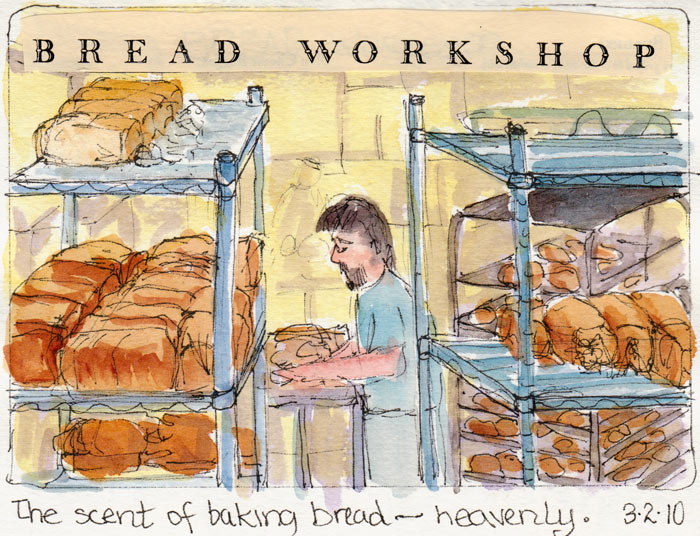
The Bread Workshop is a combination café and artisan bread bakery in Berkeley. They focus on seasonal, sustainable, organic, healthy and delicious foods served in a comfortable atmosphere. From our table we had a view of the small team of bakery workers, hustling to get hundreds of loaves of bread packaged and ready for next morning delivery to local restaurants.
Sawyer and Oven, ink & watercolor
We sat beside a table of young medical students (including the above guy named Sawyer) who were studying and discussing gastroenterology and what symptoms equaled which diseases—not the most appetizing dinner conversation, but interesting nevertheless. The back of the large “Inferno” oven faced the café and was sparkly clean and decorated with little lights beside a bulletin board.
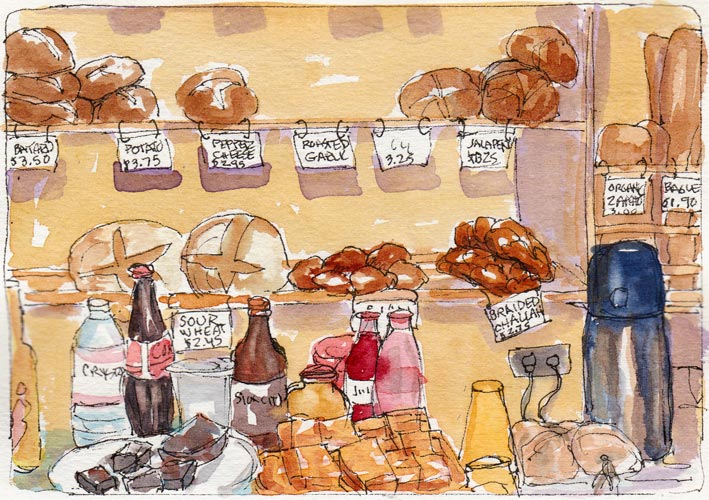
Bread and Snacks Counter, ink & watercolor
I stood in front of the counter where you order (above) to sketch and then painted it at our table. This was really fun to draw.
Dinner at Bread Workshop, ink & watercolor
My grilled chicken breast had been marinated in a yogurt sauce first and it was spicy and delicious, the grilled veges were fresh and tasty and they even had brown rice.
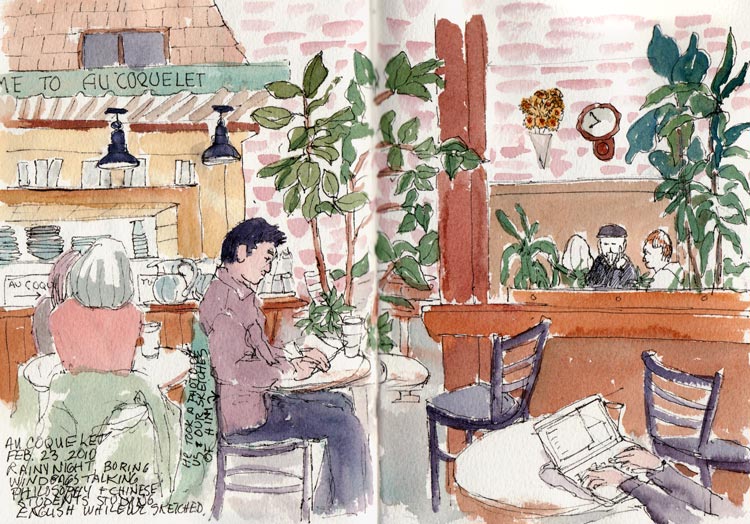
It was a dark and stormy night when Cathy and I met at Au Coquelet Cafe to sketch while listening to people debate the existence of reality and/or study English in Chinese.
I started by sketching the guy in the middle with black hair and just kept on going, seeing more and more stuff to draw. At one point he walked by our table, saw what we were doing, pulled out his cellphone and took photos of our sketches of him. That was a first! But it seemed a fair trade.
A group of four (perhaps retired professors from the university) seemed to have gathered for the sole purpose of defining reality, or proving it’s existence, or both, punctuated regularly by “huh?” “what did you say?” as one of the gents was hard of hearing (but not hard of “talking” as he blathered on and on). On our other side were Chinese college students studying English, but mostly in Chinese, with the occasional English phrase thrown in such as “I am a pretty girl” and “I am eating an apple” (which she wasn’t).
Au Coquelet is a perfect place to sketch. It’s large, open very late, has a couple of rooms, and counter service only so you don’t have to worry about waiters. There’s lots of wood, bricks, brick-a-brack and plants, design left over from the hippie days.
I have fond memories of sketching there on another stormy night, New Year’s Eve 1997, when I was supposed to be in Yosemite National Park but had canceled the trip due to rain. And it was good I didn’t go: the next day Yosemite had the worst flooding in 100 years, with roads and bridges so damaged that people were stranded there for weeks without sanitary facilities or food.
So with no plans for the evening, I headed up to the café to draw people who did have plans, partygoers coming in before and after their parties. After a while, a tall, handsome artist sketching at another table came over and joined me. We sketched together and talked, and ended up dating for a few months until I decided that the tales he told were too good to be true.
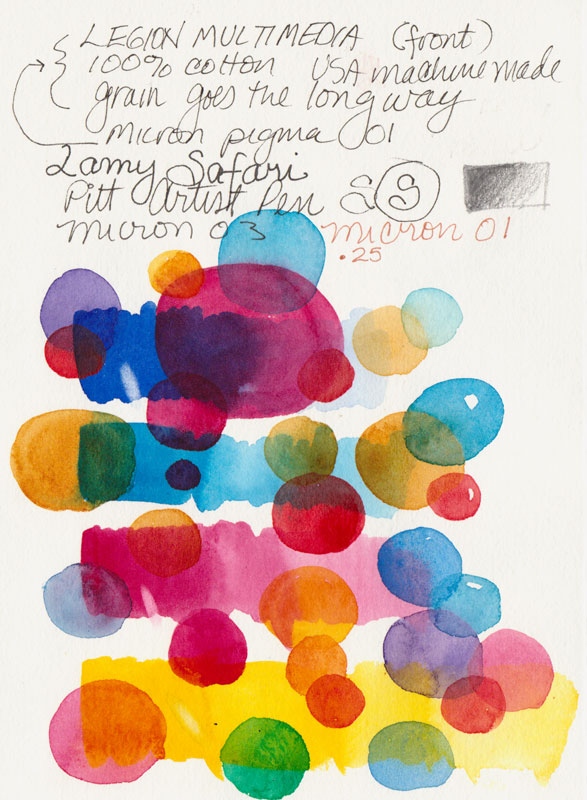
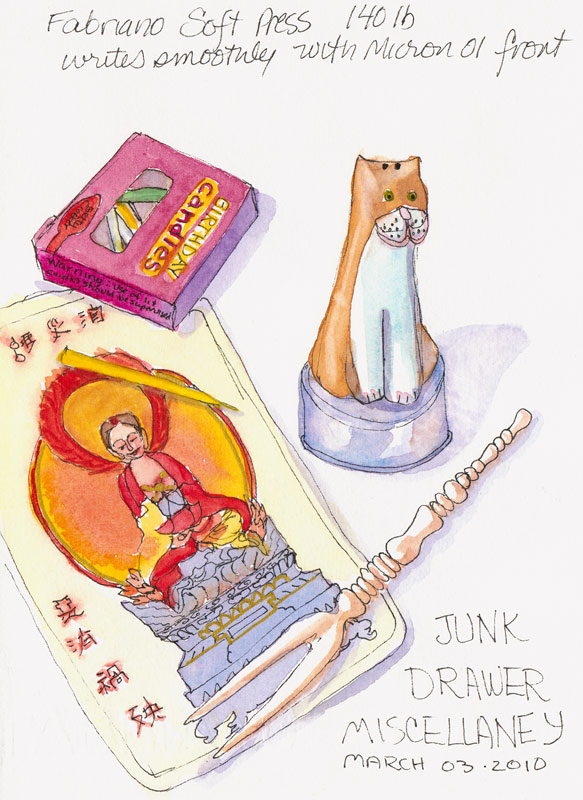
I used random items from my junk drawer as still-life subjects to test paper for binding my next journal. The paper I’ve chosen is Legion Multimedia Aquarelle 300 gsm (a little thinner than 140 lb). An employee at my local Artists & Craftsman store suggested it when I was unsuccessfully seeking the Fabriano Soft Press 140 lb recommended by Shirley of Paper and Threads.
Legion Test #2
Legion Multimedia/Aquarelle
I was delighted to find that the texture of the Multimedia/Aquarelle paper is perfect for writing on with the finest of pen points (unlike my current journal’s Arches CP paper). It took watercolor washes and multiple layers of glazes beautifully without buckling, pooling, or pilling. Color lifted off easily when rubbed with a damp brush.
The paper is nicely sized to prevent the paper from soaking up the paint, but not so extremely sized as the Arches 90 pound cold press that practically resists the ink.
It has two deckle edges and is relatively inexpensive. The Legion Multimedia/Aquarelle paper cost $2.69 a sheet at my Blick store while the Fabriano Soft Press 140 lb paper was $4.99 a sheet. Unlike the Fabriano, this paper is also available in 90 lb weight which I will try next, but I think that will have to be a special order through Artists & Craftsman since Blick only carries the 300 gsm paper.
“Use any painting and drawing media you choose on this fine quality, crisp white paper! Multimedia/Aquarelle Paper consists of 100% cotton fiber, is acid-free, and has a neutral pH. The paper is 140 lb (300 gsm) weight, and has an uneven textured surface. Available in two different surfaces — Cold Press and Rough. Cold Press is available in sheets and pads, Rough is available in sheets only, and comes in 200 lb (380 gsm) weight.”
I tested the paper for grain direction and it runs the long way, making it possible to tear it down for a journal just the size I like: 5.5″ x 7.5″, with no waste, which is not possible with the Fabriano whose grain runs the short way.
I finally was able to buy a sheet of Fabriano Soft Press (which has a similar surface texture, between hot press and cold press) and tested it too:
Fabriano Soft Press 140 lb: Test #1
Fabriano Soft Press
The Fabriano Soft Press paper had some things in its favor but ultimately the cons outweighed the pros in my mind. It seems like good sturdy paper, and the paint lifted OK without surface damage, but it was slightly less pleasant to write on with a fine-point pen, even though the surfaces of the two papers are very similar.
Since the grain runs the short way (which means the pages will need to fold the short way) you either end up wasting some of the paper or have fewer size options for the book. Also, the paper is thicker and stiffer, which means fewer sheets per book or a thicker, heavier book. And it is more expensive.
But what bothered me the most was the sizing. According to Blick:
“Fabriano papers are synthetically sized both internally and externally so that no animal by-products are used.”
In fact, Fabriano uses an acrylic sizing as opposed to the organic sizing (gelatin) that other companies use. I found that juicy washes on this paper took forever to dry and I assume it has to do with the non-porosity of acrylic sizing.
Fabriano Soft Press Test #2
Despite waiting and waiting and finally using a hair dryer before adding the next layer of glaze, the paint still wasn’t dry and glazes bled into each other.
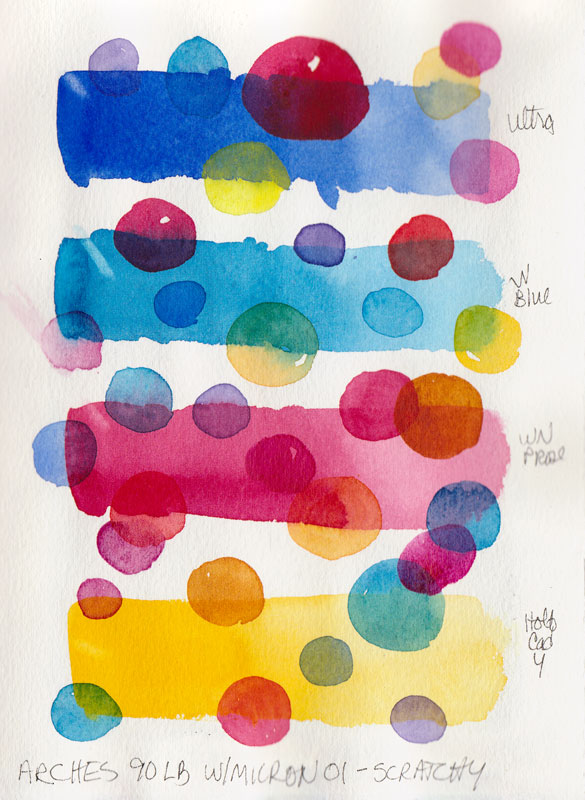
I also tested the Arches 90 lb Cold Press in my journal (below). Washes, glazing, lifting worked fine, but just isn’t pleasant to use with a fine point pen.
90 lb Arches Cold Press test
I’m looking forward to binding my new book and then giving the Legion Multimedia Aquarelle paper a true test of its journal-goodness and whether it really is the “perfect” watercolor journal bookbinding paper for me.
We had a sunny day after months of rain, so I took a walk around my garden. I was happy to see the hydrangeas coming back after having been cut down to little woody stalks. The three I’d planted after the comical hydrangea planting fiasco were all sprouting and there was a new one, a volunteer that appeared on its own volition.
And I too feel cut down to my woody stems, stretched thin by all I try to do.
So I’ve been thinking about who I am as an artist, who I want to be, what work brings me the most joy or the most suffering, my artistic strengths and weaknesses, and how I can make the time I spend on art as satisfying as possible.
I’m so grateful for artist friends like Barbara and my sister, who are good listeners and understand the challenge of having so many (too many?) interests and artistic pursuits to follow. Or, as Barbara writes, we’re “Never Bored” (or “Never B-ed” as she spelled it, for reasons she explains in her blog post).
Ultimately my goal is a more balanced life; I know that to stay healthy, along with time for art, I need to make more time for exercise, relaxation and play. (And some of my best art-making has been play; it just doesn’t have to be so darn serious!)
And like my hydrangeas, some good ideas are starting to bud and bloom about how I can nurture my most rewarding art pursuits now, while putting off or letting go of the others until more of my time is my own.














 Jana Bouc, Artist