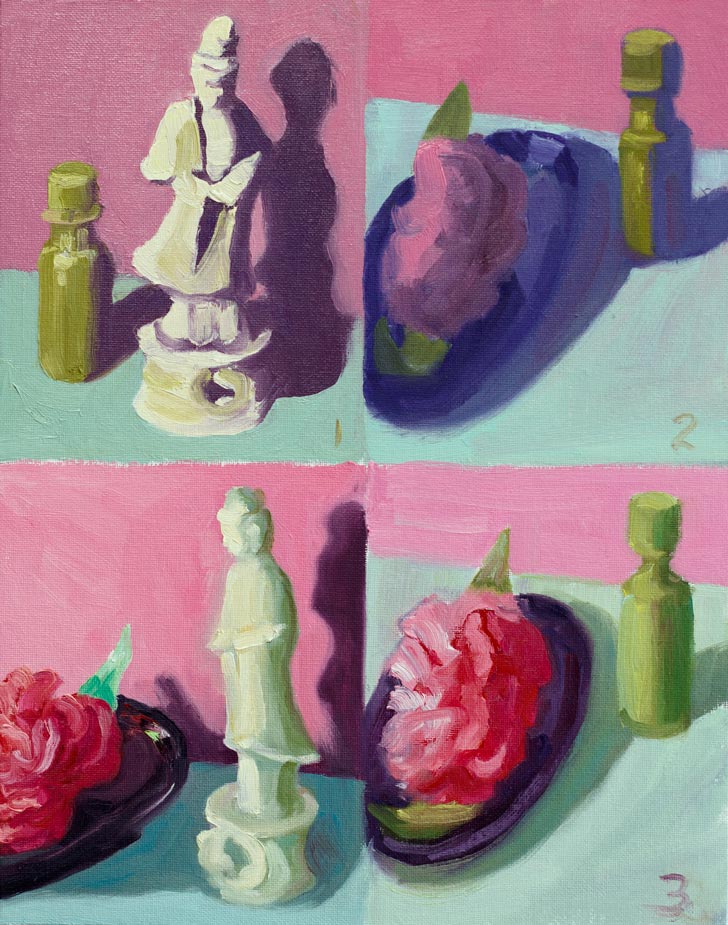
Kwan Yin, Pepper Sauce, Camellia in Soap Dish, oil on 8x10" panel
In the Simplified Shadow Mass exercise you practice visualizing the darks and shadows grouped into as few shapes as possible and paint them in one dark color. Then you can vary the colors for the rest of the painting. I tried that in the two top studies.
In the bottom two I allowed myself to use two different colors for the shadows instead of just one. I like the last one best (bottom left) and the first one second best (top left). I hate the muddy second one (top right).
It was fun experimenting with massing shadows and playing with composition by sticking to two objects and changing only one at a time.
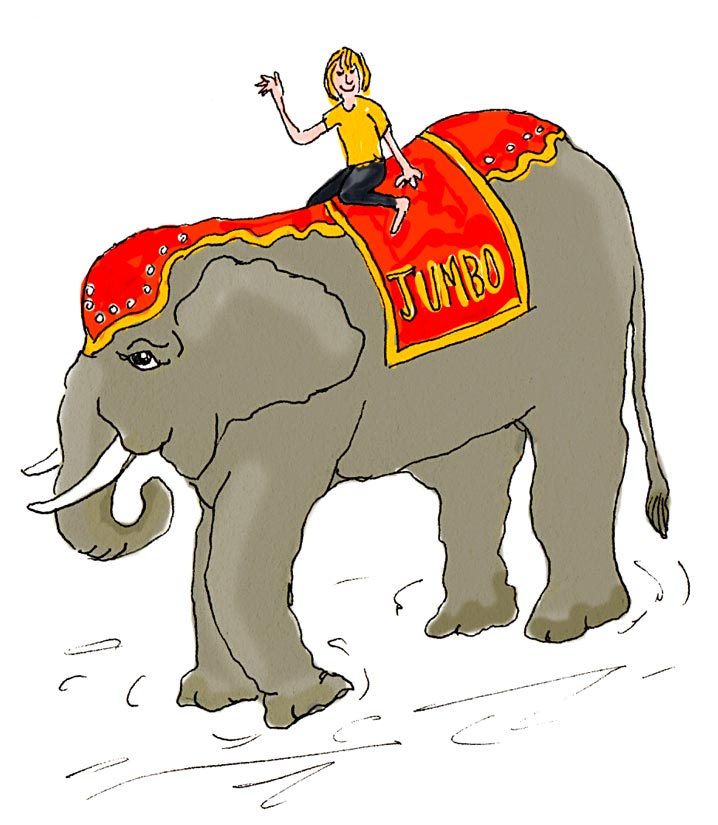
I drew this elephant to illustrate an interesting blog post for my job last week. The post is about change and uses the analogy of an elephant and a rider. The “Rider” is our rational, analytical side and the “Elephant” is our emotional side and the author explains why you have to work with both to make a change.
Elephant, ink drawing painted in Photoshop
I drew the elephant in my sketchbook, scanned the line drawing and painted it in Photoshop. That’s the one I used for that post. Later I painted the line drawing at top with gouache in my sketchbook. Which do you like better?
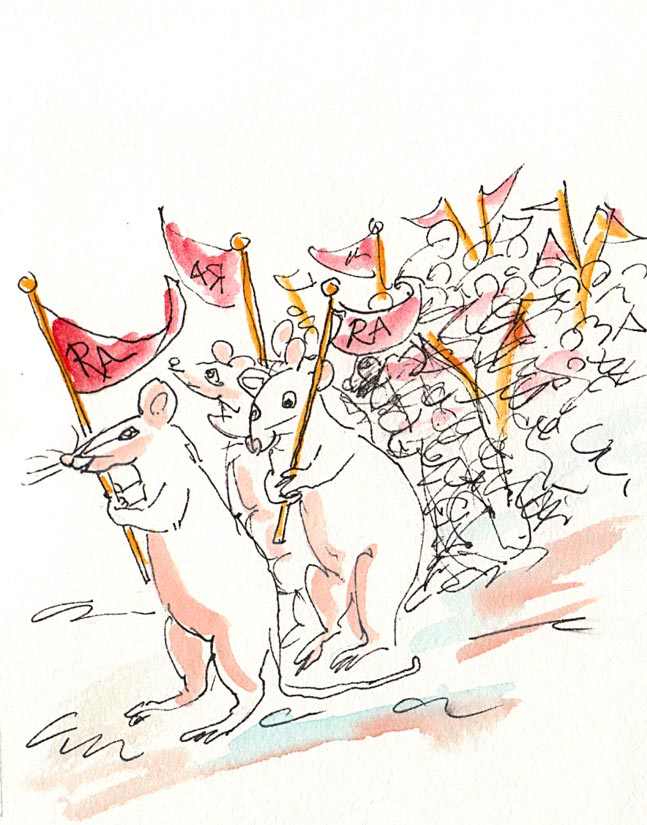
Rats Rally the Herd, Ink & Gouache
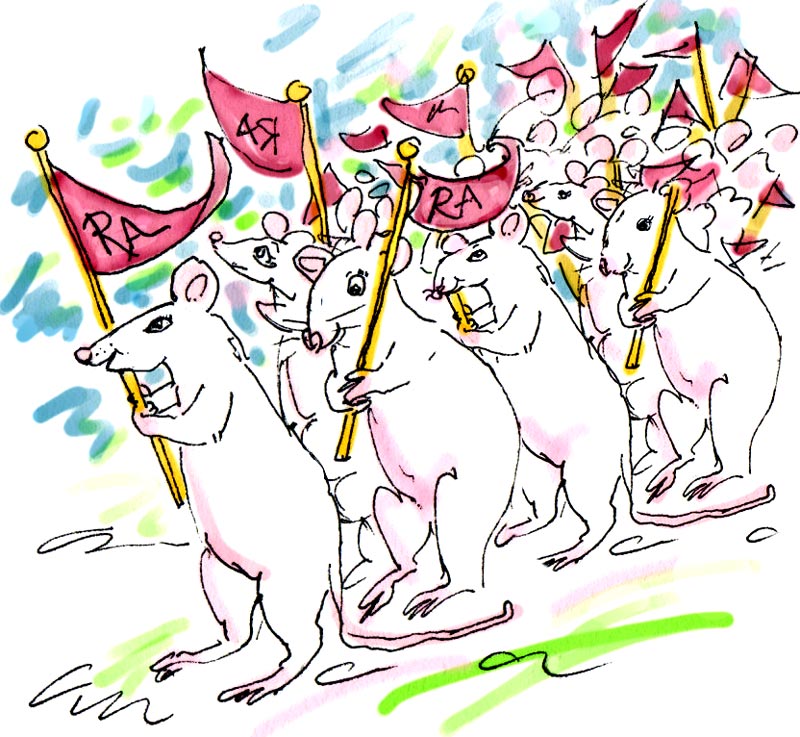
I did this illustration for the same article, but it got rejected, theoretically because two pictures were too many for the one post, but I suspect it was because rats are a little too creepy, even though it is the acronym of a group that was highlighted in the post (RATS: Reading Apprenticeship Teachers and Supporters).
Rats Rally the Herd, ink drawing recomposed, painted in Photoshop
I used the same line drawing for the final illustration above, but cloned/altered some of the rats and painted and sketched more in Photoshop. This is the one I proposed for the post and got rejected. I didn’t mind, it was fun to do.
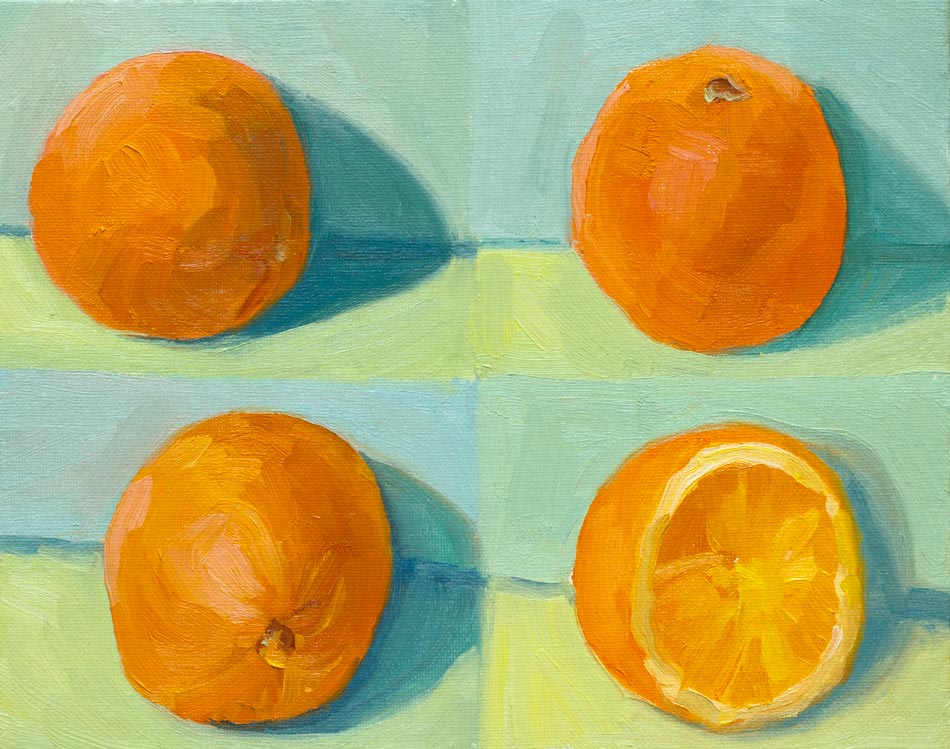
I read about the Daily Painters’ 10 minute exercise (paint the same thing four times, 10 minutes each) and thought it sounded like fun. What I learned from my attempt (below) is that I need more than ten minutes to do a painting, even if it is small. So when I finished doing the exercise below, I gave myself more time, and painted the study above, exploring a way of painting that works better for me.
Orange four times @ 10 minutes each, 0il on 10x8" panel
I think I’ve found a way to approach an oil painting that works for me, and it’s sort of* illustrated in the top study above.
Sketch in the big shapes and indicate the lines of the planes using *thinned paint (see diagrams in previous post here).
With the same thin paint (*not thick paint as I did here), fill in the shadows to indicate darks and leave the light areas white.
Use both dark/light and warm/cool variations of colors to model the form.
Lastly add light highlights, dark accents, details and make any other necessary adjustments.
*Sort of because originally in the top study each square illustrated those 4 steps, but I played around with the first two, adding white paint between the plane lines, and turning the thinly blocked in value sketch into a value study with black and white paint.
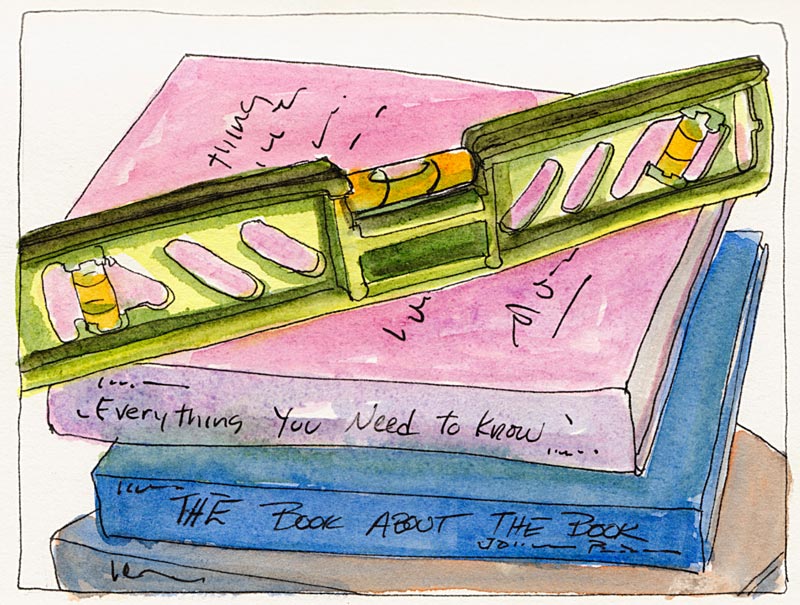
As the “blog master” at my day job, I’ve been enjoying contributing illustrations for posts as well as getting them edited and published. I drew the ladder and level for a two-part post about helping English as a Second Language students improve their reading. The ladders and levels used in the posts were metaphorical. (If you’re interested here are Part 1 and Part 2).
Level, ink & watercolor
The level in the picture above is a small plastic one that I have in the studio. It’s actually an offensive Day-Glo green so I used a different green for the sketch. I keep the level on my easel to make sure a canvas is straight before I start painting.
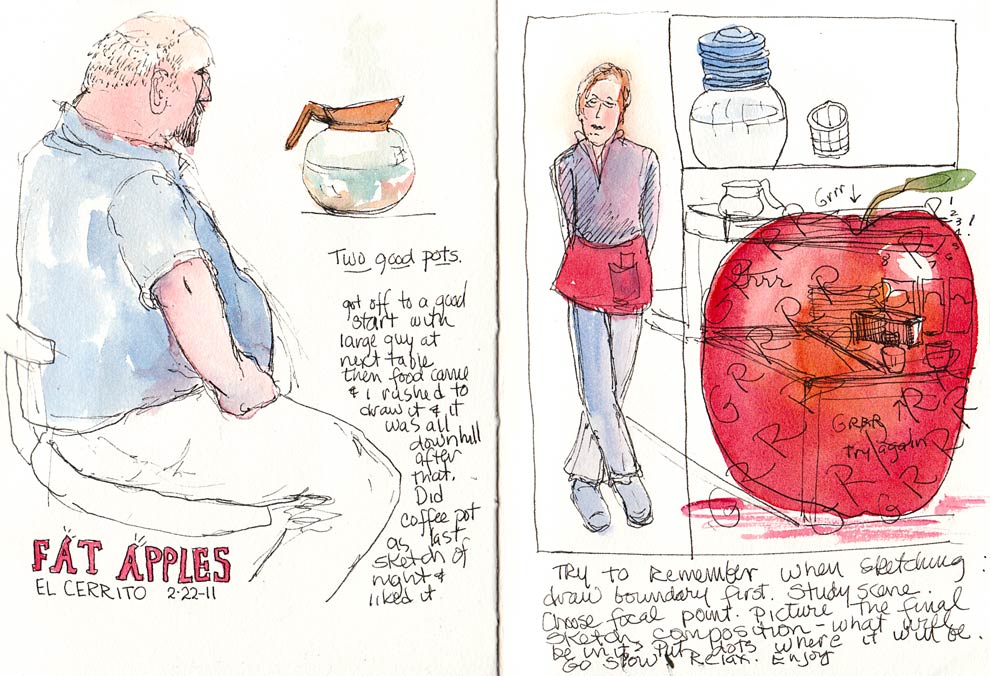
My favorite two sketches the night we met to sketch at Fat Apples Restaurant in El Cerrito were the two “pots” on the left hand page above. The guy was the first thing I drew, the coffee pot the last. I wasn’t in great shape, having had little sleep the night before. I just couldn’t get into the drawing zone, turn off the inner critic or relax into seeing, drawing, and enjoying the adventure.
Underneath the watercolor apple above are lots of messed up lines and the word “Grrrr” written all over the things that frustrated me. The waitress on the right kept returning to her spot and standing in exactly the same position each time and the counter beside her was even more stationary but I just couldn’t draw it.
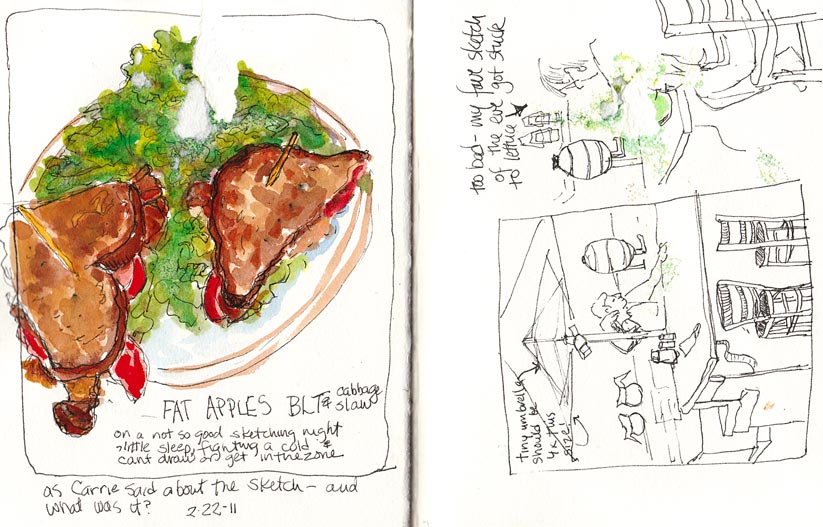
Fat Apples BLT, ink & watercolor
When I added m ore watercolor at home to the BLT (left page above) I must have closed the book too soon because the pages glued themselves together. When I tried to separate the pages, part of my sandwich stuck to the other side. Not only did that ruin the sandwich but also a small ink drawing I’d liked on the other page.
I’d repainted the sandwich because when we showed our sketches at the end of the evening and I said it was my dinner, one of the sketchers innocently asked “what was it?” And she was right — it was so loosely drawn and painted that it wasn’t recognizable as a sandwich.
Another drawing opportunity while the girls play in the park. They got bored and ready to leave at just the moment I finished the sketch. I added a little color with Pitt Artist brush pens when I got home. That’s quite a fancy light fixture at this nice little park in Richmond Annex.
I have so many other pictures to post but all have stories that need writing, and after a day of unsuccessfully trying to re-paint a painting for the third time, any words I might share at the moment aren’t really fit for print!
Saul's Deli & their famous pickles, ink & watercolor
We always enjoy a visit to Saul’s Deli in Berkeley for sketching and dinner. I got my usual grilled trout dinner but was too hungry to draw it before eating. One of the owners of Sauls, Karen Adelman does the wonderful quirky drawings on their menus and website and always makes us feel welcome to come and sketch there.
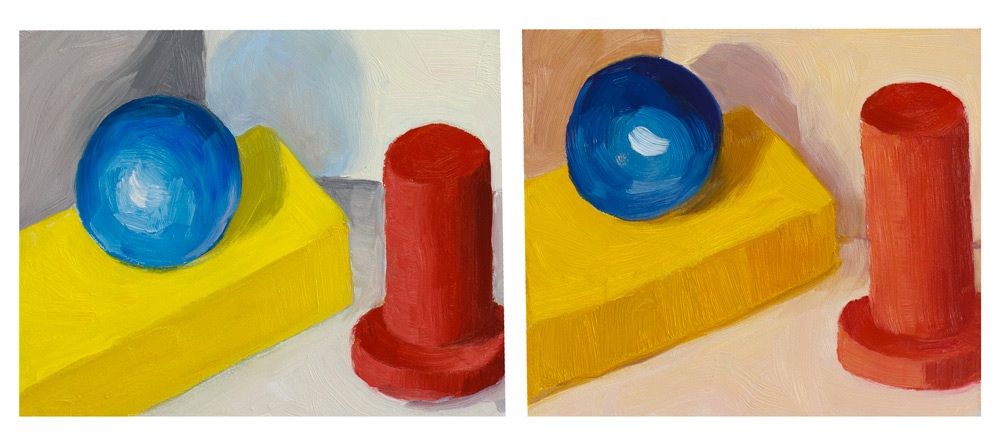
Cool light on the left; warm light on the right; same objects with white background; oils
When painting outdoors, lighting is controlled by the sun, clouds, atmosphere, and time of day. But in the studio you get to choose your lighting source from window light to bulbs of all kinds. In an article about color in the March 2011 Artists Magazine, Scott Burdick suggests an experiment to compare the effect of cool and warm light sources: Set up a still life of primary-colored objects and paint it twice; once under a warm light and again under cool light. That’s what I did in the studies above.
While I’m not sure I captured every nuance (or get the drawing just right), it’s interesting to see how different the same-colored objects and white background cloth look under different “temperatures” of light.
I did these two studies in Peggi Kroll-Roberts‘ studio, with the subjects lit by 150 watt incandescent bulbs which have an even warmer color temperature than the bulbs I used in my two top studies. The actual goal of the study on the left was to paint the scene (cantaloupe and watermelon slices) with as few brush strokes as possible. The assignment for the one on the right was to group and paint the shadows with one color only.
Yes Target! Although we’ll be so happy when we can go outside for our Tuesday evening Urban sketching again, sketching at Target was a lot more fun than you might think. I had fun sketching the silly high heels and flip-flops on the wall behind them. Nobody seemed to notice or question why I was painting in the shoe department.
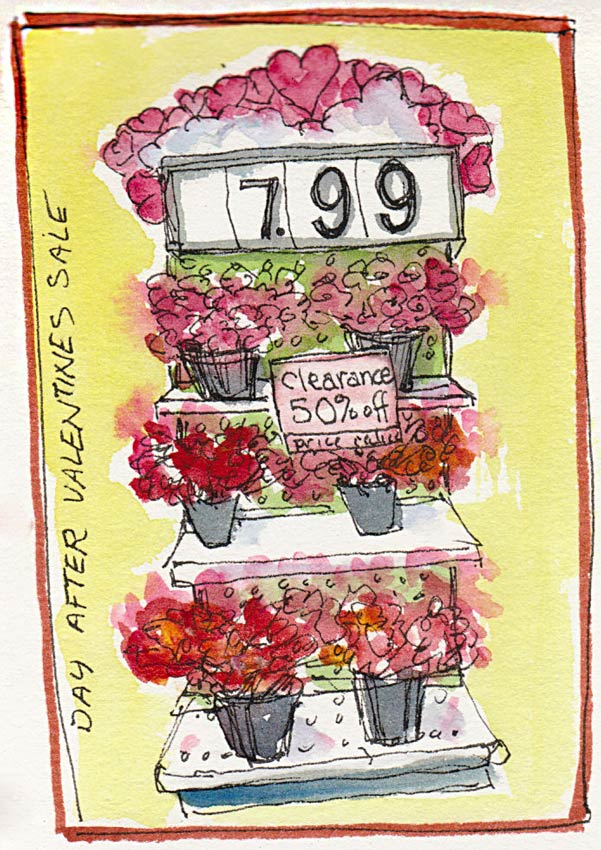
Left over Valentine Flowers, ink & watercolor
It was the night after Valentine’s day and there was the display of sad, wilting Valentines roses, on clearance, half off.
Remote Controlled Baby Swing, ink & watercolor
Whatever happened to sitting in a rocking chair holding the baby in your arms? This contraption had a touch pad remote control with 6 speeds and more. Someone told me he bought one of these only to discover it came in a million parts that was a nightmare to assemble.
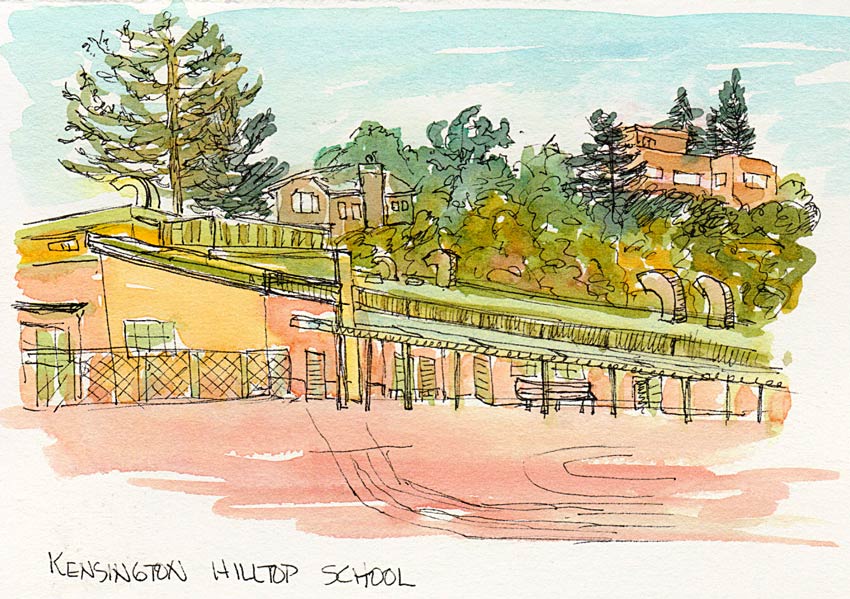
Kensington Hilltop School, ink & watercolor (a beautiful school above a wonderful park at the very tip-top of Kensington hills)
In my last post I asked for advice on sorting and storing completed oil paintings on panels. Along with the good suggestions from readers, I found a fantastic website that provides the answers to these and many other questions about proper handling of artwork and art materials of all kinds.
The website is AMIEN.org (Art Materials Information and Education Network), “a resource for artists dedicated to providing the most comprehensive, up-to-date, accurate, and unbiased factual information about artists’ materials.” They are part of the education department of the Intermuseum Conservation Association.
AMIEN’s forums are the place to find information to all our questions about proper use, handling, storage, shipping, application, etc. of art materials and finished art work or all kinds. Here is a portion of what they say (more here) about storing oil paintings on panels:
Store your paintings standing on edge, one next to the other, with a piece of acid-free paper loosely covering the face of each painting. You can tape the paper to the back of the panel and fold it over the front.
Ideally, you will put these paintings in a rack, elevated off the floor, in some location that is relatively dust-free and not subject to wild swings of temperature and relative humidity. Even more ideally, each painting ought to be separated from the others, but that would take a very large rack. Second best: You should not have more than about 5 paintings leaning against each other; separate the groups of paintings.
AMIEN’s forums cover topics like Watercolors, Pastel, Encaustics, Acrylic Paints, Supports, Grounds, Solvents and Thinners, Varnishes, Pigments, Color charts, Oil Paints and Mediums, Alkyds, Mural Paints and Techniques, Colored Pencils, Printmaking, Photography and Printed Digital Media, Matting, Framing and Labeling, Picture Protection, Crating, Shipping, Storage, Conservation, Hazards and much more.
About the sketch at top: Friday afternoons I have the pleasure of spending time with two lovely 11-year-old girls who still like to swing and play make-believe games on playground equipment. I discovered Kensington Hilltop School while hiking in the hills on the weekend and brought them there the next week. They played, I sketched, we had fun.








 Jana Bouc, Artist