Categories
Art theory Illustration Friday Sketchbook Pages Watercolor

Early Theory of Perspective

Illustration Friday

Early Theory of Perspective

  1. The world is flat and ends at the horizon.
  2. As you get closer to the horizon you get smaller and smaller until….
  3. You fall off the edge and disappear…
  4. And that’s why it’s called the “vanishing point.”

This week’s Illustration Friday challenge is the word “Theory.” Since I’ve been re-learning perspective and reading about the progression of artists’ attempts to create the illusion of depth and space, I thought I’d propose my own history of what the earliest thoughts about perspective might have been.

My continuing exploration of perspective has led to me making a fool of myself as I walk around, closing one eye and putting my hands up to match the angles on buildings and trees as I look for vanishing points and check how angles and lines relate to one another.

I tried to demonstrate to some co-workers as we went out foraging for lunch how the horizon is relative to the individual viewing it, not a fixed location. Nobody was going for it though, either trying to prove me wrong or having more important things to think about, like whether they were in the mood for soup or salad.

Here’s what my favorite book (so far) on perspective says about the horizon:

Eye level rises and falls with the level of your eye, wheher you are down near the floor, sitting, standing, in a tall building, or in an airplane. The eye-level plane extends an infinite distance in all directions and at a remote distance coincides with the horizon, which the eye level is often called.

I can’t really explain why this concept so intrigues me, but I just can’t get over it. I loved the way Brittney Gilbert, writer of CBS5.com’s blog “Eye on Blogs,” titled her link to my recent post: “The Horizon is You-Dependent.”

It just makes me wonder what other facts of life that I’ve taken for granted are only perceptual, not actual. Is reality completely subjective?

Categories
Art theory Drawing Landscape Plein Air Sketchbook Pages

Back to Basics: Perspective

20080212-perspective1

Pencil sketch, 9×12 (larger)

I studied perspective in college drawing class but didn’t completely understand it, didn’t like it, and thought I had little use for it. Years later my friend Barbara gave me a copy of Drawing on the Right Side of the Brain. In that wonderful book, the author offers a more “right-brained” way to work with perspective, using a variety of strategies that allow one to see angles and shapes without having to use more “left-brained” techniques like 2-point perspective.

It gave me what I needed to draw well enough to get by, and I came to appreciate my slightly wonky style of drawing. It worked just fine for free-spirited sketches or paintings. When I needed something to be drawn accurately (as the basis for a realistic watercolor, for example), I would either grid it up, trace the enlarged photo onto watercolor paper, or draw/erase/draw/erase first on tracing paper until I got it right and then trace that onto watercolor paper.
20080212-perspective6

I got confused in this one…it has several problems

But plein air painting, which I’ve become passionate about, requires a quick accurate drawing in order to start and finish a painting within 2-3 hours max. After that time the light changes so much that colors, shadows, and anything moving (clouds, creatures, water) are completely different. Starting with a bad drawing dooms the painting right from the start. I needed to go back to basics and get a grip on perspective.

I grabbed Keys to Drawing by Bert Dodson, read the section on perspective and started sketching stacked up childrens blocks, stuff in my house, and from my imagination, trying to understand perspective.

20080212-perspective3

Here’s something I didn’t know before: The horizon is always at your eye level. The horizon line (e.g. where the sky meets the land or the sea) is actually what you see when looking straight ahead at your eye level, whether you’re sitting, standing, or lying on the ground. I find that really amazing — it just seems so self-centered, somehow.

20080212-perspective5

(I drew eyeballs on this one to remind me of my point of view/horizon)

A few things still confused me so I did some more research on the web and found two helpful sites with good information. How to Draw and Paint, offers a couple of basic, easy to understand articles about perspective. Ralph Larmann’s Art Studio Chalkboard from the University of Evansville goes into more technical detail and provided answers to the things that were confusing me (like what happens when the object straddles the horizon, or the object is at an angle, like peaked roofs, or the ground is hilly).
20080212-perspective2 20080212-perspective4

I’m going to do some more practicing using what I’ve printed out from those two sites. I also picked up an excellent book from the library: Perspective Drawing by Kenneth Auvil, which is actually fun and interesting reading. Any other suggestions for improving linear perspective drawing would be gratefully accepted.

Categories
Life in general Sketchbook Pages

Maybe it’s time to kick the coffee habit (again)

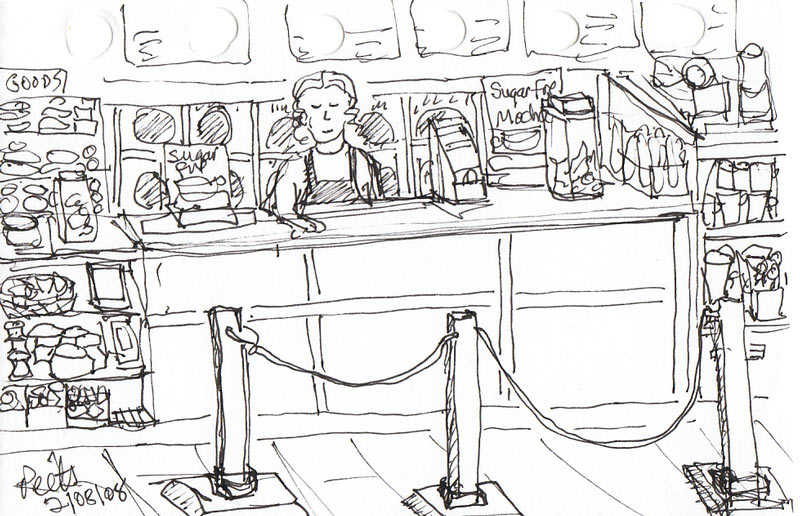
Peet's Coffee

Ink, 3.5″x4.75″ (Larger)

I sketched this at Peets when I stopped to pick up some coffee beans, now that my grinder is working again. It’s in my new combo wallet/sketchbook. I visited my local stationary store looking for a small binder to use as a sketchbook and the owner offered me this little Filofax for only $5.00 since someone had returned it. It’s a perfect wallet (even a zipper section for change) and has rings to hold nice paper. See the bottom of this post for photos of it.

The problem with being addicted to a morning cup of coffee is that I wake up stupid and dysfunctional until I’ve had my cup. This is dangerous since making the coffee involves handling scalding liquids, equipment with motors and sharp blades (to grind the coffee), drip filter holders that can be easily knocked over, and carrying cups of milky coffee across the room with shaky hands. I’ve encountered disasters with all of the above.

To read the rest of this post and see the wallet/sketchbook photos, click “Continue Reading” below:

Categories
Drawing Dreams Life in general Painting People Sketchbook Pages Watercolor

Dreams: Definitely not on the best dressed list

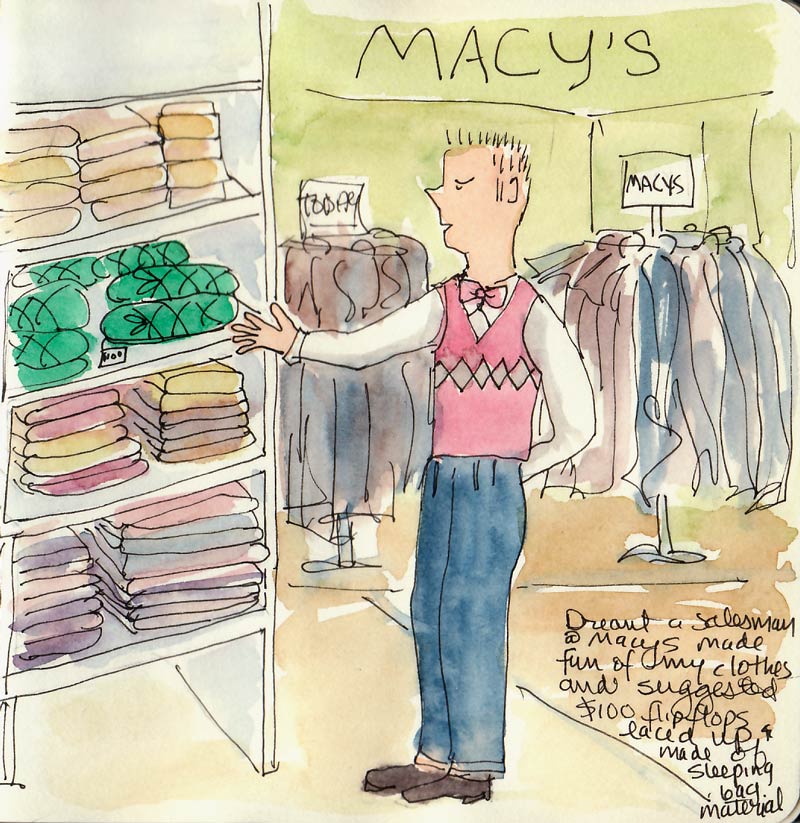
20080208-Macys

Ink and watercolor in 5.5″ square sketchbook (larger)

Last night I dreamt first that I was shopping in Macy’s and a snooty salesman looked me up and down and made fun of what I was wearing. He offered to help me dress better and recommended $100 flip-flops with made of thin green nylon (like they make sleeping bags from) with criss-crossed shoelaces that held the flimsy things on your feet.

“The latest thing,” he told me. I wasn’t going for it.

Carrying on the poorly-dressed theme, the next dream was that I was wandering around Los Angeles, looking for a bus to Santa Monica (a suburb of LA where my mother lives) wearing only a large (but not large enough) shirt.

20080208-shirt-only

(larger)

I wasn’t terribly embarrassed by this partial nudity, having gotten used to it from all the time I’ve spent in previous dreams completely naked in public.

In real life, I don’t go out naked, though I did spend a summer nude in the early ’70s when I was 22, camping with 6 friends at a beautiful spot in the Siskiyou National Forest, 10 miles down a dirt road from the town of Happy Camp. The temperature in the afternoons reached 117 so nudity seemed pretty reasonable.

Running by our campsite was the perfectly named Clear Creek which fed into a wonderful swimming hole surrounded by huge boulders, perfect for lying on and diving off of.

We were the only ones there during the weekdays but on the weekends the occasional truckload of Native Americans from the nearby reservation would come out to swim or a family might camp for the weekend. The guys in our group would put on bathing suits when we had visitors but us hippie girls stayed au naturel for the duration and nobody seemed to mind.

Categories
Art theory Oil Painting Other Art Blogs I Read Painting Photos Plein Air

Learning to See Color

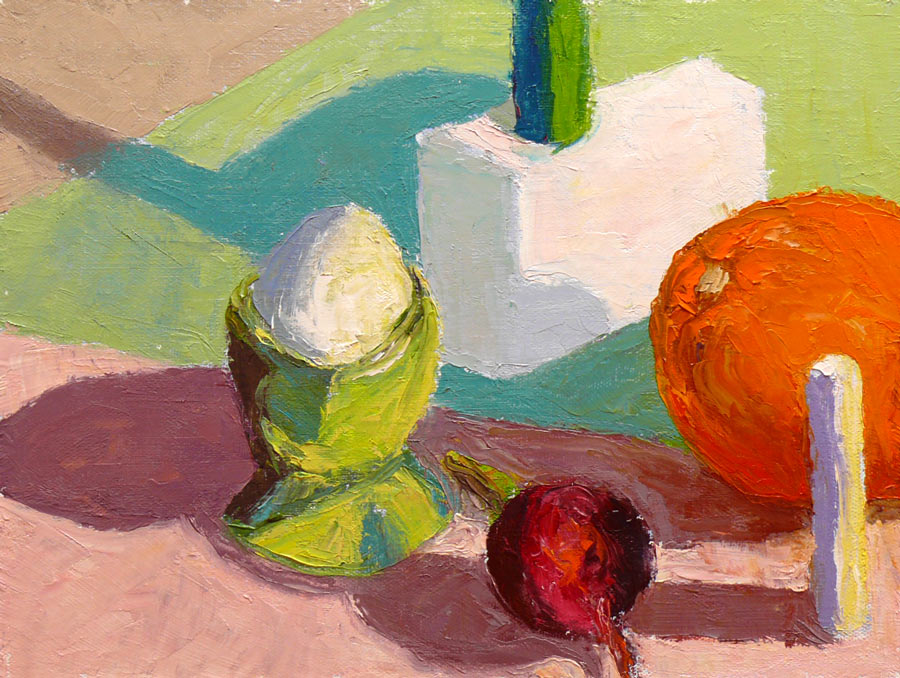
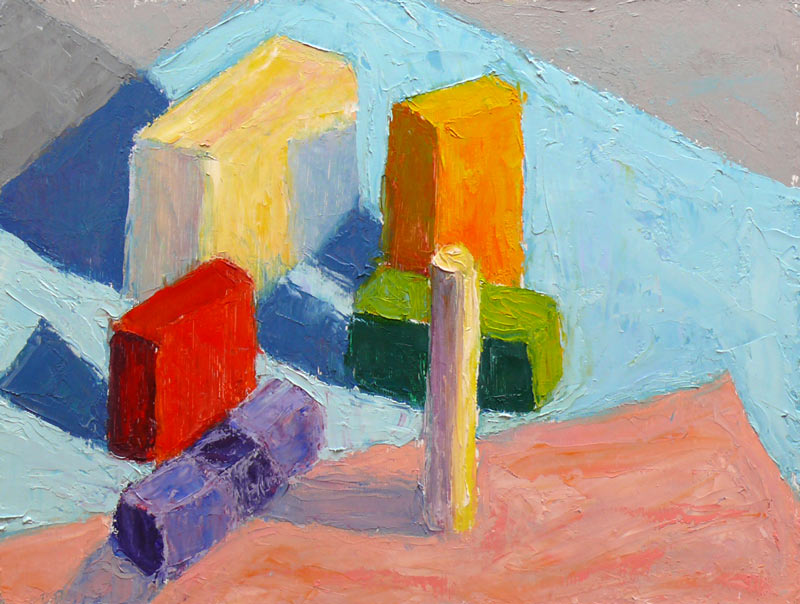
Color study with blocks and food

Oil on panel, 9×12″ (Larger)

On Monday mornings I’m taking a painting class from Camille Przewodek in Petaluma. I first read about her on Ed Terpening’s blog and when I saw her absolutely stunning work I was thrilled to be able to study with her.

As I understand it, the focus of her class is learning to develop one’s ability to see light, atmosphere, and their effects on the subject one is painting and to develop the ability to interpret that in paint. Camille bases her teaching on Henry Hensche‘s, with whom she studied and then spent many years further expanding upon his work. Hensche was a student of Charles Hawthorne who was a student of William Merrit Chase, an American Impressionist who developed his color theories via his study of Monet‘s groundbreaking work.

Camille’s paintings are simply stunning. A slide show of her paintings brought tears to my eyes with their beauty…something that has only happened to me once before when I saw Renoir’s Luncheon of the Boating Party in person.

Newcomers to the class begin by doing plein air still life color studies of colored blocks. Using blocks simplifies the subject matter in order to focus on using changes in color hue and temperature to create the illusion of form and depth. There’s an explanation of this process in the book, Painting the Impressionist Landscape: Lessons in Interpreting Light and Color by Lois Griffel, who took over Hensche’s art school after he died.

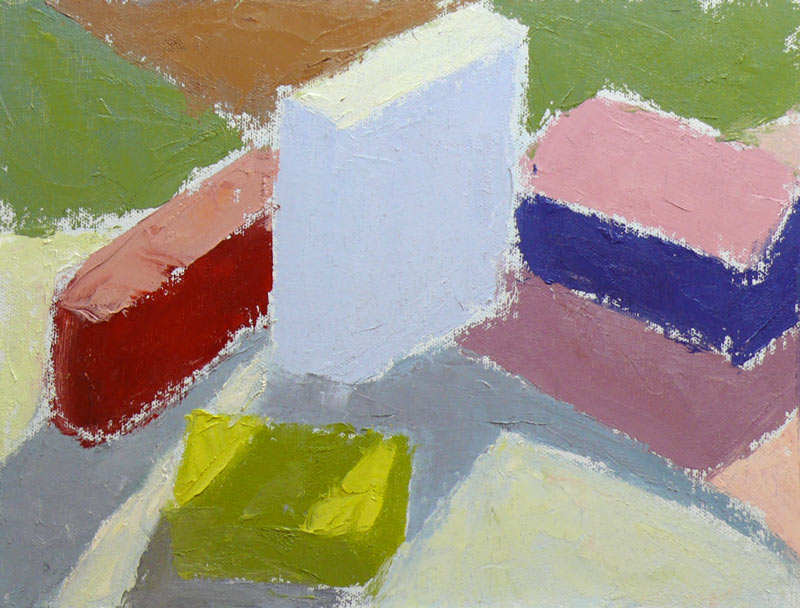
Color Study plein air with blocks

Oil on panel, 9×12″ (larger)

Above is the first block study I did in class while everyone else was painting beautiful marshland. The process for doing the studies is to block in the masses with a palette knife, leaving white space between color areas, breaking each shape into two values: shade and light. You start with one color and move to the next, focusing on the relationship between each color and the next.

Elio Camacho, my other wonderful painting teacher, also strongly emphasizes the importance of the relationship between contiguous colors. They both explain that there’s no such thing as a “muddy” color—that the appearance of muddiness results from the relationship not being right between a color and it’s neighbor.

Color Study, cloth lightened

Oil on panel, 9×12″ (Larger)

The one above was done at home under a bright light, trying to simulate sunlight on a dark and rainy day. When I brought the original version of this painting to class for critique, Camille pointed out that blue cloth was too dark because in the bright light it shouldn’t be darker than the shadow on the white block so I worked on it some more, lightening the cloth. If you want to see how it looked before, and the steps in getting there, including the photo of the blocks, just click “continue reading” below.

Categories
Cartoon art Colored pencil art Life in general Sketchbook Pages Watercolor

Hamster Brain, Part Two

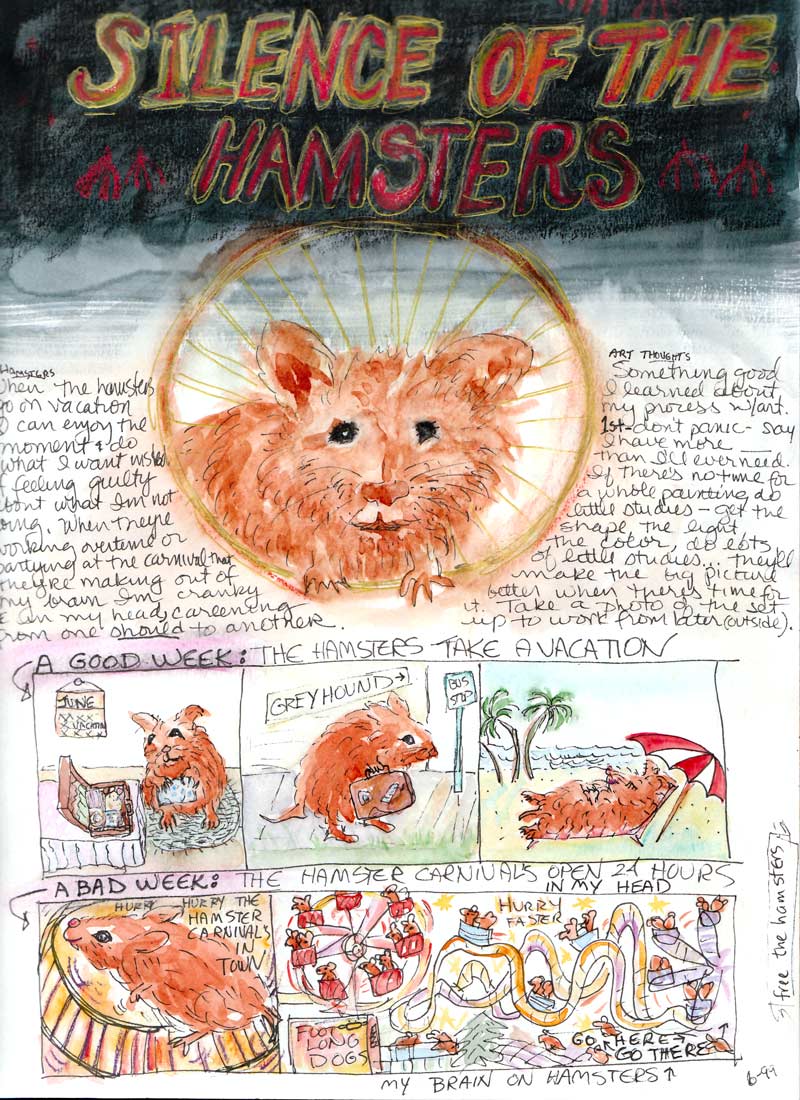
Silence of the Hamsters

Ink, colored pencil & watercolor in 9×12 sketchbook (Larger)

In yesterday’s post I wrote about what I call “Hamster Brain” (when my mind gets stuck spinning in a hamster wheel of “shoulds” and I can’t figure out what to do next and so do nothing). I was going through an old sketchbook and found this illustration I did in 1999 on a similar day of “my brain on hamsters.”

When I read the journal entry it was interesting to see that I’d figured out back then what was really going: a fear of not having enough: not enough time, and maybe not enough talent or skill either as I faced the artist’s version of writer’s block…that icky fear that seems to come around when I finish one project and am faced with the blank canvas/sheet of paper. I’ve learned to encourage myself and turn off those critical voices but every once in awhile they sneak up and get me when I’m not looking.

Today was so much more enjoyable,  even though it was pouring down rain. I did my errands, went to the gym, and painted. Sometimes it takes a hamster-brained day like yesterday to make me really appreciate an ordinary day that is joyous just by the absence of negativity and blocks.

Categories
Life in general Sketchbook Pages Still Life Watercolor

Stanley 93E Box Cutter & Polish

Stanley 93E & Polish

Watercolor on hot press paper, 5 x 7″ (Larger)

Yesterday at work someone had left a strange little still-life set up on a table in the ladies restroom: a little cosmetic bag and a a heavy metal box cutter (well, to me it looked like a still life, probably nobody else would have thought so). I recreated it on my drawing table tonight, adding a bottle of nail polish that I keep in a similar cosmetic bag.

I like the way the box cutter came out looking like a fish with a little rooster comb on top (the brass thingee you push to move the blade in and out). It felt so good to do this painting after a frustrating day in which I never made it out of my pajamas.

Hamster Brain Part One

Fridays I work half a day from home, but today the half day stretched out into the late afternoon, due to problems needing my attention and because I got a late start due to spending a frustrating hour trying to reassemble my wonderful Capresso coffee grinder after finally receiving the missing part in the mail (it had fallen on the floor when I cleaned the grinder, and was promptly stolen and hidden by my plastic-gizmo loving calico cat Fiona). It turns out I’d put the burr grinder piece in wrong and it was jammed and I could not remove it and so the bean hopper wouldn’t screw back in on top. Now the whole thing needs to go back to Capresso for repair. Makes me think it’s time to give up coffee (again!).

It was the first sunny day in a long time and I wanted to get outdoors and paint…and I needed to get some exercise…and I had some errands and phone calls to make. Plus I had a bunch of studio art projects I wanted to do — some dream paintings, color exercises, and this one.

I got into one of those stuck places, going around in circles…I’ll go to the gym first, no to the store first, no outside to paint first, but really I should vacuum…I’ll just check my email….and around and around. I call it Hamster Brain, since it feels like running in one of those hamster wheels.

Finally, at 8:00 P.M. I pulled myself out of it, did about half an hour of Pilates (while simultaneously putting in my weekly call to my mother) and having accomplished both those things, got to my drawing table and made this picture. Now it’s 11:00 p.m. and I’m free! My weekend has begun and it will joyfully include exercise, painting, and as little erranding and hamstering as possible!

Categories
Every Day Matters Faces Life in general People Sketchbook Pages Subway drawings

13 minutes, 4 commuters, politics and art books

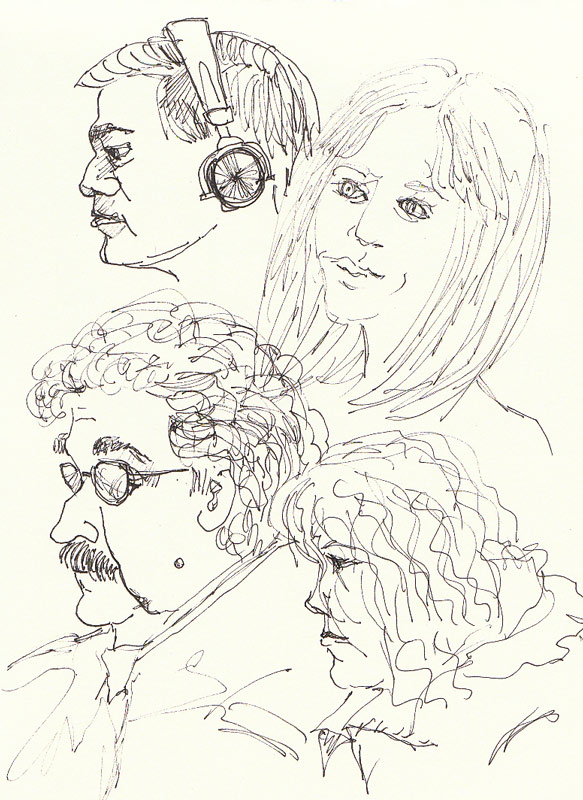
Ink in 6×9 sketchbook (Larger)

On my way home from work tonight I intended to continue reading Hensche on Painting (about an American Impressionist painter and his teachings about seeing and painting color under the influence of light). But the BART train was full of fascinating faces and I had to sketch instead. There are four stops between my office and home. The person in the seat two rows ahead of me was replaced at each stop, which made for a wonderfully random assortment of models, with 2 to 4 minutes each to draw them.

Tonight my painting group was here and we talked about whether we were going to vote for Hillary or Obama. As I wrote that sentence, I realized that it doesn’t feel right to call her by her last name or to call him by his first name. I wonder what that means and if it’s unconsciously sexist of me? Or is that I didn’t know how to spell Barack and had to look it up, even though I’ve seen it a hundred times already? Or is it because when I think “Clinton” I think of her hubby?

Susie has been reading Obama’s first book, Dreams from My Father: A Story of Race and Inheritance, about his life pre-candidacy and it has convinced her to vote for him. I’m going to download it from Audible.com and listen to it.

Tomorrow night (Thursday) is the California debate between the two of them, and although I don’t get CNN on my TV, they are streaming the debates live on CNN.com so I will watch it on my computer. Then I’ll make my decision and mail in my absentee ballot. (I like pretending that my vote actually matters.)

I’m just looking forward to the end of the Bush era and not having to run to turn off the sound when he’s on the radio or TV.

Categories
Flower Art Oil Painting Painting Plants Still Life

Daffodils Again

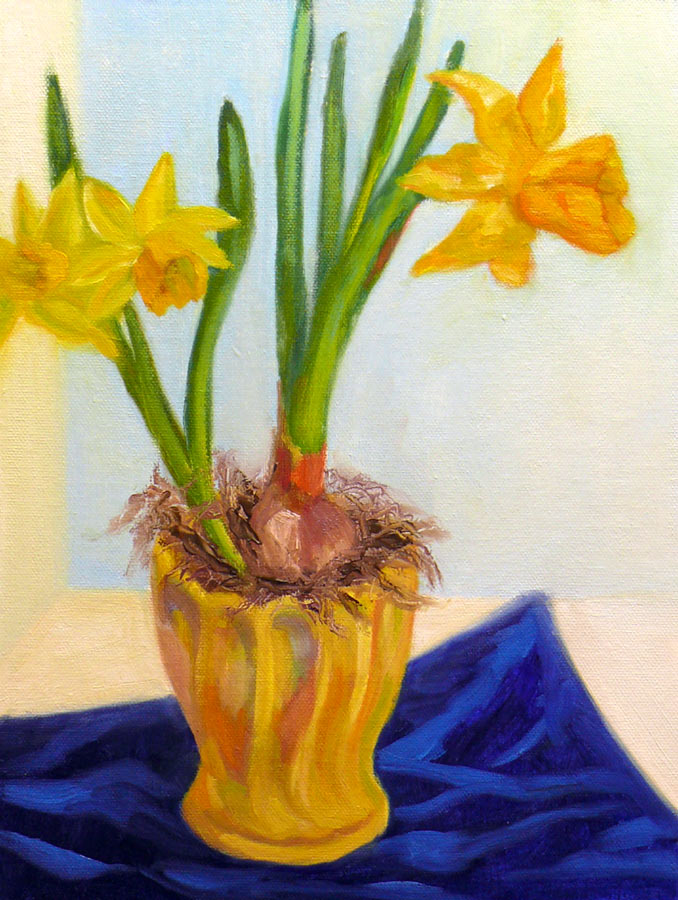
Daffodils 2 - Finished (maybe)

Oil on panel, 12 x 9″ (larger)

In between a million (well, maybe 25) other things this weekend I made another attempt at painting these daffodils from life. I don’t think I’ve nailed it yet, and was amused by how the flower on the right turned into anything but a miniature daffodil like it’s sisters on the left. It just kept growing and growing but I let it because I liked it.

There’s a lot I still need to learn and figure out (having to do especially with the effects of light but also how to set up a still life with more interesting background) but I’m happy enough with my progress. If you’d like to see the steps of painting this, click “Continue Reading” below.

Categories
Art theory Drawing Flower Art Oil Painting Painting Plants Still Life

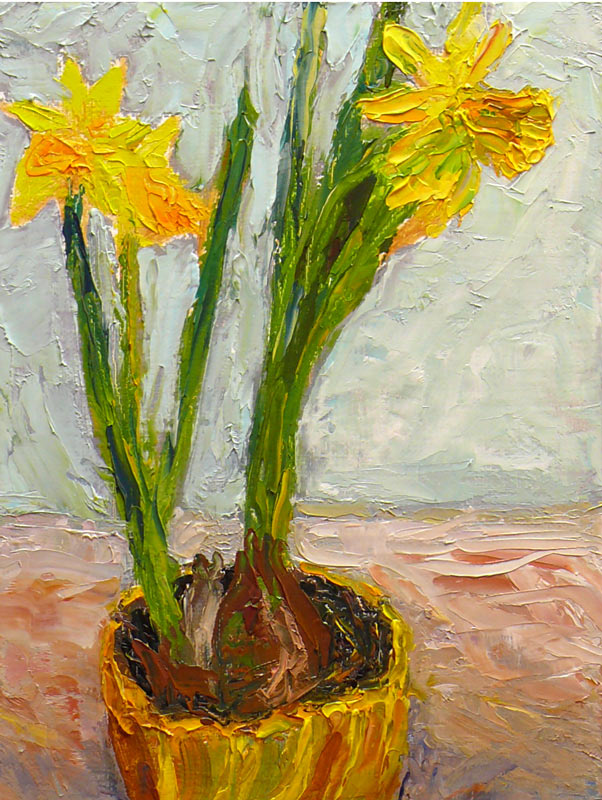
Miniature Daffodils in oil

Finished oil painting

Oil on canvas panel, 8×6″ (larger)

I’m happy to report that my computer is back up and running but I lost a couple months of email messages in the crash.
If I haven’t responded to an important message you sent me, please send it again and I’ll reply quickly.

Early last week my boss gave me this charming little pot of “Spring Brite Mini Bulb” daffodils for me. I couldn’t wait for the weekend so I could it home and paint it. I experimented with using a palette/painting knife. It’s so much fun — a lot like sketching in that you can work quickly, easily replace colors, add to them, or scrape off and re-do sections or the whole composition. It also forces you to be less concerned with details (at least at my level of skill in handling the palette knife). I used a small diamond-shaped knife for this.

Below is a progression of my steps, working backwards: (click Continue Reading to see the rest)