Categories
Flower Art Painting Published work Sketchbook Pages Still Life Watercolor

My art in the book!

I'm in the book!

The Watercolor Flower Artist’s Bible: An essential reference for the practicing artist (link to Amazon for more info)

Last December I received an invitation from an editor at Quarto Publishing in London to submit photos of my watercolor flower paintings for publication in an upcoming book. At first I ignored the message because I assumed it was the kind of spam email I get regularly inviting the artist [to pay] to be in a show or a book. Just before the submission deadline I did some investigation and discovered they are a good publisher and that I actually owned another of their books. I submitted files of my photos and scans of five paintings.

That editor’s editor approved the photos for inclusion and they asked me to write about my process, goals, focus, techniques, etc. for each painting which I did. Then I waited. I was promised only a copy of the book and good publicity in exchange for their right to publish the art in their book.

I got the book this week and was so excited! Not only did they do a really nice job with my artwork and the descriptions, but it’s a really good and comprehensive book on flower painting in watercolor. The most exciting part for me is that I’m sharing the pages of a book with some truly amazing artists, including one of my favorites, Lucy Willis, who has published several wonderful books (that I own and treasure) on watercolor painting, seeing and painting light, and travel painting.

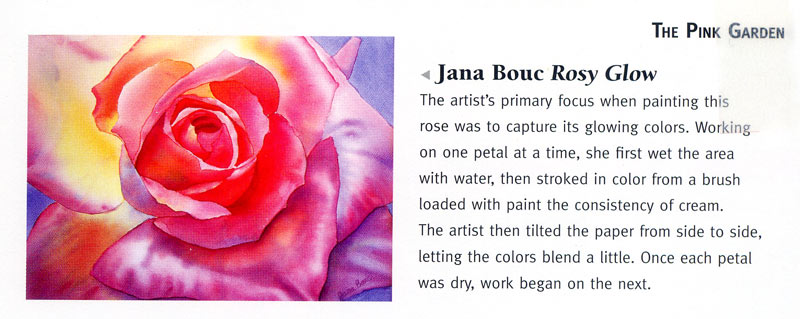
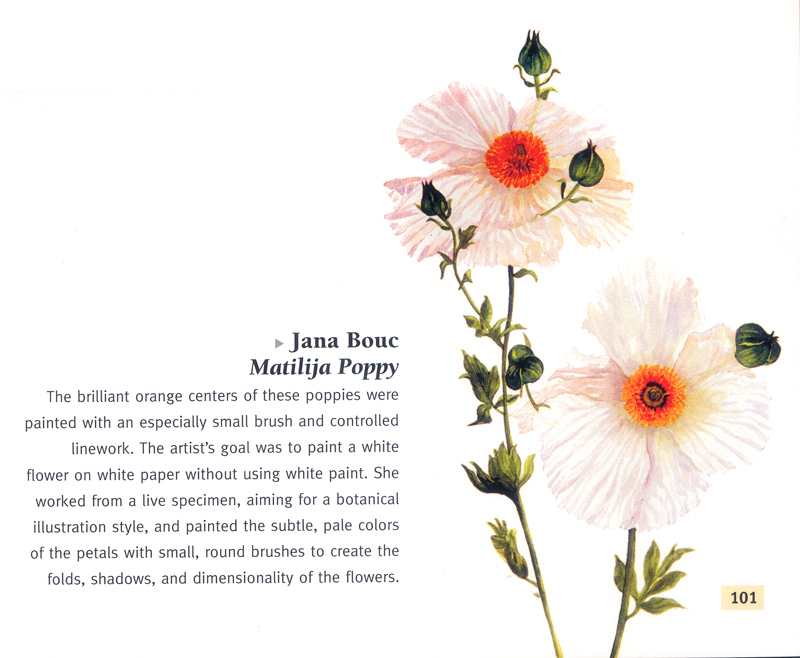
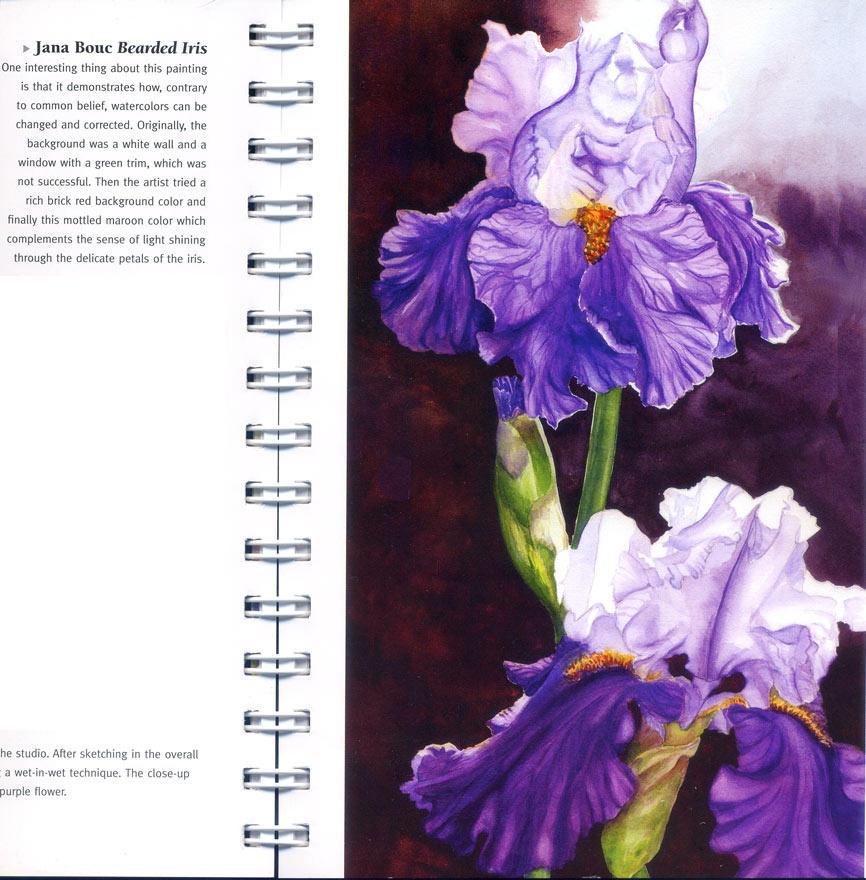
My artwork can be found on pages 72, 85, 86, 101, and 152. Here are my chunks of those pages:
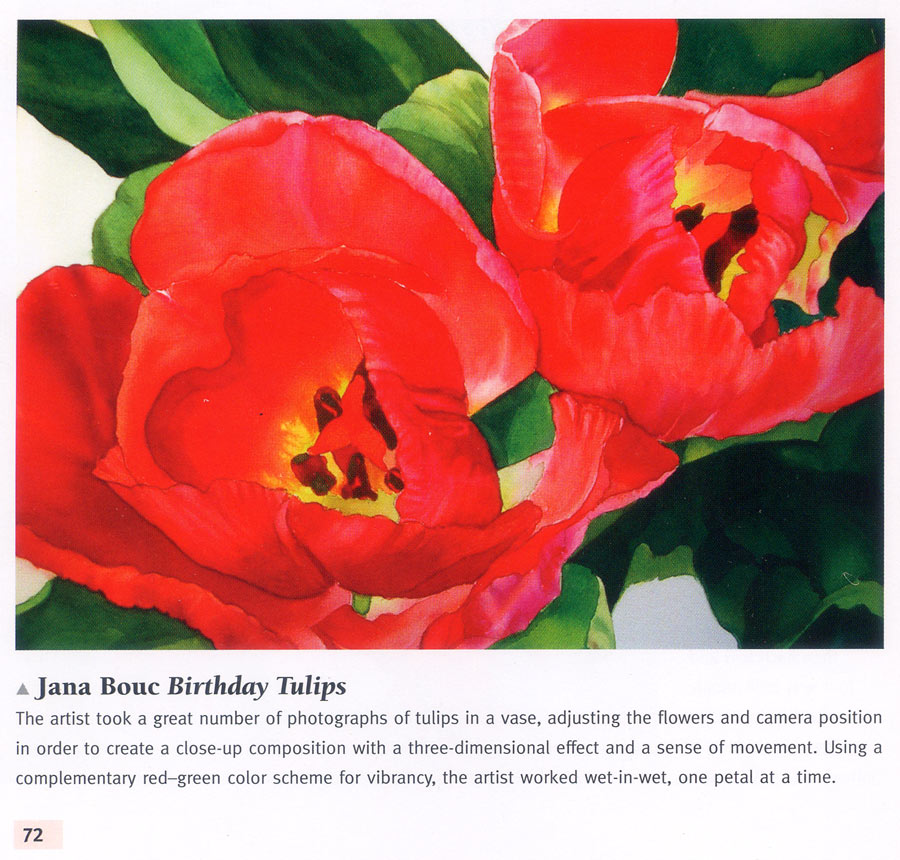
My tulips in the Watercolor Flower Artist's Bible
Larger

My rose in the Watercolor Flower Artist's Bible
Larger

My rose and bottle in the Watercolor Flower Artist's Bible
Larger

My poppies in the Watercolor Flower Artist's Bible
Larger

My irises in the Watercolor Flower Artist's Bible
Larger

Categories
Life in general Painting Sketchbook Pages Still Life Watercolor

Organic Bananas, The FURminator & Blindness

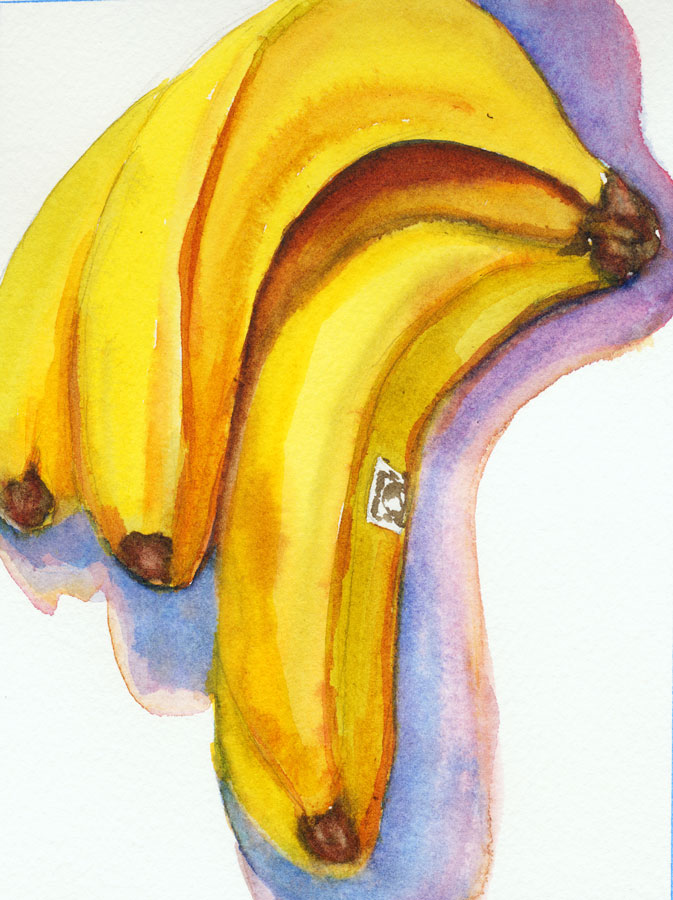
Organic Bananas

Watercolor on Arches Cold-Pressed paper in 5.5 x 7.5 sketchbook
Larger

After working half the day I decided to finally vacuum my house since I was feeling sleepy and not particular creative and the house and studio sorely needed cleaning. I’ve been contentedly choosing painting over housecleaning for too long, and the cat hair was piling up. So I dusted, vacuumed, washed the throw rugs, brushed the kitties with a great new cat and dog brush, the FURminator, that thoroughly removes the undercoat and ends shedding for weeks (the pictures on their website don’t lie–it’s amazing how much fur comes off the first time).

After dinner I was still sleepy but knew I’d be sad if I just turned on the TV and had no fun in the studio at all today. So I grabbed the only produce left in the kitchen (I’ve also been putting off the grocery shopping) and painted these bananas.

While I painted I was listening to a fascinating book, Crashing Through, about a man who was blinded at the age of 3, became a downhill speed skier, an entrepeneur, married, had kids, and a great life. Then he was given the historical opportunity to try an experimental surgery and become one of only 20 people in the history of the world who, after a lifetime of total blindness, had his sight restored, via a stem cell and corneal transplant. The book provides really interesting information about vision and how we make sense of what we see, from distance perception, to 3-dimensionality, to recognizing faces and expressions. It turns out it actually has to do with parts of the brain rather than the eyes and is learned in infancy.

A lot of that information is useful for painting. When the author explains how the brain uses visual clues to judge distance, these are the same things artists use to create the illusion of depth and distance in paintings. These include objects getting smaller the further away they are, closeness to the horizon (the further away or taller something is, the closer to the horizon it is), aerial perspective (the effect of moisture and particles in the air between the distant object and the viewer that causes distant objects to appear grayer, cooler, paler than closer objects), linear perspective, and occlusion (one thing in front of another).

Categories
Art theory Glass Oil Painting Painting Still Life

Conscious Competence?

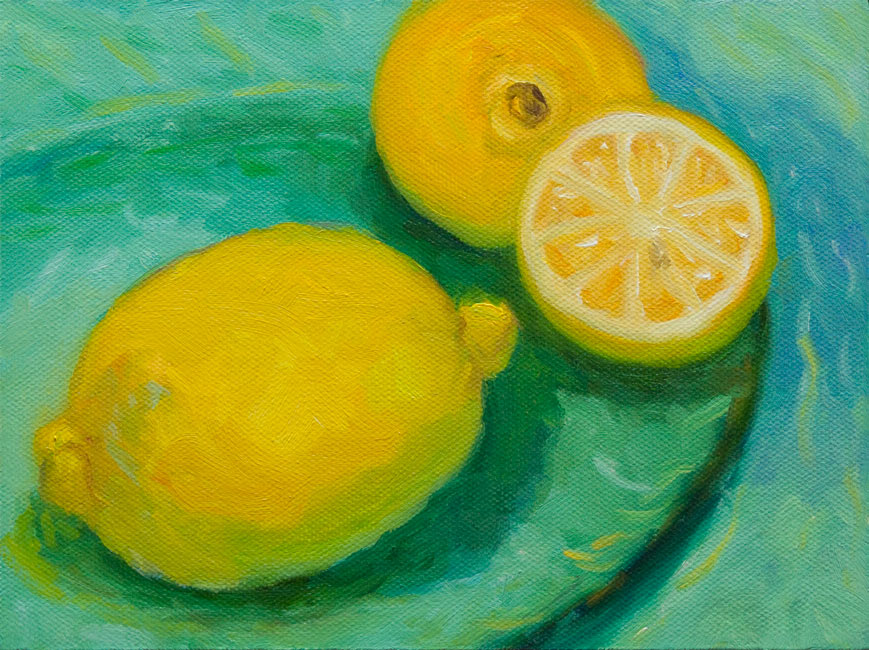
Lemons on Green Glass Platter

Oil on canvas panel, 8×6″
Larger

I think I’m finally making a little progress with my oil painting. I’m starting to understand about color temperature and how to make transparent darks (which you absolutely have to protect just like the white of the paper in watercolor). I couldn’t figure out how to get the little highlights on these lemons but maybe I have to wait for the paint to dry and then use a dry brush to sweep across it. Or maybe I could do it with a knife? I tried painting it on with a brush but just kept smearing and muddying the paint. Any suggestions?

In July, I did these lemons on a different green glass plate and …

Lemon on green glass plate (P1010468)
Larger

…I think I see some progress.

My friend Judith told me about a learning theory that divides the stages of learning into four stages:

  1. Unconscious incompetence .(You don’t know how much you don’t know and sometimes have beginner’s luck that makes it seem like it will be easy to learn).
  2. Conscious incompetence. (Now you’ve realized how much you don’t know and how bad you are at the thing you’re trying to learn, and how many people are way ahead of you. You may have the knowledge or information about HOW to do something but not the skill to do it.)  A lot of people give up at this point. This is where I’ve been for past couple months.
  3. Conscious competence. (You understand how to do it, you’ve practiced and built some skill, but it doesn’t come naturally. You have to think through each step but you can do it and a basic level.)
  4. Unconscious competence. (It just comes naturally and you don’t have to constantly think through each step.)

Mom was half-right when she said “practice makes perfect.” I know that when I strive for “perfect” I only end up miserable. I think the saying should be “Practice makes Progress” and right now progress feels great after being mired in Conscious Incompetence for months!

Categories
Art theory Oil Painting Painting Plein Air

What “we” did in painting class today

My teacher helped paint this

Oil on 12×9 panel
Larger

First a disclaimer: There’s more Elio than Jana in this painting. I started this painting and really liked where it was going, with a decent composition and nice fressh, bright colors, but asked for help when my path wouldn’t stop looking like a waterfall. My wonderful teacher, Elio Camacho, has been hesitant to paint on my paintings but I encouraged him to do so since I was confused. Once he’d solved all my problems and added some beautiful touches, I stopped working on this one and started another so I could save this in order to remember the things he did.

Elio is such an amazing teacher. His shares his incredible enthusiasm for painting, his knowledge, experience and skill so generously. After the five-hour class ends, he starts a very large painting and paints until sunset. If we stick around, he will continue answering questions while he paints, which makes it very tempting to stay and paint or just hang out for another hour or two.

I thought I’d share a few of the things I learned in class today that I think are going to really help my painting (CLICK on “Continue Reading” below) to read what I learned about color, plein air composition, highlights, mediums, darks and sky-holes:

Categories
Art theory Faces Oil Painting Painting People Portrait

Persistence, Acceptance and Freedom

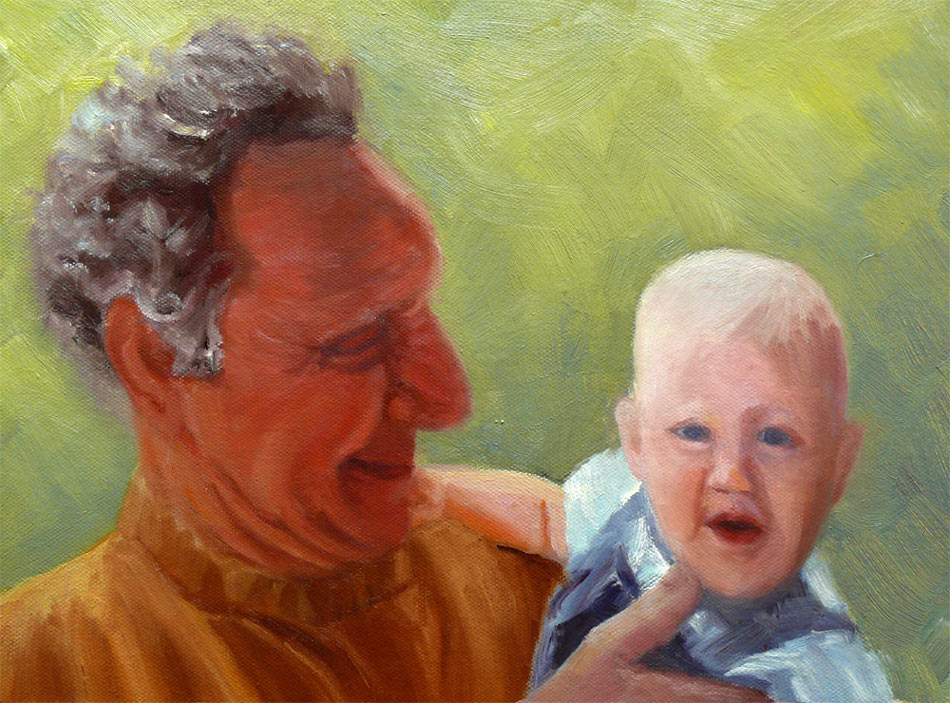
Don and Robin

Oil on panel, 9×12″
Larger

This is a portrait of my son and his grandfather, Don, from a photo taken 30 years ago. I started working on this painting a few days before he died two weeks ago. Although he was afraid of dying he had tremendous acceptance, from years of regular meditation. Visiting him was a very peaceful experience. Even though he was experiencing so much loss, having been an athlete all his life and now watching his body fail, he was incredibly serene. We brought him some photos to look at, including the one from which this picture was made, and they cheered him up and made him laugh.

The reason I titled this post “Persistence, Acceptance and Freedom” is both because of Don, and also because I’ve had to accept that I don’t yet have the skills to make this a good portrait in oil paint, despite my persistence, and that this painting is as far as it’s going to get and it’s time to let it go. And that gives me much needed freedom, after working on this for way too many days. In the beginning it was a wonderful way to remember Don and think about those early days. I was determined to do the best I could but now by accepting that this is as far as I’m willing to take it, I free myself to move on to something else.

I didn’t spend enough time with the initial drawing, the photo I was working from was old and funky, and the color had faded strangely. Initially there were three generations in the picture, my son, his dad, and his grandad. First the two men were great but the baby was a mess. Then the baby got good but I messed up one of the men. After scraping off and redoing all or some of the people many, many times I decided to eliminate my son’s Dad, paint the background and clothes, and call it done. The thing with oil painting is that you can edit forever but I need to stop.

I’ve read it’s better for learning to paint hundreds of one-hour paintings than to spend hundreds of hours on one painting. I’ve tried the later and it’s not fun. I’m ready for the former and excited about doing timed paintings — more like sketches — one hour apiece.

Categories
Every Day Matters Painting Sketchbook Pages Still Life Watercolor

A shiny, new hour for free (& EDM #144- Something Square)

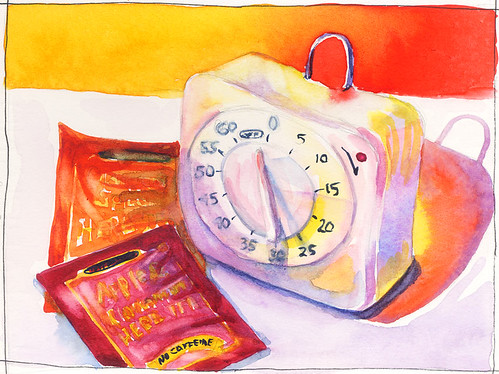
EDM #144 - Something Square

Watercolor on Arches hot pressed paper in sketchbook, 5.5 x 7.5″
Larger

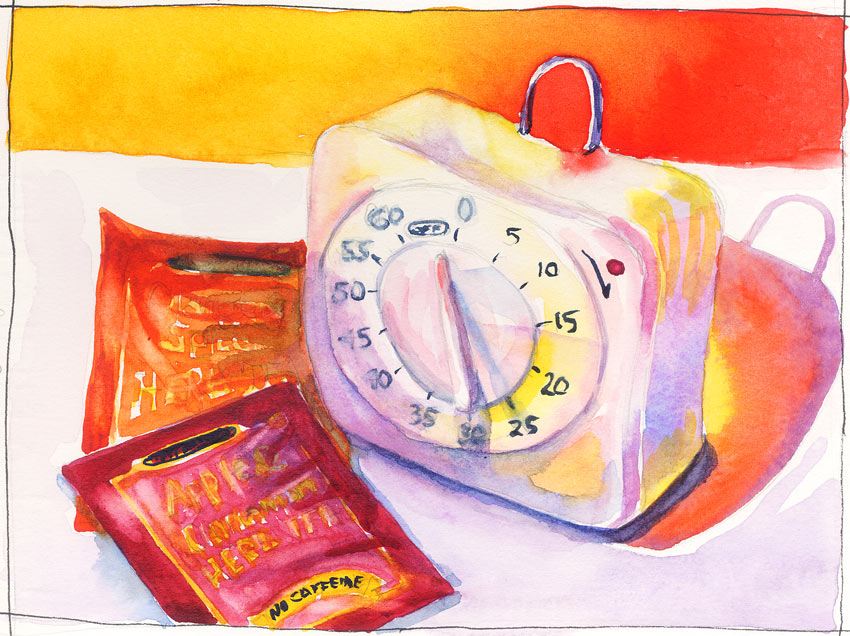
This week’s Everyday Matters challenge is to draw something square. I searched my house and office and found nothing square until I started thinking about time.Then I remembered this kitchen timer that I’m going to use to make the timed paintings I wrote about yesterday. It was sitting next to these tea bags which are also (nearly) square.

I’ve been having a hard time making the transition back to ordinary time after the end of Daylight Savings. The actual day of “falling back” is my favorite day of the year because it means getting an extra hour.  Instead of resetting my clocks on Saturday night and wasting the fresh new hour sleeping, I pick an hour that I want to experience fully as my new hour. I use it for something extra special, or for something that in my usual driven way I don’t allow time for—like relaxing in a bubble bath or other such luxuries. This year I stretched it out through Monday, actually giving myself the hour several times, and then each time deciding that it wasn’t the one, and giving myself another. It was such fun!

But by Tuesday when I returned to the office, I still hadn’t settled on the perfect hour or reset my clocks and it was getting confusing. Instead of getting to say, “Oh goodie, it’s not really 3:00, it’s only 2:00! Whoopie! Another free hour!” I was looking at my watch and saying, “Oh drat, it’s not really 3:00, it’s only 2:00 — three more hours until I can take my headache home and put it to bed.”

And then today (Wednesday), even though I went to bed early and woke on time, I ended up arriving at work really late—exactly opposite what should be happening, given the extra hour in the morning. So now I’ve finally reset all my clocks and joined the world in ordinary time.

I wonder if it’s possible to give myself a special “free” hour every day, without having to wait for the annual end of Daylight Savings. Maybe I could just declare one hour each day a special hour to enjoy as I see fit. Why not? What do you think?

Categories
Art theory Landscape Oil Painting Outdoors/Landscape Painting Plein Air

Tilden Park Re-do

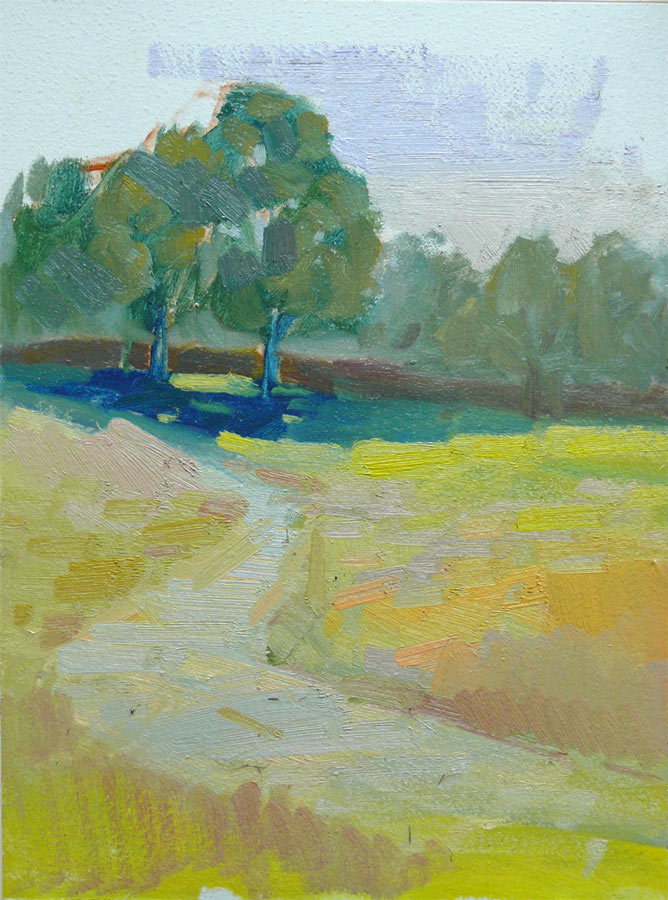
Tilden Park

Oil painting on panel, 9″x12″
Larger

Last Sunday in my plein air oil painting class I painted this scene on this panel but it pretty much looked like dark mud so I worked on it some more today. I like to keep going with a painting until I either succeed, push it as far as it can go, get sick of it, or it just gets too late and I have to go to bed. I think tonight I hit all of the above.

I have the hardest time painting outdoors in the bright sun. Everything ends up much darker than it should be. I’m also not very good at mixing light colors in oils—possibly due to never using white in watercolor. Adding white to oil paint creates quite different color mixtures than adding more water to watercolor to let the white of the paper shine through and lighten the color.

I’m going to be plein air painting both Saturday and Sunday this weekend, and given the weather report of sunny days, I’ll continue trying to find my way painting in bright light. Tomorrow I’m going to try wearing my polarized sun glasses and see what I come up with. I’m also going to try forcing myself to make high key paintings, with most of the painting lighter than middle gray to force myself to get away from the dark mud.

Categories
Life in general Painting Sketchbook Pages Still Life Watercolor

Halloween Candy & Earthquakes

Halloween Candy

Watercolor on Arches Hot Press paper in 5.5 x 7.5″ sketchbook
Larger

Last night was Cody’s birthday party at Hunan Villa in Pinole.  There were 10 of us sitting around the table celebrating, with good food and good company. Halfway through dinner we all noticed the table seemed to be rocking back and forth and so did my chair. Everyone looked at each other trying to make sense of it.  At first we all thought it was someone bumping the table, but the floor seemed to be moving in a strange wavelike manner as well. Suddenly a painting flew off the wall two feet away from us and smashed to the floor, scattering glass everywhere. That’s when we realized it was a fairly good-sized earthquake. Fortunately that was the end of it (for now) and we all went back to celebrating, considerably more alert than before.

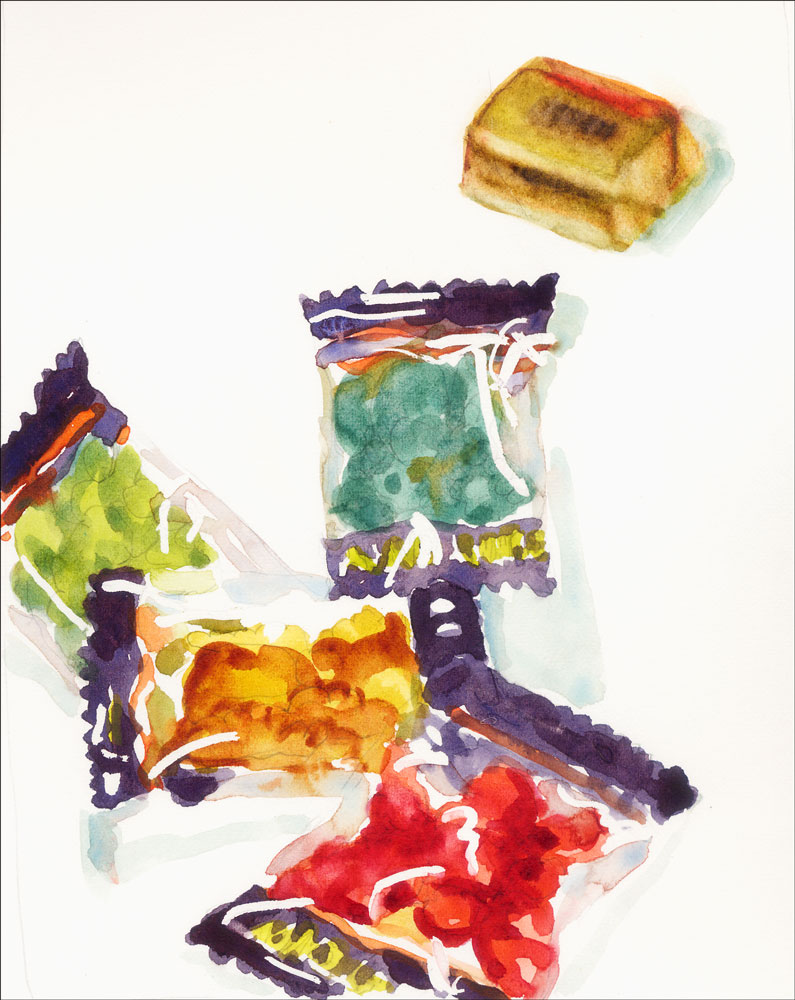
These candies are called “Gruesome Gummy Candy” (and one Hersheys Nugget) — all that was left at 6:00 P.M. at Longs on my way home.  I think they’re supposed to be spiders or tarantulas. I like to wait until the last minute to buy Halloween candy so I don’t eat it all, long before the trick-or-treaters arrive. Sadly only three groups came to my door tonight. In my old neighborhood where I lived on a main street, streams of cute little ones came by all night long, which I relished. Now what to do with all the extra candy? Hmmmm…..

Categories
Gardening Painting Plants Sketchbook Pages Still Life

More Last Tomatoes

The Last Tomatoes in a Bowl

Watercolor on Arches 140 lb hot press paper drawn first in blue Micron Pigma pen, 5.5″ 7.5″
Larger

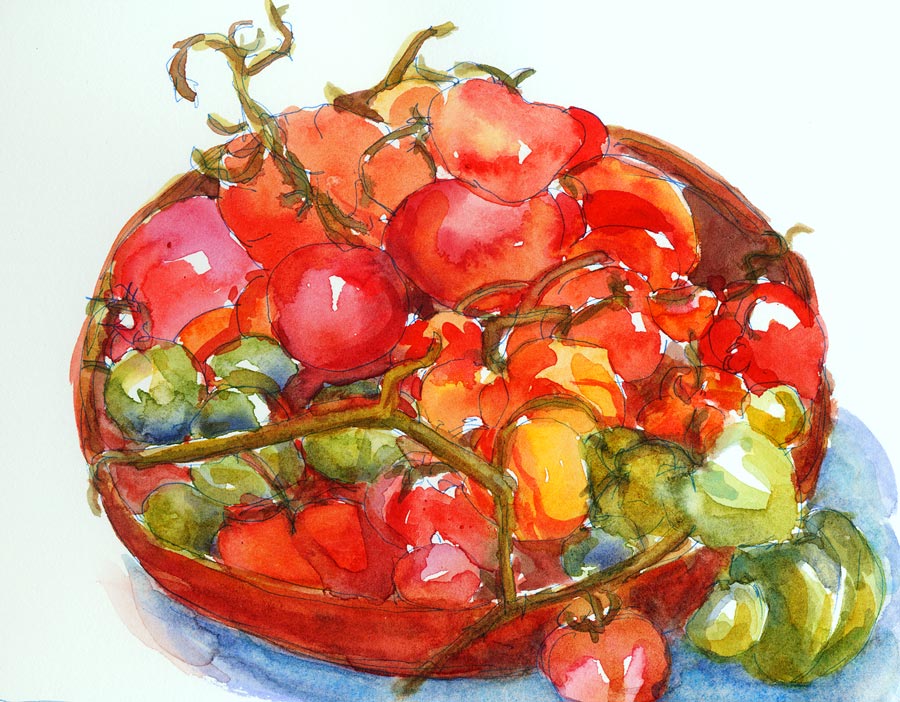
Yesterday I cleaned up my four tomato plants, removing all the dead leaves and icky, gooshy tomatoes (without screaming once — squooshy, slimey things scare me) and was delighted to discover an abundance of still quite lovely tomatoes, ripe and ready to be picked. I was sure when I painted the last bunch of tomatoes that they were truly the last, but we’ve had some wonderful summer weather all over again and the tomatoes just keep on doing their thing.

I piled them in this old stoneware bowl and stuck them in the fridge. I’ve been working on an oil painting family portrait (more about that tomorrow) and have been neglecting my blog. So I decided to stop working on the oil painting, and loosen up with the tomatoes and some watercolor in my sketchbook.

Now back to the portrait. If I don’t finish it tomorrow I’ll post the work in progress. The painting was inspired by looking through some baby pictures of my son with his father and grandfather that we wanted to bring on a visit to my father-in-law. He’s been very ill and on Thursday night he thoroughly enjoyed seeing the pictures (and us). I was hoping to finish the painting before he died and to share it with him but sadly/blessedly he passed away this morning. If the painting turns out well enough, I’ll bring it to his memorial. In the meantime it’s been a blessing for me to lovingly paint his smiling face, knowing it would not be visible much longer.

Categories
Art theory Oil Painting Painting Still Life

Pear on Blue Plate

Pear in Oil

Oil on canvas panel, 8×6″
Larger

After feeling like I’d taken one big step forward with my painting on Saturday, in Sunday’s painting class I felt like I’d taken two giant steps backwards. I wasn’t inspired by the view of dry, grayish rolling hills and just kept putting paint down, deciding it was all wrong, and scraping it off. I guess I was just tired after painting day and night on Saturday and also there were some new concepts that needed to sink in.

I was determined to do a better job today and wanted to focus on the guidance I received from my teacher on Sunday: avoiding muddy colors by putting strokes down and leaving them, focusing on color temperature and using colorful grays. I painted the pear about three or four times this evening, getting it almost done and then messing it up one way or another, scraping off all the paint, and starting over.

As it got closer to bedtime I got even more determined to put strokes down and leave them. It worked and I’m happy with the results.