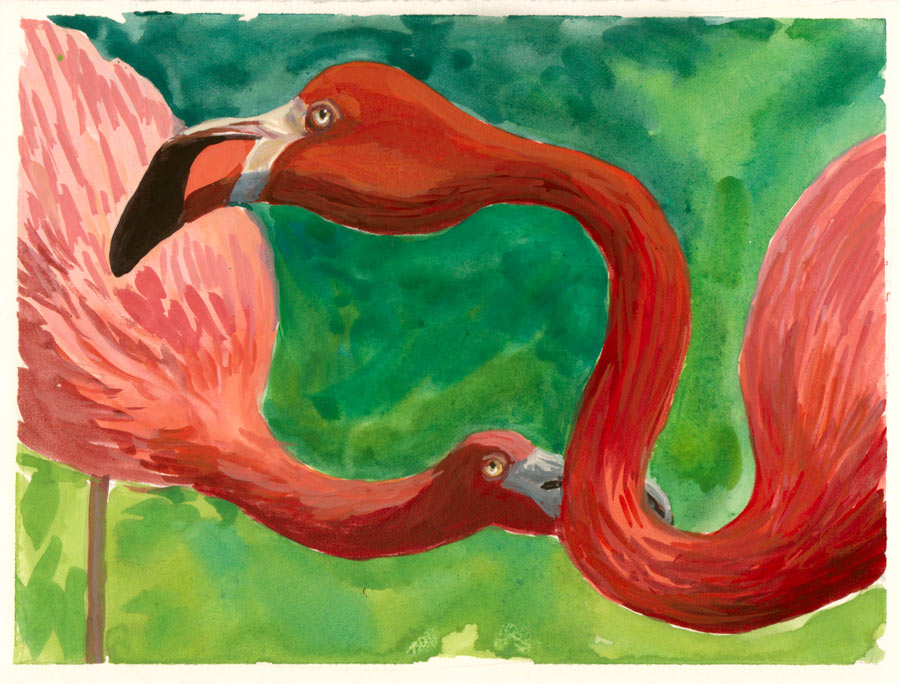
Why Are Flamingoes Pink? Gouache on hot press paper, 5.5x7.5"
Why Flamingoes Are Pink (Hint: You Are What You Eat!)
Why Are Flamingoes Pink? Gouache & Ink, 5.5x7.5"
I adore Maira Kalman‘s wonderfully quirky gouache and ink illustrations. When I’ve tried to use ink on my own gouache paintings, the ink always got sucked into the paint and blurred, or the pen clogged immediately (or both). I searched every way I could on the internet and finally found this link to India Amos’s blog. India, as Art Director, was responsible for preparing some of Maira’s artwork for print. In the post she wrote that Maira creates the painting and lettering separately. Then they’re scanned and layered together electronically using Photoshop.
So yesterday I investigated this approach. I painted the flamingoes above from a photo I took at Six Flags last month. Then I tried various pens and tracing papers. I also sent a message to India asking if she’d be willing to provide more information about the process.
Inspired by Casey’s success with the Carder Method and frustrated with my own slow progress at oil painting, I bought the Carder Method video and Color Checker tool. Below are step by step photos of my using the method to paint this still life, a brief review of the Carder Method and photos of my studio set up for working with it.
The Carder Method is designed to eliminate many of the problems that can make painting difficult. By creating an carefully lit, controlled environment, a painter can focus on learning to clearly see color and value differences while eliminating problems caused by variables such as changing light.
Click “Continue Reading” to see photos and read more….
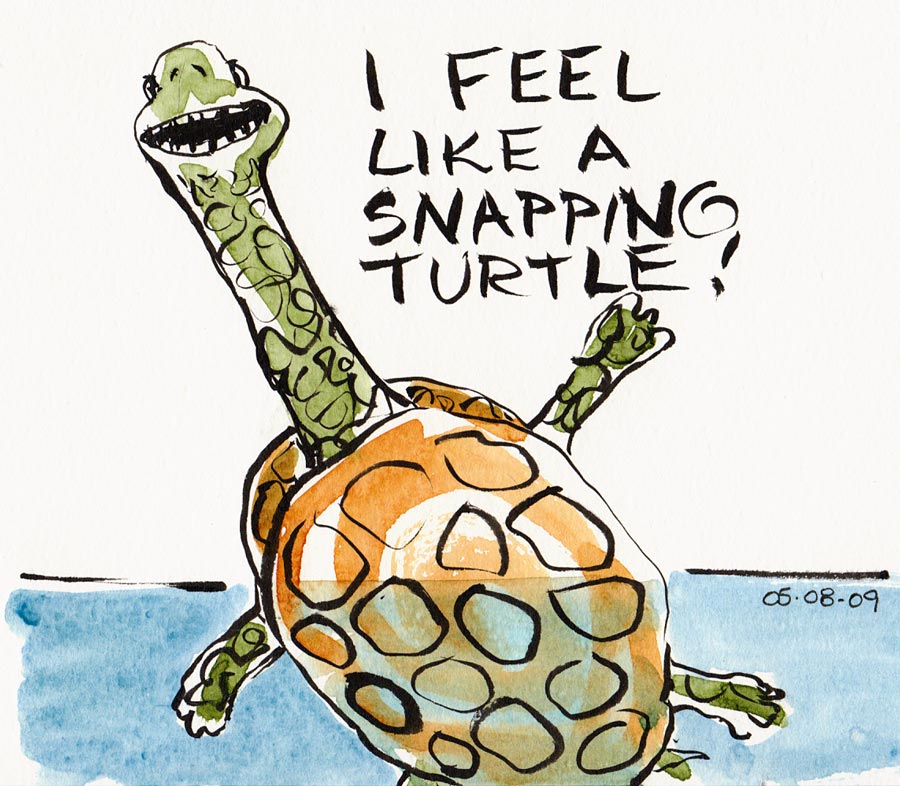
Snapping Turtle Me, brush pen and watercolor in Moleskine
It was one of those days. It started full of possibilities and ended with me feeling like a snapping turtle looking for someone to bite. So I drew how I was feeling and it made me laugh.
And now I’m officially giving up and heading to bed with a good book and a cup of cocoa.
Update: Michelle asked about the pen I used. It’s a Pentel Pocket Brush Pen with code letters GFKB. It’s permanent, waterproof and refillable with cartridges. I bought it from this link on Wet Paint’s website. Wet Paint is a great art supply store in Minnesota that I learned about from Roz.
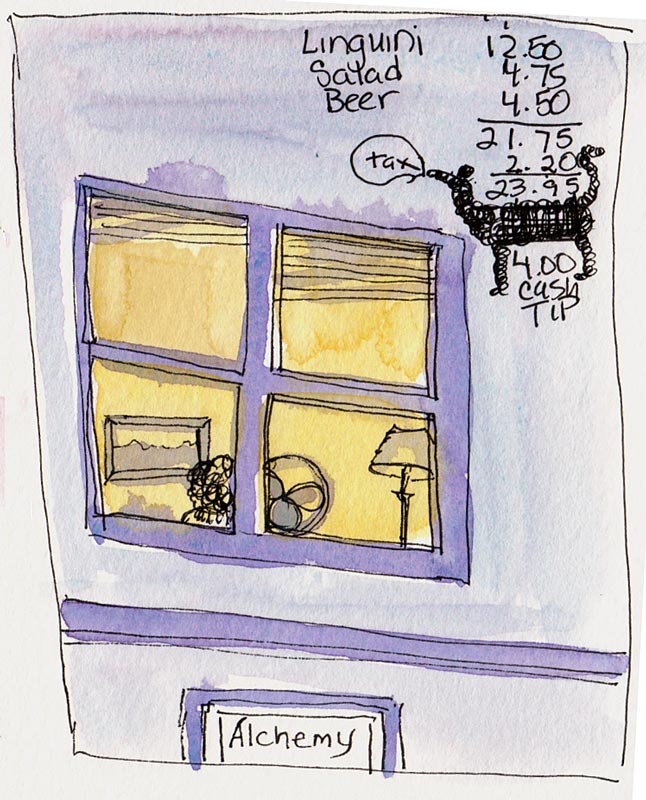
Two of my favorite sketchers, Martha and Cathy, joined me for an evening of sketching and dinner at Kensington Circus Pub. The image above was my view out the window just after sunset. Next I sketched a window across the street (below), and then used the page to total my portion of the bill. When I scribbled out a mistake it turned into a creature.
Alchemy, dusk; ink & watercolor
Martha brought her fountain pen collection for us to try out, along with a bottle of Platinum Carbon ink. I was especially interested in her Namiki Falcoln pen, which I’d heard good things about. The two images below were my fooling around with her pens. The Namiki was a little clogged so I switched to using it as a dip pen. It’s a fabulous pen, very flexible and a ton of fun to use, but I found the line to be thicker than I prefer. I was happy to return to my favorite .05 Micron Pigma when I did the first two sketches above.
Ketchup bottle, Namiki Falcoln pen & ink
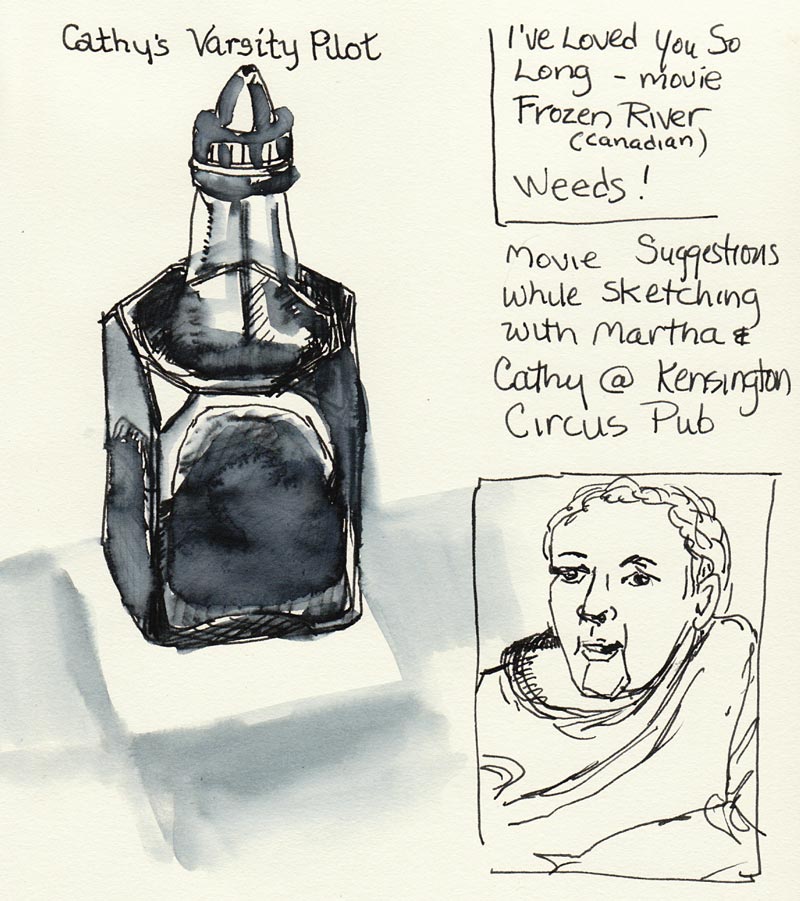
Cathy gave me a Pilot Varsity pen. It doesn’t have permanent ink so you can use it for ink & wash techniques. I used more ink than was needed to make a good wash so next time I’ll be more restrained when I use it.
Ink bottle, drawn w/Pilot Varsity pen & water wash
We discovered we are all huge fans of the HBO series The Wire which we’re working through on DVD and Cathy shared a few other favorites on DVD that I noted on the page.
I was really tired because I’d been painting all day and then went home afterward and painted until midnight, working on a project I’ll post about soon. But now, back to painting again (with a quick break for watching Adam’s performance on American Idol).
So I’m still at it with these camellias, this time in oil. I have a plan for Camellias #4 as I still haven’t quite got what I’m after. I want to see if I can get bright light colors in oils without the chalkiness of white paint. I think that will mean using thin transparent washes instead of thick paint, even though the usual method in oil is to make lights thick and darks thin.
I saved two rose buds to paint when I pruned my roses last week (in case winter ever comes to the San Francisco Bay Area—it’s been ridiculously hot and sunny). By the time I could get back in the studio, one bud had opened and my order of M. Graham and Schmincke gouache arrived. Although I planned to test the new gouache by making color charts first, I knew the roses wouldn’t hold up much longer. Also included in my art supply order was a new Rotring Art Pen.
I tried out the gouache and pen in the sketch above. I also wrote a quickie review of the Rotring Art Pen and offer some technical information about gouache by experts on the subject. If you’d like to know more about gouache or the pen, please click the “Continue reading” link below.
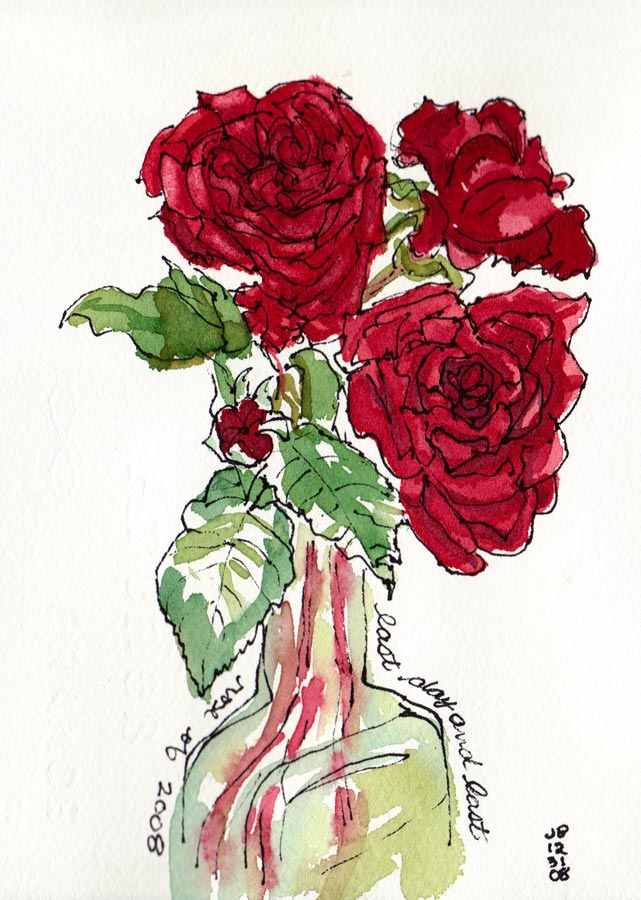
My next door neighbors were pruning their roses for winter so I asked them to save some for me to draw (they were going to throw the still perky roses in the recycling bin). I started by trying to paint them in oils but was having a terrible time mixing the right colors. I scraped off the paint and went to bed, planning to try again the next day.
When the cats knocked the vase over during the night I was actually relieved, thinking the roses would be too funky to paint since all the water was on the floor, not in the vase. But these were some tenacious roses, and were still fine so I decided to try sketching them in watercolor (above and below). I also consulted one of my books on flower painting that said roses were shaped like teacups, so I added a few of those tilted at the same angles to the sketch to help me understand their shape better better.
Blood Red Roses, Ink, Watercolor & Blood
I’d just finished the sketch (above) and was writing about how hard it is to mix the highlight color of “blood red” roses in oil paint. At that very moment, my nose started bleeding for no reason at all and it dripped onto my sketchbook! Now I feel like a real Avant-garde artiste, painting in blood!
P.S. A little pinching of the nose and it stopped.
Red Roses, Oil, 6x6"
Mixing a light red color in oil paints
It’s hard to mix a warm, light red in oil paint because when you add white to red oil paint, it makes a cool pink. This is because all white oil paint is cool (meaning it tends more towards a blue than a warm color like orange or red). But the color of these roses in bright, warm light was a hot pink. It’s easier to get a warm, light red in watercolor because you use the “white” of the watercolor paper to show through and “lighten” the red, not white paint.
To get help with the dilemma I sent an email to Diane Mize at Empty Easel since she and I had recently corresponded about color charts and she’d written an excellent article on Empty Easel about how to mix correct color in oils. She validated that mixing a light red is challenging and offered some good suggestions, including using Naphthol Red, which is a more intense red than the cadmiums (which quickly lose strength in white).
I tried making the lighter areas of the rose thicker, using a palette knife, since those raised areas will catch the light and reflect it making it appear lighter. I also intended to make the dark areas on the roses more neutral and cooler, so that by comparison the warm light area would look even more brilliant. But the roses finally died and that put an end to the painting. My favorite part of this painting are the leaves at the bottom left.
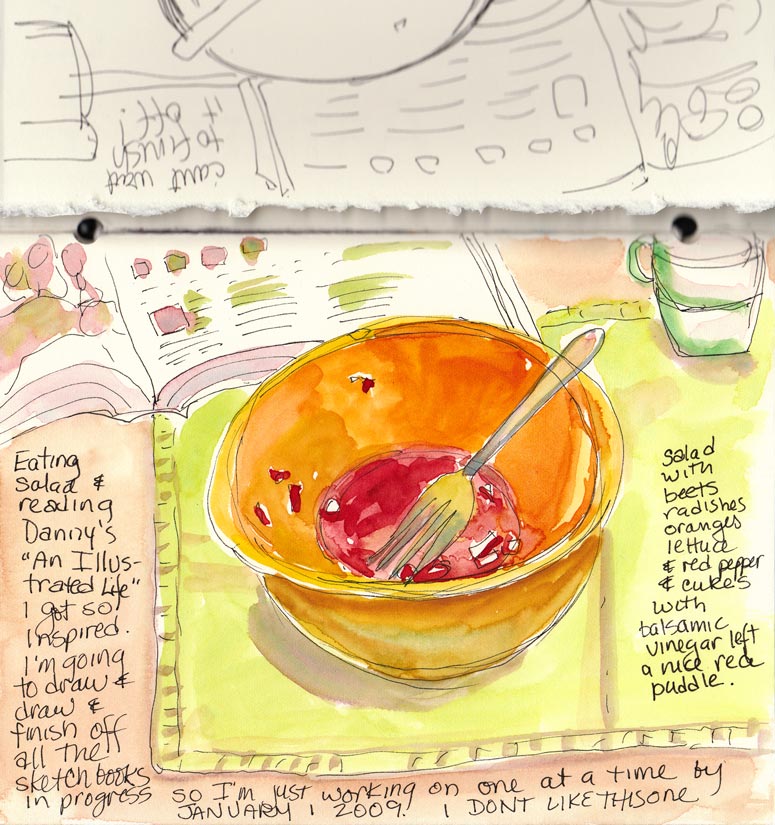
Salad Remains with Danny's Book (ink & watercolor)
I was feasting my eyes on Danny Gregory‘s new book, “An Illustrated Life” while I was eating a delicious salad in my big yellow salad bowl for lunch today. When I finished eating I had to sketch the colorful remains. The first drawing didn’t work (partially seen on the previous sketchbook page above), though I took it as far as I could and then drew it again and painted it (happily using up two pages in this sketchbook I don’t like).
I love reading about all the other sketchbook artists in Danny’s book and the way they think about sketching and their sketchbooks. It inspired me to finally finish off all of the random sketchbooks I have going. I have at least half a dozen unfinished sketchbooks, some that I’ve made (like the one used above) and some that I’ve bought. I keep them in a special open box and grab the one that calls to me.
There are several that I don’t like for a variety of reasons (e.g. don’t like the paper, don’t like the dimensions, don’t lay flat, don’t scan well, too fancy…) and they’ve been partially used and abandoned. I’m making it my goal to fill them all by January 1 so that I can put them on a shelf and start working in one book at a time in a chronological order. I like order.
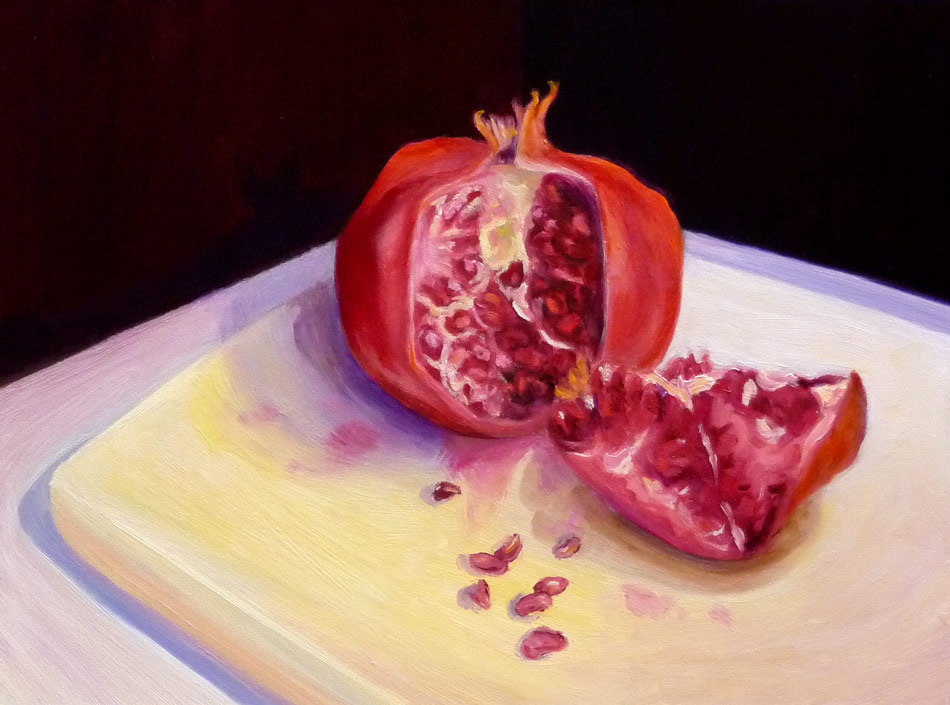
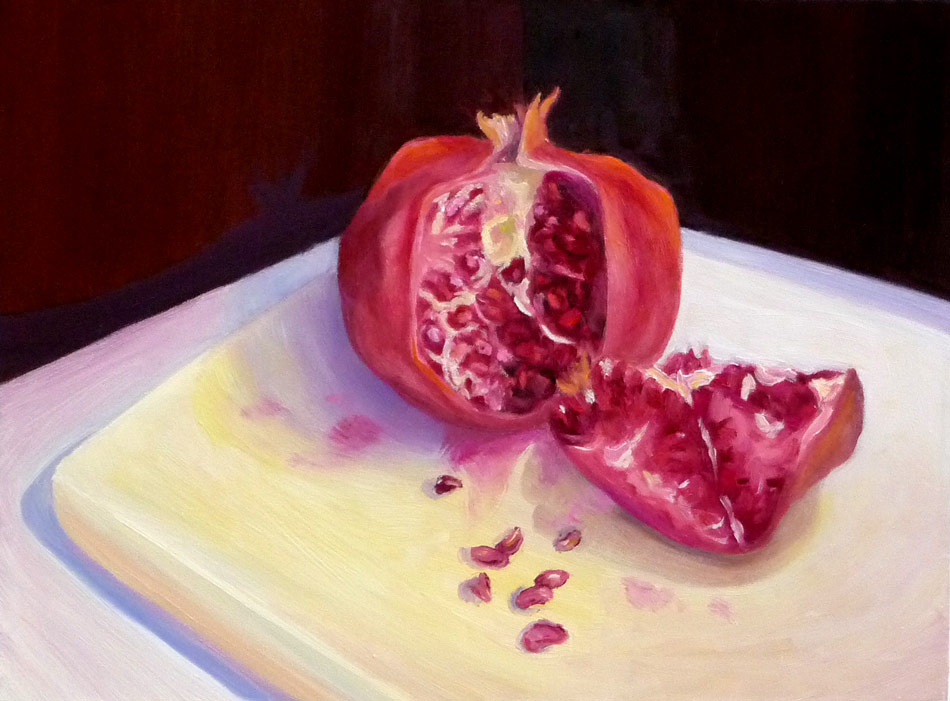
Pomegranate and seeds, oil painting on Gessobord, 9x12"
I never thought I was a procrastinator but after a week’s vacation meant to be spent painting but rarely getting into the studio until early afternoon at best, I began to look at how I’ve spent my time this week and had trouble figuring out where it had gone.
Then l saw this incredibly creative and well-made four-minute movie on YouTube entitled “Procrastination.” I could see myself in every single scene (except maybe smoking). If you’ve ever procrastinated getting started on a creative project out of fear of failure, perfectionism, artist’s or writer’s block or any other reason, this video and will make you laugh (or cry).
About the painting:
I discovered Gessobord this week and fell in love with the wonderful surface of these panels. They’re smooth but have a texture that sort of bites into the paint and grabs it, as well as enhancing the colors of the paint. It’s really amazing and is a total pleasure to paint on with oil paints. I wish they were less expensive, but they’re still cheaper than pre-stretched canvas, especially when purchased on sale online.
Instead of trying to do a one or two hour painting and finishing this still life in one chunk, I had to do this one in several short sessions over a period of a few days (because of procrastination and various holiday events and other responsibilities).
I paused and studied the painting, and saw that I needed to improve the composition and values:
Stopping point to analyze problems
I looked at the painting and the set-up through a piece of red plastic (which elimates the color, emphasizing values) and could see that I needed to darken the background and the inside of the fruit on the left side. I also added the seeds and stains on the cutting board to avoid so much empty space and lead the eye into the painting.
The pomegrantate (already less than fresh when I started) got less attractive and eventually I had to stop and call the painting finished. I think it will serve as a good stepping stone to the next as I try to put more “miles” on my brushes. And now to stop procrastinating and focus on starting that next painting!
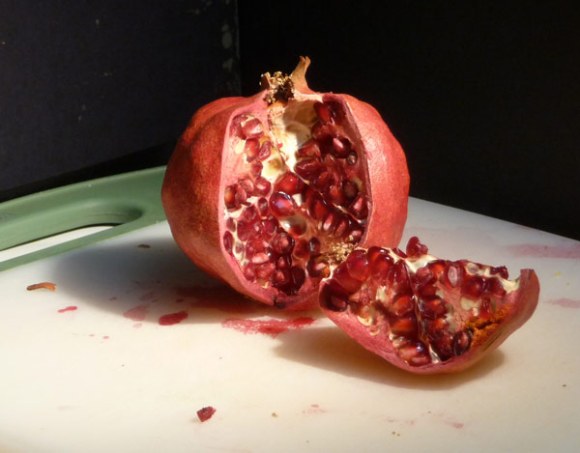
Ooops…when I posted what I thought was the “finished” painting (at bottom) a few minutes ago and then posted this photo of the set-up from day one, I could see that the color of the pom needed to be warmer and the background cooler so I just applied a dark cool glaze to the background and a warm red glaze on some of the pom and posted the finished picture at the top of the post. Now I’m done (I think).
Photo of set-up on day oneThought I was finished but more work needed









 Jana Bouc, Artist