Categories
Art supplies Food sketch Painting Sketchbook Pages Watercolor

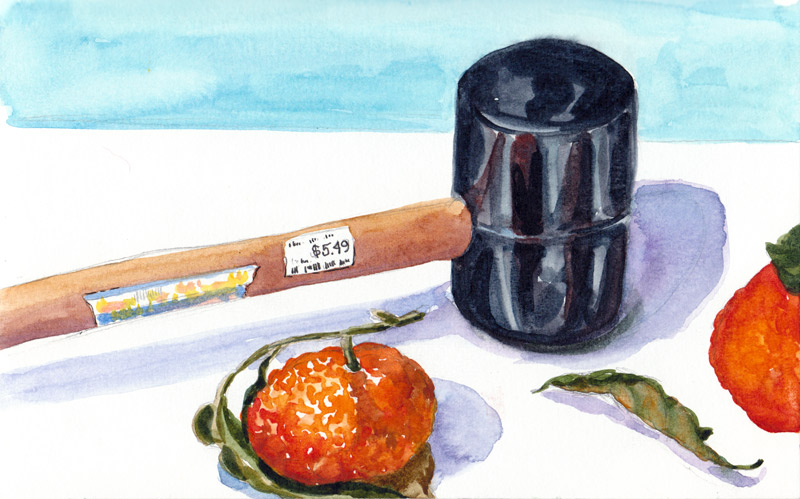
Rubber Mallet $5.95 and Tangerines

Mallet and Tangerines, watercolor & graphite

After a lifetime of not even knowing rubber mallets existed outside of cartoons, twice in the past year while working on projects I read directions to “tap with a rubber mallet.” I thought to myself, “Who has a rubber mallet? Not me.” And then used a regular hammer which didn’t work out too well to put it mildly.

So when I was shopping for bookbinding supplies at my local Dick Blick art store and I saw a rubber mallet sitting on a nearby shelf for only $5.95 I couldn’t resist. It was just so funny looking. I have no idea why they were selling it at Blick’s and what artists would be using it for, or how it could sell for less than a toilet plunger at the hardware store.

So I found a good use for it in the studio—as a still life subject—and it fits right in, don’t you think? Tangerines, rubber mallets, why not? Maybe my next still life will be of smashed fruit and a juicy mallet. But that will have to wait for a sunny day. No way I’m smashing fruit in the studio. It’s messy enough as it is.

Meanwhile I thought I’d check out what rubber mallets are really for and I found this on About.com‘s Home Renovation tools page:

“Admittedly, the rubber mallet is not the first thing on your tool list. But once you have a rubber mallet, you begin to discover many uses. Here are some common uses:

  • For ceramic tile, it helps gently tap tile into place.
  • Laminate flooring: great for this brittle material.
  • Tap carpeting onto tacking strips.
  • A “sounding device” if you need to hear what is behind a wall or in a pipe.
  • PVC pipe work.
  • Two tight-fitting sections of drywall.”

I can’t help picturing cartoon versions of each of these uses, especially with me behind the mallet accidentally tapping something into smithereens. And how funny is it that my blog’s spell checker thinks “smithereens” is spelled correctly but that the word “blog’s” is not.
Categories
Drawing Food sketch Ink and watercolor wash Painting Sketchbook Pages Still Life

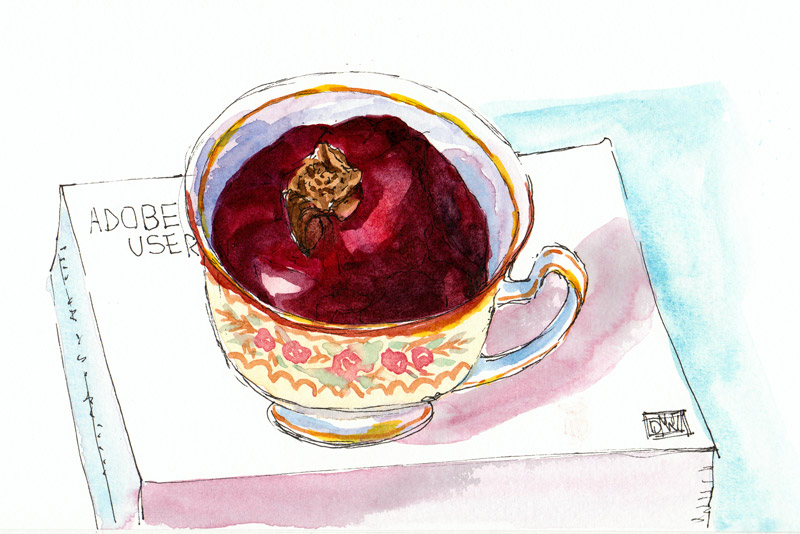
Pomegranate in a Teacup

Pomegranate in a Teacup, ink & watercolor

Randomly grabbing items to sketch, a little still life composed itself:  one of my sister’s teacups, an aging pomegranate and an Adobe user manual (I keep four of their heavy manuals handy as weights to flatten my sketchbook when scanning it).

I’ve spent the past few days making my first hardcover journal (more about that when it’s done being pressed). And now my current sketchbook only has about 20 pages left and then I’ll get to start the new one. I used to treat sketchbooks like they were so precious and couldn’t waste a page. I’m so much happier now that I use them for everything, and enjoy filling them because that means I get to start another one. I even subject them to sketchbook abuse, dragging it everywhere and not worrying if it gets bumped or dirty, sort of the way siblings poke each other as a way of showing sisterly love.

Categories
Animals Drawing Food sketch Gouache Life in general Painting Sketchbook Pages Still Life

Sweet Pears and a Buzz with Busby

Pears on a Blue Plate, ink and gouache
Pears on a Blue Plate, Pentel Pocket Brush Pen and gouache, 7x5"

In the week and half since I gave up sugar and Splenda, pears have become my new treat. Not only are they crispy, sweet and delicious but they come in such pretty colors too. This sketch is a celebration of their gifts.

But meanwhile, giving up coffee didn’t go as well….

Busby and the Coffee Buzz

After five days of feeling wiped out, depressed, listless and witless I couldn’t take it anymore and finally had half a cup of coffee.  That’s all it took: within a few minutes I was back to my old inspired self again and the blues were gone. Yay!

Maybe I’ll try to quit caffeine when I’m retired in a few years, but for now, each day is too precious to spend feeling like a zombie.

Categories
Drawing Food sketch Ink and watercolor wash Sketchbook Pages Still Life

Insipid Cuppa

Insipid Cuppa
Insipid Cuppa, ink & watercolor 7x5

I like to use my winter holiday vacation as a time to review my past year and sort out what I did well and what needs work. Since this is also the end and beginning of a whole decade, this process felt even more important this year. One thing that really stood out was that I needed to kick  my caffeine habit and its evil companion, sugar (both fake and real).

So, after a week of being foggy-brained, sleepy and witless, I’m now free of caffeine, sugar, and Splenda* and finally starting to feel good and my inspiration is returning.

Without the sweeteners, decaf coffee and tea were tasting pretty vile to me so I began the search for a flavorful herbal tea with at least a hint of sweetness. I finally found a couple that I like but in the meantime spent a fortune buying seductively-named but ultimately insipid teas that taste like something you might use to clean windows.

Case in point: the tin of “Hot Apple Cider Tea” pictured above. It looks and tastes like hot apple cider about as much as a picture of an apple tastes like an apple. If I’d painted a cup of that tea, it would look like a cup of water. The tea in the cup above is Good Earth Tea and warm milk. It’s not bad. 🙂 But it sure isn’t a latte.  😦

*UPDATE: Just looked up “What is Splenda” and here’s what I found:

Splenda is made from cane sugar by replacing three hydroxyl groups on the sugar molecule with chlorine. The resulting molecule is not recognized as sugar or a carbohydrate by the body and as such, is not digested. Some refer to Sucralose as Chlorinated Sugar. Sucralose does not occur in nature.

Eek! I’m embarrassed to admit how much of that stuff I was consuming!

Categories
Flower Art Gardening Ink and watercolor wash Life in general Painting Plants Sketchbook Pages

Geranium Getting Going (Except it’s a Camellia)

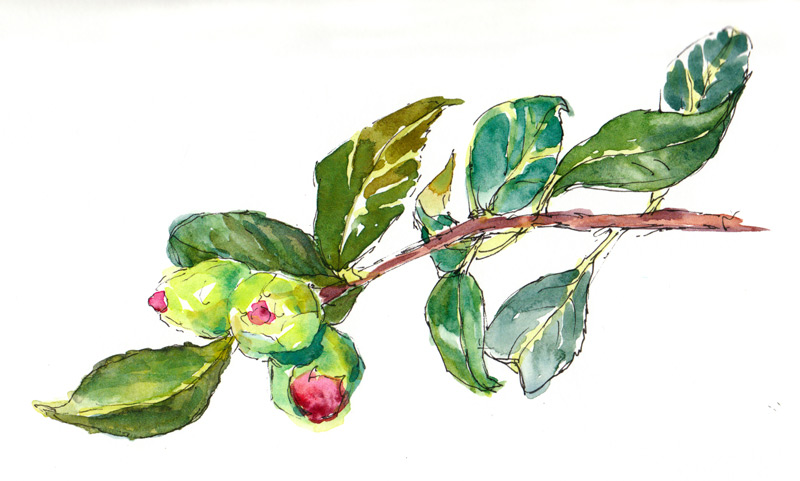
Camelia Buds, ink & watercolor

In a momentary memory lapse I wrote “Geranium Getting Going” in large letters in my sketchbook under this image. Then I thought, “Wait a minute, aren’t geraniums those red, ruffled, bitter smelling flowers often found in window boxes or untended and leggy in sad little gardens that someone has given up?”

And then it came back to me, DUH! This is a Camellia, not a Geranium. From a Camellia bush that I planted and that lives right outside my studio door and always blooms in the winter. It’s full of buds now and soon will be blooming madly.

I’ll just blame the memory lapse on the 4 hours of sleep I got last night as a result of working into the wee hours rebuilding my website, which is nearly done. I’m a bit disappointed that after all my work I’m finding some design issues that may be limitations of the platform I chose after much research last summer. I’m even tempted to start over on the system I would have chosen if I knew then what I know now. But this service comp’d me several years of hosting for free (because of all their system screw ups when I first started the build last summer) and I’ve already done so much work that starting over, when I’d rather be painting anyway, seems pointless.

If you would be willing to visit the new site and “beta-test” it a bit before I make it my official webs site, I’d love to have a few extra eyes on it. Just leave me a note if you’re willing to go there and click around a bit. It helps to know whether it looks ok on various computers and monitors or if there are any problems I’ve missed. Thanks!

Categories
Art theory Flower Art Painting Still Life Watercolor

Orchid Painting in Watercolor for the book but….

Orchid painting in watercolor, 8.5" x 11.5"

So here’s the frustrating thing: I learned that the publisher wants me to write the text accompanying the step by step photos as instructions (first do this, now do that) rather than a description of what I’ve done. Sometimes watercolors go as planned and that would be simple to do, because what I did is how I would tell someone else to do it.  But with this painting there was just as much taking off of paint as there was putting it on. Some of that was about softening edges with a damp brush and then blotting, but some of it was just removing paint that wasn’t working. I’ve never seen a “how to” book that says paint on a nice wash. Now wipe it off.

My biggest problem with this painting was the photo I had to work from. Like many artistic photos of flowers, it was shot without shadows or directional light and therefore everything was very flat with little dimensionality. Even more difficult, everything except the front center flower was intentionally out of focus. That makes for a lovely photo but not an easy watercolor painting project. And there is no variation in color: they’re all just cotton candy pink with dark magenta veins. And I picked the stupid photo and thought it would be easy. But for me, what is easy is lots of detail and variations in color, shape and value.

I started over four times, each time getting a little further and then abandoning ship. If I was just painting for myself any of those starts would have been fine and enjoyable to paint but I was finding myself exaggerating shapes and colors and losing fidelity with the photo.

Now I’m not sure what to do: Paint this again in order to be able to do write a logical “how to” that doesn’t include undoing previous steps? Write a “how to” and leave out the do-overs? Enjoy my vacation this week and forget about the whole project? (the latter sounds most appealing)

I think I’ll send a photo of the painting to my editor and see if she even likes the painting. My persistent (compulsive?) side really wants to paint the painting again, trying to do it more simply and cleanly. But my (sane?) side says “Go have a bowl of ice cream and watch a movie.” I wonder which side will win and how late the ice cream shop is open?

Categories
Art theory Flower Art Painting Plants Still Life Watercolor

Painting for the book: Part III ~ Finale

"Sunny Serenade", watercolor, 15.5"x10.5"
"Sunny Serenade", watercolor, 15.5"x10.5" (click to enlarge)

The editor requested that I name the finished painting (above). Corny painting names are a pet peeve of mine and so I rarely name them. But as I was uploading the image the name “Sunny Serenade” came to me. I know that’s about as sappy a name as you could try to invent, but since it seemed to name itself, so it shall be.

To finish sharing the steps in the painting, here they are in order, continuing from the previous post.

Painting the green leaves, flowers and stems

The next step was to work on all of those leaves, stems, buds and little yellow green flowers. Using a variety of mixed greens, some neutralized with Burnt Sienna, I painted the first layers of the leaves. I also glazed details over the yellow green flowers I’d painted previously.

Adding the darks
Adding the darks

I mixed up several puddles of these dark mixtures: Winsor Green, Alizarin Crimson, and Burnt Sienna; Ultramarine Blue and Burnt Sienna; Sap Green and Sepia with a dab of Winsor Red; Winsor Green and Winsor Violet. Then I loaded my brush with one and started painting a section, switching to another one of the puddles as the background colors changed. I was careful to stay within the dark shapes and to negatively paint around lighter shapes. Because watercolor dries lighter, I tried to mix colors that would be dark enough in one layer.

I thought I was finished and signed the painting. The next day I studied the painting with fresh eyes and realized I needed to make some adjustments. I glazed in some more darks on the right of the pitcher and on its handle on the left. I added a middle-dark green mixture to the long leaf that hangs down along the right side of the pitcher and on some other leaves as well. (Compare the pitcher in the top two pictures in this post to see the changes).

While some people have commented that this painting seemed very challenging, in fact an image broken into many small complicated shapes is much easier to paint and more forgiving of “mistakes” than one composed of large simple shapes.

My editor liked the painting and immediately requested the next one, due the end of November. It will be a completely different project: a close up view of some pink orchids with a light background. I will be working much more loosely, mostly wet into wet.


Categories
Art theory Flower Art Painting Published work Still Life Watercolor

Painting for the book: “Must Paint Watercolor Flowers” – Part II

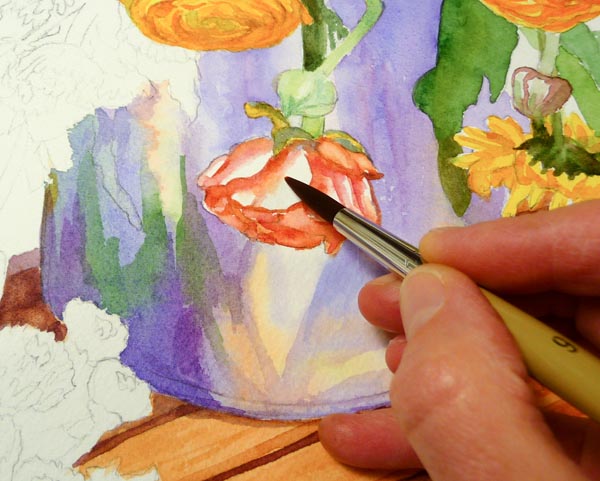
Starting orange flowers; softening an edge

Continuing on from Part I, here is a close up as I began to paint the yellow and orange flowers. For the first layer of this flower I painted the darker sections and then used clear water in a damp brush to pull/feather the color out into the flower so it didn’t make a hard edge.

Yellow underpainting of some flowers
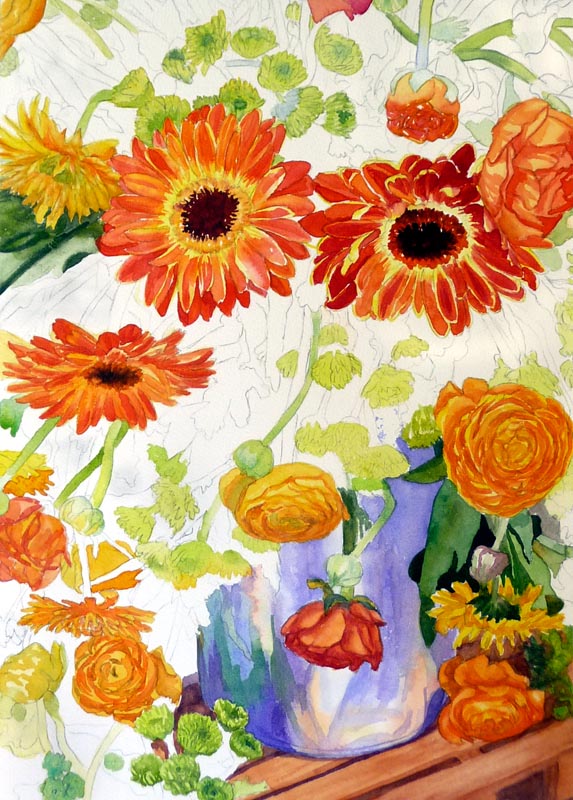
Yellow underpainting (click to enlarge)

For the three large zinnias, I outlined all the petals with Holbein Cadmium Yellow Light. Then I brushed a ring of clear water around the center of each of those flowers and painted a narrower ring of yellow inside that so the paint would softly spread in the water to not quite the edge of the water, producing a soft edge. When that dried I painted the flower’s very dark center with a mixture of Winsor Newton (WN) Burnt Sienna and Winsor Violet. Then I painted the gold ring between them with WN Cadmium Orange mixed with Daniel Smith (DS) New Gamboge.

Painting one petal at a time

I began applying mixtures of WN Cadmium Orange, WN Permanent Rose and DS New Gamboge to one petal at a time while avoiding painting over the yellow outlines on the petals,. You can see the juicy puddle of color I like to put down. I’m careful to let it dry without shifting the tilt of the paper to avoid backwashes.

Orange flowers completed

I worked all over the paper, turning the painting sideways and upside down instead of reaching across, to complete all of the yellow and orange flowers. Some of them will get touch-ups before the painting is completely finished.

Next time: more greens, the dark background, and the finished painting. Meanwhile, I’ve been assigned the next painting to do: a lovely orchid which I will approach in a completely different manner.

Categories
Art theory Drawing Gouache Ink and watercolor wash Life in general Painting Places Sketchbook Pages

Sketchcrawl at Pastime Hardware

Toilet seat display, ink & watercolor

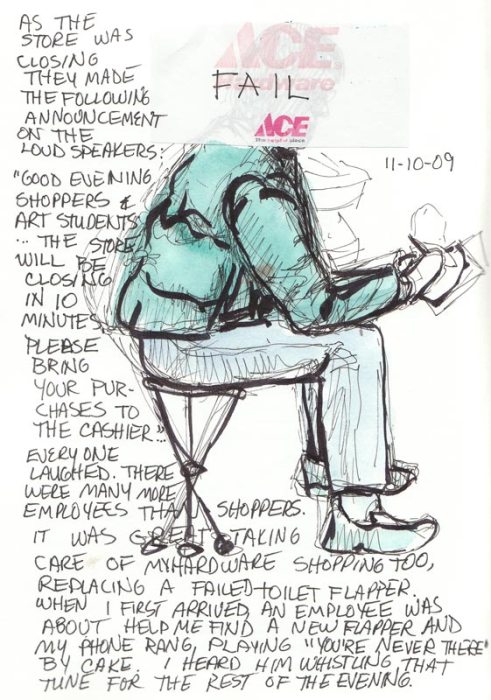
Who knew it could be fun to sketch at the hardware store? There were laughs (see end of post) and artistic discoveries galore at our Tuesday night sketchcrawl, now forced to go indoors for the winter.  When I first arrived I started to ask  one of the  helpful employees that Pastime Hardware is famous for, about the part I needed for my toilet. Before he could show me where to find it, my phone rang with the ringtone I made from the Cake song “Never There” (click below to hear the ringtone).
An employee who was standing nearby said, “Hey! That’s Cake.” and then began whistling it. Throughout the evening I could hear him whistling the tune from all around the large store, which gratefully, is one of the few stores in existence that does not play annoying music 24/7 over the loudspeakers.

I had no idea how many differently shaped toilet seats there are. I discovered that looking at the negative shapes between the seats helped me to better find the shape of each seat. Then, looking more deeply and trying not to generalize, I discoverd the piles of boxed and/or wrapped toilet seats on the shelves behind the display. And then I noticed and added the pegboard behind that. I fell in love with the pretty color I mixed from cerulean blue and yellow ochre for the pegboard. This, to me, is the joy of sketching in a nutshell: seeing more and more deeply and the fun of making lines and dots and shapes and playing with color.

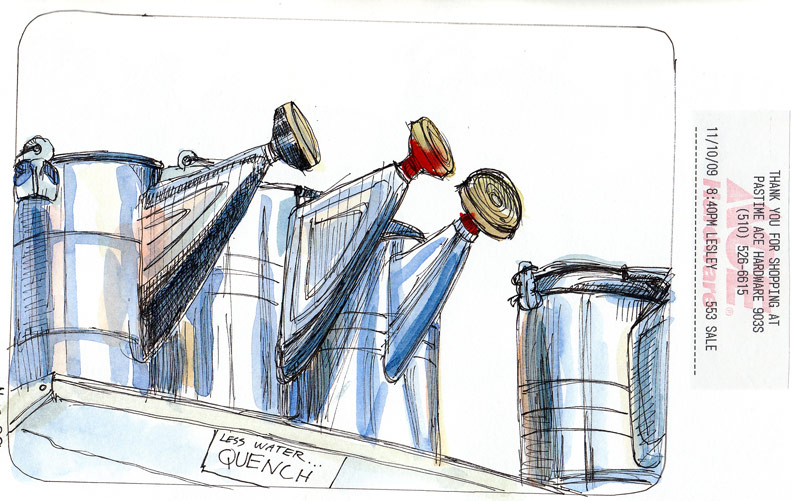
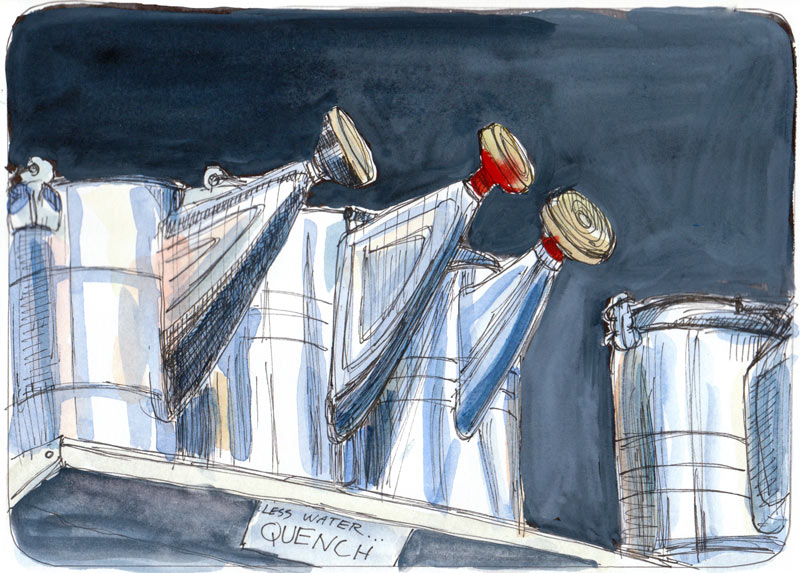
Next I faced the opposite direction and drew and painted these large metal watering cans up on a tall shelf.

Watering Cans version 1, ink and watercolor

When I got home I glued a bit of my receipt (from the toilet flapper I bought) to the edge of the page in my sketchbook (above). Tonight I thought the page might look better with a dark background so I added some ink, didn’t like that, and then painted with gouache over the ink to get more what I had in mind. (The receipt is still there, I just didn’t scan that part below).

Watering cans, ink, watercolor, gouache

The last sketch I did was of Cathy sketching a row of hand trucks in the room filled with bins of nails. I messed up her face but fixed the FAIL by pasting another piece of receipt over her head.

Last Sketch of Cathy Sketching

I would have liked to sketch more but it was nearly time for the store to close. It had been a lot of fun, and I enjoyed the comments and questions of passing employees and the few customers shopping on a very quiet Tuesday night. Cathy said that when she was sketching outside the employee break room she overheard employees talking about us and saying, “There’s a lady out there painting… TOILET SEATS!”

At 8:45 a man announced over the loudspeakers:

“Good evening customers…and… ART STUDENTS [giggle]. The store will be closing in 15 minutes so please bring your purchases to the [giggle giggle] cashier …[giggle]…”

…and then laughter ensued throughout the store, employees, customers and us artists alike! It was a slow night at Pastime, with twice the employees as customers, so I’d like to think they enjoyed our company as much as we enjoyed theirs.

Categories
Art supplies Art theory Painting Still Life Watercolor

Better Bowl of Fruit, Better Watercolor: Now I Can Eat the Fruit!

Better Bowl of Fruit, Watercolor on paper, 7" x 10.5"

I’m so much happier with the way this watercolor of my bowl of fruit turned out than the one in my sketchbook. It makes such a difference to use Arches 140 lb cold-pressed watercolor paper. It also helped that I was painting consciously and taking my time, instead of rushing through it, half asleep as I had been when I made the sketch.

Even more fun is that I made the the large porcelain bowl when I was a potter and had glazed it with two of my favorite glazes…and now I was “glazing” it again, in watercolor.

I enjoyed every bit of the process, from planning the composition, to drawing (see below) from life, to masking the whites, then painting one shape at a time, using juicy washes, adding color wet-into-wet, as well as glazing over dried washes, then removing the mask, softening the highlights and some edges.

Fruit bowl pencil sketch on watercolor paper

Since I’m teaching a watercolor class right now, I tried to also pay attention to my process so that I could better explain to my students how and why I did what I did. I surprised myself with the range of techniques I was actually using in one painting. Even though in class we study them as separate techniques (flat wash, graded wash, wet-into-wet, etc.) you often need them all in one painting and sometimes in one passage of a painting.

(Boring technical stuff follows…read at your own risk…) For example, after the fruit, bowl, and shadow were painted I did a flat wash of Ultramarine Blue mixed with Burnt Sienna for the neutral background. Then it felt like the table top, which I’d initially left white with just a light blue shadow, needed paint too. So the first layer was a pale flat wash of Cadmium Yellow. When it dried it didn’t feel warm enough so I glazed over it with a flat wash of Permanent Rose (so that the whole table top was the pale apricot color now only seen on the right of the table top). It still wasn’t warm enough so I did another wash of Permanent Rose mixed with a little Cadmium Yellow and let it fade out 3/4 of the way across. I liked the way that looked but now the shadow was too pale. So I glazed over over the shadow a couple of times and then softened the edges of the shadow where it meets the table top.)