Categories
Oil Painting Painting Still Life

Christmas Citrus & Saint Nicholas

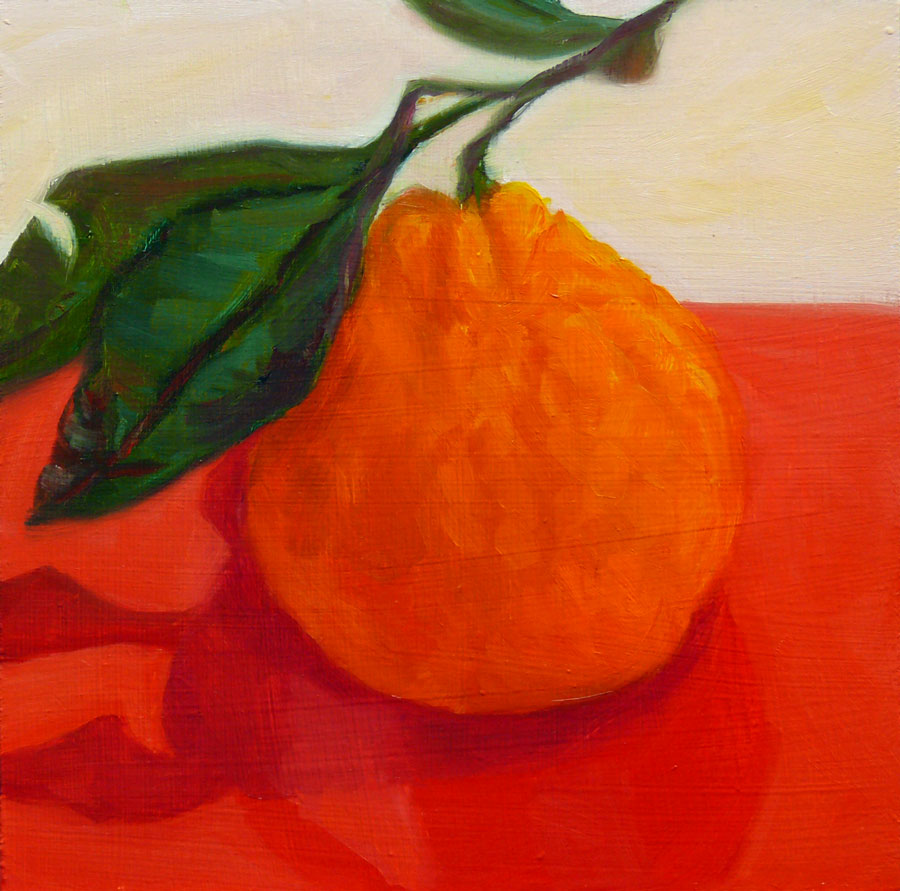
Christmas Tangerine

Oil on masonite panel, 6″x6″ (Larger)

Although I personally don’t celebrate Christmas, I thought a bright orange tangerine would be a fitting tribute to the day (see below about the tradition of oranges and tangerines as stocking stuffers).

My sons and my dear friends and family are all with their significant others and families and knowing they’re all having a lovely Christmas day, I’m exactly where I want to be: in the studio.

I hope you too are safe, warm and happy today, whether you celebrate Christmas or not!

St. Nicholas traditions in America

Immigrants brought St. Nicholas holiday traditions to the United States. Over time these have melded into some common practices.

StockingsChristmas stockings by the fireplace
And the stockings were hung by the chimney with care in hopes that St. Nicholas soon would be there, goes the oft repeated Christmas rhyme. In the story of Nicholas rescuing the poor maidens from being sold into slavery, the gold dowry money, tossed in through the window, is said to have landed in stockings left to dry before the fire.

OrangeOrange or tangerine in the toe of filled Christmas stockings
The gold Nicholas threw to provide the dowry money is often shown as gold balls. These are symbolized by oranges or even apples. So the orange in the toe of the stocking is a reminder of Nicholas’ gift.

Categories
Landscape Oil Painting Painting

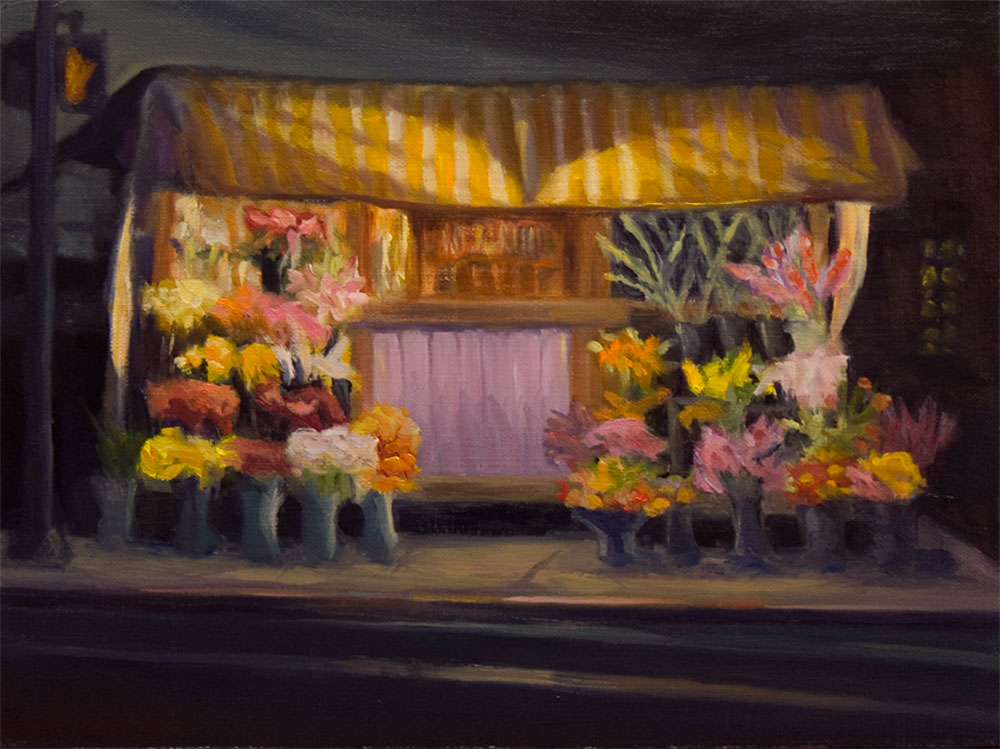
Flower Stand at Night in Oils

Oils

Oil on panel, 9″x12″ (larger)

This is the same scene I did a few days ago in watercolor last week. I’m not sure if I’m done or not, but it’s time to set it aside and give it a week to see what if anything is still needed. It’s interesting how much better I like it when viewing it from a few feet away instead of a close up view like this.

Several times today I thought I was nearly done and then took a break, sitting in a chair across the room with a notepad, writing down all the little things I spotted that needed adjusting and then went back to the painting and checked them all off.

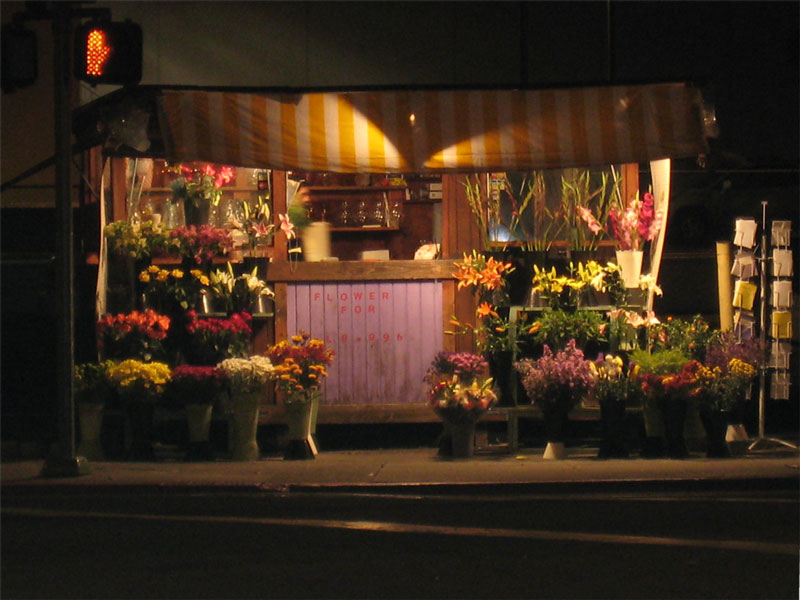
Here’s the original photo reference I took the night before Thanksgiving:
Photo reference for Night Flowerstand
Photo (Larger)

I also got out and did some plein air painting with Elio‘s class on Sunday. He seems to be charmed as we have had no rain on Sundays now for three months of classes…or maybe it’s global warming? But it is pretty amazing being out painting in a sunny meadow in the middle of December. I dug out my longjohns and gloves from my skiing days and a Lifa turtle neck from my sailing days and dressed in several layers, which worked just fine in the mid-50 degree weather. Now if I can just get all the mud out of the crevices in my boots!

Categories
Art theory Glass Oil Painting Painting Still Life

Conscious Competence?

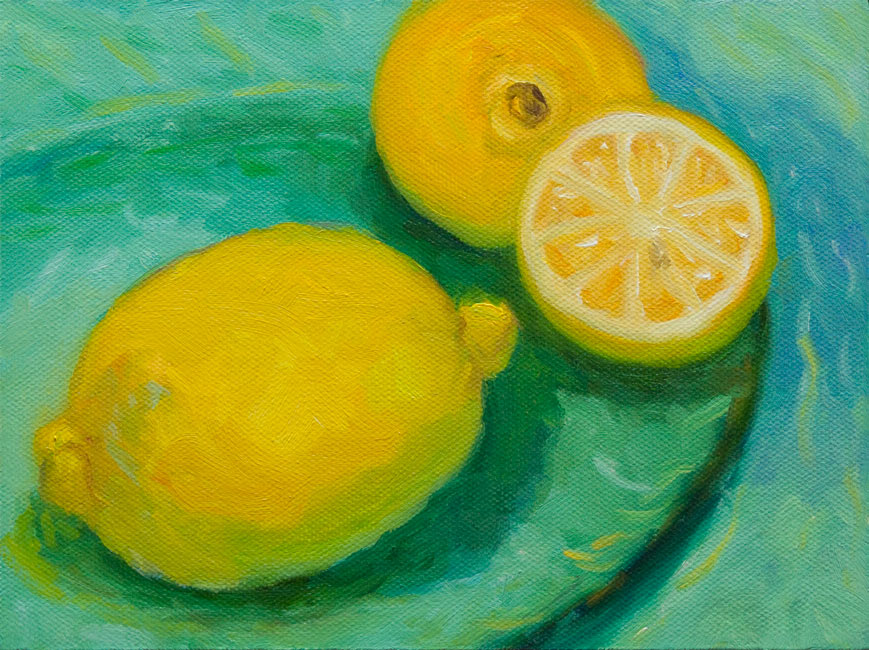
Lemons on Green Glass Platter

Oil on canvas panel, 8×6″
Larger

I think I’m finally making a little progress with my oil painting. I’m starting to understand about color temperature and how to make transparent darks (which you absolutely have to protect just like the white of the paper in watercolor). I couldn’t figure out how to get the little highlights on these lemons but maybe I have to wait for the paint to dry and then use a dry brush to sweep across it. Or maybe I could do it with a knife? I tried painting it on with a brush but just kept smearing and muddying the paint. Any suggestions?

In July, I did these lemons on a different green glass plate and …

Lemon on green glass plate (P1010468)
Larger

…I think I see some progress.

My friend Judith told me about a learning theory that divides the stages of learning into four stages:

  1. Unconscious incompetence .(You don’t know how much you don’t know and sometimes have beginner’s luck that makes it seem like it will be easy to learn).
  2. Conscious incompetence. (Now you’ve realized how much you don’t know and how bad you are at the thing you’re trying to learn, and how many people are way ahead of you. You may have the knowledge or information about HOW to do something but not the skill to do it.)  A lot of people give up at this point. This is where I’ve been for past couple months.
  3. Conscious competence. (You understand how to do it, you’ve practiced and built some skill, but it doesn’t come naturally. You have to think through each step but you can do it and a basic level.)
  4. Unconscious competence. (It just comes naturally and you don’t have to constantly think through each step.)

Mom was half-right when she said “practice makes perfect.” I know that when I strive for “perfect” I only end up miserable. I think the saying should be “Practice makes Progress” and right now progress feels great after being mired in Conscious Incompetence for months!

Categories
Art theory Faces Oil Painting Painting People Portrait

Persistence, Acceptance and Freedom

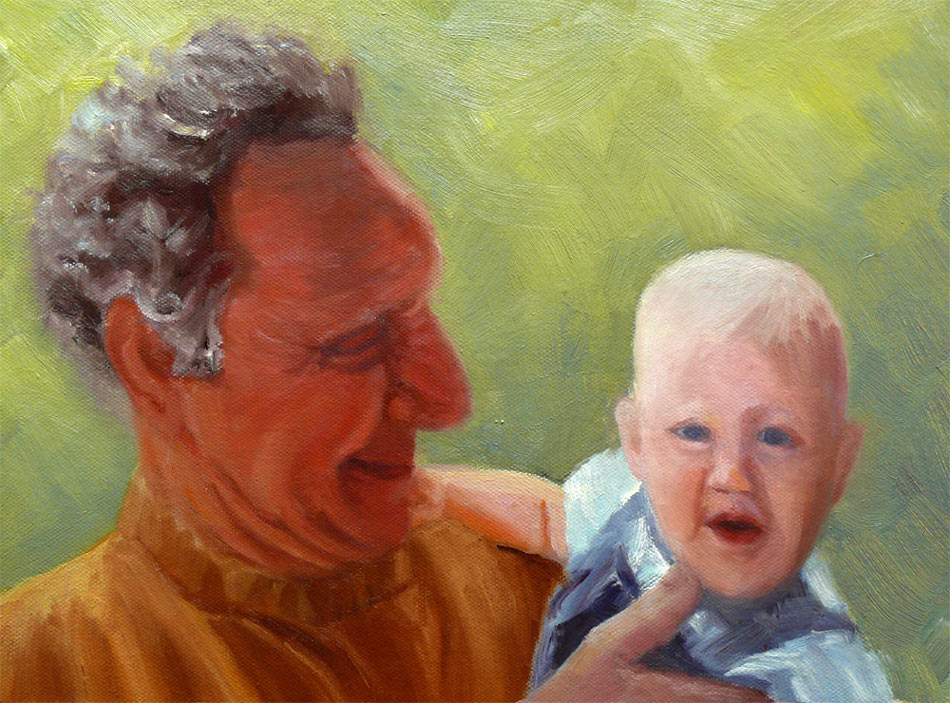
Don and Robin

Oil on panel, 9×12″
Larger

This is a portrait of my son and his grandfather, Don, from a photo taken 30 years ago. I started working on this painting a few days before he died two weeks ago. Although he was afraid of dying he had tremendous acceptance, from years of regular meditation. Visiting him was a very peaceful experience. Even though he was experiencing so much loss, having been an athlete all his life and now watching his body fail, he was incredibly serene. We brought him some photos to look at, including the one from which this picture was made, and they cheered him up and made him laugh.

The reason I titled this post “Persistence, Acceptance and Freedom” is both because of Don, and also because I’ve had to accept that I don’t yet have the skills to make this a good portrait in oil paint, despite my persistence, and that this painting is as far as it’s going to get and it’s time to let it go. And that gives me much needed freedom, after working on this for way too many days. In the beginning it was a wonderful way to remember Don and think about those early days. I was determined to do the best I could but now by accepting that this is as far as I’m willing to take it, I free myself to move on to something else.

I didn’t spend enough time with the initial drawing, the photo I was working from was old and funky, and the color had faded strangely. Initially there were three generations in the picture, my son, his dad, and his grandad. First the two men were great but the baby was a mess. Then the baby got good but I messed up one of the men. After scraping off and redoing all or some of the people many, many times I decided to eliminate my son’s Dad, paint the background and clothes, and call it done. The thing with oil painting is that you can edit forever but I need to stop.

I’ve read it’s better for learning to paint hundreds of one-hour paintings than to spend hundreds of hours on one painting. I’ve tried the later and it’s not fun. I’m ready for the former and excited about doing timed paintings — more like sketches — one hour apiece.

Categories
Art theory Landscape Oil Painting Other Art Blogs I Read Outdoors/Landscape Painting Photos Plein Air

Inspiration Point, Tilden Park

Inspiration Point, Tilden Park

Larger
Oil on panel, 9×12″

Sunday was my plein air oil painting class in Tilden Park and we met at Inspiration Point in Tilden Park in the Berkeley Hills. On a clear day you can see far into the distance from this site. Unfortunately, when we arrived at 9:00 a.m. the fog was so thick we could barely see halfway across the parking lot. Our teacher, Elio Camacho, had planned to start class by doing a demo — an expansive vista on a large canvas. To try to accomplish something until the fog cleared, he had us set up our easels facing the alleged view and get ready to paint. I enjoyed the idea of randomly picking a spot with no idea what I’d see or paint.

At 10:00, after delicious coffee and treats from Peets Coffee generously brought by a class member, Elio did an amazing small demo of the sun glaring through the fog above some nearby trees. Happily, just as he finished the fog lifted and we got to work.

This time I remembered to take a photo of the scene before I got started so that I could finish the painting at home:
Inspiration Point, Tilden - Photo

Categories
Art theory Flower Art Glass Oil Painting Other Art Blogs I Read Painting Still Life

Dahlias after Painting Class

Dahlias in Oil

Larger
Oil paint on gessoed mat board, 12×7.5″

Sunday was my first plein air oil painting workshop with Elio Camacho and it was fabulous! Elio is not only a wonderful painter, but he’s a fantastic teacher — so energetic, enthusiastic and generous in sharing everything he knows (which is a lot!).

Although Elio covered a huge amount of artistic territory in his conversations with us, what really sunk in for me at this session was the importance of temperature (warm vs cool colors) and value (dark vs light) and how to use those relationships to paint the effects of light in the landscape.

To better understand this concept and practice seeing color temperature, he suggested doing a still life of all yellow objects as homework so I painted these dahlias from my garden (after scrubbing all the nasty aphids and ants off them–ick!). Yellow is a good color to practice with because there are many yellow pigments from cool to warm and dark to light and you can successfully lighten it with white, unlike red which turns pastel pink when white is added.

Since I started this journey to learn oil painting, I’ve read many books, watched a dozen oil painting videos, and received wonderful support from my online painting mentor, Nel. There were so many concepts, “rules”, and techniques that I understood intellectually but in class they came to life! Seeing the process demonstrated and being able to ask questions each step of the way was great.

And even better was having Elio checking on me every 15 minutes or so during the three hours I was painting. He demonstrated what he meant when I didn’t understand; he recommended I quit dabbling– put down a stroke and leave it; he showed me how to hold my brush correctly and at what angle, so I was putting paint down without scraping it off at the same time (hold the tip of the brush and keep it at a low angle to the canvas, not perpendicular as I was doing). So many things just clicked.

The painting I did in class isn’t worth posting, though it had some nice moments along the way. Now that I know how to hold my brush properly and understand the importance of the direction of the brush stroke, and am learning to see color temperature and value better, I’m can’t wait to start my next painting!

Categories
Art theory Flower Art Glass Oil Painting Painting Sketchbook Pages Still Life

Wax On, Wax Off (Breathe In, Breathe Out)

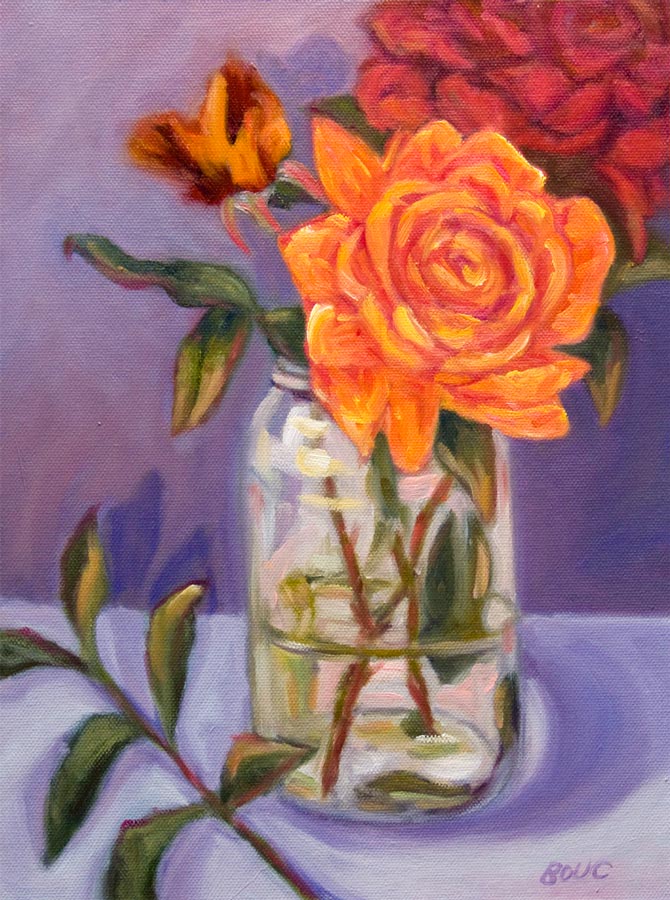
Rose in a Jar

Oil on panel, 12×9″
Larger

The title of this post refers to words from the 1984 movie Karate Kid and also my process in this painting except for the painting it would be more like “Paint On, Wipe Off (Breathe!) Paint On, Wipe Off… ” (click on “Keep Reading” below to see photos of the steps). I’m not happy with the front flower but I’m ready to move on to the next painting. With each one I learn so much more, including how much more there is to learn!!!!

I had two main goals for this painting/learning experience:

  • Think in terms of “Whole Canvas”
  • Keep trying to understand how to work with oil paint so that I’m taking advantage of its wonderful qualities rather than fighting them. (I’ll keep trying!)

In my many years of watercolor painting, I worked hard to capture what excited me about my subject. I often worked close focus without much background, or just using the lovely white of the paper as my background to set off the glittering glass or glowing flowers I was painting. If the composition didn’t quite work out–no problem, just crop as needed with a mat and frame.

In oil painting the background has to be an integral part of the painting–you can’t just leave the glaring white of the gessoed canvas as your background. And you can’t crop a stretched canvas or panel like you can paper. I was struggling with this concept and finally it clicked. It’s just another way of seeing and, like peeling layers of the onion, the haze peeled from eyes and I could see that a painting is not subject & background — they fit together to complete the picture, just as night completes day. While an object that interests me enough to paint it is the focal point, I need (for now) to think of the PAINTING as the subject.