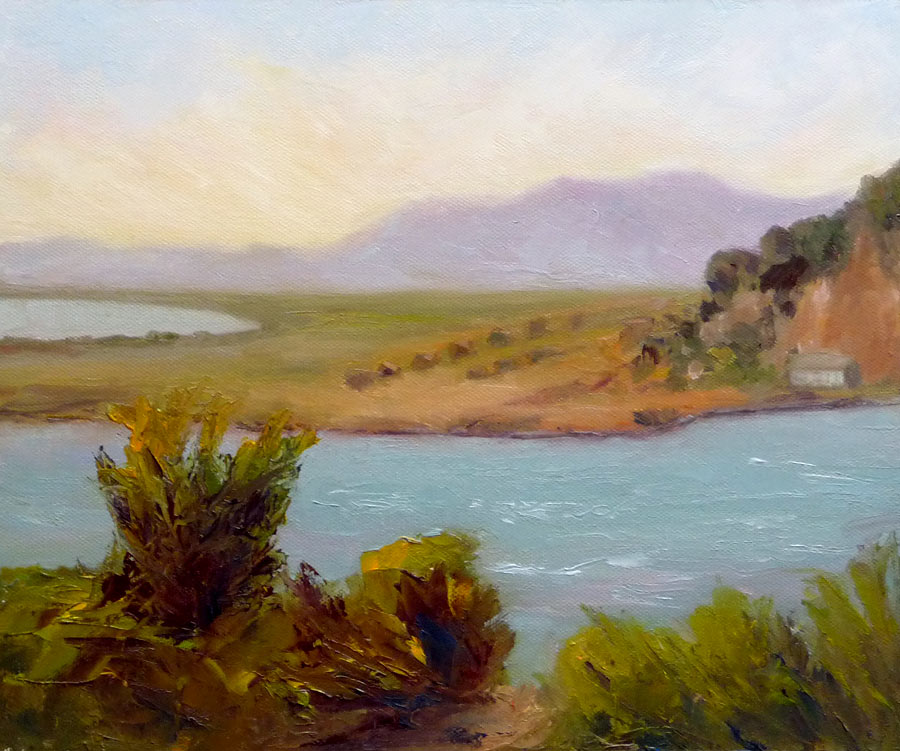
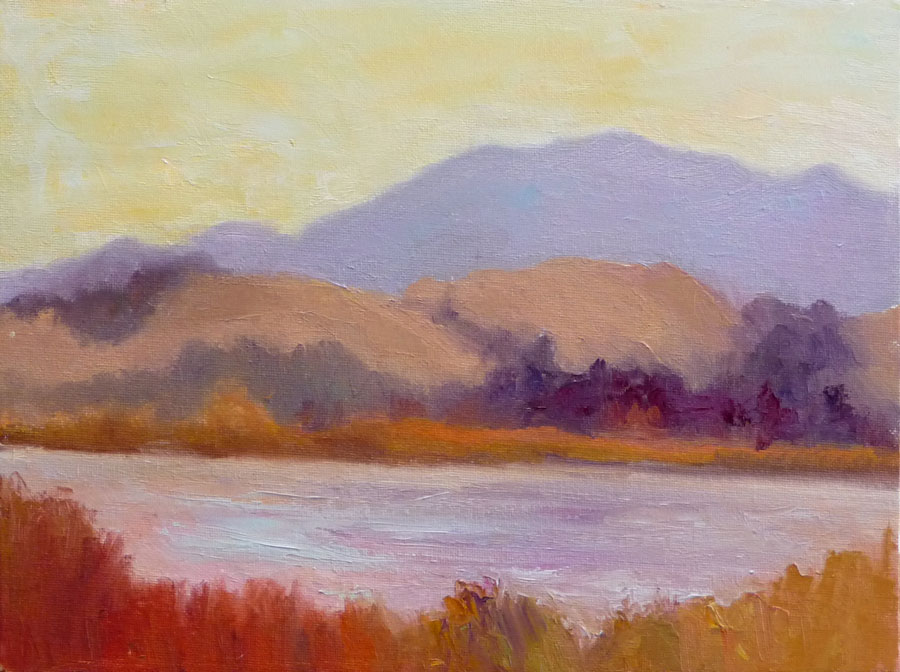
Rodeo Shore, plein air oil on panel, 9x12 in. (click image to enlarge)
The little shoreline park in Rodeo where we painted Sunday is funky like the town itself, but a fun place to paint. Click here to see some of Sue Wilson’s cool photos of the area or her little video of some of us in Da Group painting there. This beach is about 40 feet from the railroad tracks where freight trains and Amtrak trains rumble by, whistles blowing, every 20 minutes or so. One train made me laugh: an engine pulling another two dozen engines which were all riding backwards. It looked so silly.
On the north end of the little beach there’s a broken down old pier and a couple of tin shacks. The shacks and pier are all that remains of the “resort” that a man with big dreams (but apparently little common sense) built there on a former industrial dump. In his later years he allowed a homeless encampment to flourish on his property. When he died his heirs had the vagrants evicted. To get even, they burned the resort down to the ground. The property is worth less than nothing because of the clean up needed due to the toxins under the ground.
Dumps to Cities
Most of the bayfront land in the San Francisco Bay Area is built on former dumps. A combination of ignorance, greed, and “out of sight, out of mind” thinking, led cities and businesses to dump everything from tires and batteries to whole cars; from industrial waste to ordinary garbage into the beautiful bay, eventually creating “landfill” upon which homes, hotels, parks and major freeways were built.
I remember going to the dump at the Berkeley waterfront where you drove up (holding your nose) and dumped your trash in a pile on the ground, seagulls flying overhead. Then the bulldozers would push it into big hills. Now that dump is hidden under Cesar Chavez Park, home of the Berkeley Kite Festival. The park has air vents to allow the methane gas to escape from the garbage dump buried underneath the grassy hills and waterfront trails. Vents won’t help buildings on landfill if there’s a big earthquake and the landfill undergoes liquefaction.
Now trash goes first to a warehouse “transfer station” where it is sorted and then piled onto trucks and hauled to a dump/landfill in another town. (And in my own bit of “out of sight, out of mind” I realized I didn’t know where it went and had to look it up). It’s trucked to Livermore, land of rolling hills and wind farms.
Dump amidst the lovely Livermore rolling hills
I’ve heard that all the Bay Area dump/landfills are all going to be full within the near future. I hope we learn to do a better job of recycling and precycling before that happens.
Trash and Art
And now to tie this digression about dumps back to art, San Francisco offers an artist in residence program at the Solid Waste Transfer and Recycling Center where San Francisco’s garbage goes before being trucked away. Artists get 24-hour access to a well-equipped studio, a monthly stipend, and an exhibit at the end of their residency.
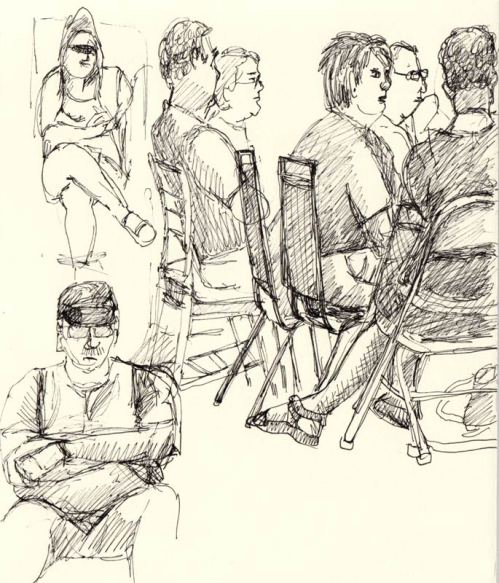
Meeting, thinking, waiting (click images to enlarge)
Practicing patience while doing for others the past week has meant less time for painting. A dear friend broke his leg and has required 2 trips to the hospital and other chauffering. The computer I gave to my wonderful neighbors came down with a variety of ills, including a dead power supply and a huge load of viruses (or is that virii?). And work was a non-stop series of meetings, trouble-shooting and brainstorming sessions that completely wore out my brain.
Doodleheads: Subway sketches of people on BART
Today instead ofpainting I’ve spent hours trouble-shooting and (hopefully) restoring my former computer (the virus scan is still running and zapping hundreds of virus files). Lesson: Never let a 12 year old boy use a PC without first installing virus software! A friend told me about the free (for home users)and downloadable Avast Antivirus and he is right: it is fantastic!
Doodleheads 2: Subway sketches of people on BART
I need to start a new sketchbook. This one is nearly full and I seem to be postponing the dreaded blank sketchbook, instead cramming everything on the remaining few pages.
Another thing I discovered this week is that Amazon offers all sorts of free music mp3 downloads, (click this link then scroll down) from whole albums to songs from a variety of artists. I’m listening to the ones I downloaded yesterday and really enjoying them. Everything from Billie Holiday, the Butchies, and Firewater to the entire album “Very Best of Naxos Early Music,” which is heavenly.
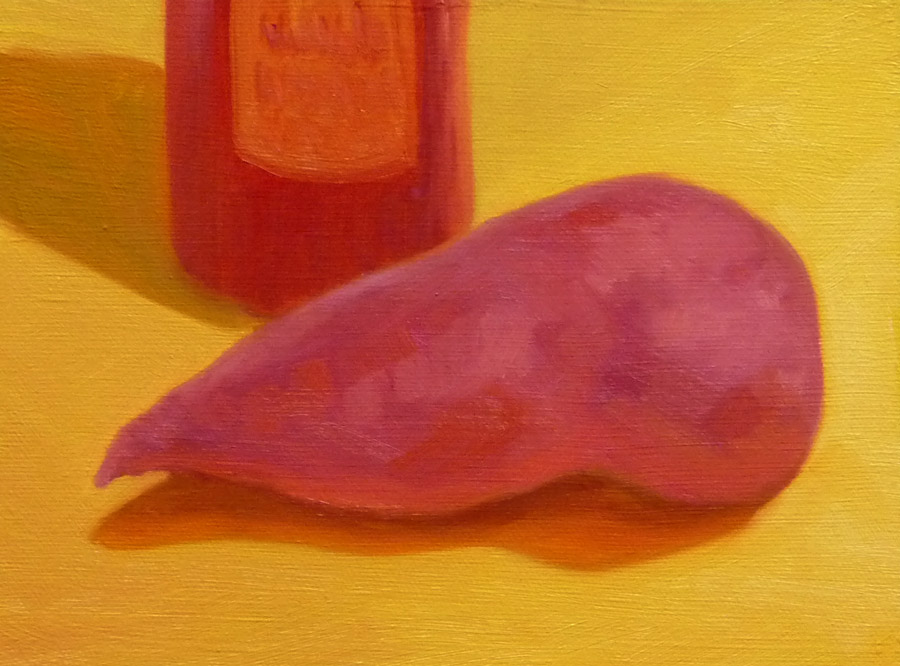
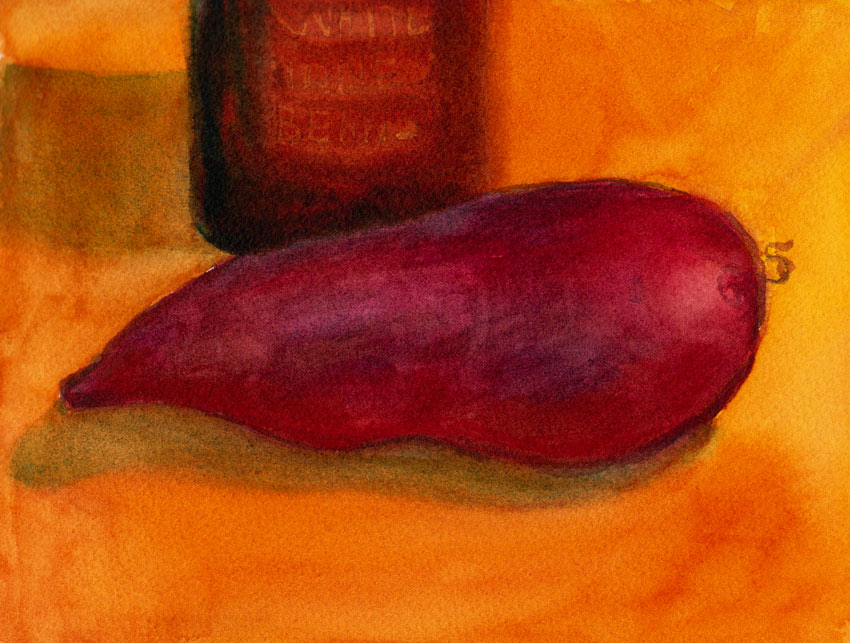
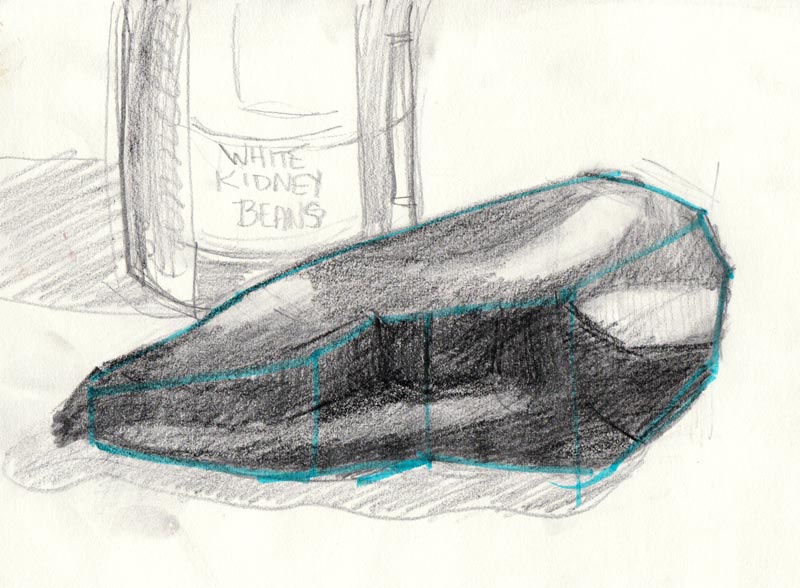
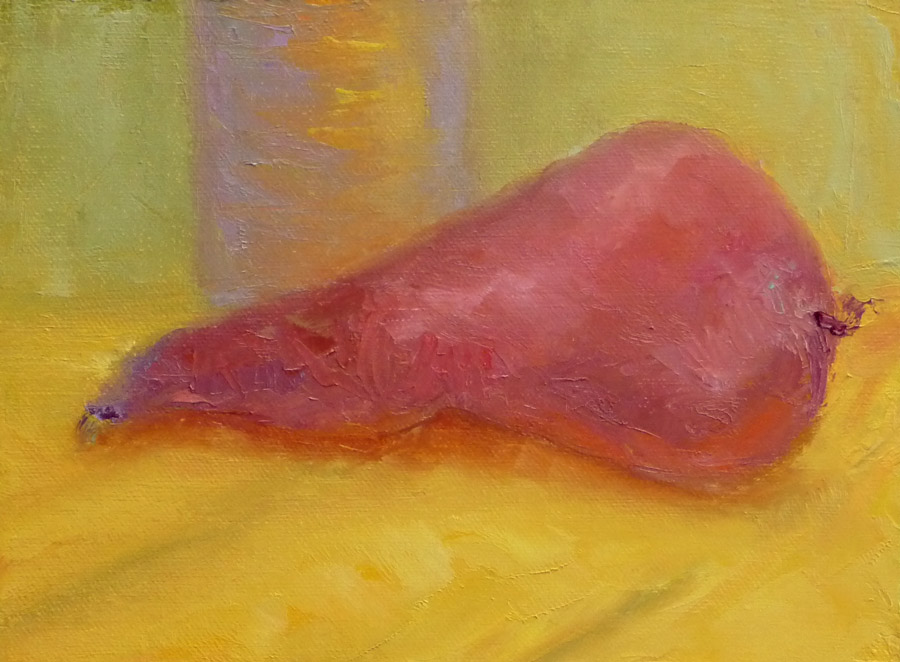
Feeling frustrated from failing to form a faithful facsimile of a silly spud I sought some solutions. (I’ve always loved alliteration.) Displayed below in reverse order (last version first) are my efforts in trying to understand the shape of one homely sweet potato (and a can of beans).
Sweet Spud #4 , Oil on panel, 6x8" (after watercolor study and sketch below)Sweet Spud #3, watercolor on Arches cold pressed paper, 6x8"Sweet potato #2 (Pencil sketch to try to understand planes and volume), 6x8"Sweet Spud #1, (First oil painting before doing the studies) 6x8"
I think I like the watercolor best, what about you?
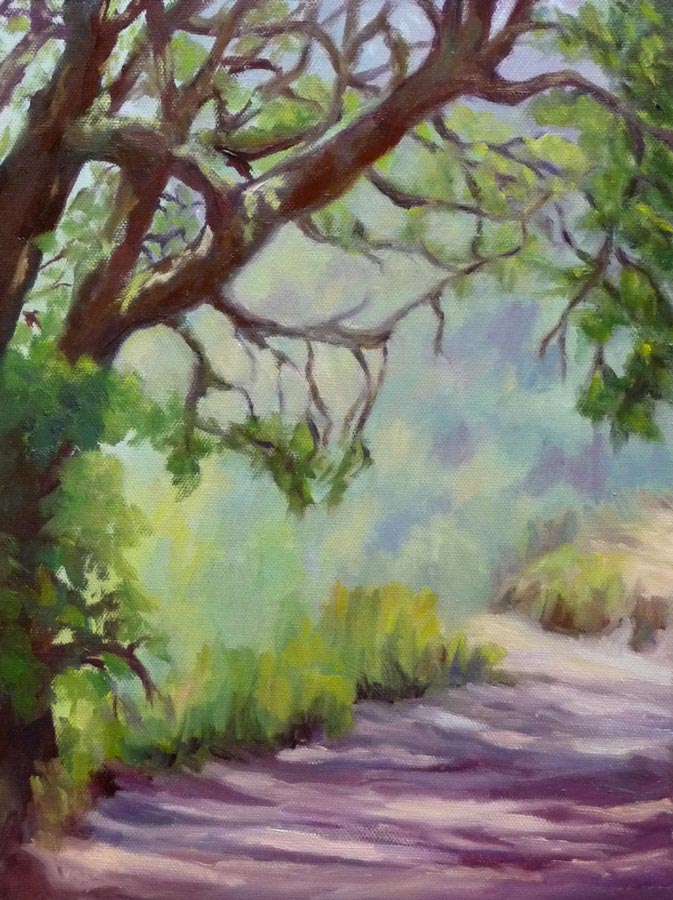
Last Sunday it was a perfect day for hiking in beautiful Tilden Park in the East Bay hills above Berkeley with my best friend Barbara. When we came upon this scene I had to stop and take photos to use as reference for a painting, along with my memories of how the scene felt to me.
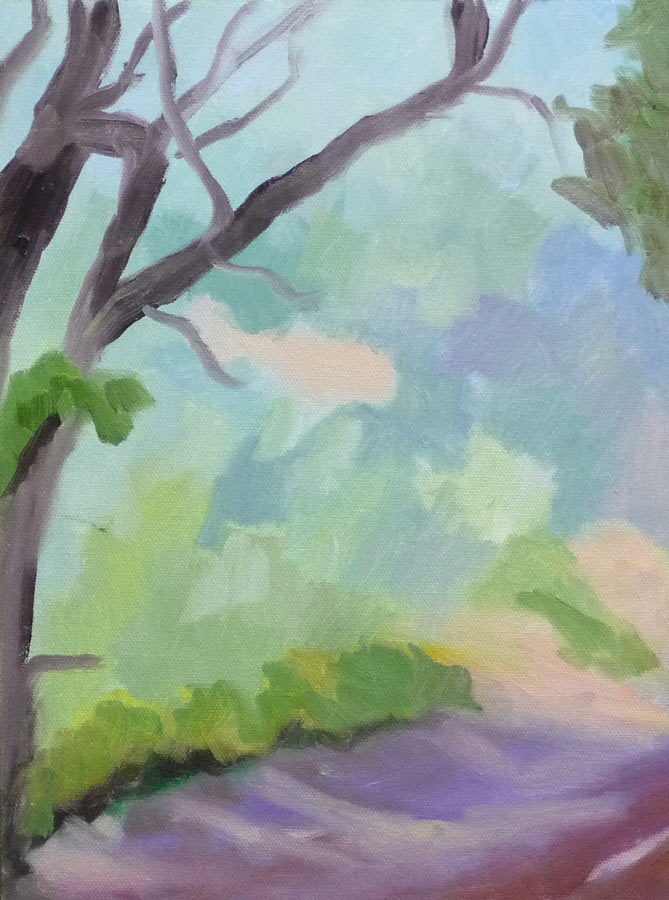
Late that night instead of going to bed I gave myself one hour to block in the basic shapes and get the painting started:
First draft of Tilden Trail painting
For a variety of reasons it was a whole week before I could get back to the painting. After spending this afternoon and evening with the painting I think it’s finished (or nearly so). I really tried not to lose the things I liked in the first “draft” and for once (I hope) I stopped before it got overworked.
This is the first oil painting I’ve done that I’ve been happy with from beginning to end. I know I still have a long way to go with learning (which is good since learning is my favorite thing), but I’m happy that all the studying and practicing I’ve done is beginning to allow me to get an image on canvas that I can see in my mind and feel in my heart, like this one.
I’ve made some improvements to lighting and comfort in my studio and wanted to share what I’ve learned in the process. In the picture below you can see some of the changes from my previous post about reorganizing the studio. These include the floor mat, the wall paint, and a still-life lighting setup.
This post could also be called, “What I Bought Myself for My Birthday” as these goodies were all birthday presents to myself. (Click the images to enlarge.)
Studio with new cushy floor mat, lighting and dark painted wall
FLOOR MAT
The floor mat pictured above makes a huge difference in comfort. I got the idea at my hairdressers when I wondered how she stands all day. She pointed out her floor mat and when I felt how cushy it was, I had to get one. I work standing at a computer or at the easel much of the time. Without a cushion my feet tend to hurt by the end of the day. I tend to sit until my back hurts and then stand until my feet hurt and then switch agin. The mat makes it comfortable to stand comfortably for much longer.
WALL PAINT
I painted the wall behind my easel and desk Benjamin Moore “1490 Country Life” using their new Aura line of which is nearly odor free and covers in one coat. I’d noticed studio walls painted this color in many of the painting videos I’ve watched. Finally one of the artists actually specified that this 1490 color was especially popular with portrait artists for their studios because of how the color sets off skin.
But it also reduces the glare off of the previously white wall I was getting from my overhead light and helps to cut unwanted bounced light and the resulting double shadows on a still life that I’m lighting with a strong directional light (more about that in a minute).
I still have to wear the hat you see hanging on the ease—the overhead fixture does a beautiful job of lighting a canvas without reflection, but with a relatively low ceiling it’s pretty bright on the eyes.
STORAGE
Below is the wonderful canvas and supply rack that my next door neighbor built for me.
Canvas storage rack in closet
It can be free standing but was built to fit inside this closet. The four sections on the far left hold already painted panels and for now, the rest hold panels and canvases ready to paint. The structure is seriously overbuilt due to a slight miscommunication. We speak in a combination of English (my native language) and Spanish (his) and sometimes we think we understand each other but don’t. It’s so sturdy it may even hold up the house in the case of an earthquake.
To the right of the structure is still a bit of closet hanging space where I hang my painting smock and my plein air painting outfit, a very lightweight, ventilated, long sleeved, sunproof shirt so I don’t need sunscreen and lightweight pants that are also sunproof that turn into shorts when you unzip and remove the legs.
The top shelf of the structure (below) provides a place to put my other plein air gear: my Soltek easel, my brushes in a canvas brush carrier, and two canvas carriers from RayMar Art, the company from which I also buy my painting panels (they are archival, don’t warp and are less expensive than most of this quality).
Shelf for easel and other plein air equipment
LIGHTING
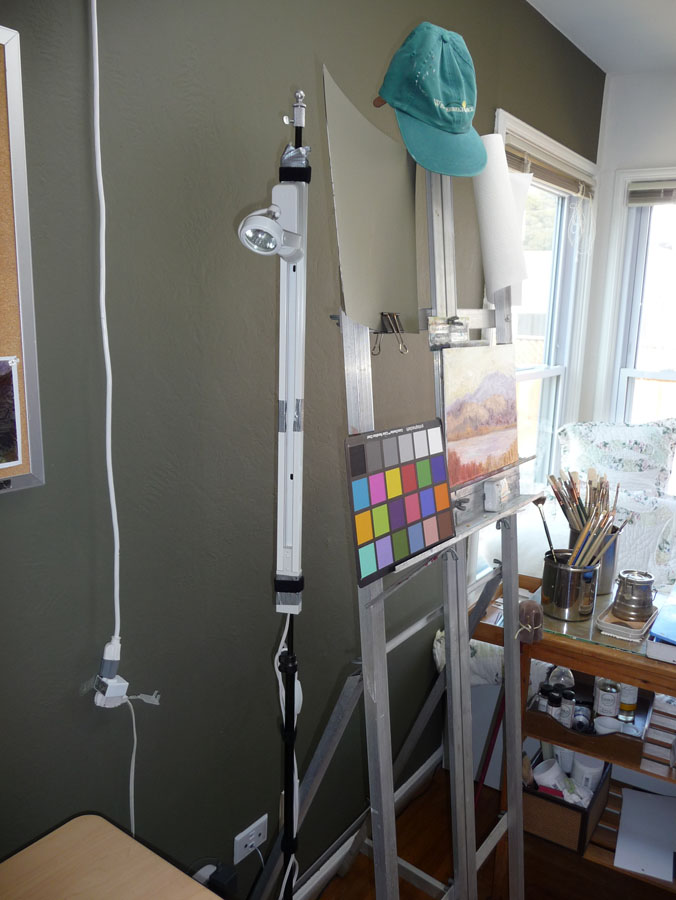
Below is the setup for lighting still life that I’m finally satisfied with, after trying numerous other lightbulbs, fixtures, and other accessories. I wanted a way to get a strong directional light on the still life so there was good contrast in values, modeling of the shape and structure of the object(s), a strong shadow shape without double or triple shadows caused by interference from other lights, and a light color/temperature that gives the illusion of sunlight. A tall order indeed!
Still life lighting set up
As you can see above this system creates a nice swath of directional light, with a strong single shadow (though the photo doesn’t do it justice–it’s hard to photograph lighting!). Below is another picture of how I have it set up.
I went to a local lighting store and we tried out all sorts of things. It took them awhile to understand that I wasn’t buying lighting to light a painting, but to light a still life I was going to paint. They recommended a short section of halogen tracklighting with a narrow-beam floodlight halogen bulb. They added a cord and switch for me since I was going to keep it nearby rather than permanently install it on the ceiling. Then I attached the track light to a cheap old lighting stand I had from photography days.
Track light attached to light stand
The ugly cord and switch on the left above is an inelegant solution that allowed me to avoid having to have an electrician wire the overhead light. It just plugs in and switches on and off. Too bad the cord isn’t the right length.
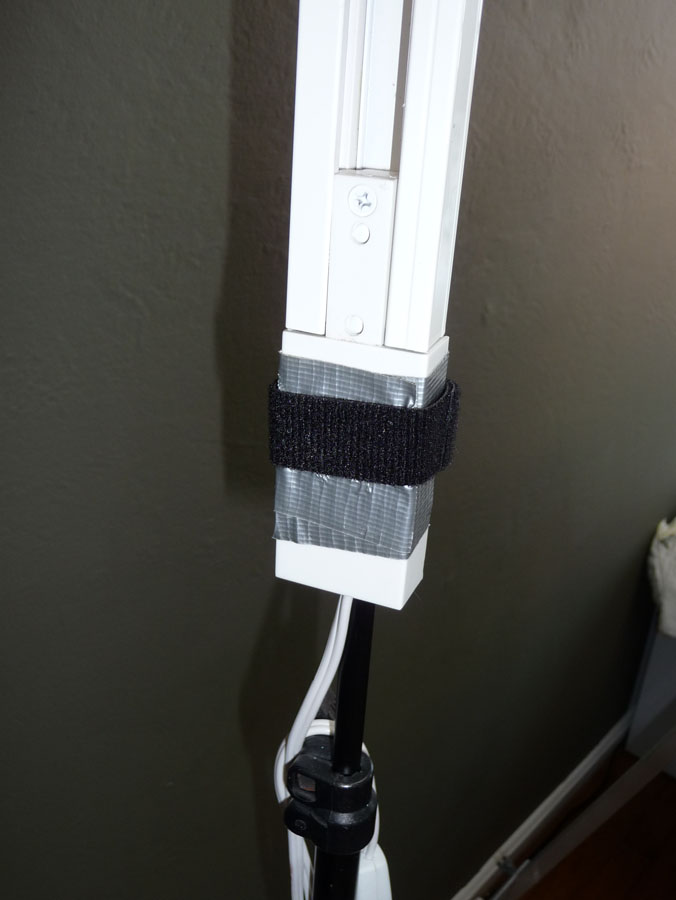
On the two pics below you can see how I used duct tape and a strip of velcro 2-sided strapping to attach the track light to the stand.
Track light with halogen spot attached to old light standDuct tape/velcro attachment
Below is the lighbulb we found that works perfectly for this application: Sylvania Tru-Aim Brilliant Halogen (50MR16/B/NFL25) which I think means it’s a 50 watt narrow-beam flood light.
Lightbulb box for track light
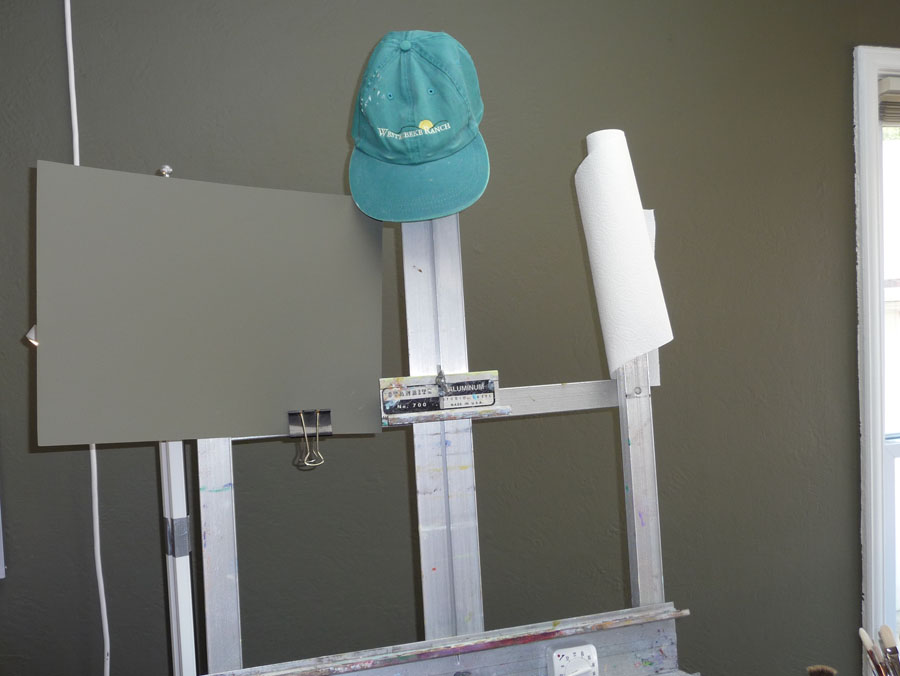
SInce the light was so bright I made this cardboard shield and painted it the same color as the wall and clipped it on to the easel so I could study the still life without also looking at the light. I’m sure there’s a more elegant solution, but this works. The paper towels sit on a funky paintbrush which is stuck into a slot at the top of the easel.
Cardboard painted with wall paint to shade light, paper towel "holder"
My WorkRite electric desk, which holds my computer and monitor not only allows me to work sitting or standing but I discovered that I can use the end of the table by the easel to place a still life at whatever height I like. I can also display a photo on the monitor and scoot the monitor closer to the easel to work from.
Set up for still life with electric desk
I can hang different colored cloths as still life backdrops from the bulletin board with pushpins and I like having artwork on it that inspire me.
The painting to the left isn’t usually there. I hung it when a gallery owner came over for a studio visit because she was interested in including it in an upcoming show (it will be there next month — more about that later).
Another view
I should also say that I have no financial or other interest in any of the companies or products I mentioned in this post. I just like them.
Garbage in the Sun, 10x8", oil on panel (click image to enlarge)
When my neighbors saw me painting their trash cans, with my easel set up in the driveway, they didn’t even look surprised. They know I’m a nutty artist and so they just apologized for interrupting my painting to throw some bottles in the recycling bin.
The truth is, I am easily amused and can find almost anything interesting to paint or draw. Seeing these city-issued garbage cans glowing in the sun, transformed from their usual blah colors, seemed a perfect subject for a quick oil sketch last weekend.
When I showed the painting to my painting teacher Camille, she said I’d done a good job with showing that it was a sunny day, but that I should lose the detail and focus more on the difference in value between top, side and front, to better indicate the direction of light and dimensionality of the cans. And she’s right, of course.
What’s the weirdest, oddest, or nuttiest thing you’ve drawn or painted?
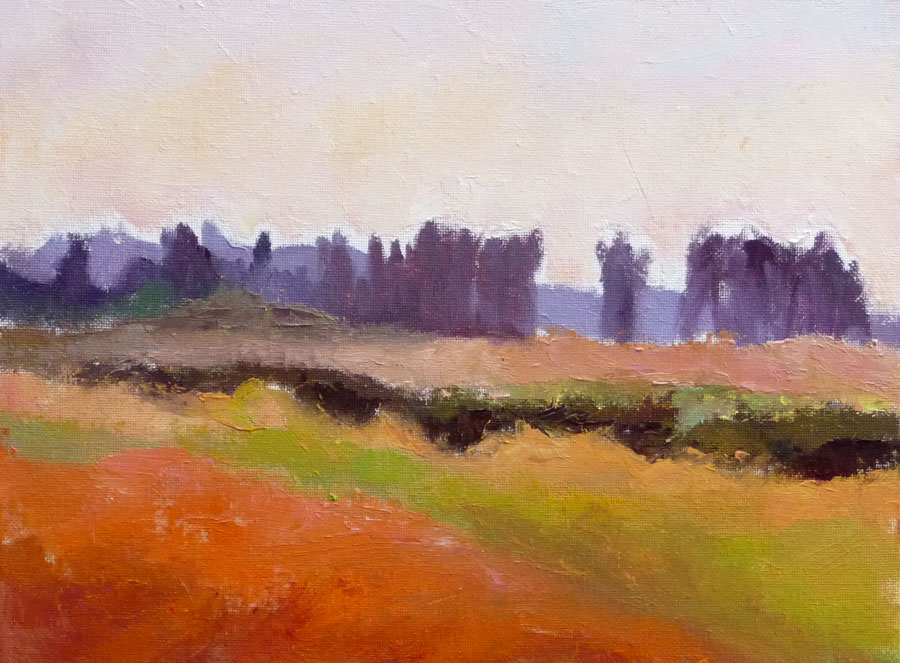
Dry wetlands sketch, 12x9", Oil on panel (click image to enlarge)
Shollenberger Park is normally a watery paradise where you see swans, herons, egrets, pelicans, geese, turtles, frogs, lizards and the occasional harmless snake. But when I arrived there this morning with Camille Przewodek’s class, we were surprised to find cracked dry soil where the watery marsh used to be. Camille said she’d been painting there for years and had never seen it dry before. You can see many of her marsh paintings on her website here.
She set up for her demo in the hot sun, on land that used to be under water. Seeing her paint is like watching a magician, the way she creates the illusion of space, depth, atmosphere, weather, even time of day, all done with color relationships.
The smell from the dried up marsh was making me nauseous but nothing phases Camille when she’s painting. She never complains, whether it’s hot or freezing, windy or smelly; she just gets in the zone and paints. Her students know better than to whine about weather or anything else; or as one student pointed out:
“It’s called ‘PLEIN Air’ NOT ‘Complain Air’!”
About the paintings:
Both of these 1 to 2 hour plein air sketches were done at the marsh, trying to work on getting the big shapes and color relationships. I think my easel must not have been level today; the horizon seems to be slanting downhill on today’s sketch above.
Shollenberger Wetlands sketch, 12x9", oil on panel (click image to enlarge)
When I got home I tried to find out what happened to the water at Shollenberger but couldn’t find anything online. I did learn some interesting things about wetlands and what a valuable and important resource they are on the Petaluma Wetlands site.
I know we’re having a drought in California, but I don’t see how such a large body of water could dry up that quickly from being full just a few weeks ago.
I hope all the birds and fish and froggies are OK. If you know what’s going, please do tell!
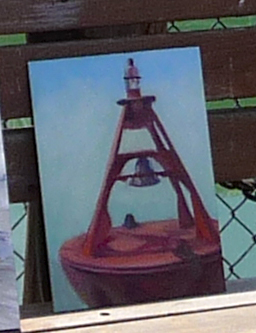
Old Bell Buoy, Oil on panel, 12x9" (click image to enlarge)
If this is a “Bell buoy” I wonder if there is any connection to “Bell Boys”–did the latter get named for the former? (A beacon of light with a bell to warn you of dangers?–probably not). At any rate, this is a buoy and it has a bell, so I suppose the answer is yes, but somehow it just sounds funny to me… I keep picturing hotel bell boys weaing red hats with a bell mounted on top.
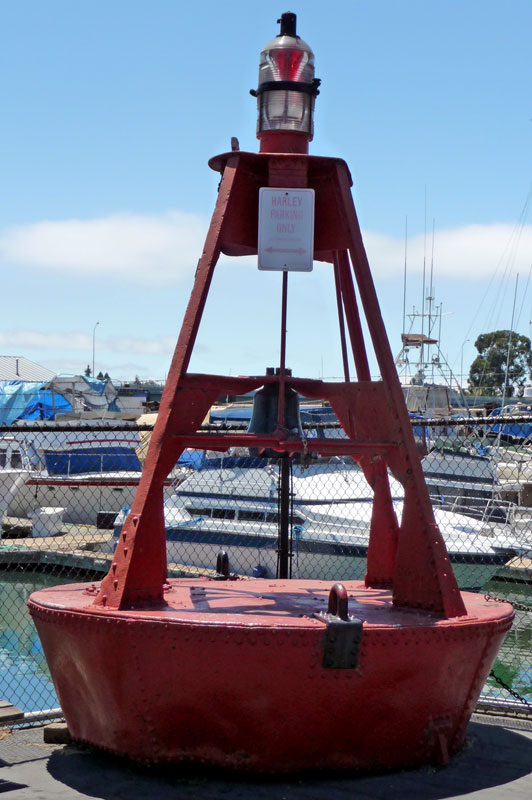
I didn’t paint this aboard a boat in the middle of a foggy sea. This huge old buoy (about 20 feet tall) is actually parked in front of Quinn’s Lighthouse in Embarcadero Cove near Jack London Square in Oakland but when I started painting it was so foggy we could have been at sea.
I arrived at 10:00 a.m. and there were so many interesting subjects (Victorian buildings, gazebos, gardens, boats, Quinns) that I wandered for nearly an hour, trying to choose. I finally picked this and got to work with only two hours to make the painting before our 1:00 group critique.
I nearly finished the painting in the two hours, with just a few details to touch up once I got home. Someday I will learn toleave a plein air painting alone! I started touching up a little here and there and before I knew it, I’d mucked things up. Then I spent the next several hours unsuccessfully trying to get back to what I had originally, which I’d really liked.
Plein air finish before studio "touch up"
Despite my efforts, I couldn’t quite get there. I lost some of the darks, fresh bright lights and interesting color variations I had. Maybe when it’s dry I can do a little glazing and solve those problems, but without being there and painting from life, it’s just not the same, even with a good memory (which I don’t have) and a photo (which I do, below).
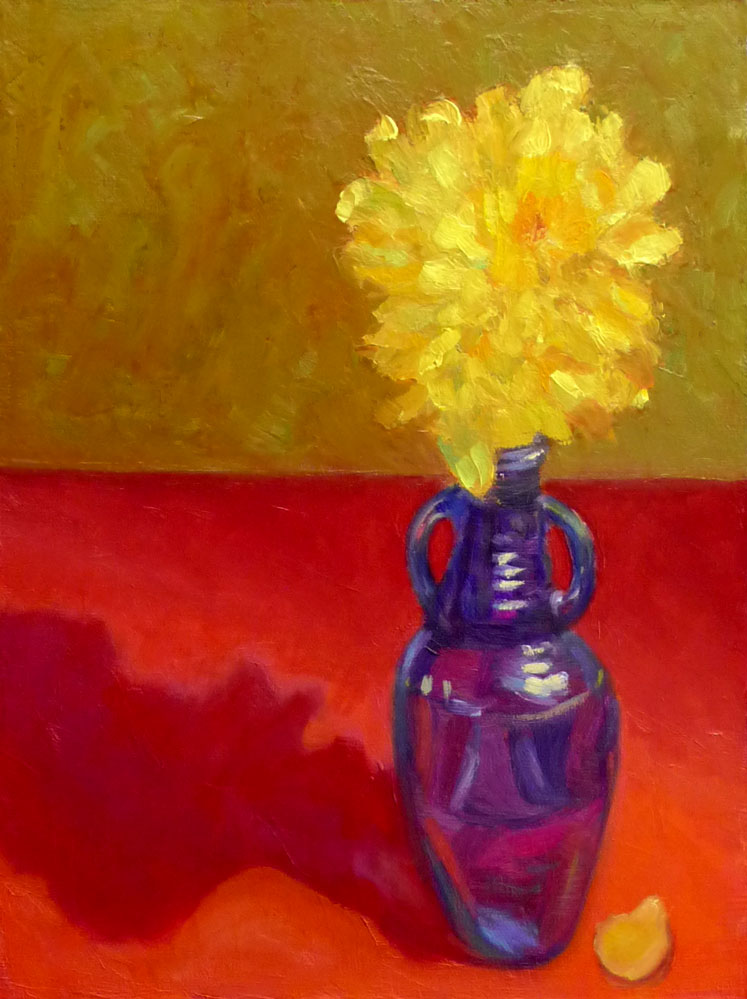
Flowers Buggin' • 12x9" • oil on panel • (Click image to enlarge)
During a temporary burst of gardening interest a few years ago I planted chrysanthemum bulbs around my garden. I’d bought the package of bulbs at Costco and there were two colors in the pack: a lovely peachy color and a sour lemon color. I hoped they’d be mostly the peachy ones and the first year that’s what came up. The next year and ever since, all that appears are the icky lemon yellow ones.
Even worse than their color is the fact that they are bug magnets. Whole colonies of tiny black ball-like bugs appear on the stems and inside the flower, between all the petals, which took forever to wash off before putting them in the bottle. Yuck!
I’m pretty sure the bugs are aphids, which are farmed by the ants that also hang out on these plants. I gained new respect for ants when I learned that they actually raise and protect herds of aphids and then milk them for the “nectar” they produce.
QUESTION: Is my site taking a long time to load for you? Do the pictures load slowly, especially when they’re large like this one?
Carbo-Kittie
Speaking of ants, that reminds me of the very bad morning I had last Friday. I woke up with a nasty migraine and when the first cup of coffee didn’t get rid of the headache, I went out to get a latte at Peets (which usually works).
When I returned home an hour later, I walked into the house and discovered that my crazy calico cat had barfed at least once in every room of the house, managing to hit every throw rug. After I cleaned up the floors and threw the rugs in the washer, I discovered a swath of ants marching across the studio and had to clean them up too. All this before 9:00 a.m. and still with a migraine.
I couldn’t figure out what had so badly upset Fiona’s stomach until, when putting the newly laundered throw rugs back on the floor, I found sesame seeds under my bed. Then I remembered the box of Ak-Mak high-fiber, whole wheat crackers I’d found on the kitchen floor when I came home from work the night before. I thought I caught her before she ate any, but the sesame seeds under the bed meant she must have been snacking on them under the bed before I got home.
She’s been fine since that morning but I bet it’s just a matter of time before she goes grazing in the cracker/cereal/pasta cabinet again. She’s ripped open and sampled boxes of Cheerios and dry pasta, carried a bag of split peas to tear up under my bed (lots of fun to clean up) and her favorite, corn cobs, which I’ve also found under my bed.
I’ve got to figure out how to install baby latches. I tried once but couldn’t get the two parts lined up right and then stripped the screw when trying to remove it. So now it’s just limply hanging there, getting in the way.
P.S. The title of this post is borrowed from an interesting band’s name, Critters Buggin’. Some members of that band are also in Garage a Trois, whose music I prefer to the more frenetic Critters.
(Larger)
The Dead Fish Restaurant is on a hill in Crockett, California and just above it there is a wonderful new little park with amazing views of Mare Island (pictured above) a former military base and naval shipyard, Benicia, and the Carquinez Bridge.
I arrived at the site close to 4:00 p.m. and painted until around 6:00 when some persistent wasps (I think they’re wasps — they’re the yellow buzzing things attracted to meat at picnics) finally drove me away. One kept trying to crawl up my sleeve or into my rubber glove and bit me twice on the wrist.
To anyone watching from a distance I’m sure I appeared to be painting with great flourish as every stroke required swiping at the wasp to move him before I could put a bit of paint on the canvas. That combined with the sun glaring in my eyes and the heat and the fact that everyone else in the plein air group had already left, convinced me it was time to go home.
It’s too nice outside right now to be on the computer so I’m going to keep this short and go paint. I’ve made some changes and additions to my studio that I will post soon as well as some of the paintings and drawings done while I’ve been spending more time in the real world and less in the virtual one while my computer was in the shop. See you again soon!
About the painting: Oil on canvas on panel, 10″x12″, painted 75% on site and 25% in the studio.












 Jana Bouc, Artist