Categories
Berkeley Flower Art Plants Sketchbook Pages Watercolor

Wisteria in Cathy’s Garden

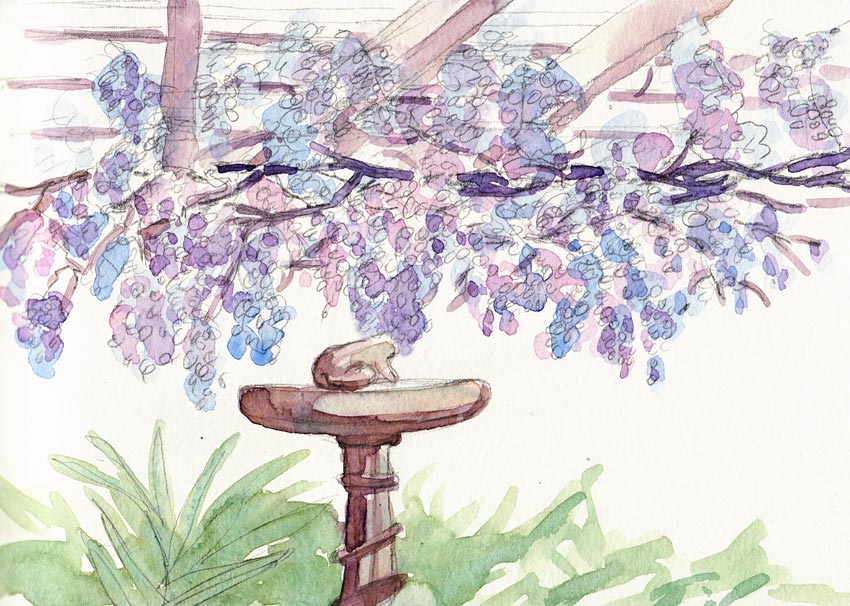
Cathy's Wisteria, watercolor, 5.5x6"

My plein air painting buddy Cathy,  invited me over to sketch her wisteria which was blooming in her beautiful, backyard Zen garden.

Cathy is a graphic designer and her wonderful design sense is apparent throughout her home and garden. I loved being in the presence of the quiet empty spaces, balanced with beautifully designed sculptural installations of plantings, ceramics,  orchids and bonsais; and Japanese style fences, stones used to simulate streams and landscape features.

With a fountain tinkling, bees visiting the wisteria and hummingbirds sipping from the fuchsia while we sat in the shade sketching, it was a wonderful way to end the day feeling relaxed and at peace.

Categories
Flower Art Ink and watercolor wash Life in general Plants Sketchbook Pages

Multitasking with Fuchsias & Botanical Sketching in the 1500s

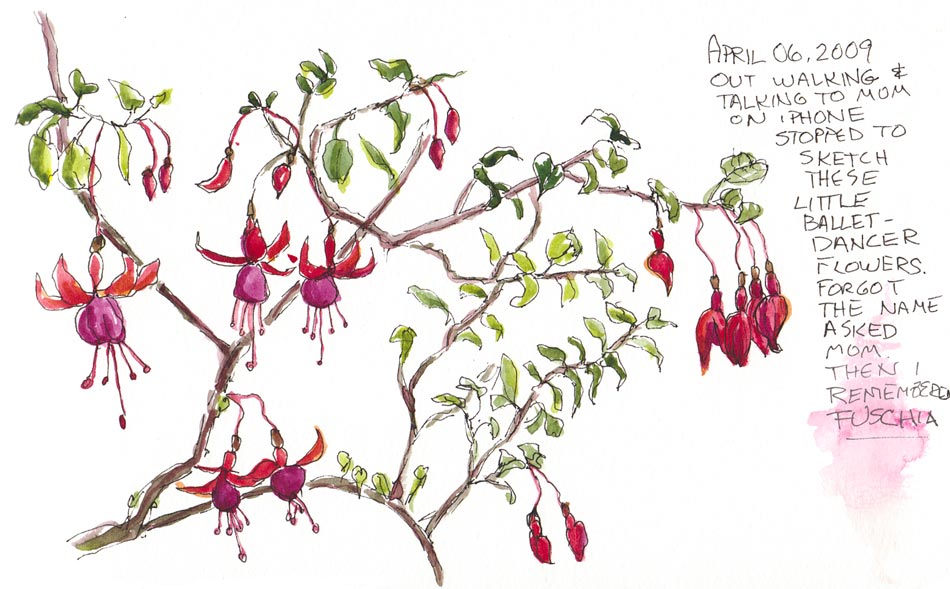
Fuschias, Ink & watercolor, 5x7" in Moleskine
Fuchsias, Ink & watercolor, 5x7" in Moleskine

The weather has been so glorious the past few days it’s hard to be indoors, especially when cold April showers are predicted for the rest of the week. I decided to combine a walk with doing errands and calling my mom, so I tossed my sketching kit in my bag, grabbed my iPhone and headed out the door.

Three blocks from home I spotted these fuchsias. I remembered how my sister and I used to pretend these flowers were little ballerinas and dance them around our San Diego backyard. But I couldn’t remember what they were called. Since I had my mom on the phone, I asked her, “What are those little pink flowers called that look like ballet dancers?”

My mother is 86 years old and we’d just been having a fruitless conversation about Digital TV vs HD TV and LCD vs LED (and this with someone whose VCR has been blinking 12:00 for years). She said she had no idea what flower I was talking about but began describing random flowers that might qualify.

Meanwhile, I’d finished my ink drawing, set up my watercolors on the ground, and started painting. As I was writing a note in my sketchbook I remembered they were called fuchsias, like the color.

I changed the subject, packed up, and started walking again.  We continued our conversation until I reached the market and it was time for her to watch General Hospital.

Botanical Sketching in the 1500s

Fuchsias were named for Leonhart Fuchs, born in 1501,  a doctor who studied plants for their medicinal uses and wrote De Historia Stirpium comentarii insignes (or Notable Commentaries on the History of Plants) (because all medicine was herbal back then). The original book,  in excellent condition, is in the University of Missouri library and available for viewing. There are digital images of the book and its illustrations on their website or clicking the image below.

Fuchs illustration of pumpkin in De Historia Stirpium
Fuchs illustration in De Historia Stirpium
Categories
Drawing Flower Art Gardening Gouache Outdoors/Landscape Painting Photos Plants Sketchbook Pages

Botanical Sketches: Proteus

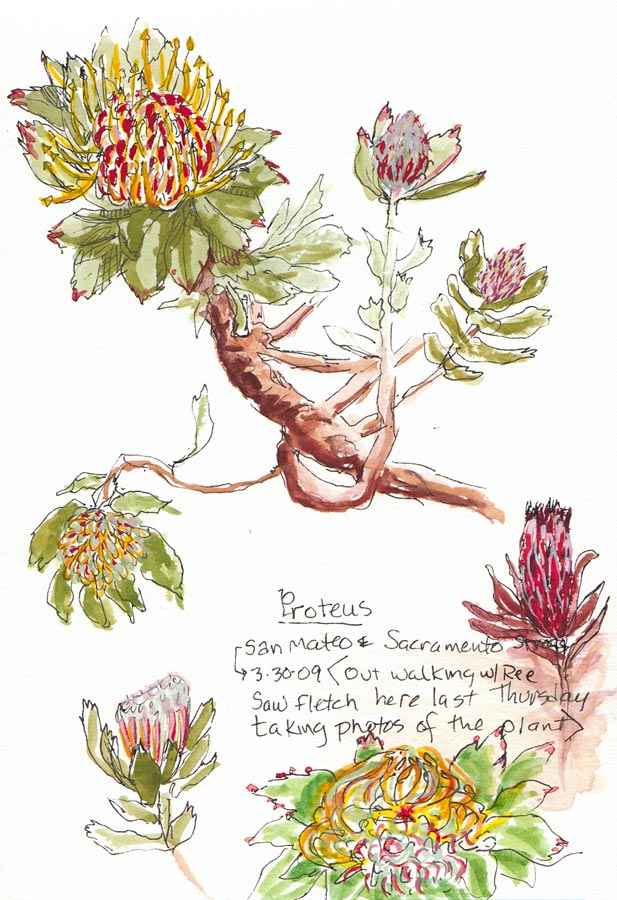
Proteus in Bloom, ink & gouache, Moleskine 5x7 sketchbook

When I was walking to BART last week I ran into Fletch who had just finished shooting photos of an amazing Proteus  a few blocks from my house. I must have walked by this stunning plant a hundred times and never noticed it until he pointed it out to me. I couldn’t stop to sketch that morning but finally got back there this afternoon.

I got as close as I could without trespassing and sketched with my Micron Pigma .01 pen, trying to capture the many different forms the blossoms take along the way to fully blooming. Then I used my mini gouache palette and a tiny brush to paint the details.  Gouache seemed like a perfect medium for doing this kind of detailed botanical sketching.

I also took a bunch of photos of these amazing and diverse flowers. Here are a couple of them:

Photo of Proteus blossom
Proteus in bloom, photo

Note to self: Find proteus at a nursery and plant them! But first I want to do some larger botanical illustrations from my photos (or from life if I can convince the woman who owns the plant to allow me to take some cuttings). Fletch told me she reluctantly allowed him to take one.

And here’s a bit of etymological (word origin) trivia about theProteus:

The Proteus got its name because of its amazing diversity of form: It was named after the Greek sea god, Proteus, who was able to change his appearance at will.  From this comes the adjective “protean,” which means “versatile”, “mutable”, “capable of assuming many forms.” “Protean” has positive connotations of flexibility, versatility and adaptability.

Categories
Art theory Drawing Flower Art Ink and watercolor wash Painting Plants Sketchbook Pages Still Life Watercolor

Happy Spring Camellia

Happy Spring Camellia, Ink & watercolor, 7x5"

I couldn’t resist drawing this one cutting from my camellia bush instead of going straight to the oil painting I was planning to do of the little bouquet of camellias I was assembling. I wanted to enjoy deeply seeing all the shapes and connections and patterns and reflections and colors in the leaves, buds, and flower.

I realize now that I should have gone a little more slowly when I was drawing the flower petals so that I could really capture the personality of this particular flower, the way I did with the leaves and bud. But I think it was making me dizzy, trying to follow all those different curly shapes and ins and outs of the line so I got a little lazy and generalized instead of paying absolute attention and getting it exactly.

I’m always torn between going for the detailed exactitude of botanical illustration and the way oil painters say to skip the detail, skip the individual petals and paint the mass, the form instead. I see the value in both but combining them in one painting rarely satisfies either goal.

Categories
Gardening Life in general Oil Painting Painting Photos Plants Still Life

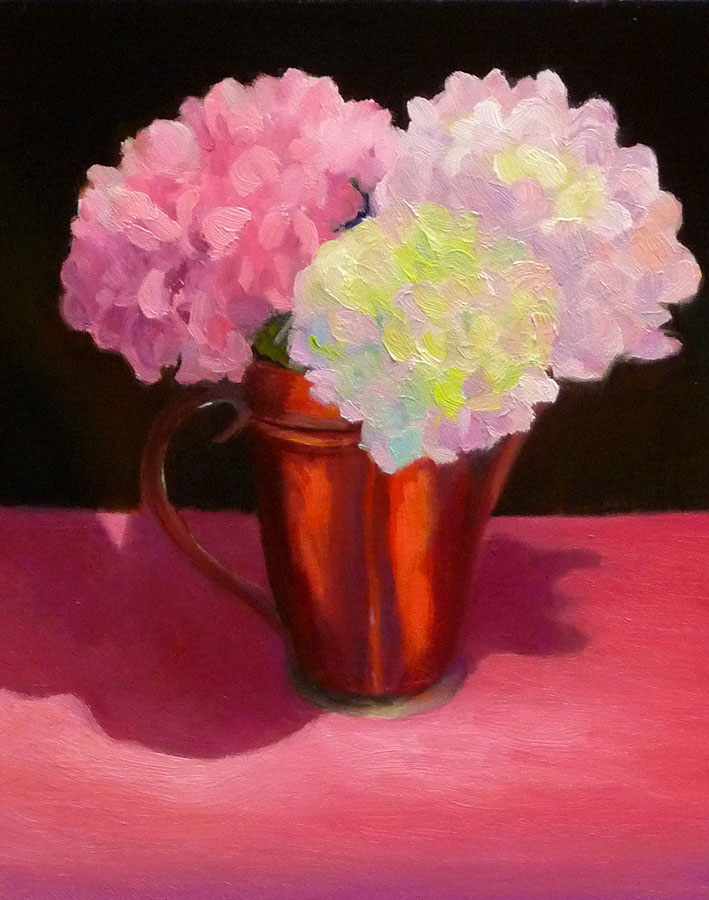
Humble Hydrangeas; Antidote to Procrastination

Humble Hydrangeas
Humble Hydrangeas

These humble but persistent hydrangeas were still blooming outside my kitchen window, despite suffering through drought then rain and cold.  Their leaves were few, gray and blotchy and the stems were bent and woody but the flowers just weren’t giving up.

While I worked on the painting I was thinking about humility. I’ve discovered that being humble is a good antidote to procrastination.

When I think that I have to be “good” at something (especially painting), it creates fear that I won’t be. Then I find myself either procrastinating or, if it strikes while I’m painting, reworking a painting again and again because it’s not “perfect” yet.

I’ve found that the best way to step out of that rut of perfectionism is to focus on being honestly humble and not worry about being good, better, best, or perfect. All I have to be is humble little me and like the hydrangeas, just hang in there and shine forth.

About the painting:

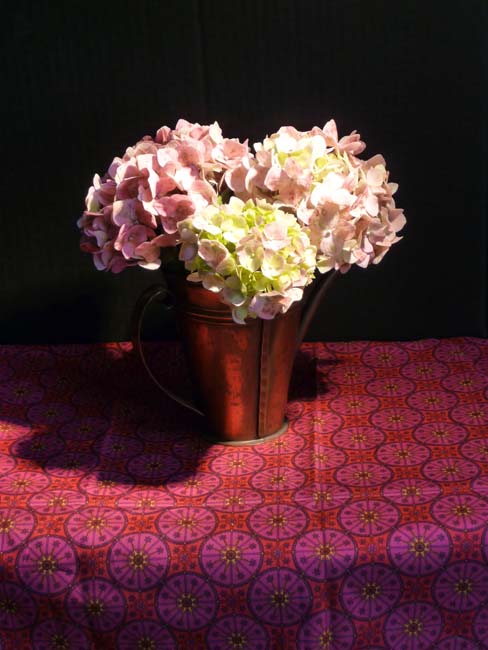
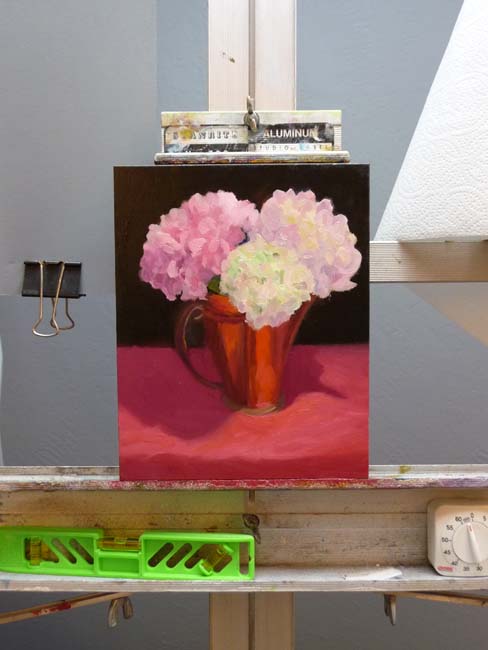
I was trying to see and paint light and make good use of color temperature and value contrasts to model the form. I started by doing a monochrome underpainting in acrylic, but didn’t really like the way the acrylic paint kind of ruined the wonderful texture of the ArtBord.  Here are the steps along the way:

1 & 2 are photos of the still life set up, the second in black and white to look at values.

Categories
Gardening Life in general Oil Painting Painting Plants Still Life

Early Girl on Blue Velvet

Tomato on Purple Velvet, Oil on panel, 6x6"
Tomato on Blue Velvet, Oil on panel, 6x6"

Last year I planted Early Girl tomatoes and Best Boy tomatoes. They must have gotten together and had some fun over the winter because they’ve returned bearing fruit this summer all on their own.

I was ready to paint something other than that stupid scene at Sibley. Rummaging around in the kitchen a  tomato caught my eye and then when I reached into the stack of colored cloths I keep for still lifes (or is it still lives?) in an overhead cabinet, I came away with a blue-violet piece of velvet (actually it’s a small velvet bag).

It was fun working with such saturated vibrant colors but now I have to clean brushes and let go of painting for a few days while I return to my “day job.” Although I often feel grumpy at having to make that switch, today I’m feeling very grateful for a good job and my comfy home and studio, given all the terrible news of financial ruin and weather-caused devastation I’ve heard today. I haven’t been watching any TV for the past month, which has been great, but today I took a look at the news while I ate dinner and was so sad to see all the suffering.

Categories
Art theory Flower Art Glass Painting Plants Sketchbook Pages Still Life Studio Watercolor

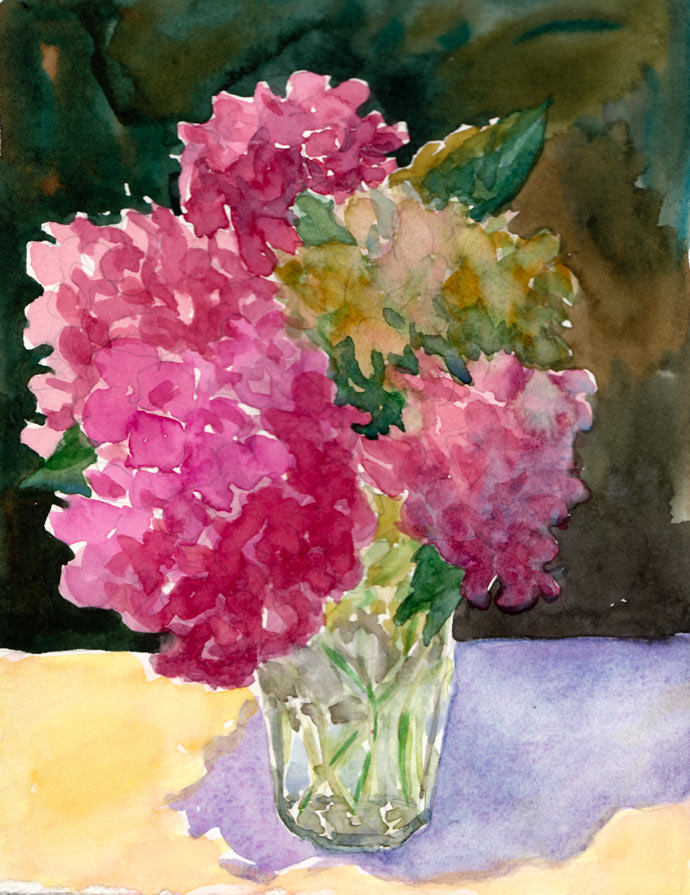
Painting popcorn ball flowers (hydrangeas) instead…

Hydrangeas (popcorn ball flowers)
Larger

Have you ever been so sleepy you’re just slap-happy silly? That’s how I was yesterday. I’ve been trying to change my schedule to get up early and go to bed early but after a few days of doing the former but not the latter, I was so sleep-deprived yesterday afternoon that I just stopped making sense, even to myself.

When I get over-tired, instead of thinking, “sleep,” I think I’m hungry and crave carbs (and now research is showing that sleep deprivation causes weight gain and other health risks…see here and here).  So instead of eating popcorn (or going to bed at 7:00), I decided to paint these “popcorn ball flowers” (as my sister and I used to call hydrangeas when we were kids…and I thought everybody did until I Googled “popcorn ball flowers because I can never remember their real name, and discovered only recipes for making flowers out of popcorn and no references to hydrangeas!).

First I had to refill my watercolor palette because a couple weeks ago I’d washed out all the funky old paint that had been in there for too long. Some of it was getting moldy and all of it was dirty.  Before refilling my palette, I did color tests of all my paints to decide which pigments I wanted to use now. I love organizing things, so this was a perfectly soothing task for a tired mind.

Finally I was ready to paint, and grabbed my homemade 6×8” sketchbook filled with hot pressed Fabriano Artistico paper, and this bouquet of hydrangeas from my yard that I’d plopped into a drinking glass the day before. Instead of starting with my usual ink drawing, I used pencil and then painted using more of an oil painting technique, starting with the darkest darks instead of the lights.

Maybe it was because I was so tired, but I had so much fun, just being playful as I painted and not worrying about the outcome. As usual I wished I’d stopped about 10 minutes sooner and someday I’ll learn that “when you’re 75% finished you ARE finished!”  Some day….

If you’d like to know which pigments I settled on, click “Continue Reading for the details….

Categories
Flower Art Glass Oil Painting Painting Plants Still Life

Orchids in Green Bottle & Mental Spam

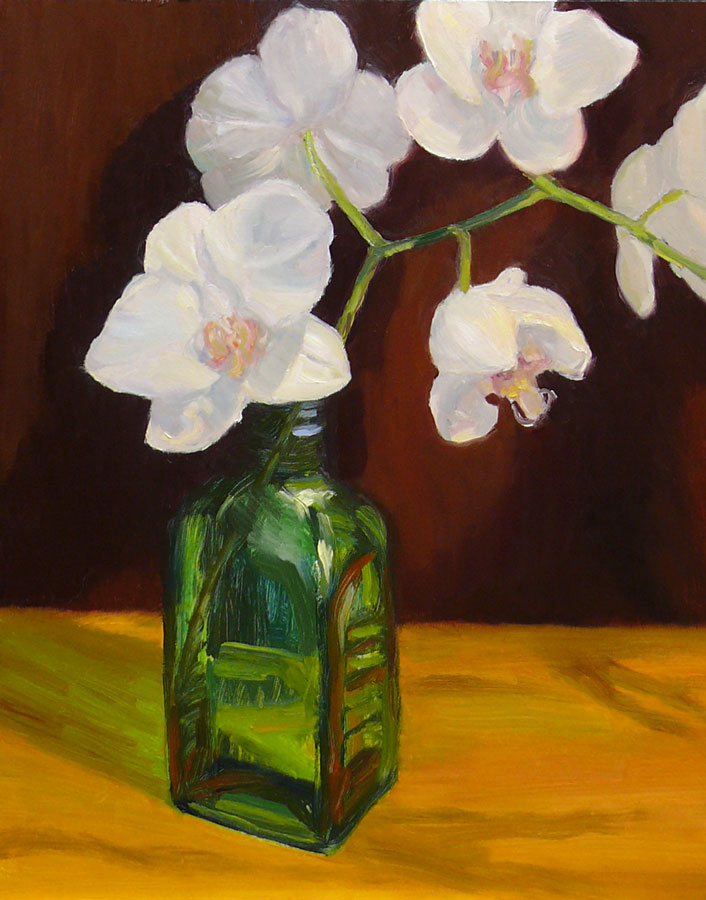
Orchids in Green Bottle
Oil on panel, 14×11″ (larger)

I love painting glass and was happy with the way this bottle turned out. I tried to use the same free and fun approach I take to painting glass in watercolor and it actually worked this time. I wish the flowers were as easy.

It’s easier to show off the beauty and delicate nature of flowers in watercolor than in oil paint, especially white flowers. In watercolor you don’t use white paint, but rather leave the brilliant white of the paper for white areas.

White oil paint can look blueish, cold, chalky and dull so in oil painting you have to create the illusion of warm glowing light by placing either dark or subdued, neutral, or grayed colors beside the white so in comparison it looks bright.  It also helps to add a little yellow or orange to white paint to warm it. I tried doing all of the above in this painting, but still struggled with the white flowers, scraping and repainting several times.

I read an inspiring and funny post on singer Christine Kane’s blog called “What Spam Can Teach You About Inner Peace.” It’s really worth reading if you have one of those annoying inner critics who says mean things about you or your artwork. While you’re there, check out another post of hers that is helpful for artists and/or self employed people, “How to Get Off the Hamster Wheel.”

Categories
Flower Art Gardening Life in general Oil Painting Outdoors/Landscape Painting Plants Plein Air Still Life

Hydrangeas Plein Air & Creativity Interview

Hydrangeas plein air

Oil on panel, 6×8″ (larger)

It felt so good to get outside and paint this sunny afternoon, even if it was only for an hour on the side of my house by my trash cans where this small hydrangea is finally starting to blossom and grow.

Creativity Interview

I was interviewed by Creativity Coach, Liz Massey and she posted the interview on her blog today. If you’d like to read about my creative process, thoughts on inspiration, overcoming artistic blocks, etc., please stop by her excellent blog. While you’re there, check out some of her other interviews. I was especially intrigued by her post about “clutter-busting with one sentence journaling.”

Painting lessons learned the hard way

This week I’ve been mucking about in the studio trying to fix the compositional problems with my painting of the ladies at the farmer market. Today I gave up on it and moved on.

The struggles I had with it were a good reminder for me about how important it is to resolve compositional issues before starting to paint (like the area where you couldn’t tell hands from plastic bag from shopping cart handle).  Also a good lesson that if a painting’s initial framework isn’t working, it’s better to start over than to spend hours and hours trying to fix it. Although I really liked many parts of that painting, it just wasn’t working as a whole.

Inspiration at 87

My sister and I joined my vibrant and adorable 87 year old aunt and her two sons (our cousins) who I hadn’t seen for 30 years for lunch today. It was so inspiring to see how youthful my aunt is — she drives, goes bowling with her girlfriends, and takes long walks several times a day with her Border Collie.

Categories
Drawing Flower Art Gardening Glass Painting Plants Sketchbook Pages Still Life Watercolor

Zen & First Spring Roses

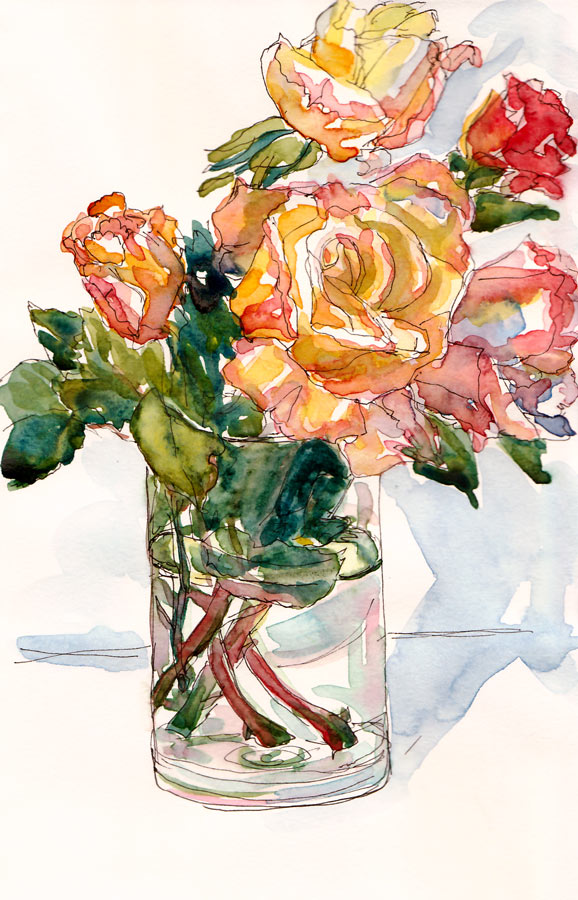
First spring roses

Ink & watercolor, 9×6″ (larger)

When I picked these roses yesterday evening, they were heartbreakingly fresh, new and beautiful. I put them in a vase of water in the kitchen, planning to paint them today. This morning I found them laying on the counter where they’d obviously been without water too long and looked limp.

Either they jumped out of their vase or my cats had a hand (er… paw) in their escape. After a few hours back in water they plumped right back up and were a joy to draw. I only had about an hour and that was just enough time to make a happy ink and watercolor.

But why do I feel so sad seeing the beauty of my seven rose bushes and thick patch of irises all loaded with flowers? It’s as if I’m already mourning their demise, knowing how temporary their burst of color and vibrancy is before winter comes again.

Is it my enhanced awareness of the cycle of life and death as I approach one of those milestone birthdays this June? Or is that time seems to be moving so fast these days that I can picture the blooming season flying by like those time-lapse films where the flowers sprout, bloom, shrivel and die within moments.

Instead of feeling sad about their demise (and my own, for that matter), I need to remember the Buddhist teaching of being in the present moment, accepting that everything changes, everything dies; that desire and clinging cause suffering and that letting go relieves it.

So with that, I will allow my flowers to live and die as nature sees fit (as if I had any other choice!), and will enjoy them while they’re here. I’ll try to make the most of my own moments while I’m here too, with as much acceptance as I can. And maybe I’ll finally return to my Zen meditation practice which always brought me such joy and peace, and made all of life more vibrant.