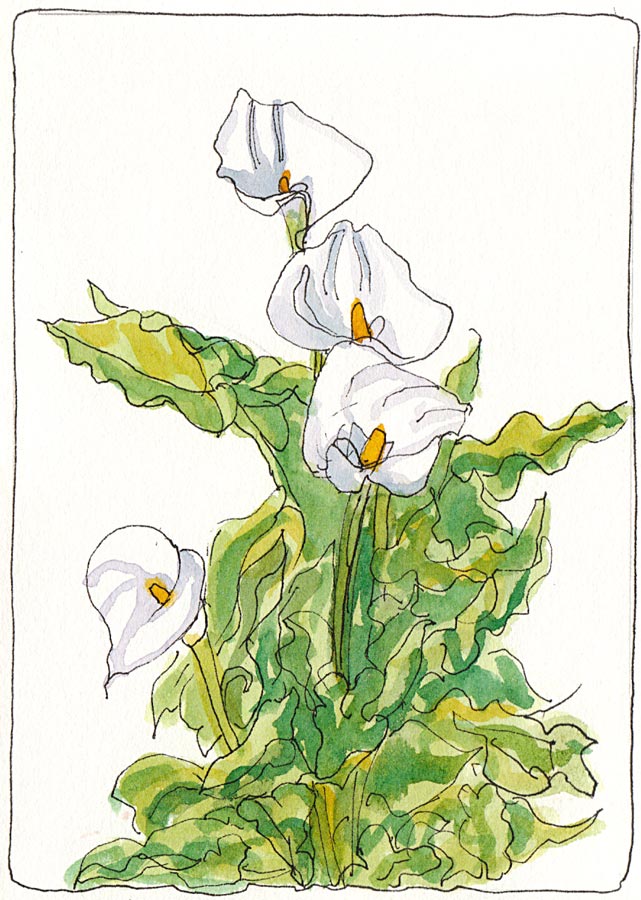
Tonight it is thundering and lightening and pouring down buckets of rain. But there was a warm sunny day last week when I was able get out in the garden and sketch a bit. Callas are so graceful and such lovely volunteers, popping up all on their own wherever they please.
My tiny fig tree, ink & watercolor
Just after my friend Barbara finished writing her book about growing fruit trees and delivered the manuscript to the publisher, she also delivered to me a baby fig tree that she couldn’t find a space for her in garden.
I was so excited to see that my new baby tree made it through the worst of the winter and was no longer just a stick. It now has actual leaves sprouting from the tip. In case you can’t tell from my sketchy drawing, those are random rocks and bricks I placed around the baby tree as a warning to the gardeners so they wouldn’t mow over it.
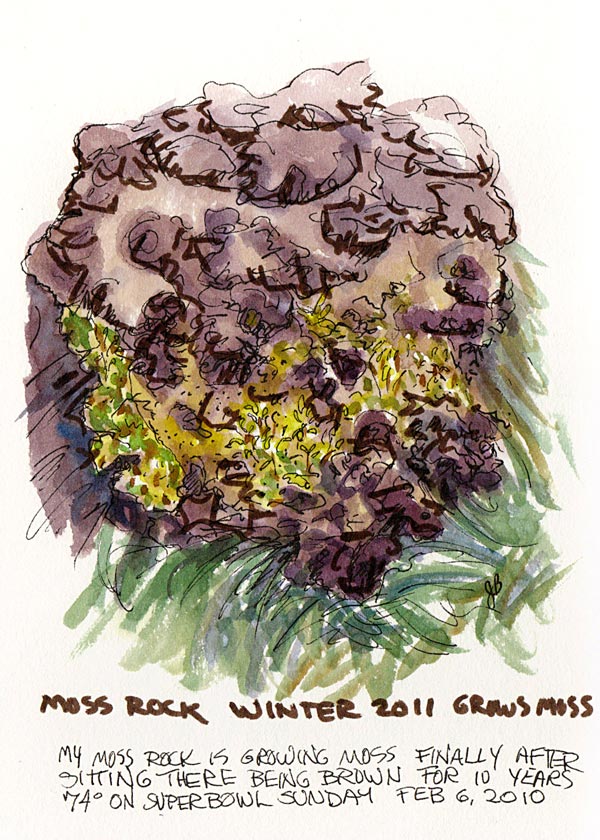
After ten years this very large rock sold to me as a “Moss Rock” and installed in my front garden has finally grown a patch of moss. It looked so pretty and the day was unseasonably warm and sunny so I couldn’t resist going out to sketch it. I sat on my porch and drew the mossy rock while my usually indoor kitties joined me in the sun.
And now my request for advice:
I need help figuring out how to sort/store my oil paintings. I have at least a hundred oil paintings and plein air studies on panels (probably more) that I’ve done over the past few years. I’m sure for some people it’s simple: just sell them all.
But if you’re like me and still have many paintings on hand, I’d love to hear how you organize, catalog, store and/or protect them from damage. I have many watercolors on paper in large flat files sorted by subject matter, with drawers labeled accordingly. But I haven’t figured out a good system for my oils.
When I get a request from someone wanting to purchase a painting it can be challenging to find it and I always have my fingers crossed that it hasn’t gotten damaged.
My questions:
ORGANIZING: Do you store your paintings by subject? Size? Date? Inventory number (requires entering in art tracking program)? OR…just skip the organizing and spend the time painting instead?!!
STORAGE: Should they be separated with wax paper when stored touching each other? Does it matter if they’re in the dark? My garage is fairly dry but not insulated so is affected by weather. Is it ok to store oils on panels in Clearbag envelopes to protect their surface?
At the beginning of the year I usually sort through the past year’s paintings stored vertically on shelves like books in my studio. I dump the losers, label the keepers, and move older paintings to shelves in the garage. This year I had the flu during my two-week holiday vacation so never did the “dump and sort” so paintings have piled up in the studio shelves and storage closet and there are more drying.
Any advice or suggestions would be greatly appreciated!
Despite this being the coldest summer in the San Francisco Bay Area that I can remember, my tomato plants produced their first little, shiny, red tomato. Now if we’d just get some sun instead of wind and fog, the green ones might get a chance to ripen too.
Ironically, last February some news reports warned that due to global warming, fog along the Californian coast had declined by a third over the past 100 years; the equivalent of three hours a day, dropping from 56 to 42 percent of the time. Meanwhile another report came to the opposite conclusion, saying, “The Bay Area just had its foggiest May in 50 years. And thanks to global warming, it’s about to get even foggier.”
All I know is that this is the first summer that my down comforter and electric blanket have remained on my bed all the way through July. I wouldn’t want to trade for the extreme heat in other parts of the U.S. and the world, but it would be nice to have a little bit of summer before fall!
P.S. In case you have sharp eyes and noticed that the stem behind the tomato seemed to have previously held four tomatoes, you’re right. It was leftover from a purchased bunch of tomatoes on the vine but I thought it was cute and would look nice in this picture.
Hydrangeas Attempt #2; Painted directly without drawing and ink lines added after finishing attempt #3
During days of dismay at my disappointingly dismal drawing dexterity I determined to draw ’til I improved. But I was under the influence of migraine medicine which fixed the headache but left me drowsy. I actually fell asleep at the drawing table, dropped my brush on the page which woke me up, and had to go lie down for a spell between drawings.
Hydrangeas Attempt #1; drawn in ink, painted with ugly dark background which was then sponged off and a bit more paint added
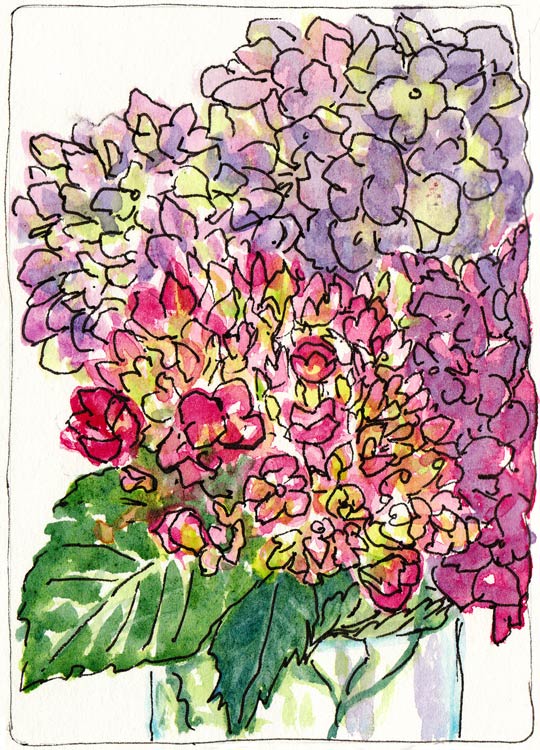
My hydrangeas are bursting with vibrant blooms so I made them my subject. The first attempt got off to a decent start until I painted a nearly black background, probably due to my really dark mood and being too doped up to know when to stop.
I couldn’t stand the way it looked, so before scanning tonight took a soft, wet sponge and washed off the dark background. Then I dropped a little more color into the wet background.
Hydrangeas Attempt #3, ink & watercolor
I had the most fun with this last attempt, where I drew and painted more loosely, trying to capture the flavor and personality of the flowers.
My best friend Barbara ordered baby chicks by mail. She’d built a little hen house from scrap lumber and had it all ready for them. So she was surprised when the bundle of chirping chicks arrived with instructions to keep them indoors at 90°F for several weeks. Instead of being in the garden when we came to sketch they were living in the upstairs guestroom/studio in a big box with a heat lamp.
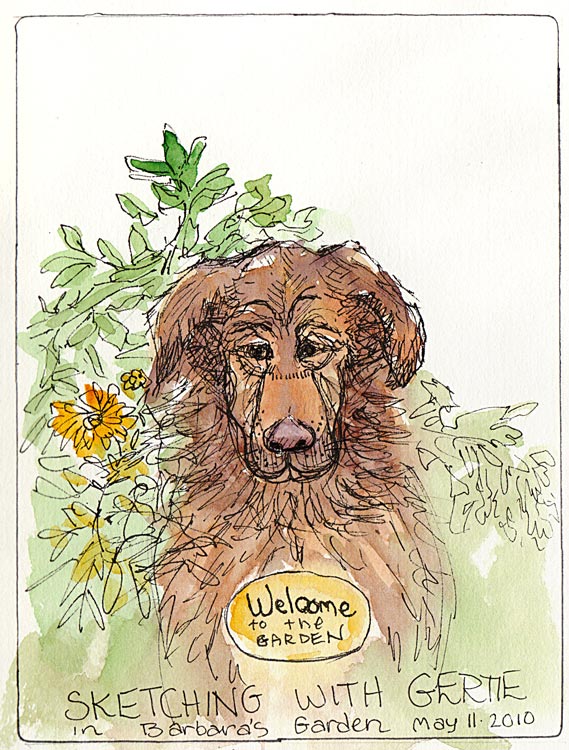
We were greeted at the garden gate by Gertie, her big, old, sweet Sharpei/Mutt.
Gertie the Garden Greeter
I tried to get her to pose for me but she was a bit unclear on the concept.
Garden path at sunset with cactus sculpture. Ink & watercolor
Barbara’s garden (photos from previous post) is abundant with flowers, vegetables, fruit trees, wild birds, her ceramic sculptures (the 3′ tall cactus above is actually made of glazed ceramic), her mosaics and the fabulous scent of healthy growing things. It’s a small garden in North Berkeley, but feels like a visit to the country far from urban stress. Her next door neighbors are musicians and so our sunset sketching was accompanied by birdsong and live music playing softly next door.
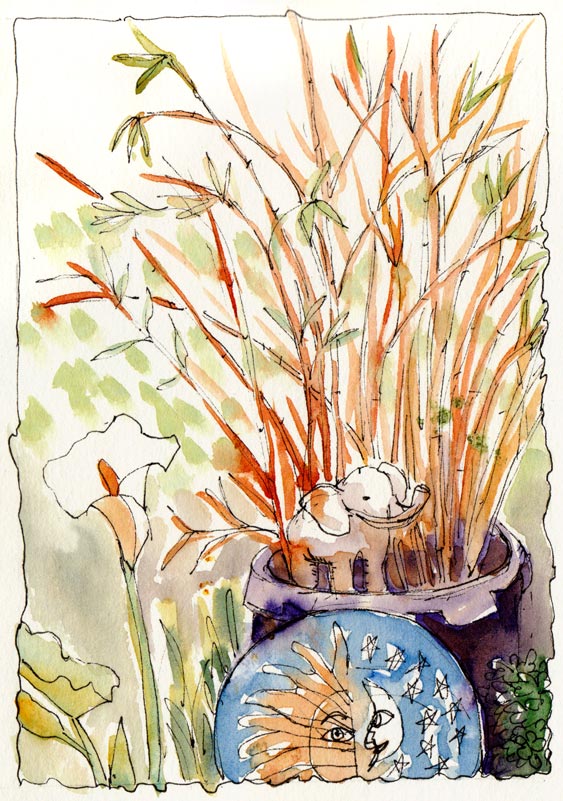
Elephant, sun/moon plate and potted bamboo
One of Barbara’s many garden still lifes. Every few steps in her garden (and in her jewel of a cottage) there is another such treasure, but she is the best treasure of them all!
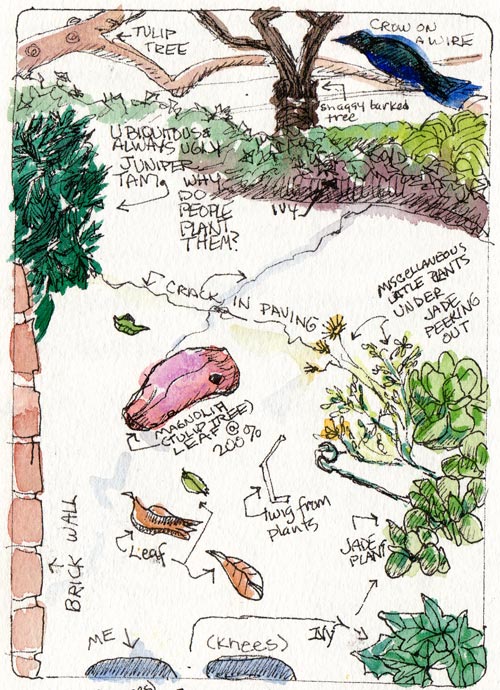
After having a rough day, I met Cathy in front of the Northbrae Church at the top of Solano in Berkeley to sketch. I considered staying home, feeling crummy, but knew if I went out sketching I would start feeling better. So I sat on some steps and drew a sort of map (above) of all the nature around me to get warmed up.
Next I sketched the street signs in front of my parked car (below).
Parking and Ferrari Foods, Ink & Watercolor
Then we walked a block north to Solano and sketched the interior of Ferrari Foods (above), which was closed. One worker was inside cleaning up. When he finished and turned off the lights we walked around a bit looking for our next target, realized we were freezing and moved indoors to Cactus Taqueria.
Don't Play With the Fountain, ink and watercolor
Despite the sign on the fountain telling parents not to let their children play with the fountain, children wandering around while their parents finished dinner in the family-friendly Mexican cafeteria found it irresistable. One tot helped himself to a nice long drink of water from one of the streams while the young man sitting beside me yelled “No!” and asked around whose kid it was, dismayed to see him drinking the recycled water. Nobody responded and the kid eventually wandered back to his family, who seemed unworried.
Tuesday night we met at Cathy’s house instead of a public place where moving every two minutes with a timer ringing would be a nuisance. We started on her deck to the sound of burbling water and birds singing and lovely sights all around and warmed up with an untimed sketch. Drawing this little bonsai on the table in front of me was just what I needed to unwind from the crazy day. The sun went down and it was nearly dark when I painted it.
Then we went inside and started the timed two-minute sketches.
Cathy’s Berkeley Craftsman style home is a serene oasis decorated with simplicity and a Japanese zen style. Open space and emptiness balances still-life displays of special objects, art and her wonderful collections. She set the timer for two minutes and said “Go” and we moved through the house, our eyes and pens devouring tender new morsels around every corner every two minutes.
I added the watercolor at home later for these two sketches.
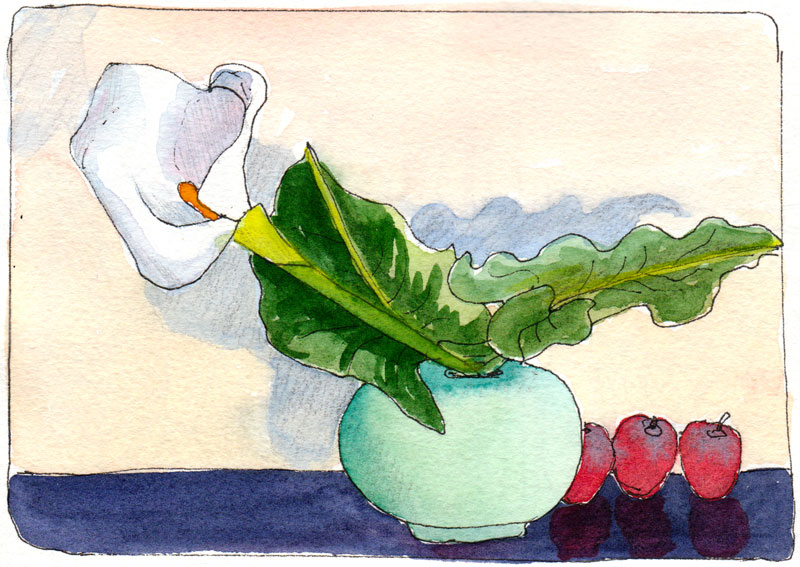
After each set of 6 two-minutes sketches we met back at the dining room table to look at each other’s sketches. When I saw Sonia’s calla lily and apples sketch I realized I’d missed that corner. I liked that display so much I chose to ignore the two-minute bells and spent six minutes enjoying drawing this one.
I’ll post the rest of the sketches after I add color to them. I am soooo lucky to have such great, dedicated sketching buddies!
We had a sunny day after months of rain, so I took a walk around my garden. I was happy to see the hydrangeas coming back after having been cut down to little woody stalks. The three I’d planted after the comical hydrangea planting fiasco were all sprouting and there was a new one, a volunteer that appeared on its own volition.
And I too feel cut down to my woody stems, stretched thin by all I try to do.
So I’ve been thinking about who I am as an artist, who I want to be, what work brings me the most joy or the most suffering, my artistic strengths and weaknesses, and how I can make the time I spend on art as satisfying as possible.
I’m so grateful for artist friends like Barbara and my sister, who are good listeners and understand the challenge of having so many (too many?) interests and artistic pursuits to follow. Or, as Barbara writes, we’re “Never Bored” (or “Never B-ed” as she spelled it, for reasons she explains in her blog post).
Ultimately my goal is a more balanced life; I know that to stay healthy, along with time for art, I need to make more time for exercise, relaxation and play. (And some of my best art-making has been play; it just doesn’t have to be so darn serious!)
And like my hydrangeas, some good ideas are starting to bud and bloom about how I can nurture my most rewarding art pursuits now, while putting off or letting go of the others until more of my time is my own.
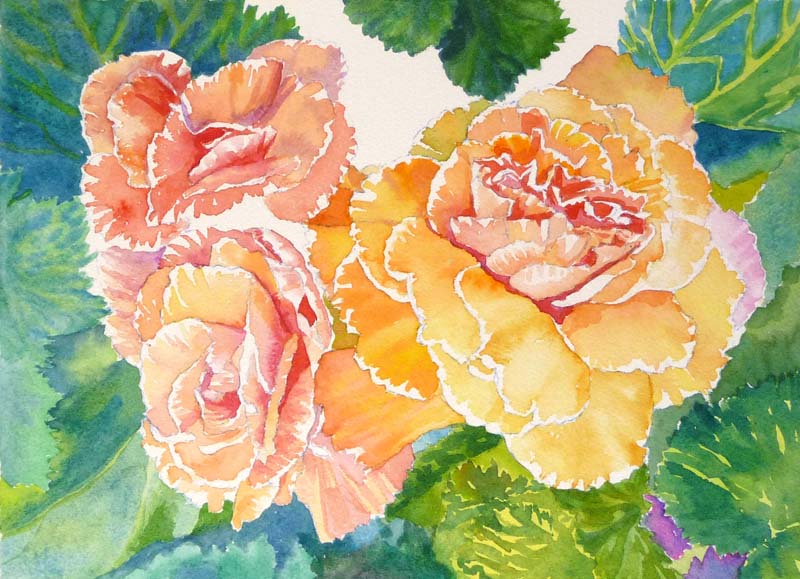
I finished my third painting for the book Must Paint Watercolor Flowers (above). This one was fun and not a struggle like the orchid painting. Since the lighting in the photo reference was flat with no obvious source of light I pretended there was one coming from the upper right and tried to exaggerate it a bit in my painting to give it some life.
Now I just have to write up my process and the materials and techniques I used for the publisher and I’ve completed my three-painting commitment. There are some really fine artists contributing to the book and I am honored to be included with them.
Below are my steps in getting to the final version.
Tracing the photo print-out onto watercolor paper using blue Saral Transfer Paper
I printed the photo on my printer and sandwiched the Saral Transfer paper between the print and the watercolor paper.
The transfered drawing on Arches 140 lb watercolor
Normally I would use a much lighter line, but the publisher requests we make the drawing dark so that it photographs well. At least the blue Saral transfer erases easily with a kneaded eraser.
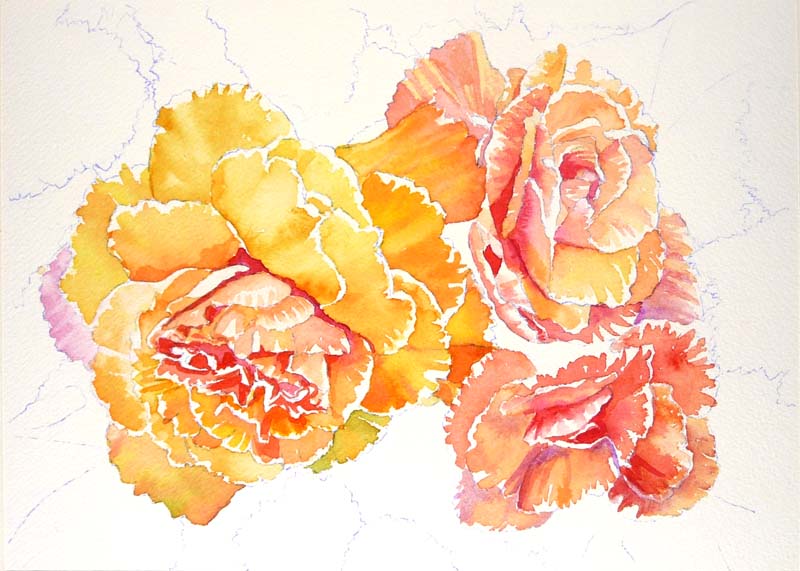
Painting the first layer of yellows, oranges and redsFirst layer of flowers painted
I like the sort of botanical illustration look of this phase.
Beginning to paint the blues and greens in the leaves
When this brightly painted leaf dried I glazed over it with Viridian so it would stay in the background but I enjoyed these pretty colors together.
First layers of flowers and leaves paintedAfter adding the darks between leaves and additional glazing on leavesAdding details to the flowers
I had a good time glazing on the lines and shadows on the flowers. Then it was just a matter of adding a few more shadows here and there and signing my name.
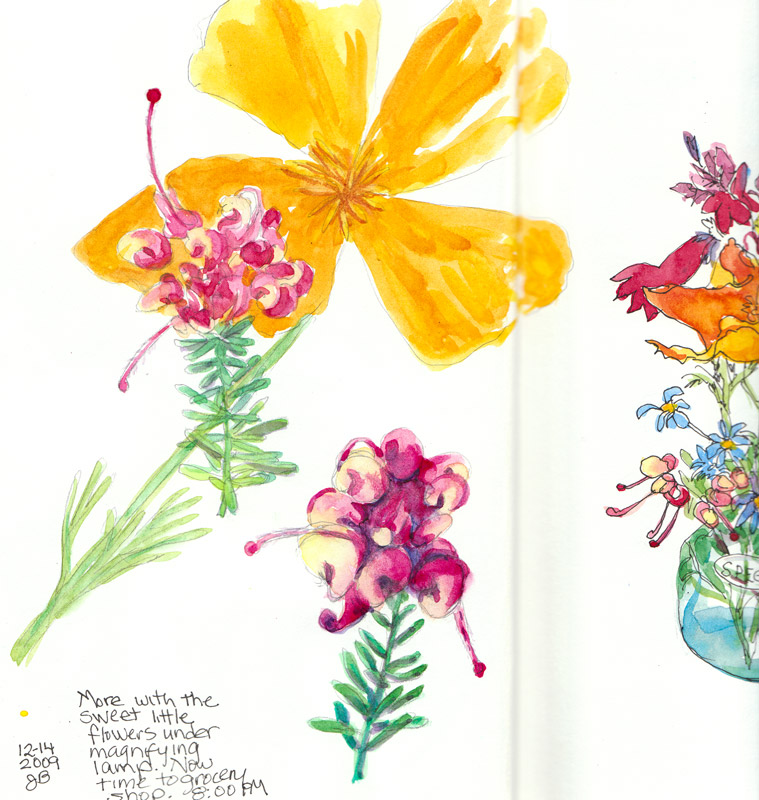
The teensy bouquet was still holding up and the complicated shapes in these flowers intrigued me. So I stuck them under my magnifying lamp and drew them again in sketchbook opposite the bouquet side. The California poppy had opened up and wanted to play too so I stuck him in behind the little flowers after I painted them. It’s fun drawing what’s under the magnifying glass and getting to see all the neat details.
Then it was back to work on the third painting I’ve been asked to do for the book, Must Paint Watercolor Flowers. This time it’s a peach colored begonia with really interesting veiny leaves.
Begonia leaf color tests
My first step was to test colors and try to find the pigments that will mix to the right values, colors and textures. On the tests above I experimented with glazing with different yellows, blues and greens, and tried lifting color for the veins in the leaves to see which worked best for that.
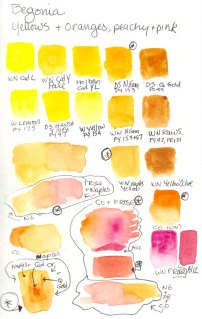
Begonia petal test colors
I found just the right mixture of colors for the petals with a color I’ve rarely ever used because it is more opaque than I usually prefer: Naples Yellow. When mixed with combinations of Cadmium Orange, Permanent rose, and Quinacridone gold, it looks like it will give me perfect petals. But now it’s back to “day job” work for the rest of the week. That will give me time to focus more on how I will approach the painting so once I have brush in hand I’m ready to go.
I don’t always plan things out so carefully, but it can help prevent wasted time and do-overs which becomes more important when I’m also photographing each step and writing about it for the book.












 Jana Bouc, Artist