Categories
Animals Cartoon art Drawing Gardening Illustration Ink and watercolor wash Life in general Painting Plants Richmond Annex Sketchbook Pages

Strange Garden Ecology: From Birds to Mice to Wasps to Ants to Birds

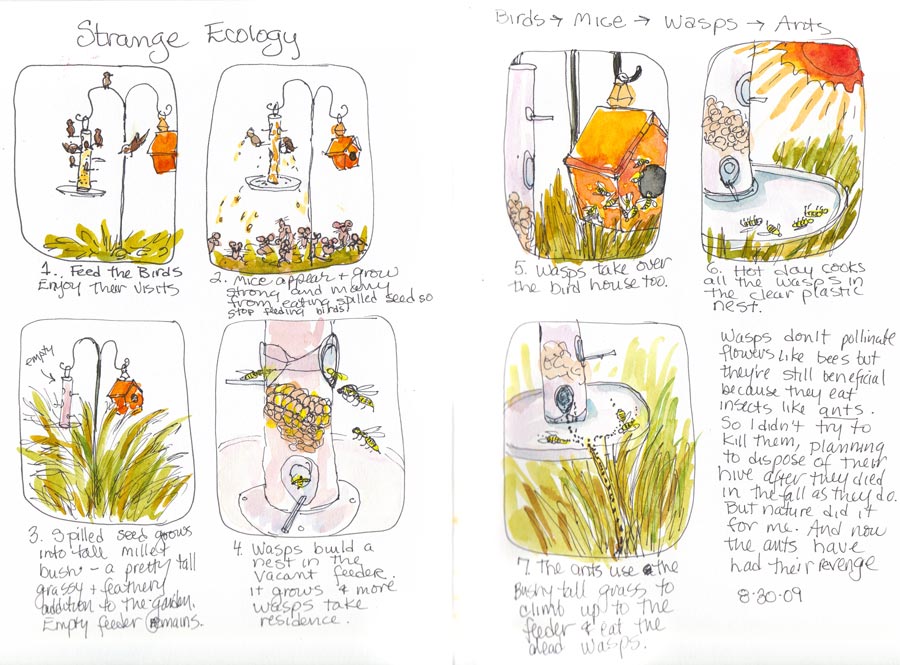
Weird Ecology, ink & watercolor in sketchbook
Strange Ecology, ink & watercolor (click to enlarge or see big images below)

I used to love feeding the birds and seeing my little customers flocking to the feeder. But one day I thought I saw the wood chip ground covering moving under the feeder. When I looked closely I saw it wasn’t the tan bark moving, it was dozens of mice! By feeding the birds I was also nourishing a growing army of mice with all the seed the birds scattered!

1. Feed the Birds  2. Mice grow strong and prosper
1. Feed the Birds ---> ---> ---> ---> ---> ---> ---> 2. Mice grow strong and prosper

I called “Vector Control” (a euphemism for the county rat patrol) and an interesting female rat inspector came out and inspected. She told me the only way to get rid of the mice was to stop feeding the birds and that for each mouse I saw there were 50 more I wasn’t seeing. I was sad to stop feeding the birds but it was better than the alternative (which included multiple mouse traps, even sadder).

Meanwhile, the spilled millet seed grew into a lovely, tall, feathery bush under the feeder, which I left hanging in a bit of wishful thinking that one day I’d be able to return to feeding my feathery friends.
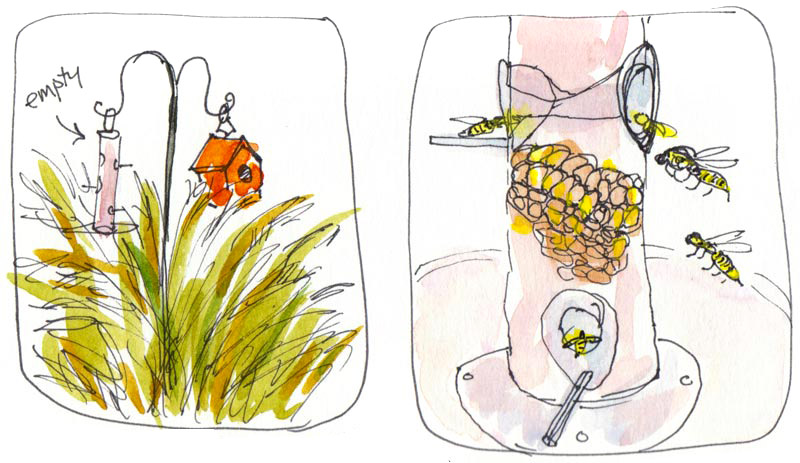
3. Millet grass grows under feeder. 4. Wasps move in.
3. Millet grass grows under feeder ---> ---> ---> --->4. Wasps move in.

A couple years pass, the feeder and bird house remain empty and the millet bush continues to be a pretty garden feature. One day I notice something odd: wasps are buzzing in and out of the feeder and have built a nest inside it. I learned that while wasps do not pollinate like bees, they are still beneficial because they eat insect pests in the garden. I decided to leave them alone and enjoyed watching them care for their  babies (larvae) in the nest.

Wasps eat potential garden pests including the venomous black widow spider. Adult wasps eat only pollen and nectar (or your soda at picnics). They only hunt for meat (insects, worms, your barbequed hamburgers) to feed their larvae. Wasps nests have only one purpose: to ensure the production of young. At the end of the nest’s cycle, every member of the nest, except emerging queens, dies.

5. The wasps move in next door ---> 6. The Greenhouse Effect
5. The wasps move in next door ---> ---> ---> 6. The Greenhouse Effect

I guess things got a little crowded in the nest because the wasps started hanging out at the neighboring empty bird house too. Then one day we had a scorcher of a summer day. The temperature in my usually cool and foggy neighborhood by the Bay was in the 90s (f). The clear plastic bird feeder turned into a greenhouse and cooked all the wasps in the nest. So sad. All those poor little larvae, all that building and hunting and gathering of food.

But it wasn’t entirely wasted…

7. The millet bush becomes a little ladder and the ants have a party
7. The millet bush becomes ladder to an ant party

The stalks of tall millet grass made a perfect ladder for the gazillions of ants who live in my garden (and don’t even get me started about the ants and their nasty aphid ranches). The ants were streaming up the grass onto the feeder and having a lovely dinner party of roasted wasp.

And because my garden is well stocked with ants and aphids, I am, in a way, still feeding the birds. They still flock to my garden, but now they eat the ants and aphids off the rose bushes and it doesn’t even cost a penny in bird seed.

Categories
Flower Art Gardening Plants Sketchbook Pages Still Life Watercolor

Succulent Birthday Gift

Succulent Garden in a Bowl, watercolor 9x6"

My wonderful sister Marcy and niece Sophie gave me this little succulent garden in a bowl for my birthday, wrapped with twine with a little ticket for a card. When the plants outgrow the bowl she said I could just stick them in the ground and break off little pieces to stick back in the bowl.

They’re easy to care for: very little water and some sun. A week later they’re still alive and well; a good sign. I only have one other houseplant, an orchid I was given as a remembrance of my father’s passing. It’s been nearly 10 years and that orchid continues to thrive and bloom nearly constantly, despite my lack of a green thumb and tendencies toward plant abuse. (I tend to enjoy drawing plants more than caring for them, but I think that’s changing: I repotted my orchid last week and that was quite satisfying).

Categories
Flower Art Gardening Oil Painting Painting Plein Air Still Life

Pansies Plein Air

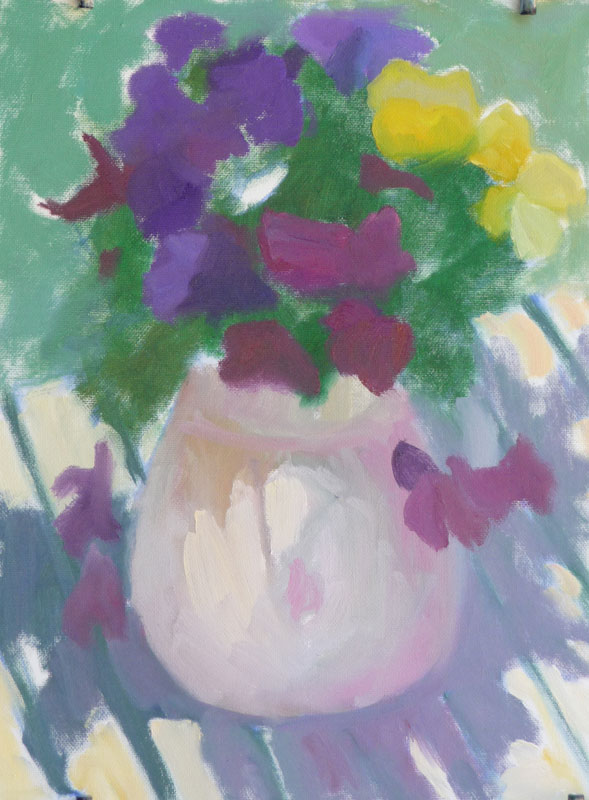
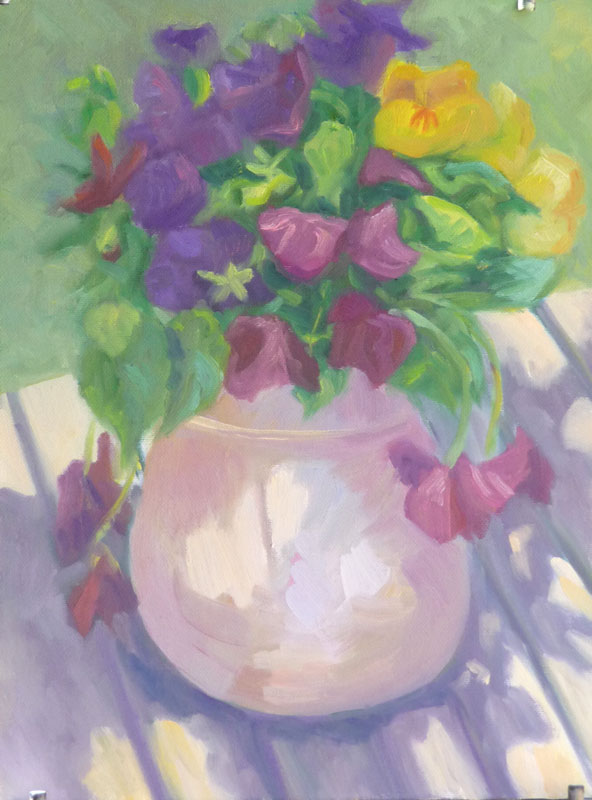
Pansies in Pitcher Plein Air, oil on panel 12x9"

The weather was too perfect to paint indoors but I didn’t feel like driving anywhere. My next door neighbor was out pruning his pansies and he’d pulled out a whole bucketful he was about to put in the compost bin.  Voila! A perfect painting subject. I stuffed a big clump of the pansies into a pitcher and set them on a table in the backyard.

I’d made the pitcher as a gift for my friend Barbara in the late 70s when I was a ceramic artist and she was a silversmith. She’s now a brilliant and prolific ceramic artist herself and she recently gave me the pitcher back. She was no longer using it due to a leaky crack and a house full of her own ceramics. I’ve been enjoying using it in still life set ups while fondly remembering it being filled with Mimosas every year for the annual Easter egg hunt and brunch her family held every year while our kids were growing up.

I knew that time was very limited before the shade moved across the yard onto the table so I worked quickly and had a great time.

Here’ are a couple steps in the work in progress:

Pansies Plein Air WIP #1
Pansies Plein Air WIP #2
Categories
Berkeley Drawing Gardening Ink and watercolor wash Sketchbook Pages

Sketching Berkeley’s Northbrae Neighborhood

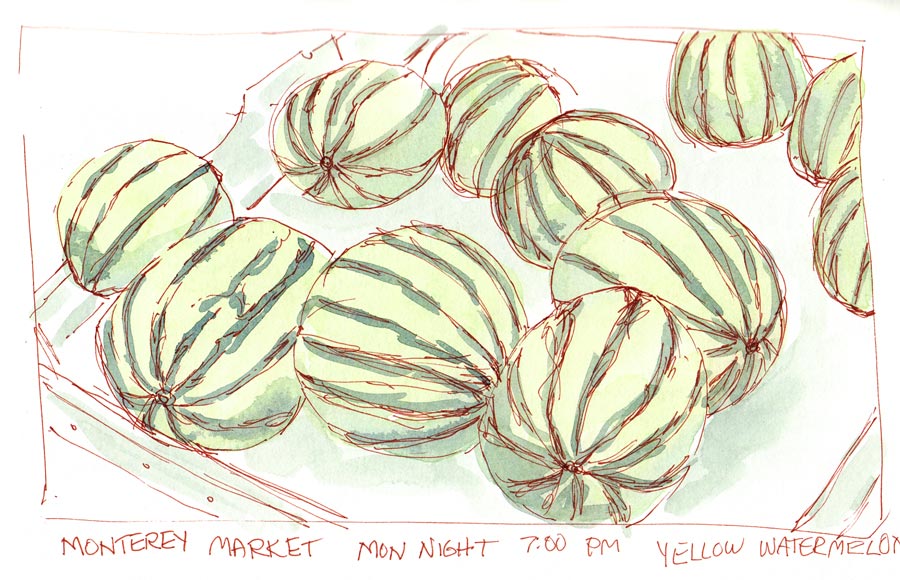
Monterey Market Watermelons, ink & watercolor, 6x9"

Cathy and I met at Monterey Market on Hopkins Street in Berkeley’s Northbrae neighborhood for our Monday night sketchcrawl. The scent of ripe fruit was heavenly in their screened fruit patio, but the store was closing so we were soon out on the street.

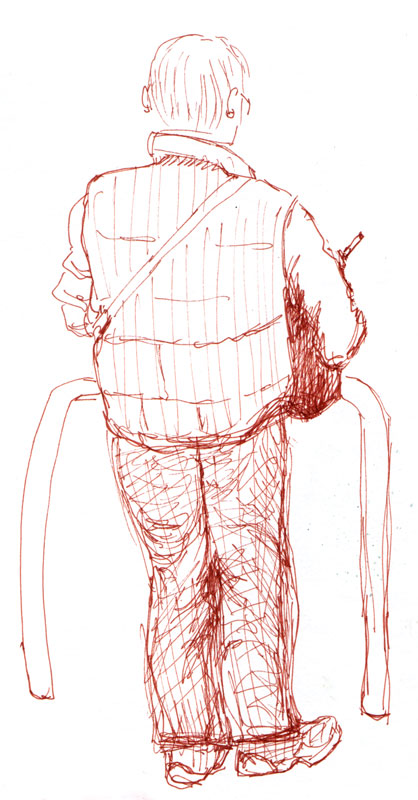
Cathy sketching
Cathy sketching

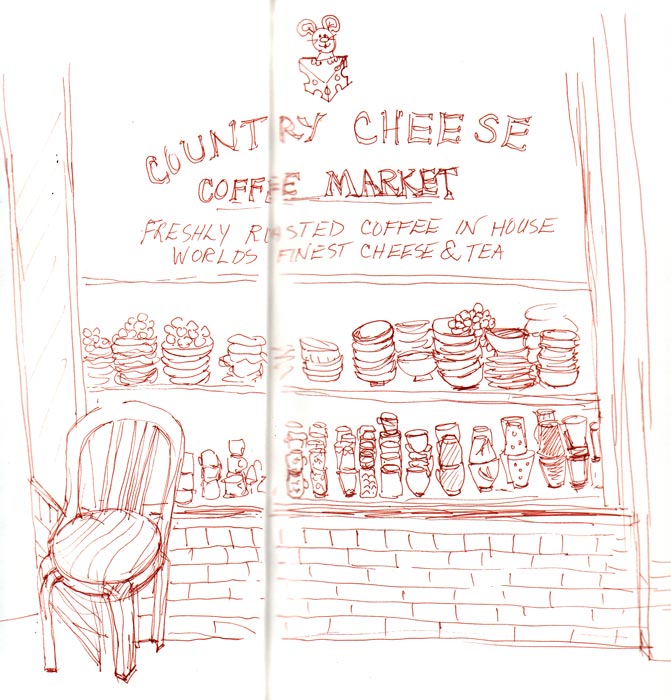
I stood behind Cathy while she leaned on a bike rack to sketch the signs on the corner. Then we walked up Hopkins to the Country Cheese and Coffee Market.

Country Cheese, Sepia Micron Pigma, 9x8"

The scents were quite different here: damp cardboard and wafts of the day’s refuse from all the now-closed food sellers on this block including Magnanis Poultry and Monterey Fish Market.  My butt fell asleep from leaning against a large metal box on the sidewalk while I was sketching. I could have sat on the chair but decided to sketch it instead. It felt good to start moving again. We walked around the block looking for inspiration at Berkeley Horticultural Nursery but since they were closed there wasn’t enough to see through the fence.

We headed up Rose Street and through the King Middle School play yard where people were throwing frisbees for their dogs in the sunshine at 8:00 at night. It was really starting to feel like summer.

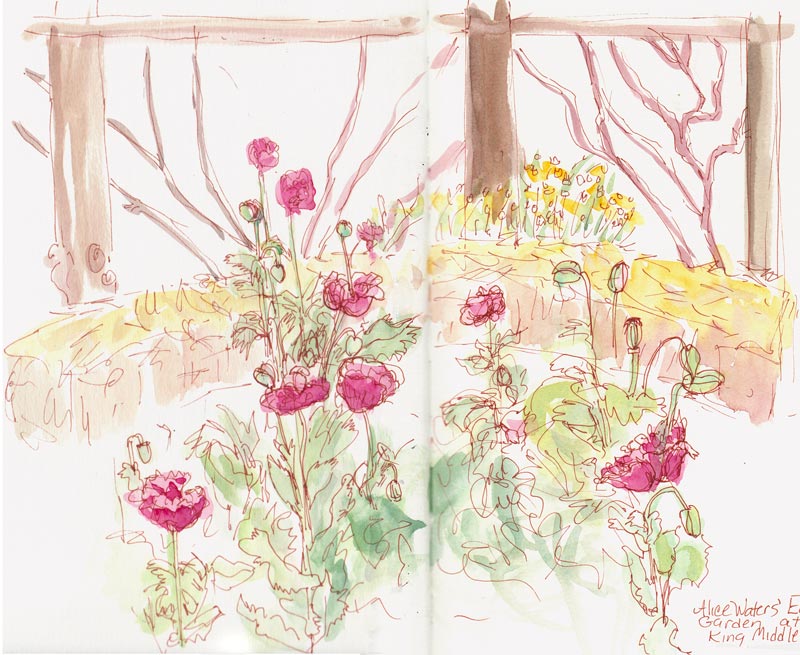
Alice Waters of Chez Panisse fame, helped start an “edible garden” on the school property and that’s where we did our final sketches, surrounded by beds of vegetables, flowers and fruit.

Edible Garden "campfire", ink & watercolor, 9x12"

We felt like we were at camp, sitting on hale bales arranged in a large circle under an arbor made of rough hewn posts and branches woven together. At the center of the circle, a huge “campfire” of flaming pink and red poppies blazed. I imagined how rewarding it must be for a class of young gardeners to gather there for lessons with their teacher, the beautiful results of their work growing all around them. What a wonderful learning environment!

Categories
Drawing Flower Art Gardening Gouache Outdoors/Landscape Painting Photos Plants Sketchbook Pages

Botanical Sketches: Proteus

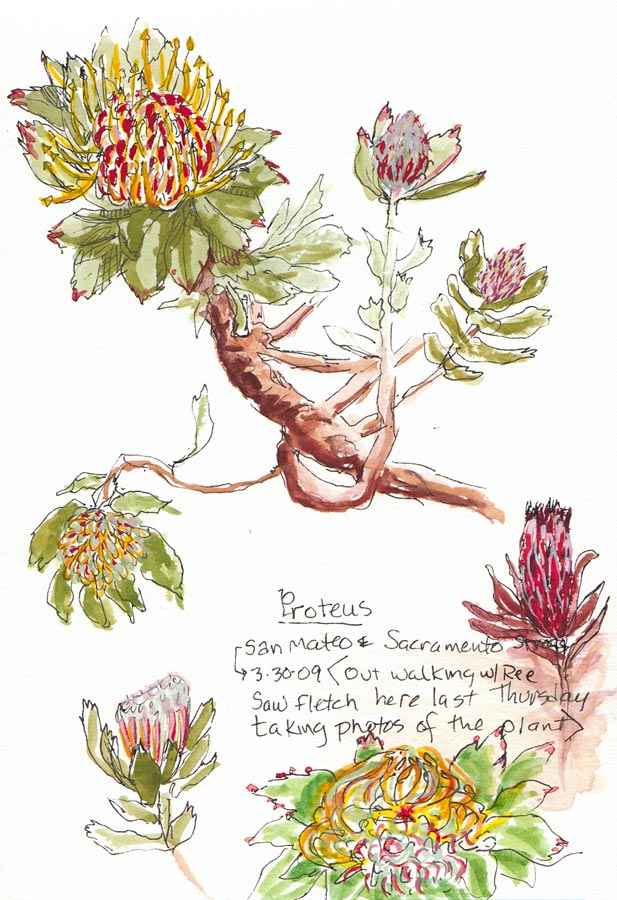
Proteus in Bloom, ink & gouache, Moleskine 5x7 sketchbook

When I was walking to BART last week I ran into Fletch who had just finished shooting photos of an amazing Proteus  a few blocks from my house. I must have walked by this stunning plant a hundred times and never noticed it until he pointed it out to me. I couldn’t stop to sketch that morning but finally got back there this afternoon.

I got as close as I could without trespassing and sketched with my Micron Pigma .01 pen, trying to capture the many different forms the blossoms take along the way to fully blooming. Then I used my mini gouache palette and a tiny brush to paint the details.  Gouache seemed like a perfect medium for doing this kind of detailed botanical sketching.

I also took a bunch of photos of these amazing and diverse flowers. Here are a couple of them:

Photo of Proteus blossom
Proteus in bloom, photo

Note to self: Find proteus at a nursery and plant them! But first I want to do some larger botanical illustrations from my photos (or from life if I can convince the woman who owns the plant to allow me to take some cuttings). Fletch told me she reluctantly allowed him to take one.

And here’s a bit of etymological (word origin) trivia about theProteus:

The Proteus got its name because of its amazing diversity of form: It was named after the Greek sea god, Proteus, who was able to change his appearance at will.  From this comes the adjective “protean,” which means “versatile”, “mutable”, “capable of assuming many forms.” “Protean” has positive connotations of flexibility, versatility and adaptability.

Categories
Gardening Ink and watercolor wash Painting Sketchbook Pages Watercolor

Walking and Sketching in the Neighborhood

Fireplug and Flowers

I see something that inspires me to draw every time I take a walk. On this sunny winter walk, neighbors were out tending to their gardens, and flowers were blooming in unexpected places, like surrounding the fireplug above on a busy street corner.

Cactus Trimming Day, Ink & watercolor

There’s a house a few blocks from mine where the front lawn was replaced long ago by a hundred different kinds of cacti and succulents. I wondered how they managed to keep the various spikey things trimmed and on this day I found out: carefully, with very thick gloves and shovels.

They’d trimmed their enormous Nopales (or Prickly Pear) cactus and piled up the “paddles” in this old wheelbarrow. As the husband and wife worked they acted like it was completely normal for me to be standing in front of their house for 15 minutes sketching their wheelbarrow. I’m not sure what they ended up doing with the pieces of cactus. As I finished sketching, the husband piled a few paddles on his shovel and walked off down the street with them.

Ready to party
Ready to party

Later I passed this cheery scene in someone’s driveway. I didn’t see anyone around, but the brightly colored chairs and containers of (?) on a tray looked awfully inviting.

Categories
Art supplies Art theory Drawing Flower Art Gardening Glass Ink and watercolor wash Oil Painting Other Art Blogs I Read Painting Sketchbook Pages Still Life Watercolor

Red Roses Painted with Watercolor, Oil and Blood (!?!)

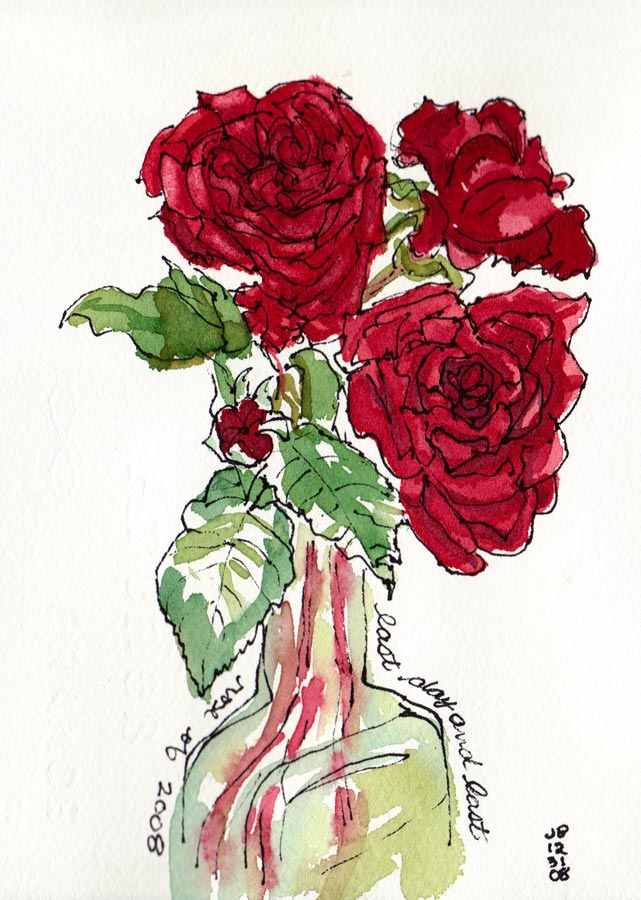
Red Roses, watercolor

My next door neighbors were pruning their roses for winter so I asked them to save some for me to draw (they were going to throw the still perky roses in the recycling bin). I started by trying to paint them in oils but was having a terrible time mixing the right colors. I scraped off the paint and went to bed, planning to try again the next day.

When the cats knocked the vase over during the night I was actually relieved, thinking the roses would be too funky to paint since all the water was on the floor, not in the vase. But these were some tenacious roses, and were still fine so I decided to try sketching them in watercolor (above and below). I also consulted one of my books on flower painting that said roses were shaped like teacups, so I added a few of those tilted at the same angles to the sketch to help me understand their shape better better.

Blood Red Roses, Ink, Watercolor & Blood!
Blood Red Roses, Ink, Watercolor & Blood

I’d just finished the sketch (above) and was writing about how hard it is to mix the highlight color of  “blood red” roses in oil paint. At that very moment, my nose started bleeding for no reason at all and it dripped onto my sketchbook!  Now I feel like a real Avant-garde artiste, painting in blood!
P.S. A little pinching of the nose and it stopped.

Red Roses, Oil, 6x6"

Mixing a light red color in oil paints

It’s hard to mix a warm, light red in oil paint because when you add white to red oil paint, it makes a cool pink.  This is because all white oil paint is cool (meaning it tends more towards a blue than a warm color like orange or red). But the color of these roses in bright, warm light was a hot pink. It’s easier to get a warm, light red in watercolor because you use the “white” of the watercolor paper to show through and “lighten” the red, not white paint.

To get help with the dilemma I sent an email to Diane Mize at Empty Easel since she and I had recently corresponded about color charts and she’d written an excellent article on Empty Easel about how to mix correct color in oils. She validated that mixing a light red is challenging and offered some good suggestions, including using Naphthol Red, which is a more intense red than the cadmiums (which quickly lose strength in white).

I tried making the lighter areas of the rose thicker, using a palette knife, since those raised areas will catch the light and reflect it making it appear lighter. I also intended to make the dark areas on the roses more neutral and cooler, so that by comparison the warm light area would look even more brilliant. But the roses finally died and that put an end to the painting.  My favorite part of this painting are the leaves at the bottom left.

Categories
Gardening Life in general Oil Painting Painting Photos Plants Still Life

Humble Hydrangeas; Antidote to Procrastination

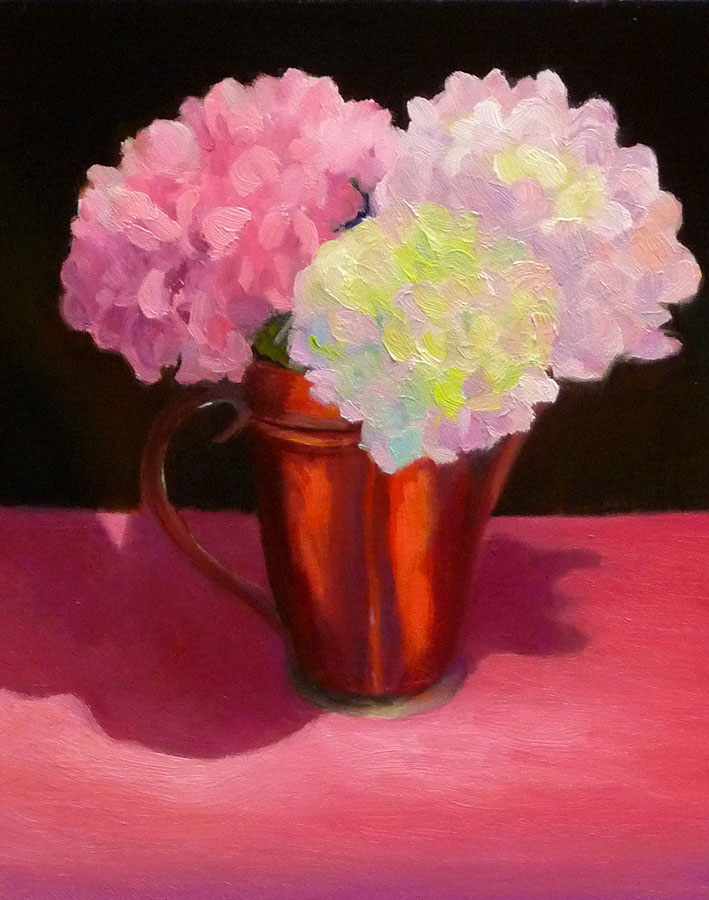
Humble Hydrangeas
Humble Hydrangeas

These humble but persistent hydrangeas were still blooming outside my kitchen window, despite suffering through drought then rain and cold.  Their leaves were few, gray and blotchy and the stems were bent and woody but the flowers just weren’t giving up.

While I worked on the painting I was thinking about humility. I’ve discovered that being humble is a good antidote to procrastination.

When I think that I have to be “good” at something (especially painting), it creates fear that I won’t be. Then I find myself either procrastinating or, if it strikes while I’m painting, reworking a painting again and again because it’s not “perfect” yet.

I’ve found that the best way to step out of that rut of perfectionism is to focus on being honestly humble and not worry about being good, better, best, or perfect. All I have to be is humble little me and like the hydrangeas, just hang in there and shine forth.

About the painting:

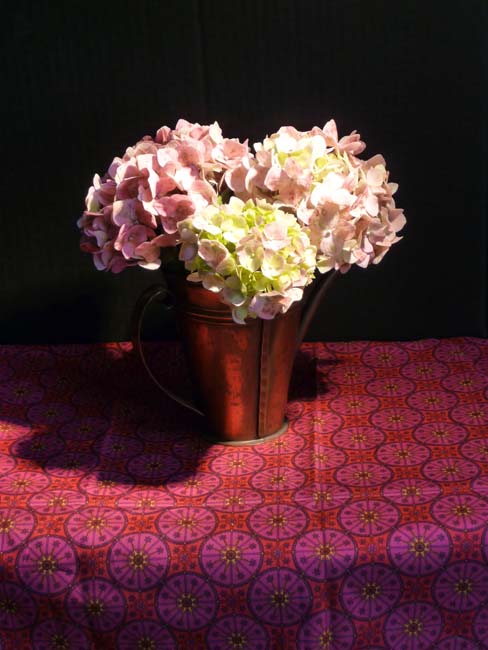
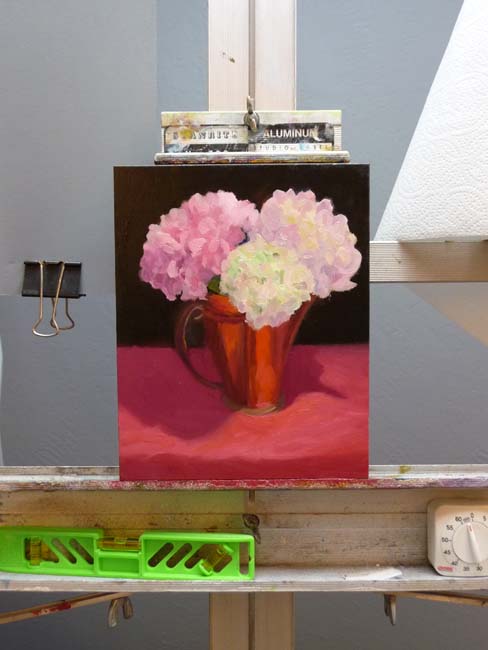
I was trying to see and paint light and make good use of color temperature and value contrasts to model the form. I started by doing a monochrome underpainting in acrylic, but didn’t really like the way the acrylic paint kind of ruined the wonderful texture of the ArtBord.  Here are the steps along the way:

1 & 2 are photos of the still life set up, the second in black and white to look at values.

Categories
Gardening Life in general Oil Painting Painting Plants Still Life

Early Girl on Blue Velvet

Tomato on Purple Velvet, Oil on panel, 6x6"
Tomato on Blue Velvet, Oil on panel, 6x6"

Last year I planted Early Girl tomatoes and Best Boy tomatoes. They must have gotten together and had some fun over the winter because they’ve returned bearing fruit this summer all on their own.

I was ready to paint something other than that stupid scene at Sibley. Rummaging around in the kitchen a  tomato caught my eye and then when I reached into the stack of colored cloths I keep for still lifes (or is it still lives?) in an overhead cabinet, I came away with a blue-violet piece of velvet (actually it’s a small velvet bag).

It was fun working with such saturated vibrant colors but now I have to clean brushes and let go of painting for a few days while I return to my “day job.” Although I often feel grumpy at having to make that switch, today I’m feeling very grateful for a good job and my comfy home and studio, given all the terrible news of financial ruin and weather-caused devastation I’ve heard today. I haven’t been watching any TV for the past month, which has been great, but today I took a look at the news while I ate dinner and was so sad to see all the suffering.

Categories
Flower Art Gardening Life in general Oil Painting Outdoors/Landscape Painting Plants Plein Air Still Life

Hydrangeas Plein Air & Creativity Interview

Hydrangeas plein air

Oil on panel, 6×8″ (larger)

It felt so good to get outside and paint this sunny afternoon, even if it was only for an hour on the side of my house by my trash cans where this small hydrangea is finally starting to blossom and grow.

Creativity Interview

I was interviewed by Creativity Coach, Liz Massey and she posted the interview on her blog today. If you’d like to read about my creative process, thoughts on inspiration, overcoming artistic blocks, etc., please stop by her excellent blog. While you’re there, check out some of her other interviews. I was especially intrigued by her post about “clutter-busting with one sentence journaling.”

Painting lessons learned the hard way

This week I’ve been mucking about in the studio trying to fix the compositional problems with my painting of the ladies at the farmer market. Today I gave up on it and moved on.

The struggles I had with it were a good reminder for me about how important it is to resolve compositional issues before starting to paint (like the area where you couldn’t tell hands from plastic bag from shopping cart handle).  Also a good lesson that if a painting’s initial framework isn’t working, it’s better to start over than to spend hours and hours trying to fix it. Although I really liked many parts of that painting, it just wasn’t working as a whole.

Inspiration at 87

My sister and I joined my vibrant and adorable 87 year old aunt and her two sons (our cousins) who I hadn’t seen for 30 years for lunch today. It was so inspiring to see how youthful my aunt is — she drives, goes bowling with her girlfriends, and takes long walks several times a day with her Border Collie.