Categories
Drawing Flower Art Gouache Painting Still Life

Playing with my flowers

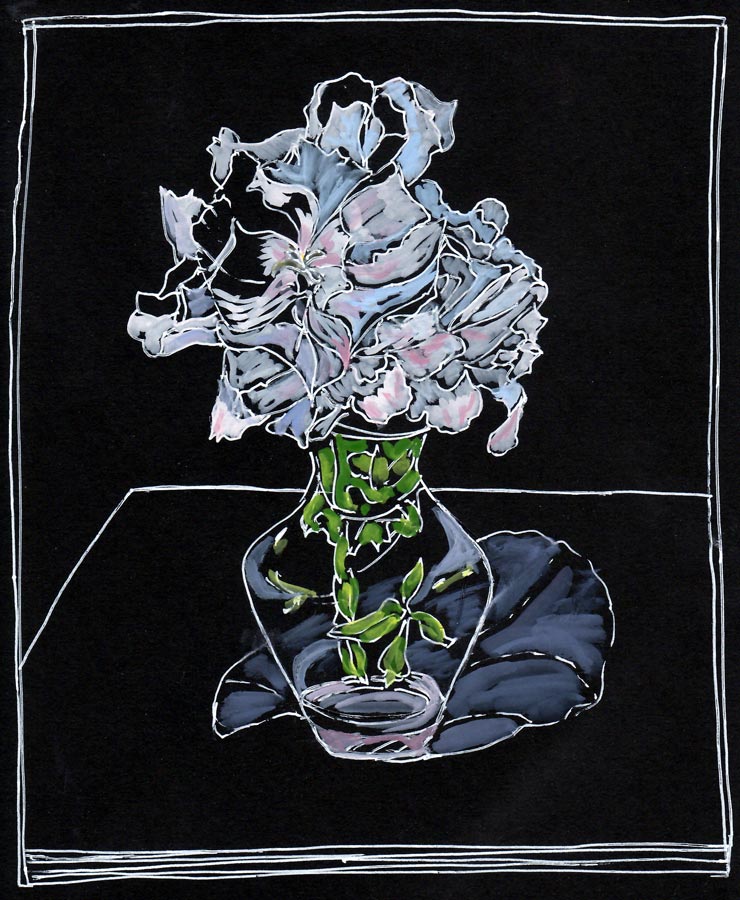
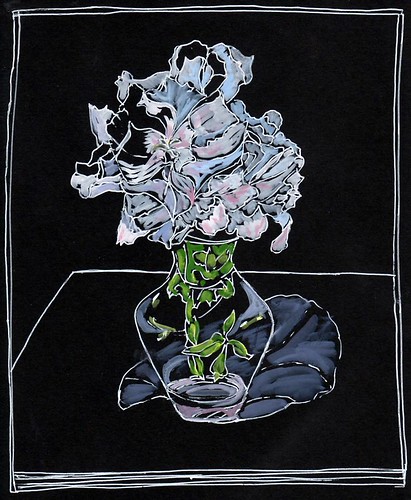
20080521-black+gouache-mothersday-flowers

White ink, gouache on black Canford paper 10″x8″ (larger)

I got home from work just as my painting group was arriving for our weekly painting session in my studio. I grabbed a quick bowl of shredded wheat for dinner, fed the cats and plopped this little vase of white flowers on my drawing table.

I looked at the dainty, delicate white flowers, and feeling a little rebellious decided to draw them with white ink (using my favorite white ink pen, a Uni-ball Signo) on black paper, with no idea what I’d do after that. This was a “let’s try this and that and see what happens” sort of thing.

Once I had the drawing I decided to fool around with adding a little gouache. Just for fun I stopped before I’d covered all the petals, leaving some random black spots.

What I discovered is how much fun it is to paint with gouache on a dark background, which I’d never done before. It reminded me of those cool coloring books I always wanted (but rarely got) when I was a kid where you painted with water and the painting appeared magically.

It might have been a “better” painting if I’d paid attention to value, composition, light, etc. but tonight I just felt like playing like a kid, not trying to make a good painting.

Here’s the drawing without the gouache:
20080521-bw-mothersday-flowers

Which do you like better?

Categories
Drawing Flower Art Gardening Glass Painting Plants Sketchbook Pages Still Life Watercolor

Zen & First Spring Roses

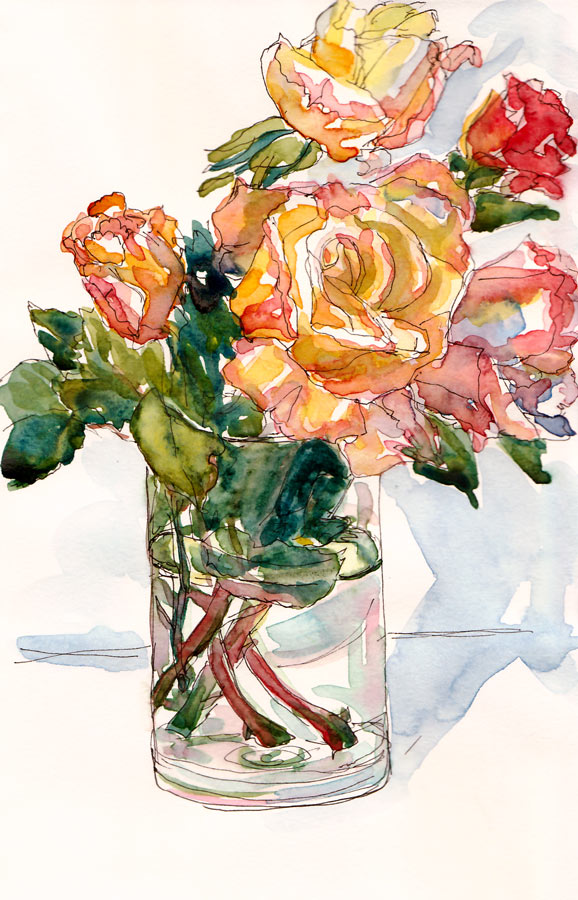
First spring roses

Ink & watercolor, 9×6″ (larger)

When I picked these roses yesterday evening, they were heartbreakingly fresh, new and beautiful. I put them in a vase of water in the kitchen, planning to paint them today. This morning I found them laying on the counter where they’d obviously been without water too long and looked limp.

Either they jumped out of their vase or my cats had a hand (er… paw) in their escape. After a few hours back in water they plumped right back up and were a joy to draw. I only had about an hour and that was just enough time to make a happy ink and watercolor.

But why do I feel so sad seeing the beauty of my seven rose bushes and thick patch of irises all loaded with flowers? It’s as if I’m already mourning their demise, knowing how temporary their burst of color and vibrancy is before winter comes again.

Is it my enhanced awareness of the cycle of life and death as I approach one of those milestone birthdays this June? Or is that time seems to be moving so fast these days that I can picture the blooming season flying by like those time-lapse films where the flowers sprout, bloom, shrivel and die within moments.

Instead of feeling sad about their demise (and my own, for that matter), I need to remember the Buddhist teaching of being in the present moment, accepting that everything changes, everything dies; that desire and clinging cause suffering and that letting go relieves it.

So with that, I will allow my flowers to live and die as nature sees fit (as if I had any other choice!), and will enjoy them while they’re here. I’ll try to make the most of my own moments while I’m here too, with as much acceptance as I can. And maybe I’ll finally return to my Zen meditation practice which always brought me such joy and peace, and made all of life more vibrant.

Categories
Flower Art Oil Painting Painting Plants Still Life

Daffodils Again

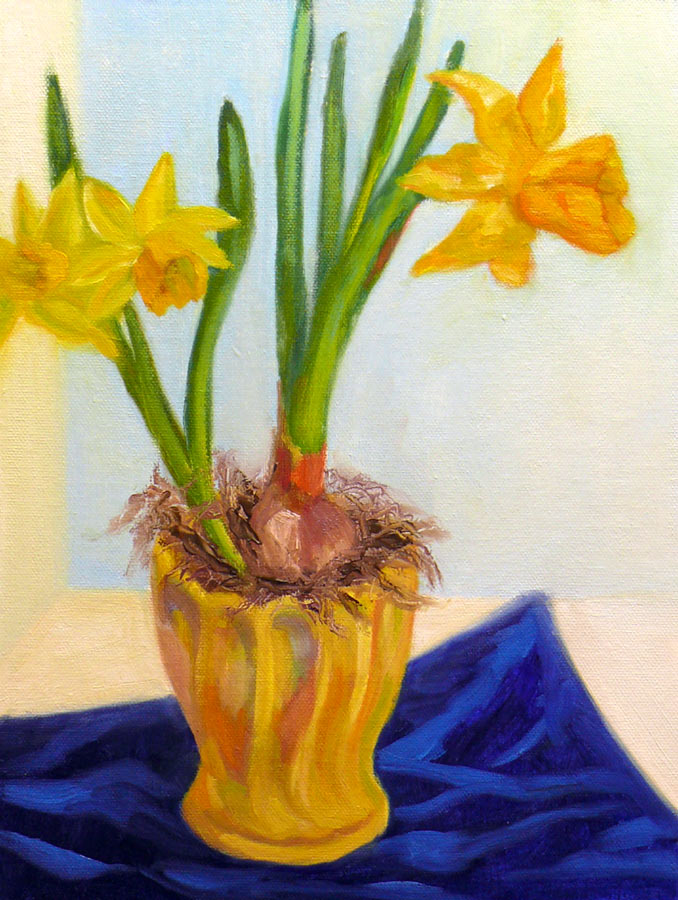
Daffodils 2 - Finished (maybe)

Oil on panel, 12 x 9″ (larger)

In between a million (well, maybe 25) other things this weekend I made another attempt at painting these daffodils from life. I don’t think I’ve nailed it yet, and was amused by how the flower on the right turned into anything but a miniature daffodil like it’s sisters on the left. It just kept growing and growing but I let it because I liked it.

There’s a lot I still need to learn and figure out (having to do especially with the effects of light but also how to set up a still life with more interesting background) but I’m happy enough with my progress. If you’d like to see the steps of painting this, click “Continue Reading” below.

Categories
Art theory Drawing Flower Art Oil Painting Painting Plants Still Life

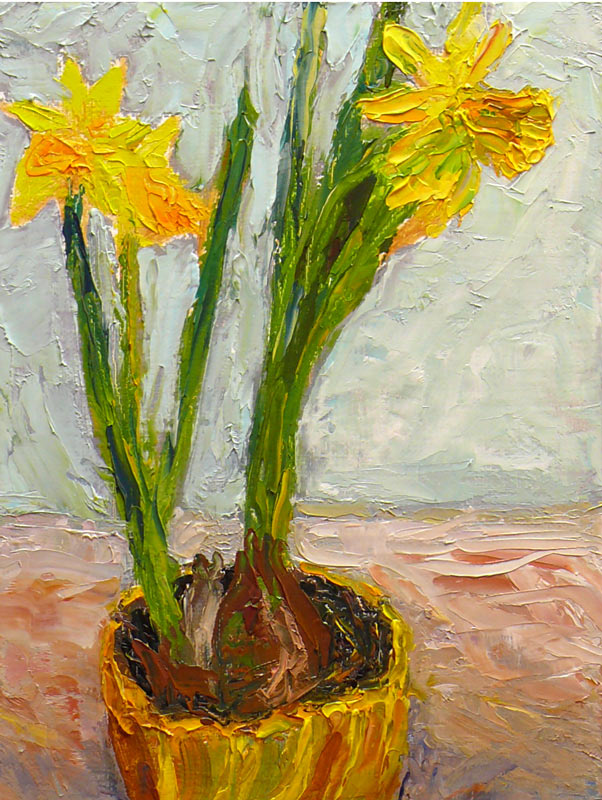
Miniature Daffodils in oil

Finished oil painting

Oil on canvas panel, 8×6″ (larger)

I’m happy to report that my computer is back up and running but I lost a couple months of email messages in the crash.
If I haven’t responded to an important message you sent me, please send it again and I’ll reply quickly.

Early last week my boss gave me this charming little pot of “Spring Brite Mini Bulb” daffodils for me. I couldn’t wait for the weekend so I could it home and paint it. I experimented with using a palette/painting knife. It’s so much fun — a lot like sketching in that you can work quickly, easily replace colors, add to them, or scrape off and re-do sections or the whole composition. It also forces you to be less concerned with details (at least at my level of skill in handling the palette knife). I used a small diamond-shaped knife for this.

Below is a progression of my steps, working backwards: (click Continue Reading to see the rest)

Categories
Flower Art Life in general Outdoors/Landscape Painting Sketchbook Pages Watercolor

Flower Stand at Night

Ink & Watercolor in Canson 7″x10″ Sketchbook (Larger)

This little flower stand looked inviting and yet so forlorn all by itself on a dark, lonely corner in downtown Oakland the night before Thanksgiving. On my way home from work I stopped to take a few photos using a postbox as a tripod and was lucky enough to get some good shots.

I did this quick ink sketch with watercolor from a photo as a study for an oil painting. I especially like the way this appears on the monitor since it enhances the feeling of light glowing out of the dark.

I’ve been feeling a bit of Seasonal Affective Disorder (SAD) lately — grumpy and craving light. I know that it’s a common affliction and just a physical reaction — that things are just as fine in my life as they were a couple weeks ago before SAD hit. A friend of mine recommends sitting in front of special lights designed for this purpose and says they really help her. I know exercise helps mood so I’ve been trying to do more of that, especially outdoors when it’s sunny, but I think it’s time to explore SAD lights.

As much as I love to occasionally spend a good rainy afternoon listening to Mozart’s Requiem and wallowing in melancholia, generally I prefer feeling cheery.

Categories
Flower Art Painting Published work Sketchbook Pages Still Life Watercolor

My art in the book!

I'm in the book!

The Watercolor Flower Artist’s Bible: An essential reference for the practicing artist (link to Amazon for more info)

Last December I received an invitation from an editor at Quarto Publishing in London to submit photos of my watercolor flower paintings for publication in an upcoming book. At first I ignored the message because I assumed it was the kind of spam email I get regularly inviting the artist [to pay] to be in a show or a book. Just before the submission deadline I did some investigation and discovered they are a good publisher and that I actually owned another of their books. I submitted files of my photos and scans of five paintings.

That editor’s editor approved the photos for inclusion and they asked me to write about my process, goals, focus, techniques, etc. for each painting which I did. Then I waited. I was promised only a copy of the book and good publicity in exchange for their right to publish the art in their book.

I got the book this week and was so excited! Not only did they do a really nice job with my artwork and the descriptions, but it’s a really good and comprehensive book on flower painting in watercolor. The most exciting part for me is that I’m sharing the pages of a book with some truly amazing artists, including one of my favorites, Lucy Willis, who has published several wonderful books (that I own and treasure) on watercolor painting, seeing and painting light, and travel painting.

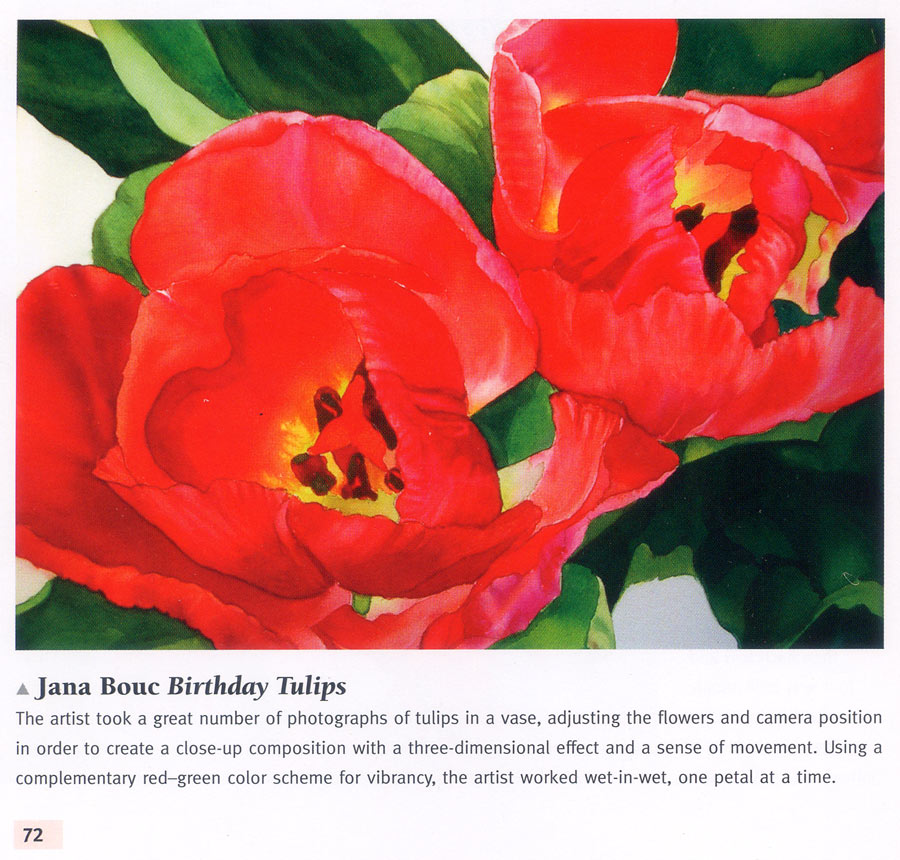
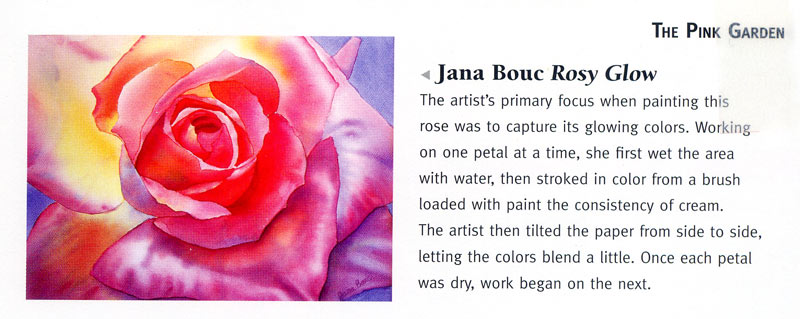
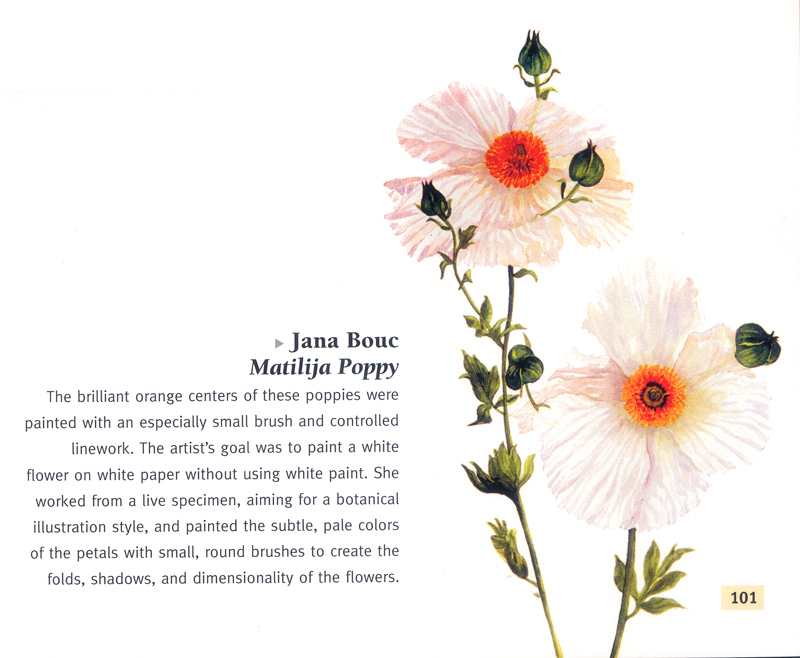
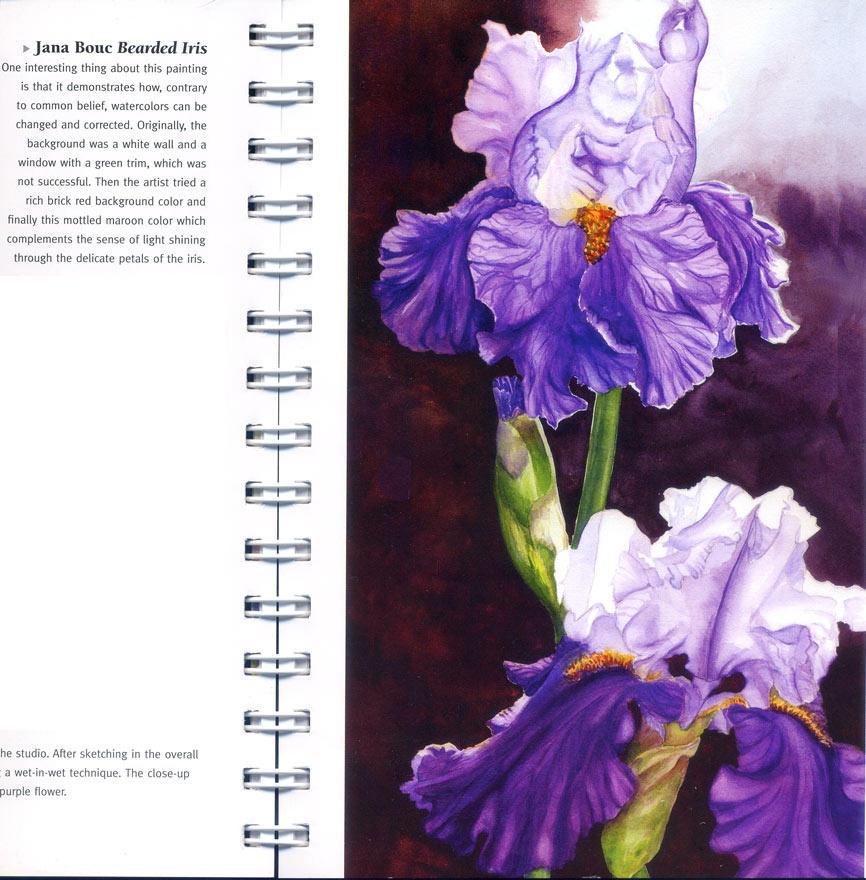
My artwork can be found on pages 72, 85, 86, 101, and 152. Here are my chunks of those pages:

My tulips in the Watercolor Flower Artist's Bible
Larger

My rose in the Watercolor Flower Artist's Bible
Larger

My rose and bottle in the Watercolor Flower Artist's Bible
Larger

My poppies in the Watercolor Flower Artist's Bible
Larger

My irises in the Watercolor Flower Artist's Bible
Larger

Categories
Art theory Flower Art Glass Oil Painting Other Art Blogs I Read Painting Still Life

Dahlias after Painting Class

Dahlias in Oil

Larger
Oil paint on gessoed mat board, 12×7.5″

Sunday was my first plein air oil painting workshop with Elio Camacho and it was fabulous! Elio is not only a wonderful painter, but he’s a fantastic teacher — so energetic, enthusiastic and generous in sharing everything he knows (which is a lot!).

Although Elio covered a huge amount of artistic territory in his conversations with us, what really sunk in for me at this session was the importance of temperature (warm vs cool colors) and value (dark vs light) and how to use those relationships to paint the effects of light in the landscape.

To better understand this concept and practice seeing color temperature, he suggested doing a still life of all yellow objects as homework so I painted these dahlias from my garden (after scrubbing all the nasty aphids and ants off them–ick!). Yellow is a good color to practice with because there are many yellow pigments from cool to warm and dark to light and you can successfully lighten it with white, unlike red which turns pastel pink when white is added.

Since I started this journey to learn oil painting, I’ve read many books, watched a dozen oil painting videos, and received wonderful support from my online painting mentor, Nel. There were so many concepts, “rules”, and techniques that I understood intellectually but in class they came to life! Seeing the process demonstrated and being able to ask questions each step of the way was great.

And even better was having Elio checking on me every 15 minutes or so during the three hours I was painting. He demonstrated what he meant when I didn’t understand; he recommended I quit dabbling– put down a stroke and leave it; he showed me how to hold my brush correctly and at what angle, so I was putting paint down without scraping it off at the same time (hold the tip of the brush and keep it at a low angle to the canvas, not perpendicular as I was doing). So many things just clicked.

The painting I did in class isn’t worth posting, though it had some nice moments along the way. Now that I know how to hold my brush properly and understand the importance of the direction of the brush stroke, and am learning to see color temperature and value better, I’m can’t wait to start my next painting!

Categories
Art theory Flower Art Glass Oil Painting Painting Sketchbook Pages Still Life

Wax On, Wax Off (Breathe In, Breathe Out)

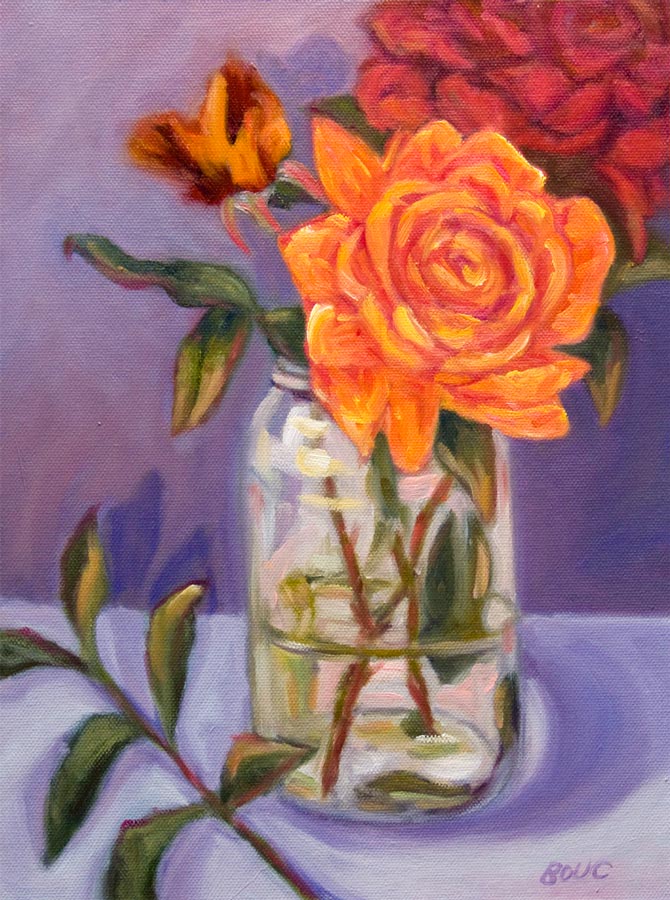
Rose in a Jar

Oil on panel, 12×9″
Larger

The title of this post refers to words from the 1984 movie Karate Kid and also my process in this painting except for the painting it would be more like “Paint On, Wipe Off (Breathe!) Paint On, Wipe Off… ” (click on “Keep Reading” below to see photos of the steps). I’m not happy with the front flower but I’m ready to move on to the next painting. With each one I learn so much more, including how much more there is to learn!!!!

I had two main goals for this painting/learning experience:

  • Think in terms of “Whole Canvas”
  • Keep trying to understand how to work with oil paint so that I’m taking advantage of its wonderful qualities rather than fighting them. (I’ll keep trying!)

In my many years of watercolor painting, I worked hard to capture what excited me about my subject. I often worked close focus without much background, or just using the lovely white of the paper as my background to set off the glittering glass or glowing flowers I was painting. If the composition didn’t quite work out–no problem, just crop as needed with a mat and frame.

In oil painting the background has to be an integral part of the painting–you can’t just leave the glaring white of the gessoed canvas as your background. And you can’t crop a stretched canvas or panel like you can paper. I was struggling with this concept and finally it clicked. It’s just another way of seeing and, like peeling layers of the onion, the haze peeled from eyes and I could see that a painting is not subject & background — they fit together to complete the picture, just as night completes day. While an object that interests me enough to paint it is the focal point, I need (for now) to think of the PAINTING as the subject.

Categories
Animals Flower Art Outdoors/Landscape Watercolor

Butterfly at Blake Gardens

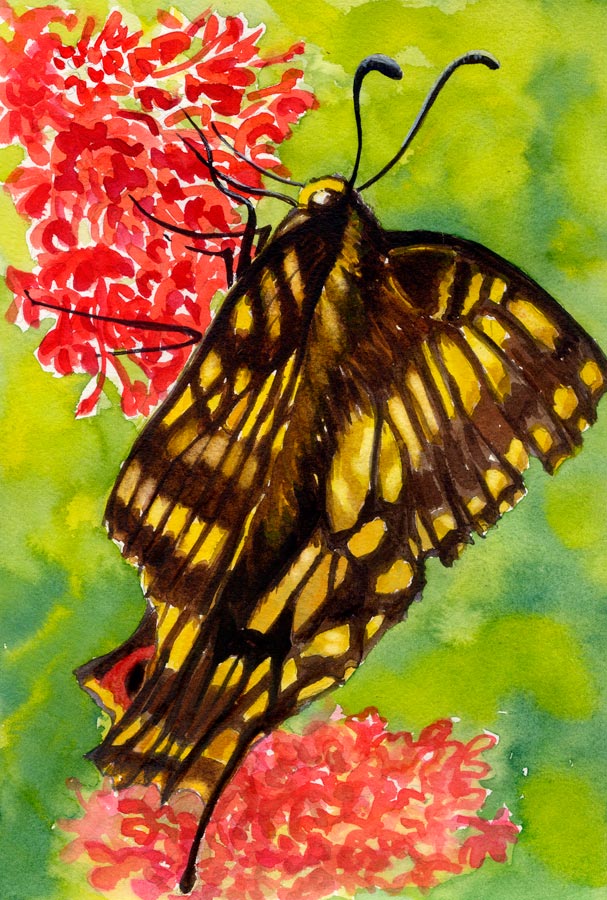
Butterfly watercolor

Watercolor on Arches paper, 11 x 7.5″ (with a touch of white gouache on antennae)
Click here for larger version

Buttefly photo

(Above) Reference photo I took on Thursday at Blake Gardens.

I have two more days of vacation left and finally I’m really ready to paint. I’ve sorted out the images I want to work from and have some ideas how I want to approach them. This first image seemed to call for watercolor and it felt good to get back to paint again tonight.

But unfortunately today mostly got lost to errands, paperwork and monitor calibration again when I called the company who makes the Eye One calibration tool I bought because of some continuing problems I was having. Their tech support was superb and the patient and intelligent gentleman I spoke to uncovered a number of problems I’d created by messing around with stuff I shouldn’t have been messing with. He helped me undo my mistakes, got everything working properly, and helped me to understand more about the concept of color management.

Now it’s back to managing REAL color on the end of a paintbrush. I’m not panicking too badly about the end of vacation because I only go back to work for one day (Thursday) and then I’m off again for my usual 3 1/2 day weekend.

Categories
Flower Art Gardening Landscape Outdoors/Landscape Plants Plein Air Sketchbook Pages Watercolor

Tilden Botanical Garden

Serpentine Cone Flower

Serpentine Cone Flower
Ink and watercolor in large Moleskine watercolor notebook
Click here to see enlarged

Today I went to Berkeley’s Tilden Park Botanical Gardens with Richard. It’s a lovely, serene place filled with California native plants and trees from giant redwoods to wildflowers. He hiked around the hills, fields, bridges, creeks and wooded areas, enjoying the quiet breeze and birdsong. Most of the flowering plants had already done their big blooming in the spring but these coneflowers grabbed my interest so I sat down on the grass and did this quick sketch while Richard, a photographer, took close up shots of flowers.

Then we decided to move on to Blake Gardens. Richard had never been there and there were many parts of the estate I’d never explored, so we hiked all around there too, finding amazing jewels of nature and design at every turn. We took lots of photos but since time was limited and we wanted to see everything, I didn’t do another drawing. Now that I’ve seen the full scope of what’s there I think it holds promise for unlimited painting opportunities.