To shake things up a bit I thought I’d try a watercolor Moleskine watercolor sketchbook this time instead of binding a new journal. These sketches are the first in the Moleskine from a walk in my neighborhood on a sunny winter day.
A few spreads into the Moleskine, I’m liking the paper but hating the stupid, floppy, too-wide landscape format. Why, oh why does Moleskine refuse to bind a watercolor book on the long size in portrait format! Brenda Swenson had a clever solution: she bought a very large watercolor Moleskine and sawed off half to make one the right size! Here’s someone else who had hers sliced at the local photocopy shop.
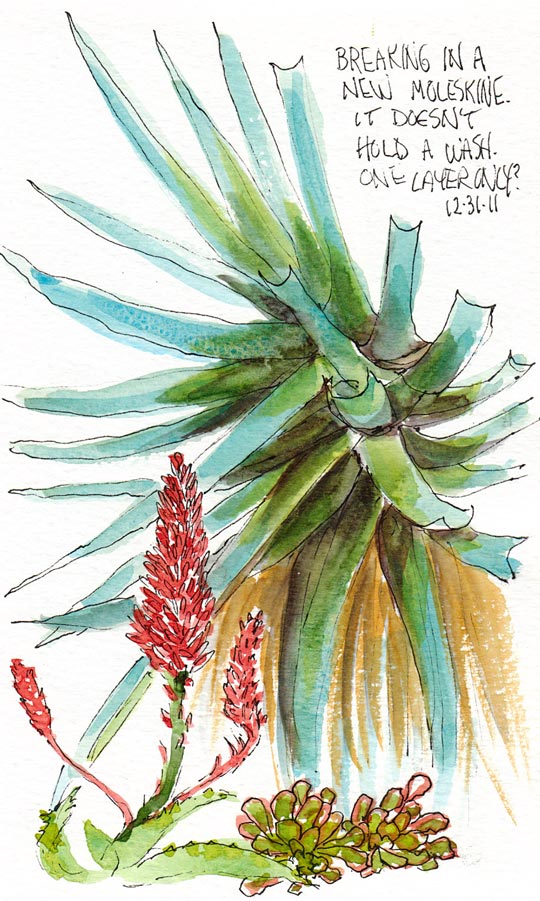
Succulents 2, ink & watercolor, 7x5"
The spike on this plant was about 15 feet tall but I didn’t think through how to make it look that way, and since it was in ink, it is what it is. The stalk should have gotten skinnier as it got further away instead of looking like a fat asparagus.
After I did the watercolors I posted yesterday, I set up the sketch, the watercolor and my iPad displaying the photo on the table beside my easel and painted the scene once again, this time with oil paint. After a month or two of being totally frustrated with oil painting, trashing everything I made and about ready to give it up, suddenly painting was easy and I was loving it!
Point Bonita Painting set up in studio
The entire painting worked like a charm except the foreground mount of dirt and ice plant which was the last thing I painted and which I did over and over. It kept trying to call too much attention to itself. I think I finally successfully muted that foreground while still keeping the light on it.
Then I was looking at some delightfully free and vibrant oil pastel work on Aletha Kuschan’s blog which inspired me to try the scene in oil pastels too. I know nothing about oil pastels so I quickly read a few how-to’s on the web and dug in.
BUT before I show you the drawing, I have to say that I made a fatal misstep: I chose a sheet of the totally wrong paper to work on. Instead of starting small on a sheet of white or blue pastel paper, I chose a large sheet of brown Stonehenge drawing paper. What was I thinking? Brown under a turquoise sea?
Point Bonita #4, Oil pastel on Stonehenge paper, 17x13"
It was impossible to cover all the brown paper because even though the oil pastels got really thick in some areas—so thick that no more could be applied—in other spots they just wouldn’t cover.
Although my Holbein Oil Pastels are very old, purchased for a small project I did more than 20 years ago, they were still in good shape. But I didn’t have the right colors, and I had trouble blending. I didn’t have blending stumps, didn’t want to use my fingers and was wearing gloves which didn’t work. I tried a paper towel but it just smeared and left paper towel lint.
Compared to paint, oil pastels seems like a lot of extra work, having to fill in so much area by scribbling over and over. And it was messy; my gloves and the pastels got dirty from colors transferring onto them.
But maybe if I knew what I was doing, or had used the right paper it would have been easier or less messy? (Not to say that oil painting isn’t messy! Everything I own has paint on it!) I like the look of oil pastels done well so I’ll try another experiment with them. But on the right paper this time! Any tips?
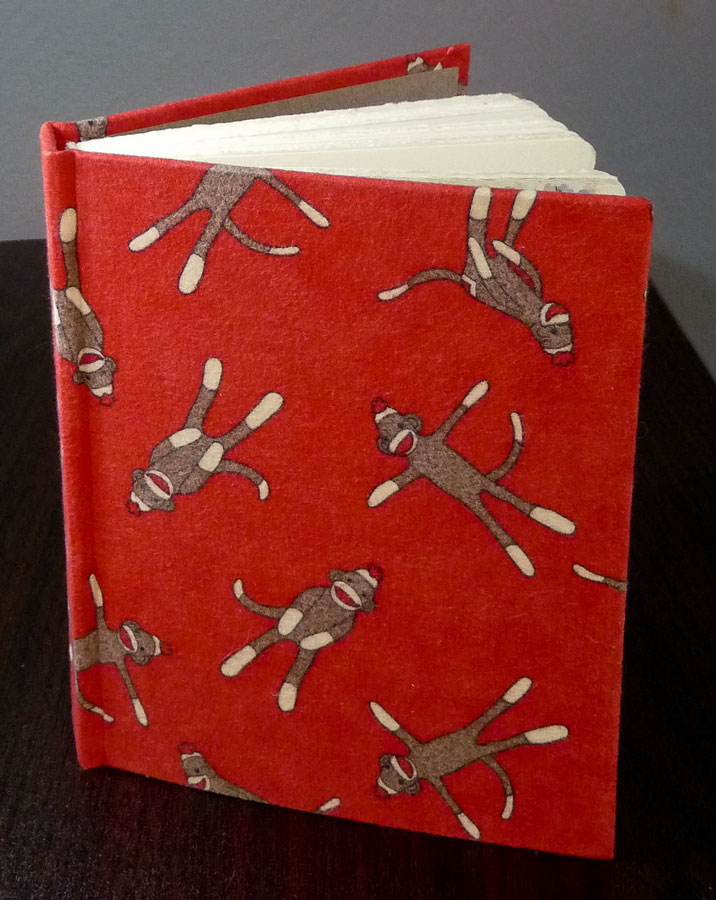
When I was a kid I had a sock puppet that looked like this so when I saw this fabric at the store I couldn’t resist. I used a piece of it to cover a cushion on a stool about 5 years ago and then put the rest on the shelf. I needed to bind a new journal right away and was too lazy to go shopping for book cloth or to make my own. Hence off the shelf and onto the book!
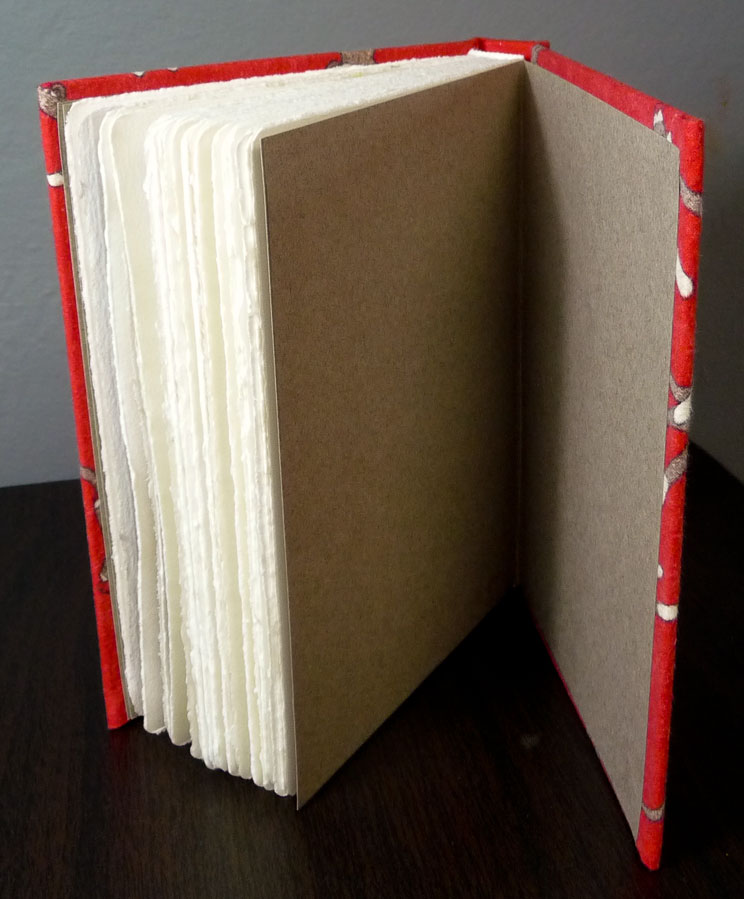
Monkey Business Journal inside
For the end papers I used some lovely warm grey paper a friend left at my house from a family history book-making project I was helping her with. This was the first time I could use my case-bound journal making instructions all the way through without needing to revise them and it went really quickly.
Monkey business journal
I’ve actually been using this journal already for a couple of weeks and writing this post prompted me to name the journal which I hadn’t yet done. Calling it “Monkey Business” will help me to lighten up as I use it, to get more playful and fool around and let go of “right” and “good” which always trip me up when I get in that judgmental place when I’m drawing, instead of just enjoying the act of looking and sketching what I see.
And since it’s red flannel it’s warm and cozy–perfect for fall sketching.
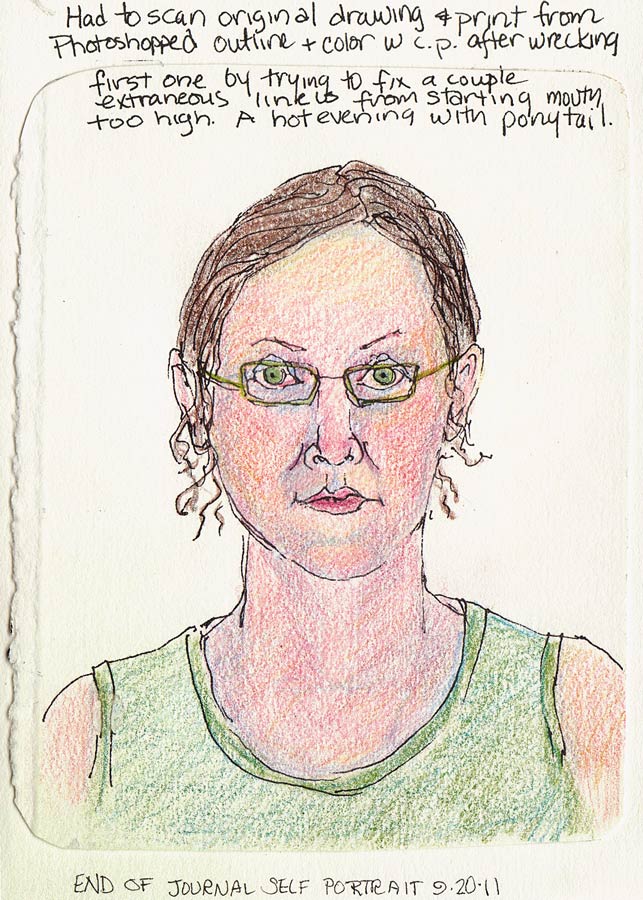
End of Journal Self Portrait, colored pencils, 7x5"
As I complete each journal I draw a self-portrait for the last page. I really liked the ink drawing I made for this one but then totally messed it up when I was painting it and tried to “fix” something. The more I tried, the worse it became. So I scanned the sketch and used Photoshop to remove all the color, leaving me with just the original line drawing below.
Line drawing for self-portrait scanned from bad watercolor sketch
From Photoshop I printed the line drawing onto a piece of the same watercolor paper I use in my journals. Since the ink from my inkjet printer is water-soluble (darn) I couldn’t add watercolor. I used Faber-Castell POLYCHROMOS colored pencils instead and tried to keep a light touch after having overworked the original.
I cut out the sketch to fit into the journal (and cover the yucky sketch), and glued it down with a glue stick. The completed journal is pictured below, covered with a piece of an old tablecloth that lost its “oil cloth” coating when I washed it years ago.
Completed tablecloth-covered journal
It’s so interesting to me how these end of journal sketches turn out. I’d had a rare and unusually good night’s sleep and was in a good mood when I drew this one. What they say about beauty sleep seems to be true, even in sketches — I definitely look more youthful and pretty in this sketch than some of the others I did under less optimal circumstances.
You can see previous end of journal self portraits at this link.
Foil bag of potato chips reflecting on red cloth, ink & watercolor, 5x7"
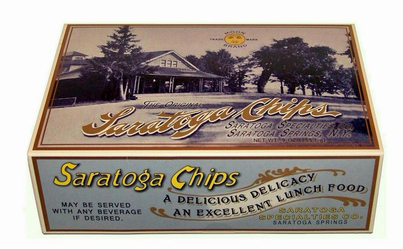
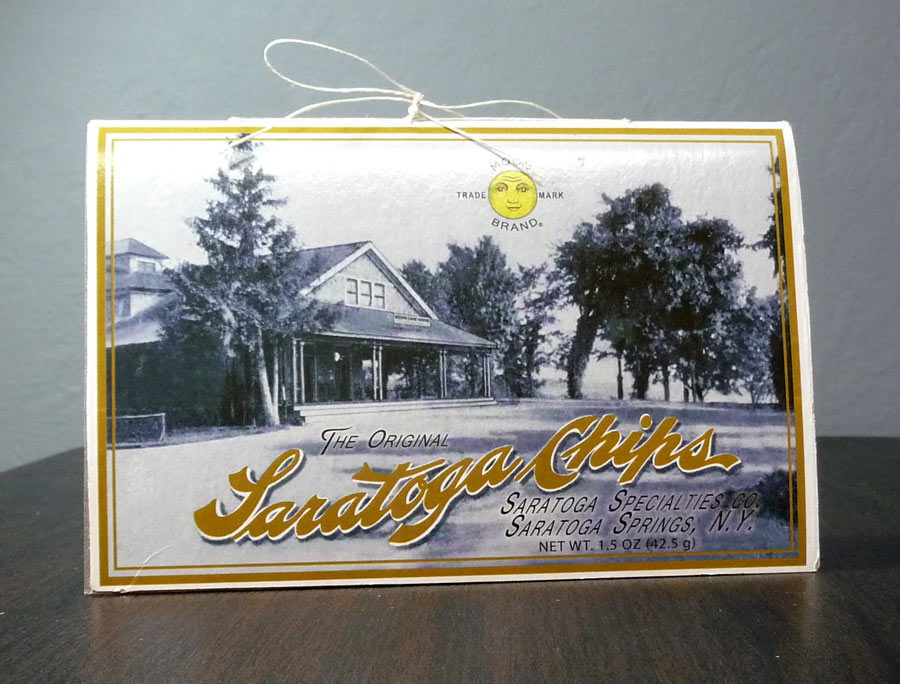
When my friend Mindy sent me a fun little gift box of potato chips (which were invented in her town, Saratoga Springs, in 1853–read funny history here), I was smitten by the cute box (photo below). Then I opened the box, saw the foil inner pouch and had to try to draw it (sketch above, on a red cloth).
Box of Saratoga Springs Chips
The box was charming, a replica of their original packaging from 1853. I remembered seeing journals created from packaging on the fabulous Make a Book a Day blog where Donna Meyer binds and posts a new book almost every day. In August she did a whole series of recycled packaging books, from KitKats and Snowballs to root beer books.
Will You Accept This Rose? Yes, Finally. Watercolor, 7x5"
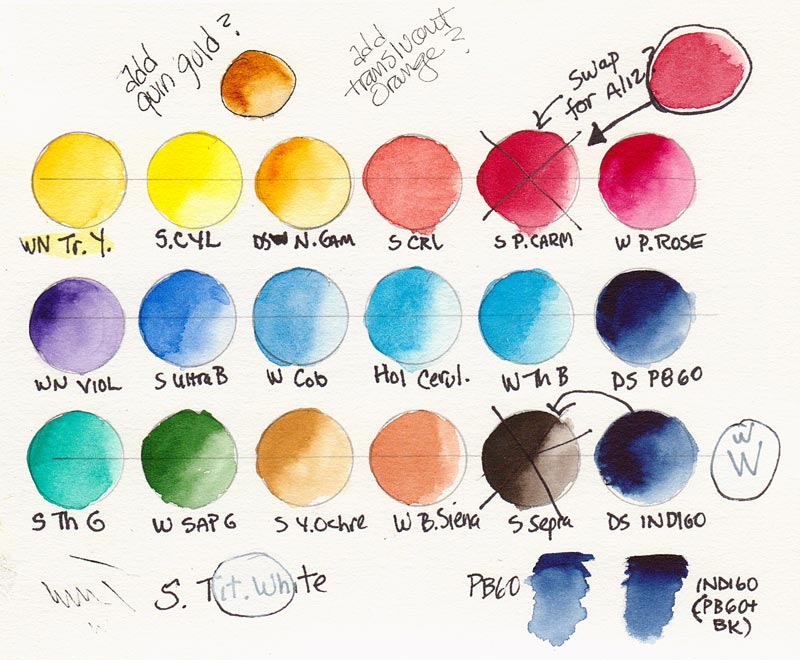
After all the struggles of the previous day, I was determined to succeed in painting a rose and decided to give myself a break. First I rearranged the colors in the palette, putting them in my prefered, mostly color-wheel order instead of helter skelter as they were, and replaced several colors (see below for color chart).
Revised Schmincke Palette chart
(WN=Winsor Newton, S=Schmincke, DS= Daniel Smith, H=Holbein):
Top Row: WN Transparent Yellow, S Cadmium Yellow Light, DS New Gamboge, S Cadmium Red Light, WN Permanent Alizarin, WN Permanent Rose.
Middle Row: WN Violet, S Ultramarine, WN Cobalt Blue, H Cerulean Blue, WN Winsor Blue, DS Indanthrone Blue.
Bottom Row: S Thalo Green, WN Sap Green, S Yellow Ochre, WN Burnt Sienna, DS Indigo, S Titanium White (the latter will probably be removed since I’ve never successfully been able to incorporate white into watercolors).
Second to Last Rose Test, ink & watercolor
The other thing I did to give myself a break was that after I made the second to last rose sketch above from life, I decided to work from a photo of the rose.
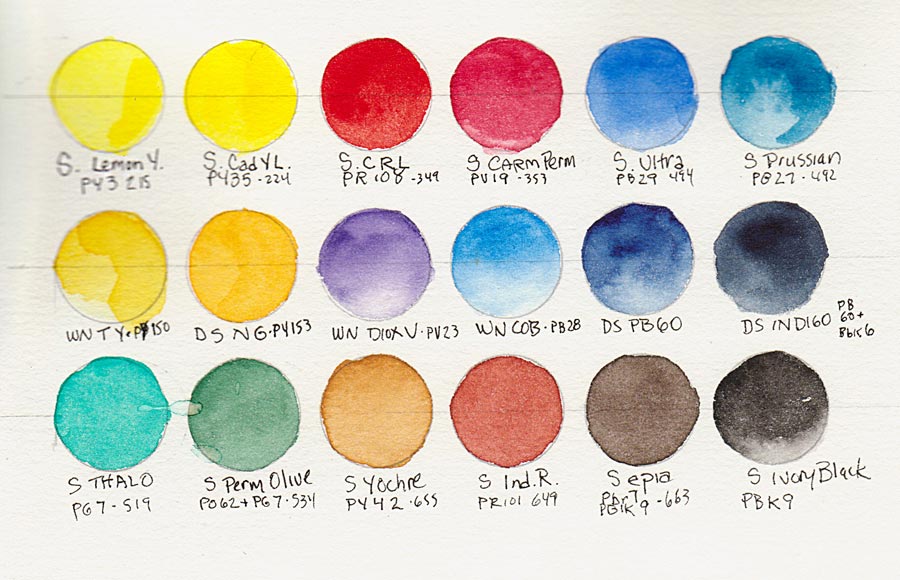
On the next test run of my new Schmincke palette that Roz introduced here, I painted some roses on a tablecloth in the sun on the deck. While the Schmincke pan paint is lovely to use, and the palette a good size and design, the colors frustrated me. Their version of rose called Permanent Carmine (PV19) is much redder than the Winsor Newton (PV19) Permanent Rose I rely on for pinks and several other colors didn’t appeal to me.
In the color chart below, the top and bottom rows are the original Schmincke colors that came with the set. I added the colors in the center row by filling empty half-pans from tube paint in the space designed for adding extra pans.
Schmincke palette original colors plus added middle row
Lavatera Clippings in Amaretti Cookie Can, ink & watercolor,7x5"
I love this old can that once held Amaretti cookies. After trimming some branches off the giant Lavatera bush by my deck, I decided to paint the cuttings. The cookie can was the first thing I spotted that would hold water and flowers.
I used the new Schmincke watercolors palette I recently bought on sale at Wet Paint. I love the palette but after a few trials, added and replaced some colors which I’ll write about next time. The Schmincke pan paints worked beautifully in the hot sun, releasing juicy flowing paint with just a touch of a wet brush.
I think the sketch captured the feeling of heat and strong light and the funky little table with a dirty glass top looks just like itself.
Along with an end of journal self-portrait, I always put an “If Found” notice and silly self-portrait at the beginning of each book (phone number erased for privacy). I started doodling something I was carrying under my arm that turned into a very fat cat (or is it a pig?) And yes, I do wear Pippi braids and bright green shirts sometimes.
Newly bound journal; cover from old tablecloth
Above is my new journal, covered in a piece of cloth cut from an old tablecloth, stacked on top of the last journal, now complete. I temporarily added the silly butterfly sticker as a reminder of what I intended as the front and bottom of the book. And then in my usual Jana way, I accidentally ignored it and started sketching from the opposite direction. And it doesn’t make a bit of difference.
Even though I’ve gotten the binding process down to a 6-hour project per book (when done one at a time; haven’t tried batching them yet), I was looking for a way to save time and be able to sketch without having to bind my own journals. I have yet to find a store-bought journal I like as much as my own, so I wasn’t considering that option.
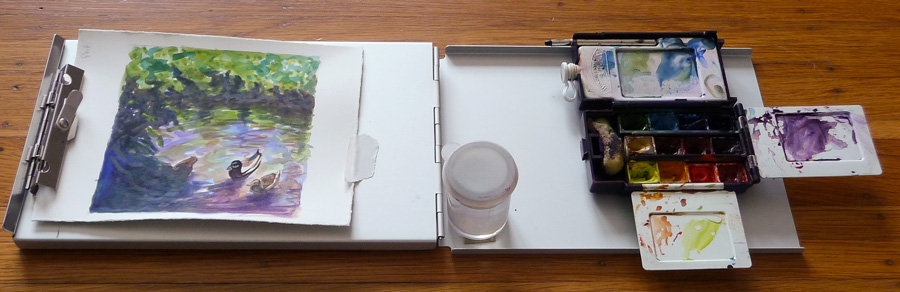
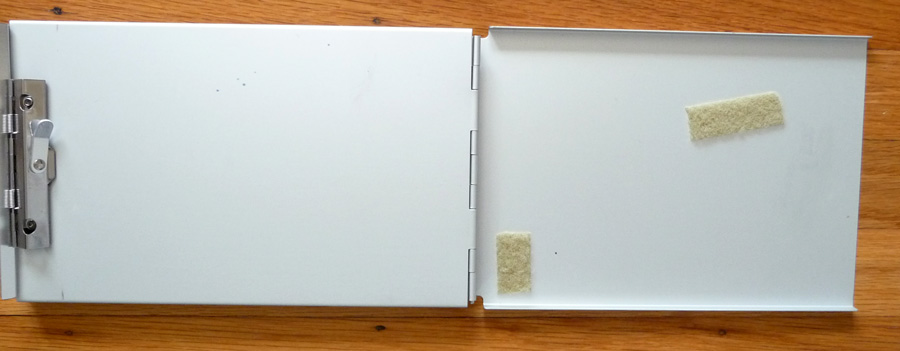
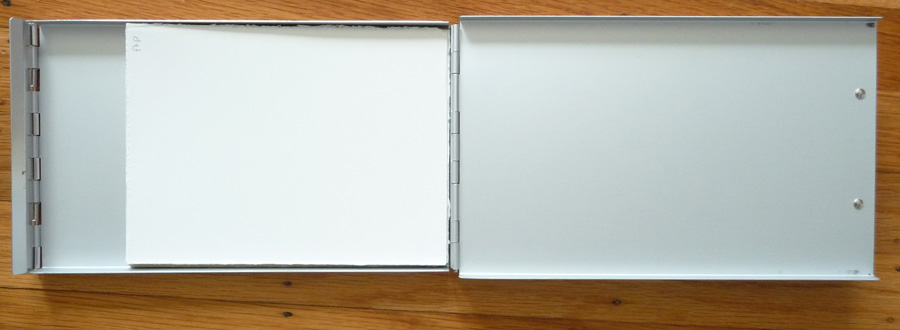
I came up with the idea of using an aluminum form holder filled with individual sheets that I could later put in an inexpensive art presentation binder in order, as if in a journal. I liked the idea I could keep different types of paper in the holder and set it up to use with my little watercolor kit.
As used, with sketch on left; palette & water container velcroed on rightClipboard for drawing on left, velcroed spots for palette on rightInterior of section that holds paper
While I like this nifty system, and have used it a few times, it just felt weird not carrying a journal containing a little history of what I’ve been seeing, doing and thinking (I don’t share the “thinking” pages here). So now I’m doing both, always carrying the journal above, and when I want a variety of paper, individual sheets, and/or a convenient surface for sketching and painting, I also bring the lightweight Form Holder. Mine is a small size, but a larger one might be really super as a laptop desk.
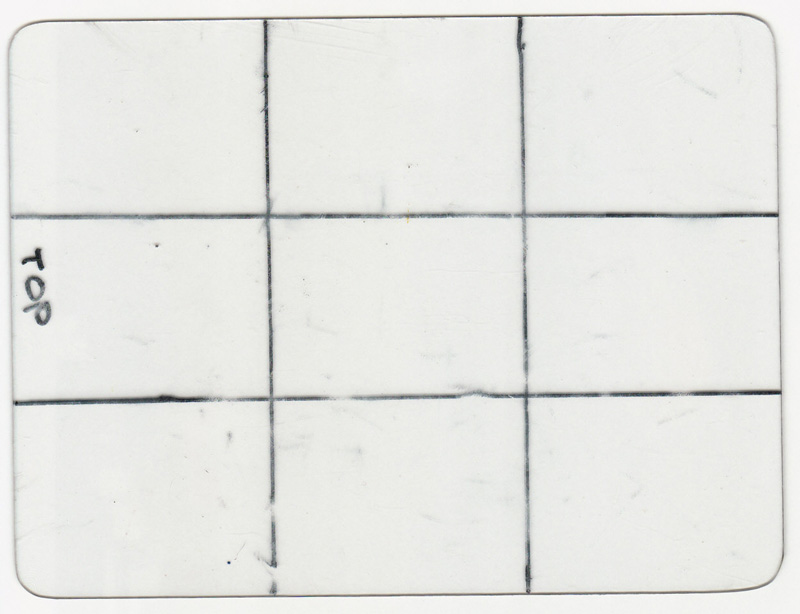
Page window template
Above is another nifty tool I had made at my neighborhood Tap Plastics for about $3.00: a little template made of very thin plastic with rounded corners that I trace around with a pencil to pre-draw borders on my journal pages. It helps me to have a window to draw within (which I sometimes ignore or erase if I want to work across the spread). Once I finish a sketch I go over the pencil line with black ink.
I drew the black lines on the template with a wet-erase marker so it can also be used as a viewer to see how and where what I’m looking at “should” fit in the drawing (though I rarely use it for that).
I neither know why, again in typical spatially challenged Jana fashion, I wrote “Top” on the template (why would it matter?), and even more perplexing, why I wrote “Top” at the bottom of the template. But it makes me laugh when I see it so I haven’t wet-erased it.
To put the finishing touches on a completed journal, I make a self-portrait for the last page. Since it was also my birthday, I wanted to incorporate my birthday flowers in the painting. So I hung a mirror with a yellow clip from one of my swing-arm lamps on my drawing table and put the vase of sunflowers between me and the mirror and then drew what I could see in front of me: the flowers in front of the mirror, with me and the flowers reflected in the mirror.
As usual for my end-of-journal self-portraits, I wasn’t willing to measure or try to draw and place features accurately but I think I did capture the feeling of me or the me as I was feeling.
In the next post I’ll show you my new journal and another idea I tried out for sketchbooking minus the sketchbook.










 Jana Bouc, Artist