I know the title sounds like random word salad but since the still life objects are equally random I think it is fitting. The tin can in the painting is from a can of Trader Joe’s Split Pea Soup.
I was fidgeting with the can while the soup was warming in a bowl in the office microwave and in the process removed the label. I was struck by how pretty the can was and so to my office mates’ amusement, I washed out the can to take it home and paint it. It needed companions in the composition; an apple was handy as was a paint brush.
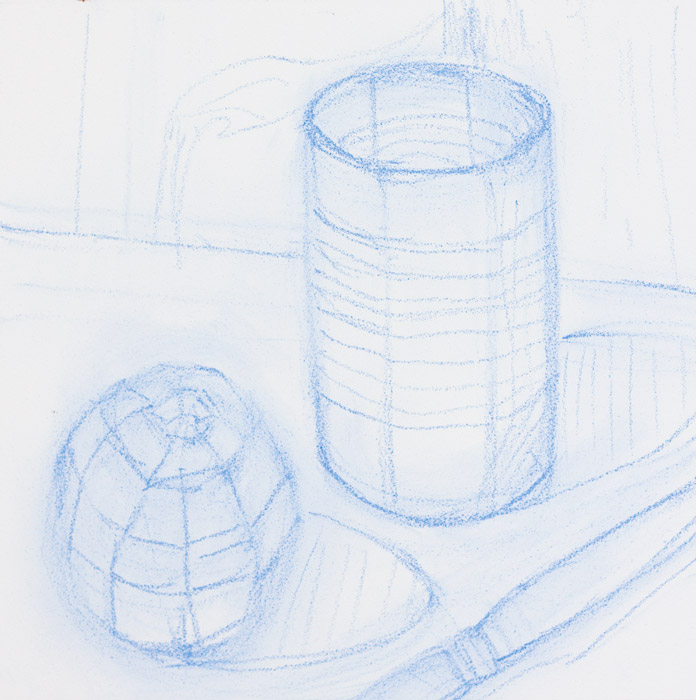
Apple Can Brush, drawn on panel with pastel pencil
I focused on seeing planes values, and putting the paint down and leaving it. The picture above shows the way I sketched out the composition with the planes on the panel with pastel pencil before painting.
I really enjoyed the process and the results. Can’t ask for more than that!
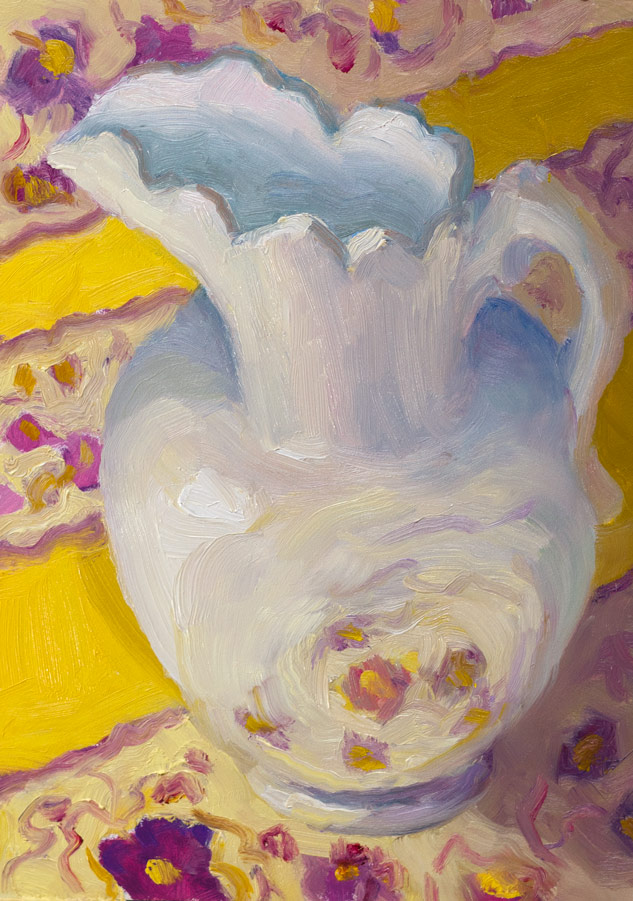
White Pitcher on Provence Pattern, oil on panel, 7x5"
The Daily Paintworks folks are hosting weekly painting exercises that offer an opportunity to practice a particular painting challenge. Last week it was painting a white object sitting on a patterned fabric using only primary colors and white.
I’d found this funny, funky (chipped) pitcher at my local thrift shop and thought it would make a good subject for this exercise, along with a Provencal print tablecloth.
White pitcher preliminary sketch on panel
I sketched in the shapes with pastel pencil onto my Gessobord panel and then used some thinned Ultramarine Blue to block in the shadows on the pitcher. I like the way this looks so nice and sketchy.
This was another fun painting. I love how oil painting is getting to be more fun and less of a struggle (less of, but not without, that’s for sure!).
Since I tend to lose interest if something is too easy or there’s nothing more to learn, knowing that painting will always provide a challenge and there will always be more to learn, is a good thing.
If you’d like to buy this unframed 7×5″ painting for $60, just click here.
White teapot on wrapping paper, oil on panel, 6x6"
The Daily Paintworks‘ challenge last week was to paint a white object sitting on patterned fabric using only primary colors and white. For this attempt I decided to use some turquoise, patterned wrapping paper instead. The wrapping paper had clever little snowmen all over it but after giving one snowman a try, I realized I didn’t have the patience or interest to try to paint all the details on them (top hat, scarf, etc.).
So I gave myself permission to abstract the snowmen into the circular, swirly shapes I saw reflected on the teapot. Since it was meant to be a painting exercise, I didn’t get too concerned with perfecting the painting. I just wanted to experiment with seeing reflections and building the form of a white object on a cool background.
I don’t really “get” football although I have fond memories of men (my father and others) gleefully yelling at televised games. I didn’t want to feel left out of the Super Bowl Sunday festivities so I celebrated in my own way: painting a Super Bowl of apples.
I love this old “Metlock California Pottery” bowl which I think might have been my grandmother’s. I use it for my big lunch salads nearly every day. It’s also a great popcorn bowl.
Plane Divisions chart, from Hensche Colour Study pdf*
At last weekend’s workshop with Peggi Kroll-Roberts, one important bit of guidance she gave me was that “every plane has a color change and/or value change” and she diagrammed for me how to visual the planes of the cylindrical object I was painting (an old teapot), similar to Fig. C above. She encouraged me to see and paint those changes in value and color and I tried to do that with the apples.
I learned so much at the workshop and hope to return to her next session in March. It was also great finally meeting my friend Kathryn Law in person (she attended the workshop too). Kathryn has already posted her terrific workshop paintings with commentary on her blog. You can see her Workshop Day One here and Day Two here.
*The diagram above was from a source completely unrelated to Peggi Kroll-Roberts. I extracted it from the lengthy .pdf file “Colour Study,” downloadable from the website, Oil Painting Thoughts and Ideas about Henry Hensche’s approach to color study.
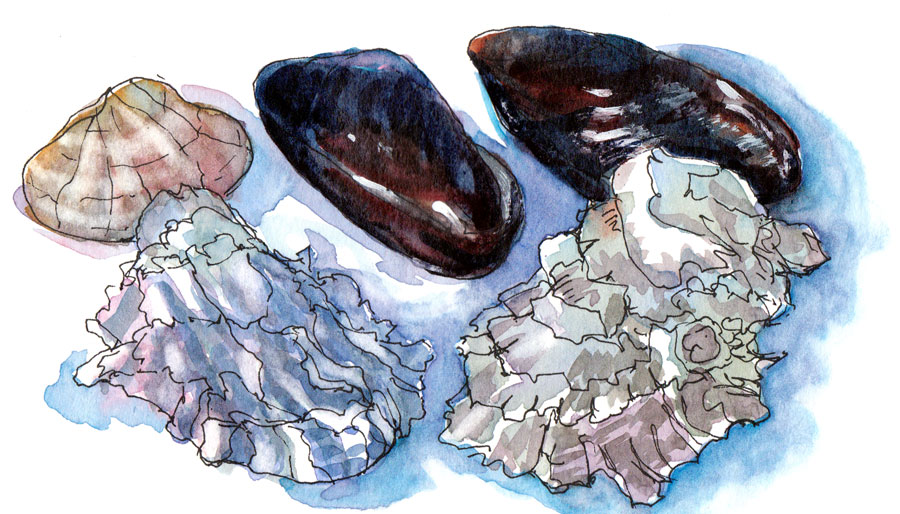
Shellfish Shells, original version, ink & watercolor, 5x8"
A shellfish company saw a previous shell painting of mine and commissioned me to paint one for them to use as a background on their business cards. They shipped me a box of their oyster, clam and mussel shells to use as reference. I created the above sketch in my Moleskine watercolor notebook and sent them the file for their review.
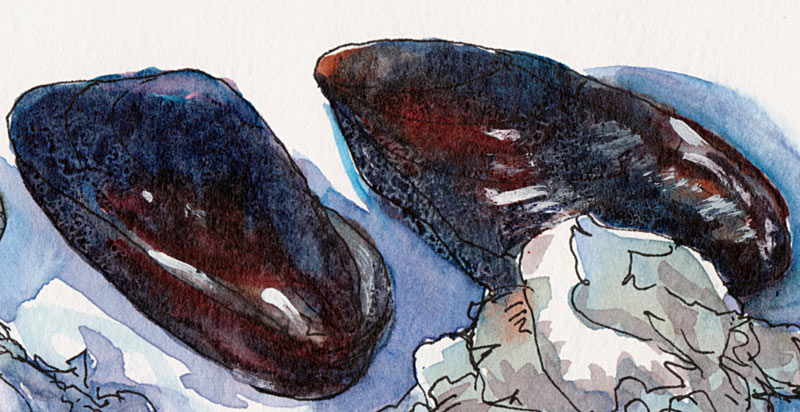
Close up: Accidental texture caused by painting on reverse page
On the next page in my Moleskine, I sketched a landscape and painted it with juicy washes, something I do on the 140 lb watercolor paper in my hand-bound sketchbooks all the time. Without my noticing, the water seeped through the lighter-weight Moleskine paper, wetting the shell painting on the previous page.
Some of the mussels’ paint lifted, creating the wonderful texture (close up above) that I probably couldn’t have achieved if I had I tried. The only downside to this “technique” is that some of the lifted paint printed on the opposite (fortunately blank) page.
I wasn’t worried about the change in the art for my client because I’d already created a high-resolution file of the original. And as it turned out, they asked me to do another version with two different kinds of oyster shells and more clams, apologizing for changing their directions. I’m happy to paint as many versions as it takes since shells are one of my favorite subjects.
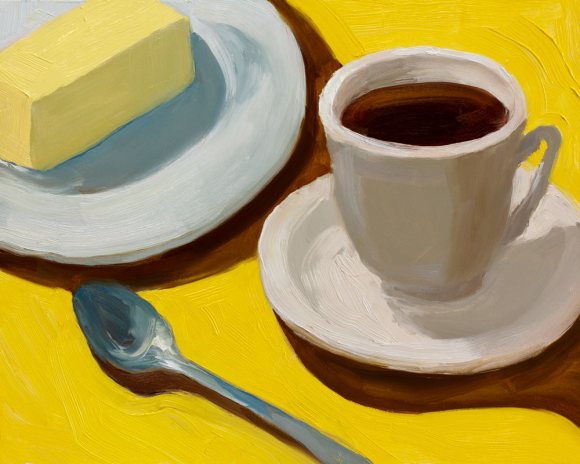
Tea and Butter, Surface Quality Study #2, oil painting on panel, 8×10″
This is my second study based on Peggi Kroll Robert’s “Surface Quality” video. In order to paint along with her in the video, I tried to use the same elements: a yellow table (or cloth in my case), a cup of tea, a spoon and a cube of butter on a plate. (This time I made sure the cat couldn’t get to the butter!)
I learn so much from Peggi’s videos, whether I’m watching her paint or just listening. Each time I play one of the DVDs I hear or see or understand something I missed the first time. I’m so excited I get to paint with her in person at her studio in Angels Camp, CA.
I’m also excited that I’m going to spend the weekend workshop with fellow artist-blogger Kathryn Law, whose friendship and support over the past couple of years I treasure but whom I will be meeting in person for the first time. Kathryn has also been working with Peggi’s videos and you can see her “Surface Quality” study here.
Tea and Lemon, Surface Quality Study #1, oil painting on panel 8x10"
This painting is a study based on the exercise in Peggi Kroll-Roberts “Surface Quality” video. I watched the video, then turned it off and painted from my still life set up, trying to incorporate the lesson: paint the darks with thin paint (so that they recede, don’t reflect light that hits lumpy edges, and don’t draw attention to themselves) and paint the light areas with rich, thick paint (and of course mix the correct colors and values).
When Peggi demonstrated this exercise she used a cube of butter (in her still life, not to paint with! though her paint is very buttery). I had to replace the butter with the yellow lemon because while I brewed the tea in the other room, my cat had a little feast, licking my only cube of butter into a misshapen mess.
There are some passages in this painting I like very much, such as the lemon, its leaves and blossom, the tea, and the way the tin in back is kept all in shadow.
I did buy another cube of butter to try the exercise again, and that will post tomorrow while I’m off at Peggi’s workshop.
Ginger Ale and Saltines Namiki Falcon pen, Carbon Platinum Ink, and watercolor
Today was a bad news, good news day. It started with a migraine that eventually passed enough to work most of the day (despite the internet going down, fixing that and then a little later the electricity went out long enough to shut down the computer with several projects in progress). The migraine left behind a tummy ache. I couldn’t deal with the supermarket so went to the little health food store and bought some natural Ginger Ale, organic saltines and candied ginger (all supposed to be good for tummy aches).
Candied Ginger in an Egg Cup
The good news is that this morning my reliable but grumpy mailman delivered my new Namiki Falcon fine point fountain pen and this evening I felt well enough to fill it with ink and give it a spin. I LOVE IT! The nib floats like a dream over the page with control and flexibility and a really nice fine line. It’s the best pen I’ve ever used. UPDATE June 2011: After using the pen for a few weeks I discovered that I didn’t really like it that much and sold it. I felt I had too little control of the ink flow, which went to fast for me, even with the extra fine nib. I’ve gone back to my Lamy Safari extra fine point which I LOVE!
The other good news is that with these sketches I finally finished filling the Moleskine watercolor sketch book that I’ve so detested using during the interim between binding sketchbooks. Tomorrow I get to start using the one I bound a couple of weeks ago. Yay!
All those 1’s in today’s date: 1 a good number for beginnings. So even though I’m still under the weather, it felt important to focus on my goals for the new year, the accomplishments of the past year, and to start the year right with a little sketching.
I grabbed some of my new best friends to pose for me: tissues, Vitamin C, Sudafed and my Neti pot with which I have a love/hate relationship. It really helps, but it’s weird (leaning over the sink you pour salty water in one nostril and it flows out the other).
New Years Still Life #2New Years Still Life #3New Years Still Life #4
I’m very grateful to have finished the year with a clear understanding of where I want to go with my art, how to get there, and a feeling that it is a reachable destination. A couple of months ago that seemed impossible but thanks to the advice and encouragement of our wonderful community of online (and in person) artists who have supported me through my questioning, frustration, and struggles I seem to have found my way.
2011 Goals
I wrote in my journal about the year past (not shown), and more or less doodled my goals for the new year, appropriate since they’re all about being more playful and in the moment. Being in that doodling, right-brained place, I wrote “goles” and thought wait, that’s wrong, tried golse, wrong, is it golze? No! Oh yeah, GOALS! Sheesh! I used to be a champion speller.
I want to be a more analog* person in 2011, less digital*. I want to move my body, not my mouse; I want to draw and paint with intention, a sense of adventure, and playfulness; I will spend less time on the computer. I want to slow down and appreciate each moment instead of rushing because “there’s not enough time.”
I want to experience the feeling of abundance that comes from “enough-ness” which you get by wanting what you have and not wanting what you don’t have. And I will practice being gentle: to myself, the earth, and others.
*Analog vs. digital makes sense to me, but technically really doesn’t in this context:
Analog describes a continuous system like a clock in which the hands move continuously around the face. Such a clock is capable of indicating every possible time of day. In general, humans experience the world analogically. Vision is an analog experience because we perceive infinitely smooth gradations of shapes and colors.
In contrast, a digital clock is capable of representing only a finite number of times (every tenth of a second, for example). Computers are digital because they consist of discrete units, a series of zeroes and ones, called bits that are either on or off. (from Webopedia).
Happy New Year! Thanks for hanging out with me this past year! Even though I’ve had a nasty cold all week I managed to get in some pomegranate painting between nose blowing, naps, and chicken soup breaks, but not nearly as much as I’d hoped to do over my year-end vacation.
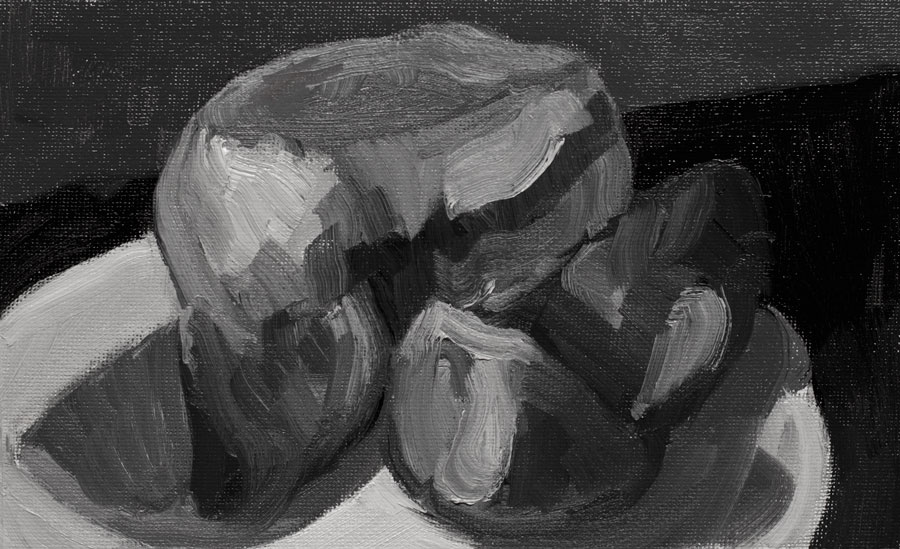
Pomegranate value study in oils, 8x5"
I only had enough energy to be in the studio for a couple of hours a day but fortunately the pom waited nicely for me. I started by doing a value study in oils (above), trying to sort out where the darkest darks and lightest lights are and just how dark and light they are.
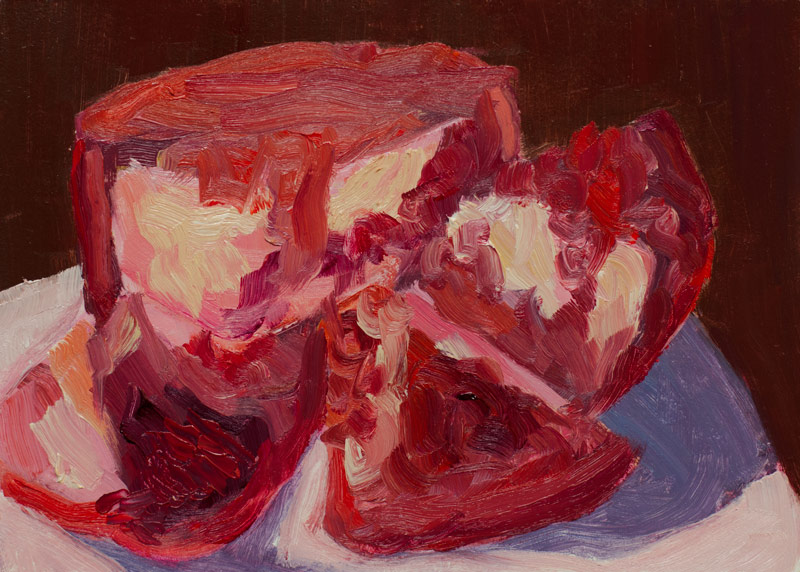
Pomegranate quick study, oil on board, 5x7"
I did a small study next since I knew I didn’t have more than an hour or so of painting energy. I had fun with this and feel like I’m starting to find a way to get loose and sketchy with oils.
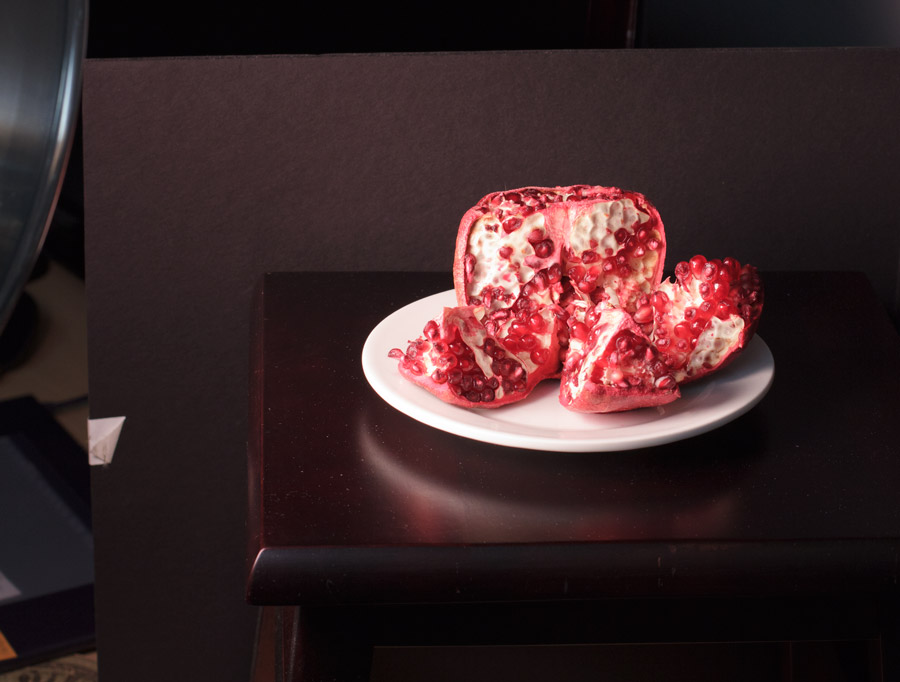
Pom under Reveal bulb
I used a GE Reveal light bulb in my lamp which gave everything a pinkish-lavender cast and that’s why I named the painting “Pomegranate Revealed.” GE says they are “specially made to filter out the dull yellow rays produced by standard incandescent bulbs.” I’d bought it originally thinking it would simulate daylight but it doesn’t at all. I usually use a fluorescent 5000K bulb 40 watt bulb (equal to 150 watts) which does a better job of producing clean light.
Cropped in Photoshop to 8x10"
When I compared the final painting and the studies I realized I liked the original composition with less background better so I experimented with cropping the painting in Photoshop. It’s not hard to cut the board down if I decide to crop it for real.
What do you think? Do you like this cropped version or the “final” version at the top of the post better?






 Jana Bouc, Artist