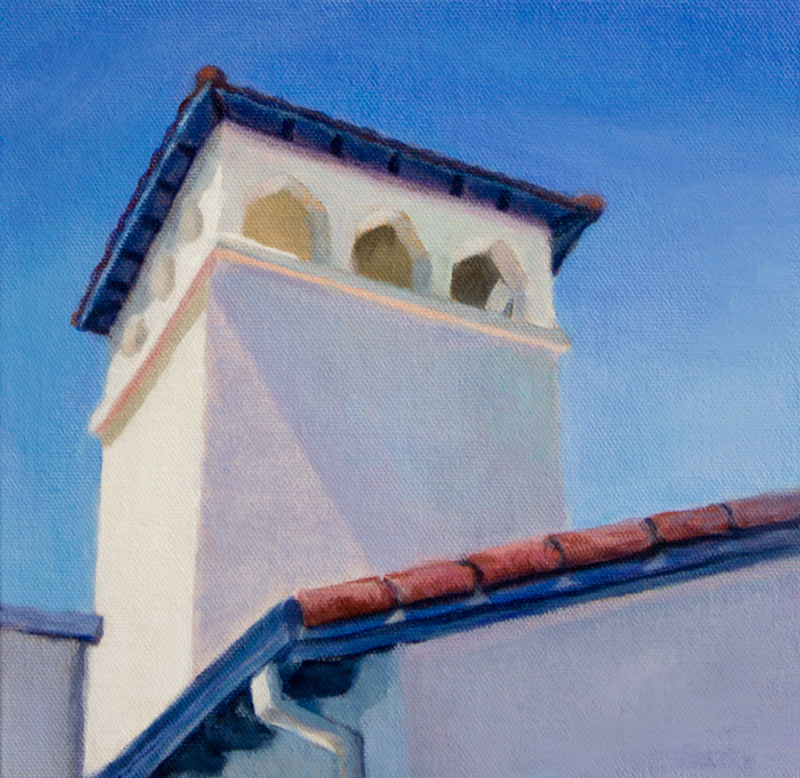
On Solano Avenue in Albany to do an errand I looked up and saw the bell tower of this church against the very blue sky and was sorry I’d accidentally left my sketchbook and paints at home. Fortunately I did have my little camera and took a few photos I could paint from.
The title of the painting is actually the name of the church. According to their website this 100-year old church community changed their name from “First Baptist Church of Albany” to “Church on the Corner” in 2005 because “many people in the community refer to it that way.”
I can’t stop pondering the implications of this: like what if other businesses started dropping their identities and brand names and Apple Computer became “Big Corporation in Cupertino” or Starbucks became “That Coffee Place on Every Corner.”
Golden Open Acrylics and Utrecht Masters Panels
This painting had been nearly finished when I tried glazing over the sky and it failed miserably, lifting off some of the previous layer. So I painted the sky again. Not sure if it was something I did wrong or that the Open Acrylic Gloss Medium doesn’t work well for glazing over layers.
For this painting I used an archival-quality Utrecht Masters panel which is medium-textured canvas on MDF (medium density fiberboard). The surface seemed too absorbent and coarse for the soft Golden Open Acrylics so I applied a first layer of regular acrylic.
That solved the absorbency problem but the texture is still a little too rough for the way I like to paint in thin layers. I have several more of these panels so will continue to experiment with them, using paint more abundantly so the texture isn’t as problematic.
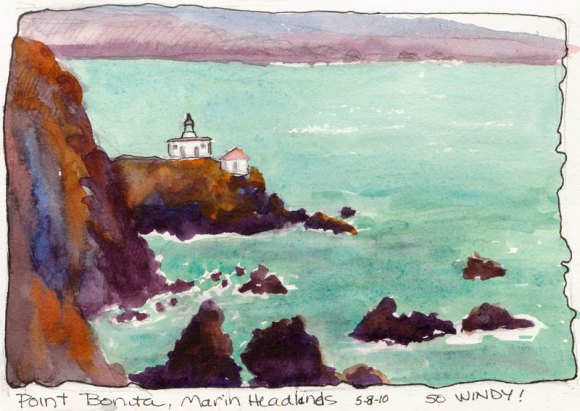
Pt. Bonita Lighthouse, Marin Headlands, watercolor
Sketching at Point Bonita in the Marin Headlands yesterday it was so windy that I could barely hold my sketchbook and all my photos were blurry because my camera was being blow around so much. At one point my watercolor palette blew right off the ledge on the old fort where I perched while another painter’s table blew away from her. I wore several layers of clothes, and had my head wrapped in ear warmers, a hoodie, a jacket hood and over that tied a bandana over most of my face so only my eyes were peeking out.
View from Pt. Bonita, Marin Headlands
I didn’t even try to set up an easel although others did, finding shelter in one of the old forts. I wasn’t thrilled with these or my other sketches but I was pleased that I’d made the effort to go and enjoyed the gorgeous scenery. I’d love to come back some time when it’s not windy, but I’m not sure if there is such a time.
The area is fascinating:
One of the most unique areas in the Golden Gate National Recreation Area, the Marin Headlands covers various types of histories from the Miwok Indians to the Military. Included are historic Fort Barry and Fort Cronkhite, the NIKE Missile site and other military installations and fortifications, dating from 1776 through the Cold War, and the 150 year-old Point Bonita lighthouse. Other attractions include varied hiking trails, dog friendly Rodeo Beach, and astonishing views of the coast and San Francisco. The explosion of wildflowers in the spring and raptor migration in the fall fill the headlands with year round excitement.
The day I painted in this meadow was gorgeous: warm and sunny with the air full of the scents of spring and the sounds of birds, bees and frogs. The plein air painting I did wasn’t worth posting but served as a memory guide, along with my photos for this painting. It is painted with Golden Open Acrylics on a RayMarArt canvas/hardboard panel.
I know I’ve been a bit quiet here lately—just a bit of spring fever and choosing to be outdoors and/or painting, not at the computer. (:
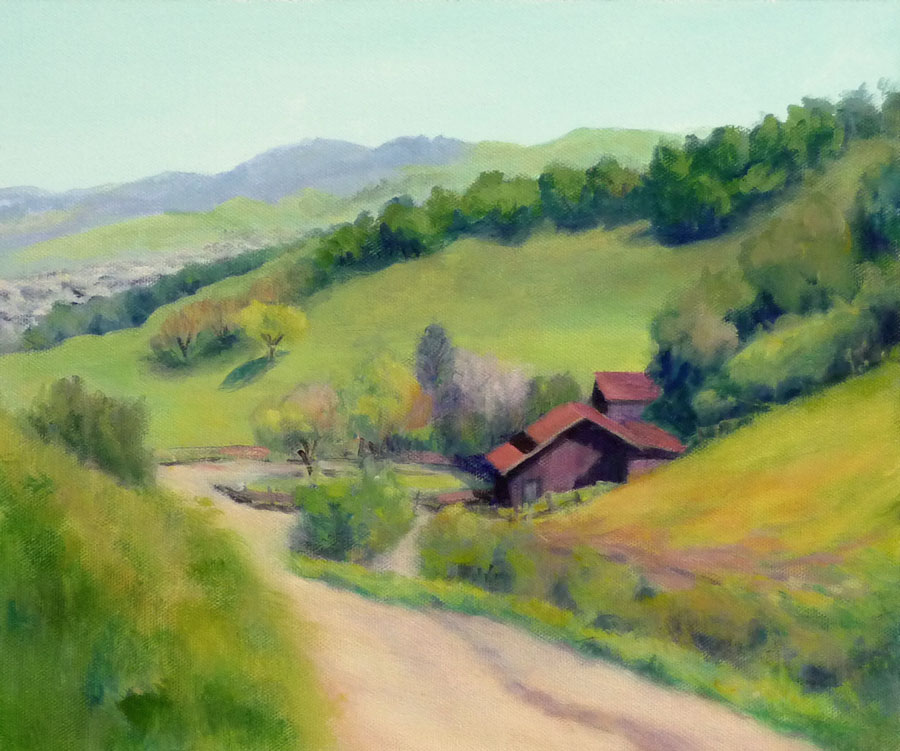
Borges Ranch View, Open Acrylics on canvas panel, 10x12" (studio painting)
It’s springtime in California and those famous “golden rolling hills” are actually a million shades of green right now, thanks to all the rain (which we probably won’t see again until next winter). When my plein air group went to Borges Ranch in Walnut Creek last month for our paint out, I used the time to hike, sketch and take photos. Then I made the painting above in the studio from my photos memories of the day.
You can see my recent sketches of Borges here. The two Borges paintings below from 2009 and 2008 help me see that I am making progress.
I really like going out sketching with the group and experiencing everything about the day without the frustration of trying to make a 2-hour painting as the light and scene changes completely. I’m better suited to doing sketches in the field and paintings in the studio.
Last Sunday I tried again to paint on site. I thoroughly enjoyed the sounds of birds, crickets and frogs in the meadow where I painted in the sun along the bay in Benicia. The painting was a 50-50 flop that might be salvageable but I took some photos which I altered in Photoshop to match my memories, from which I will make a painting
After waking up way too early and having loads of extra time before I needed to leave for my plain air painting session today, I somehow managed to get late anyway. When I finally got to our meeting place—Borges Ranch on the Shell Ridge Open Space in Walnut Creek—I decided to leave my easel and acrylics in the car and hike the ridge trail with my sketchbook, watercolor kit and camera.Then when I was heading back for the critique, I stopped at the barn and painted the quick sketch above.
Often when I’m plein air painting I’m jealous of all the people who are enjoying the day by hiking the hills instead of standing in one spot trying to capture all the abundant nature in two dimensions on a little piece of canvas. So this time I joined them and it was heavenly. After exploring for an hour or so I found a spot on the trail beside a large muddy pond where I sat and painted the picture below. It doesn’t make sense as a picture but when I look at it I can hear the buzzing bees (must have been a hive in a nearby tree), the birds chirping, and can feel the warm sun shining on me.
Warm sun, buzzing bees, a pond, a cyclist
This was the first sketch in my new journal with the Legion Multimedia paper. It’s a dream to sketch on; the pen slides right along. The paper is nicely sized and while it won’t take the abuse that Arches cold press will, it does hold up pretty well as long as you don’t try to do more than 2 or 3 layers. This slight limitation will hopefully me keep me moving on to the next sketch instead of overworking one to death.
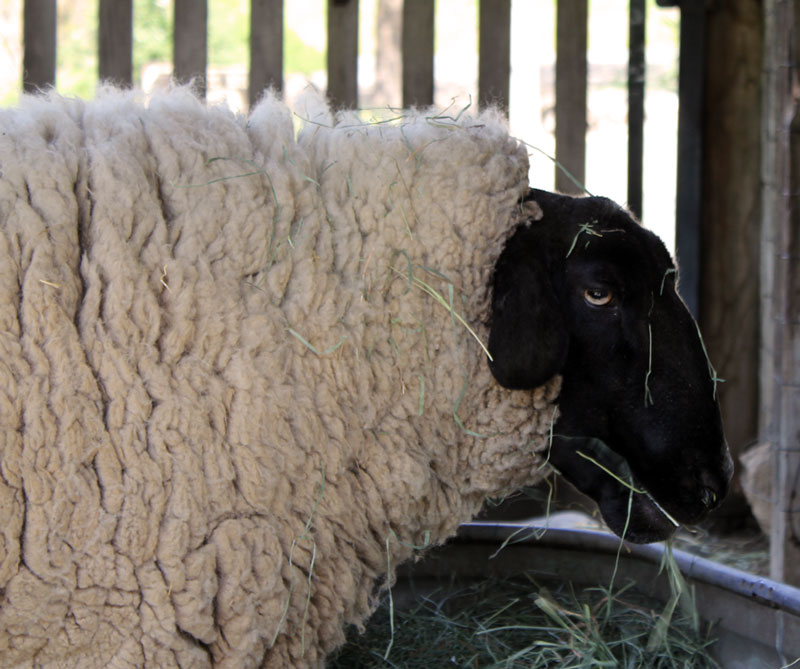
After the critique (and my lunch) it was mealtime for the farm animals and I couldn’t get any of their attention. This guy looked at me like I was really annoying.
Borges sheep chowing down
Only the rooster seemed to have places to go and things to do.
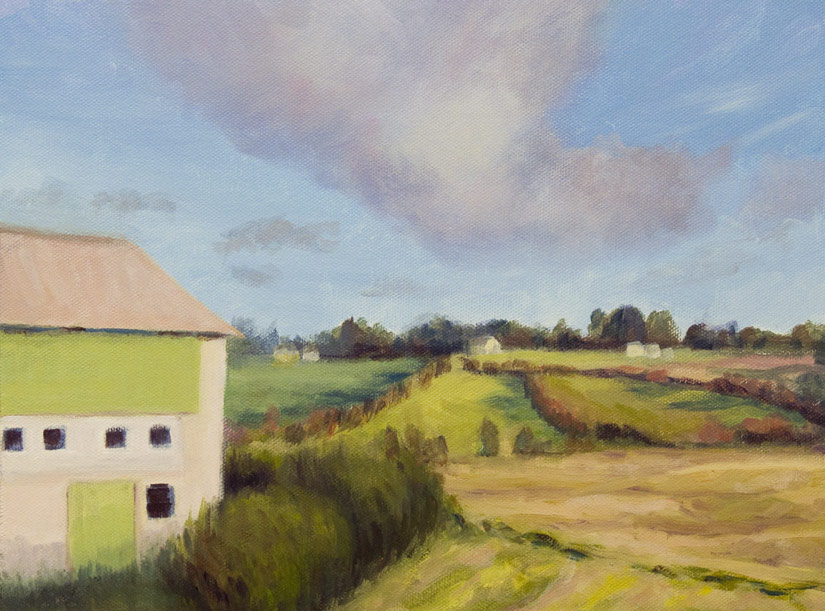
This month’s Virtual Paint-out is taking place in Norway. When I picture Norway it’s always snowing—silly me. I was amazed to wander the roads and see the beautiful summer light and perfectly maintained buildings and fields. There was so much gorgeous scenery it was hard to pick, but I couldn’t resist all the different greens in this scene.
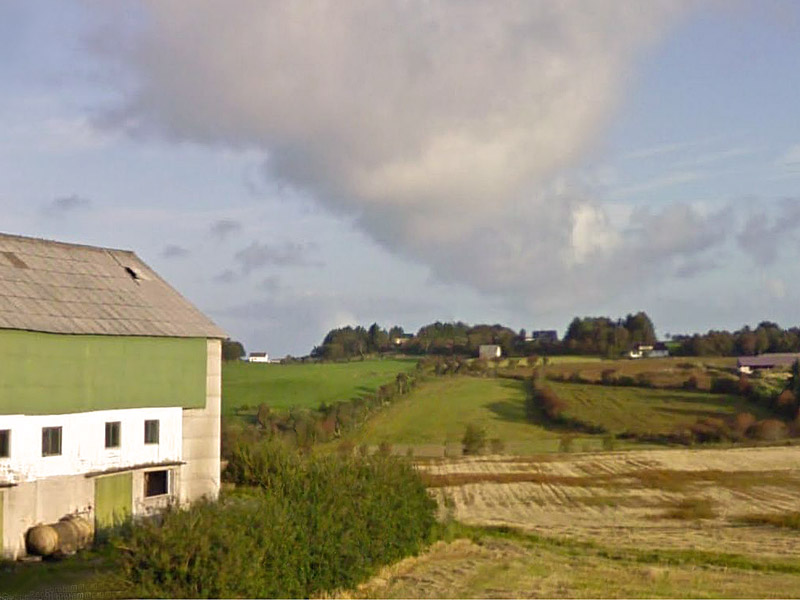
Here is the original scene from Google Earth. I used Windows 7 cool “Snipping Tool” that lets you select an area of the screen to copy and save:
Original Google photo
If you click to enlarge the image you will see the address of this farm in the top left. I played around in Photoshop to compose and crop the scene. Then I used the “Content Aware Scaling” feature in CS4 that allows you to compress a scene without distorting elements such as buildings or people. I wanted to fit the image on a 9×12″ canvas:
Cropped/Scaled in Photoshop
What’s really exciting to me about this painting is that I used Golden Open Acrylics to paint it. I am in love with these paints! [SEE less enthusiastic UPDATE AT BOTTOM]. They have all features that I love about oils and acrylics with none of the features I don’t like. I’ve been struggling with both those mediums for months and was going through an artistic crisis, considering giving them both up.
The problem with acrylics
I couldn’t stand working with regular acrylics because I like to layout a palette of paint and work intuitively, mixing as I go. Acrylics dry too fast to do this. (Yes I know you can mist the paint regularly and that there are special stay-wet palettes but I found they turn the paint to soup and smell bad after a couple of days). I also like to blend colors on the canvas and to be able to wipe off a passage if it’s not quite right. None of this is easy to do with regular acrylics.
The problem with oils
Because I try to use solvents as little as possible with oils due to their toxicity and smell, I can’t start with juicy washes for the first layer as I like to do when sketching out the composition with oils. And even with the minimal use of the least toxic odorless solvent (Gamsol mineral spirits) I found there was an odor (probably from linseed oil going rancid that was left in the solvent) that bothered me anyway. And then there’s the cleanup up dozens of brushes after a painting session.
Why I love[d] Golden Open Acrylics
Golden Open Acrylics do not smell, stay workable about as long as oil paints [update: they don’t really], can be diluted with medium and/or water, clean up with water, do not dry on brushes (for 24 hours at least), blend nicely and are just a dream to work with. When I quit painting last weekend I stuck a small, damp sponge on the palette, and closed my Masterson “Palette Seal” box. I opened it today, a week later, and the paint was still in perfect working condition, better than oil paint would have been.
While I admire thick, expressive, brush strokes in paintings, it’s not really my thing. I prefer working more thinly and that’s just the way Golden Open Acrylics are meant to be used: in layers less than the thickness of a penny. They can also be mixed with regular acrylics to modify the texture or the drying time. Or they can be combined in different layers, although it’s suggested to use regular acrylics as the first layer(s) before adding the Opens or waiting for the layers of Open Acrylics to thoroughly dry (2 weeks) before applying a layer of regular acrylics.
I think these paints are also going to transform my plein air painting. [update: they didn’t work for plein air; got tacky too quickly] I won’t need to bring solvent or a slew of brushes. I haven’t figured out what to carry for a water container or how much water I will need to carry for brush washing between colors.
Our first plein-air session of the new season is next Friday and I’m looking forward to playing with my new medium in a Non-Virtual paint-out too.
UPDATE June 30, 2010
After working the Golden Open Acrylics for three months I’m considerably less enthusiastic about them. The deal breaker is that the paint dries darker (about 10%, varies between colors) which requires guessing when mixing paint how much lighter to make it and makes it impossible for me to try to match colors I’m seeing . Other problems are the drying time which depends on the humidity and wind which makes painting outdoors with them next to impossible in my area. Unless there is no breeze and high humidity, even indoors, you have to work quickly before the painting starts getting tacky within an hour or so. But then it can take a really long time for the paint to dry completely. When trying to glaze on top of a seemingly dry layer, I’ve ended up lifting the previous layer instead and had to give up glazing.
I’ve now switched to Holbein Duo Aqua water soluble oils and so far and am finding them the best of all worlds. No color shift, artist quality pigments and pigment load, no toxics, no smells, easy clean up. I write about them here.
The little known Hayward Japanese Garden is a lovely and a very peaceful place. I set up my easel inside one of the little structures sprinkled throughout the gardens as it had a good view and nice shade on a very sunny day last week. It was also a popular spot for wedding and family photos, as two different wedding parties came to take photos at this spot while we painted.
There were a number of challenges with this painting. First was the complicated scene I chose. Also painting under a roof in a shaded area looking directly at a bright scene was tricky.
I was attracted by the rhythm of the crisscrossing diagonals of the bridge, the building, the tree and the reflections. While I was pleased that I met my goal for this session: to focus on composition, I only got as far as an underpainting on site (after starting with thumbnails, value study and a fairly careful drawing). I worked on it some more today from a photo on my computer screen.
Now I see a few things I’d like to adjust (toning down the bright yellow greens, shrinking the rocks under the tree that somehow grew while I was painting, and adding some dark accents). But that will have to wait because…
Book commission
Now it’s time to get to work on the first watercolor for a book commission that is due in two weeks. I’ll be making three paintings for another book about painting flowers in watercolor by my previous publisher. I love the first photo I was assigned to paint from and am excited about the project. It’s so cool getting paid to paint flowers! I’m supposed to photograph 6 stages of the painting and then ship it off to London for them to make the final photo, Then they’ll send me back the painting and the digital file.
I’m hoping I can post some of the steps here, but my guess is that since they get publishing rights, I probably can’t. Either way, first I have to get painting!
I have a theory about the paths we take in life, and how important it is to notice what I call “Angels Holding Up Signs” along the way. Sometimes those angels take the form of a person offering helpful information or silently pointing the way by example, an intuitive thought, or an unexpected turn of events that makes you pause. When I see or hear an angel holding up a sign, whether it’s “Yield”, “STOP,” or “Go This Way” with an arrow, I consider it a gift and give it serious consideration.
Disclaimer: I’m not a New-Age angels and crystals sort of girl. But I do believe there are angels all around us; good, kind, generous people, like Adam at Kragen Auto Parts today who helped me dispose of gallons of old motor oil and their containers that had been abandoned in my garage (long story; don’t get me started!). Thanks Adam!
…And like the angels who’ve held up signs in my art life lately, including Kathryn Law and Ed Terpening who’ve both helped me to a breakthrough in my understanding about why simplifying is important in oil painting, especially when painting plein air. I’m always attracted to details, and so I’ve fought against that principle, and then fought my paints trying to put those details into my paintings.
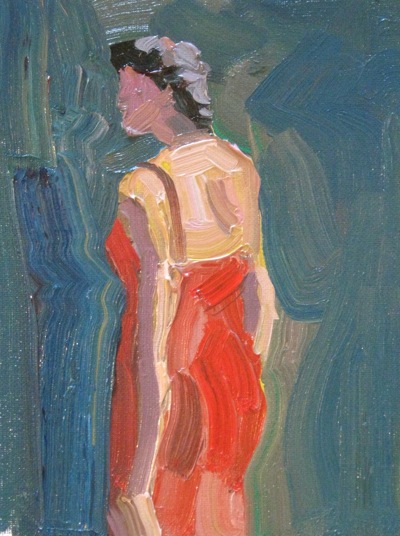
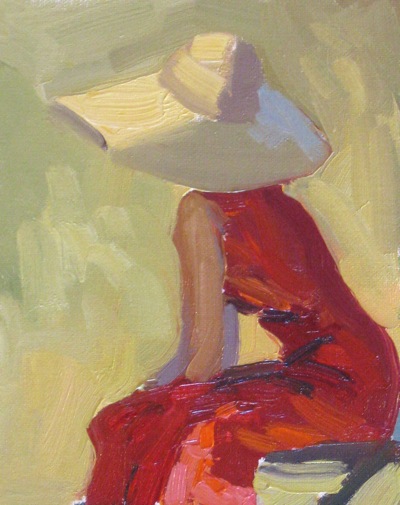
Then I saw these paintings (below) by Ed Terpening on his blog, Life Plein Air, made during a workshop in which the instructor, Peggi Kroll-Roberts, challenged the class to break the scene into as few large shapes as possible and paint those shapes with a large, fully loaded brush in one brush stroke.
Each study evoked in me a mood and my mind created a whole life story for each of these women. A mom at the beach trying to keep her kids in line; a sad, matron, wondering where her life had gone; a glamorous, young society lady at the country club watching a tennis game while sipping a martini….
How did so much come from such simple paintings? Leaving out the details left it to my mind to fill them in. This is something I so needed to learn: that simplifying and omitting detail doesn’t make a painting boring—it lets the viewer’s mind play and be creative, making for an exciting, rewarding experience. Thanks, Ed, for holding up that signpost!
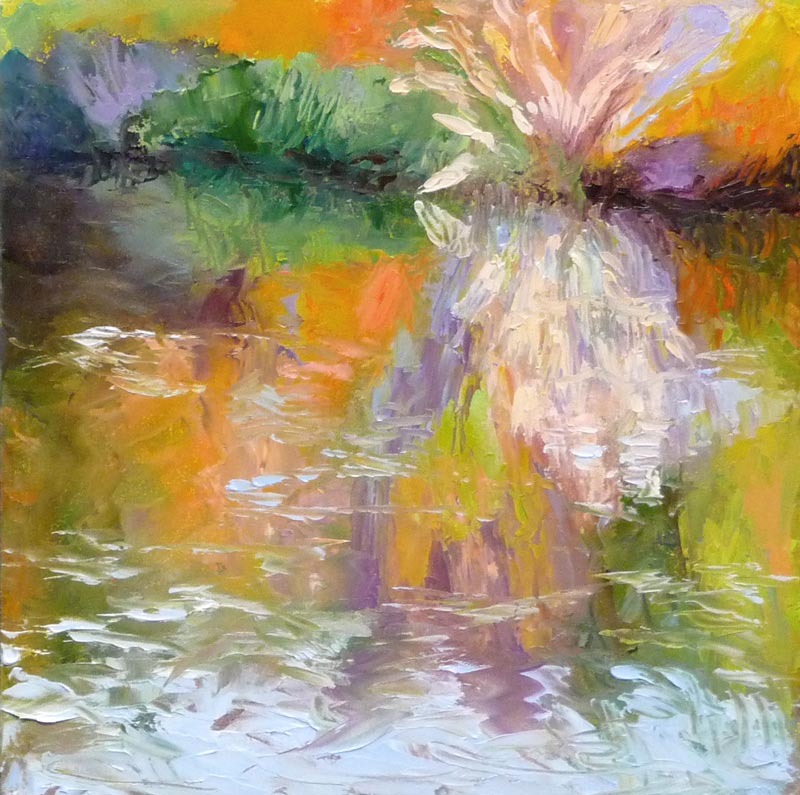
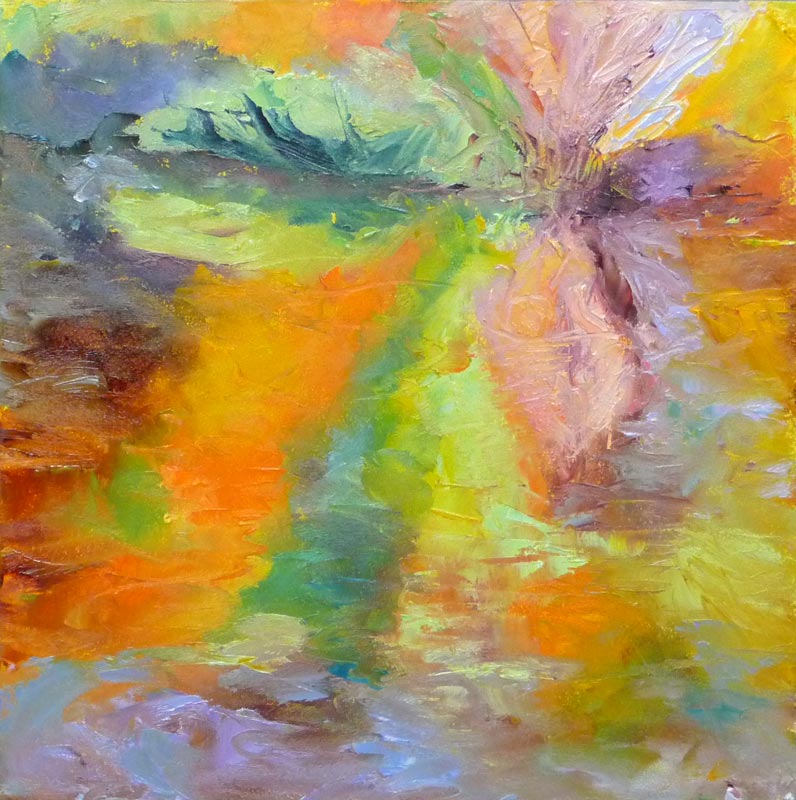
Another sign-toting angel came via email this week: a request to purchase this plein air oil painting I made last summer at Lake Temescal. There I was at the crossroads, wondering whether to give up plein air oil painting, and this angel popped up with a sign saying, “You’re on the right path, don’t turn back.”
And now about my process with today’s painting. First I tried to simplify by painting large color shapes with the plan to create a color study for a work to be done in the studio. I also focused on the composition, picking a focal point, being careful not to divide the canvas in half as I have a tendency to do, making the subject (the water) the largest portion.
Here’s how it looked when I’d covered the whole panel:
Lake Temescal Reflections, Phase 1
I’d worked quickly, using a palette knife, going for big shapes of color. I should have stopped there and gone for a walk. But instead I messed around for another hour and muddied up the design and the colors:
Temescal Reflections (muddied), Phase 2
But the great thing about palette knife painting is that it’s easy to scrape off passages and repaint them. So later that evening I put the photo of Phase 1 on my computer monitor side-by-side with a photo of the scene and worked on the painting until I was satisfied with it (as posted at top).
And I’m very happy with another breakthrough: the way I was able to enjoy the plein air painting process without worrying about making a Painting with a capital P while I was out there.
After my flop of a painting on Saturday, I was determined to have another go at plein air painting. But first I wanted to put together a cheat sheet; a personalized “How to Paint Plein Air” based on what I’ve learned from teachers, books, experience, mistakes, successes and goals. I started jotting down notes as ideas and images came to me and then when the list felt complete, I typed it up and taped it to my paint box so that it will always be with me when I’m out painting. I posted another on the studio wall.
Then I went out to paint. First I drove to a site I’d been wanting to try out, a hillside cemetery in El Sobrante with what I thought would be interesting views. But once I found a spot where I could be off the road and away from mourners, it was so windy, and the view so boring, that I left and headed for Blake Gardens.
By the time I got there and set up, I only had an hour and a half to paint before they closed at 4:30. It was so serene and beautiful there and the weather was perfect, warm sunny and no wind. I worked as fast as I could, finished all of the main areas, and added the final touches at home.
It was a confusing scene with all sorts of trees and foliage, but not having enough time helped me to simplify rather than draw all the trees in the background. I took artistic license to move things a bit to improve my composition and to delete something that wasn’t working. I’m learning!
Here is my Oil Painting Plein Air Process Cheat Sheet. I imagine it will change as I learn and grow, but it definitely helped me with this painting.
FOCAL POINT: Choose one!
COLOR KEY: Decide: Will the painting be predominantly Warm or Cool, High key or Low key, Predominant hue?
SQUINT! to see values, simplify
THUMBNAIL: Keep making them until there’s a good composition with leading lines in to focal point. A bad composition can only lead to a bad painting.
CANVAS: Transpose thumbnail to canvas, creating large puzzle piece shapes, using pastel pencil or thin paint.
UNDERPAINT: Loose, sketchy monochrome underpainting of shapes, darks with very diluted paint (optional)
DARKS: Thinly paint the darks but MATCH values and colors using value scale and testing paint first on edge of little cards held up to compare to actual color. Just because it’s dark doesn’t mean it’s black.
PAINT LARGE SHAPES: Match or exagerate the average (VIBRANT) color in large shapes, using not too thick paint.
COLOR PATCHES: Break larger shapes into smaller patches of color and light, matching or slightly exagerating the color.
HIGHLIGHTS & ACCENTS: Add thick LIGHT paint, thin dark accents, and occasional splashes of “broken” color for VIBRANCY.
EDGES: Put a dab of COMPLEMENTARY colors around edges of focal points to pop, SOFTEN and/or cool receding edges.
STOP: It’s a field study!
If you have discovered other things that have helped you and are willing to share them, I’d love to hear about them. And if you’d like more information about any of the items on my list, let me know and I’ll do another post with more explanation and details.
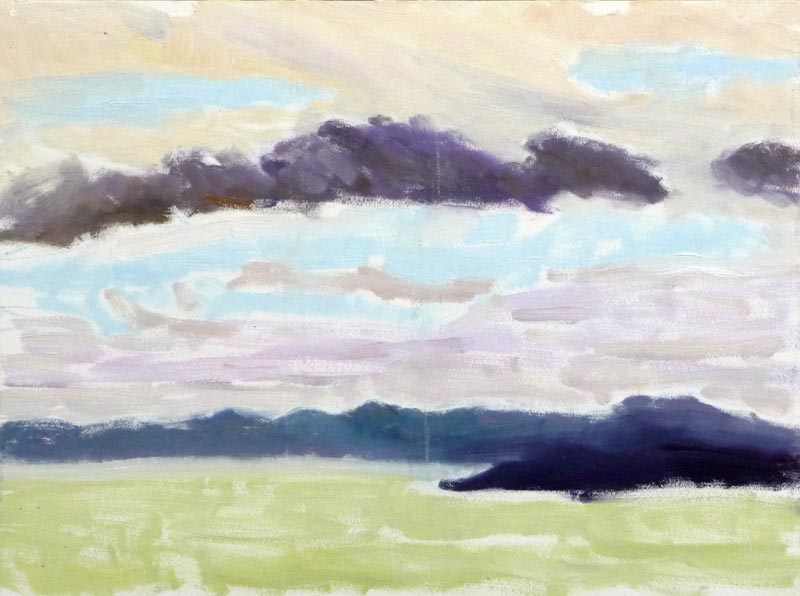
Cloudy Bay, View from China Camp, oil on panel, 9x12"
When I first arrived at China Camp in San Rafael for our plein air paint-out, I decided to make the dramatic, dark clouds my subject. Except that once I’d completed a quick thumbnail sketch for composition, drew the main shapes on my panel, blocked in the colors of the sky, clouds, land, water… POOF! The sun came out, the clouds blew away, and the hills that were my darkest darks were now glowing with light.
Since the scene was now completely different I put the panel away and started another small study, which I might mess with a bit and post another time.
I planned to finish the first painting in the studio, from photos I took before everything changed. Of course later when I looked at the photos, they had none of the color and drama I’d seen and felt in person. So I tried to work from memory along with the photo, and eventually just let the painting tell me what it needed.
This is the original block-in with the painting barely started. I’d put the clouds in first, but after I’d blocked in the rest of the elements, realized they were way too dark.
China Camp View blocked in
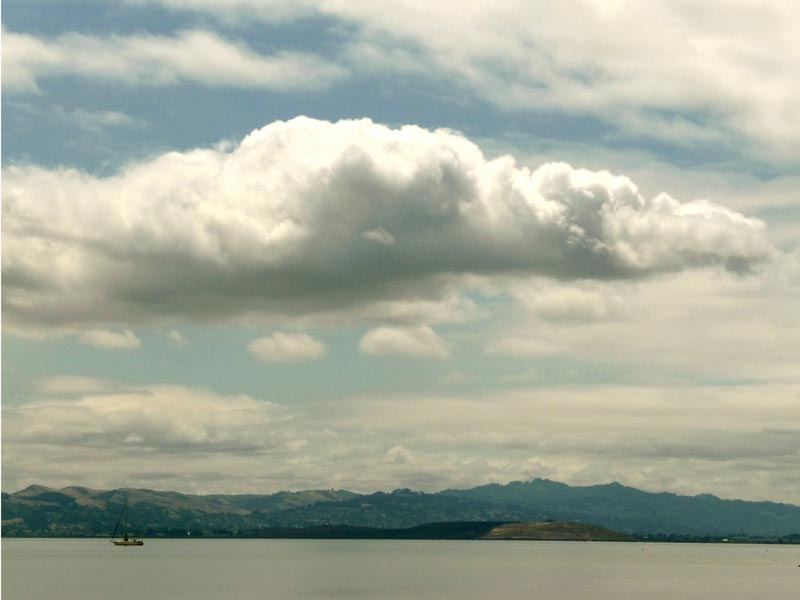
And this is the photo of the scene, in which the colors are all wrong, and which mostly just confused me when trying to paint from it.
Photo of China Camp cloudy view
As a wonderful bonus to the pleasure of being out painting on a gorgeous day, my painting group had hired plein air painter Elio Camacho to lead a workshop for us that day. I used to study with Elio a couple years ago so it was great working with him again. He is such a generous teacher and brilliant artist. Everyone had rave reviews afterward and were very pleased with what they’d learned that day.











 Jana Bouc, Artist