Table Mountain View, Cape Town. Oil on 5x7" panel.
This month’s Virtual Paintout is in Cape Town, South Africa. What a beautiful country! I needed a project I could complete in an hour or two so I chose a simple scene and a small panel to paint on (5×7″).
But I think I spent as much time tooling around South Africa on Google Streetview than I did painting. And tonight I had such a hard time getting the color right in the photo (the sky in the painting isn’t turquoise, it’s a warmer blue) that I’ve probably spent an equal amount of time trying to fix the photo and get this blog post finished!
So I will let it be. As my boss always says, “…good enough for jazz!” She knows I can be a perfectionist and has taught me that little mantra so that I don’t get stuck finessing one little thing while all the other work stacks up.
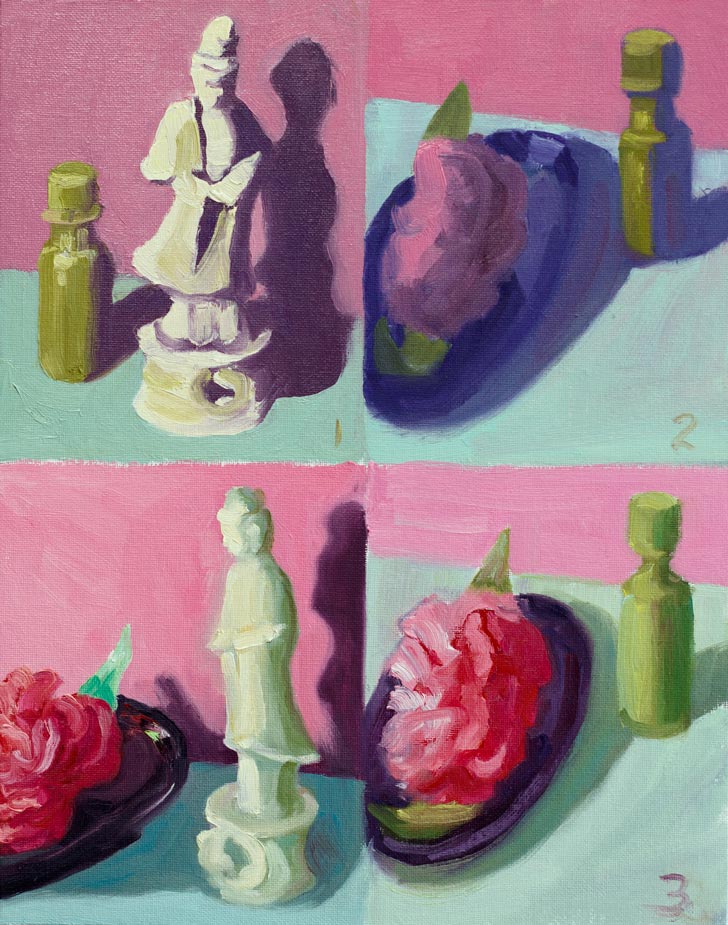
Kwan Yin, Pepper Sauce, Camellia in Soap Dish, oil on 8x10" panel
In the Simplified Shadow Mass exercise you practice visualizing the darks and shadows grouped into as few shapes as possible and paint them in one dark color. Then you can vary the colors for the rest of the painting. I tried that in the two top studies.
In the bottom two I allowed myself to use two different colors for the shadows instead of just one. I like the last one best (bottom left) and the first one second best (top left). I hate the muddy second one (top right).
It was fun experimenting with massing shadows and playing with composition by sticking to two objects and changing only one at a time.
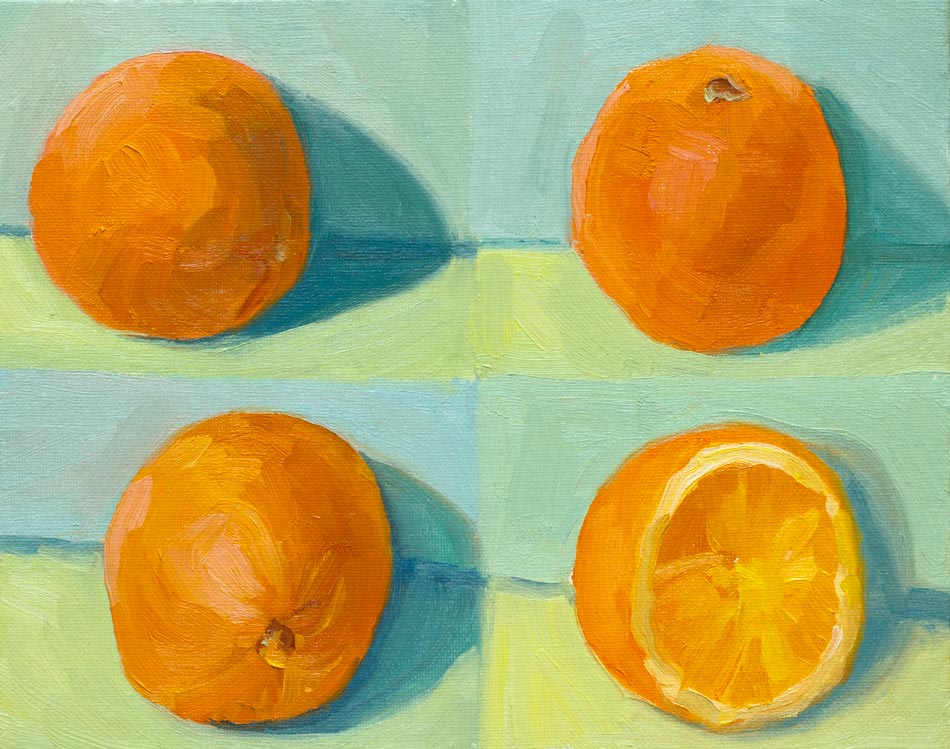
I read about the Daily Painters’ 10 minute exercise (paint the same thing four times, 10 minutes each) and thought it sounded like fun. What I learned from my attempt (below) is that I need more than ten minutes to do a painting, even if it is small. So when I finished doing the exercise below, I gave myself more time, and painted the study above, exploring a way of painting that works better for me.
Orange four times @ 10 minutes each, 0il on 10x8" panel
I think I’ve found a way to approach an oil painting that works for me, and it’s sort of* illustrated in the top study above.
Sketch in the big shapes and indicate the lines of the planes using *thinned paint (see diagrams in previous post here).
With the same thin paint (*not thick paint as I did here), fill in the shadows to indicate darks and leave the light areas white.
Use both dark/light and warm/cool variations of colors to model the form.
Lastly add light highlights, dark accents, details and make any other necessary adjustments.
*Sort of because originally in the top study each square illustrated those 4 steps, but I played around with the first two, adding white paint between the plane lines, and turning the thinly blocked in value sketch into a value study with black and white paint.
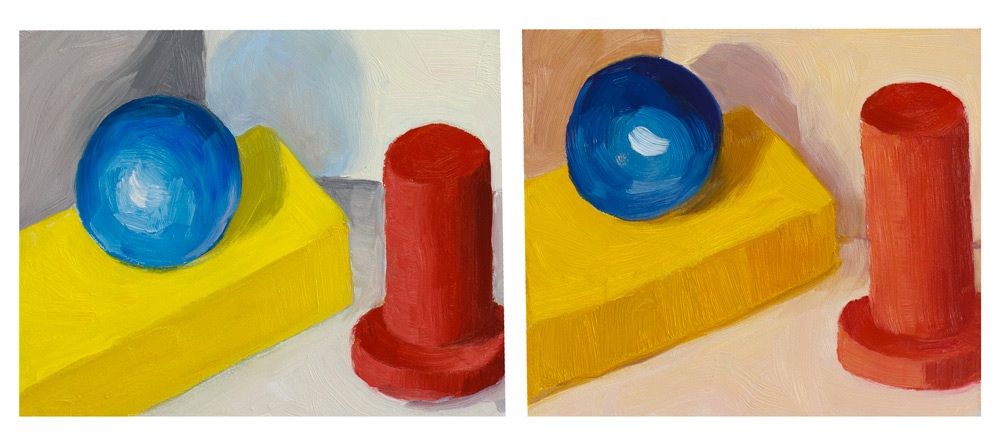
Cool light on the left; warm light on the right; same objects with white background; oils
When painting outdoors, lighting is controlled by the sun, clouds, atmosphere, and time of day. But in the studio you get to choose your lighting source from window light to bulbs of all kinds. In an article about color in the March 2011 Artists Magazine, Scott Burdick suggests an experiment to compare the effect of cool and warm light sources: Set up a still life of primary-colored objects and paint it twice; once under a warm light and again under cool light. That’s what I did in the studies above.
While I’m not sure I captured every nuance (or get the drawing just right), it’s interesting to see how different the same-colored objects and white background cloth look under different “temperatures” of light.
I did these two studies in Peggi Kroll-Roberts‘ studio, with the subjects lit by 150 watt incandescent bulbs which have an even warmer color temperature than the bulbs I used in my two top studies. The actual goal of the study on the left was to paint the scene (cantaloupe and watermelon slices) with as few brush strokes as possible. The assignment for the one on the right was to group and paint the shadows with one color only.
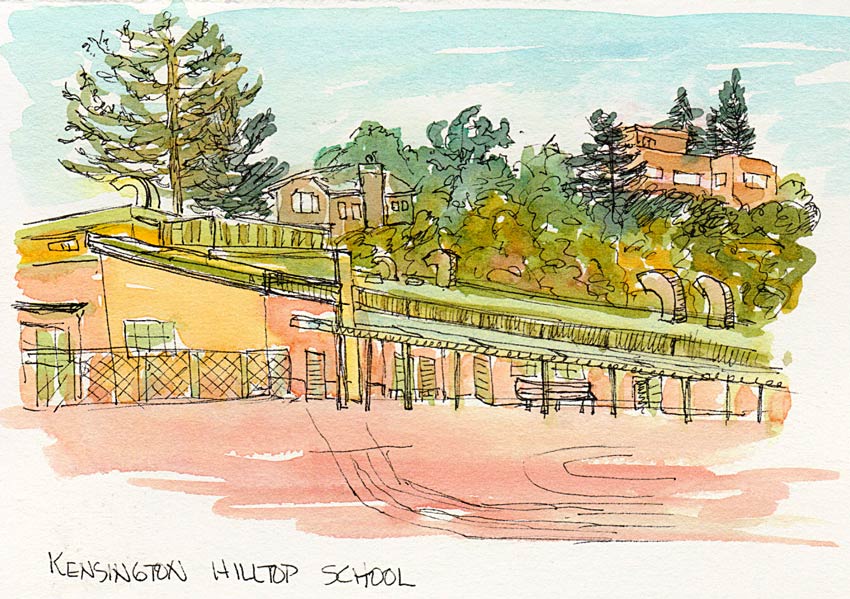
Kensington Hilltop School, ink & watercolor (a beautiful school above a wonderful park at the very tip-top of Kensington hills)
In my last post I asked for advice on sorting and storing completed oil paintings on panels. Along with the good suggestions from readers, I found a fantastic website that provides the answers to these and many other questions about proper handling of artwork and art materials of all kinds.
The website is AMIEN.org (Art Materials Information and Education Network), “a resource for artists dedicated to providing the most comprehensive, up-to-date, accurate, and unbiased factual information about artists’ materials.” They are part of the education department of the Intermuseum Conservation Association.
AMIEN’s forums are the place to find information to all our questions about proper use, handling, storage, shipping, application, etc. of art materials and finished art work or all kinds. Here is a portion of what they say (more here) about storing oil paintings on panels:
Store your paintings standing on edge, one next to the other, with a piece of acid-free paper loosely covering the face of each painting. You can tape the paper to the back of the panel and fold it over the front.
Ideally, you will put these paintings in a rack, elevated off the floor, in some location that is relatively dust-free and not subject to wild swings of temperature and relative humidity. Even more ideally, each painting ought to be separated from the others, but that would take a very large rack. Second best: You should not have more than about 5 paintings leaning against each other; separate the groups of paintings.
AMIEN’s forums cover topics like Watercolors, Pastel, Encaustics, Acrylic Paints, Supports, Grounds, Solvents and Thinners, Varnishes, Pigments, Color charts, Oil Paints and Mediums, Alkyds, Mural Paints and Techniques, Colored Pencils, Printmaking, Photography and Printed Digital Media, Matting, Framing and Labeling, Picture Protection, Crating, Shipping, Storage, Conservation, Hazards and much more.
About the sketch at top: Friday afternoons I have the pleasure of spending time with two lovely 11-year-old girls who still like to swing and play make-believe games on playground equipment. I discovered Kensington Hilltop School while hiking in the hills on the weekend and brought them there the next week. They played, I sketched, we had fun.
Clockwise from top left; all also include white: Cadmium Lemon Yellow + Sevre Blue; Cad. Yellow + Viridian; Cad. Yellow Pale + Permanent Rose; Ultramarine + Perm. Aliz., oil on 12x12" panel
Following in the footsteps of Kathryn Law’s 36 (!) color studies inspired by the Peggi Kroll-Roberts Limited Palettes video, I returned to doing more of my own. As Kathryn explains on her post, it’s all about learning what your colors can do.
The four at top I did yesterday, after switching back to regular oils (mostly Winsor & Newton). Below are some that I did previously using Holbein Aqua Duos water-soluble oils that I fell out of love with.
Ultramarine Blue & Cadmium Orange; cool light, warm shadows
Phthalo Green and Cad Lemon Yellow; warm lights, cool shadows
This is a really fun exercise. The idea is to discover about all the variations of value and hue that you can make with just two colors (plus white) and to experiment with using both cool and warm colors for the light or the shadows. It can be done with any medium (with watercolor you’d use two colors and vary the amounts of water instead of adding white).
Doing exercises like this is also a great way to have fun with paint when time is short or if there’s a big scary painting that you’re not quite ready to begin.
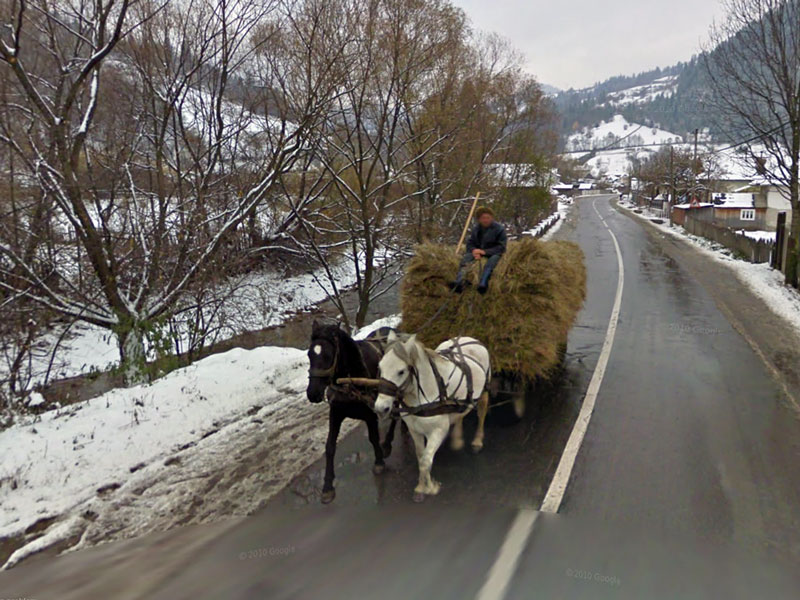
Romanian Winter Hayride, oil painting on panel, 9×12″ (SOLD)
After rambling around Romania, seeing beautiful summery farmland, busy cities, and a shepherd walking his sheep down a village street, suddenly it was Christmas with nativity scenes in front yards and this wonderful snowy hayride (virtually, of course via Google Streetview for the Virtual Paintout).
Yesterday I’d tried painting a different Romania scene (below) but soon realized I was laboring joylessly on a hopeless painting, fighting paint the consistency of toothpaste. I gave up, scraped off the panel (glad I’ve gotten smarter about when to cut my losses), and returned to Google’s wonderful new MapCrunch.com where I found the above photo.
I don’t really “get” football although I have fond memories of men (my father and others) gleefully yelling at televised games. I didn’t want to feel left out of the Super Bowl Sunday festivities so I celebrated in my own way: painting a Super Bowl of apples.
I love this old “Metlock California Pottery” bowl which I think might have been my grandmother’s. I use it for my big lunch salads nearly every day. It’s also a great popcorn bowl.
Plane Divisions chart, from Hensche Colour Study pdf*
At last weekend’s workshop with Peggi Kroll-Roberts, one important bit of guidance she gave me was that “every plane has a color change and/or value change” and she diagrammed for me how to visual the planes of the cylindrical object I was painting (an old teapot), similar to Fig. C above. She encouraged me to see and paint those changes in value and color and I tried to do that with the apples.
I learned so much at the workshop and hope to return to her next session in March. It was also great finally meeting my friend Kathryn Law in person (she attended the workshop too). Kathryn has already posted her terrific workshop paintings with commentary on her blog. You can see her Workshop Day One here and Day Two here.
*The diagram above was from a source completely unrelated to Peggi Kroll-Roberts. I extracted it from the lengthy .pdf file “Colour Study,” downloadable from the website, Oil Painting Thoughts and Ideas about Henry Hensche’s approach to color study.
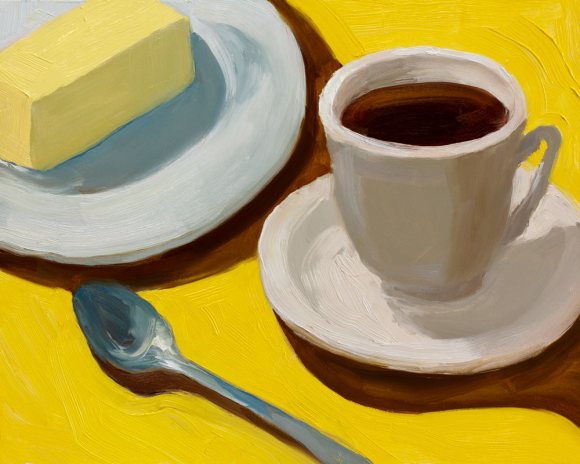
Tea and Butter, Surface Quality Study #2, oil painting on panel, 8×10″
This is my second study based on Peggi Kroll Robert’s “Surface Quality” video. In order to paint along with her in the video, I tried to use the same elements: a yellow table (or cloth in my case), a cup of tea, a spoon and a cube of butter on a plate. (This time I made sure the cat couldn’t get to the butter!)
I learn so much from Peggi’s videos, whether I’m watching her paint or just listening. Each time I play one of the DVDs I hear or see or understand something I missed the first time. I’m so excited I get to paint with her in person at her studio in Angels Camp, CA.
I’m also excited that I’m going to spend the weekend workshop with fellow artist-blogger Kathryn Law, whose friendship and support over the past couple of years I treasure but whom I will be meeting in person for the first time. Kathryn has also been working with Peggi’s videos and you can see her “Surface Quality” study here.
Tea and Lemon, Surface Quality Study #1, oil painting on panel 8x10"
This painting is a study based on the exercise in Peggi Kroll-Roberts “Surface Quality” video. I watched the video, then turned it off and painted from my still life set up, trying to incorporate the lesson: paint the darks with thin paint (so that they recede, don’t reflect light that hits lumpy edges, and don’t draw attention to themselves) and paint the light areas with rich, thick paint (and of course mix the correct colors and values).
When Peggi demonstrated this exercise she used a cube of butter (in her still life, not to paint with! though her paint is very buttery). I had to replace the butter with the yellow lemon because while I brewed the tea in the other room, my cat had a little feast, licking my only cube of butter into a misshapen mess.
There are some passages in this painting I like very much, such as the lemon, its leaves and blossom, the tea, and the way the tin in back is kept all in shadow.
I did buy another cube of butter to try the exercise again, and that will post tomorrow while I’m off at Peggi’s workshop.









 Jana Bouc, Artist