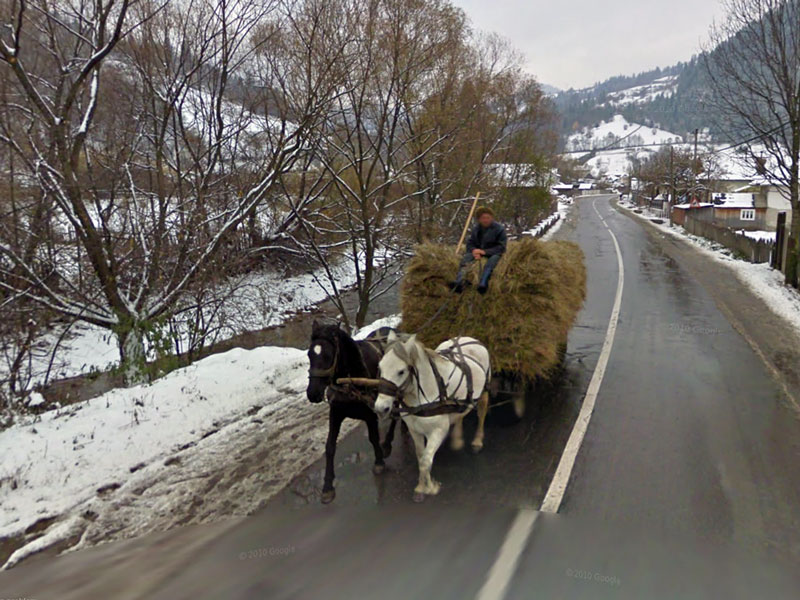
Romanian Winter Hayride, oil painting on panel, 9×12″ (SOLD)
After rambling around Romania, seeing beautiful summery farmland, busy cities, and a shepherd walking his sheep down a village street, suddenly it was Christmas with nativity scenes in front yards and this wonderful snowy hayride (virtually, of course via Google Streetview for the Virtual Paintout).
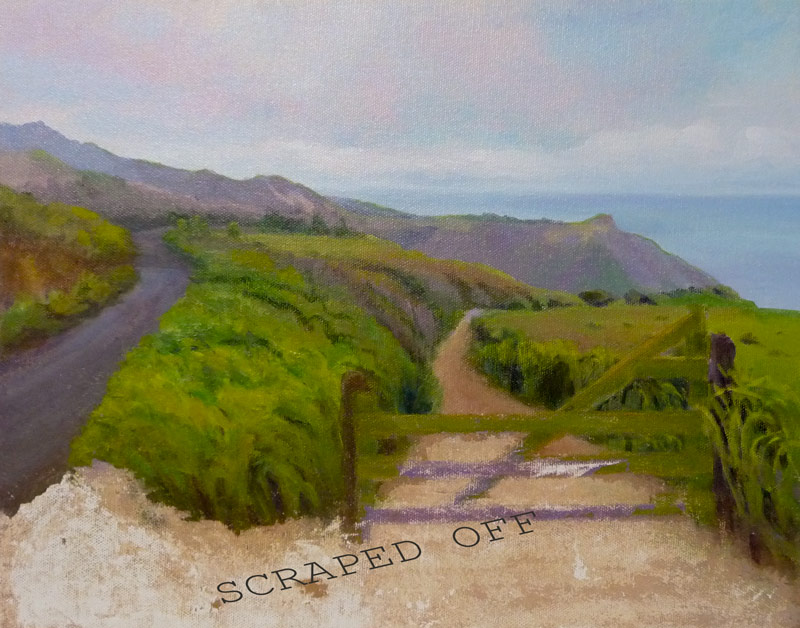
Yesterday I’d tried painting a different Romania scene (below) but soon realized I was laboring joylessly on a hopeless painting, fighting paint the consistency of toothpaste. I gave up, scraped off the panel (glad I’ve gotten smarter about when to cut my losses), and returned to Google’s wonderful new MapCrunch.com where I found the above photo.
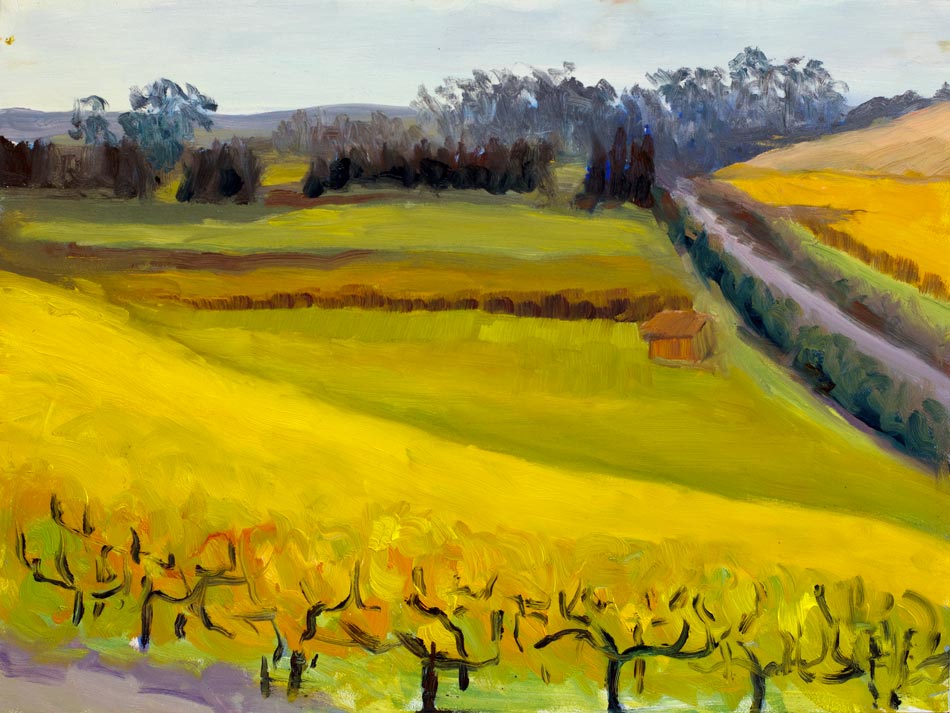
Foggy Morning at Viansa Vineyard, 11/2010-1/2011, Oil painting, 9x12"
My plein air group had our last meeting of the season in November at Viansa Winery in Sonoma. I’d made a good start on the painting plein air, but it needed work. Today I got tired of looking at the unfinished painting and completed it (above), using both brushes and palette knife.
I’d set up my easel at the edge of the parking lot and had a great view of the vineyard. But there were so many interesting things to see that I included all of them in my original painting below (except maybe the cars and the birds and bees—that’s some progress I suppose).
Viansa Vineyard, unfinished plein air
There are some passages in the painting I liked, especially the top fourth, but there were some problems too: the strong yellow diagonal line leading you out of the painting, the bright gold triangle top right, the green line of bushes beside the purple road, both of which weren’t needed even though they were there in real life.
Viansa photo reference
This is the photo I took at the beginning of the painting session. The sun and fog and clouds kept changing but the overall impression I had of the day was sunny.
A previous Viansa painting can be seen here. It’s nice to see the progress I’ve made since then.
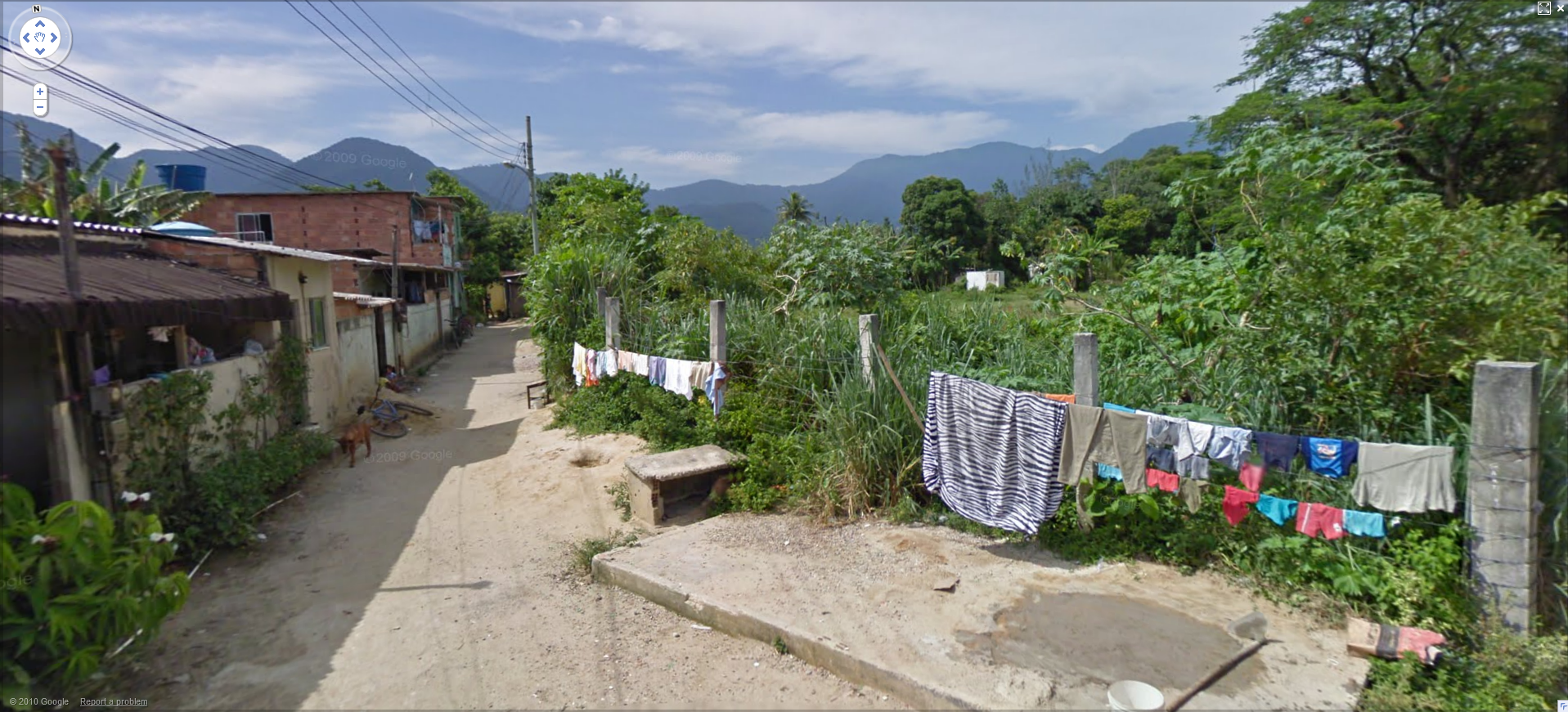
This month’s Virtual Paint-Out location is Rio de Janeiro, Brazil. Since I seldom travel I find it so much fun to do so virtually via Google Street View. I love being able to wander, exploring roads to see where they go without fear of getting lost (let alone dealing with airports or spending the money).
Here’s the way the scene looked on Google and then the way I cropped and the way I adjusted it in Photoshop.
Original Google Street View, RioRio Photoshopped for painting
As I do these each month I’ve noticed patterns in the way nicer houses and neighborhoods are near beaches or on top of hills and the poorer neighborhoods are indeed on the wrong side of the tracks.
I’ve also noticed a sense of freedom when painting these since I don’t have so much investment in the outcome. And maybe that’s what led to my liking most of my Virtual Paintout paintings more than the ones I’ve labored over.
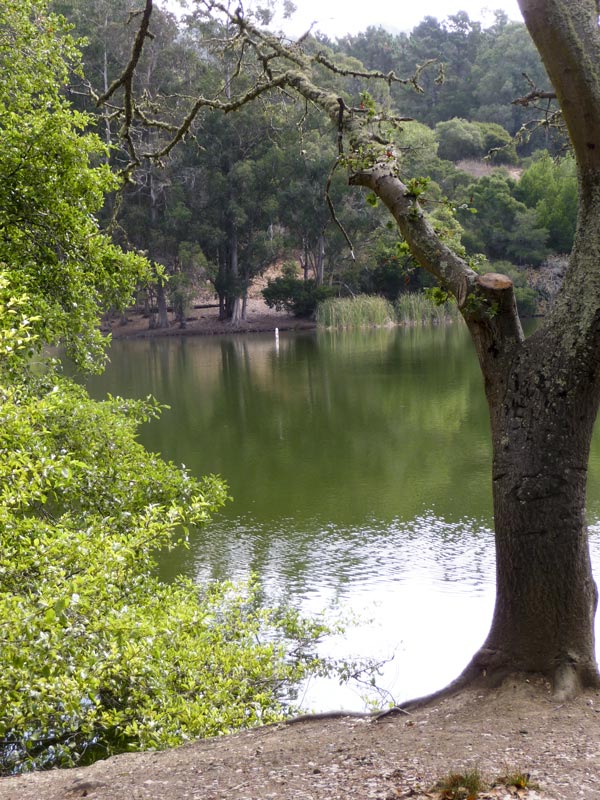
Grey Day at Lake Anza, plein air (mostly) oil on Gessoboard, 10x8"
Only two of us showed up to paint at Lake Anza in Tilden Park on an almost-drizzly, grey Monday morning last month. The air smelled fresh and clean and it was so quiet there; a wonderful change from the noise of the city just a few miles away.
I painted most of this onsite, with some corrections and clean up later in the studio from the photo below.
Lake Anza reference photo
One of the corrections I made was to the little clumps of marsh grasses on the other side of the lake (barely visible in the revised painting). They had been my focal point but I realized when I got home and looked at the photo that I had made them three times bigger than they should have been.
Yesterday I was painting in Sonoma and saw the same problem when I got home: I painted some distant trees way bigger than they should be. It’s interesting to me how as I focus on one element of painting and begin to improve it (like composition, values, color, etc.), I discover another area needing work. Next time I’ll pay attention to measuring/comparing sizes of the things in the painting.
While I’m still miles of canvas away from mastering plein air painting, at least I am beginning to grasp the principles and see that while there are many important concepts to consider out there, the list isn’t endless (as it once seemed). Maybe eventually it will become more automatic like driving; I’ll still have to pay attention and keep my eyes on the “road,” but I won’t be driving over curbs, crashing into things, or totaling my car/canvas.
Sometimes painting in a pretty park with views leads to painting surrounding suburbia (or is it “urbia”?) instead of the park. The scene I wanted to paint (a picnic area between big eucalyptus trees) was occupied by teenage boys smoking pot and I decided to leave them alone. I didn’t think they’d appreciate me setting up my easel and staring at them, and they were there first.
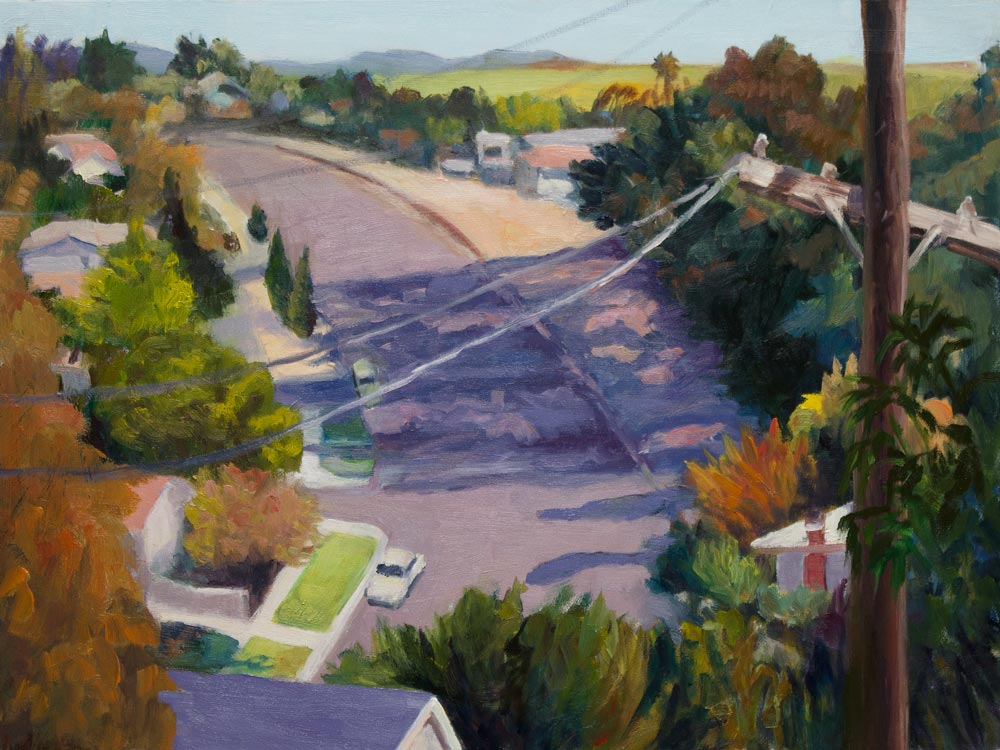
Fairmead Park in Richmond is a little, hidden gem of a park. It is almost at the top of a hill with interesting views, the sounds of birds and squirrels, and the wonderful scent of eucalyptus. I got a good start to the painting while I was there and took some photos so I could finish it at home. I tried to focus on values, color and getting the paint down and leaving it alone and I really like the way it turned out.
Here is the photo I used, taken from the edge of the park which goes up the hill behind where I stood:
Fairmead Park photo reference
So is this Suburbia or Urbia — it’s on the edge of a very urban area in the town of San Pablo but it looks pretty suburban, doesn’t it?
San Miguel de Allende, Mexico, 9"x12, oil on panel
It was so wonderful traveling around sunny San Miguel Allende, Mexico (virtually via Google street view and my paintbrush!) while it was cold and rainy here. I tried “driving” around to find the church at the end of the road, but just like I do with real driving, I got lost and never found it.
Once I’d adjusted the image in Photoshop to straighten the walls, crop to 9×12″ and warm the color a bit, I used the “gridding-up” method to create a drawing first. I displayed the image in Photoshop using”View/Show Grid” set to overlay a tic-tac-toe like grid). Then I drew a matching grid on my paper and started drawing, one square at a time.
Using the grid makes it easier to accurately see and draw the shapes in the image, section by section. Drawing first instead of going directly to paint helped me to understand what I was seeing and to notice interesting patterns like the pipes sticking out of the buildings and the circular motif of the windows in the building on the left as well as the church in the distance.
What a gorgeous little town! I’d love to visit there sometime!
Bleecker and Sullivan Streets, New York; Oil on Panel, 8"x10"
When I saw that this month’s Virtual Paintout was taking place in Manhattan, I wanted to paint the Lower East Side tenement where I lived when I made my big move to New York City from San Diego, California at the age of naive and tender age of 19, chasing my dreams.
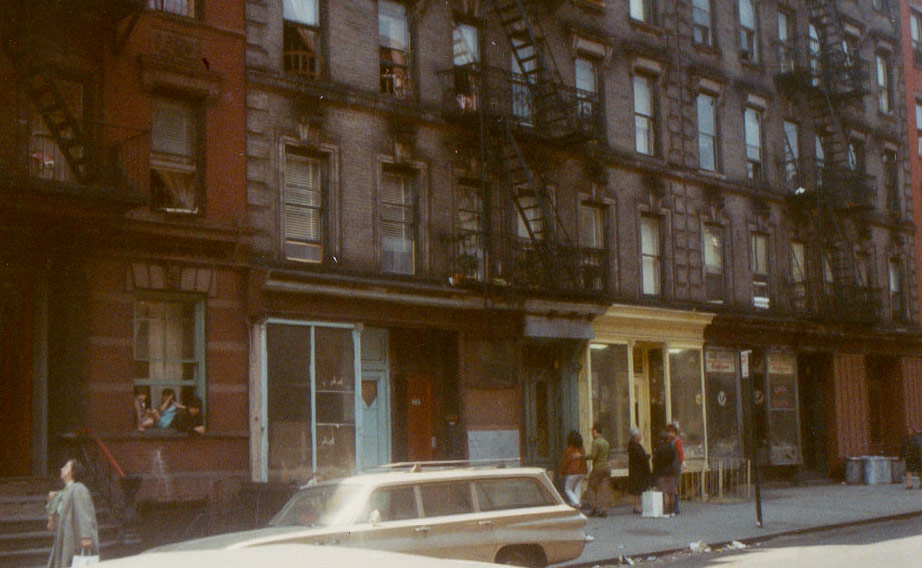
I couldn’t find the building where I lived on East 13th Street between Avenue A and B (possibly torn down and replaced by a small community garden) using Google Street View but I could see that now it’s fluffy with foliage and yuppified with yoga studios. There were no gardens or trees on East 13th Street when I lived there, just trash cans, junked cars and the occasional group of men playing dominoes on card tables in front of their storefront church downstairs or throwing dice on the corner by the drug store.
East 13th Street between Ave. A & B, 1969
Next I looked for my favorite Greenwich Village cafe back then: the historic Le Figaro Cafe (New York Times article) which survived 50 years before closing down in 2008. It had famously been the haunts of Bob Dylan, Lenny Bruce, Dave Van Ronk, and Jack Kerouac.
During that year in NYC, I visited Le Figaro weekly for a little taste of home: their California Burger contained actual lettuce and tomato, unlike all other NYC burgers that were just bun and meat. They also served great espresso that you could sip while playing chess or people watching. (Although to be honest, at 19 I was more interested in their ice cream floats than espresso.)
I couldn’t find Le Figaro so I painted the next corner, Bleecker and Sullivan, which interested me as a subject. It turns out I gave up looking too soon, because in writing this post I actually found the remains of Le Figaro on Google Street View:
I got inspired to try water-soluble (aka water-miscible) so researched which brand had artist quality paints made with real, archival pigments that performed most like regular oils. From my reading, Holbein Duo Aqua Oils was the answer.
I bought 3 colors (Cad Yellow, Napthol Red, and Ultramarine Blue) and white and gave them a go with this happy little painting above from a photo and watercolor sketch. I really, REALLY enjoyed working with them.
Indeed they worked exactly like oils, but with no solvents, no odor, and brushes clean up with water! To thin the paint you can use a little water or Duo Linseed Oil. The consistency was nearly perfect but I used a tiny bit of water because I like my paint smooth. Next time I’ll try the oil.
After working with the Golden Open Acrylics for several months I became frustrated with the way they dry darker and how sometimes the paint gets tacky or dry in minutes (outdoors) and other times stays sticky for days.
When I paint, I like trying to match the colors and values I see, so I’m disappointed when I paint with Open Acrylics and the painting dries to look completely different. Supposedly they only shift 10% but I just don’t seem to be able to guess right when mixing (and don’t want to have to guess!)
With the Duo oils I loved being able to mix colors and have them not change, and to not worry about the paint getting sticky during a painting session. I spent about 2 hours on the painting above last night and it’s still wet today. And, because I could clean the brushes with a swish of water while I worked, I only used a few. Clean up was quick and easy, with a little Masters Brush Cleaner for the brushes and a spritz of water and a paper towel across the palette.
Holbein Duo paints are more expensive than the other water-soluble brands because of their higher pigment load and use of more expensive pigments. Their prices are about the same as regular artist-quality oil paint. From my research and my first experiment with them, they’re worth it. I’ve ordered a few more colors and look forward to trying them out for plein air painting too, where I think they should be ideal.
P.S. I know you can use regular oils without any solvents, and that you can clean up regular oils using walnut oil followed by soap and water. But it means painting with thick paint and spending even more time in the clean up process.
I’m back on the blog after an intense week spent alternately deep in the bowels of a massive garage clean up/reorganization, and obsessively fighting the acrylic version of the watercolor sketch above. After finishing the garage on Saturday afternoon it was time to clean up in the house and studio and prep for my Sunday morning watercolor class (which went great with a terrific group of artists who left me feeling inspired).
Virtual Paintout: Hawaii
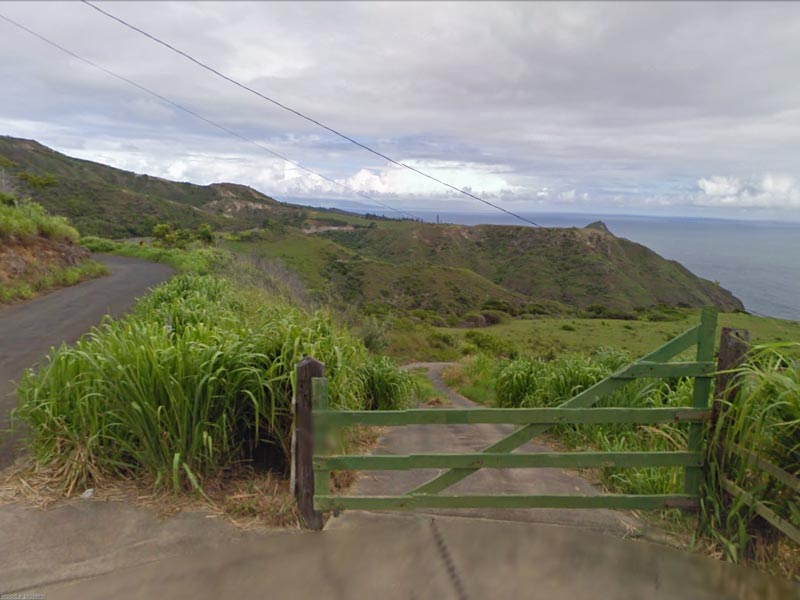
For the Virtual Paintout we went to Hawaii this month via the very cheap Google Air (just kidding—to participate you use Google Maps’ Street View feature to find your painting spot and all travels are virtual). Here’s the original scene:
Hawaii - near West Maui Forest Reserve
The painting got off to a good start with Golden Open Acrylics. I was trying to work from both my watercolor sketch above in which I’d changed the colors, warming up the scene, and also from the Google photo which just has a blur for the foreground. I first painted the gate purple for fun, but nearing completion realized the gate was too prominent and acting as roadblock into the painting so I repainted it green.
Then I started fighting the foreground. Over and over I painted, repainted, scraped, repainted. Here it is in its current state with the foreground (and some of the fence) scraped off again .
Hawaii with Scraped Off Foreground, Acrylic, 11x14"
Part of the problem may be the Utrecht Masters canvas panel that I was experimenting with. The canvas texture is too coarse and too absorbent so first I painted a layer of regular acrylic to smooth it out and reduce the absorbency (which is OK to do according to Golden). But then I had a paint adhesion problem, easily peeling off several layers where I’d painted thickly or repainted over not quite dry paint.
Since I wasted so much time messing with this painting and because I really love the top half of it I just didn’t want to give up. But to enjoy the second half of my vacation I’ve banished it to the closet and have gone back to working on a big watercolor of a tulip that is going great and makes me happy when I paint, not frustrated. I’m becoming convinced that I’m meant to be a watercolor painter and should forget about oils and acrylics.
The Garage
Cody unloading and saying "Bye" to his junk at the dump
When I bought my house 10 years ago it had been a rental for many years before that and the standalone garage probably hadn’t been cleaned forever. Then for 9 years my son used it to dismantle and rebuild his 71 Firebird, leaving grease, car parts, tires, miscellaneous junk, and bondo dust on top of years of grime, cobwebs, and worse (we found a literal rats’ nest made of fluffy chewed up shop towels in one corner behind a piece of plywood but no sign of recent rodents).
After moving most of his stuff out and the initial trip to the dump above, the real clean up began. I hired the smart, hardworking 15-year old boy next door to help me clean and we worked together most of Friday and Saturday. He vacuumed the wood walls and concrete floors after cleaning out the Bondo-filled ShopVac, removed and cleaned all my storage bins from the shelving units and then cleaned the shelving too. Meanwhile I sorted my junk and took a carload to the recycling/donation center and made another pile for the dump.
Finally the garage is ready for its new life as studio annex and multipurpose room. And I’m ready for my last week of vacation which I will fill with art fun, rest and recreation!
Study for Kaiser Garden II, watercolor, 6.5" x 4.5"
There are still openings in my watercolor class starting Sunday, June 27; click here for all the information. Ok, business done, now on to the painting above, another study from photos I took at the Kaiser garden.
I learned the hard way to do a study first, after time and again putting hours, days or weeks into a painting that was doomed from the start.
No matter how skillful the painting technique is, if the composition is bad (the viewer’s eye goes to a bright corner and then right off the painting), or you’re trying to work from a photo that doesn’t have enough information, or your colors or values are uninteresting, the painting isn’t likely to succeed. Sketching exactly what you see is great fun, but sometimes nature requires editing to make it a painting.
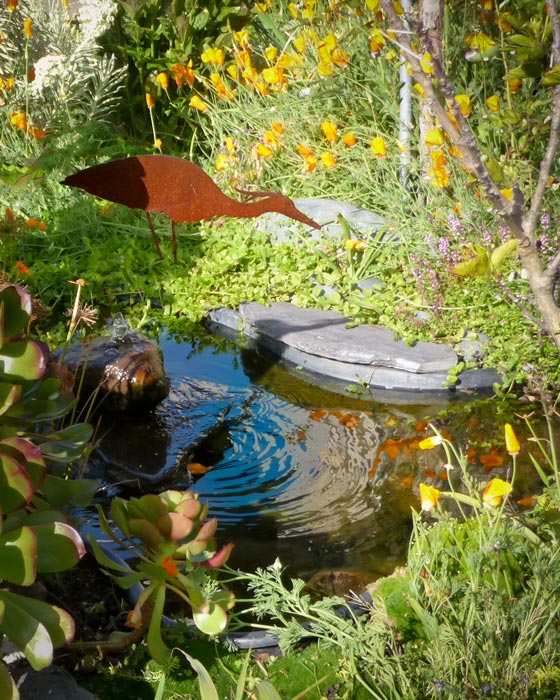
What made me want to paint this scene was the water feature and the bird sculpture but when I looked at my photo I saw big problems with the composition:
Original photo, Kaiser garden
There is way too much going on, the two big succulent plants on the bottom left dominate, a big stem above them leads the eye out of the frame, and the composition seems divided right down the middle, vertically. You barely notice the water.
So I spent some time in Photoshop cropping, rearranging and revising things:
Revised Photo Reference, Kaiser Garden II
Before cropping off the left side, I cut out the bird, moved it to the right, tilted it and gave it legs. Then I darkened the remaining succulents on the left and bottom to use them as a frame for the water feature instead of competing with it. When I started sketching the composition in my journal I decided to get rid of the messy tree branches poking in from the right too.
Although Photoshop is great for preparing a photo reference, so are the scissors, glue, sketches and notes that I used pre-Photoshop. Along with learning Photoshop, I’m also trying to become a better photographer and compose more carefully. I can do that with my digital SLR because it has a viewfinder but my carry-everywhere little Panasonic doesn’t. In the bright sun it was impossible to see anything on the LCD screen, so I guess I’m lucky that I got something I could work from at all.
My notes for the painting are in my journal opposite the study, with reminders about colors and things that worked (or didn’t). I’ve transferred the drawing to the canvas and it’s just waiting for its turn at the easel. I have a feeling it’s really meant to be a watercolor, not an acrylic painting, so may do it both ways.












 Jana Bouc, Artist