Categories
Art theory Landscape Oil Painting Outdoors/Landscape Painting Photos Places Plein Air

Port Costa Bull Valley Restaurant, Plein Air Plus

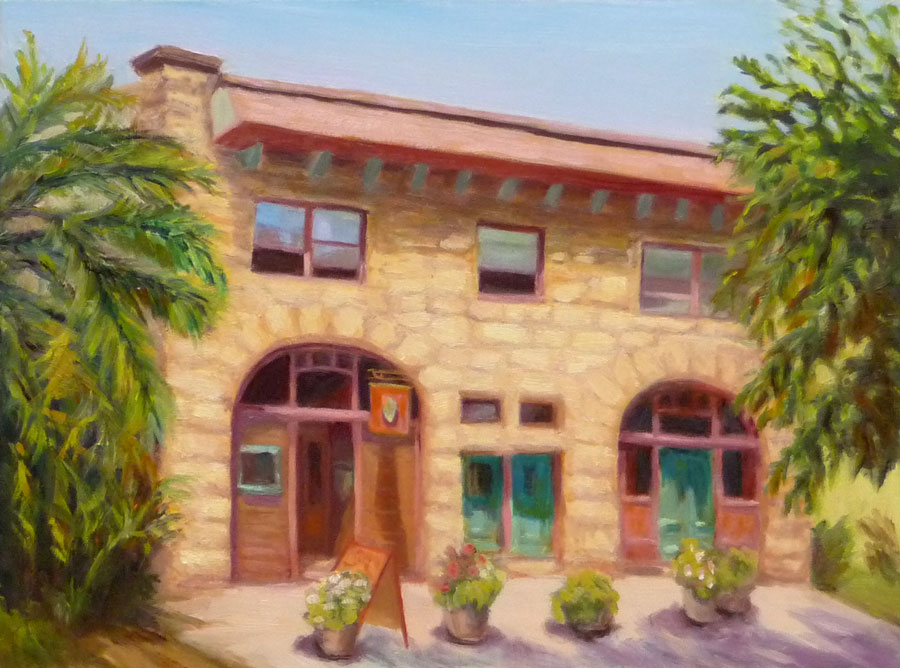
Port Costa Bull Valley Restaurant, Oil on panel, 9x12
Port Costa's Bull Valley Restaurant, Oil on panel, 9x12

When we gathered for our critique on the patio outside the funky Warehouse Cafe, a biker bar at the end of Port Costa‘s main road, I thought I’d gotten my painting of the Bull Valley Restaurant off to a good start. It was a sunny Saturday and the quirky local residents of the little town had been very welcoming, chatting and joking with the plein air painters.

Just as the critique was getting started the old lady bartender turned up the rock and roll so loud that we couldn’t hear each others’ comments and suggestions. Someone went in and asked her to turn it down and she sneered, “This is a bar. We play rock and roll!” Although some of our group had bought lunch and beer (served in mason jars), I guess we weren’t exactly their preferred clientelle.

Their usual patrons continued to roar in on their Harleys and wanna be Harleys. Some were dressed in full leather or raunchy heavy metal t-shirts and black denim. At least half of them were over 50, the guys paunchy and bald and the women, with their dyed thinning black hair, looked “rode hard and put away wet” as I’ve heard it said.

Anyway, back to the painting. As you’ll see from my initial sketch below, my perspective was even further off than it ended up in the finished painting above.
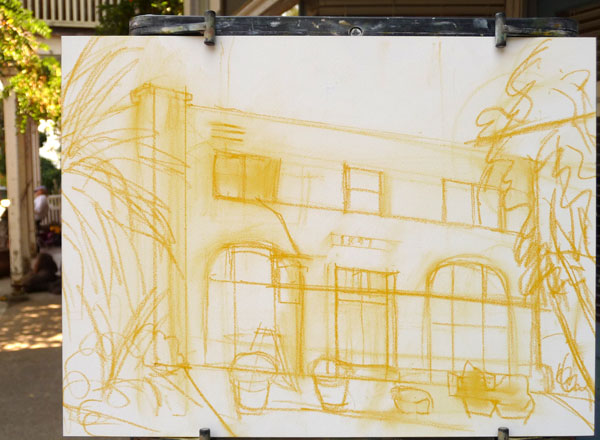
Port Costa-WIP 1
Port Costa-WIP 1

I’m always amazed how often my eyes fool me. Sometimes I’m sure a line slants one way and then I hold up a pencil to check and the line slants in the completely opposite direction.

This is the point when I stopped painting on site, planning to finish at home from photos.

Port Costa 2
Port Costa WIP 2

Once home I realized that I had a serious perspective problem with the way the roof  line and the line where the building meets the ground were parallel to each other instead of coming towards each other to finally meet at a vanishing point. I worked on the painting for a couple of days and thought I’d fixed it (blind to what was in front of my face from seeing it for too long).

When I shared what I thought was the final painting with some artist friends, they generously pointed out a few things that needed adjusting, including continuing perspective problems. Below M. added lines in Photoshop to demonstrate for me how I’d gone wrong with the perspective. It’s so great to have that kind of support!
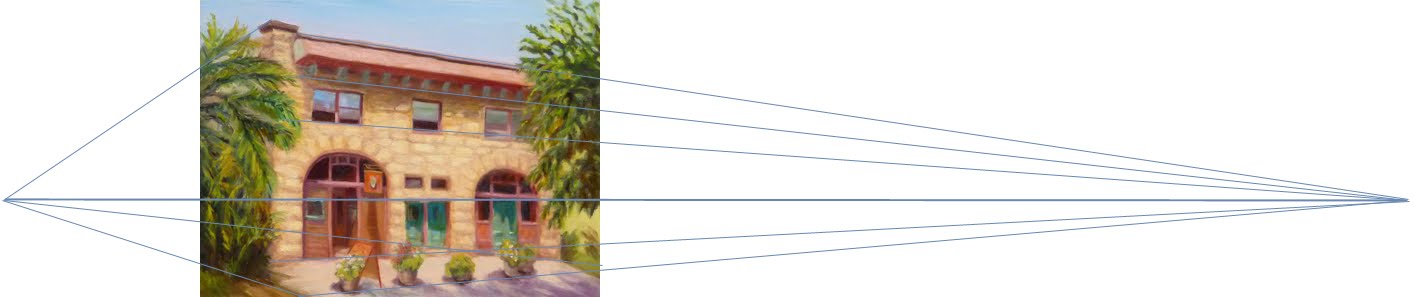
Port Costa Perspective
Diagram showing how the perspective should have been
In the end I decided I’d taken this painting as far as it needed to go and moved on to the next project. But I promised myself that next time I’d pay more attention to perspective.

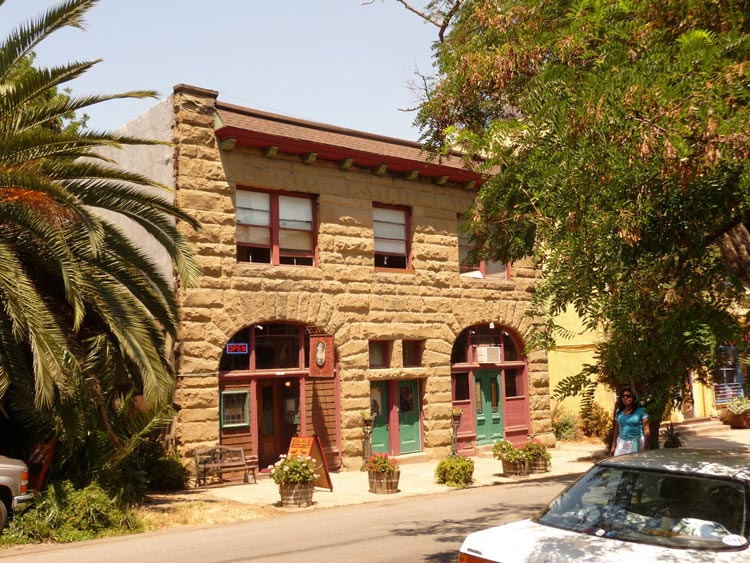
Here’s the original photo of the scene.

Bull Valley Restaurant original photo
Categories
Art theory Blake Gardens Landscape Oil Painting Outdoors/Landscape Painting Places Plein Air

Blake Gardens Revised; Pondering Painting

Blake Gardens Revised, oil on panel 9x12"

When my sister looked at the original version of this painting (posted here) she told me her eye kept going to the bright area in the upper right. There was a lot that was distracting in that image, and I thought the ground was too dark and the two little patches of flowers on opposite sides of the path were distracting too.  But now maybe I lost some of the sunshine by lightening the ground and darkening that corner?  (see original below)

Blake Gardens Late Afternoon, oil on panel, 9x12"
Blake Gardens (version 1, click to enlarge)

So it was back to the drawing board…er easel. I spent some more time working on it and I think it’s done now. Which do you like better? Or do you think the revised version needs more work and if so what?

Yesterday I was out plein air painting in the funky little town of Port Costa, and because I was painting buildings, spent more time drawing than painting to get the perspective right.  (Which makes me realize I need to add one more point to my How to Oil Paint Plein Air List: # 5. “Get the drawing right!”). Today I tried to (but didn’t quite ) finish it. While I used to often spend a month or more completing a watercolor painting, for some reason I have the idea that an oil painting should be finished more quickly, like in one session.

Perhaps what bothers me is that when I paint plein air I work small, using a 9×12″ panel.  It seems like a waste of time to work such a small painting for days afterward, putting in lots of details (because I like details, darn it, even though plein air oil paintings are supposed to be simplified).

Maybe the trick is to paint the plein air painting as a simplified field study and then if I like it, if it has life and soul and the subject still interests me, grab a bigger canvas and paint big where I can really get into things like reflections in windows and other crunchy details,  instead of continuing to work on the study.

But for now, it’s back to overworking yesterday’s study since I just scraped off the bottom 1/4 of the painting and need to redo it before the paint dries.

Categories
Art theory Landscape Oil Painting Outdoors/Landscape Painting Plants Plein Air

My “How-To Oil Paint Plein Air” Cheat Sheet

Blake Gardens Late Afternoon, oil on panel, 9x12"

After my flop of a painting on Saturday, I was determined to have another go at plein air painting. But first I wanted to put together a cheat sheet; a personalized “How to Paint Plein Air” based on what I’ve learned from teachers, books, experience, mistakes, successes and goals. I started jotting down notes as ideas and images came to me and then when the list felt complete, I typed it up and taped it to my paint box so that it will always be with me when I’m out painting. I posted another on the studio wall.

Then I went out to paint. First I drove to a site I’d been wanting to try out, a hillside cemetery in El Sobrante with what I thought would be  interesting views. But once I found a spot where I could be off the road and away from mourners, it was so windy, and the view so boring, that I left and headed for Blake Gardens.

By the time I got there and set up, I only had an hour and a half to paint before they closed at 4:30. It was so serene and beautiful there and the weather was perfect, warm sunny and no wind. I worked as fast as I could, finished all of the main areas, and added the final touches at home.

It was a confusing scene with all sorts of trees and foliage, but not having enough time helped me to simplify rather than draw all the trees in the background. I took artistic license to move things a bit to improve my composition and to delete something that wasn’t working. I’m learning!

Here is my Oil Painting Plein Air Process Cheat Sheet. I imagine it will change as I learn and grow, but it definitely helped me with this painting.

  1. FOCAL POINT: Choose one!
  2. COLOR KEY: Decide: Will the painting be predominantly Warm or Cool, High key or Low key, Predominant hue?
  3. SQUINT! to see values, simplify
  4. THUMBNAIL: Keep making them until there’s a good composition with leading lines in to focal point. A bad composition can only lead to a bad painting.
  5. CANVAS: Transpose thumbnail to canvas, creating large puzzle piece shapes, using pastel pencil or thin paint.
  6. UNDERPAINT: Loose, sketchy monochrome underpainting of shapes, darks with very diluted paint (optional)
  7. DARKS: Thinly paint the darks but MATCH values and colors using value scale and testing paint first on edge of little cards held up to compare to actual color. Just because it’s dark doesn’t mean it’s black.
  8. PAINT LARGE SHAPES: Match or exagerate the average (VIBRANT) color in  large shapes, using not too thick paint.
  9. COLOR PATCHES: Break larger shapes into smaller patches of color and light, matching or slightly exagerating the color.
  10. HIGHLIGHTS & ACCENTS: Add thick LIGHT paint, thin dark accents, and occasional splashes of “broken” color  for VIBRANCY.
  11. EDGES: Put a dab of COMPLEMENTARY colors around edges of focal points to pop, SOFTEN and/or cool receding edges.
  12. STOP: It’s a field study!

If you have discovered other things that have helped you and are willing to share them, I’d love to hear about them. And if you’d like more information about any of the items on my list, let me know and I’ll do another post with more explanation and details.

Categories
Landscape Life in general Oil Painting Outdoors/Landscape Painting Places Richmond Annex

Richmond Annex Smurf House

Annex Smurf House, oil on Gessobord, 9x12"

Every time I go for a walk in my neighborhood this house always makes me stop and wonder. It’s painted a perfect Smurf blue and someone obviously puts a lot of care into keeping the juniper tams carved into moon-rock shapes amidst the sparkly white quartz ground cover. But why? Maybe so that one day someone like me would come along and be inspired to paint it. And so I did!

It also brings back memories of when I lived in a Smurf house of my own creating. We’d just bought a fixer upper in North Berkeley and while my husband and his brothers did all the really hard remodeling work, my job was to shop for the stuff they needed and keep the kids out of their way.

I was sent out for house paint and had in mind a nice Colonial blue. I found the perfect color and had many gallons mixed, not wanting to spend the money to buy a quart to test first. Major mistake! In a neighborhood of craftsman bungalows painted in tasteful  earth colors, our little Smurf house stood out, and not in a good way.

It’s been a couple of decades since we sold the house and went our separate ways, but the house is still there, and the paint job is holding up nicely and hasn’t faded a bit.

Categories
Flower Art Gardening Oil Painting Painting Plein Air Still Life

Pansies Plein Air

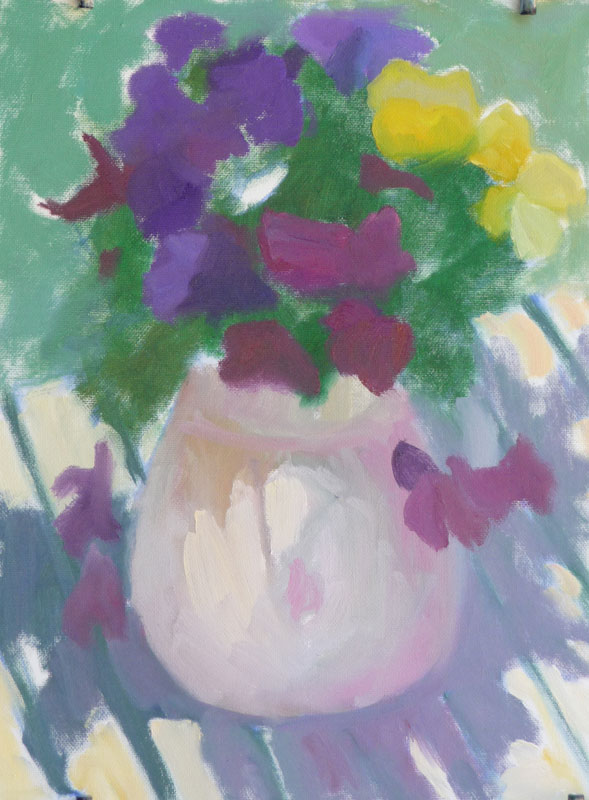
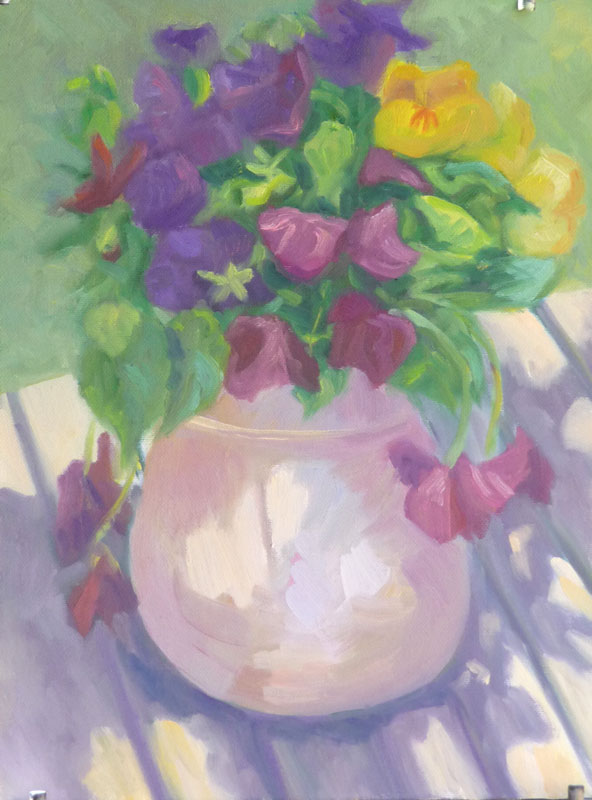
Pansies in Pitcher Plein Air, oil on panel 12x9"

The weather was too perfect to paint indoors but I didn’t feel like driving anywhere. My next door neighbor was out pruning his pansies and he’d pulled out a whole bucketful he was about to put in the compost bin.  Voila! A perfect painting subject. I stuffed a big clump of the pansies into a pitcher and set them on a table in the backyard.

I’d made the pitcher as a gift for my friend Barbara in the late 70s when I was a ceramic artist and she was a silversmith. She’s now a brilliant and prolific ceramic artist herself and she recently gave me the pitcher back. She was no longer using it due to a leaky crack and a house full of her own ceramics. I’ve been enjoying using it in still life set ups while fondly remembering it being filled with Mimosas every year for the annual Easter egg hunt and brunch her family held every year while our kids were growing up.

I knew that time was very limited before the shade moved across the yard onto the table so I worked quickly and had a great time.

Here’ are a couple steps in the work in progress:

Pansies Plein Air WIP #1
Pansies Plein Air WIP #2
Categories
Bay Area Parks Landscape Marin County Oil Painting Outdoors/Landscape Painting Photos Places Plein Air

Cloudy Day on the Bay, View from China Camp

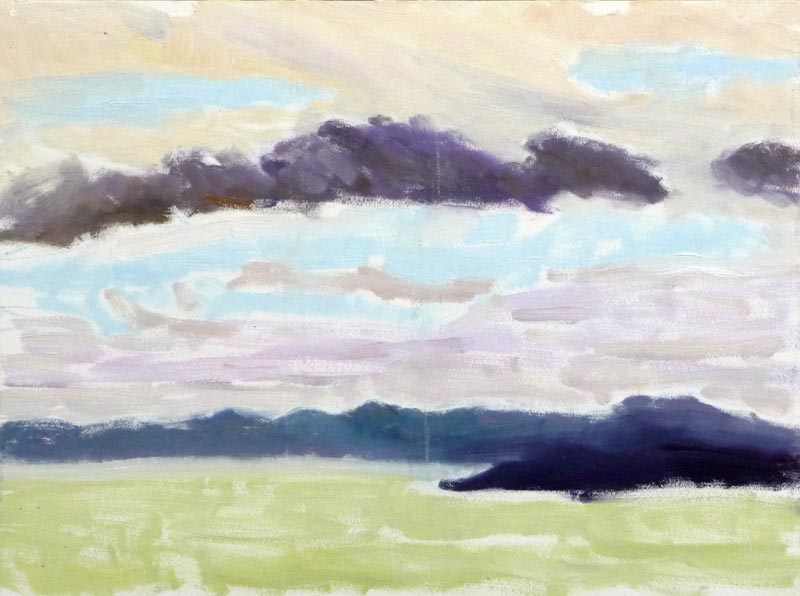
Cloudy Bay, View from China Camp, oil on panel, 9x12
Cloudy Bay, View from China Camp, oil on panel, 9x12"

When I first arrived at China Camp in San Rafael for our plein air paint-out, I decided to make the dramatic, dark clouds my subject. Except that once I’d completed a quick thumbnail sketch for composition, drew the main shapes on my panel, blocked in the colors of the sky, clouds, land, water… POOF! The sun came out, the clouds blew away, and the hills that were my darkest darks were now glowing with light.

Since the scene was now completely different I put the panel away and started another small study, which I might mess with a bit and post another time.

I planned to finish the first painting in the studio, from photos I took before everything changed. Of course later when I looked at the photos, they had none of the color and drama I’d seen and felt in person. So I tried to work from memory along with the photo, and eventually just let the painting tell me what it needed.

This is the original block-in with the painting barely started. I’d put the clouds in first, but after I’d blocked in the rest of the elements, realized they were way too dark.

China Camp View blocked in

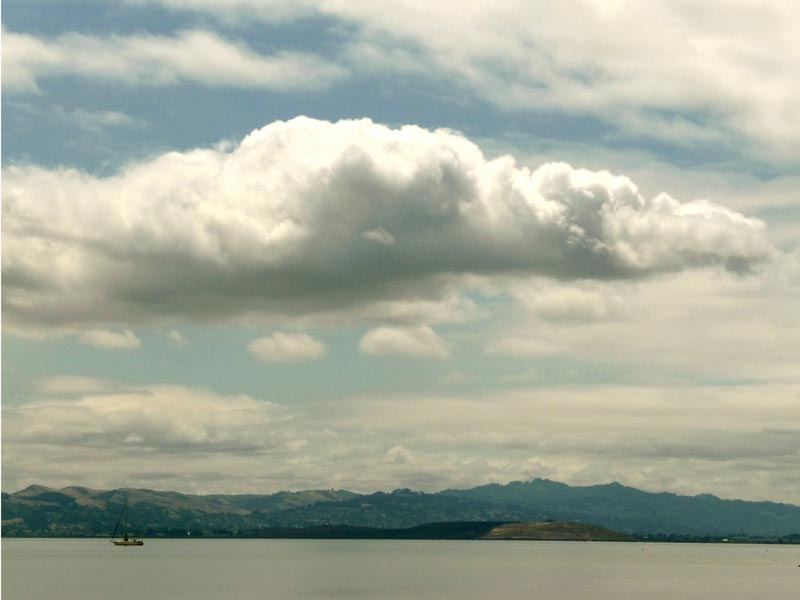
And this is the photo of the scene, in which the colors are all wrong, and which mostly just confused me when trying to paint from it.

Photo of China Camp cloudy view

As a wonderful bonus to the pleasure of being out painting on a gorgeous day, my painting group had hired plein air painter Elio Camacho to lead a workshop for us that day. I used to study with Elio a couple years ago so it was great working with him again. He is such a generous teacher and brilliant artist. Everyone had rave reviews afterward and were very pleased with what they’d learned that day.

Categories
Landscape Oil Painting Outdoors/Landscape Painting Photos Plein Air

Shorebird Marsh in Corte Madera; new oil painting

Shorebird Marsh, Corte Madera, Oil painting, 9x12"

A few weeks ago my plein air group met on a blistering hot day at a little shadeless park alongside a marsh that was right next to the noisy highway and a block from an upscale shopping center (Village Shopping Center in Corte Madera). Some watercolorists in the group set up at the shopping center but were kicked out for taking up outdoor tables meant for food court customers.

Reference photo
Reference photo

I was tempted to leave. The scene didn’t appeal to me, I was tired, it was hot, there was no shade or other facilities and the noise of the traffic was terrible. But I decided to give it a shot, and of course, as I started drawing I got more enthusiastic (“such cute hills” I said to myself, and listening to music with headphones helped block out the highway noise.

Initial sketch on panel

I stopped taking photos after the one below because I was trying to finish quickly as the temperature kept climbing. I nearly completed the painting on site before I started  feeling like I was getting sunstroke and had to pack up and head home, without even waiting for the critique.

Starting to block in color

I worked from the reference photo a bit in the studio but then just started addressing the painting’s needs instead of what was in the photo. I tried not to mess with the hills and trees that I’d painted on site because I liked the way they were loosely painted in.

Categories
Drawing Oil Painting Painting Photos Still Life

Stripey Still Life with Lemon: The importance of getting the drawing right first

Stripey Still Life with Lemon
Stripey Still Life with Lemon, 10x8", oil on Gessobord

Getting the drawing right before beginning to paint is so important when trying to paint realistically. Although it’s theoretically easier to correct drawing errors with oil paint than watercolor, it’s still a lot less fun than painting with a good drawing. As you can see from the start of this painting below, I hadn’t quite nailed the elipse on the top of the pitcher before I started painting.

Stripey Still Life start

I wanted to get started with the painting quickly because I knew the leaves from the lemon tree were going to change wilt, even though I had inserted the stems in a little florist tube with water (and they did!). But by not getting the elipse on the top of the pitcher drawn correctly, I ended up redoing it over and over and finally giving up. I am happy with the way the fabric under the pitcher turned out, as well as the lemon and didn’t have to do any repainting on those areas, although I did change some of the fabric as I painted.

Stripey still life photo of set up
Stripey still life photo of set up with wilted leaves

On my next still life, I’m going to sketch the composition on tracing paper first, and then transfer it to the painting panel, rather than trying to sketch it on the panel. Maybe that will make the painting more fun and less of a struggle.

Win some, lose some, learn some, move on.

Categories
Art supplies Art theory Glass Lighting Oil Painting Painting Photos Still Life Studio

Painting a Still Life Using The Carder Method”

Still Life with Tangelo, oil on gessobord, 12x12"

Inspired by Casey’s success with the Carder Method and frustrated with my own slow progress at oil painting, I bought the Carder Method video and  Color Checker tool. Below are step by step photos of my using the method to paint this still life, a brief review of the Carder Method and photos of my studio set up for working with it.

The Carder Method is designed to eliminate many of the problems that can make painting difficult. By creating an carefully lit, controlled environment, a painter can focus on learning to clearly see color and value differences while eliminating problems caused by variables such as changing light.

Click “Continue Reading” to see photos and read more….

Categories
Bay Area Parks Landscape Oil Painting Outdoors/Landscape Painting Places Plein Air

Martinez Waterfront Park Plein Air Step by Step

6. Martinez Waterfront Final version
6. Martinez Waterfront, oil, 8x8"

When my plein air group at Martinez Waterfront Park last Saturday I really enjoyed the painting process despite getting a late start. Then I tinkered in the studio, never one to leave well enough alone. Above is the final version and below are the steps I took to get there, recorded just for fun. First is the thumbnail sketch/value study:

1. Thumbnail, pencil
1. Thumbnail/value study

Then I blocked in the colors using really thin paint at the average color of each of the large shapes and planes or puzzle pieces as I like to think of them.  I was pleased to see I did the drawing pretty well, and was able to fit everything on the square panel in about the same proportions as I saw them and as in my thumbnail sketch.