Capetown Company Gardens, South Africa, oil on panel, 9x12"
During a very rainy week it’s been wonderful to have this sunny view to paint from Google Street View for Virtual Paintout‘s March location of Cape Town, South Africa. It will be interesting to see how (and hopefully if) my winter practice with landscape painting in oil carries over to painting real landscapes outdoors. Now that the rainy season seems at last to be over I will soon find out!
A note about the color in the photo: despite my best efforts, I couldn’t get the foreground shadow on the path to perfectly match the color in the painting which is a little more purple and a little less bright.
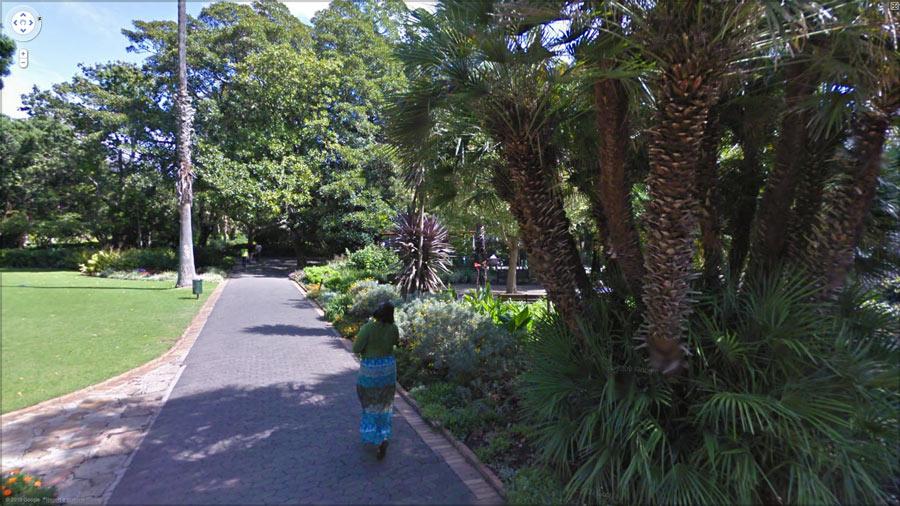
Here’s the original Google Streetview image:
Google Streetview image: Capetown
If you’re interested in the actual location, just click here for the map. And if you’d like to purchase this painting for $100, just click here.
Table Mountain View, Cape Town. Oil on 5x7" panel.
This month’s Virtual Paintout is in Cape Town, South Africa. What a beautiful country! I needed a project I could complete in an hour or two so I chose a simple scene and a small panel to paint on (5×7″).
But I think I spent as much time tooling around South Africa on Google Streetview than I did painting. And tonight I had such a hard time getting the color right in the photo (the sky in the painting isn’t turquoise, it’s a warmer blue) that I’ve probably spent an equal amount of time trying to fix the photo and get this blog post finished!
So I will let it be. As my boss always says, “…good enough for jazz!” She knows I can be a perfectionist and has taught me that little mantra so that I don’t get stuck finessing one little thing while all the other work stacks up.
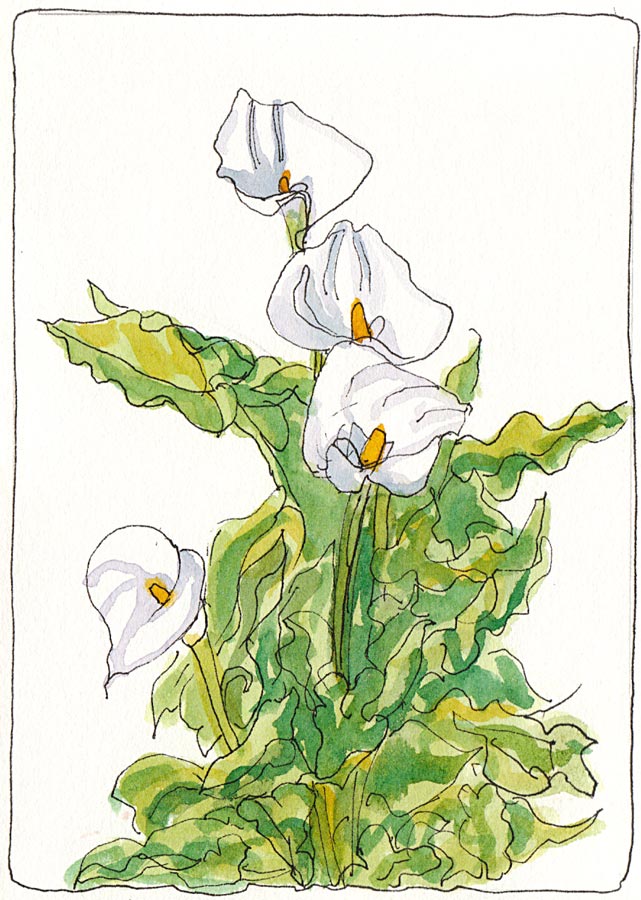
Tonight it is thundering and lightening and pouring down buckets of rain. But there was a warm sunny day last week when I was able get out in the garden and sketch a bit. Callas are so graceful and such lovely volunteers, popping up all on their own wherever they please.
My tiny fig tree, ink & watercolor
Just after my friend Barbara finished writing her book about growing fruit trees and delivered the manuscript to the publisher, she also delivered to me a baby fig tree that she couldn’t find a space for her in garden.
I was so excited to see that my new baby tree made it through the worst of the winter and was no longer just a stick. It now has actual leaves sprouting from the tip. In case you can’t tell from my sketchy drawing, those are random rocks and bricks I placed around the baby tree as a warning to the gardeners so they wouldn’t mow over it.
Another drawing opportunity while the girls play in the park. They got bored and ready to leave at just the moment I finished the sketch. I added a little color with Pitt Artist brush pens when I got home. That’s quite a fancy light fixture at this nice little park in Richmond Annex.
I have so many other pictures to post but all have stories that need writing, and after a day of unsuccessfully trying to re-paint a painting for the third time, any words I might share at the moment aren’t really fit for print!
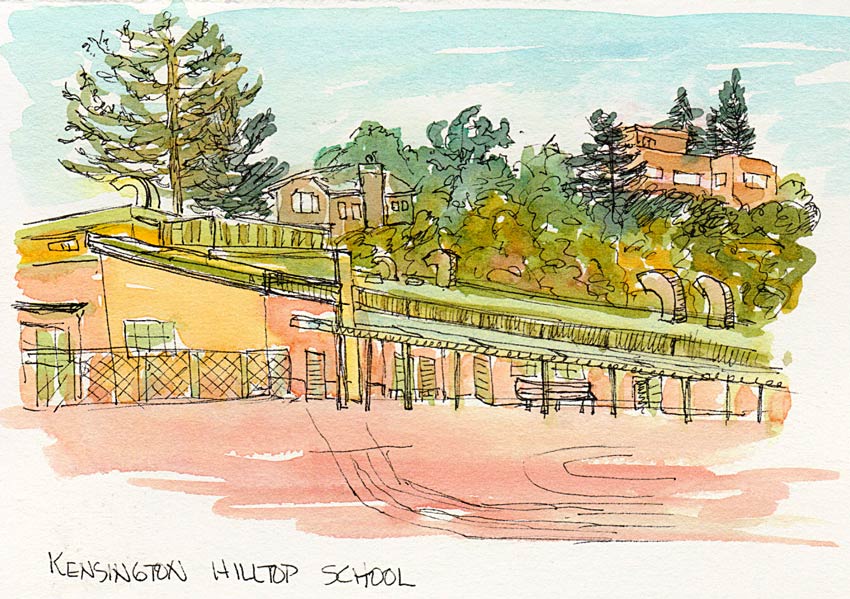
Kensington Hilltop School, ink & watercolor (a beautiful school above a wonderful park at the very tip-top of Kensington hills)
In my last post I asked for advice on sorting and storing completed oil paintings on panels. Along with the good suggestions from readers, I found a fantastic website that provides the answers to these and many other questions about proper handling of artwork and art materials of all kinds.
The website is AMIEN.org (Art Materials Information and Education Network), “a resource for artists dedicated to providing the most comprehensive, up-to-date, accurate, and unbiased factual information about artists’ materials.” They are part of the education department of the Intermuseum Conservation Association.
AMIEN’s forums are the place to find information to all our questions about proper use, handling, storage, shipping, application, etc. of art materials and finished art work or all kinds. Here is a portion of what they say (more here) about storing oil paintings on panels:
Store your paintings standing on edge, one next to the other, with a piece of acid-free paper loosely covering the face of each painting. You can tape the paper to the back of the panel and fold it over the front.
Ideally, you will put these paintings in a rack, elevated off the floor, in some location that is relatively dust-free and not subject to wild swings of temperature and relative humidity. Even more ideally, each painting ought to be separated from the others, but that would take a very large rack. Second best: You should not have more than about 5 paintings leaning against each other; separate the groups of paintings.
AMIEN’s forums cover topics like Watercolors, Pastel, Encaustics, Acrylic Paints, Supports, Grounds, Solvents and Thinners, Varnishes, Pigments, Color charts, Oil Paints and Mediums, Alkyds, Mural Paints and Techniques, Colored Pencils, Printmaking, Photography and Printed Digital Media, Matting, Framing and Labeling, Picture Protection, Crating, Shipping, Storage, Conservation, Hazards and much more.
About the sketch at top: Friday afternoons I have the pleasure of spending time with two lovely 11-year-old girls who still like to swing and play make-believe games on playground equipment. I discovered Kensington Hilltop School while hiking in the hills on the weekend and brought them there the next week. They played, I sketched, we had fun.
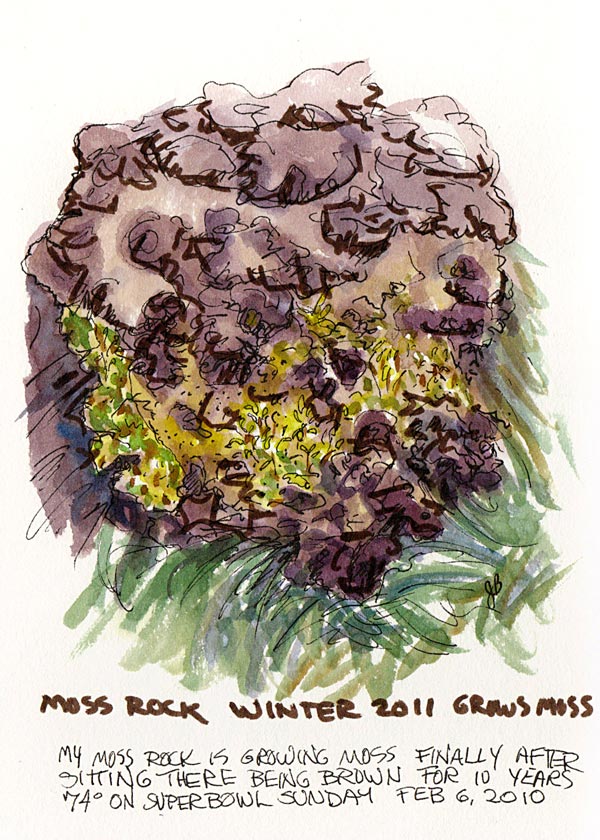
After ten years this very large rock sold to me as a “Moss Rock” and installed in my front garden has finally grown a patch of moss. It looked so pretty and the day was unseasonably warm and sunny so I couldn’t resist going out to sketch it. I sat on my porch and drew the mossy rock while my usually indoor kitties joined me in the sun.
And now my request for advice:
I need help figuring out how to sort/store my oil paintings. I have at least a hundred oil paintings and plein air studies on panels (probably more) that I’ve done over the past few years. I’m sure for some people it’s simple: just sell them all.
But if you’re like me and still have many paintings on hand, I’d love to hear how you organize, catalog, store and/or protect them from damage. I have many watercolors on paper in large flat files sorted by subject matter, with drawers labeled accordingly. But I haven’t figured out a good system for my oils.
When I get a request from someone wanting to purchase a painting it can be challenging to find it and I always have my fingers crossed that it hasn’t gotten damaged.
My questions:
ORGANIZING: Do you store your paintings by subject? Size? Date? Inventory number (requires entering in art tracking program)? OR…just skip the organizing and spend the time painting instead?!!
STORAGE: Should they be separated with wax paper when stored touching each other? Does it matter if they’re in the dark? My garage is fairly dry but not insulated so is affected by weather. Is it ok to store oils on panels in Clearbag envelopes to protect their surface?
At the beginning of the year I usually sort through the past year’s paintings stored vertically on shelves like books in my studio. I dump the losers, label the keepers, and move older paintings to shelves in the garage. This year I had the flu during my two-week holiday vacation so never did the “dump and sort” so paintings have piled up in the studio shelves and storage closet and there are more drying.
Any advice or suggestions would be greatly appreciated!
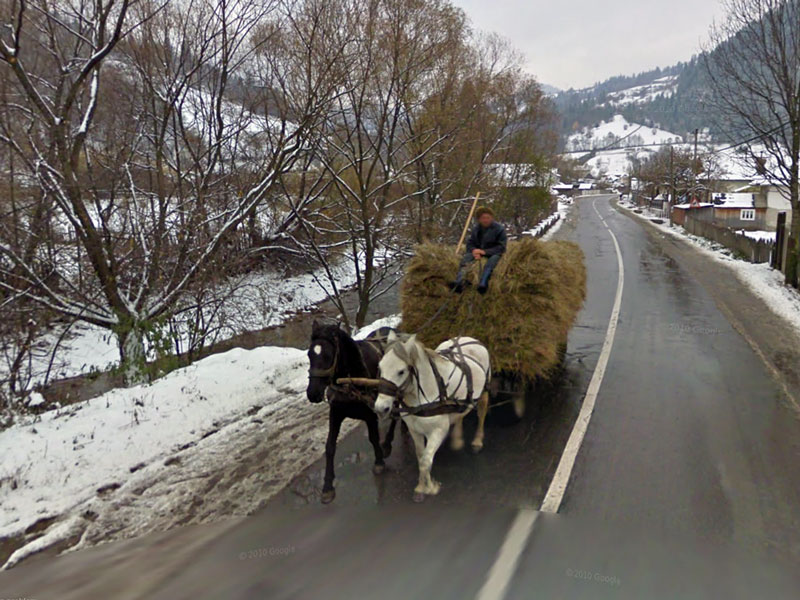
Romanian Winter Hayride, oil painting on panel, 9×12″ (SOLD)
After rambling around Romania, seeing beautiful summery farmland, busy cities, and a shepherd walking his sheep down a village street, suddenly it was Christmas with nativity scenes in front yards and this wonderful snowy hayride (virtually, of course via Google Streetview for the Virtual Paintout).
Yesterday I’d tried painting a different Romania scene (below) but soon realized I was laboring joylessly on a hopeless painting, fighting paint the consistency of toothpaste. I gave up, scraped off the panel (glad I’ve gotten smarter about when to cut my losses), and returned to Google’s wonderful new MapCrunch.com where I found the above photo.
It was fun to meet the South Bay members of our Urban Sketchers SF Bay Area group Suhita and John, and to meet some of the members of Sketchcrawl Silicon Valley at the Stanford sketchcrawl on Saturday. Cathy and I made the hour plus drive down there and met at noon. We started with lunch at the outdoor cafe with a view of the Rodin Sculpture Garden (sketched above at the end of the day after everyone left and it is my favorite because I love those funny, imperfectly groomed trees).
Sculpture of "Faith" in front of Cantor Center
My first sketch was the one above, of a statue called “Faith” in front of the Cantor Center for Visual Arts. Starting with “Faith” seemed good, since it helps to have a little faith that the sketching will go well. By 1:00 there were about 10 of us and everyone went off to follow their muses with a plan to regroup around 3:00. I followed Cathy who knew her way around, since my muse, like me, has no sense of direction.
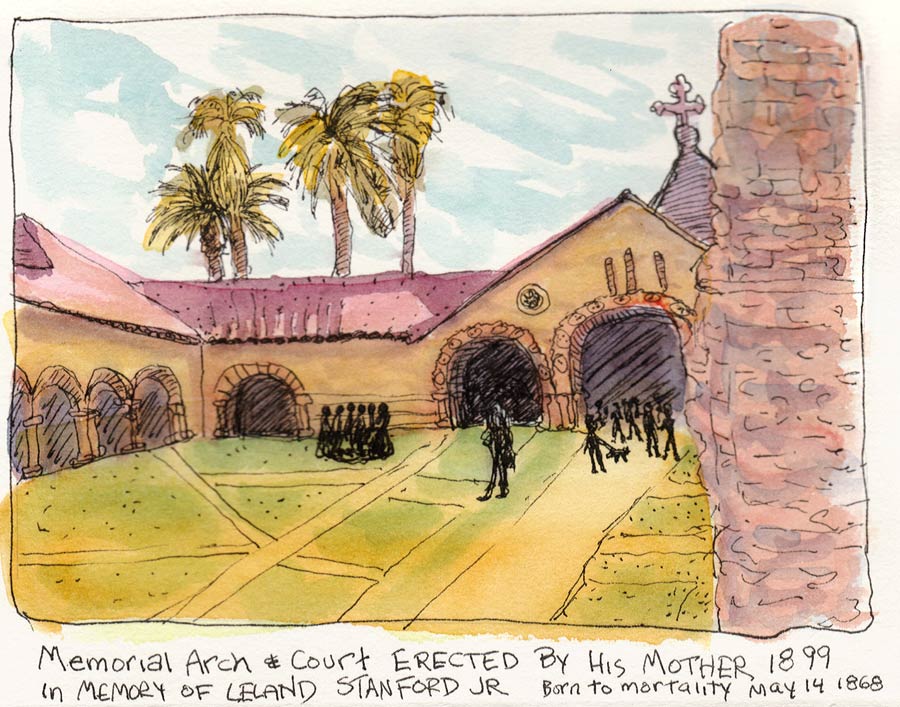
Stanford Memorial Arch, ink & watercolor
The sign on the building said “Memorial Arch and Court Erected by His Mother, 1898 in Memory of Leland Stanford Jr. Born to mortality May 14, 1868…” I ran out of room to record his year of death but he only lived until age 16 so his mother donated the land Stanford was built on to create a memorial for her son.
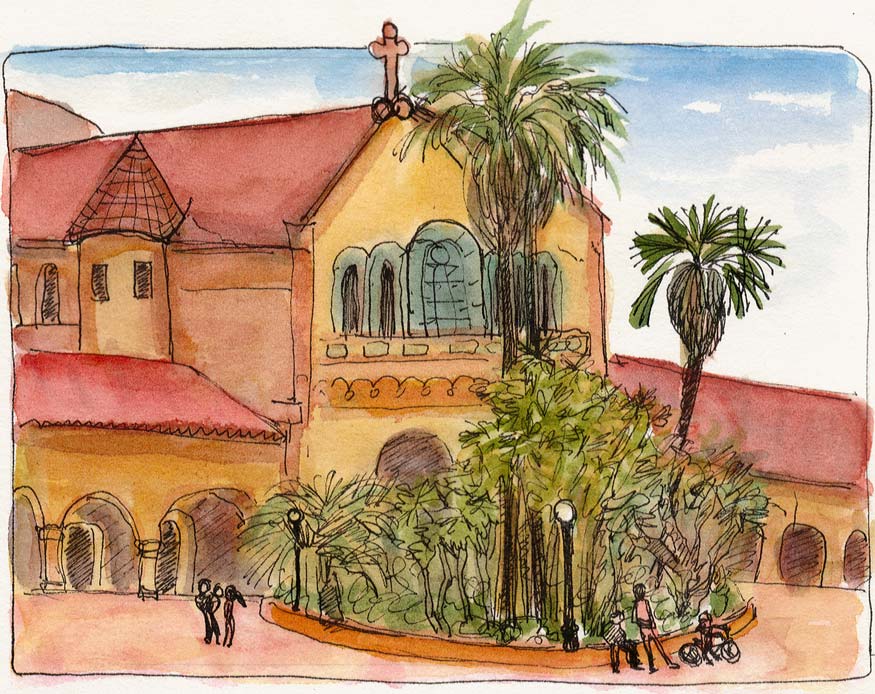
Chapel and courtyard
From a distance the front of the chapel appears to be glowing gold but when you get closer you can see it’s covered with a stunning mural made entirely in mosaic. Coming from an urban environment where things are crowded, noisy and grungy, Stanford was amazing. The Stanford campus is tremendously spread out (over 8,000 acres), with most buildings only one or two stories, but massive nonetheless. Everything is immaculately clean, with amazing gardens, gazillions of trees (well, officially 43,000), and quiet. At $51,000 a year for tuition, room and board I suppose one should expect a lovely environment!
When I painted this oil sketch I had three inspirations: First was the Peggi Kroll Roberts video focusing on designing value patterns by simplifying and grouping values, even when the colors are different (e.g. the red umbrella and green trees above are very different colors but approximately the same values).
Curran: Afternoon in the Cluny Garden
My second inspiration was the Curran painting above that I saw at the Impressionists show at the DeYoung Museum. I fell in love with this painting because of the colors, strong values and abstract qualities and brought home a print. Charles Courtney Curran was an American artist who studied with the Impressionists in Paris in the 1880s and then returned to the U.S. His other work I’ve seen online doesn’t appeal to me at all, too sugary and romantic.
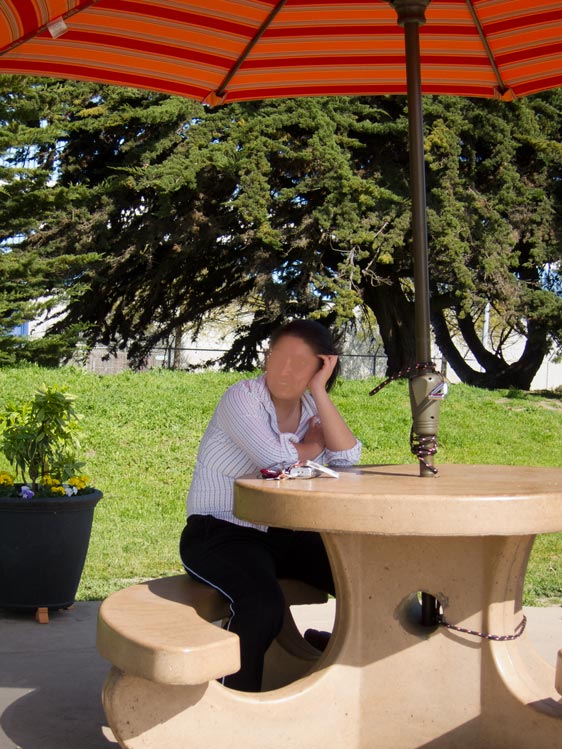
Original photo reference with face blurred for anonymity
I was also inspired by my reference photo (above) that I took at the Sit Stay Cafe at Pt. Isabel’s dog park where I was lunching, sketching and taking photos to test a new camera last summer.
The tired young woman was very kind about allowing me to sketch and take photos of her. She told me she also liked to paint. Since I didn’t ask for permission to post her picture online I blurred her face in Photoshop first.
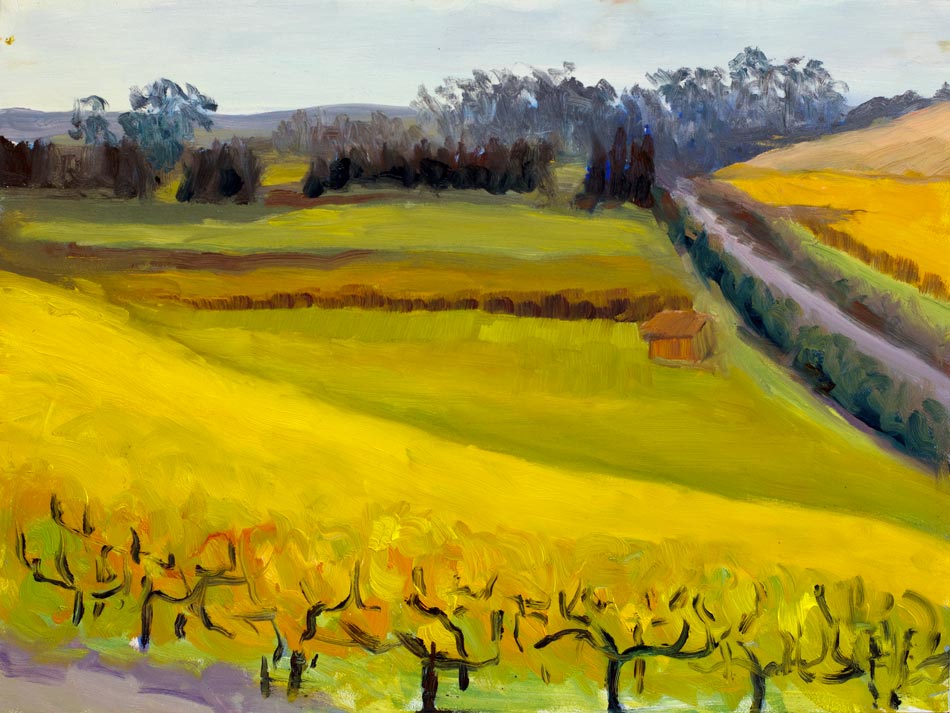
Foggy Morning at Viansa Vineyard, 11/2010-1/2011, Oil painting, 9x12"
My plein air group had our last meeting of the season in November at Viansa Winery in Sonoma. I’d made a good start on the painting plein air, but it needed work. Today I got tired of looking at the unfinished painting and completed it (above), using both brushes and palette knife.
I’d set up my easel at the edge of the parking lot and had a great view of the vineyard. But there were so many interesting things to see that I included all of them in my original painting below (except maybe the cars and the birds and bees—that’s some progress I suppose).
Viansa Vineyard, unfinished plein air
There are some passages in the painting I liked, especially the top fourth, but there were some problems too: the strong yellow diagonal line leading you out of the painting, the bright gold triangle top right, the green line of bushes beside the purple road, both of which weren’t needed even though they were there in real life.
Viansa photo reference
This is the photo I took at the beginning of the painting session. The sun and fog and clouds kept changing but the overall impression I had of the day was sunny.
A previous Viansa painting can be seen here. It’s nice to see the progress I’ve made since then.












 Jana Bouc, Artist