Categories
Art theory Landscape Oil Painting Outdoors/Landscape Painting

Inspiration Point – Take Two

Oil on Masonite panel, 9″x12″
Larger

This morning on the way to work I started thinking about yesterday’s painting of Inspiration Point and how what I painted didn’t really represent the colors I saw and generally annoyed me.  I started sketching and taking notes about for making another painting of the scene. Also yesterday I talked to technical support at Gamblin Oil Paints about putting together a good limited palette and he gave me some really good suggestions.

So anxious to put my new ideas into action, after work I ran to the art store, picked up a couple colors I didn’t have and set up my palette with the following Gamblin colors: (the ones with asterisks are what Gamblin recommended — the others are my additions)

  • Transparent Earth Red* (used primarily for the drawing and a tonal underpainting using paint thinned with Gamsol which dries in minutes and creates a beautiful glow), Titanium White*, Chromatic Black*;
  • Indian Yellow*, Cad Yellow Light;
  • Quinacridone Red*, Cad Red Light;
  • Ultramarine Blue*, Manganese Blue Hue (a form of Pthalo Blue that looks closer to Cerulean).

I did the sketch/underpainting quickly (a bit too quickly–didn’t quite get the shapes of the hills on the left) and then started in with the rest of the painting. The gessoed masonite is very slick which I kind of like and makes it easy to wipe paint off but also makes it easy to take paint off when you’re trying to paint on top of paint.

I’m happier with this version; pleased that I came closer to what I saw and that I managed to get in a painting after a long day at work.

Categories
Art theory Landscape Oil Painting Other Art Blogs I Read Outdoors/Landscape Painting Photos Plein Air

Inspiration Point, Tilden Park

Inspiration Point, Tilden Park

Larger
Oil on panel, 9×12″

Sunday was my plein air oil painting class in Tilden Park and we met at Inspiration Point in Tilden Park in the Berkeley Hills. On a clear day you can see far into the distance from this site. Unfortunately, when we arrived at 9:00 a.m. the fog was so thick we could barely see halfway across the parking lot. Our teacher, Elio Camacho, had planned to start class by doing a demo — an expansive vista on a large canvas. To try to accomplish something until the fog cleared, he had us set up our easels facing the alleged view and get ready to paint. I enjoyed the idea of randomly picking a spot with no idea what I’d see or paint.

At 10:00, after delicious coffee and treats from Peets Coffee generously brought by a class member, Elio did an amazing small demo of the sun glaring through the fog above some nearby trees. Happily, just as he finished the fog lifted and we got to work.

This time I remembered to take a photo of the scene before I got started so that I could finish the painting at home:
Inspiration Point, Tilden - Photo

Categories
Art theory Faces Life in general Painting People Portrait Sketchbook Pages Watercolor

Squinting to See the Light (funny story)

Squinting to see the light

Larger
Watercolor in large Moleskine notebook

Today at work, 10 of us were sitting around the table in the lunchroom eating and chatting. I sat across from our director, facing the picture window and our 27th-story view of Oakland, the San Francisco Bay, Mt. Tamalpais and the huge, cloudy sky. I was thinking about what I learned in my painting class last Sunday about the importance of learning to see color temperatures and value. A good way to do that is to close one eye and squint, which helps to blur the details, so that you can see shapes and values. I decided to practice on a blue house and a large brick building that I could see in the distance. I tried one eye and then the other, curious if it made a difference between my left and right eyes.

Suddenly I realized the conversation had stopped, our director was asking me if I was OK, and everyone was staring at me. I burst out laughing realizing that I was sitting there making weird squinty faces and they were all thinking I had an excruciating headache or had suddenly gone mad. I started trying to explain what I was doing and they looked at me perplexed. They finally realized it was an “art thing” and went back to chatting about work and TV shows and travel.

When I got home tonight, I looked in the mirror to see just how funny I looked and had to do this quickie self-portrait in my sketchbook. Amazingly it actually looks like me!

Categories
Art theory Flower Art Glass Oil Painting Other Art Blogs I Read Painting Still Life

Dahlias after Painting Class

Dahlias in Oil

Larger
Oil paint on gessoed mat board, 12×7.5″

Sunday was my first plein air oil painting workshop with Elio Camacho and it was fabulous! Elio is not only a wonderful painter, but he’s a fantastic teacher — so energetic, enthusiastic and generous in sharing everything he knows (which is a lot!).

Although Elio covered a huge amount of artistic territory in his conversations with us, what really sunk in for me at this session was the importance of temperature (warm vs cool colors) and value (dark vs light) and how to use those relationships to paint the effects of light in the landscape.

To better understand this concept and practice seeing color temperature, he suggested doing a still life of all yellow objects as homework so I painted these dahlias from my garden (after scrubbing all the nasty aphids and ants off them–ick!). Yellow is a good color to practice with because there are many yellow pigments from cool to warm and dark to light and you can successfully lighten it with white, unlike red which turns pastel pink when white is added.

Since I started this journey to learn oil painting, I’ve read many books, watched a dozen oil painting videos, and received wonderful support from my online painting mentor, Nel. There were so many concepts, “rules”, and techniques that I understood intellectually but in class they came to life! Seeing the process demonstrated and being able to ask questions each step of the way was great.

And even better was having Elio checking on me every 15 minutes or so during the three hours I was painting. He demonstrated what he meant when I didn’t understand; he recommended I quit dabbling– put down a stroke and leave it; he showed me how to hold my brush correctly and at what angle, so I was putting paint down without scraping it off at the same time (hold the tip of the brush and keep it at a low angle to the canvas, not perpendicular as I was doing). So many things just clicked.

The painting I did in class isn’t worth posting, though it had some nice moments along the way. Now that I know how to hold my brush properly and understand the importance of the direction of the brush stroke, and am learning to see color temperature and value better, I’m can’t wait to start my next painting!

Categories
Art theory Painting Sketchbook Pages Watercolor

Working on Cars in My Driveway

Car Repair 2
Larger
Sharpie pen and watercolor in Aquabee sketchbook

Cody Car Repair 2
Larger

Just as I finally was ready to start painting today, both my sons came over to work on their cars in my driveway (right outside the studio). It was a beautiful Indian summer day and I wanted the door open. But Cody was running a compressor and a power tool that made horrible noise as he removed the bolts holding all the wheels on the car. I made lemonade out of the lemon by drawing them (very quickly — they kept moving) and then turning up the stereo really loud.

I spent a lot of the weekend preparing for a new series of paintings  — sketching, making notes and digging up reference material and also thinking about next steps for a painting in progress. I’m trying to wait until I have a plan of action before I put brush to canvas so that I don’t spend half of my painting time dabbling and the other half wiping off the dabbles.

When I’m in that “between paintings” stage I can get very grumpy and frustrated. But for once I took advantage of the lull and cleaned up the studio; organized my cabinet full of glassware, fabrics and still life objects; and cleared off the studio kitchen counter which had been piled with random stuff waiting for a home. When I finished I was ready to start the sketch of the first of the new series and finally knew what I needed to do to the paint in progress (more about that tomorrow).

Categories
Art theory Flower Art Glass Oil Painting Painting Sketchbook Pages Still Life

Wax On, Wax Off (Breathe In, Breathe Out)

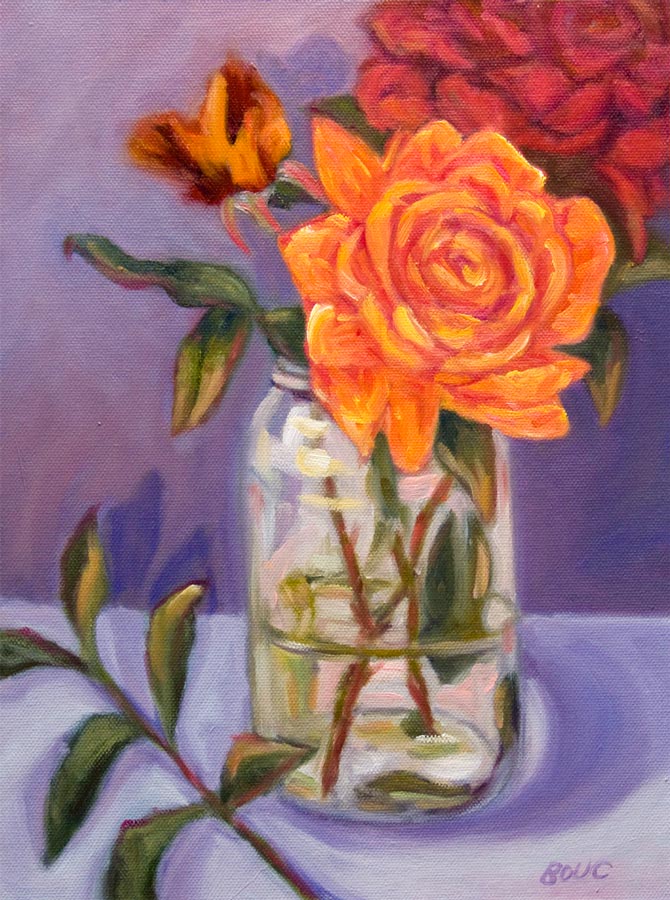
Rose in a Jar

Oil on panel, 12×9″
Larger

The title of this post refers to words from the 1984 movie Karate Kid and also my process in this painting except for the painting it would be more like “Paint On, Wipe Off (Breathe!) Paint On, Wipe Off… ” (click on “Keep Reading” below to see photos of the steps). I’m not happy with the front flower but I’m ready to move on to the next painting. With each one I learn so much more, including how much more there is to learn!!!!

I had two main goals for this painting/learning experience:

  • Think in terms of “Whole Canvas”
  • Keep trying to understand how to work with oil paint so that I’m taking advantage of its wonderful qualities rather than fighting them. (I’ll keep trying!)

In my many years of watercolor painting, I worked hard to capture what excited me about my subject. I often worked close focus without much background, or just using the lovely white of the paper as my background to set off the glittering glass or glowing flowers I was painting. If the composition didn’t quite work out–no problem, just crop as needed with a mat and frame.

In oil painting the background has to be an integral part of the painting–you can’t just leave the glaring white of the gessoed canvas as your background. And you can’t crop a stretched canvas or panel like you can paper. I was struggling with this concept and finally it clicked. It’s just another way of seeing and, like peeling layers of the onion, the haze peeled from eyes and I could see that a painting is not subject & background — they fit together to complete the picture, just as night completes day. While an object that interests me enough to paint it is the focal point, I need (for now) to think of the PAINTING as the subject.

Categories
Art theory Other Art Blogs I Read Painting Sketchbook Pages Still Life Watercolor

Egg Cup with Mushrooms

Egg cup with mushrooms

Watercolor on Arches cold pressed paper, 6″x5″ in sketchbook
Larger

I was at Berkeley Giclee on 4th Street in Berkeley on Monday to approve a test print of a painting I sold before the final giclee was made. The photographer/printer, Tony Molatore is a genius and so great to work with. The print is the same size as the original painting and it’s really hard to tell them apart.

While I was on 4th Street I stopped at the Crate and Barrel Outlet and bought some inexpensive goodies to use in still life setups including this little egg cup and periwinkle colored square plate. I’m going to paint this in oils too, but tonight my painting group was here and I wanted to join them with watercolor.

In my many years of painting in watercolor I focused on accurately capturing what I was seeing and on watercolor technique. Now that I’m also painting in oils I can’t just leave the white of the paper as background, or easily crop paintings when they’re done. Overall design and composition become very important so I’ve been trying to relearn all those elements from classes I took so many years ago. I tried to apply a couple of “rules” of good composition here:

1. Never “float” a still life. Make it go off the page on two sides or more (Told to me by Nel Jansen who learned it from another artist.)

2. “Never make any two intervals the same.” In other words, no equal divisions of space or equal quantities of dark/light, warm/cool, color, hard edge/soft edge etc. in a painting (The Simple Secret to Better Painting by Greg Albert — a good basic book on composition).

On the other hand, I’m noticing I have a foreground with nothing in the middle ground or background which seems a little odd and a few hard edges that should have been softened (which I will do later).

And on the other, other hand I had a wonderful time painting and being with my dear painting buddies tonight and seeing the lovely colors and shapes in the things I was painting.

Categories
Art theory Painting Sketchbook Pages Still Life

Roses on Stage

Roses-on-Stage (FINAL?)Write

Oil on canvas 16×12″
Larger

UPDATE 9/22/07: Please see my friend and painting mentor Nel Jansen’s painting of this subject and her step by step process. It’s really great!

I’ve been working on this painting for three weekends, painting, scraping off what I painted, and painting again. When I started I was working from life but I ran out of time, the flowers died, and I had to work from the photo. It just wasn’t as much fun. I was determined to finish tonight and I think I have. I may still touch it up a bit, so any suggestions are welcomed!

I read that it’s better for one’s learning with oil painting in the beginning to do 30 small, quick (an hour or two) paintings than to work on one painting for 30 hours. I can see why! So that will be my next step. My goal with oil painting is to mix the right colors the first time, put down the paint, and leave it alone but I’m not there yet as the following progression demonstrates:

Categories
Art theory Glass Painting Sketchbook Pages Still Life Watercolor

Kelp Pickles & Creative Blogger Award

Kelp Pickles from Sitka Alaska

Watercolor & ink (black & white in label) on Arches hot press in 6 x 8″ sketchbook
Larger

The Pickles
A co-worker who lives in Alaska part of the year brought back delicious treats, all made from seaweed. These crunchy pickles taste like sweet pickles except better–with a touch of the sea in them. I love anything tasting of the sea, including raw oysters. Eating raw oysters is like eating peaches: the texture is the same, the soft bite through, and then the sudden juiciness. They always remind me of my childhood in Southern California where I practically lived in the ocean, tasting that fresh salty flavor every time I dove or got knocked under a big wave.

The Painting
I painted this from life (well, from jar) with a light shining on it. I added a few highlights with Golden Absorbent Ground, a product that also allows you to cover and repaint problem areas in watercolor paintings. It creates an absorbent texture that doesn’t bleed or dissolve and is similar to the original texture of watercolor paper. It’s best to apply in thin layers if you’re using it to cover an area to repaint it so that it dries smooth.

The Creative Blogger Award
Two art bloggers and wonderful artists, Nel Jansen and Bonny Racca, both honored me by nominating me for this award. I wanted to acknowledge their kindness and admit that I’m a naughty Creative Blogger. When one receives the award one is supposed to pass it forward, nominating 5 others, who nominate 5 others, etc. For a number of reasons I’ve chosen to opt out of that part of the process, but do appreciate the nomination very much! I’ve also learned these kinds of “pass it on” awards and questionnaires are called memes and their definition on Wikipedia is quite interesting.

Categories
Art theory Oil Painting Other Art Blogs I Read Painting Photos Plein Air Sketchbook Pages

Treasure Island Marina, SF Bay, Plein Air

Treasure Island Marina, SF Bay
Oil on 9 x 12″ canvas board
Larger

My plein air group painted on Treasure Island this morning, a former military base and site of the 1939 World’s Fair in the San Francisco Bay. There were some amazing views of the SF skyline, the Bay Bridge, and Port of Oakland but it was very foggy and windy (as usual for the bay) when we arrived so I chose to paint in a more sheltered location in the marina.

Here’s the scene when I arrived:
IMG_1328

And here’s a quick snapshot I caught of the sailboat in the foreground as it glided past me:
IMG_1335

These are the sketches I did when I arrived, trying to decide on the view and focal point.
At first I was going to do the SF skyline but after sketching it realized it didn’t interest me; the shape of the dip along the skyline of trees on the hill did.
Treasure Island thumbnails

I did some things right on this painting, after taking to heart the good advice from my wonderful oil painting mentor Nel (whose wonderful Everyday Paintings deservedly sell Every Day — I own two), from Katherine Tyrell‘s post about plein air painting, and from the comments here on my last plein air attempt.

This time I didn’t chase the light (changing the painting every time the light changed). Instead, I noted when I started that the light wasn’t interesting–too foggy–but guessed it would probably clear up at some point. So I decided to block in the masses–the big shapes of the hills, sky and water and as soon as the sun came out I would then add the light effects, which worked fine. I also remembered that boats are flat on the bottom because the water line is flat and level. I also liked the the way I did the tree tops against the sky.

A couple things I didn’t quite get right: I forgot that everything looks darker and duller when you bring it indoors–it looked so pretty in the bright sun but is actually a little too dark. Also last time I swore I wouldn’t “fix” things in the studio, but I hadn’t had time to finish the boats so I worked on them, which was fine,. But then I “touched up” the hills and lost some of the glowing edges I had originally.

It might not be great art, but at least I didn’t feel like I had no idea what I was doing, as I had a month or two ago.

Advice, critique, comments are welcomed!