When I arrived at Miller/Knox Regional Shoreline the sky was gray and cloudy but even in the fog the park had so many great views: a salt water lagoon, Mt. Tamalpais across the bay, a fishing pier, an abandoned ferry landing, beautiful trees, and across the road, a railroad museum and a squat yellow building that houses a motorcycle club.
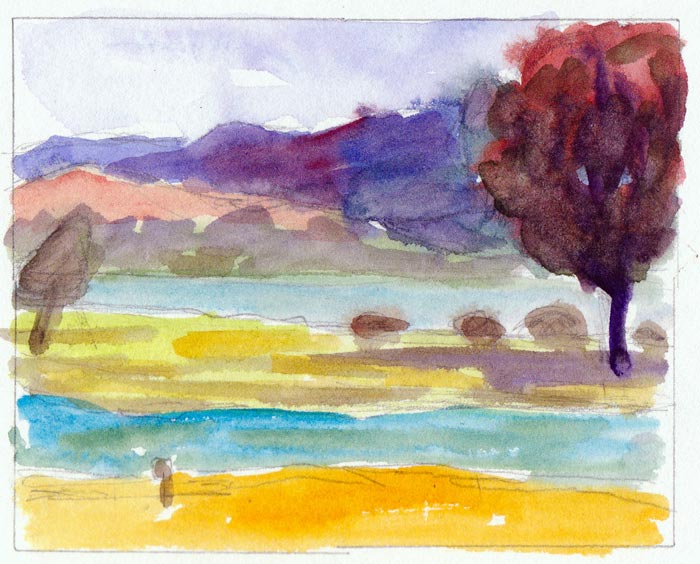
Miller Knox thumbnail
I finally picked a spot and got started with the above thumbnail sketch. I set my ViewCatcher to 8×10 and looked through its “window” to choose the composition. Then I put the ViewCatcher on my sketchbook and traced around the inside of the window to outline a box in my journal of the same proportion. By the time I was ready to add watercolor to the thumbnail sketch most of the fog had lifted except over the hills, and the sun was shining.
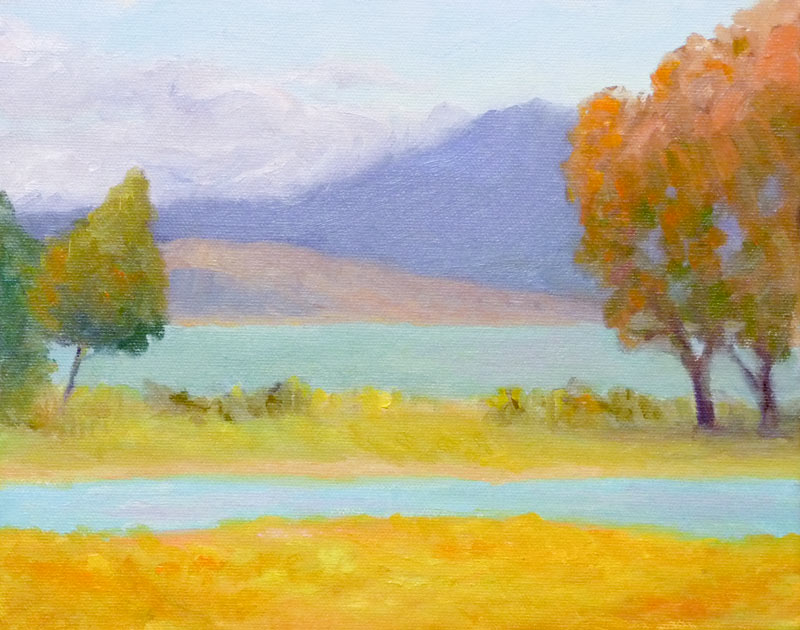
After 2-hour plein air session, oil on panel
Above is how the painting looked when I brought it home. The composition needed work: the picture is evenly divided in half with 2 trees on left, 2 trees on right and an empty center. The lagoon and bay should have been different colors. Too bad I’d ignored my thumbnail once I started painting because it had a much better composition.
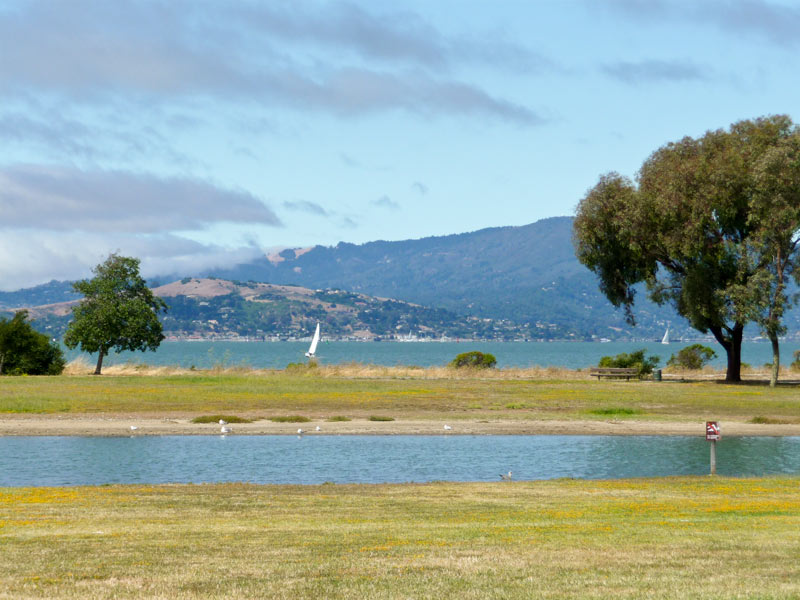
I tried to continue the painting from a photo but the photo didn’t match my memory of the colors and light, even after Photoshopping it (below). But it did at least offer some clues for fixing the composition, like adding the sailboats (duh!).
Miller/Knox Regional Shoreline photo
Maybe I should add in the little “No Swimming” sign (only putting it on the left side as I did in my thumbnail). What do you think?
After waking up way too early and having loads of extra time before I needed to leave for my plain air painting session today, I somehow managed to get late anyway. When I finally got to our meeting place—Borges Ranch on the Shell Ridge Open Space in Walnut Creek—I decided to leave my easel and acrylics in the car and hike the ridge trail with my sketchbook, watercolor kit and camera.Then when I was heading back for the critique, I stopped at the barn and painted the quick sketch above.
Often when I’m plein air painting I’m jealous of all the people who are enjoying the day by hiking the hills instead of standing in one spot trying to capture all the abundant nature in two dimensions on a little piece of canvas. So this time I joined them and it was heavenly. After exploring for an hour or so I found a spot on the trail beside a large muddy pond where I sat and painted the picture below. It doesn’t make sense as a picture but when I look at it I can hear the buzzing bees (must have been a hive in a nearby tree), the birds chirping, and can feel the warm sun shining on me.
Warm sun, buzzing bees, a pond, a cyclist
This was the first sketch in my new journal with the Legion Multimedia paper. It’s a dream to sketch on; the pen slides right along. The paper is nicely sized and while it won’t take the abuse that Arches cold press will, it does hold up pretty well as long as you don’t try to do more than 2 or 3 layers. This slight limitation will hopefully me keep me moving on to the next sketch instead of overworking one to death.
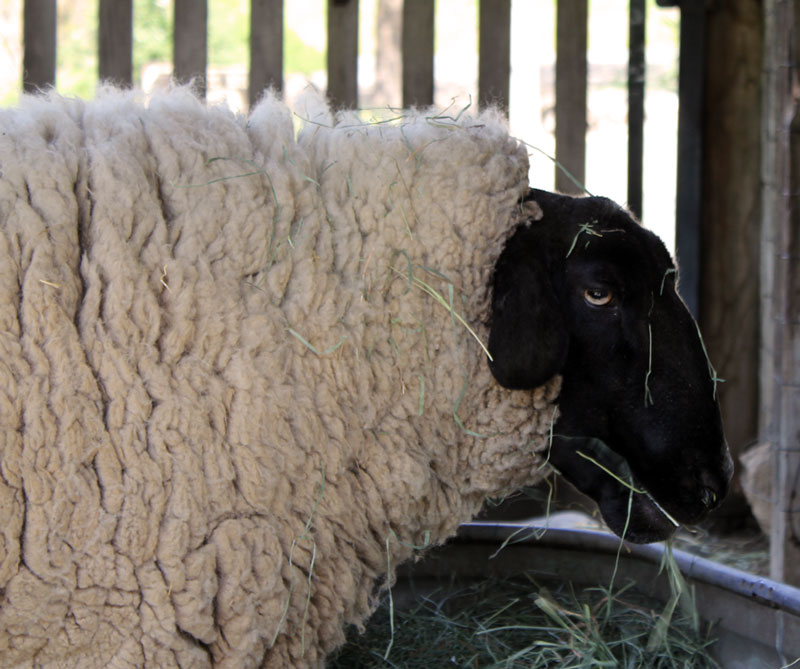
After the critique (and my lunch) it was mealtime for the farm animals and I couldn’t get any of their attention. This guy looked at me like I was really annoying.
Borges sheep chowing down
Only the rooster seemed to have places to go and things to do.
I have a theory about the paths we take in life, and how important it is to notice what I call “Angels Holding Up Signs” along the way. Sometimes those angels take the form of a person offering helpful information or silently pointing the way by example, an intuitive thought, or an unexpected turn of events that makes you pause. When I see or hear an angel holding up a sign, whether it’s “Yield”, “STOP,” or “Go This Way” with an arrow, I consider it a gift and give it serious consideration.
Disclaimer: I’m not a New-Age angels and crystals sort of girl. But I do believe there are angels all around us; good, kind, generous people, like Adam at Kragen Auto Parts today who helped me dispose of gallons of old motor oil and their containers that had been abandoned in my garage (long story; don’t get me started!). Thanks Adam!
…And like the angels who’ve held up signs in my art life lately, including Kathryn Law and Ed Terpening who’ve both helped me to a breakthrough in my understanding about why simplifying is important in oil painting, especially when painting plein air. I’m always attracted to details, and so I’ve fought against that principle, and then fought my paints trying to put those details into my paintings.
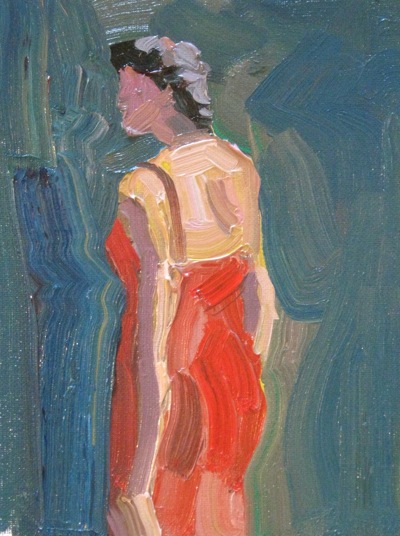
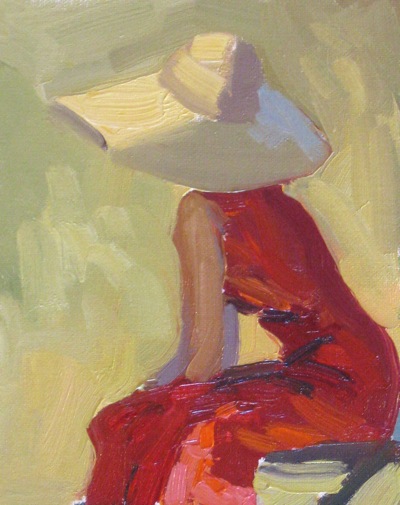
Then I saw these paintings (below) by Ed Terpening on his blog, Life Plein Air, made during a workshop in which the instructor, Peggi Kroll-Roberts, challenged the class to break the scene into as few large shapes as possible and paint those shapes with a large, fully loaded brush in one brush stroke.
Each study evoked in me a mood and my mind created a whole life story for each of these women. A mom at the beach trying to keep her kids in line; a sad, matron, wondering where her life had gone; a glamorous, young society lady at the country club watching a tennis game while sipping a martini….
How did so much come from such simple paintings? Leaving out the details left it to my mind to fill them in. This is something I so needed to learn: that simplifying and omitting detail doesn’t make a painting boring—it lets the viewer’s mind play and be creative, making for an exciting, rewarding experience. Thanks, Ed, for holding up that signpost!
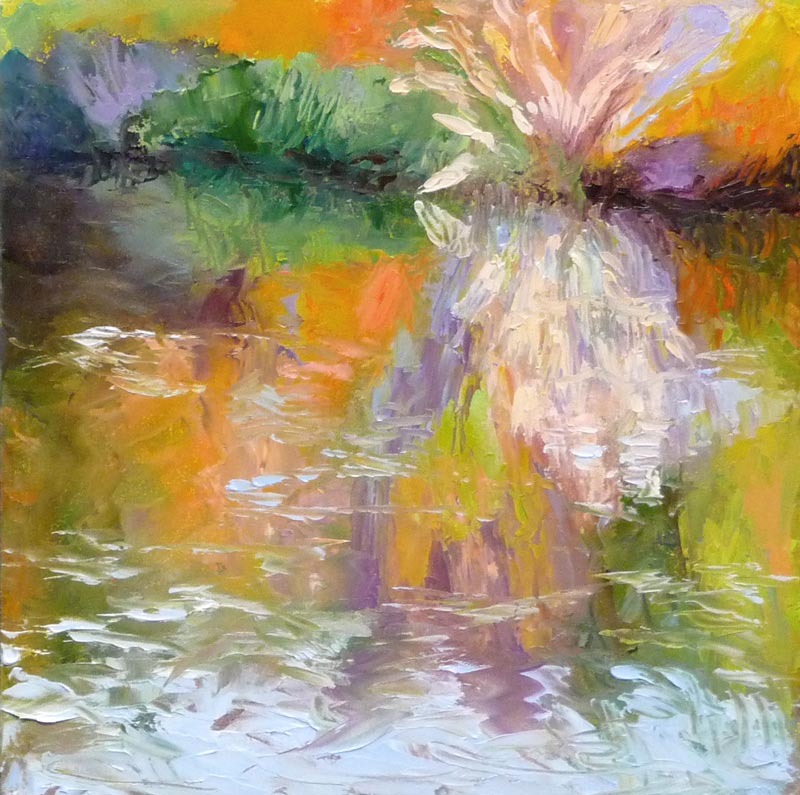
Another sign-toting angel came via email this week: a request to purchase this plein air oil painting I made last summer at Lake Temescal. There I was at the crossroads, wondering whether to give up plein air oil painting, and this angel popped up with a sign saying, “You’re on the right path, don’t turn back.”
And now about my process with today’s painting. First I tried to simplify by painting large color shapes with the plan to create a color study for a work to be done in the studio. I also focused on the composition, picking a focal point, being careful not to divide the canvas in half as I have a tendency to do, making the subject (the water) the largest portion.
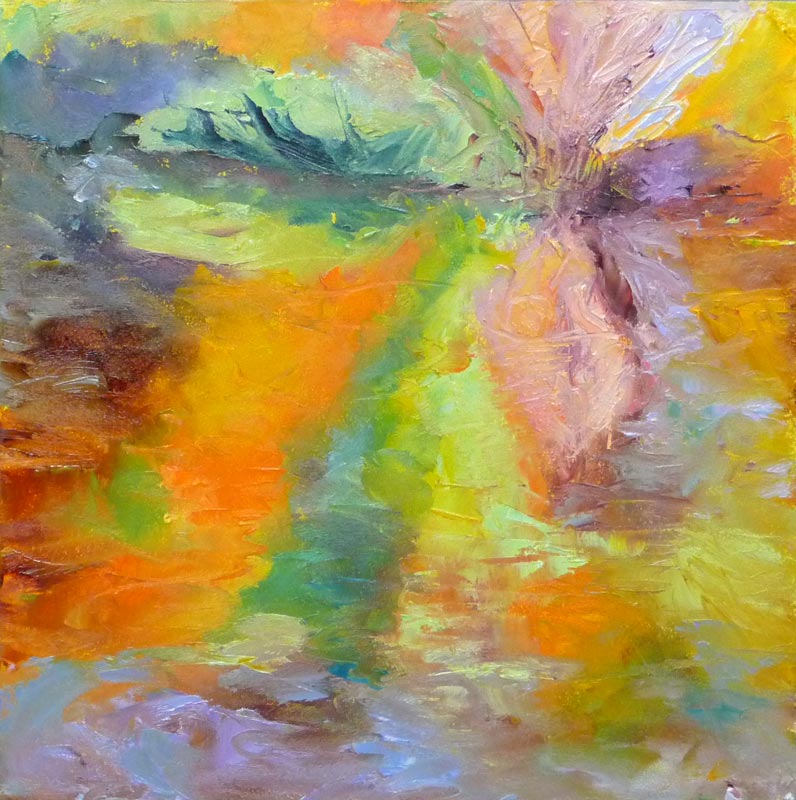
Here’s how it looked when I’d covered the whole panel:
Lake Temescal Reflections, Phase 1
I’d worked quickly, using a palette knife, going for big shapes of color. I should have stopped there and gone for a walk. But instead I messed around for another hour and muddied up the design and the colors:
Temescal Reflections (muddied), Phase 2
But the great thing about palette knife painting is that it’s easy to scrape off passages and repaint them. So later that evening I put the photo of Phase 1 on my computer monitor side-by-side with a photo of the scene and worked on the painting until I was satisfied with it (as posted at top).
And I’m very happy with another breakthrough: the way I was able to enjoy the plein air painting process without worrying about making a Painting with a capital P while I was out there.
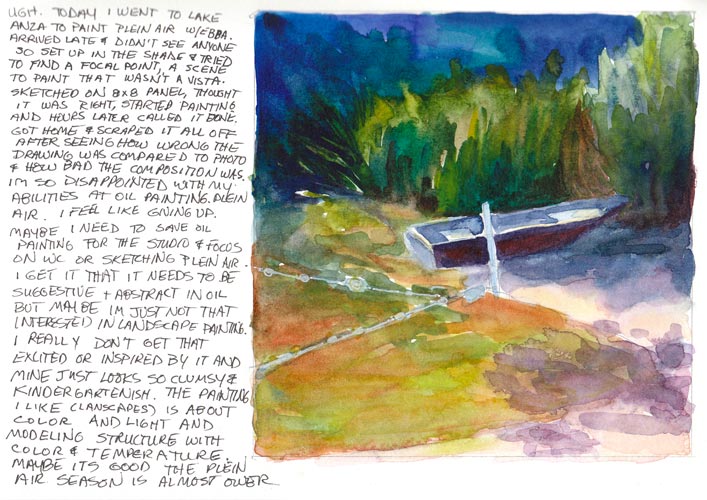
When I brought home today’s plein air oil painting, I spent a few minutes messing with it, tried to fix it, and then just wiped it all off. Then I painted the scene in watercolor instead (above). I’m getting really frustrated with plein air oil painting and I’m starting to reconceptualize how I might approach plein air painting in the future.
I love being out in nature looking closely at it, and trying to capture it in paint. I also really like hiking in these beautiful parks. But when I paint with oils I focus on painting and then when I leave, I’m often envious of the people who hiked past me as I stood there in one spot.
My new idea is to bring my watercolors, sketchbook and my camera and spend half of the time walking and taking photos and the other half making watercolor sketches. Then I can use those studies, photos and my memory and experience of the place to either make larger watercolors or oil paintings in the studio.
I so admire people who can make beautiful oil paintings plein air. I know that there’s nothing that can compare to seeing color and light and painting it right in the midst of nature’s glory. But maybe it’s time to accept that it’s just not my forte and focus on the things that I both enjoy and can do with some modicum of success.
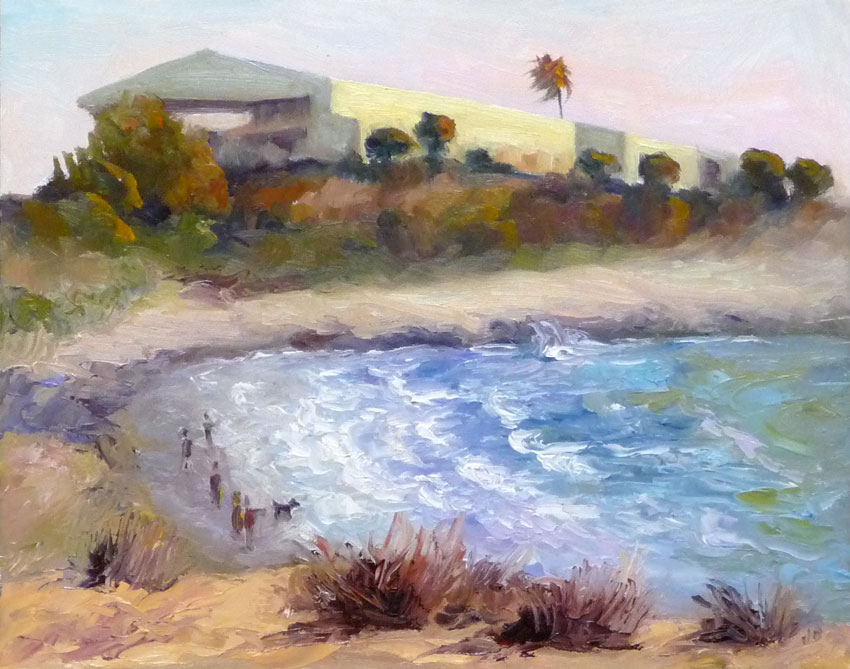
Albany Bulb Beach and Golden Gate Fields, 8x10", oil on Gessobord
Today I spent the afternoon painting in the bright windy sunshine at Albany Bulb across the way from the Golden Gate Fields racetrack. I could hear the announcer calling the races while I painted. And I was visited by numerous dogs and curious children and the occasional art critic.
It felt so good to be out painting again–it had been too long. The only downside was that I was painting in the bright sun because I was too lazy to walk back to my car to get my umbrella. And it was so windy the umbrella probably would have blown away anyway. When the canvas and/or palette are in the bright sun it’s really easy to mix all the colors too dark.
So of course when I got home and took the painting out of its box everything was too dark. Although I’d taken photos, they were pretty boring so I mostly worked from my memory this evening to to make some corrections and add a bit of artistic license.
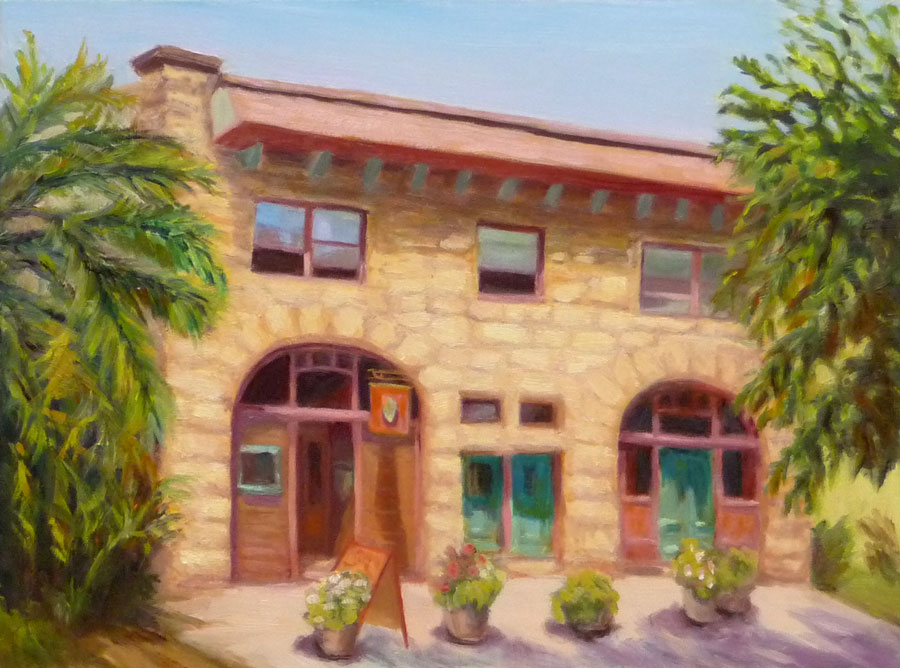
Port Costa's Bull Valley Restaurant, Oil on panel, 9x12
When we gathered for our critique on the patio outside the funky Warehouse Cafe, a biker bar at the end of Port Costa‘s main road, I thought I’d gotten my painting of the Bull Valley Restaurant off to a good start. It was a sunny Saturday and the quirky local residents of the little town had been very welcoming, chatting and joking with the plein air painters.
Just as the critique was getting started the old lady bartender turned up the rock and roll so loud that we couldn’t hear each others’ comments and suggestions. Someone went in and asked her to turn it down and she sneered, “This is a bar. We play rock and roll!” Although some of our group had bought lunch and beer (served in mason jars), I guess we weren’t exactly their preferred clientelle.
Their usual patrons continued to roar in on their Harleys and wanna be Harleys. Some were dressed in full leather or raunchy heavy metal t-shirts and black denim. At least half of them were over 50, the guys paunchy and bald and the women, with their dyed thinning black hair, looked “rode hard and put away wet” as I’ve heard it said.
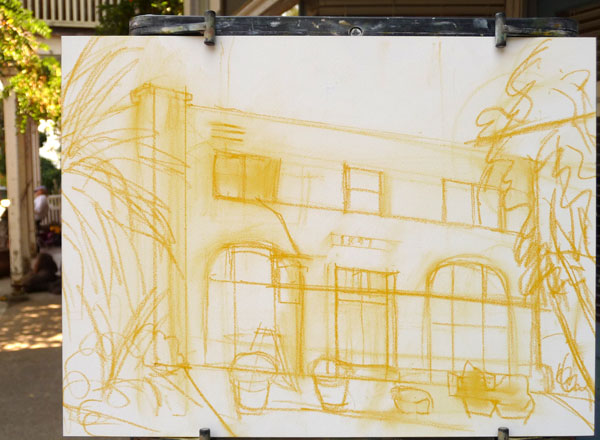
Anyway, back to the painting. As you’ll see from my initial sketch below, my perspective was even further off than it ended up in the finished painting above.
Port Costa-WIP 1
I’m always amazed how often my eyes fool me. Sometimes I’m sure a line slants one way and then I hold up a pencil to check and the line slants in the completely opposite direction.
This is the point when I stopped painting on site, planning to finish at home from photos.
Port Costa WIP 2
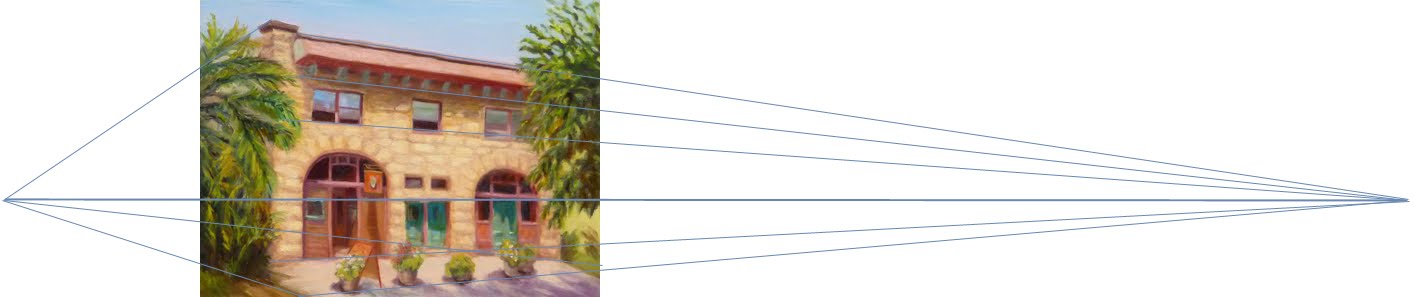
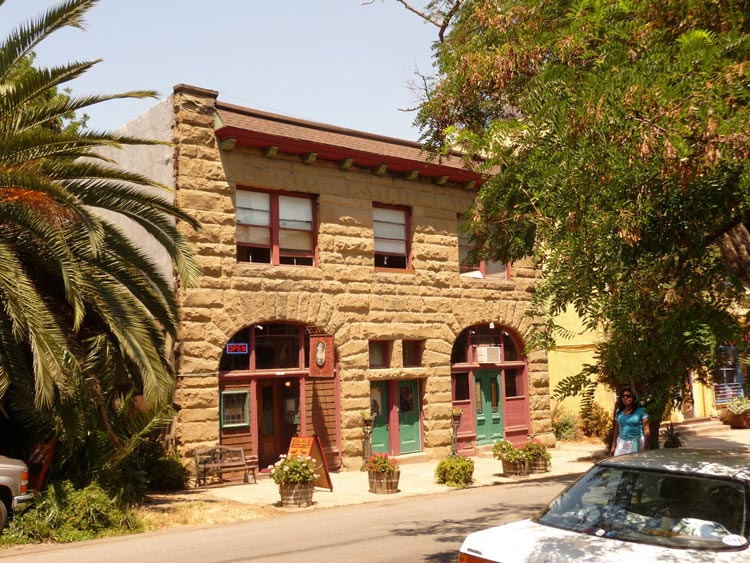
Once home I realized that I had a serious perspective problem with the way the roof line and the line where the building meets the ground were parallel to each other instead of coming towards each other to finally meet at a vanishing point. I worked on the painting for a couple of days and thought I’d fixed it (blind to what was in front of my face from seeing it for too long).
When I shared what I thought was the final painting with some artist friends, they generously pointed out a few things that needed adjusting, including continuing perspective problems. Below M. added lines in Photoshop to demonstrate for me how I’d gone wrong with the perspective. It’s so great to have that kind of support!
Diagram showing how the perspective should have been
In the end I decided I’d taken this painting as far as it needed to go and moved on to the next project. But I promised myself that next time I’d pay more attention to perspective.
After my flop of a painting on Saturday, I was determined to have another go at plein air painting. But first I wanted to put together a cheat sheet; a personalized “How to Paint Plein Air” based on what I’ve learned from teachers, books, experience, mistakes, successes and goals. I started jotting down notes as ideas and images came to me and then when the list felt complete, I typed it up and taped it to my paint box so that it will always be with me when I’m out painting. I posted another on the studio wall.
Then I went out to paint. First I drove to a site I’d been wanting to try out, a hillside cemetery in El Sobrante with what I thought would be interesting views. But once I found a spot where I could be off the road and away from mourners, it was so windy, and the view so boring, that I left and headed for Blake Gardens.
By the time I got there and set up, I only had an hour and a half to paint before they closed at 4:30. It was so serene and beautiful there and the weather was perfect, warm sunny and no wind. I worked as fast as I could, finished all of the main areas, and added the final touches at home.
It was a confusing scene with all sorts of trees and foliage, but not having enough time helped me to simplify rather than draw all the trees in the background. I took artistic license to move things a bit to improve my composition and to delete something that wasn’t working. I’m learning!
Here is my Oil Painting Plein Air Process Cheat Sheet. I imagine it will change as I learn and grow, but it definitely helped me with this painting.
FOCAL POINT: Choose one!
COLOR KEY: Decide: Will the painting be predominantly Warm or Cool, High key or Low key, Predominant hue?
SQUINT! to see values, simplify
THUMBNAIL: Keep making them until there’s a good composition with leading lines in to focal point. A bad composition can only lead to a bad painting.
CANVAS: Transpose thumbnail to canvas, creating large puzzle piece shapes, using pastel pencil or thin paint.
UNDERPAINT: Loose, sketchy monochrome underpainting of shapes, darks with very diluted paint (optional)
DARKS: Thinly paint the darks but MATCH values and colors using value scale and testing paint first on edge of little cards held up to compare to actual color. Just because it’s dark doesn’t mean it’s black.
PAINT LARGE SHAPES: Match or exagerate the average (VIBRANT) color in large shapes, using not too thick paint.
COLOR PATCHES: Break larger shapes into smaller patches of color and light, matching or slightly exagerating the color.
HIGHLIGHTS & ACCENTS: Add thick LIGHT paint, thin dark accents, and occasional splashes of “broken” color for VIBRANCY.
EDGES: Put a dab of COMPLEMENTARY colors around edges of focal points to pop, SOFTEN and/or cool receding edges.
STOP: It’s a field study!
If you have discovered other things that have helped you and are willing to share them, I’d love to hear about them. And if you’d like more information about any of the items on my list, let me know and I’ll do another post with more explanation and details.
Have you had bad experiences with plein air umbrellas that were flimsy, funky, poorly designed, or just plain hazardous when it gets windy? Often when my plein air group is out painting, a gust blows over an easel or two when the umbrellas attached to them turn into sails. When I felt my old umbrella about to carry off my easel I started attaching it to the tall handles of my rolling cart (which also got pulled over once) but I had a hard time adjusting my small umbrella to be in the right place, at the right height or at the right angle.
Now I have a ShadeBuddy Umbrella and Stand and the problem is solved. In the picture above the umbrella is set up in my backyard next to my Soltek easel. (Also pictured, is my trash container (a mesh pop-up laundry basket that folds flat to a circle about 8″ in diameter) clipped to my easel, a folding brush holder, and a plastic shoe box that holds my paint palette and paints. You can see the large area of shade the umbrella provides.
The pansies and pitcher on a table I was preparing to paint are on the far right.
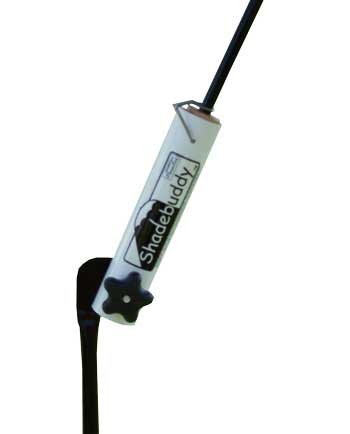
Cylinder that holds umbrella
The umbrella and the stand are two separate sections that fit together into the sturdy black zippered bag with a shoulder that comes with them. At the top of the stand is a white cylinder (above) into which you stick the umbrella’s wooden handle. There is a secure locking mechanism for keeping the umbrella in the cylinder and a knob that allows you adjust the angle of the umbrella and then holds it in firmly at that angle.
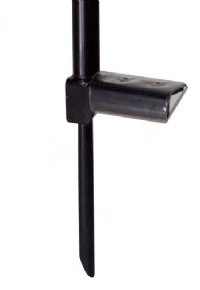
Foot pedal
The cylinder is attached to a metal pole that has a pedal about six inches from the bottom that you step on to push the pointed end of the pole into the ground. When I set mine up for the first time I was surprised how well it all worked and how easy it was. I tend to be spatial-relations challenged and am always prepared for difficulty when assembling things but this was a snap. I was able to adjust the tilt and direction of the umbrella as the sun moved, and the vented umbrella handled the afternoon wind gusts with without even a flutter!
The umbrella is very well made, with a 48″ diameter with “wind vented construction combined with a nonreflective black lining to keep your colors true and a reflective silver outer shell to keep you cool.” Both the closed umbrella and the pole are 48″ long and, when stashed together in the bag, weigh a little over 4 pounds.
The umbrella and pole are manufactured and sold by Judsons Art Outfitters and are also sold at several major online art supply stores. I checked prices and availability on the web and bought mine on sale from Dakota Art Pastels. It was my first purchase from Dakota (in Washington state) and they provided excellent service. My new umbrella arrived two days after I ordered it.
Having the easel made my previously posted painting, “Pansies in Pitcher Plein Air” a pleasure to paint, even under the hot sun in my windy backyard.
Because I really appreciate good tools and well-made products that just work (and that experience is so rare!), and because I know that many other plein air painters struggle with lousy umbrellas that flop or fly, I wanted to share my positive experience. I have no other connections with the manufacturer or store (except that I think highly of both). Judson Art Outfitters also manufacturers the Guerilla Painter line of plein air products and is a family-run business with very helpful and knowledgable staff who can answer most plein air outfitting questions with expertise.
When my plein air group at Martinez Waterfront Park last Saturday I really enjoyed the painting process despite getting a late start. Then I tinkered in the studio, never one to leave well enough alone. Above is the final version and below are the steps I took to get there, recorded just for fun. First is the thumbnail sketch/value study:
1. Thumbnail/value study
Then I blocked in the colors using really thin paint at the average color of each of the large shapes and planes or puzzle pieces as I like to think of them. I was pleased to see I did the drawing pretty well, and was able to fit everything on the square panel in about the same proportions as I saw them and as in my thumbnail sketch.
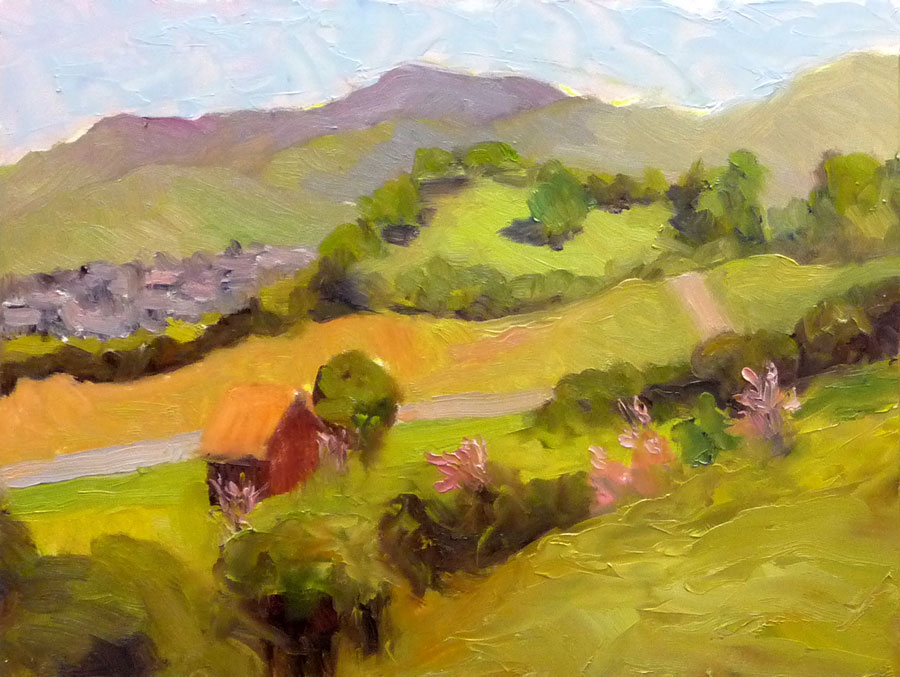
View from Old Borges Ranch; Plein air, Oil on panel, 9x12"
I’m celebrating a bit of progress I saw today when I painted plein air at Old Borges Ranch in Walnut Creek. I painted at this site a year ago and had a terrible time, titling the post of the awful painting I did that day, “Am I Having Fun Yet? Uh…no!”
Today was a lot more fun. I started the painting with a plan (described below) and stuck with it until I started rushing to wrap it up in time for our group critique at 1:00 when I muddied things up a bit since the light had changed in the scene from when I first started at 10:30.
When I put the painting in the line up with the other 14 paintings, I didn’t even cringe or feel embarrassed. It helped too, that I now understand that my plein air paintings are sketches, not finished works of art.
Here are the steps I took that seemed to work for me:












 Jana Bouc, Artist